Gospel of Luke 1:1-4: The Historian's Prologue
Introduction
Luke’s prologue is unique among the Gospels. Where Matthew begins with genealogy, Mark with prophecy, and John with ontology, Luke begins with method. He addresses a single patron—Theophilus—and tells him exactly what he has done and why: he has investigated everything carefully from the beginning, drawing on those who were eyewitnesses and servants of the word from the start, and he has written an orderly account so that Theophilus may know the certainty (asphaleia, ἀσφάλεια) of the things he has been taught. This is not a claim to inspiration. It is a claim to diligence.
This makes Luke 1:1–4 the earliest statement of historical methodology in Christian literature. Luke does not say “God told me to write this.” He says “many have undertaken to compile a narrative, and I, having followed all things closely for some time past, decided to write.” He names his sources (eyewitnesses), his method (careful investigation from the beginning), and his purpose (certainty for the reader). The passage is directly relevant to the Theosis Library’s own mission of verification. Luke is saying: I checked the sources so you can trust the account. We are saying: here are the sources so you can check for yourself.
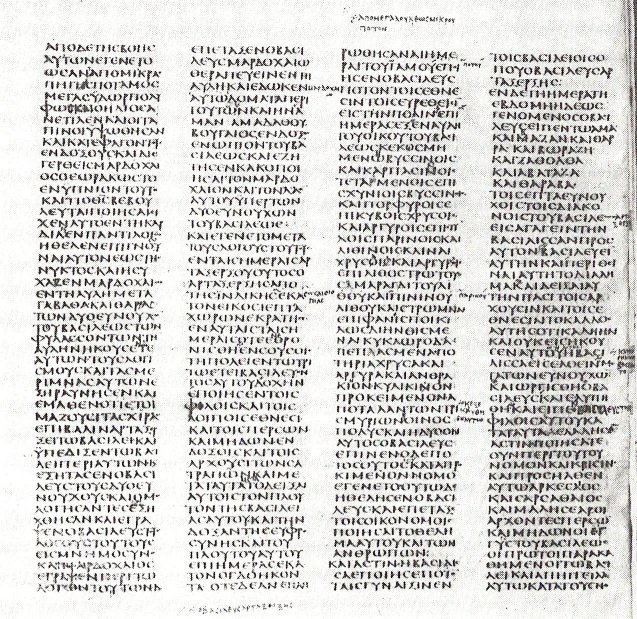
The text presented here is from Codex Sinaiticus, the earliest complete surviving manuscript of the New Testament, produced in the fourth century. Luke’s prologue is remarkably stable across the manuscript tradition—there are no major textual variants in these four verses—which itself testifies to the care with which this methodological statement was transmitted.
ἐπειδήπερ πολλοὶ ἐπεχείρησαν ἀνατάξασθαι διήγησιν περὶ τῶν πεπληροφορημένων ἐν ἡμῖν πραγμάτων · καθὼς παρέδοσαν ἡμῖν οἱ ἀπ’ ἀρχῆς αὐτόπται καὶ ὑπηρέται γενόμενοι τοῦ λόγου ·
Since many have undertaken to compile a narrative concerning the events that have been fulfilled among us, just as those who from the beginning were eyewitnesses and servants of the word (autoptai kai hyperetai tou logou, αὐτόπται καὶ ὑπηρέται τοῦ λόγου) delivered them to us,
ἔδοξεν κἀμοὶ παρηκολουθηκότι ἄνωθεν πᾶσιν ἀκριβῶς καθεξῆς σοι γράψαι · κράτιστε Θεόφιλε · ἵνα ἐπιγνῷς περὶ ὧν κατηχήθης λόγων τὴν ἀσφάλειαν ·
it seemed good to me also, having followed all things closely from the beginning, to write for you an orderly account, most excellent Theophilus, so that you may know the certainty (asphaleia, ἀσφάλεια) of the things about which you have been instructed.
Translator's Notes
- §1:4: The word asphaleia (ἀσφάλεια) is rendered here as “certainty,” but the Greek carries a stronger physical sense: it means security, firmness, the quality of not being tripped up. It shares its root with the verb sphallein (σφάλλειν), to trip or to cause to fall, so asphaleia is literally un-trippability. Luke is not promising Theophilus mere intellectual assent. He is promising a foundation that will not give way. The word appears only three times in the New Testament (here, Acts 5:23, and 1 Thessalonians 5:3), and in each case it denotes a condition that is tested against instability. Luke’s prologue is a promise that his account can bear the weight of scrutiny.
- §1:2: The phrase “eyewitnesses and servants of the word” (autoptai kai hyperetai tou logou, αὐτόπται καὶ ὑπηρέται τοῦ λόγου) describes a chain of transmission. The autoptai (αὐτόπται) are those who saw with their own eyes—the term is the root of the English “autopsy,” a direct personal inspection. The hyperetai (ὑπηρέται) are servants or attendants, those who carried the word forward. Luke distinguishes between seeing and serving: some people witnessed the events, and those same people (or others) became ministers of the account. This is not hearsay. Luke is claiming access to first-generation testimony, and he is telling Theophilus exactly where his information comes from. The chain runs: events, eyewitnesses, servants of the word, the many who compiled narratives, and finally Luke himself, who investigated everything from the beginning.
Export
Source & Cross-References
- Source text: Codex Sinaiticus (4th century), British Library Add. MS 43725 — view original
- Critical edition: Lake, K. and Lake, S. (eds.), Codex Sinaiticus Petropolitanus, Oxford: Clarendon Press, 1911
- Gospel of John, Chapter 1:1–18 (The Logos Prologue) by John (attributed)