Adapa (Standard Babylonian fragments)
Introduction
The later fragments of the story: Adapa as sage of Eridu, the fishing trip on which he breaks the wing of the South Wind, and the scene before Anu.
Adapa, a sage of Eridu and servant of Ea, breaks the wing of the South Wind and is summoned to heaven by Anu. On Ea's advice he refuses the bread and water offered to him, which would have given him eternal life. The story is known from a Middle Babylonian tablet found at el-Amarna in Egypt and from later fragments. This page follows the line numbering of the electronic Babylonian Library edition.
How this page is built. Each section is a run of consecutive lines as written on one photographed clay tablet. For every line the eBL edition (https://www.ebl.lmu.de/corpus/L/1/7/SB/-) lists the manuscripts that carry it, with each tablet's own column and line numbers; the tablet chosen for each run is the photographed copy of the work with the most signs preserved there. Commentaries and texts that only quote a line are never chosen. School and excerpt tablets are used only for lines that no photographed library copy preserves as well, and only where they carry the line as text; their sections say so. The original text is eBL's transliteration of that tablet's signs (not a modern composite text): square brackets mark broken signs, x an illegible sign, # a damaged sign, ? an uncertain reading, and words in {braces} are determinatives; the notes give a key to every sign used on this page, and eBL's layout codes are written out in words (for example '(line break)' or '(blank space)'). Superscript numbers are the line numbers of the eBL edition, used in both the Akkadian and the English. The English is B. R. Foster's translation in the eBL edition (CC BY-NC-SA 4.0), one line of English per line of the text; italics mark uncertain renderings, as in the source. Where the tablet is broken, the English still translates the whole line of eBL's composite text; each section's note names the lines that are broken on its tablet.
Finding a line on the photograph. Each section names the tablet, the face and column, and the tablet's own line numbers (a prime, as in 5', counts from the first preserved line of a broken column). On a tablet with six columns the obverse carries columns i-iii from left to right; the reverse, turned over from bottom to top, carries columns iv-vi from right to left. The photographs often show the obverse above the reverse with the edges around them; a fragment preserves only part of this layout.
This page shows 73 of the 97 lines of the eBL edition (75%), from 4 tablets in the British Museum: K.15072 (Nineveh), K.9994 (Nineveh), K.8743 (Nineveh), K.8214 (Nineveh).
Lines not shown. 24 of the 97 lines of the eBL edition are not shown, because no photographed copy of the work used here carries them: a+1-a+14 (no photograph in eBL: MLC.1296 (Morgan Library)); a+17 (no photograph in eBL: MLC.1296 (Morgan Library)); d+1-d+9 (no photograph in eBL: MLC.1296 (Morgan Library)). A line is shown only on a photographed tablet that carries it as text. Commentaries and other texts that quote a line (letters, rituals, god lists) are not used as witnesses, because they carry it with explanations or inside another text; tablets without a photograph in eBL are not used, because the line could not be shown on its tablet.
How was this verified? (Provenance)
Where on the image
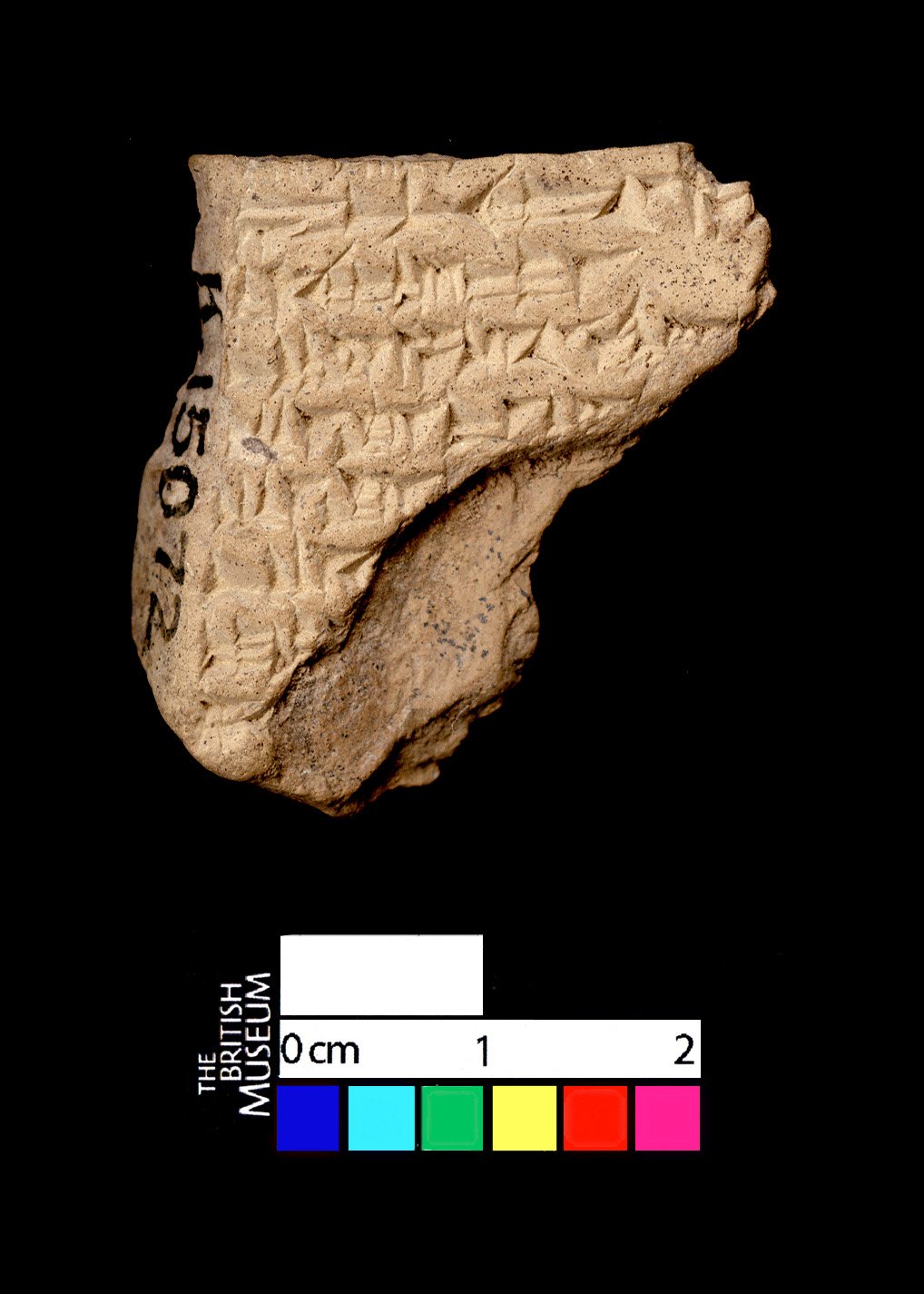
British Museum K.15072: the inscribed face, the tablet's own lines 1' to 9'. eBL's corpus edition (https://www.ebl.lmu.de/corpus/L/1/7/SB/-) attributes SB a+15-a+24 to this manuscript at these column and line numbers. Photograph checked: one face with the ink number K.15072 and about 9 lines; eBL gives no column for this fragment. On this tablet of lines a+21-a+24 only one to three signs survive and lines a+15-a+16, a+18-a+20 are partly broken (square brackets and x in the Akkadian). The English of these lines translates eBL's composite text, so it includes words that are not preserved on this tablet but are restored from other manuscripts or by the editors. Square brackets in the English mark eBL's restorations in its composite text; words that survive on other tablets carry no brackets even where this tablet is broken. eBL line(s) a+17 fall within this run but are not on this tablet (they are listed among the lines not shown).
a+15MA₂?# u₂#-ma#-har?# Š[U!?.KU₆.UD.DA-ku-tu₂ x x x x x x]
a+16i₃-nu-mi-šu₂ a-d[a-pa x x x]
a+18u₄-mi-šam-ma š[i-ga-ar x x x x x]
a+19ina ka-a-ri e[l-li x x x x x x x x x x]
a+20ba-lu {giš}Z[I.GAN-ni-ma x x x x x x x]
a+21ba-lu {g[iš}GI.MUŠ-ši-ma x x x x x x]
a+22ina ti-[(a)-am-ti x x x x]
a+23i-l[a? x x x x x x x x x x x x]
a+24ha [x x x x x x x x x x x x x]
a+15He steered the boat, he made the daily fish catch for Eridu(’s cult).
a+16At that time Adapa, citizen of Eridu,
a+18Would see each day to the gate bolt of Eridu.
a+19At the sacred quay, the quay of “Heavenly Splendor,” he boarded the sailboat.
a+20Without a steering oar his boat would drift on course,
a+21Without a punting pole he would pilot his boat.
a+22Into the wide sea.
a+23… […] … […]
a+24… […]
Where on the image
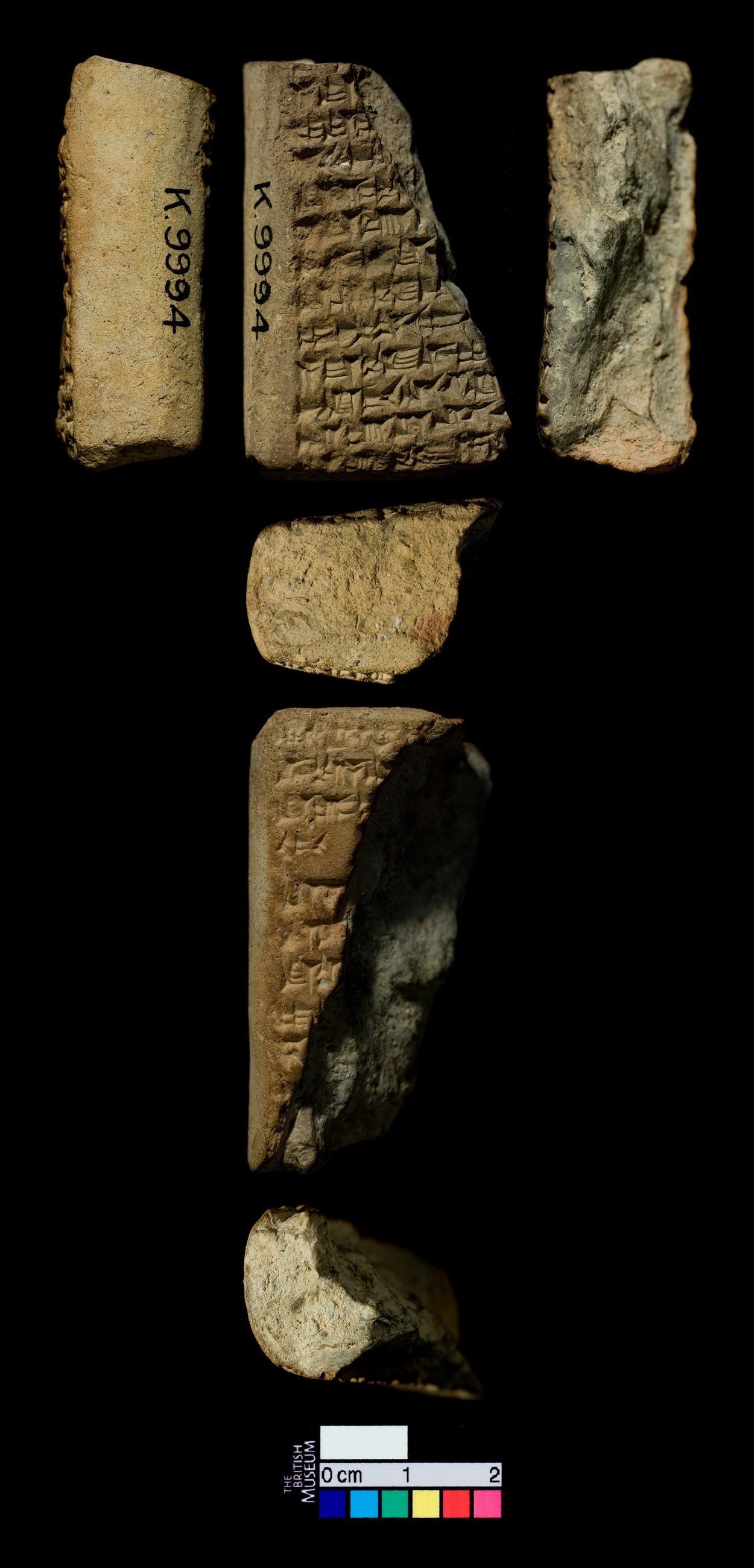
British Museum K.9994: obverse, column i, the tablet's own lines 1' to 13'. eBL's corpus edition (https://www.ebl.lmu.de/corpus/L/1/7/SB/-) attributes SB b+1-b+13 to this manuscript at these column and line numbers. Photograph checked: obverse, reverse and edges, ink number K.9994 on the edges; text on both faces, consistent with eBL's obverse column i (13 lines) and reverse column iv (10 lines). On this tablet of line b+1 only illegible traces (x) survive, of lines b+2-b+6 only one to three signs survive and lines b+7-b+13 are partly broken (square brackets and x in the Akkadian). The English of these lines translates eBL's composite text, so it includes words that are not preserved on this tablet but are restored from other manuscripts or by the editors. Square brackets in the English mark eBL's restorations in its composite text; words that survive on other tablets carry no brackets even where this tablet is broken.
b+1x x [...]
b+2a-na [...]
b+3i-na x [...]
b+4a#-bu? x [...]
b+5šu#-u₂#-t[u₄ ...]
b+6a#-na# E₂ x [...]
b+7ina pi?#-i?#-šu₂ x [...]
b+8šu#-u₂#-tu₄ ina? x [...]
b+9i-nu-u₄-mi-š[u₂ ...]
b+10a-ma-tu₄ ši-i [...]
b+11ina qi₂-bi-ti-šu₂ ki [...]
b+12se-bet ur-ri u [...]
b+13šu#-u₂#-tu₄# a-n[a ...]
b+1… […]
b+2To […]
b+3In … […]
b+4… […]
b+5(The) South Wi[nd …]
b+6To the house … […]
b+7At his command … […]
b+8The South Wind […] in … […]
b+9At th[at] time […]
b+10This order […]
b+11At his command … […]
b+12For seven days and [seven nights (…)],
b+13The South Wind [did not blow] towa[rd the land (…)]
Where on the image
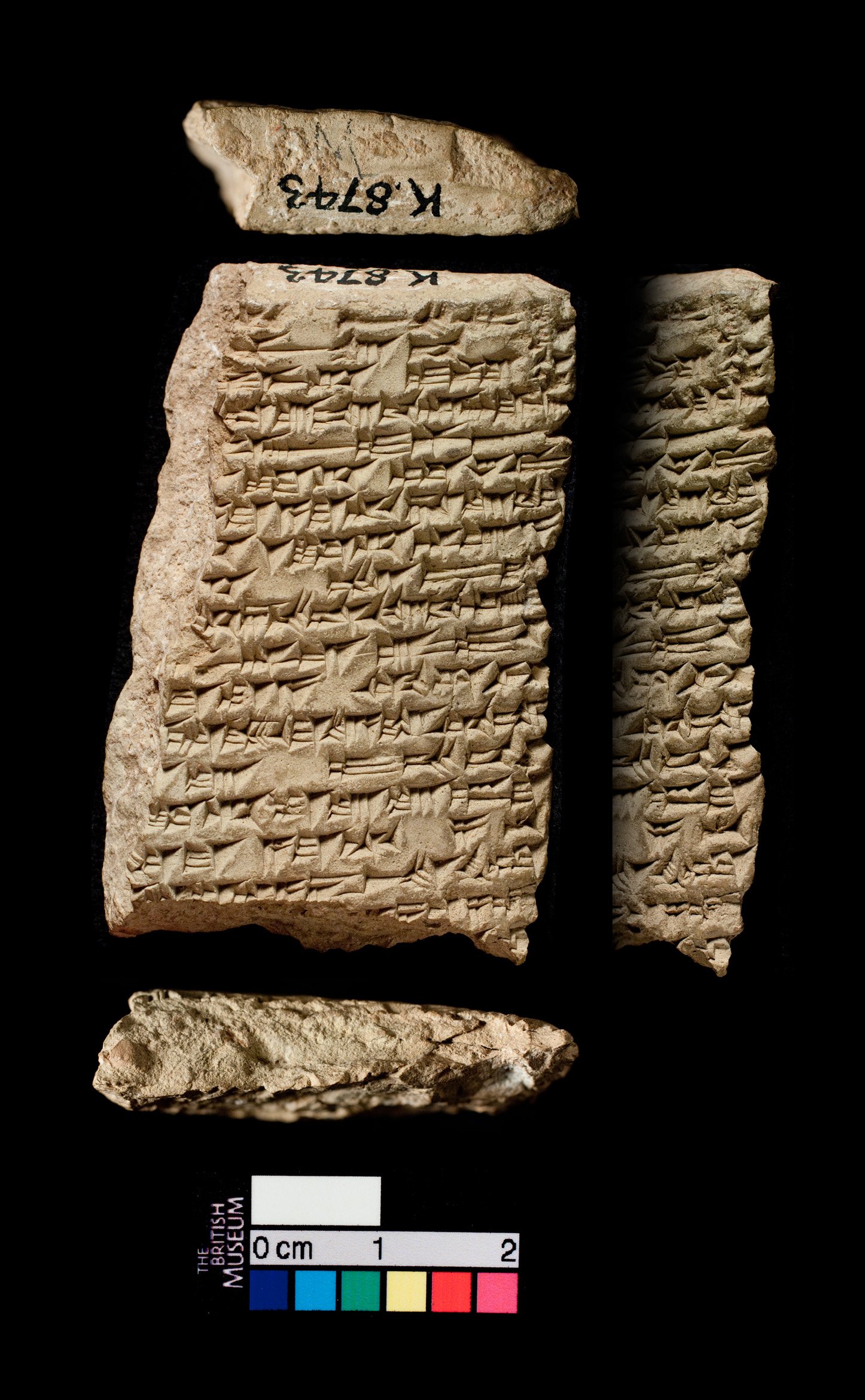
British Museum K.8743: column ii, the tablet's own lines 1 to 19. eBL's corpus edition (https://www.ebl.lmu.de/corpus/L/1/7/SB/-) attributes SB c+1-c+19 to this manuscript at these column and line numbers. Photograph checked: one face with about 19 lines and the inscribed side edge, ink number K.8743 on the upper edge, consistent with eBL's column ii. On this tablet of line c+19 only one to three signs survive and lines c+1-c+18 are partly broken (square brackets and x in the Akkadian). The English of these lines translates eBL's composite text, so it includes words that are not preserved on this tablet but are restored from other manuscripts or by the editors. Square brackets in the English mark eBL's restorations in its composite text; words that survive on other tablets carry no brackets even where this tablet is broken.
c+1[x x x x x x x x x x-t]i ina še-mi-šu#
c+2[x x x x x x x x x ug]-gat lib₃-bi-šu
c+3[x x x x x x x x x x D]UMU šip-ri i-šap-par
c+4[x x x x x x x x x m]u-du-u₂ lib₃-bi DINGIR-MEŠ GAL-MEŠ
c+5[x x x x x x x x x x DIN]GIR-MEŠ i-bar-ru₃-u#
c+6[x x x x x x x x x x a]na? šar-ri ka-ša₂-di
c+7[x x x x x x x x x] x-ma a-ma-ti uš-ta-bil
c+8[x x x x x x x x x-r]i? ana šar-ri {d}e₂-a
c+9[x x x x x x x x šip?-r]i il-tap-ra
c+10[x x x x x x x x x u]z-ni mu-du-u lib₃-bi DINGIR-MEŠ GA[L-MEŠ]
c+11[x x x x x x har?-r]a?-an# AN-e u₂-kan-šu₂
c+12[x x x x x x x x] ma-la-a ul-taš-ši-šu₂
c+13[x x x x x x x x] u₂#-ba-lil-ma kar-ra ul-tap-pi-[it?]
c+14[x x x x x x a-m]a-ta i-qab-bi-šu₂
c+15[x x x x x x x x x] šar#-ri at-ta ta-lak-ma
c+16[x x x x x x x] x-ma a-ma-ti ṣa-bat
c+17[x x x x x x x a]na ba#-ab# {d#}a#-ni ina ṭe₄-hi-ka
c+18[x x x x x x x x x x x x] {d#}a#-ni iz-za-az-[zu]
c+19[x x x x x x x x x x iš-ta-na-ʾa-l]u-ka#
c+1When […] heard [(this)],
c+2[… in] his [f]ury,
c+3[He …] and sent [a me]ssenger.
c+4[… Ea, the exceedingly wise one, who k]nows the hearts of the great gods,
c+5[…, who] examines [the hearts of the g]ods,
c+6[… t]o approach the king,
c+7[…] … deliberated the matter.
c+8[…] … to Ea the king,
c+9“[…] has sent [a messeng]er.”
c+10[(…) Ea, the exceedingly w]ise one, who knows the hearts of the gods,
c+11[… (Adapa) …] and prepared him [(to take) the roa]d to heaven.
c+12[He …] and made him wear his hair unkempt,
c+13He smeared […] and rubbe[d] a mourning weed.
c+14[… and s]aid to him,
c+15“[Adapa], you are to go [before Anu] the king,
c+16“[…], hold fast to my words.
c+17“[When you go up to heaven] and draw near [t]o Anu’s door,
c+18“[(…) Tammuz (and) Gizzida] will be standing [at] Anu’s [door].
c+19“[(…) (when) they see you, they will as]k you,
Where on the image
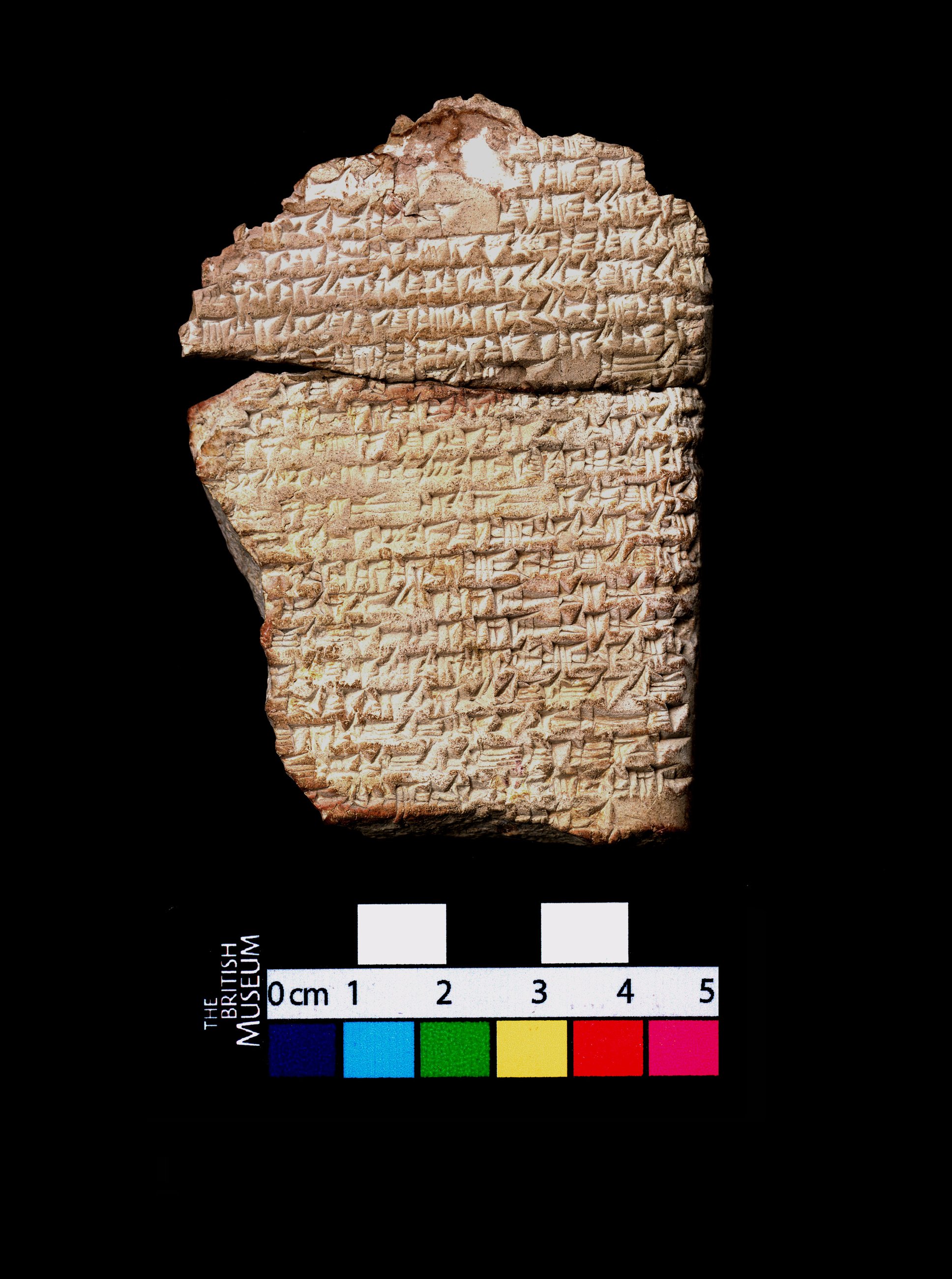
British Museum K.8214: reverse, column iii?, the tablet's own lines 1' to 22'-23'. eBL's corpus edition (https://www.ebl.lmu.de/corpus/L/1/7/SB/-) attributes SB e+1-e+22 to this manuscript at these column and line numbers. Photograph checked: one face of two joined pieces with about 22 lines, consistent with eBL's reverse column iii. On this tablet of line e+22 only one to three signs survive and lines e+1-e+21 are partly broken (square brackets and x in the Akkadian). The English of these lines translates eBL's composite text, so it includes words that are not preserved on this tablet but are restored from other manuscripts or by the editors. Square brackets in the English mark eBL's restorations in its composite text; words that survive on other tablets carry no brackets even where this tablet is broken. eBL translates lines e+16 and e+17 together in one English sentence (given under e+16; e+17 has none of its own), with the clause of line e+17 first; the sentence is shown once for both lines. eBL's markers inside it read (e+16) and (e+15), one lower than the Akkadian lines they translate in eBL's own numbering (Ninkarrak is in line e+17, the sore laid upon people's bodies in line e+16); they are shown here as (e+17) and (e+16).
e+1[x x x x x i]q-bi#-[šum-ma] šu-u₂# la# i[š?-ti?]
e+2[x x x i]q-bi-šum-ma# šu-u₂ ip-pa-[šiš]
e+3[ṣu-b]a-ta# iq-bi-šum-ma šu-u₂ il-la-bi[š]
e+4[{d}]a#-nu# ana ep-šet {d}e₂-a ša₂-qiš i-ṣi-ih-m[a]
e+5[x DINGIR-M]EŠ ša₂ AN-e u KI-ti₃ ma-la ba-šu₂-u man-nu ki-a-am ip-pu₂*#-[uš]
e+6[qi₂]-bit-su ša ki-ma qi₂-bit {d}a-nu man-nu u₂-at-tar
e+7[x x (x)] a#-da#-pa# TA i-šid AN-e ana e-lat AN-e
e+8[x (x) ip-p]a-lis-ma pu-luh-ta#-šu₂# i-mur
e+9[i₃-nu-m]i-šu₂ {d}a-nu ša₂ a-da-pa e-li-šu₂ ma-ṣar#-ta# iš-k[un]
e+10[x] x-ki ša₂ {d}e₂-a šu-ba-ra-šu₂ iš-kun
e+11[{d}a-n]u EN-us-su ana ar₂-kat₃ u₄-me ana šu-pi-i šim-tu₂ i-š[im]
e+12[x]-x-mi?# a-da-pa ze-er a-mi-lu-ti
e+13[x x ši?]-ni#-šu₂ šal-ṭiš kap-pi šu-u₂-ti iš-bi-ru
e+14[x x (x)] x a-na AN-e e-lu-u₂ ši-i lu-u ki-a-am
e+15[x x x š]a₂ zaq-ša₂ lem-niš ana UN-MEŠ iš-tak-nu
e+16[x x x m]ur-ṣu ša₂ ina SU UN-MEŠ iš-tak-nu
e+17[x x x K]U₃-tu₄ {d}nin-kar-ra-ak u₂-na-ah-hu#
e+18[x x x l]it-bi-ma si-im-mu mur-ṣu lis-hur
e+19[x x x š]u-a-tu₄ hur-ba-šu₂ lim-qut-ma
e+20[x x x] x šit-tu₄ DUG₃-tu₄ la i-ṣal-lal
e+21[x x x] x x bu u₂ du nu-ug lib₃-bi UN-MEŠ
e+22[x x x x x x x x] x da# bi (line break) (blank space) [...]-tu₄?#
e+1[H]e ordered [water of life for him], he did not dr[ink].
e+2[H]e ordered [oil] for him, he anoi[nted himself],
e+3He ordered a [gar]ment for him, he pu[t it on].
e+4Anu laughed uproariously at what Ea had done,
e+5“Who (else), [of (all) the go]ds of heaven and netherworld, could d[o] something like this?
e+6“Who (else) could make his [com]mand outweigh Anu’s?”
e+7Adapa [surveyed] from the horizon to the heights of heaven,
e+8He saw the awesomeness of […].
e+9[At] that [tim]e Anu impo[sed] on Adapa a duty,
e+10[(But) at the …] … of Ea he released him.
e+11[An]u ordai[ned] that he be distinguished for his leadership for all time.
e+12[…] … Adapa, the seed of humankind,
e+13[Who] arrogantly broke the wing of the South Wind [in t]wo,
e+14[…] … to ascend to heaven; so be it.
e+15[The South Wind, wh]o, having malevolently set its gust upon the people,
e+16-e+17(e+17) [(From now on), the bandages] of [pu]re Ninkarrak will bring alleviation (e+16) [of the pa]inful [sore] it has laid upon people’s bodies.
e+18[Should the South Wind] rise, and the painful sore return,
e+19Should shivering fall [upon t]his […]
e+20[…] … lest he not sleep a good sleep,
e+21[…] … joy of people’s heart,
e+22[…] … […] …
Where on the image
British Museum K.9994: reverse, column iv?, the tablet's own lines 1 to 10. eBL's corpus edition (https://www.ebl.lmu.de/corpus/L/1/7/SB/-) attributes SB f+1-f+10 to this manuscript at these column and line numbers. Photograph checked: obverse, reverse and edges, ink number K.9994 on the edges; text on both faces, consistent with eBL's obverse column i (13 lines) and reverse column iv (10 lines). On this tablet of line f+10 only illegible traces (x) survive and of lines f+1-f+9 only one to three signs survive. The English of these lines translates eBL's composite text, so it includes words that are not preserved on this tablet but are restored from other manuscripts or by the editors. Square brackets in the English mark eBL's restorations in its composite text; words that survive on other tablets carry no brackets even where this tablet is broken.
f+1li#-taš#-ša₂ x [...]
f+2ši-kar A[N-e? ...]
f+3šu-u₂-t[u₄ ...]
f+4(gloss: he-pi₂) [...]
f+5šu#-x [...]
f+6šu#-u₂#-[tu₄? ...]
f+7šu-p[i?-i? ...]
f+8i-n[a? ...]
f+9ša₂ x [...]
f+10x [...]
f+1Let them become confused […]
f+2The beer of he[aven …]
f+3The South Wi[nd …]
f+4… […]
f+5… […]
f+6The South [Wind …]
f+7Resp[lendent …]
f+8I[n …]
f+9Of … […]
f+10… […]
Notes
- Akkadian: eBL transliteration of the signs on the photographed tablet (manuscript-level ATF), not a composite text.
- English: B. R. Foster's translation in the eBL edition; it renders eBL's composite text, including restorations from other tablets.
- Line numbers: eBL edition. Each section also gives the tablet's own column and line numbers.
- Signs in the Akkadian: [ ] broken away; x illegible sign; # damaged sign; ? uncertain reading; ! sign corrected by the editor; * collated sign; ... broken signs of unknown number; ( ) signs perhaps broken away; { } determinative; (line break) the line runs on to the next line of the tablet; (blank space) a space left by the scribe; (gloss: ...) a note written by the scribe in small signs or in the margin.
Cite
Sources
- Source: British Museum tablet photographs + eBL manuscript transliterations (eBL corpus edition L I.7, Adapa, SB -) + English of the eBL edition (B. R. Foster (eBL edition)) (holding institution)
- Critical edition: electronic Babylonian Library, Adapa, manuscript transliterations
← previous · → next · v cycle view · l back to library