1 Timothy, Chapter 6 (Codex Alexandrinus)
Introduction
1 Timothy 6 from Codex Alexandrinus (GA 02), a fifth-century Greek Bible held by the British Library (Royal MS 1 D. VIII). In the New Testament it is the chief witness to the Byzantine text in the Gospels and to the Alexandrian text in the rest of the New Testament. Its New Testament volume lacks Matthew 1:1-25:5, John 6:50-8:52 and 2 Corinthians 4:13-12:6.
This entry meets the strict three-criteria standard of the Theosis Library:
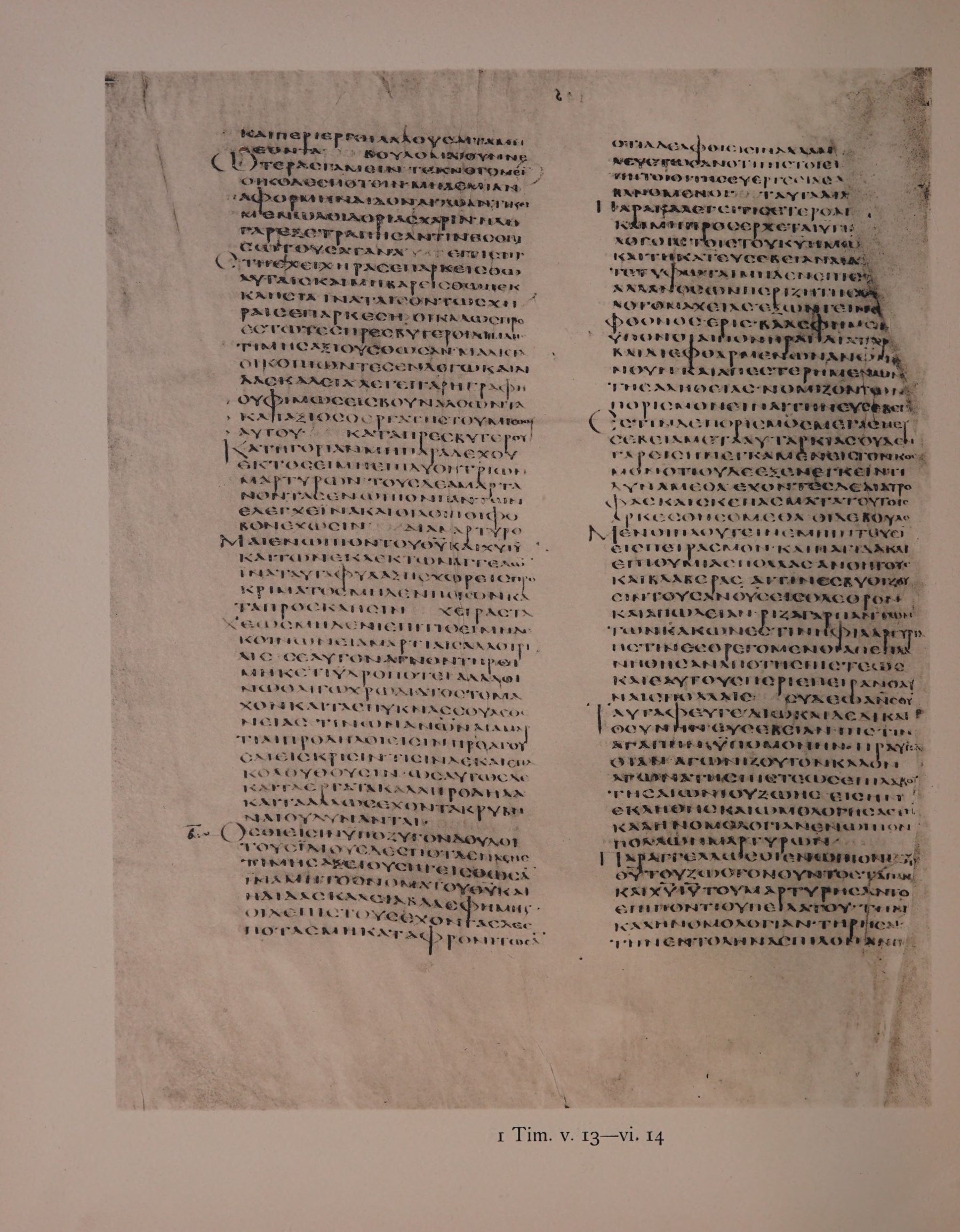
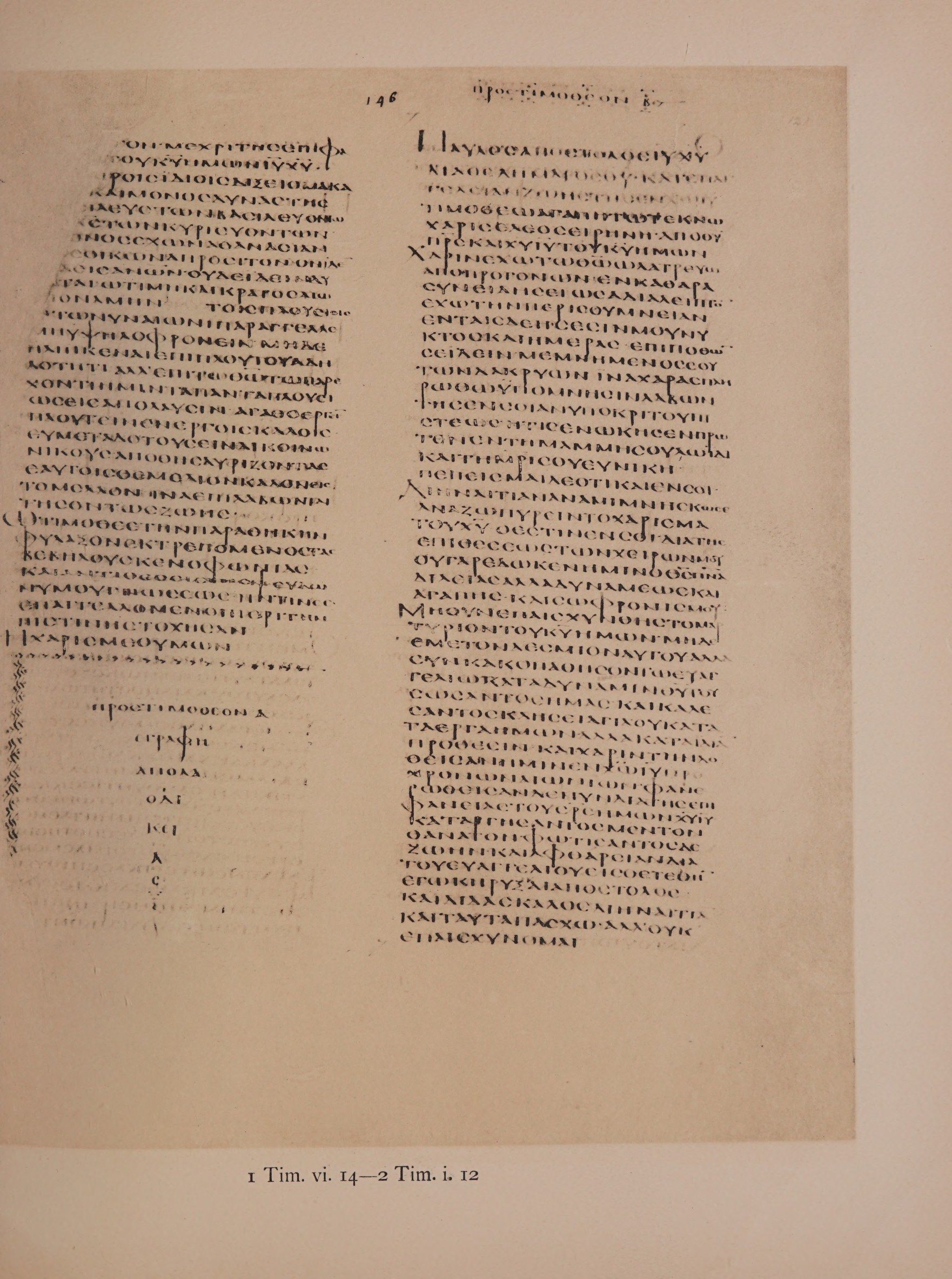
- Manuscript scan: the actual page(s) of Codex Alexandrinus containing this passage (folios 145v, 146r), reproduced from the British Museum's 1909 photographic facsimile edited by F. G. Kenyon, as digitised by the Getty Research Institute for the Internet Archive. The facsimile prints the verse range beneath each plate; that printed range was read for every page used and agrees with the INTF's NTVMR verse-level page index (CC BY 4.0). The page for each section now comes from the NTVMR transcription itself, which records the page and column on which every verse is written.
- Original text: the manuscript's own text, from a diplomatic transcription (see Greek text below), with Tischendorf's 8th critical edition (1869) for comparison.
- English translation: the King James Version (1611), retrieved verbatim from the public-domain bible-api.com endpoint.
Greek text: a diplomatic transcription of Codex Alexandrinus made by the Institut für Neutestamentliche Textforschung (INTF), Münster, for the New Testament Virtual Manuscript Room (NTVMR), published under a Creative Commons Attribution 4.0 licence. It gives the letters as the first scribe wrote them: no accents or breathings, the scribe's own spelling, and the sacred names in their contracted form (θς for θεος, ις for ιησους, κς for κυριος; the overline is not reproduced). Corrections by later hands are not shown. Letters in square brackets are not legible on the page and were restored by the transcribers, a dot under a letter marks an uncertain reading, and [...] marks text lost to damage. Beneath each section, for comparison, is Tischendorf's 8th critical edition (1869). Where the two differ, the transcription is what the manuscript says. Each section is shown with the page on which the transcription places its verses.
How was this verified? (Provenance)
Where on the image
Page from the NTVMR transcription (docID 20002): verses 1-2 on fol. 145v (facsimile leaf 254), col. 1.
1οσοι εισιν υπο ζυγον δουλοι τους ιδιους δεσποτας πασης τιμης αξειους ηγεισθωσαν ινα μη το ονομα του θυ και η διδασκαλεια βλασφημηται · 2οι δε πιστους εχοντας δεσποτας μη καταφρονιτωσαν οτι αδελφοι εισιν αλλα μ[αλλον] [δου]λευετωσαν οτι πιστοι ει[σιν] [και] [αγα]πητοι οι της ευεργεσιας α[ντιλαμ]βανομενοι · ταυτα διδ[ασκε] [και] παρακαλει ·
Compare: Tischendorf 8th edition (1869)
1Ὅσοι εἰσὶν ὑπὸ ζυγὸν δοῦλοι, τοὺς ἰδίους δεσπότας πάσης τιμῆς ἀξίους ἡγείσθωσαν, ἵνα μὴ τὸ ὄνομα τοῦ θεοῦ καὶ ἡ διδασκαλία βλασφημῆται. 2οἱ δὲ πιστοὺς ἔχοντες δεσπότας μὴ καταφρονείτωσαν, ὅτι ἀδελφοί εἰσιν· ἀλλὰ μᾶλλον δουλευέτωσαν, ὅτι πιστοί εἰσιν καὶ ἀγαπητοὶ οἱ τῆς εὐεργεσίας ἀντιλαμβανόμενοι. Ταῦτα δίδασκε καὶ παρακάλει.
1Let as many servants as are under the yoke count their own masters worthy of all honour, that the name of God and his doctrine be not blasphemed. 2And they that have believing masters, let them not despise them, because they are brethren; but rather do them service, because they are faithful and beloved, partakers of the benefit. These things teach and exhort.
Where on the image
Page from the NTVMR transcription (docID 20002): verses 3-14 on fol. 145v (facsimile leaf 254), col. 2; verse 14 continues on fol. 146r (facsimile leaf 255), col. 1 (which begins '[λημπ]τ̣ον · μεχρι').
3ει τις ετεροδι[δασκαλει] και μη προσερχεται υγι[αινουσιν] λογοις τοις του κυ ημω[ν] [ιυ] [χυ] και τη κατ ευσεβειαν διδ[ασκαλια] 4τετυφωται μηδεν επισ[ταμενος] αλλα νοσων περι ζητησε̣[ις] [και] λογομαχειας · εξ ων γεινε̣[ται] φθονος · ερις · βλασφημει[αι] υπονοιαι πονηραι 5διαπαρ[ατρι]βαι διεφθαρμενων ανων τ̣[ον] νουν και απεστερημενων της αληθειας · νομιζοντων πορισμον ειναι την ευσεβεια̣ν̣ 6εστιν δε πορισμος μεγας η ευσεβεια μετα αυταρκιας · 7ουδεν γαρ εισηνεγκαμεν εις τον κοσμον οτι ουδε εξενεγκειν τι δυναμεθα · 8εχοντες δε διατροφας και σκεπασματα τουτοις αρκεσθησομεθα 9οι δε βουλομενοι πλουτειν εμπιπτουσιν εις πειρασμον · και παγιδα και επιθυμιας πολλας ανοητους και βλαβερας · αιτινες βυθιζουσιν τους ανους εις ολεθρον και απωλειαν · 10ριζα γαρ παντων των κακων εστιν η φιλαργυρια ης τινες ορεγομενοι απεπλανηθησαν απο της πιστεως και εαυτους περιεπειραν οδυναις πολλαις · 11συ δε ω ανε θυ ταυτα φευγε · διωκαι δε δικαιοσυνην · ευσεβειαν · πιστιν αγαπην · υπομονην · πραυπαθιαν · 12αγωνιζου τον καλον αγωνα της πιστεως επιλαβου της αιωνιου ζωης · εις ην εκληθης και ωμολογησας την καλην ομολογιαν ενωπιον πολλων μαρτυρων · 13παραγγελλω σοι ενωπιον τ̣ο̣υ̣ θυ του ζωογονουντος τα παν[τα] και χυ ιυ του μαρτυρησαντο[ς] επι ποντιου πειλατου · την καλην ομολογιαν · 14τηρησαι σ[ε] την εντολην ασπιλον ανε̣[πι][λημπ]τ̣ον · μεχρι της επιφα[νειας] του κυ ημων ιυ χυ ·
Compare: Tischendorf 8th edition (1869)
3εἴ τις ἑτεροδιδασκαλεῖ καὶ μὴ προσέρχεται ὑγιαίνουσιν λόγοις, τοῖς τοῦ κυρίου ἡμῶν Ἰησοῦ Χριστοῦ, καὶ τῇ κατ’ εὐσέβειαν διδασκαλίᾳ, 4τετύφωται, μηδὲν ἐπιστάμενος, ἀλλὰ νοσῶν περὶ ζητήσεις καὶ λογομαχίας, ἐξ ὧν γίνεται φθόνος, ἔρις, βλασφημίαι, ὑπόνοιαι πονηραί, 5διαπαρατριβαὶ διεφθαρμένων ἀνθρώπων τὸν νοῦν καὶ ἀπεστερημένων τῆς ἀληθείας, νομιζόντων πορισμὸν εἶναι τὴν εὐσέβειαν. 6ἔστιν δὲ πορισμὸς μέγας ἡ εὐσέβεια μετὰ αὐταρκείας· 7οὐδὲν γὰρ εἰσηνέγκαμεν εἰς τὸν κόσμον, ὅτι οὐδὲ ἐξενεγκεῖν τι δυνάμεθα· 8ἔχοντες δὲ διατροφὰς καὶ σκεπάσματα, τούτοις ἀρκεσθησόμεθα. 9οἱ δὲ βουλόμενοι πλουτεῖν ἐμπίπτουσιν εἰς πειρασμὸν καὶ παγίδα καὶ ἐπιθυμίας πολλὰς ἀνοήτους καὶ βλαβεράς, αἵτινες βυθίζουσιν τοὺς ἀνθρώπους εἰς ὄλεθρον καὶ ἀπώλειαν· 10ῥίζα γὰρ πάντων τῶν κακῶν ἐστιν ἡ φιλαργυρία, ἧς τινες ὀρεγόμενοι ἀπεπλανήθησαν ἀπὸ τῆς πίστεως καὶ ἑαυτοὺς περιέπειραν ὀδύναις πολλαῖς. 11Σὺ δέ, ὦ ἄνθρωπε θεοῦ, ταῦτα φεῦγε· δίωκε δὲ δικαιοσύνην, εὐσέβειαν, πίστιν, ἀγάπην, ὑπομονήν, πραϋπαθίαν. 12ἀγωνίζου τὸν καλὸν ἀγῶνα τῆς πίστεως, ἐπιλαβοῦ τῆς αἰωνίου ζωῆς, εἰς ἣν ἐκλήθης καὶ ὡμολόγησας τὴν καλὴν ὁμολογίαν ἐνώπιον πολλῶν μαρτύρων. 13παραγγέλλω ἐνώπιον θεοῦ τοῦ ζῳογονοῦντος τὰ πάντα καὶ Χριστοῦ Ἰησοῦ τοῦ μαρτυρήσαντος ἐπὶ Ποντίου Πειλάτου τὴν καλὴν ὁμολογίαν, 14τηρῆσαί σε τὴν ἐντολὴν ἄσπιλον ἀνεπίλημπτον μέχρι τῆς ἐπιφανείας τοῦ κυρίου ἡμῶν Ἰησοῦ Χριστοῦ,
3If any man teach otherwise, and consent not to wholesome words, even the words of our Lord Jesus Christ, and to the doctrine which is according to godliness; 4He is proud, knowing nothing, but doting about questions and strifes of words, whereof cometh envy, strife, railings, evil surmisings, 5Perverse disputings of men of corrupt minds, and destitute of the truth, supposing that gain is godliness: from such withdraw thyself. 6But godliness with contentment is great gain. 7For we brought nothing into this world, and it is certain we can carry nothing out. 8And having food and raiment let us be therewith content. 9But they that will be rich fall into temptation and a snare, and into many foolish and hurtful lusts, which drown men in destruction and perdition. 10For the love of money is the root of all evil: which while some coveted after, they have erred from the faith, and pierced themselves through with many sorrows. 11But thou, O man of God, flee these things; and follow after righteousness, godliness, faith, love, patience, meekness. 12Fight the good fight of faith, lay hold on eternal life, whereunto thou art also called, and hast professed a good profession before many witnesses. 13I give thee charge in the sight of God, who quickeneth all things, and before Christ Jesus, who before Pontius Pilate witnessed a good confession; 14That thou keep this commandment without spot, unrebukeable, until the appearing of our Lord Jesus Christ:
Where on the image
Page from the NTVMR transcription (docID 20002): verses 15-21 on fol. 146r (facsimile leaf 255), col. 1.
15[ην] [κα]ι̣ροις ιδιοις διξει ο μακα[ριος] και μονος δυναστης [ο] [βα]σ̣ιλευς των βασιλευοντων̣ [και] κς των κυριευοντων · 16[ο] [μ]ονος εχων αθανασιαν [φω]ς οικων απροσιτον · ον ιδεν [ου]δεις ανων · ουδε ιδειν δυ[να]ται · ω τιμη και κρατος αιω[ν]ιον αμην · 17τοις πλουσιοις [ε]ν̣ τω νυν αιωνι παραγγελλε μ̣η υψηλοφρονειν · μηδε ηλπικεναι επι πλουτου αδηλοτητι · αλλ επι τω θω τω παρεχοντι ημιν τα παντα πλουσιως εις απολαυσιν · 18αγαθοεργειν πλουτειν εν εργοις καλοις ευμεταδοτους ειναι κοινωνικους · 19αποθησαυριζοντας εαυτοις θεμελιον καλον εις το μελλον · ινα επιλαβωνται της οντως ζωης · 20ω τιμοθεε την παραθηκην φυλαξον εκτρεπομενος τας βεβηλους κενοφωνιας και αντιθεσεις τ̣ης ψευδωνυμου γνωσεως · 21ην τινες · επαγγελλομενοι περι την πιστιν ηστοχησαν · η χαρις μεθ υμων ·
Compare: Tischendorf 8th edition (1869)
15ἣν καιροῖς ἰδίοις δείξει ὁ μακάριος καὶ μόνος δυνάστης, ὁ βασιλεὺς τῶν βασιλευόντων καὶ κύριος τῶν κυριευόντων, 16ὁ μόνος ἔχων ἀθανασίαν, φῶς οἰκῶν ἀπρόσιτον, ὃν εἶδεν οὐδεὶς ἀνθρώπων οὐδὲ ἰδεῖν δύναται· ᾧ τιμὴ καὶ κράτος αἰώνιον· ἀμήν. 17Τοῖς πλουσίοις ἐν τῷ νῦν αἰῶνι παράγγελλε μὴ ὑψηλὰ φρονεῖν μηδὲ ἠλπικέναι ἐπὶ πλούτου ἀδηλότητι, ἀλλ’ ἐπὶ θεῷ τῷ παρέχοντι ἡμῖν πάντα πλουσίως εἰς ἀπόλαυσιν, 18ἀγαθοεργεῖν, πλουτεῖν ἐν ἔργοις καλοῖς, εὐμεταδότους εἶναι, κοινωνικούς, 19ἀποθησαυρίζοντας ἑαυτοῖς θεμέλιον καλὸν εἰς τὸ μέλλον, ἵνα ἐπιλάβωνται τῆς ὄντως ζωῆς. 20Ὦ Τιμόθεε, τὴν παραθήκην φύλαξον, ἐκτρεπόμενος τὰς βεβήλους κενοφωνίας καὶ ἀντιθέσεις τῆς ψευδωνύμου γνώσεως, 21ἥν τινες ἐπαγγελλόμενοι περὶ τὴν πίστιν ἠστόχησαν. Ἡ χάρις μεθ’ ὑμῶν.
15Which in his times he shall shew, who is the blessed and only Potentate, the King of kings, and Lord of lords; 16Who only hath immortality, dwelling in the light which no man can approach unto; whom no man hath seen, nor can see: to whom be honour and power everlasting. Amen. 17Charge them that are rich in this world, that they be not highminded, nor trust in uncertain riches, but in the living God, who giveth us richly all things to enjoy; 18That they do good, that they be rich in good works, ready to distribute, willing to communicate; 19Laying up in store for themselves a good foundation against the time to come, that they may lay hold on eternal life. 20O Timothy, keep that which is committed to thy trust, avoiding profane and vain babblings, and oppositions of science falsely so called: 21Which some professing have erred concerning the faith. Grace be with thee. Amen.
Cite
Sources
- Source: Codex Alexandrinus page images + NTVMR transcription (CC BY 4.0) + Tischendorf 8th edition + KJV (holding institution)
- Critical edition: Codex Alexandrinus transcription, NTVMR (INTF Münster, CC BY 4.0); Tischendorf 8th edition for comparison
← previous · → next · v cycle view · l back to library