Acts, Chapter 17 (Codex Alexandrinus)
Introduction
Acts 17 from Codex Alexandrinus (GA 02), a fifth-century Greek Bible held by the British Library (Royal MS 1 D. VIII). In the New Testament it is the chief witness to the Byzantine text in the Gospels and to the Alexandrian text in the rest of the New Testament. Its New Testament volume lacks Matthew 1:1-25:5, John 6:50-8:52 and 2 Corinthians 4:13-12:6.
This entry meets the strict three-criteria standard of the Theosis Library:
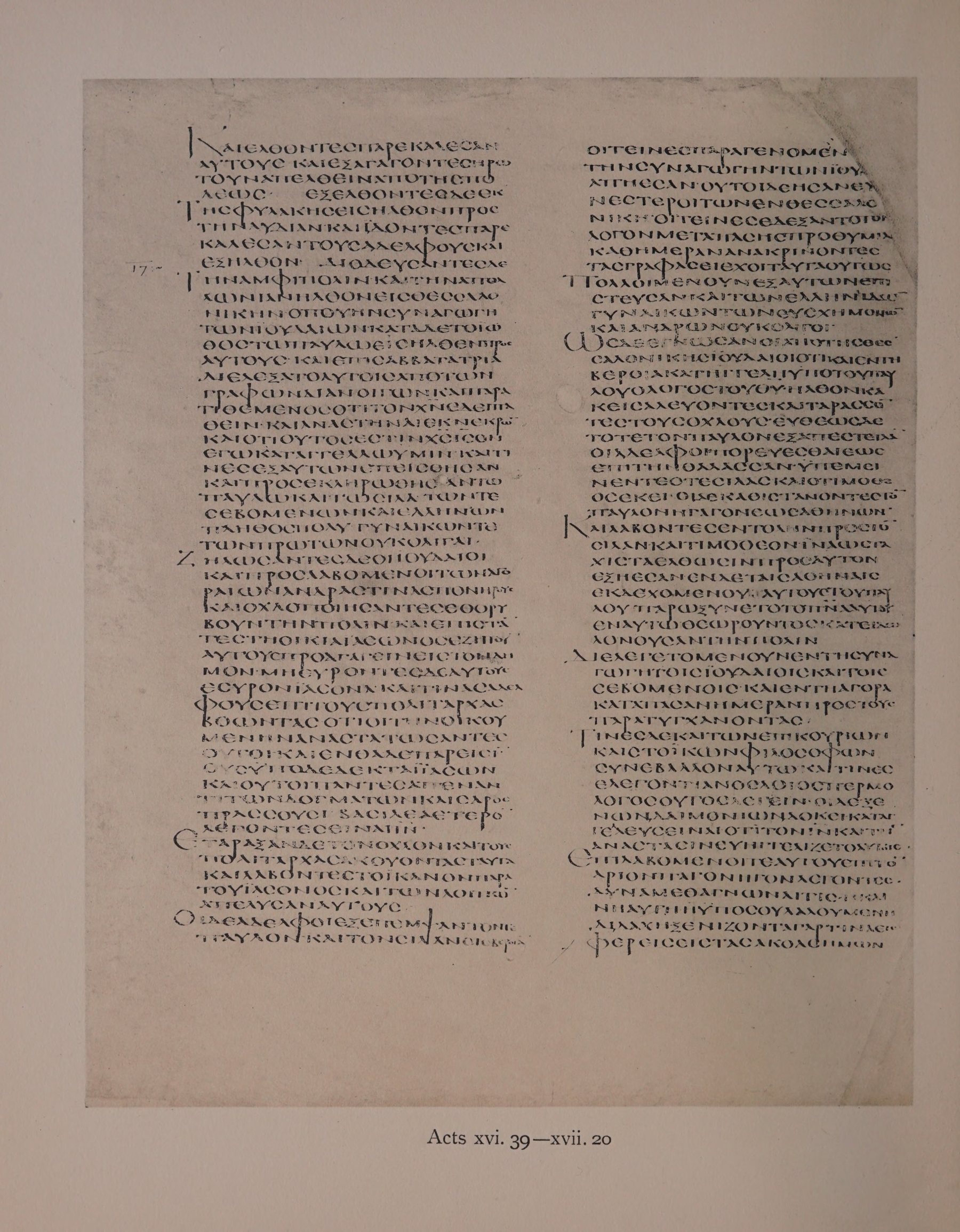
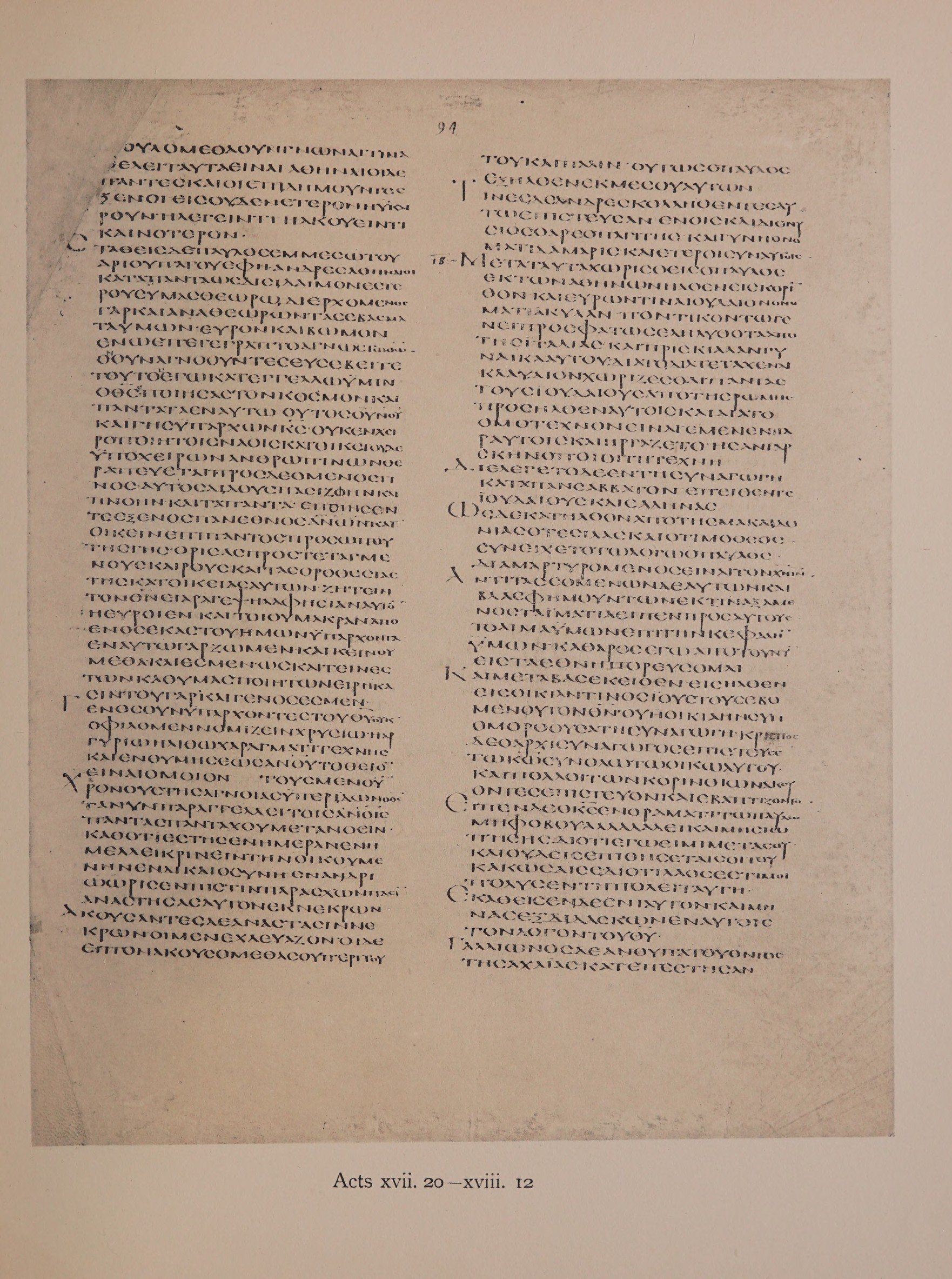
- Manuscript scan: the actual page(s) of Codex Alexandrinus containing this passage (folios 93v, 94r), reproduced from the British Museum's 1909 photographic facsimile edited by F. G. Kenyon, as digitised by the Getty Research Institute for the Internet Archive. The facsimile prints the verse range beneath each plate; that printed range was read for every page used and agrees with the INTF's NTVMR verse-level page index (CC BY 4.0). The page for each section now comes from the NTVMR transcription itself, which records the page and column on which every verse is written.
- Original text: the manuscript's own text, from a diplomatic transcription (see Greek text below), with Tischendorf's 8th critical edition (1869) for comparison.
- English translation: the King James Version (1611), retrieved verbatim from the public-domain bible-api.com endpoint.
Greek text: a diplomatic transcription of Codex Alexandrinus made by the Institut für Neutestamentliche Textforschung (INTF), Münster, for the New Testament Virtual Manuscript Room (NTVMR), published under a Creative Commons Attribution 4.0 licence. It gives the letters as the first scribe wrote them: no accents or breathings, the scribe's own spelling, and the sacred names in their contracted form (θς for θεος, ις for ιησους, κς for κυριος; the overline is not reproduced). Corrections by later hands are not shown. Letters in square brackets are not legible on the page and were restored by the transcribers, a dot under a letter marks an uncertain reading, and [...] marks text lost to damage. Beneath each section, for comparison, is Tischendorf's 8th critical edition (1869). Where the two differ, the transcription is what the manuscript says. Each section is shown with the page on which the transcription places its verses.
How was this verified? (Provenance)
Where on the image
Page from the NTVMR transcription (docID 20002): verses 1-10 on fol. 93v (facsimile leaf 148), col. 1.
1διοδευσαντες δε την αμφιπολιν · και την απολλωνιαν ηλθον εις θεσσαλονικην · οπου ην συναγωγη των ιουδαιων · 2κατα δε το ιωθος τω παυλω εισηλθεν προς αυτους · και επι σαββατα τρια διελεξατο αυτοις απο των γραφων 3διανοιγων και παρατιθεμενος οτι τον χν εδει παθειν · και αναστηναι εκ νεκρων και οτι ουτος εστιν χς ις ον εγω καταγγελλω υμιν · 4και τινες εξ αυτων επεισθησαν και προσεκληρωθησαν τω παυλω και τω σιλα · των τε σεβομενων · και ελληνων πληθος πολυ · γυναικων τε των πρωτων ουκ ολιγαι · 5ζηλωσαντες δε οι ιουδαιοι και προσλαβομενοι των αγοραιων ανδρας τινας πονηρους και οχλοποιησαντες εθορυβουν την πολιν · και επισταντες τη οικια ιασωνος εζητουν αυτο[.] προαγαγειν εις τον δημον · 6μη ευροντες δε αυτους εσυρον ιασονα · και τινας αδελφους επι τους πολιταρχας βοωντας · οτι οι την οικουμενην αναστατωσαντες ουτοι · και ενθαδε παρεισιν · 7ους υποδεδεκται ιασων και ουτοι παντες απεναντι των δογματων καισαρος πρασσουσι · βασιλεα ετερον λεγοντες ειναι ιν · 8εταραξαν δε τον οχλον και τους πολιταρχας ακουοντας ταυτα 9και λαβοντες το ικανον παρα του ιασονος και των λοιπων απελυσαν αυτους · 10οι δε αδελφοι εξεπεμψαν τον τε παυλον · και τον σιλαν εις βεροιαν οιτεινες παραγενομεν[οι] [εις] την συναγωγην των ιουδ̣[αιων] απηεσαν ·
Compare: Tischendorf 8th edition (1869)
1Διοδεύσαντες δὲ τὴν Ἀμφίπολιν καὶ τὴν Ἀπολλωνίαν ἦλθον εἰς Θεσσαλονίκην, ὅπου ἦν συναγωγὴ τῶν Ἰουδαίων. 2κατὰ δὲ τὸ εἰωθὸς τῷ Παύλῳ εἰσῆλθεν πρὸς αὐτοὺς καὶ ἐπὶ σάββατα τρία διελέξατο αὐτοῖς ἀπὸ τῶν γραφῶν, 3διανοίγων καὶ παρατιθέμενος ὅτι τὸν Χριστὸν ἔδει παθεῖν καὶ ἀναστῆναι ἐκ νεκρῶν, καὶ ὅτι οὗτός ἐστιν Χριστός, Ἰησοῦς, ὃν ἐγὼ καταγγέλλω ὑμῖν. 4καί τινες ἐξ αὐτῶν ἐπείσθησαν καὶ προσεκληρώθησαν τῷ Παύλῳ καὶ τῷ Σιλᾷ, τῶν τε σεβομένων Ἑλλήνων πλῆθος πολὺ γυναικῶν τε τῶν πρώτων οὐκ ὀλίγαι. 5ζηλώσαντες δὲ οἱ Ἰουδαῖοι καὶ προσλαβόμενοι τῶν ἀγοραίων τινὰς ἄνδρας πονηροὺς καὶ ὀχλοποιήσαντες ἐθορύβουν τὴν πόλιν, καὶ ἐπιστάντες τῇ οἰκίᾳ Ἰάσονος ἐζήτουν αὐτοὺς προαγαγεῖν εἰς τὸν δῆμον. 6μὴ εὑρόντες δὲ αὐτοὺς ἔσυρον Ἰάσονα καί τινας ἀδελφοὺς ἐπὶ τοὺς πολιτάρχας, βοῶντες ὅτι οἱ τὴν οἰκουμένην ἀναστατώσαντες οὗτοι καὶ ἐνθάδε πάρεισιν, 7οὓς ὑποδέδεκται Ἰάσων· καὶ οὗτοι πάντες ἀπέναντι τῶν δογμάτων Καίσαρος πράσσουσιν, βασιλέα ἕτερον λέγοντες εἶναι Ἰησοῦν. 8ἐτάραξαν δὲ τὸν ὄχλον καὶ τοὺς πολιτάρχας ἀκούοντας ταῦτα, 9καὶ λαβόντες τὸ ἱκανὸν παρὰ τοῦ Ἰάσονος καὶ τῶν λοιπῶν ἀπέλυσαν αὐτούς. 10Οἱ δὲ ἀδελφοὶ εὐθέως διὰ νυκτὸς ἐξέπεμψαν τόν τε Παῦλον καὶ τὸν Σιλᾶν εἰς Βέροιαν, οἵτινες παραγενόμενοι εἰς τὴν συναγωγὴν τῶν Ἰουδαίων ἀπῄεσαν.
1Now when they had passed through Amphipolis and Apollonia, they came to Thessalonica, where was a synagogue of the Jews: 2And Paul, as his manner was, went in unto them, and three sabbath days reasoned with them out of the scriptures, 3Opening and alleging, that Christ must needs have suffered, and risen again from the dead; and that this Jesus, whom I preach unto you, is Christ. 4And some of them believed, and consorted with Paul and Silas; and of the devout Greeks a great multitude, and of the chief women not a few. 5But the Jews which believed not, moved with envy, took unto them certain lewd fellows of the baser sort, and gathered a company, and set all the city on an uproar, and assaulted the house of Jason, and sought to bring them out to the people. 6And when they found them not, they drew Jason and certain brethren unto the rulers of the city, crying, These that have turned the world upside down are come hither also; 7Whom Jason hath received: and these all do contrary to the decrees of Caesar, saying that there is another king, one Jesus. 8And they troubled the people and the rulers of the city, when they heard these things. 9And when they had taken security of Jason, and of the other, they let them go. 10And the brethren immediately sent away Paul and Silas by night unto Berea: who coming thither went into the synagogue of the Jews.
Where on the image
Page from the NTVMR transcription (docID 20002): verses 11-20 on fol. 93v (facsimile leaf 148), col. 2; verse 20 continues on fol. 94r (facsimile leaf 149), col. 1 (which begins '[β]ουλομεθα ουν γνωναι').
11ουτοι δε ησαν ευ[γε]νεστεροι των εν θεσσαλονικη · οιτεινες εδεξαντο τον λογον μετα πασης προθυμια[ς] καθ ημεραν ανακρινοντες τας γραφας ει εχοι ταυτα ουτως 12πολλοι μεν ουν εξ αυτων επιστευσαν και των ελληνιδων γυναικων των ευσχημονων και ανδρων ουκ ολιγοι · 13ως δε εγνωσαν οι απο της θεσσαλονικης ιουδαιοι οτι και εν τη βεροια κατηγγελη υπο του παυλου ο λογος του θυ · ηλθον κακει σαλευοντες · και ταρασσοντες τους οχλους · 14ευθεως δε τοτε τον παυλον εξαπεστειλαν οι αδελφοι πορευεσθαι εως επι την θαλασσαν · υπεμεινεν τε ο τε σιλας και ο τιμοθεος εκει · 15οι δε καθιστανοντες τον παυλον ηγαγον εως αθηνων · και λαβοντες εντολην προς τον σιλαν · και τιμοθεον · ινα ως ταχιστα ελθωσιν προς αυτον εξηεσαν · 16εν δε ταις αθηναις εκδεχομενους̣ αυτους του παυλου παρωξυνετο το πνα αυτου εν αυτω · θεωρουντος κατειδωλον ουσαν την πολιν · 17διελεγετο μεν ουν εν τη συναγωγη τοις ιουδαιοις και τοις σεβομενοις · και εν τη αγορα κατα πασαν ημεραν προς τους παρατυγχανοντας · 18τινες δε και των επικουριων και στοικων φιλοσοφων συνεβαλλον αυτω · και τινες ελεγον τι αν θελοι ο σπερμολογος ουτος λεγειν · οι δε ξενων δαιμονιων δοκει · καταγγελευς ειναι · οτι τον ιν · και την αναστασιν ευηγγελιζετο αυτοις · 19επιλαβομενοι τε αυτου επι τον αριον παγον ηγον λεγοντες . δυναμεθα γνωναι τις η καινη αυτη η υπο σου λαλουμενη διδαχη · 20ξενιζοντα γαρ τινα εισφερεις εις τας ακοας ημων [β]ουλομεθα ουν γνωναι τινα θ̣ελει ταυτα ειναι ·
Compare: Tischendorf 8th edition (1869)
11οὗτοι δὲ ἦσαν εὐγενέστεροι τῶν ἐν Θεσσαλονίκῃ, οἵτινες ἐδέξαντο τὸν λόγον μετὰ πάσης προθυμίας, καθ’ ἡμέραν ἀνακρίνοντες τὰς γραφὰς εἰ ἔχοι ταῦτα οὕτως. 12πολλοὶ μὲν οὖν ἐξ αὐτῶν ἐπίστευσαν, καὶ τῶν Ἑλληνίδων γυναικῶν τῶν εὐσχημόνων καὶ ἀνδρῶν οὐκ ὀλίγοι. 13ὡς δὲ ἔγνωσαν οἱ ἀπὸ τῆς Θεσσαλονίκης Ἰουδαῖοι ὅτι καὶ ἐν τῇ Βεροίᾳ κατηγγέλη ὑπὸ τοῦ Παύλου ὁ λόγος τοῦ θεοῦ, ἦλθον κἀκεῖ σαλεύοντες καὶ ταράσσοντες τοὺς ὄχλους. 14εὐθέως δὲ τότε τὸν Παῦλον ἐξαπέστειλαν οἱ ἀδελφοὶ πορεύεσθαι ἕως ἐπὶ τὴν θάλασσαν· ὑπέμεινάν τε ὅ τε Σιλᾶς καὶ ὁ Τιμόθεος ἐκεῖ. 15οἱ δὲ καθιστάνοντες τὸν Παῦλον ἤγαγον ἕως Ἀθηνῶν, καὶ λαβόντες ἐντολὴν πρὸς τὸν Σιλᾶν καὶ τὸν Τιμόθεον ἵνα ὡς τάχιστα ἔλθωσιν πρὸς αὐτὸν ἐξῄεσαν. 16Ἐν δὲ ταῖς Ἀθήναις ἐκδεχομένου αὐτοὺς τοῦ Παύλου, παρωξύνετο τὸ πνεῦμα αὐτοῦ ἐν αὐτῷ θεωροῦντος κατείδωλον οὖσαν τὴν πόλιν. 17διελέγετο μὲν οὖν ἐν τῇ συναγωγῇ τοῖς Ἰουδαίοις καὶ τοῖς σεβομένοις καὶ ἐν τῇ ἀγορᾷ κατὰ πᾶσαν ἡμέραν πρὸς τοὺς παρατυγχάνοντας. 18τινὲς δὲ καὶ τῶν Ἐπικουρίων καὶ Στοϊκῶν φιλοσόφων συνέβαλλον αὐτῷ, καί τινες ἔλεγον· τί ἂν θέλοι ὁ σπερμολόγος οὗτος λέγειν; οἱ δέ, ξένων δαιμονίων δοκεῖ καταγγελεὺς εἶναι, ὅτι τὸν Ἰησοῦν καὶ τὴν ἀνάστασιν εὐηγγελίζετο. 19ἐπιλαβόμενοί τε αὐτοῦ ἐπὶ τὸν Ἄριον πάγον ἤγαγον, λέγοντες· δυνάμεθα γνῶναι τίς ἡ καινὴ αὕτη ἡ ὑπὸ σοῦ λαλουμένη διδαχή; 20ξενίζοντα γάρ τινα εἰσφέρεις εἰς τὰς ἀκοὰς ἡμῶν· βουλόμεθα οὖν γνῶναι τίνα θέλει ταῦτα εἶναι.
11These were more noble than those in Thessalonica, in that they received the word with all readiness of mind, and searched the scriptures daily, whether those things were so. 12Therefore many of them believed; also of honourable women which were Greeks, and of men, not a few. 13But when the Jews of Thessalonica had knowledge that the word of God was preached of Paul at Berea, they came thither also, and stirred up the people. 14And then immediately the brethren sent away Paul to go as it were to the sea: but Silas and Timotheus abode there still. 15And they that conducted Paul brought him unto Athens: and receiving a commandment unto Silas and Timotheus for to come to him with all speed, they departed. 16Now while Paul waited for them at Athens, his spirit was stirred in him, when he saw the city wholly given to idolatry. 17Therefore disputed he in the synagogue with the Jews, and with the devout persons, and in the market daily with them that met with him. 18Then certain philosophers of the Epicureans, and of the Stoicks, encountered him. And some said, What will this babbler say? other some, He seemeth to be a setter forth of strange gods: because he preached unto them Jesus, and the resurrection. 19And they took him, and brought him unto Areopagus, saying, May we know what this new doctrine, whereof thou speakest, is? 20For thou bringest certain strange things to our ears: we would know therefore what these things mean.
Where on the image
Page from the NTVMR transcription (docID 20002): verses 21-32 on fol. 94r (facsimile leaf 149), col. 1.
21αθηναιοι δε παντες και οι επιδημουντες ξενοι · εις ουδεν ετερον ηυκαιρουν · η λεγειν τι · η ακουειν τι καινοτερον · 22σταθεις δε παυλος εμμεσω του αριου παγου εφη · ανδρες αθηναιοι κατα παντα ως δισιδαιμονεστερους υμας θεωρω · 23διερχομενος γαρ και αναθεωρων τα σεβασματα υμων · ευρον · και βωμον εν ω επεγεγραπτο αγνωστω θω . ο ουν αγνοουντες ευσεβειτε τουτο εγω κατεγγελλω υμιν · 24ο θς · ποιησας τον κοσμον και παντα τα εν αυτω ουτος ουνου και γης υπαρχων κς · ουκ εν χειροποιητοις ναοις κατοικει 25ουδε υπο χειρων ανθρωπινων θεραπευεται προσδεομενος τινος · αυτος διδους πασι ζοην και πνοην · και τα παντα · 26[...] τε εξ ενος παν εθνος ανων · κατοικειν επι παντος προσωπου της γης · ορισας προστεταγμενους καιρους · και τας οροθεσιας της κατοικειας αυτων · 27ζητειν τον θν ει αρα γε ψηλαφησιαν αυτον η ευροιεν · καιτοι ου μακραν απο ενος εκαστου υ̣μων υπαρχοντα 28εν αυτω γαρ ζωμεν και κεινουμεθα · και εσμεν · ως και τεινες των καθ υμας ποιητων ειρηκασιν · του γαρ και γενος εσμεν · 29γενος ουν υπαρχοντες του θυ ουκ οφιλομεν νομιζειν χρυσιω · η αργυριω η λιθω χαραγματι τεχνης και ενθυμησεως ανου το θειον ειναι ομοιον 30τους μεν ουν χρονους της αγνοιας υπεριδων ο θς τα νυν παραγγελλει τοις ανοις παντας πανταχου μετανοειν · 31καθοτι εστησεν ημεραν εν η μελλει κρινειν την οικουμενην εν δικαιοσυνη εν ανδρι ω ωρισεν πιστιν παρασχων πασιν αναστησας αυτον εκ νεκρων 32ακουσαντες δε αναστασιν νεκρων · οι μεν εχλευαζον · οι δε ειπον ακουσομεθα σου περι τουτου και παλιν ·
Compare: Tischendorf 8th edition (1869)
21Ἀθηναῖοι δὲ πάντες καὶ οἱ ἐπιδημοῦντες ξένοι εἰς οὐδὲν ἕτερον ηὐκαίρουν ἢ λέγειν τι ἢ ἀκούειν τι καινότερον. 22Σταθεὶς δὲ Παῦλος ἐν μέσῳ τοῦ Ἀρίου πάγου ἔφη· Ἄνδρες Ἀθηναῖοι, κατὰ πάντα ὡς δεισιδαιμονεστέρους ὑμᾶς θεωρῶ· 23διερχόμενος γὰρ καὶ ἀναθεωρῶν τὰ σεβάσματα ὑμῶν εὗρον καὶ βωμὸν ἐν ᾧ ἐπεγέγραπτο, ἀγνώστῳ θεῷ. ὃ οὖν ἀγνοοῦντες εὐσεβεῖτε, τοῦτο ἐγὼ καταγγέλλω ὑμῖν. 24ὁ θεὸς ὁ ποιήσας τὸν κόσμον καὶ πάντα τὰ ἐν αὐτῷ, οὗτος οὐρανοῦ καὶ γῆς ὑπάρχων κύριος οὐκ ἐν χειροποιήτοις ναοῖς κατοικεῖ 25οὐδὲ ὑπὸ χειρῶν ἀνθρωπίνων θεραπεύεται προσδεόμενός τινος, αὐτὸς διδοὺς πᾶσιν ζωὴν καὶ πνοὴν καὶ τὰ πάντα· 26ἐποίησέν τε ἐξ ἑνὸς πᾶν ἔθνος ἀνθρώπων κατοικεῖν ἐπὶ παντὸς προσώπου τῆς γῆς, ὁρίσας προστεταγμένους καιροὺς καὶ τὰς ὁροθεσίας τῆς κατοικίας αὐτῶν, 27ζητεῖν τὸν θεὸν εἰ ἄραγε ψηλαφήσειαν αὐτὸν καὶ εὕροιεν, καίγε οὐ μακρὰν ἀπὸ ἑνὸς ἑκάστου ἡμῶν ὑπάρχοντα. 28ἐν αὐτῷ γὰρ ζῶμεν καὶ κινούμεθα καὶ ἐσμέν, ὡς καί τινες τῶν καθ’ ὑμᾶς ποιητῶν εἰρήκασιν, τοῦ γὰρ καὶ γένος ἐσμέν. 29γένος οὖν ὑπάρχοντες τοῦ θεοῦ οὐκ ὀφείλομεν νομίζειν χρυσῷ ἢ ἀργύρῳ ἢ λίθῳ, χαράγματι τέχνης καὶ ἐνθυμήσεως ἀνθρώπου, τὸ θεῖον εἶναι ὅμοιον. 30τοὺς μὲν οὖν χρόνους τῆς ἀγνοίας ὑπεριδὼν ὁ θεὸς τὰ νῦν ἀπαγγέλλει τοῖς ἀνθρώποις πάντας πανταχοῦ μετανοεῖν, 31καθότι ἔστησεν ἡμέραν ἐν ᾗ μέλλει κρίνειν τὴν οἰκουμένην ἐν δικαιοσύνῃ ἐν ἀνδρὶ ᾧ ὥρισεν, πίστιν παρασχὼν πᾶσιν ἀναστήσας αὐτὸν ἐκ νεκρῶν. 32ἀκούσαντες δὲ ἀνάστασιν νεκρῶν οἱ μὲν ἐχλεύαζον, οἱ δὲ εἶπαν, ἀκουσόμεθά σου περὶ τούτου καὶ πάλιν.
21(For all the Athenians and strangers which were there spent their time in nothing else, but either to tell, or to hear some new thing.) 22Then Paul stood in the midst of Mars’ hill, and said, Ye men of Athens, I perceive that in all things ye are too superstitious. 23For as I passed by, and beheld your devotions, I found an altar with this inscription, TO THE UNKNOWN GOD. Whom therefore ye ignorantly worship, him declare I unto you. 24God that made the world and all things therein, seeing that he is Lord of heaven and earth, dwelleth not in temples made with hands; 25Neither is worshipped with men’s hands, as though he needed any thing, seeing he giveth to all life, and breath, and all things; 26And hath made of one blood all nations of men for to dwell on all the face of the earth, and hath determined the times before appointed, and the bounds of their habitation; 27That they should seek the Lord, if haply they might feel after him, and find him, though he be not far from every one of us: 28For in him we live, and move, and have our being; as certain also of your own poets have said, For we are also his offspring. 29Forasmuch then as we are the offspring of God, we ought not to think that the Godhead is like unto gold, or silver, or stone, graven by art and man’s device. 30And the times of this ignorance God winked at; but now commandeth all men every where to repent: 31Because he hath appointed a day, in the which he will judge the world in righteousness by that man whom he hath ordained; whereof he hath given assurance unto all men, in that he hath raised him from the dead. 32And when they heard of the resurrection of the dead, some mocked: and others said, We will hear thee again of this matter.
Where on the image
Page from the NTVMR transcription (docID 20002): verses 33-34 on fol. 94r (facsimile leaf 149), col. 2.
33ουτως ο παυλος εξηλθεν εκ μεσου αυτων · 34τινες δε ανδρες κολληθεντες αυτω επιστευσαν · εν οις και διονυσιος ο αρεοπαγιτης · και γυνη ονοματι δαμαρις · και ετεροι συν αυτοις ·
Compare: Tischendorf 8th edition (1869)
33οὕτως ὁ Παῦλος ἐξῆλθεν ἐκ μέσου αὐτῶν. 34τινὲς δὲ ἄνδρες κολληθέντες αὐτῷ ἐπίστευσαν, ἐν οἷς καὶ Διονύσιος ὁ Ἀρεοπαγείτης καὶ γυνὴ ὀνόματι Δάμαρις καὶ ἕτεροι σὺν αὐτοῖς.
33So Paul departed from among them. 34Howbeit certain men clave unto him, and believed: among the which was Dionysius the Areopagite, and a woman named Damaris, and others with them.
Cite
Sources
- Source: Codex Alexandrinus page images + NTVMR transcription (CC BY 4.0) + Tischendorf 8th edition + KJV (holding institution)
- Critical edition: Codex Alexandrinus transcription, NTVMR (INTF Münster, CC BY 4.0); Tischendorf 8th edition for comparison
← previous · → next · v cycle view · l back to library