Colossians, Chapter 2 (Codex Alexandrinus)
Introduction
Colossians 2 from Codex Alexandrinus (GA 02), a fifth-century Greek Bible held by the British Library (Royal MS 1 D. VIII). In the New Testament it is the chief witness to the Byzantine text in the Gospels and to the Alexandrian text in the rest of the New Testament. Its New Testament volume lacks Matthew 1:1-25:5, John 6:50-8:52 and 2 Corinthians 4:13-12:6.
This entry meets the strict three-criteria standard of the Theosis Library:
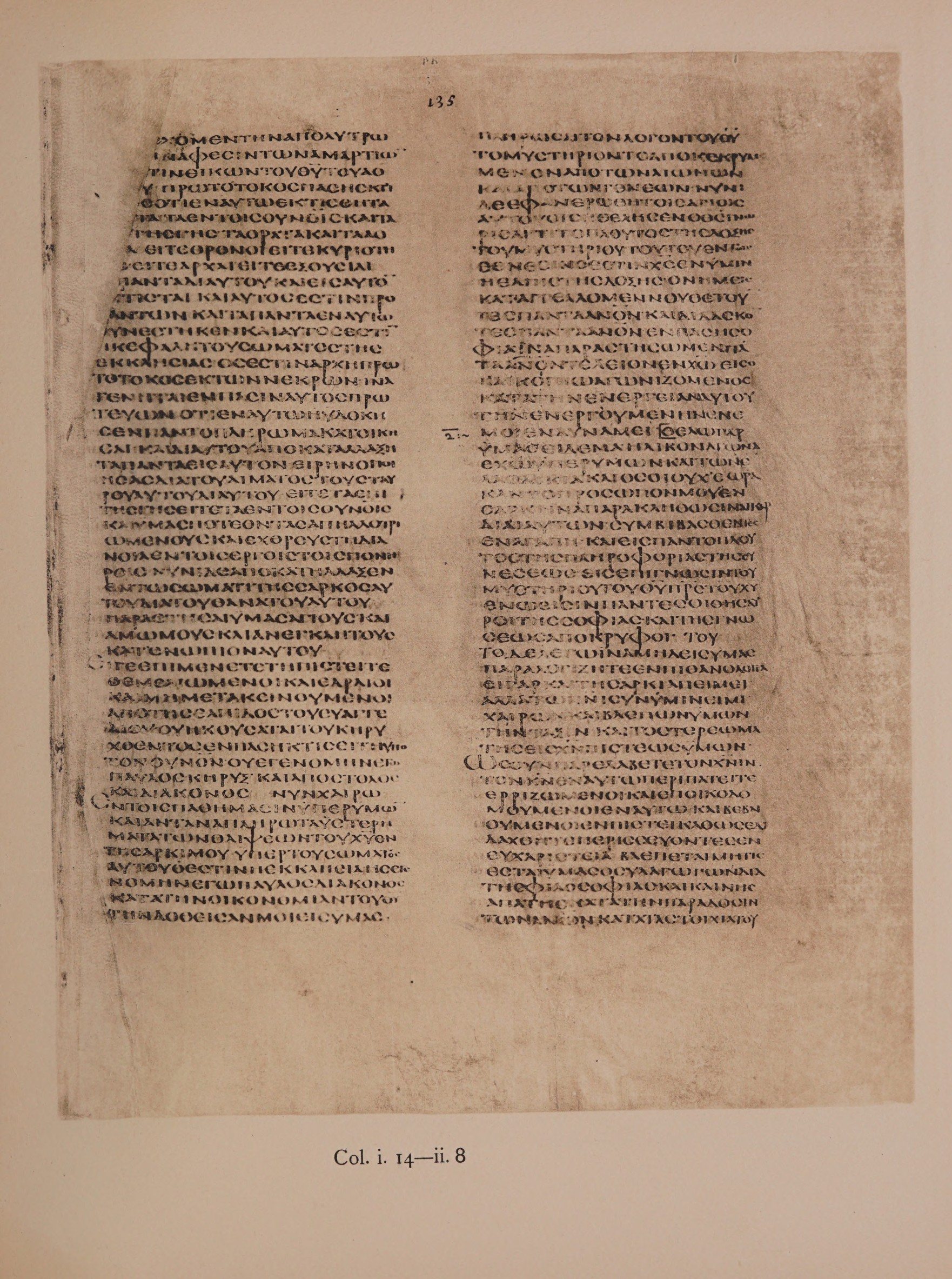
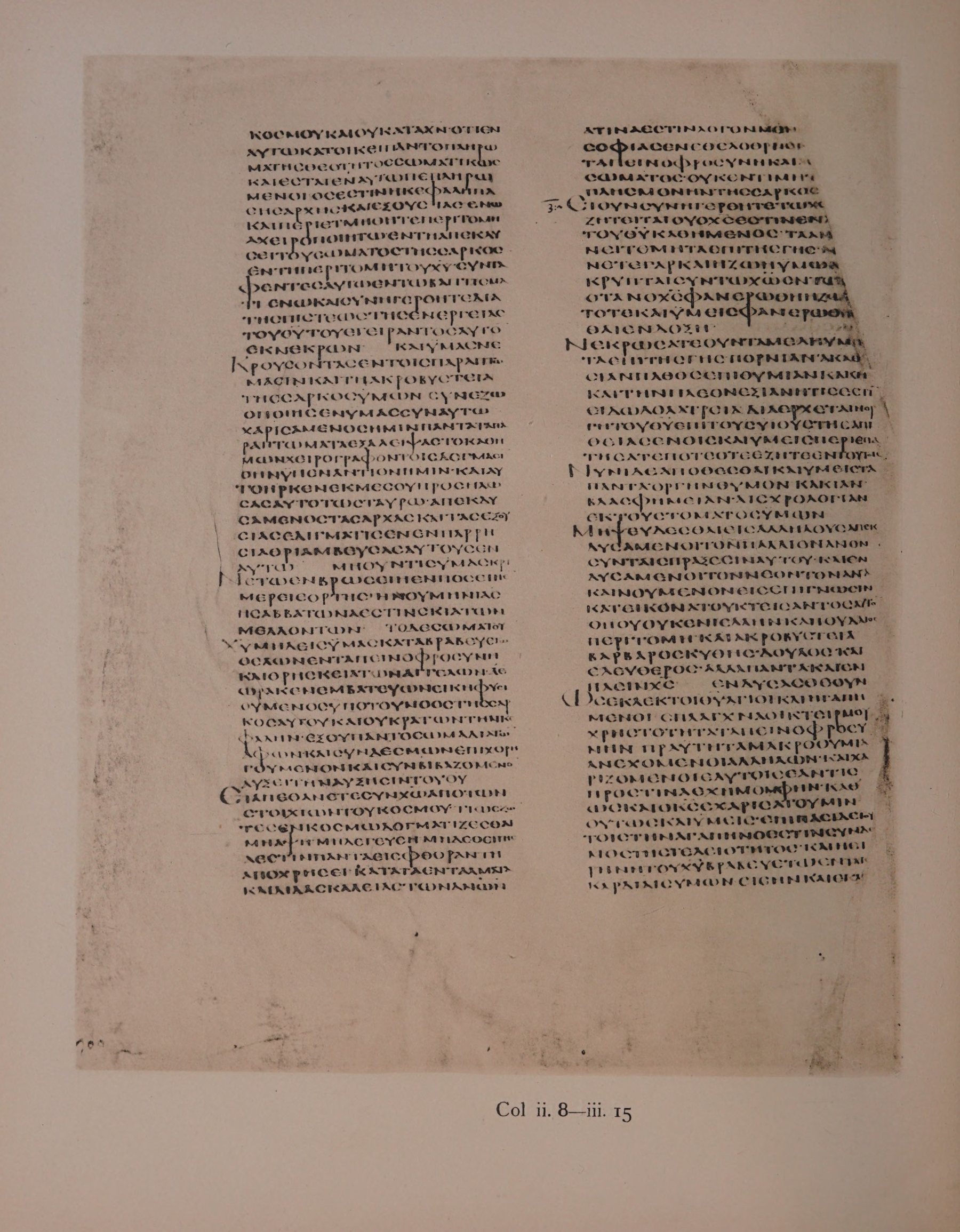
- Manuscript scan: the actual page(s) of Codex Alexandrinus containing this passage (folios 135r, 135v), reproduced from the British Museum's 1909 photographic facsimile edited by F. G. Kenyon, as digitised by the Getty Research Institute for the Internet Archive. The facsimile prints the verse range beneath each plate; that printed range was read for every page used and agrees with the INTF's NTVMR verse-level page index (CC BY 4.0). The page for each section now comes from the NTVMR transcription itself, which records the page and column on which every verse is written.
- Original text: the manuscript's own text, from a diplomatic transcription (see Greek text below), with Tischendorf's 8th critical edition (1869) for comparison.
- English translation: the King James Version (1611), retrieved verbatim from the public-domain bible-api.com endpoint.
Greek text: a diplomatic transcription of Codex Alexandrinus made by the Institut für Neutestamentliche Textforschung (INTF), Münster, for the New Testament Virtual Manuscript Room (NTVMR), published under a Creative Commons Attribution 4.0 licence. It gives the letters as the first scribe wrote them: no accents or breathings, the scribe's own spelling, and the sacred names in their contracted form (θς for θεος, ις for ιησους, κς for κυριος; the overline is not reproduced). Corrections by later hands are not shown. Letters in square brackets are not legible on the page and were restored by the transcribers, a dot under a letter marks an uncertain reading, and [...] marks text lost to damage. Beneath each section, for comparison, is Tischendorf's 8th critical edition (1869). Where the two differ, the transcription is what the manuscript says. Each section is shown with the page on which the transcription places its verses.
How was this verified? (Provenance)
Where on the image
Page from the NTVMR transcription (docID 20002): verses 1-8 on fol. 135r (facsimile leaf 231), col. 2; verse 8 continues on fol. 135v (facsimile leaf 232), col. 1 (which begins 'κοσμου και ου').
1θελω γαρ υμας ειδενα · ηλικον αγωνα εχω υπερ υμων και των εν λαοδικια και οσοι ουχ εωρακαν το προσωπον μου εν σαρκι · 2ινα παρακληθωσιν αι καρδιαι αυτων · συμβιβασθεντες εν αγαπη · και εις παν το πλουτος της πληροφοριας της συνεσεως · εις επιγνωσιν του μυστηριου του θυ πρς του χυ 3εν ω εισιν παντες οι θησαυροι της σοφιας · και της γνωσεως αποκρυφοι · 4τουτο [...] λεγω ινα μηδεις υμας παραλογιζητε εν πιθανολογια 5ει γαρ και τη σαρκι · απειμει αλλα τω πνι συν υμιν ειμι · χαιρων και βλεπων υμων την ταξιν και το στερεωμα της εις χν πιστεως υμων · 6ως ουν παρελαβετε τον χν ιν τον κν εν αυτω περιπατειτε 7ερριζωμενοι · και εποικοδομουμενοι εν αυτω και βεβαιουμενοι εν πιστει · καθως εδιδαχθητε περισσευοντες εν ευχαριστεια 8βλεπεται μη τις εσται υμας ο συλαγωγων δια της φιλοσοφιας και καινης απατης κατα την παραδοσιν των ανων κατα τα στοιχια του κοσμου και ου κατα χν ·
Compare: Tischendorf 8th edition (1869)
1Θέλω γὰρ ὑμᾶς εἰδέναι ἡλίκον ἀγῶνα ἔχω ὑπὲρ ὑμῶν καὶ τῶν ἐν Λαοδικίᾳ καὶ ὅσοι οὐχ ἑόρακαν τὸ πρόσωπόν μου ἐν σαρκί, 2ἵνα παρακληθῶσιν αἱ καρδίαι αὐτῶν, συμβιβασθέντες ἐν ἀγάπῃ καὶ εἰς πᾶν πλοῦτος τῆς πληροφορίας τῆς συνέσεως, εἰς ἐπίγνωσιν τοῦ μυστηρίου τοῦ θεοῦ, Χριστοῦ, 3ἐν ᾧ εἰσιν πάντες οἱ θησαυροὶ τῆς σοφίας καὶ γνώσεως ἀπόκρυφοι. 4τοῦτο λέγω ἵνα μηδεὶς ὑμᾶς παραλογίζηται ἐν πιθανολογίᾳ. 5εἰ γὰρ καὶ τῇ σαρκὶ ἄπειμι, ἀλλὰ τῷ πνεύματι σὺν ὑμῖν εἰμι, χαίρων καὶ βλέπων ὑμῶν τὴν τάξιν καὶ τὸ στερέωμα τῆς εἰς Χριστὸν πίστεως ὑμῶν. 6Ὡς οὖν παρελάβετε τὸν Χριστὸν Ἰησοῦν τὸν κύριον, ἐν αὐτῷ περιπατεῖτε, 7ἐρριζωμένοι καὶ ἐποικοδομούμενοι ἐν αὐτῷ καὶ βεβαιούμενοι τῇ πίστει καθὼς ἐδιδάχθητε, περισσεύοντες ἐν εὐχαριστίᾳ. 8βλέπετε μή τις ὑμᾶς ἔσται ὁ συλαγωγῶν διὰ τῆς φιλοσοφίας καὶ κενῆς ἀπάτης κατὰ τὴν παράδοσιν τῶν ἀνθρώπων, κατὰ τὰ στοιχεῖα τοῦ κόσμου καὶ οὐ κατὰ Χριστόν,
1For I would that ye knew what great conflict I have for you, and for them at Laodicea, and for as many as have not seen my face in the flesh; 2That their hearts might be comforted, being knit together in love, and unto all riches of the full assurance of understanding, to the acknowledgement of the mystery of God, and of the Father, and of Christ; 3In whom are hid all the treasures of wisdom and knowledge. 4And this I say, lest any man should beguile you with enticing words. 5For though I be absent in the flesh, yet am I with you in the spirit, joying and beholding your order, and the stedfastness of your faith in Christ. 6As ye have therefore received Christ Jesus the Lord, so walk ye in him: 7Rooted and built up in him, and stablished in the faith, as ye have been taught, abounding therein with thanksgiving. 8Beware lest any man spoil you through philosophy and vain deceit, after the tradition of men, after the rudiments of the world, and not after Christ.
Where on the image
Page from the NTVMR transcription (docID 20002): verses 9-15 on fol. 135v (facsimile leaf 232), col. 1.
9οτι εν αυτω κατοικει παν το πληρωμα της θεοτητος σωματικως 10και εσται εν αυτω πεπληρωμενοι ος εστιν η κεφαλη πασης αρχης · και εξουσιας · 11εν ω και περιετμηθητε περιτομη αχειροποιητω εν τη απεκδυσει του σωματος της σαρκος εν τη περιτομη του χυ · 12συνταφεντες αυτω εν τω βαπτισματι · εν ω και συνηγερθητε δια της πιστεως της ενεργειας του θυ του εγειραντος αυτον εκ νεκρων · 13και υμας νεκρους οντας εν τοις παραπτωμασιν και τη ακροβυστεια της σαρκος υμων · συνεζωοποιησεν υμας συν αυτω χαρισαμενος ημιν παντα τα παραπτωματα · 14εξαλειψας · το καθ ημων χειρογραφον τοις δογμασιν ο ην υπεναντιον ημιν · και αυτο ηρκεν εκ μεσου προσηλωσας αυτο τω σταυρω · 15απεκδυσαμενος τας αρχας και τας εξουσιας εδιγματισεν εν παρρησια θριαμβευσας αυτους εν αυτω ·
Compare: Tischendorf 8th edition (1869)
9ὅτι ἐν αὐτῷ κατοικεῖ πᾶν τὸ πλήρωμα τῆς θεότητος σωματικῶς, 10καὶ ἐστὲ ἐν αὐτῷ πεπληρωμένοι, ὅς ἐστιν ἡ κεφαλὴ πάσης ἀρχῆς καὶ ἐξουσίας, 11ἐν ᾧ καὶ περιετμήθητε περιτομῇ ἀχειροποιήτῳ ἐν τῇ ἀπεκδύσει τοῦ σώματος τῆς σαρκός, ἐν τῇ περιτομῇ τοῦ Χριστοῦ, 12συνταφέντες αὐτῷ ἐν τῷ βαπτίσματι, ἐν ᾧ καὶ συνηγέρθητε διὰ τῆς πίστεως τῆς ἐνεργείας τοῦ θεοῦ τοῦ ἐγείραντος αὐτὸν ἐκ νεκρῶν· 13καὶ ὑμᾶς νεκροὺς ὄντας τοῖς παραπτώμασιν καὶ τῇ ἀκροβυστίᾳ τῆς σαρκὸς ὑμῶν, συνεζωοποίησεν ὑμᾶς σὺν αὐτῷ, χαρισάμενος ἡμῖν πάντα τὰ παραπτώματα, 14ἐξαλείψας τὸ καθ’ ἡμῶν χειρόγραφον τοῖς δόγμασιν ὃ ἦν ὑπεναντίον ἡμῖν, καὶ αὐτὸ ἦρκεν ἐκ τοῦ μέσου προσηλώσας αὐτὸ τῷ σταυρῷ· 15ἀπεκδυσάμενος τὰς ἀρχὰς καὶ τὰς ἐξουσίας ἐδειγμάτισεν ἐν παρρησίᾳ, θριαμβεύσας αὐτοὺς ἐν αὐτῷ.
9For in him dwelleth all the fulness of the Godhead bodily. 10And ye are complete in him, which is the head of all principality and power: 11In whom also ye are circumcised with the circumcision made without hands, in putting off the body of the sins of the flesh by the circumcision of Christ: 12Buried with him in baptism, wherein also ye are risen with him through the faith of the operation of God, who hath raised him from the dead. 13And you, being dead in your sins and the uncircumcision of your flesh, hath he quickened together with him, having forgiven you all trespasses; 14Blotting out the handwriting of ordinances that was against us, which was contrary to us, and took it out of the way, nailing it to his cross; 15And having spoiled principalities and powers, he made a shew of them openly, triumphing over them in it.
Where on the image
Page from the NTVMR transcription (docID 20002): verses 16-22 on fol. 135v (facsimile leaf 232), col. 1.
16μη ουν τις υμας κρινετω εν βρωσει η εν ποσει η εν μερει εορτης · η νουμηνιας η σαββατων 17α εστιν σκια των μελλοντων · το δε σωμα του χυ 18μηδεις υμας καταβραβευετω θελων εν ταπεινοφροσυνη και θρησκεια των αγγελων · α εωρακεν εμβατευων εικη φυσιουμενος υπο του νοος της σαρκος αυτου · 19και ου κρατων την κεφαλην · εξ ου παν το σωμα δια των αφων · και συνδεσμων επιχορηγουμενον και συνβιβαζομενον αυξει την αυξησιν του θυ 20ει απεθανετε συν χω απο των στοιχιων του κοσμου · τι ως ζωντες εν κοσμω δογματιζεσθαι 21μη αψη · μηδε γευση · μηδε θειγης 22α εστιν παντα εις φθοραν τη αποχρησει · κατα τα ενταλματα και διδασκαλειας των ανων
Compare: Tischendorf 8th edition (1869)
16Μὴ οὖν τις ὑμᾶς κρινέτω ἐν βρώσει ἢ ἐν πόσει ἢ ἐν μέρει ἑορτῆς ἢ νουμηνίας ἢ σαββάτων, 17ἅ ἐστιν σκιὰ τῶν μελλόντων, τὸ δὲ σῶμα τοῦ Χριστοῦ. 18μηδεὶς ὑμᾶς καταβραβευέτω θέλων ἐν ταπεινοφροσύνῃ καὶ θρησκίᾳ τῶν ἀγγέλων, ἃ ἑόρακεν ἐμβατεύων, εἰκῇ φυσιούμενος ὑπὸ τοῦ νοὸς τῆς σαρκὸς αὐτοῦ, 19καὶ οὐ κρατῶν τὴν κεφαλήν, ἐξ οὗ πᾶν τὸ σῶμα διὰ τῶν ἁφῶν καὶ συνδέσμων ἐπιχορηγούμενον καὶ συνβιβαζόμενον αὔξει τὴν αὔξησιν τοῦ θεοῦ. 20εἰ ἀπεθάνετε σὺν Χριστῷ ἀπὸ τῶν στοιχείων τοῦ κόσμου, τί ὡς ζῶντες ἐν κόσμῳ δογματίζεσθε, 21μὴ ἅψῃ μηδὲ γεύσῃ μηδὲ θίγῃς, 22ἅ ἐστιν πάντα εἰς φθορὰν τῇ ἀποχρήσει, κατὰ τὰ ἐντάλματα καὶ διδασκαλίας τῶν ἀνθρώπων;
16Let no man therefore judge you in meat, or in drink, or in respect of an holyday, or of the new moon, or of the sabbath days: 17Which are a shadow of things to come; but the body is of Christ. 18Let no man beguile you of your reward in a voluntary humility and worshipping of angels, intruding into those things which he hath not seen, vainly puffed up by his fleshly mind, 19And not holding the Head, from which all the body by joints and bands having nourishment ministered, and knit together, increaseth with the increase of God. 20Wherefore if ye be dead with Christ from the rudiments of the world, why, as though living in the world, are ye subject to ordinances, 21(Touch not; taste not; handle not; 22Which all are to perish with the using;) after the commandments and doctrines of men?
Where on the image
Page from the NTVMR transcription (docID 20002): verse 23 on fol. 135v (facsimile leaf 232), col. 2.
23ατινα εστιν λογον μεν [εχοντα] σοφιας εν εθελοθρησκ̣[ια] [και] ταπεινοφροσυνη και α[φειδια] σωματος · ουκ εν τιμη τ̣[ινι] [προς] πλησμονην της σαρκος
Compare: Tischendorf 8th edition (1869)
23ἅτινά ἐστιν λόγον μὲν ἔχοντα σοφίας ἐν ἐθελοθρησκίᾳ καὶ ταπεινοφροσύνῃ καὶ ἀφειδίᾳ σώματος, οὐκ ἐν τιμῇ τινι πρὸς πλησμονὴν τῆς σαρκός.
23Which things have indeed a shew of wisdom in will worship, and humility, and neglecting of the body; not in any honour to the satisfying of the flesh.
Cite
Sources
- Source: Codex Alexandrinus page images + NTVMR transcription (CC BY 4.0) + Tischendorf 8th edition + KJV (holding institution)
- Critical edition: Codex Alexandrinus transcription, NTVMR (INTF Münster, CC BY 4.0); Tischendorf 8th edition for comparison
← previous · → next · v cycle view · l back to library