Ephesians, Chapter 5 (Codex Alexandrinus)
Introduction
Ephesians 5 from Codex Alexandrinus (GA 02), a fifth-century Greek Bible held by the British Library (Royal MS 1 D. VIII). In the New Testament it is the chief witness to the Byzantine text in the Gospels and to the Alexandrian text in the rest of the New Testament. Its New Testament volume lacks Matthew 1:1-25:5, John 6:50-8:52 and 2 Corinthians 4:13-12:6.
This entry meets the strict three-criteria standard of the Theosis Library:
- Manuscript scan: the actual page(s) of Codex Alexandrinus containing this passage (folios 132r, 132v), reproduced from the British Museum's 1909 photographic facsimile edited by F. G. Kenyon, as digitised by the Getty Research Institute for the Internet Archive. The facsimile prints the verse range beneath each plate; that printed range was read for every page used and agrees with the INTF's NTVMR verse-level page index (CC BY 4.0). The page for each section now comes from the NTVMR transcription itself, which records the page and column on which every verse is written.
- Original text: the manuscript's own text, from a diplomatic transcription (see Greek text below), with Tischendorf's 8th critical edition (1869) for comparison.
- English translation: the King James Version (1611), retrieved verbatim from the public-domain bible-api.com endpoint.
Greek text: a diplomatic transcription of Codex Alexandrinus made by the Institut für Neutestamentliche Textforschung (INTF), Münster, for the New Testament Virtual Manuscript Room (NTVMR), published under a Creative Commons Attribution 4.0 licence. It gives the letters as the first scribe wrote them: no accents or breathings, the scribe's own spelling, and the sacred names in their contracted form (θς for θεος, ις for ιησους, κς for κυριος; the overline is not reproduced). Corrections by later hands are not shown. Letters in square brackets are not legible on the page and were restored by the transcribers, a dot under a letter marks an uncertain reading, and [...] marks text lost to damage. Beneath each section, for comparison, is Tischendorf's 8th critical edition (1869). Where the two differ, the transcription is what the manuscript says. Each section is shown with the page on which the transcription places its verses.
How was this verified? (Provenance)
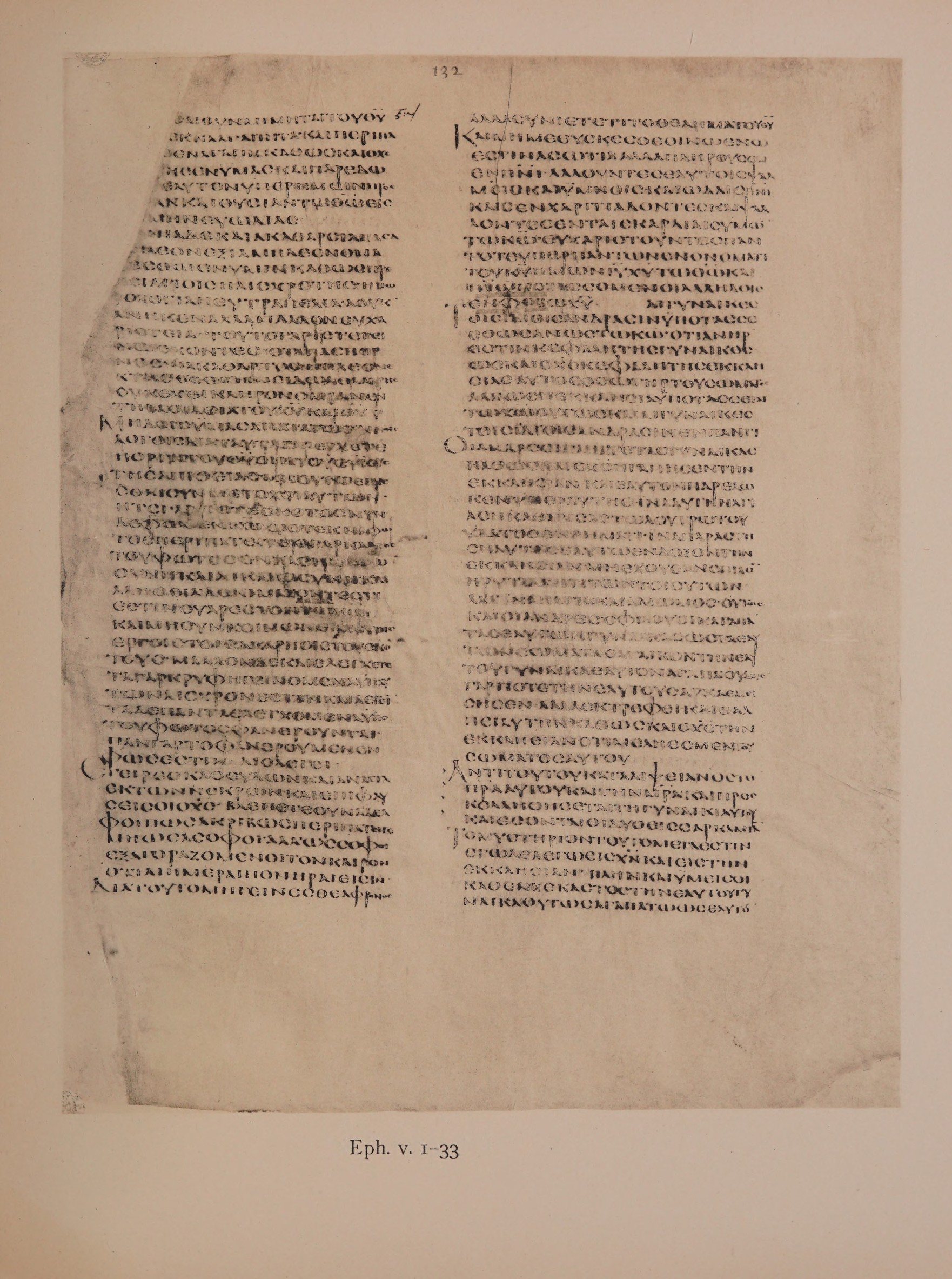
Where on the image
Page from the NTVMR transcription (docID 20002): verses 1-9 on fol. 132r (facsimile leaf 225), col. 1.
1[γινεσ]θαι ουν μιμηται του θυ [ως] [τ]εκνα αγαπητα · 2και περιπα[τειτ]ε̣ εν αγαπη καθως και ο χς [ηγαπ]ησεν υμας · και παρεδω[κεν] εαυτον υπερ ημων προσ[φορ]αν και θυσιαν τω θω εις [οσ]μην ευωδιας · 3[πορ]νια δε και ακαθαρσια πασα [η] πλεονεξια μηδε ονομα[ζ]εσθω εν υμιν καθως πρε[π]ει αγιοις 4η αισχροτης · η μωρ̣ολογια η ευτραπελια · α ουκ ανηκεν αλλα μαλλον ευχαριστεια · 5τουτο γαρ ιστε γεινωσκοντες · οτι πας πορνος η ακαθαρτος η πλεονεκτης ος εστιν ειδωλολατ̣ρης ουκ εχει κληρονομιαν εν τη β̣ασιλεια του χυ και θυ · 6μηδεις υμας απατατω καινοις λογοις δια ταυτα γαρ ερχετε η οργη του θυ επι τους υιους της απιθειας · 7μη ουν γεινεσθαι συνμετοχοι αυτων · 8ητε γαρ π̣οτε σκοτος νυν δε φως εν κω · ως τεκνα φωτος περιπατειτε 9ο γαρ κα[ρ]πος του φωτος εν παση α̣γ̣α̣θ̣ωσυνη και δικαιωσυνη και αληθεια ·
Compare: Tischendorf 8th edition (1869)
1Γίνεσθε οὖν μιμηταὶ τοῦ θεοῦ, ὡς τέκνα ἀγαπητά, 2καὶ περιπατεῖτε ἐν ἀγάπῃ, καθὼς καὶ ὁ Χριστὸς ἠγάπησεν ὑμᾶς καὶ παρέδωκεν ἑαυτὸν ὑπὲρ ἡμῶν προσφορὰν καὶ θυσίαν τῷ θεῷ εἰς ὀσμὴν εὐωδίας. 3Πορνεία δὲ καὶ ἀκαθαρσία πᾶσα ἢ πλεονεξία μηδὲ ὀνομαζέσθω ἐν ὑμῖν, καθὼς πρέπει ἁγίοις, 4καὶ αἰσχρότης ἢ μωρολογία ἢ εὐτραπελία, ἃ οὐκ ἀνῆκεν, ἀλλὰ μᾶλλον εὐχαριστία. 5τοῦτο γὰρ ἴστε γινώσκοντες ὅτι πᾶς πόρνος ἢ ἀκάθαρτος ἢ πλεονέκτης, ὅ ἐστιν εἰδωλολάτρης, οὐκ ἔχει κληρονομίαν ἐν τῇ βασιλείᾳ τοῦ Χριστοῦ καὶ θεοῦ. 6μηδεὶς ὑμᾶς ἀπατάτω κενοῖς λόγοις, διὰ ταῦτα γὰρ ἔρχεται ἡ ὀργὴ τοῦ θεοῦ ἐπὶ τοὺς υἱοὺς τῆς ἀπειθείας. 7μὴ οὖν γίνεσθε συνμέτοχοι αὐτῶν· 8ἦτε γάρ ποτε σκότος, νῦν δὲ φῶς ἐν κυρίῳ· ὡς τέκνα φωτὸς περιπατεῖτε, 9ὁ γὰρ καρπὸς τοῦ φωτὸς ἐν πάσῃ ἀγαθωσύνῃ καὶ δικαιοσύνῃ καὶ ἀληθείᾳ,
1Be ye therefore followers of God, as dear children; 2And walk in love, as Christ also hath loved us, and hath given himself for us an offering and a sacrifice to God for a sweetsmelling savour. 3But fornication, and all uncleanness, or covetousness, let it not be once named among you, as becometh saints; 4Neither filthiness, nor foolish talking, nor jesting, which are not convenient: but rather giving of thanks. 5For this ye know, that no whoremonger, nor unclean person, nor covetous man, who is an idolater, hath any inheritance in the kingdom of Christ and of God. 6Let no man deceive you with vain words: for because of these things cometh the wrath of God upon the children of disobedience. 7Be not ye therefore partakers with them. 8For ye were sometimes darkness, but now are ye light in the Lord: walk as children of light: 9(For the fruit of the Spirit is in all goodness and righteousness and truth;)
Where on the image
Page from the NTVMR transcription (docID 20002): verses 10-17 on fol. 132r (facsimile leaf 225), col. 1.
10δοκιμαζοντες τι εστιν ευαρεστον τω κω 11και μη συνκοινωνειτ̣α̣ι̣ τοις εργοις τοις ακαρποις του σκοτους · μαλλον δε και ελεγχετε 12τα γαρ κρυφη γεινομενα υπ αυτων αισχρον εστιν και λεγειν 13τα δε παντα ελεγχομενα υπο του φωτος φανερουνται · 14παν γαρ το φανερουμενον φως εστιν · διο λεγει · εγειρε ο καθευδων και αναστα εκ των νεκρων · και επιφαυσει σοι ο χς · 15βλεπετε ουν αδελφοι πως ακριβως περιπατειτε μη ως ασοφοι · αλλ ως σοφοι 16εξαγοραζομενοι τον καιρον οτι αι ημεραι πονηραι εισιν · 17δια τουτο μη γεινεσθε αφρονες αλλα συνιετε τι το θελημα του θυ
Compare: Tischendorf 8th edition (1869)
10δοκιμάζοντες τί ἐστιν εὐάρεστον τῷ κυρίῳ, 11καὶ μὴ συνκοινωνεῖτε τοῖς ἔργοις τοῖς ἀκάρποις τοῦ σκότους, μᾶλλον δὲ καὶ ἐλέγχετε. 12τὰ γὰρ κρυφῇ γινόμενα ὑπ’ αὐτῶν αἰσχρόν ἐστιν καὶ λέγειν· 13τὰ δὲ πάντα ἐλεγχόμενα ὑπὸ τοῦ φωτὸς φανεροῦται, πᾶν γὰρ τὸ φανερούμενον φῶς ἐστιν. 14διὸ λέγει, ἔγειρε, ὁ καθεύδων, καὶ ἀνάστα ἐκ τῶν νεκρῶν, καὶ ἐπιφαύσει σοι ὁ Χριστός. 15Βλέπετε οὖν ἀκριβῶς πῶς περιπατεῖτε, μὴ ὡς ἄσοφοι ἀλλ’ ὡς σοφοί, 16ἐξαγοραζόμενοι τὸν καιρόν, ὅτι αἱ ἡμέραι πονηραί εἰσιν. 17διὰ τοῦτο μὴ γίνεσθε ἄφρονες, ἀλλὰ συνίετε τί τὸ θέλημα τοῦ κυρίου.
10Proving what is acceptable unto the Lord. 11And have no fellowship with the unfruitful works of darkness, but rather reprove them. 12For it is a shame even to speak of those things which are done of them in secret. 13But all things that are reproved are made manifest by the light: for whatsoever doth make manifest is light. 14Wherefore he saith, Awake thou that sleepest, and arise from the dead, and Christ shall give thee light. 15See then that ye walk circumspectly, not as fools, but as wise, 16Redeeming the time, because the days are evil. 17Wherefore be ye not unwise, but understanding what the will of the Lord is.
Where on the image
Page from the NTVMR transcription (docID 20002): verses 18-25 on fol. 132r (facsimile leaf 225), col. 2.
18και μη μεθυσκεσθε οινω εν ω εστιν ασωτια · αλλα πληρουσθαι εν πνι · 19λαλουντες εαυτοις ψαλμοις και υμνοις · και ωδαις πνικαις εν χαριτι αδοντες και ψαλλοντες εν ταις καρδιαις υμων τω κω · 20ευχαριστουντες παντοτε υπερ παντων εν ονοματι του κυ ημων ιυ χυ τω θω και πρι 21υποτασσομενοι αλληλοις εν φοβω χυ · 22αι γυναικες τοις ιδιοις ανδρασιν υποτασσεσθωσαν ως τω κω · 23οτι ανηρ εστιν κεφαλη της γυναικος · ως και ο χς κεφαλη της εκκλησιας αυτος ο σωτηρ του σωματος 24αλλ ως η εκκλησια υποτασσεται τω χω ουτως και αι γυναικες τοις ιδιοις ανδρασιν εν παντι 25οι ανδρες αγαπατε τας γυναικας καθως και ο χς ηγαπησεν την εκκλησιαν και εαυτον παρεδωκεν υπερ αυτης ·
Compare: Tischendorf 8th edition (1869)
18καὶ μὴ μεθύσκεσθε οἴνῳ, ἐν ᾧ ἐστιν ἀσωτία, ἀλλὰ πληροῦσθε ἐν πνεύματι, 19λαλοῦντες ἑαυτοῖς ψαλμοῖς καὶ ὕμνοις καὶ ᾠδαῖς πνευματικαῖς, ᾄδοντες καὶ ψάλλοντες τῇ καρδίᾳ ὑμῶν τῷ κυρίῳ, 20εὐχαριστοῦντες πάντοτε ὑπὲρ πάντων ἐν ὀνόματι τοῦ κυρίου ἡμῶν Ἰησοῦ Χριστοῦ τῷ θεῷ καὶ πατρί, 21ὑποτασσόμενοι ἀλλήλοις ἐν φόβῳ Χριστοῦ. 22αἱ γυναῖκες τοῖς ἰδίοις ἀνδράσιν ὡς τῷ κυρίῳ, 23ὅτι ἀνήρ ἐστιν κεφαλὴ τῆς γυναικὸς ὡς καὶ ὁ Χριστὸς κεφαλὴ τῆς ἐκκλησίας, αὐτὸς σωτὴρ τοῦ σώματος. 24ἀλλὰ ὡς ἡ ἐκκλησία ὑποτάσσεται τῷ Χριστῷ, οὕτως καὶ αἱ γυναῖκες τοῖς ἀνδράσιν ἐν παντί. 25Οἱ ἄνδρες, ἀγαπᾶτε τὰς γυναῖκας, καθὼς καὶ ὁ Χριστὸς ἠγάπησεν τὴν ἐκκλησίαν καὶ ἑαυτὸν παρέδωκεν ὑπὲρ αὐτῆς,
18And be not drunk with wine, wherein is excess; but be filled with the Spirit; 19Speaking to yourselves in psalms and hymns and spiritual songs, singing and making melody in your heart to the Lord; 20Giving thanks always for all things unto God and the Father in the name of our Lord Jesus Christ; 21Submitting yourselves one to another in the fear of God. 22Wives, submit yourselves unto your own husbands, as unto the Lord. 23For the husband is the head of the wife, even as Christ is the head of the church: and he is the saviour of the body. 24Therefore as the church is subject unto Christ, so let the wives be to their own husbands in every thing. 25Husbands, love your wives, even as Christ also loved the church, and gave himself for it;
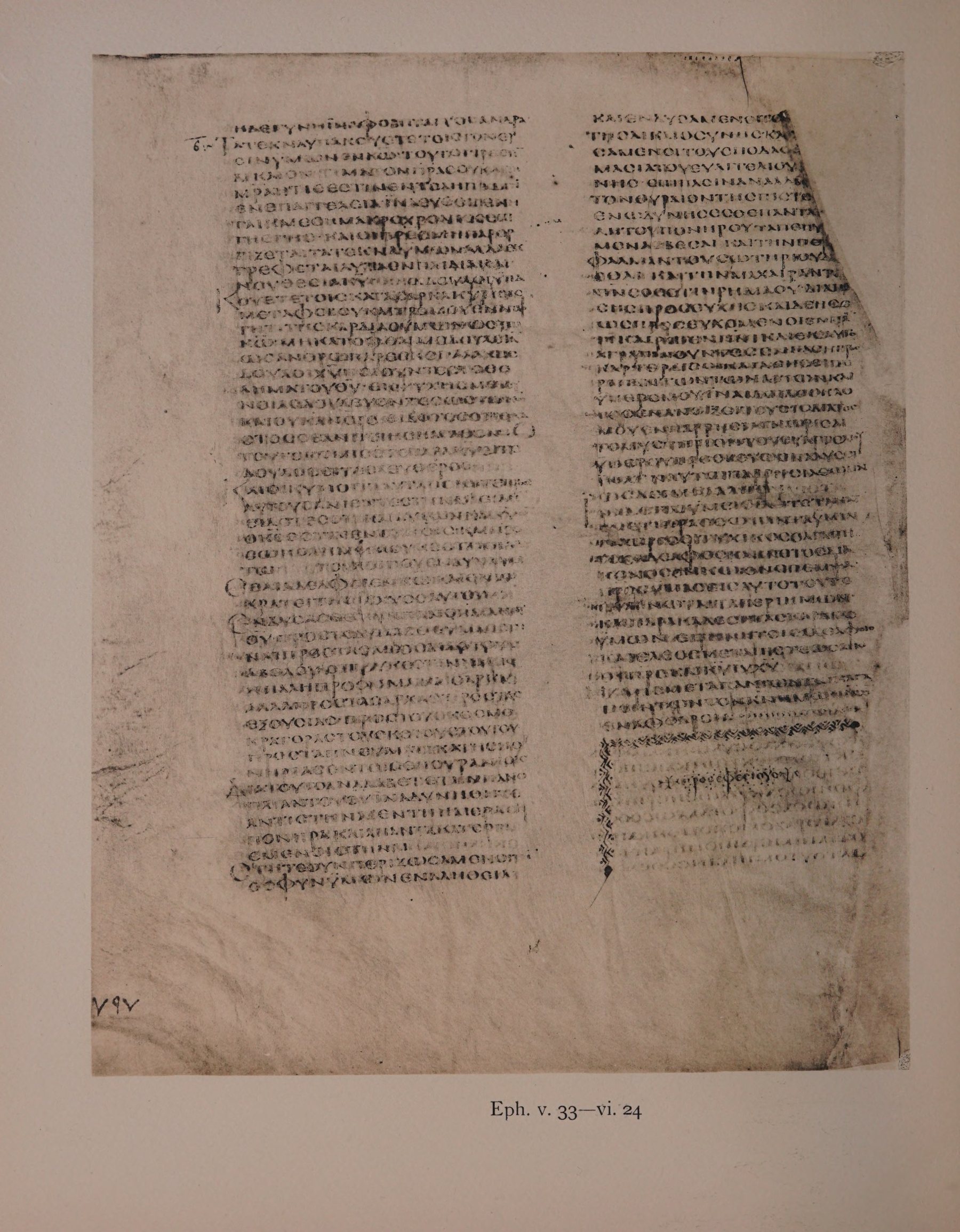
Where on the image
Page from the NTVMR transcription (docID 20002): verses 26-33 on fol. 132r (facsimile leaf 225), col. 2; verse 33 continues on fol. 132v (facsimile leaf 226), col. 1 (which begins 'η δε γυνη').
26ινα αυτην αγιαση καθαρισας τω λουτρω του υδατος εν ρηματι · 27ινα παραστηση αυτος εαυτω ενδοξον την εκκλησιαν · μη εχουσαν σπιλον η ρυτιδα · η τι των τοιουτων · αλλ ινα η αγια και αμωμος · 28ουτως και οι ανδρες · οφιλουσιν αγαπαν τας εαυτων γυναικας ως τα εαυτων σωματα · ο αγαπων την εαυτου γυναικα εαυτον αγαπα · 29ουδεις γαρ ποτε την εαυτου σαρκα εμεισησεν · αλλα εκτρεφει και θαλπει αυτην καθως και ο χς την εκκλησιαν 30οτι μελη εσμεν του σωματος αυτου 31αντι τουτου καταλιψει ανος τον πρα αυτου και την μρα και προσκολληθησεται τη γυναικι αυτου και εσονται οι δυο εις σαρκα μιαν 32το μυστηριον τουτο μεγα εστιν εγω δε λεγω εις χν και εις την εκκλησιαν · 33πλην και υμεις οι καθ ενα εκαστος την εαυτου γυναικα ουτως αγαπατω ως εαυτον η δε γυνη ινα φοβηται τον ανδρα ·
Compare: Tischendorf 8th edition (1869)
26ἵνα αὐτὴν ἁγιάσῃ καθαρίσας τῷ λουτρῷ τοῦ ὕδατος ἐν ῥήματι, 27ἵνα παραστήσῃ αὐτὸς ἑαυτῷ ἔνδοξον τὴν ἐκκλησίαν, μὴ ἔχουσαν σπίλον ἢ ῥυτίδα ἤ τι τῶν τοιούτων, ἀλλ’ ἵνα ᾖ ἁγία καὶ ἄμωμος. 28οὕτως ὀφείλουσιν οἱ ἄνδρες ἀγαπᾶν τὰς ἑαυτῶν γυναῖκας ὡς τὰ ἑαυτῶν σώματα. ὁ ἀγαπῶν τὴν ἑαυτοῦ γυναῖκα ἑαυτὸν ἀγαπᾷ, 29οὐδεὶς γάρ ποτε τὴν ἑαυτοῦ σάρκα ἐμίσησεν, ἀλλὰ ἐκτρέφει καὶ θάλπει αὐτήν, καθὼς καὶ ὁ Χριστὸς τὴν ἐκκλησίαν, 30ὅτι μέλη ἐσμὲν τοῦ σώματος αὐτοῦ. 31ἀντὶ τούτου καταλείψει ἄνθρωπος τὸν πατέρα καὶ τὴν μητέρα καὶ προσκολληθήσεται τῇ γυναικί, καὶ ἔσονται οἱ δύο εἰς σάρκα μίαν. 32τὸ μυστήριον τοῦτο μέγα ἐστίν, ἐγὼ δὲ λέγω εἰς Χριστὸν καὶ εἰς τὴν ἐκκλησίαν. 33πλὴν καὶ ὑμεῖς οἱ καθ’ ἕνα ἕκαστος τὴν ἑαυτοῦ γυναῖκα οὕτως ἀγαπάτω ὡς ἑαυτόν, ἡ δὲ γυνὴ ἵνα φοβῆται τὸν ἄνδρα.
26That he might sanctify and cleanse it with the washing of water by the word, 27That he might present it to himself a glorious church, not having spot, or wrinkle, or any such thing; but that it should be holy and without blemish. 28So ought men to love their wives as their own bodies. He that loveth his wife loveth himself. 29For no man ever yet hated his own flesh; but nourisheth and cherisheth it, even as the Lord the church: 30For we are members of his body, of his flesh, and of his bones. 31For this cause shall a man leave his father and mother, and shall be joined unto his wife, and they two shall be one flesh. 32This is a great mystery: but I speak concerning Christ and the church. 33Nevertheless let every one of you in particular so love his wife even as himself; and the wife see that she reverence her husband.
Cite
Sources
- Source: Codex Alexandrinus page images + NTVMR transcription (CC BY 4.0) + Tischendorf 8th edition + KJV (holding institution)
- Critical edition: Codex Alexandrinus transcription, NTVMR (INTF Münster, CC BY 4.0); Tischendorf 8th edition for comparison
← previous · → next · v cycle view · l back to library