Mark, Chapter 15 (Codex Alexandrinus)
Introduction
Mark 15 from Codex Alexandrinus (GA 02), a fifth-century Greek Bible held by the British Library (Royal MS 1 D. VIII). In the New Testament it is the chief witness to the Byzantine text in the Gospels and to the Alexandrian text in the rest of the New Testament. Its New Testament volume lacks Matthew 1:1-25:5, John 6:50-8:52 and 2 Corinthians 4:13-12:6.
This entry meets the strict three-criteria standard of the Theosis Library:
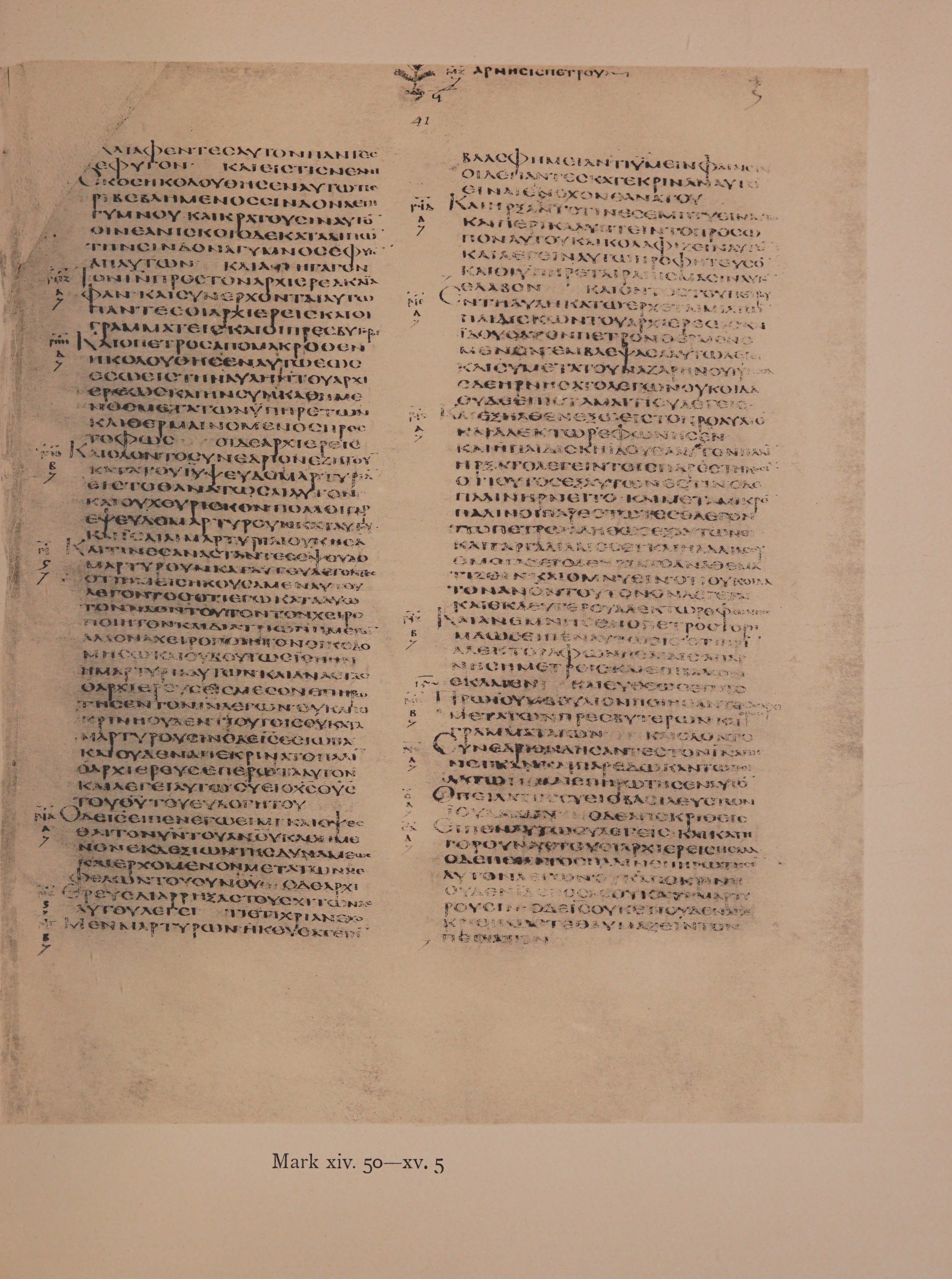
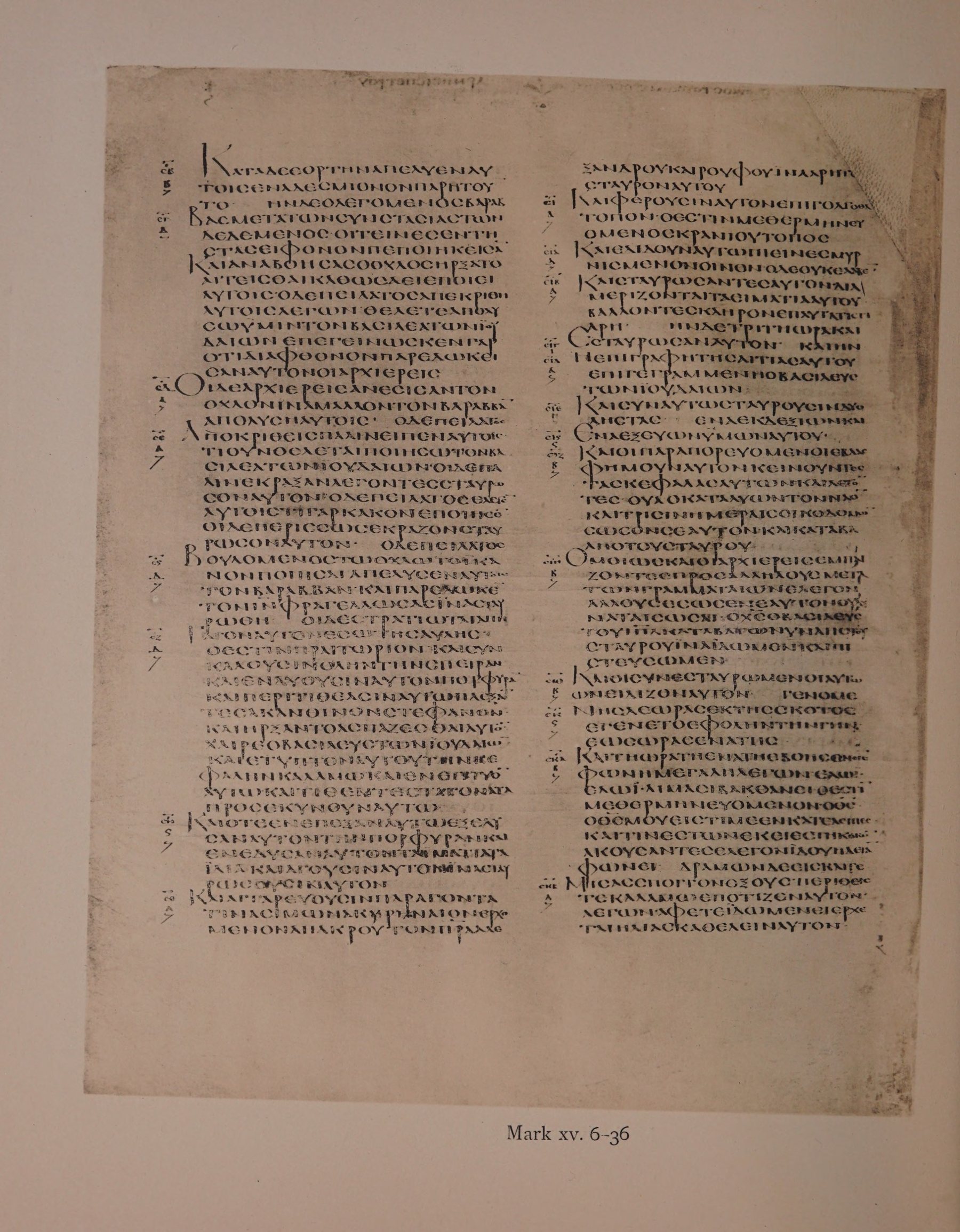
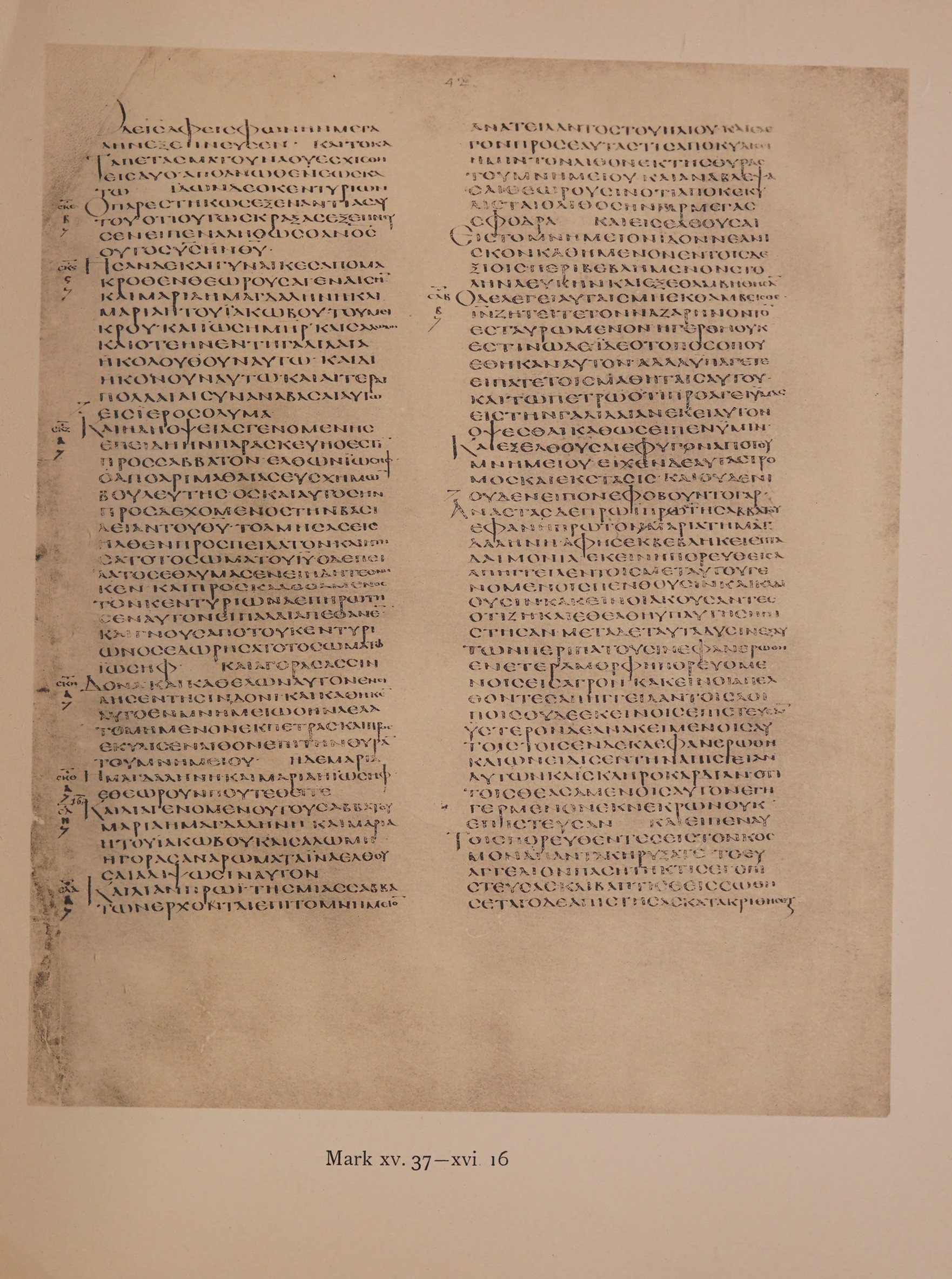
- Manuscript scan: the actual page(s) of Codex Alexandrinus containing this passage (folios 41r, 41v, 42r), reproduced from the British Museum's 1909 photographic facsimile edited by F. G. Kenyon, as digitised by the Getty Research Institute for the Internet Archive. The facsimile prints the verse range beneath each plate; that printed range was read for every page used and agrees with the INTF's NTVMR verse-level page index (CC BY 4.0). The page for each section now comes from the NTVMR transcription itself, which records the page and column on which every verse is written.
- Original text: the manuscript's own text, from a diplomatic transcription (see Greek text below), with Tischendorf's 8th critical edition (1869) for comparison.
- English translation: the King James Version (1611), retrieved verbatim from the public-domain bible-api.com endpoint.
Greek text: a diplomatic transcription of Codex Alexandrinus made by the Institut für Neutestamentliche Textforschung (INTF), Münster, for the New Testament Virtual Manuscript Room (NTVMR), published under a Creative Commons Attribution 4.0 licence. It gives the letters as the first scribe wrote them: no accents or breathings, the scribe's own spelling, and the sacred names in their contracted form (θς for θεος, ις for ιησους, κς for κυριος; the overline is not reproduced). Corrections by later hands are not shown. Letters in square brackets are not legible on the page and were restored by the transcribers, a dot under a letter marks an uncertain reading, and [...] marks text lost to damage. Beneath each section, for comparison, is Tischendorf's 8th critical edition (1869). Where the two differ, the transcription is what the manuscript says. Each section is shown with the page on which the transcription places its verses.
Manuscript note: Not written in Codex Alexandrinus: verse 28. The English is shown with a bracketed note in the Greek column.
How was this verified? (Provenance)
Where on the image
Page from the NTVMR transcription (docID 20002): verses 1-5 on fol. 41r (facsimile leaf 47), col. 2.
1και ευθεως επι̣ το πρωι συμβουλιον ποιησαντες μετα των πρεσβυτερων και γραμματαιων · και ολον το συνεδριον δησαντες τον ιν απηνεγκαν και παρεδωκαν τω πειλα̣τω 2κ̣αι επηρωτησεν αυτον ο πειλατος συ ει ο βασιλευς των ιουδαιων · ο δε αποκριθεις ειπεν αυτω συ λεγεις · 3και κατηγορουν αυ̣του οι αρχιερεις πολλα 4ο δε πειλατος παλιν επηρωτησεν αυτον λεγων · ουκ αποκρινη ουδεν ιδε ποσα σου καταμαρτυρουσιν · 5ο δε ις ουκετι ουδεν απεκριθη ωστε θαυμαζειν τον πειλατον ·
Compare: Tischendorf 8th edition (1869)
1Καὶ εὐθὺς πρωῒ συμβούλιον ἑτοιμάσαντες οἱ ἀρχιερεῖς μετὰ τῶν πρεσβυτέρων καὶ τῶν γραμματέων καὶ ὅλον τὸ συνέδριον, δήσαντες τὸν Ἰησοῦν ἀπήνεγκαν καὶ παρέδωκαν Πειλάτῳ. 2καὶ ἐπηρώτησεν αὐτὸν ὁ Πειλᾶτος· σὺ εἶ ὁ βασιλεὺς τῶν Ἰουδαίων; ὁ δὲ ἀποκριθεὶς αὐτῷ λέγει· σὺ λέγεις. 3καὶ κατηγόρουν αὐτοῦ οἱ ἀρχιερεῖς πολλά. 4ὁ δὲ Πειλᾶτος πάλιν ἐπηρώτα αὐτὸν· οὐκ ἀποκρίνῃ οὐδέν; ἴδε πόσα σου κατηγοροῦσιν. 5ὁ δὲ Ἰησοῦς οὐκέτι οὐδὲν ἀπεκρίθη, ὥστε θαυμάζειν τὸν Πειλᾶτον.
1And straightway in the morning the chief priests held a consultation with the elders and scribes and the whole council, and bound Jesus, and carried him away, and delivered him to Pilate. 2And Pilate asked him, Art thou the King of the Jews? And he answering said unto him, Thou sayest it. 3And the chief priests accused him of many things: but he answered nothing. 4And Pilate asked him again, saying, Answerest thou nothing? behold how many things they witness against thee. 5But Jesus yet answered nothing; so that Pilate marvelled.
Where on the image
Page from the NTVMR transcription (docID 20002): verses 6-13 on fol. 41v (facsimile leaf 48), col. 1.
6κατα δε εορτην απελυεν αυτοις ενα δεσμιον ον παρητουντο · 7ην δε ο λεγομενος βαραββας μετα των συνστασιαστων δεδεμενος · οιτεινες εν τη στασει φονον πεποιηκεισαν 8και αναβοησας ο οχλος ηρξατο αιτεισθαι καθως αει εποιει αυτοις · 9ο δε πειλατος απεκριθη αυτοις λεγων · θελετε απολυσω υμιν τον βασιλεα των ιουδαιων · 10επεγεινωσκεν γαρ οτι δια φθονον παρεδωκεισαν αυτον οι αρχιερεις 11οι δε αρχιερεις ανεσισαν τον οχλον ινα μαλλον τον βαραββαν απολυση αυτοις · 12ο δε πειλατος αποκριθεις παλιν ειπεν αυτοις · τι ουν θελεται ποιησω τον βασιλεα των ιουδαιων · 13οι δε παλιν εκραξαν λεγοντες σταυρωσον αυτον ·
Compare: Tischendorf 8th edition (1869)
6Κατὰ δὲ ἑορτὴν ἀπέλυεν αὐτοῖς ἕνα δέσμιον ὃν παρῃτοῦντο. 7ἦν δὲ ὁ λεγόμενος Βαραββᾶς μετὰ τῶν στασιαστῶν δεδεμένος, οἵτινες ἐν τῇ στάσει φόνον πεποιήκεισαν. 8καὶ ἀναβὰς ὁ ὄχλος ἤρξατο αἰτεῖσθαι καθὼς ἐποίει αὐτοῖς. 9ὁ δὲ Πειλᾶτος ἀπεκρίθη αὐτοῖς λέγων· θέλετε ἀπολύσω ὑμῖν τὸν βασιλέα τῶν Ἰουδαίων; 10ἐγίνωσκεν γὰρ ὅτι διὰ φθόνον παραδεδώκεισαν αὐτὸν οἱ ἀρχιερεῖς. 11οἱ δὲ ἀρχιερεῖς ἀνέσεισαν τὸν ὄχλον ἵνα μᾶλλον τὸν Βαραββᾶν ἀπολύσῃ αὐτοῖς. 12ὁ δὲ Πειλᾶτος πάλιν ἀποκριθεὶς ἔλεγεν αὐτοῖς· τί οὖν θέλετε ποιήσω ὃν λέγετε τὸν βασιλέα τῶν Ἰουδαίων; 13οἱ δὲ πάλιν ἔκραξαν· σταύρωσον αὐτόν.
6Now at that feast he released unto them one prisoner, whomsoever they desired. 7And there was one named Barabbas, which lay bound with them that had made insurrection with him, who had committed murder in the insurrection. 8And the multitude crying aloud began to desire him to do as he had ever done unto them. 9But Pilate answered them, saying, Will ye that I release unto you the King of the Jews? 10For he knew that the chief priests had delivered him for envy. 11But the chief priests moved the people, that he should rather release Barabbas unto them. 12And Pilate answered and said again unto them, What will ye then that I shall do unto him whom ye call the King of the Jews? 13And they cried out again, Crucify him.
Where on the image
Page from the NTVMR transcription (docID 20002): verses 14-21 on fol. 41v (facsimile leaf 48), col. 1.
14ο δε πειλατος ελεγεν αυτοις τι γαρ κακον εποιησεν οι δε περισσως εκραζον σταυρωσον αυτον · 15ο δε πειλατος βουλομενος τω οχλω το ικανον ποιησαι · απελυσεν αυτοις τον βαραββαν · και παρεδωκεν τον ιν φραγελλωσας ινα σταυρωθη · 16οι δε στρατιωται απηγαγον αυτον εσω της αυλης · ο εστιν πραιτωριον · και συνκαλουσιν ολην την σπειραν · 17και ενδυουσιν αυτον πορφυραν και περιτιθεασιν αυτω πλεξαντες ακανθινον στεφανον · 18και ηρξαντο ασπαζεσθαι αυτον · χαιρε ο βασιλευς των ιουδαιων 19και ετυπτον αυτου την κεφαλην καλαμω και ενεπτυον αυτω · και τιθεντες τα γονατα προσεκυνουν αυτω · 20και οτε ενεπεξαν αυτω εξεδυσαν αυτον την πορφυραν και ενεδυσαν αυτον τα ιματια τα ιδια και αγουσιν αυτον ινα σταυρωσουσιν αυτον 21και αγγαρευουσιν παραγοντα τινα σιμωνα κηρυναιον ερχομενον απ ακρου τον πρα αλεξανδρου · και ρουφου ινα αρη το̣[ν] σταυρον αυτου
Compare: Tischendorf 8th edition (1869)
14ὁ δὲ Πειλᾶτος ἔλεγεν αὐτοῖς· τί γὰρ ἐποίησεν κακόν; οἱ δὲ περισσῶς ἔκραξαν· σταύρωσον αὐτόν. 15ὁ δὲ Πειλᾶτος βουλόμενος ποιῆσαι τὸ ἱκανὸν τῷ ὄχλῳ ἀπέλυσεν αὐτοῖς τὸν Βαραββᾶν, καὶ παρέδωκεν τὸν Ἰησοῦν φραγελλώσας ἵνα σταυρωθῇ. 16Οἱ δὲ στρατιῶται ἀπήγαγον αὐτὸν ἔσω τῆς αὐλῆς, ὅ ἐστιν πραιτώριον, καὶ συνκαλοῦσιν ὅλην τὴν σπεῖραν· 17καὶ ἐνδιδύσκουσιν αὐτὸν πορφύραν καὶ περιτιθέασιν αὐτῷ πλέξαντες ἀκάνθινον στέφανον· 18καὶ ἤρξαντο ἀσπάζεσθαι αὐτόν· χαῖρε, βασιλεῦ τῶν Ἰουδαίων· 19καὶ ἔτυπτον αὐτοῦ τὴν κεφαλὴν καλάμῳ καὶ ἐνέπτυον αὐτῷ, καὶ τιθέντες τὰ γόνατα προσεκύνουν αὐτῷ. 20καὶ ὅτε ἐνέπαιξαν αὐτῷ, ἐξέδυσαν αὐτὸν τὴν πορφύραν καὶ ἐνέδυσαν αὐτὸν τὰ ἱμάτια αὐτοῦ. Καὶ ἐξάγουσιν αὐτὸν ἵνα σταυρώσουσιν. 21καὶ ἀγγαρεύουσιν παράγοντά τινα Σίμωνα Κυρηναῖον, ἐρχόμενον ἀπ’ ἀγροῦ, τὸν πατέρα Ἀλεξάνδρου καὶ Ῥούφου, ἵνα ἄρῃ τὸν σταυρὸν αὐτοῦ.
14Then Pilate said unto them, Why, what evil hath he done? And they cried out the more exceedingly, Crucify him. 15And so Pilate, willing to content the people, released Barabbas unto them, and delivered Jesus, when he had scourged him, to be crucified. 16And the soldiers led him away into the hall, called Praetorium; and they call together the whole band. 17And they clothed him with purple, and platted a crown of thorns, and put it about his head, 18And began to salute him, Hail, King of the Jews! 19And they smote him on the head with a reed, and did spit upon him, and bowing their knees worshipped him. 20And when they had mocked him, they took off the purple from him, and put his own clothes on him, and led him out to crucify him. 21And they compel one Simon a Cyrenian, who passed by, coming out of the country, the father of Alexander and Rufus, to bear his cross.
Where on the image
Page from the NTVMR transcription (docID 20002): verses 22-27, 29 on fol. 41v (facsimile leaf 48), col. 2. Verse 28 is not in Codex Alexandrinus; the NTVMR transcription (docID 20002) shows the text passing over it on fol. 41v (facsimile leaf 48), col. 2.
22και φερουσιν αυτον επι γολγοθα τοπον · ο εστιν μεθερμηνευομενος κρανιου τοπος 23και εδιδουν αυτω πιειν εσμυρνισμενον οινον · ο δε ουκ ελαβεν · 24και σταυρωσαντες αυτον · διαμεριζονται τα ειματια αυτου βαλλοντες κληρον επ αυτα τις τι αρη · 25ην δε τριτη ωρα · και εσταυρωσαν αυτον · 26και ην η επιγραφη της αιτιας αυτου επιγεγραμμενη ο βασιλευς των ιουδαιων · 27και συν αυτω σταυρουσιν δυο ληστας ενα εκ δεξιων και ενα εξ ευωνυμων αυτου · 28[not in Codex Alexandrinus] 29και οι παραπορευομενοι εβλασφημουν αυτον κεινουντες τας κεφαλας αυτων · και λεγοντες · ουα ο καταλυων τον ναον και τρισιν ημεραις οικοδομων
Compare: Tischendorf 8th edition (1869)
22καὶ φέρουσιν αὐτὸν ἐπὶ τὸν Γολγοθᾶν τόπον, ὅ ἐστιν μεθερμηνευόμενον κρανίου τόπος. 23καὶ ἐδίδουν αὐτῷ ἐσμυρνισμένον οἶνον· ὃς δὲ οὐκ ἔλαβεν. 24καὶ σταυροῦσιν αὐτὸν, καὶ διαμερίζονται τὰ ἱμάτια αὐτοῦ, βάλλοντες κλῆρον ἐπ’ αὐτὰ τίς τί ἄρῃ. 25ἦν δὲ ὥρα τρίτη καὶ ἐσταύρωσαν αὐτόν. 26καὶ ἦν ἡ ἐπιγραφὴ τῆς αἰτίας αὐτοῦ ἐπιγεγραμμένη· ὁ βασιλεὺς τῶν Ἰουδαίων. 27Καὶ σὺν αὐτῷ σταυροῦσιν δύο λῃστάς, ἕνα ἐκ δεξιῶν καὶ ἕνα ἐξ εὐωνύμων αὐτοῦ. 28 29καὶ οἱ παραπορευόμενοι ἐβλασφήμουν αὐτὸν κινοῦντες τὰς κεφαλὰς αὐτῶν καὶ λέγοντες· οὐὰ ὁ καταλύων τὸν ναὸν καὶ οἰκοδομῶν τρισὶν ἡμέραις,
22And they bring him unto the place Golgotha, which is, being interpreted, The place of a skull. 23And they gave him to drink wine mingled with myrrh: but he received it not. 24And when they had crucified him, they parted his garments, casting lots upon them, what every man should take. 25And it was the third hour, and they crucified him. 26And the superscription of his accusation was written over, THE KING OF THE JEWS. 27And with him they crucify two thieves; the one on his right hand, and the other on his left. 28And the scripture was fulfilled, which saith, And he was numbered with the transgressors. 29And they that passed by railed on him, wagging their heads, and saying, Ah, thou that destroyest the temple, and buildest it in three days,
Where on the image
Page from the NTVMR transcription (docID 20002): verses 30-36 on fol. 41v (facsimile leaf 48), col. 2.
30σωσον σεαυτον · και καταβα απο του σταυρου · 31ομοιως και οι αρχιερεις εμπαιζοντες προς αλληλους μετα των γραμματαιων ελεγον αλλους εσωσεν εαυτον ου δυναται σωσαι · 32ο χς ο βασιλευς του ιηλ καταβατω νυν απο του σταυρου ινα ιδωμεν και πιστευσωμεν · και οι συνεσταυρωμενοι αυτω ωνειδιζον αυτον · 33γενομενης δε ωρας εκτης σκοτος εγενετο εφ ολην την γην · εως ωρας ενατης · 34και τη ωρα τη ενατη εβοησεν ο ις φωνη μεγαλη λεγων · ελωι · ελωι · λιμα σιβακθανει · ο εστιν μεθερμηνευομενον · ο θς ο θς μου εις τι με ενκατελειπες 35και τινες των εκει εστηκοτων ακουσαντες ελεγον ιδου ηλειαν φωνει · 36δραμων δε εις και γεμισας σπογγον οξους · περιθεις τε καλαμω εποτιζεν αυτον · λεγων · αφετε ιδωμεν ει ερχεται ηλιας καθελειν αυτον ·
Compare: Tischendorf 8th edition (1869)
30σῶσον σεαυτὸν καταβὰς ἀπὸ τοῦ σταυροῦ. 31ὁμοίως καὶ οἱ ἀρχιερεῖς ἐμπαίζοντες πρὸς ἀλλήλους μετὰ τῶν γραμματέων ἔλεγον· ἄλλους ἔσωσεν, ἑαυτὸν οὐ δύναται σῶσαι· 32ὁ Χριστὸς ὁ βασιλεὺς Ἰσραὴλ καταβάτω νῦν ἀπὸ τοῦ σταυροῦ, ἵνα ἴδωμεν καὶ πιστεύσωμεν. καὶ οἱ συνεσταυρωμένοι σὺν αὐτῷ ὠνείδιζον αὐτόν. 33Καὶ γενομένης ὥρας ἕκτης σκότος ἐγένετο ἐφ’ ὅλην τὴν γῆν ἕως ὥρας ἐνάτης. 34καὶ τῇ ἐνάτῃ ὥρᾳ ἐβόησεν ὁ Ἰησοῦς φωνῇ μεγάλῃ· ἑλωῒ ἑλωῒ λεμὰ σαβαχθανεί; ὅ ἐστιν μεθερμηνευόμενον· ὁ θεός μου ὁ θεός μου, εἰς τί ἐγκατέλιπές με; 35καί τινες τῶν παρεστώτων ἀκούσαντες ἔλεγον· ἴδε Ἡλείαν φωνεῖ. 36δραμὼν δέ τις καὶ γεμίσας σπόγγον ὄξους περιθεὶς καλάμῳ ἐπότιζεν αὐτόν, λέγων· ἄφετε ἴδωμεν εἰ ἔρχεται Ἡλείας καθελεῖν αὐτόν.
30Save thyself, and come down from the cross. 31Likewise also the chief priests mocking said among themselves with the scribes, He saved others; himself he cannot save. 32Let Christ the King of Israel descend now from the cross, that we may see and believe. And they that were crucified with him reviled him. 33And when the sixth hour was come, there was darkness over the whole land until the ninth hour. 34And at the ninth hour Jesus cried with a loud voice, saying, Eloi, Eloi, lama sabachthani? which is, being interpreted, My God, my God, why hast thou forsaken me? 35And some of them that stood by, when they heard it, said, Behold, he calleth Elias. 36And one ran and filled a spunge full of vinegar, and put it on a reed, and gave him to drink, saying, Let alone; let us see whether Elias will come to take him down.
Where on the image
Page from the NTVMR transcription (docID 20002): verses 37-47 on fol. 42r (facsimile leaf 49), col. 1.
37ο̣ δε ις αφεις φωνην μεγαλην εξεπνευσεν · 38και το καταπετασμα του ναου εσχισθη εις δυο · απο ανωθεν εως κατω · 39ιδων δε ο κεντυριων ο παρεστηκως εξ εναντιας αυτου οτι ουτως κραξας εξεπνευσεν ειπεν · αληθως ο ανος ουτος υς ην θυ · 40ησαν δε και γυναικες απο μακροθεν θεωρουσαι · εν αις ην και μαρια η μαγδαληνη · και μαρια η του ιακωβου του μεικρου · και ιωση μηρ · και σαλωμη 41και οτε ην εν τη γαλιλαια ηκολουθουν αυτω · και διηκονουν αυτω · και αιτεραι πολλαι αι συναναβασαι αυτω εις ιεροσολυμα · 42και ηδη οψειας γενομενης επειδη ην παρασκευη ο εστιν προς σαββατον · 43ελθων ιωσηφ ο απο αριμαθαιας ευσχημων βουλευτης · ος και αυτος ην προσδεχομενος την βασιλειαν του θυ · τολμησας εισηλθεν προς πειλατον · και ητησατο το σωμα του ιυ · 44ο δε πειλατος εθαυμασεν ει ηδη τεθνηκεν · και προσκαλεσαμενος τον κεντυριωνα επηρωτησεν αυτον ει παλαι απεθανεν · 45και γνους απο του κεντυριωνος εδωρησατο το σωμα το ιωσηφ · 46και αγορασας σινδονα · και καθελων αυτον ενειλησεν τη σινδονι · και καθηκεν αυτο εν μνημειω ο ην λελατομημενον εκ πετρας · και προσεκυλισεν λιθον επι την θυραν του μνημειου · 47η δε μαρια η μαγδαληνη · και μαρια η ιωσηφ εθεωρουν που τεθειτε
Compare: Tischendorf 8th edition (1869)
37ὁ δὲ Ἰησοῦς ἀφεὶς φωνὴν μεγάλην ἐξέπνευσεν. 38καὶ τὸ καταπέτασμα τοῦ ναοῦ ἐσχίσθη εἰς δύο ἀπὸ ἄνωθεν ἕως κάτω. 39ἰδὼν δὲ ὁ κεντυρίων ὁ παρεστηκὼς ἐξ ἐναντίας αὐτοῦ ὅτι οὕτως ἐξέπνευσεν εἶπεν· ἀληθῶς οὗτος ὁ ἄνθρωπος υἱὸς ἦν θεοῦ. 40Ἦσαν δὲ καὶ γυναῖκες ἀπὸ μακρόθεν θεωροῦσαι, ἐν αἷς καὶ Μαρία ἡ Μαγδαληνὴ καὶ Μαρία ἡ Ἰακώβου τοῦ μικροῦ καὶ Ἰωσῆτος μήτηρ καὶ Σαλώμη, 41αἳ ὅτε ἦν ἐν τῇ Γαλιλαίᾳ ἠκολούθουν αὐτῷ καὶ διηκόνουν αὐτῷ, καὶ ἄλλαι πολλαὶ αἱ συναναβᾶσαι αὐτῷ εἰς Ἱεροσόλυμα. 42Καὶ ἤδη ὀψίας γενομένης, ἐπεὶ ἦν παρασκευή, ὅ ἐστιν προσάββατον, 43ἐλθὼν Ἰωσὴφ ὁ ἀπὸ Ἀριμαθαίας εὐσχήμων βουλευτής, ὃς καὶ αὐτὸς ἦν προσδεχόμενος τὴν βασιλείαν τοῦ θεοῦ, τολμήσας εἰσῆλθεν πρὸς τὸν Πειλᾶτον καὶ ᾐτήσατο τὸ σῶμα τοῦ Ἰησοῦ. 44ὁ δὲ Πειλᾶτος ἐθαύμαζεν εἰ ἤδη τέθνηκεν, καὶ προσκαλεσάμενος τὸν κεντυρίωνα ἐπηρώτησεν αὐτὸν εἰ πάλαι ἀπέθανεν· 45καὶ γνοὺς ἀπὸ τοῦ κεντυρίωνος ἐδωρήσατο τὸ πτῶμα τῷ Ἰωσήφ. 46καὶ ἀγοράσας σινδόνα, καθελὼν αὐτὸν ἐνείλησεν τῇ σινδόνι καὶ κατέθηκεν αὐτὸν ἐν μνήματι ὃ ἦν λελατομημένον ἐκ πέτρας, καὶ προσεκύλισεν λίθον ἐπὶ τὴν θύραν τοῦ μνημείου. 47ἡ δὲ Μαρία ἡ Μαγδαληνὴ καὶ Μαρία ἡ Ἰωσῆτος ἐθεώρουν ποῦ τέθειται.
37And Jesus cried with a loud voice, and gave up the ghost. 38And the veil of the temple was rent in twain from the top to the bottom. 39And when the centurion, which stood over against him, saw that he so cried out, and gave up the ghost, he said, Truly this man was the Son of God. 40There were also women looking on afar off: among whom was Mary Magdalene, and Mary the mother of James the less and of Joses, and Salome; 41(Who also, when he was in Galilee, followed him, and ministered unto him;) and many other women which came up with him unto Jerusalem. 42And now when the even was come, because it was the preparation, that is, the day before the sabbath, 43Joseph of Arimathaea, an honourable counsellor, which also waited for the kingdom of God, came, and went in boldly unto Pilate, and craved the body of Jesus. 44And Pilate marvelled if he were already dead: and calling unto him the centurion, he asked him whether he had been any while dead. 45And when he knew it of the centurion, he gave the body to Joseph. 46And he bought fine linen, and took him down, and wrapped him in the linen, and laid him in a sepulchre which was hewn out of a rock, and rolled a stone unto the door of the sepulchre. 47And Mary Magdalene and Mary the mother of Joses beheld where he was laid.
Cite
Sources
- Source: Codex Alexandrinus page images + NTVMR transcription (CC BY 4.0) + Tischendorf 8th edition + KJV (holding institution)
- Critical edition: Codex Alexandrinus transcription, NTVMR (INTF Münster, CC BY 4.0); Tischendorf 8th edition for comparison
← previous · → next · v cycle view · l back to library