Mark, Chapter 7 (Codex Alexandrinus)
Introduction
Mark 7 from Codex Alexandrinus (GA 02), a fifth-century Greek Bible held by the British Library (Royal MS 1 D. VIII). In the New Testament it is the chief witness to the Byzantine text in the Gospels and to the Alexandrian text in the rest of the New Testament. Its New Testament volume lacks Matthew 1:1-25:5, John 6:50-8:52 and 2 Corinthians 4:13-12:6.
This entry meets the strict three-criteria standard of the Theosis Library:
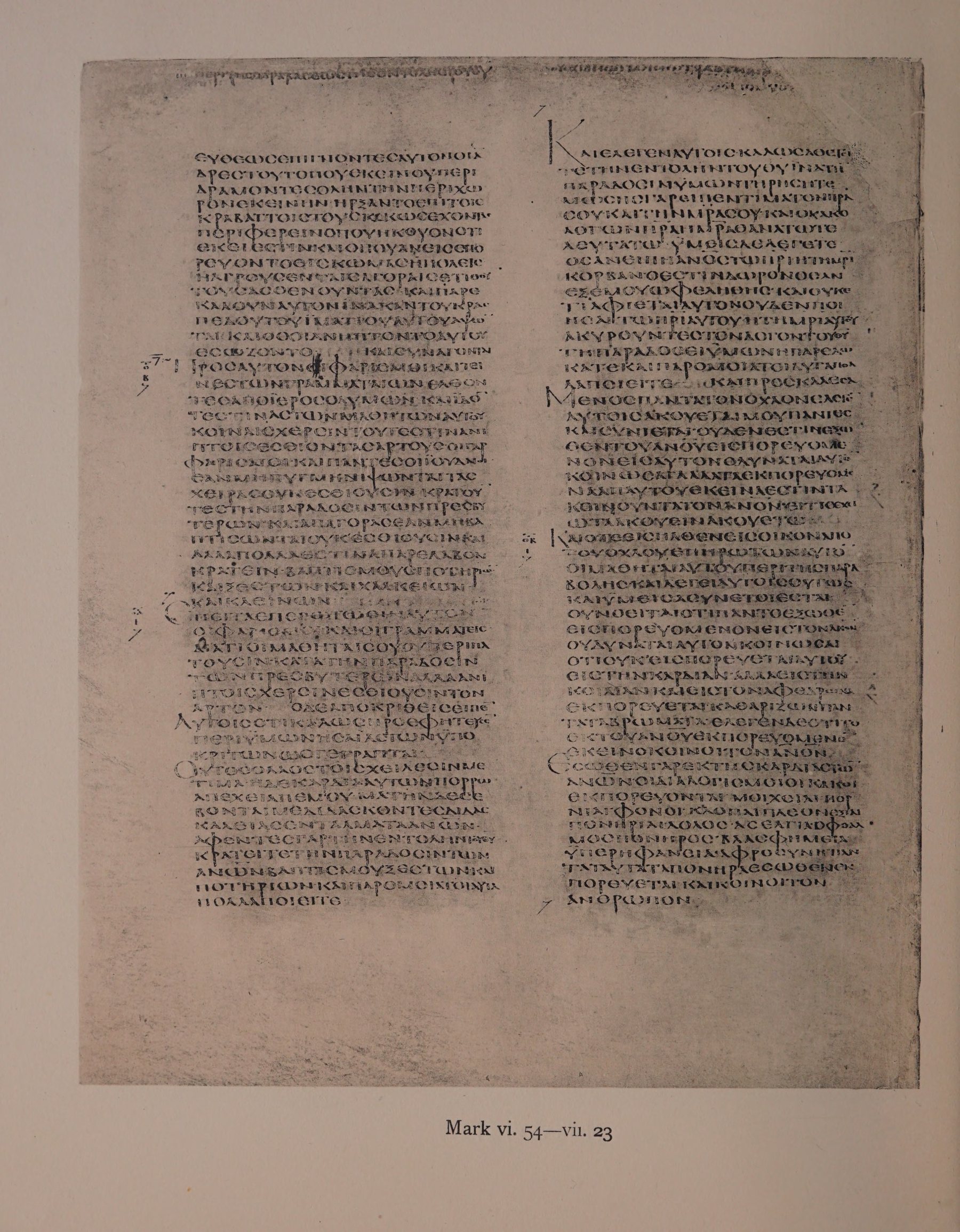
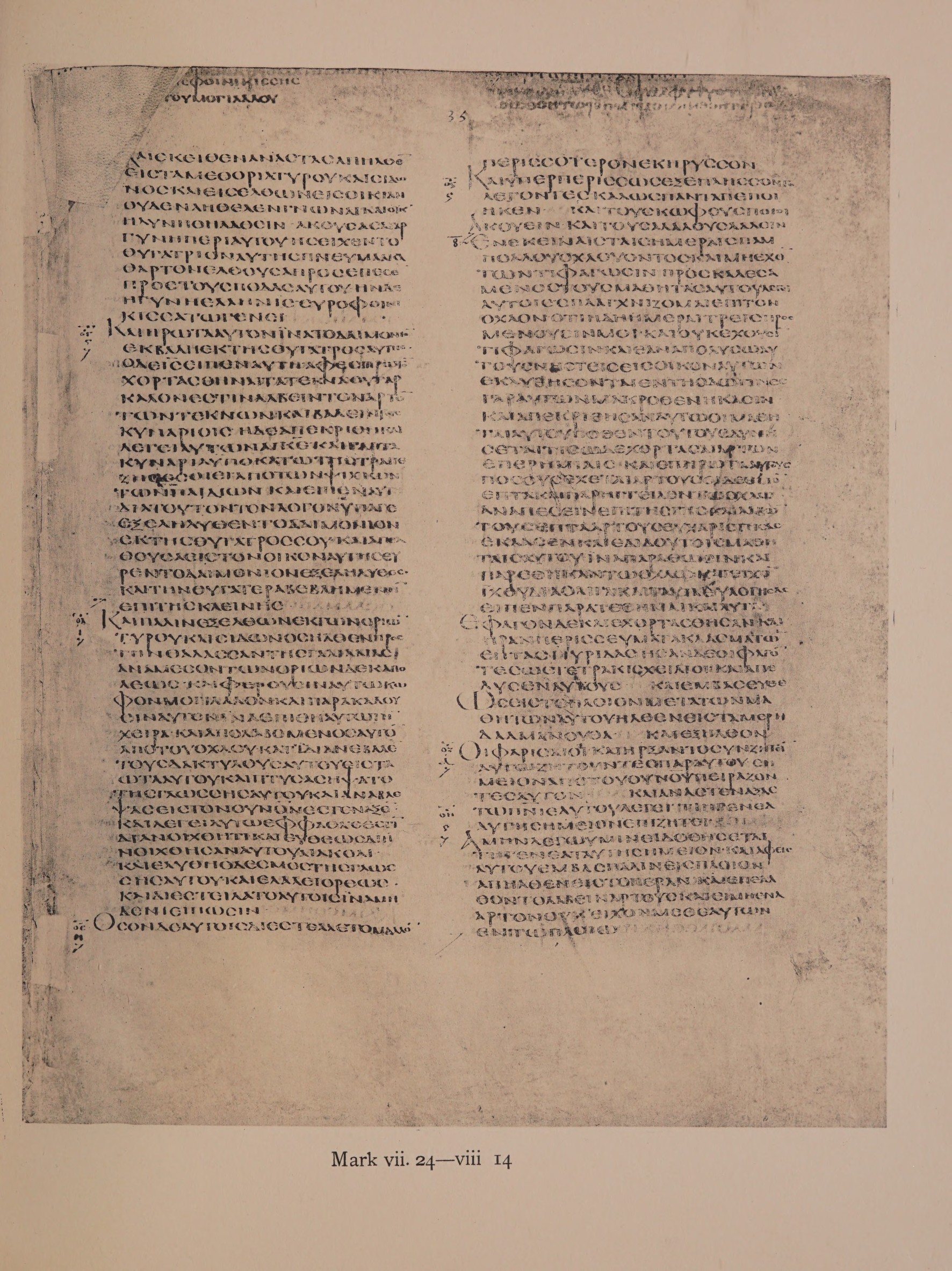
- Manuscript scan: the actual page(s) of Codex Alexandrinus containing this passage (folios 34v, 35r), reproduced from the British Museum's 1909 photographic facsimile edited by F. G. Kenyon, as digitised by the Getty Research Institute for the Internet Archive. The facsimile prints the verse range beneath each plate; that printed range was read for every page used and agrees with the INTF's NTVMR verse-level page index (CC BY 4.0). The page for each section now comes from the NTVMR transcription itself, which records the page and column on which every verse is written.
- Original text: the manuscript's own text, from a diplomatic transcription (see Greek text below), with Tischendorf's 8th critical edition (1869) for comparison.
- English translation: the King James Version (1611), retrieved verbatim from the public-domain bible-api.com endpoint.
Greek text: a diplomatic transcription of Codex Alexandrinus made by the Institut für Neutestamentliche Textforschung (INTF), Münster, for the New Testament Virtual Manuscript Room (NTVMR), published under a Creative Commons Attribution 4.0 licence. It gives the letters as the first scribe wrote them: no accents or breathings, the scribe's own spelling, and the sacred names in their contracted form (θς for θεος, ις for ιησους, κς for κυριος; the overline is not reproduced). Corrections by later hands are not shown. Letters in square brackets are not legible on the page and were restored by the transcribers, a dot under a letter marks an uncertain reading, and [...] marks text lost to damage. Beneath each section, for comparison, is Tischendorf's 8th critical edition (1869). Where the two differ, the transcription is what the manuscript says. Each section is shown with the page on which the transcription places its verses.
How was this verified? (Provenance)
Where on the image
Page from the NTVMR transcription (docID 20002): verses 1-8 on fol. 34v (facsimile leaf 34), col. 1.
1και συναγονται προς αυτον οι φαρισαιοι και τεινες των γραμματαιων ελθοντες απο ιεροσολυμων · 2και ιδοντες τινας των μαθητων αυτου κοιναις χερσιν τουτ εστιν ανιπτοις εσθιοντας αρτους · 3οι γαρ φαρισαιοι · και παντες οι ιουδαιοι εαν μη πυγμη νιψωνται τας χειρας ουκ εσθιουσιν · κρατουντες την παραδοσιν των πρεσβυτερων · 4και απ αγορας εαν μη βαπτισωνται ουκ εσθιουσιν και αλλα πολλα εστιν α παρελαβον κρατειν · βαπτισμους ποτηριων και ξεστων · και χαλκειων · και κλεινων · 5επειτα επερωτωσιν αυτον οι φαρισαιοι και οι γραμματεις δια τι οι μαθηται σου ου περιπατουσιν · κατα την παραδοσιν των πρεσβυτερων αλλα ανιπτοις χερσιν εσθιουσιν τον αρτον · 6ο δε αποκριθεις ειπεν αυτοις οτι καλως προεφητευσεν περι υμων ησαιας των υποκριτων ως γεγραπται · ουτος ο λαος τοις χειλεσιν με τιμα · η δε καρδια αυτων πορρω απεχει απ εμου · 7ματην δε σεβονται με διδασκοντες διδασκαλειας ενταλματα ανων · 8αφεντες γαρ την εντολην του θυ κρατειτε την παραδοσιν των ανων βαπτισμου ξεστων · και ποτηριων · και παρομοια τοιαυτα πολλα ποιειτε
Compare: Tischendorf 8th edition (1869)
1Καὶ συνάγονται πρὸς αὐτὸν οἱ Φαρισαῖοι καί τινες τῶν γραμματέων ἐλθόντες ἀπὸ Ἱεροσολύμων. 2καὶ ἰδόντες τινὰς τῶν μαθητῶν αὐτοῦ ὅτι κοιναῖς χερσίν, τοῦτ’ ἔστιν ἀνίπτοις, ἐσθίουσιν τοὺς ἄρτους 3οἱ γὰρ Φαρισαῖοι καὶ πάντες οἱ Ἰουδαῖοι ἐὰν μὴ πυκνὰ νίψωνται τὰς χεῖρας οὐκ ἐσθίουσιν, κρατοῦντες τὴν παράδοσιν τῶν πρεσβυτέρων, 4καὶ ἀπὸ ἀγορᾶς ἐὰν μὴ βαπτίσωνται οὐκ ἐσθίουσιν, καὶ ἄλλα πολλά ἐστιν ἃ παρέλαβον κρατεῖν, βαπτισμοὺς ποτηρίων καὶ ξεστῶν καὶ χαλκίων 5καὶ ἐπερωτῶσιν αὐτὸν οἱ Φαρισαῖοι καὶ οἱ γραμματεῖς· διατί οὐ περιπατοῦσιν οἱ μαθηταί σου κατὰ τὴν παράδοσιν τῶν πρεσβυτέρων, ἀλλὰ κοιναῖς χερσὶν ἐσθίουσιν τὸν ἄρτον; 6ὁ δὲ εἶπεν αὐτοῖς· καλῶς ἐπροφήτευσεν Ἡσαΐας περὶ ὑμῶν τῶν ὑποκριτῶν, ὡς γέγραπται ὅτι οὗτος ὁ λαὸς τοῖς χείλεσίν με τιμᾷ, ἡ δὲ καρδία αὐτῶν πόρρω ἀπέχει ἀπ’ ἐμοῦ· 7μάτην δὲ σέβονταί με διδάσκοντες διδασκαλίας ἐντάλματα ἀνθρώπων. 8ἀφέντες τὴν ἐντολὴν τοῦ θεοῦ κρατεῖτε τὴν παράδοσιν τῶν ἀνθρώπων.
1Then came together unto him the Pharisees, and certain of the scribes, which came from Jerusalem. 2And when they saw some of his disciples eat bread with defiled, that is to say, with unwashen, hands, they found fault. 3For the Pharisees, and all the Jews, except they wash their hands oft, eat not, holding the tradition of the elders. 4And when they come from the market, except they wash, they eat not. And many other things there be, which they have received to hold, as the washing of cups, and pots, brasen vessels, and of tables. 5Then the Pharisees and scribes asked him, Why walk not thy disciples according to the tradition of the elders, but eat bread with unwashen hands? 6He answered and said unto them, Well hath Esaias prophesied of you hypocrites, as it is written, This people honoureth me with their lips, but their heart is far from me. 7Howbeit in vain do they worship me, teaching for doctrines the commandments of men. 8For laying aside the commandment of God, ye hold the tradition of men, as the washing of pots and cups: and many other such like things ye do.
Where on the image
Page from the NTVMR transcription (docID 20002): verses 9-16 on fol. 34v (facsimile leaf 34), col. 2.
9και ελεγεν αυτοις καλως αθετειτε την εντολην του θυ ινα την παραδοσιν υμων τηρησητε 10μωσης γαρ ειπεν τιμα τον πρα σου · και την μρα σου · και ο κακολογων πρα η μρα θανατω τελευτατω · 11υμεις δε λεγετε ος αν ειπη ανος τω πρι η τη μρι κορβαν · ο εστιν δωρον ο εαν εξ εμου ωφεληθης · 12και ουκετι αφιεται αυτον ουδεν ποιησαι τω πρι αυτου η τη μρι αυτου 13ακυρουντες τον λογον του θυ τη παραδοσει υμων η παρεδωκατε και παρομοια τοιαυτα πολλα ποιειτε 14και προσκαλεσαμενος παντα τον οχλον ελεγεν αυτοις ακουεται μου παντες και συνιεται · 15ουδεν εστιν εξωθεν του ανου εισπορευομενον εις αυτον ο δυναται αυτον κοινωσαι · αλλα τα εκπορευομενα απ αυτου εκεινα εστιν τα κοινουντα τον ανον · 16ει τις εχει ωτα ακουειν ακουετω ·
Compare: Tischendorf 8th edition (1869)
9καὶ ἔλεγεν αὐτοῖς· καλῶς ἀθετεῖτε τὴν ἐντολὴν τοῦ θεοῦ, ἵνα τὴν παράδοσιν ὑμῶν τηρήσητε. 10Μωϋσῆς γὰρ εἶπεν· τίμα τὸν πατέρα σου καὶ τὴν μητέρα σου, καί· ὁ κακολογῶν πατέρα ἢ μητέρα θανάτῳ τελευτάτω. 11ὑμεῖς δὲ λέγετε· ἐὰν εἴπῃ ἄνθρωπος τῷ πατρὶ ἢ τῇ μητρί· κορβᾶν, ὅ ἐστιν δῶρον, ὃ ἐὰν ἐξ ἐμοῦ ὠφεληθῇς, 12οὐκέτι ἀφίετε αὐτὸν οὐδὲν ποιῆσαι τῷ πατρὶ ἢ τῇ μητρί, 13ἀκυροῦντες τὸν λόγον τοῦ θεοῦ τῇ παραδόσει ὑμῶν ᾗ παρεδώκατε. καὶ παρόμοια τοιαῦτα πολλὰ ποιεῖτε. 14καὶ προσκαλεσάμενος πάλιν τὸν ὄχλον ἔλεγεν αὐτοῖς· ἀκούσατέ μου πάντες καὶ σύνετε. 15οὐδέν ἐστιν ἔξωθεν τοῦ ἀνθρώπου εἰσπορευόμενον εἰς αὐτὸν ὃ δύναται κοινῶσαι αὐτόν· ἀλλὰ τὰ ἐκ τοῦ ἀνθρώπου ἐκπορευόμενά ἐστιν τὰ κοινοῦντα τὸν ἄνθρωπον. 16
9And he said unto them, Full well ye reject the commandment of God, that ye may keep your own tradition. 10For Moses said, Honour thy father and thy mother; and, Whoso curseth father or mother, let him die the death: 11But ye say, If a man shall say to his father or mother, It is Corban, that is to say, a gift, by whatsoever thou mightest be profited by me; he shall be free. 12And ye suffer him no more to do ought for his father or his mother; 13Making the word of God of none effect through your tradition, which ye have delivered: and many such like things do ye. 14And when he had called all the people unto him, he said unto them, Hearken unto me every one of you, and understand: 15There is nothing from without a man, that entering into him can defile him: but the things which come out of him, those are they that defile the man. 16If any man have ears to hear, let him hear.
Where on the image
Page from the NTVMR transcription (docID 20002): verses 17-23 on fol. 34v (facsimile leaf 34), col. 2.
17και οτε εισηλθεν εις οικον απο του οχλου επηρωτων αυτον οι μαθηται αυτου περι της παραβολης · 18και λεγει αυτοις ουτως και υμεις ασυνετοι εσται · ου νοειται οτι παν το εξωθεν εισπορευομενον εις τον ανον ου δυναται αυτον κοινωσαι 19οτι ουκ εισπορευεται αυτου εις την καρδιαν · αλλα εις την κοιλιαν · και εις τον αφεδρωνα εκπορευεται · καθαριζων παντα τα βρωματα · 20ελεγεν δε οτι το εκ του ανου εκπορευομενον εκεινο κοινοι τον ανον 21εσωθεν γαρ εκ της καρδιας των ανων · οι διαλογισμοι οι κακοι εκπορευονται μοιχειαι πορνιαι · φονοι · κλοπαι · 22πλεονεξιαι πονηριαι · δολος · ασελγια · οφθαλμος πονηρος · βλασφημεια · υπερηφανεια · αφροσυνη · 23παντα ταυτα τα πονηρα εσωθεν εκπορευεται και κοινοι τον ανθρωπον
Compare: Tischendorf 8th edition (1869)
17Καὶ ὅτε εἰσῆλθεν εἰς τὸν οἶκον ἀπὸ τοῦ ὄχλου, ἐπηρώτων αὐτὸν οἱ μαθηταὶ αὐτοῦ τὴν παραβολήν. 18καὶ λέγει αὐτοῖς· οὕτως καὶ ὑμεῖς ἀσύνετοί ἐστε; οὐ νοεῖτε ὅτι πᾶν τὸ ἔξωθεν εἰσπορευόμενον εἰς τὸν ἄνθρωπον οὐ δύναται αὐτὸν κοινῶσαι, 19ὅτι οὐκ εἰσπορεύεται αὐτοῦ εἰς τὴν καρδίαν ἀλλ’ εἰς τὴν κοιλίαν, καὶ εἰς τὸν ἀφεδρῶνα ἐκπορεύεται, καθαρίζων πάντα τὰ βρώματα; 20ἔλεγεν δὲ ὅτι τὸ ἐκ τοῦ ἀνθρώπου ἐκπορευόμενον, ἐκεῖνο κοινοῖ τὸν ἄνθρωπον. 21ἔσωθεν γὰρ ἐκ τῆς καρδίας τῶν ἀνθρώπων οἱ διαλογισμοὶ οἱ κακοὶ ἐκπορεύονται, πορνεῖαι, κλοπαί, φόνοι, 22μοιχεῖαι, πλεονεξίαι, πονηρίαι, δόλος, ἀσέλγεια, ὀφθαλμὸς πονηρός, βλασφημία, ὑπερηφανία, ἀφροσύνη· 23πάντα ταῦτα τὰ πονηρὰ ἔσωθεν ἐκπορεύεται καὶ κοινοῖ τὸν ἄνθρωπον.
17And when he was entered into the house from the people, his disciples asked him concerning the parable. 18And he saith unto them, Are ye so without understanding also? Do ye not perceive, that whatsoever thing from without entereth into the man, it cannot defile him; 19Because it entereth not into his heart, but into the belly, and goeth out into the draught, purging all meats? 20And he said, That which cometh out of the man, that defileth the man. 21For from within, out of the heart of men, proceed evil thoughts, adulteries, fornications, murders, 22Thefts, covetousness, wickedness, deceit, lasciviousness, an evil eye, blasphemy, pride, foolishness: 23All these evil things come from within, and defile the man.
Where on the image
Page from the NTVMR transcription (docID 20002): verses 24-30 on fol. 35r (facsimile leaf 35), col. 1.
24και εκειθεν αναστας απηλθεν εις τα μεθορια τυρου και σιδωνος · και εισελθων εις οικιαν ουδενα ηθελεν γνωναι και ουκ ηδυνηθη λαθειν · 25ακουσασα γαρ γυνη περι αυτου ης ειχεν το θυγατριον αυτης πνευμα ακαθαρτον ελθουσα προσεπεσεν προς τους ποδας αυτου · 26ην δε η γυνη ελληνις · συροφοινικισσα τω γενει · και ηρωτα αυτον ινα το δαιμονιον εκβαλη εκ της θυγατρος αυτης · 27ο δε ις ειπεν αυτη · αφες πρωτον χορτασθηναι τα τεκνα · ου γαρ καλον εστιν λαβειν τον αρτον των τεκνων · και βαλειν τοις κυναριοις · 28η δε απεκριθη και λεγει αυτω ναι κε · και γαρ τα κυναρια υποκατω της τραπεζης εσθιει απο των ψιχιων των παιδιων 29και ειπεν αυτη δια τουτον τον λογον υπαγε εξεληλυθεν το δαιμονιον εκ της θυγατρος σου · 30και απελθουσα εις τον οικον αυτης ευρεν το δαιμονιον εξεληλυθος · και την θυγατερα βεβλημενην επι της κλεινης
Compare: Tischendorf 8th edition (1869)
24Ἐκεῖθεν δὲ ἀναστὰς ἀπῆλθεν εἰς τὰ ὅρια Τύρου. καὶ εἰσελθὼν εἰς οἰκίαν οὐδένα ἠθέλησεν γνῶναι, καὶ οὐκ ἠδυνάσθη λαθεῖν· 25ἀλλὰ εὐθὺς ἀκούσασα γυνὴ περὶ αὐτοῦ, ἧς εἶχεν τὸ θυγάτριον αὐτῆς πνεῦμα ἀκάθαρτον, εἰσελθοῦσα προσέπεσεν πρὸς τοὺς πόδας αὐτοῦ· 26ἡ δὲ γυνὴ ἦν Ἑλληνίς, Συροφοινίκισσα τῷ γένει· καὶ ἠρώτα αὐτὸν ἵνα τὸ δαιμόνιον ἐκβάλῃ ἐκ τῆς θυγατρὸς αὐτῆς. 27καὶ ἔλεγεν αὐτῇ· ἄφες πρῶτον χορτασθῆναι τὰ τέκνα· οὐ γάρ ἐστιν καλὸν λαβεῖν τὸν ἄρτον τῶν τέκνων καὶ τοῖς κυναρίοις βαλεῖν. 28ἡ δὲ ἀπεκρίθη καὶ λέγει αὐτῷ· ναί, κύριε· καὶ τὰ κυνάρια ὑποκάτω τῆς τραπέζης ἐσθίουσιν ἀπὸ τῶν ψιχίων τῶν παιδίων. 29καὶ εἶπεν αὐτῇ· διὰ τοῦτον τὸν λόγον ὕπαγε, ἐξελήλυθεν ἐκ τῆς θυγατρός σου τὸ δαιμόνιον. 30καὶ ἀπελθοῦσα εἰς τὸν οἶκον αὐτῆς εὗρεν τὸ παιδίον βεβλημένον ἐπὶ τὴν κλίνην καὶ τὸ δαιμόνιον ἐξεληλυθός.
24And from thence he arose, and went into the borders of Tyre and Sidon, and entered into an house, and would have no man know it: but he could not be hid. 25For a certain woman, whose young daughter had an unclean spirit, heard of him, and came and fell at his feet: 26The woman was a Greek, a Syrophenician by nation; and she besought him that he would cast forth the devil out of her daughter. 27But Jesus said unto her, Let the children first be filled: for it is not meet to take the children’s bread, and to cast it unto the dogs. 28And she answered and said unto him, Yes, Lord: yet the dogs under the table eat of the children’s crumbs. 29And he said unto her, For this saying go thy way; the devil is gone out of thy daughter. 30And when she was come to her house, she found the devil gone out, and her daughter laid upon the bed.
Where on the image
Page from the NTVMR transcription (docID 20002): verses 31-36 on fol. 35r (facsimile leaf 35), col. 1.
31και παλιν εξελθων εκ των οριων τυρου · και σιδωνος ηλθεν προς την θαλασσαν της γαλιλαιας ανα μεσον των οριων δεκαπολεως · 32και φερουσιν αυτω κωφον μογιλαλον · και παρακαλουσιν αυτον ινα επιθη αυτω την χειρα · 33και απολαβομενος αυτον απο του οχλου κατ ιδιαν εβαλεν τους δακτυλους αυτου εις τα ωτα αυτου και πτυσας ηψατο της γλωσσης αυτου · 34και αναβλεψας εις τον ουνον εστεναξεν · και λεγει αυτω εφφαθα ο εστιν διανοιχθητι · 35και ευθεως διηνοιχθησαν αυτου αι ακοαι · και ελυθη ο δεσμος της γλωσσης αυτου · και ελαλει ορθως · 36και διεστειλατο αυτοις ινα μηδενι ειπωσιν · οσον δε αυτοις διεστελλετο μαλλον περισσοτερον εκηρυσσον
Compare: Tischendorf 8th edition (1869)
31Καὶ πάλιν ἐξελθὼν ἐκ τῶν ὁρίων Τύρου ἦλθεν διὰ Σιδῶνος εἰς τὴν θάλασσαν τῆς Γαλιλαίας ἀνὰ μέσον τῶν ὁρίων Δεκαπόλεως. 32καὶ φέρουσιν αὐτῷ κωφὸν καὶ μογιλάλον, καὶ παρακαλοῦσιν αὐτὸν ἵνα ἐπιθῇ αὐτῷ τὴν χεῖρα. 33καὶ ἀπολαβόμενος αὐτὸν ἀπὸ τοῦ ὄχλου κατ’ ἰδίαν ἔβαλεν τοὺς δακτύλους εἰς τὰ ὦτα αὐτοῦ καὶ πτύσας ἥψατο τῆς γλώσσης αὐτοῦ, 34καὶ ἀναβλέψας εἰς τὸν οὐρανὸν ἐστέναξεν, καὶ λέγει αὐτῷ· ἐφφαθά, ὅ ἐστιν, διανοίχθητι. 35καὶ ἠνοίγησαν αὐτοῦ αἱ ἀκοαί, καὶ εὐθὺς ἐλύθη ὁ δεσμὸς τῆς γλώσσης αὐτοῦ, καὶ ἐλάλει ὀρθῶς. 36καὶ διεστείλατο αὐτοῖς ἵνα μηδενὶ λέγωσιν· ὅσον δὲ αὐτοῖς διεστέλλετο, αὐτοὶ μᾶλλον περισσότερον ἐκήρυσσον.
31And again, departing from the coasts of Tyre and Sidon, he came unto the sea of Galilee, through the midst of the coasts of Decapolis. 32And they bring unto him one that was deaf, and had an impediment in his speech; and they beseech him to put his hand upon him. 33And he took him aside from the multitude, and put his fingers into his ears, and he spit, and touched his tongue; 34And looking up to heaven, he sighed, and saith unto him, Ephphatha, that is, Be opened. 35And straightway his ears were opened, and the string of his tongue was loosed, and he spake plain. 36And he charged them that they should tell no man: but the more he charged them, so much the more a great deal they published it;
Where on the image
Page from the NTVMR transcription (docID 20002): verse 37 on fol. 35r (facsimile leaf 35), col. 2.
37και υπερπερισσως εξεπλησσοντο λεγοντες · καλως παντα πεποιηκεν · και τους κωφους ποιει ακουειν · και τους αλαλους λαλειν
Compare: Tischendorf 8th edition (1869)
37καὶ ὑπερπερισσῶς ἐξεπλήσσοντο λέγοντες· καλῶς πάντα πεποίηκεν, καὶ τοὺς κωφοὺς ποιεῖ ἀκούειν καὶ ἀλάλους λαλεῖν.
37And were beyond measure astonished, saying, He hath done all things well: he maketh both the deaf to hear, and the dumb to speak.
Cite
Sources
- Source: Codex Alexandrinus page images + NTVMR transcription (CC BY 4.0) + Tischendorf 8th edition + KJV (holding institution)
- Critical edition: Codex Alexandrinus transcription, NTVMR (INTF Münster, CC BY 4.0); Tischendorf 8th edition for comparison
← previous · → next · v cycle view · l back to library