Revelation, Chapter 17 (Codex Alexandrinus)
Introduction
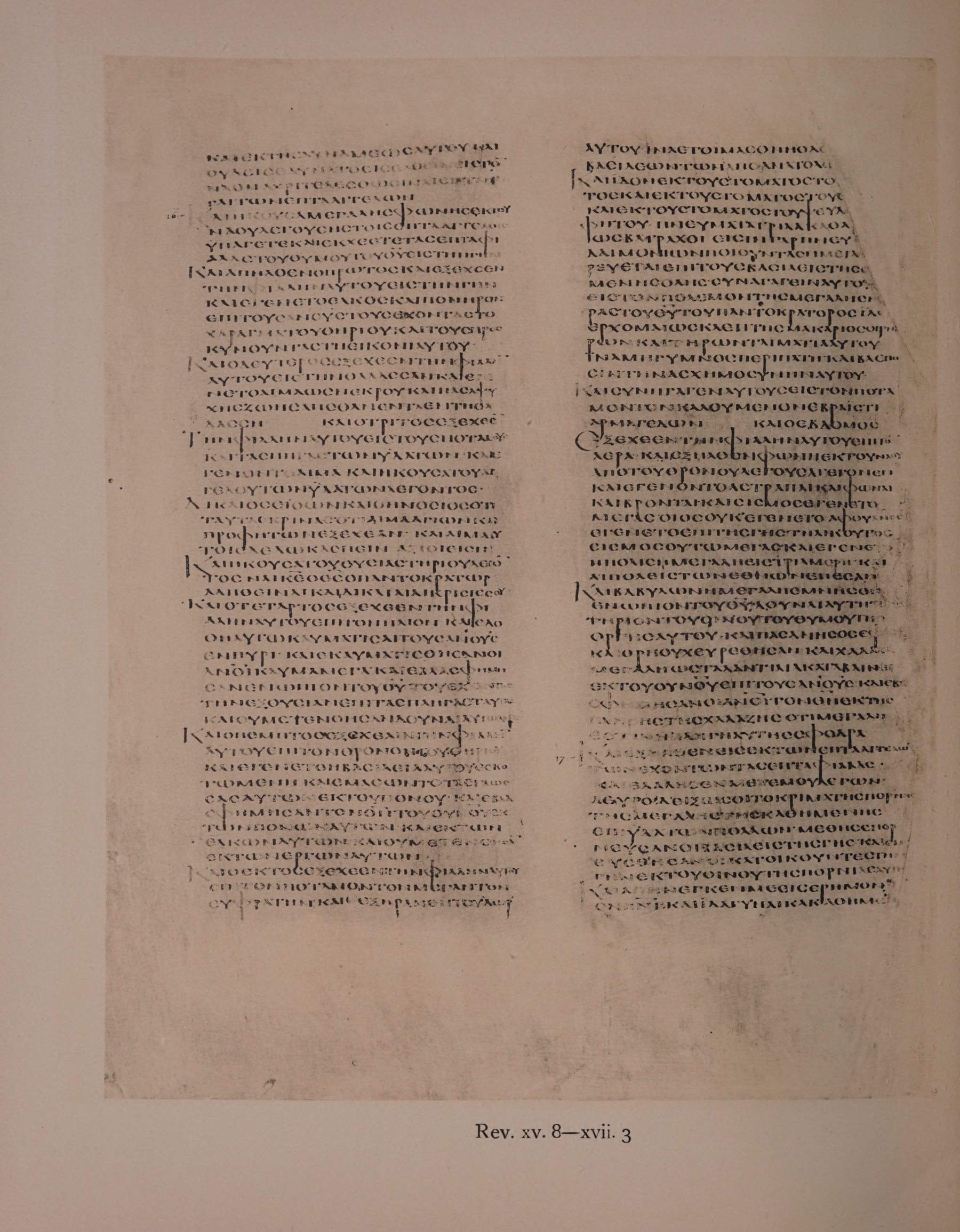
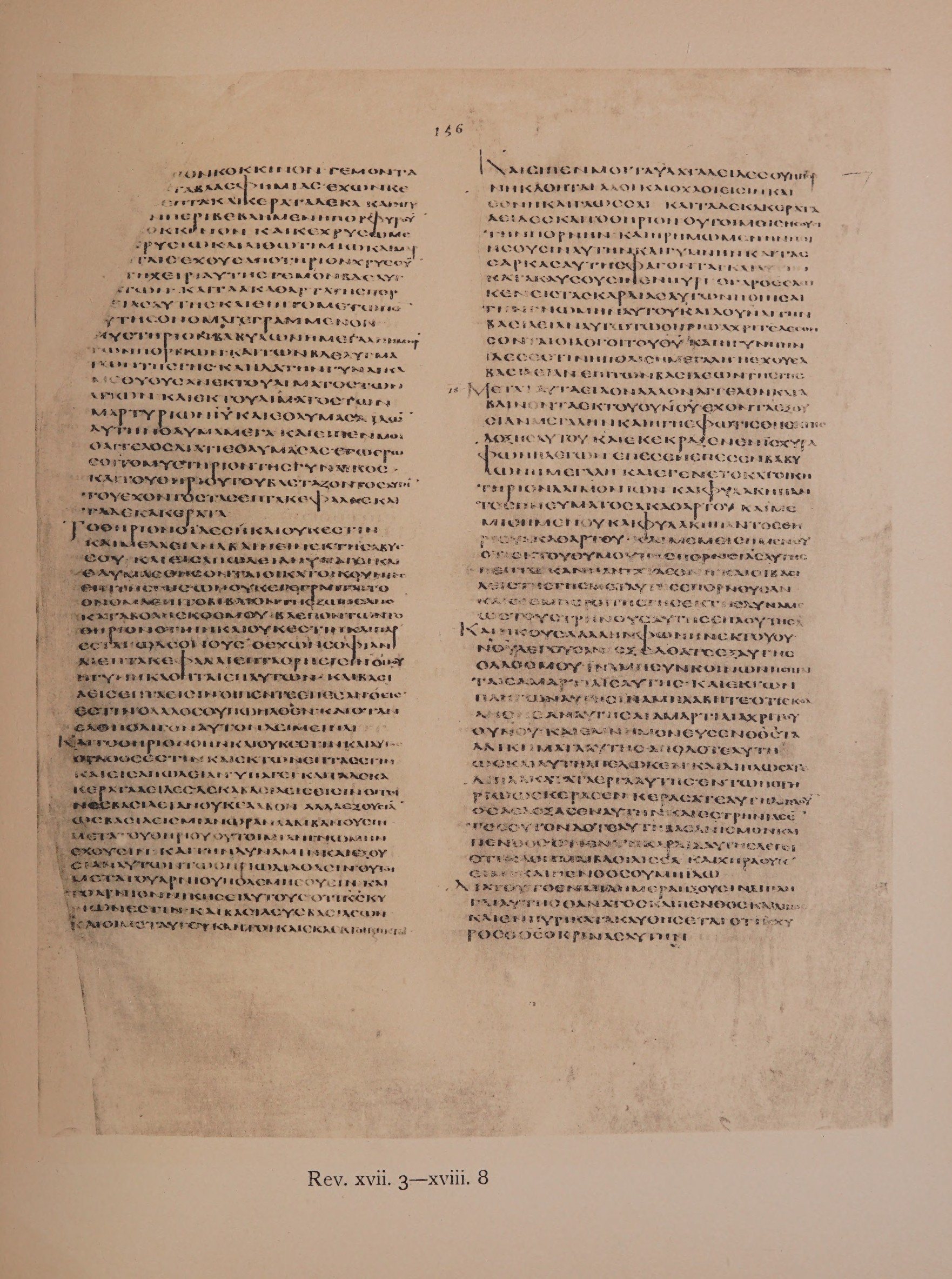
Revelation 17 from Codex Alexandrinus (GA 02), a fifth-century Greek Bible held by the British Library (Royal MS 1 D. VIII). In the New Testament it is the chief witness to the Byzantine text in the Gospels and to the Alexandrian text in the rest of the New Testament. Its New Testament volume lacks Matthew 1:1-25:5, John 6:50-8:52 and 2 Corinthians 4:13-12:6.
This entry meets the strict three-criteria standard of the Theosis Library:
- Manuscript scan: the actual page(s) of Codex Alexandrinus containing this passage (folios 155v, 156r), reproduced from the British Museum's 1909 photographic facsimile edited by F. G. Kenyon, as digitised by the Getty Research Institute for the Internet Archive. The facsimile prints the verse range beneath each plate; that printed range was read for every page used and agrees with the INTF's NTVMR verse-level page index (CC BY 4.0). The page for each section now comes from the NTVMR transcription itself, which records the page and column on which every verse is written.
- Original text: the manuscript's own text, from a diplomatic transcription (see Greek text below), with Tischendorf's 8th critical edition (1869) for comparison.
- English translation: the King James Version (1611), retrieved verbatim from the public-domain bible-api.com endpoint.
Greek text: a diplomatic transcription of Codex Alexandrinus made by the Institut für Neutestamentliche Textforschung (INTF), Münster, for the New Testament Virtual Manuscript Room (NTVMR), published under a Creative Commons Attribution 4.0 licence. It gives the letters as the first scribe wrote them: no accents or breathings, the scribe's own spelling, and the sacred names in their contracted form (θς for θεος, ις for ιησους, κς for κυριος; the overline is not reproduced). Corrections by later hands are not shown. Letters in square brackets are not legible on the page and were restored by the transcribers, a dot under a letter marks an uncertain reading, and [...] marks text lost to damage. Beneath each section, for comparison, is Tischendorf's 8th critical edition (1869). Where the two differ, the transcription is what the manuscript says. Each section is shown with the page on which the transcription places its verses.
How was this verified? (Provenance)
Where on the image
Page from the NTVMR transcription (docID 20002): verses 1-3 on fol. 155v (facsimile leaf 274), col. 2; verse 3 continues on fol. 156r (facsimile leaf 275), col. 1 (which begins '[επι] [θηρ]ιον κοκκινον').
1και εξη̣λθεν εις εκ των επτα αγγελων̣ των εχοντων τας επτα φιαλας · και ελαλησεν μετ εμου λεγων · δευρο δειξω σοι το κριμα της πορνης της μεγαλης της καθημενης επι υδατων πολλων · 2μεθ ης επορνευσαν οι βασιλεις της γης · και εμε̣θυσθησαν οι κατοικουντες την γην εκ του οινου της πορνιας αυτη[ς] 3και απηνεγκεν με εις ερημον εν πνι · και ιδα γυναικα καθημεν[ην] [επι] [θηρ]ιον κοκκινον · γεμοντα [ονομ]α̣τα βλασφημιας · εχων κε[φαλας] επτα και κερατα δεκα ·
Compare: Tischendorf 8th edition (1869)
1Καὶ ἦλθεν εἷς ἐκ τῶν ἑπτὰ ἀγγέλων τῶν ἐχόντων τὰς ἑπτὰ φιάλας, καὶ ἐλάλησεν μετ’ ἐμοῦ λέγων· δεῦρο, δείξω σοι τὸ κρίμα τῆς πόρνης τῆς μεγάλης τῆς καθημένης ἐπὶ τῶν ὑδάτων τῶν πολλῶν, 2μεθ’ ἧς ἐπόρνευσαν οἱ βασιλεῖς τῆς γῆς, καὶ ἐμεθύσθησαν οἱ κατοικοῦντες τὴν γῆν ἐκ τοῦ οἴνου τῆς πορνείας αὐτῆς. 3καὶ ἀπήνεγκέν με εἰς ἔρημον ἐν πνεύματι. καὶ εἶδον γυναῖκα καθημένην ἐπὶ θηρίον κόκκινον, γέμοντα ὀνόματα βλασφημίας, ἔχοντα κεφαλὰς ἑπτὰ καὶ κέρατα δέκα.
1And there came one of the seven angels which had the seven vials, and talked with me, saying unto me, Come hither; I will shew unto thee the judgment of the great whore that sitteth upon many waters: 2With whom the kings of the earth have committed fornication, and the inhabitants of the earth have been made drunk with the wine of her fornication. 3So he carried me away in the spirit into the wilderness: and I saw a woman sit upon a scarlet coloured beast, full of names of blasphemy, having seven heads and ten horns.
Where on the image
Page from the NTVMR transcription (docID 20002): verses 4-14 on fol. 156r (facsimile leaf 275), col. 1.
4και η γυ[νη] [η] [η]ν περιβεβλημενη πορφυρουν [και] [κ]οκκινον και κεχρυσωμε[νη] [χ]ρυσιω και λιθω τιμιω και μαρ[γαρ]ι̣ταις · εχουσα ποτηριον χρυσουν [εν] τη χειρι αυτης γεμον βδελυγ[μα]των · και τα ακαθαρτα της πορ[ν]ειας αυτης · 5και επι το μετωπον [α]υτης ονομα γεγραμμενον μ̣υστηριον βαβυλων η μεγαλη η μηρ των πορνων · και των βδελυγματων της γης · 6και ιδα την γυναικα μεθυουσαν εκ του αιματος των αγιων · και εκ του αιματος των μαρτυριων ιυ · και εθαυμασα · ιδων αυτην θαυμα μεγα · 7και ειπεν μοι ο αγγελος δια τι εθαυμασας · εγω ερω σοι το μυστηριον της γυναικος και του θηριου του βασταζοντος αυτην του εχοντος τας επτα κεφαλα̣ς και τα δεκα κερατα · 8το θηριον ο ιδες η και ουκ εστιν και μελλει αναβαινειν εκ της αβυσσου · και εις απωλειαν υπαγει και θαυμασθησονται οι κατοικουντες επι της γης · ων ουκ εγεγραπται το ονομα επι το βιβλιον της ζωης απο καταβολης κοσμου βλεποντων το θηριον οτι ην και ουκ εστιν και παρεσται · 9ωδε ο νους ο εχων σοφιαν αι επτα κεφαλαι επτα ορη εισιν οπου η γυνη καθηται επ αυτων · και βασιλεις επτα εισιν · 10οι πεντε επεσαν · ο εις εστιν ο αλλος ουπω ηλθεν · και οταν ελθη ολιγον αυτον δει μειναι 11και το θηριον ο ην και ουκ εστιν και αυτος ογδοος εστιν και εκ των επτα εστιν · και εις απωλειαν υπαγει · 12και τα δεκα κερατα α ειδες · δεκα βασιλεις εισιν οιτεινες βασιλειαν ουκ ελαβον · αλλα εξουσιαν ως βασιλεις μιαν ωραν λαμβανουσιν μετα του θηριου 13ουτοι μιαν γνωμην εχουσιν · και την δυναμιν και εξουσιαν αυτων τω θηριω διδοασιν · 14ουτοι μετα του αρνιου πολεμησουσιν · και το αρνιον νικησει αυτους οτι κς κυριων εστιν · και βασιλευς βασιλεων και οι μετ αυτου κλητοι και εκλεκτοι και πιστοι ·
Compare: Tischendorf 8th edition (1869)
4καὶ ἡ γυνὴ ἦν περιβεβλημένη πορφυροῦν καὶ κόκκινον, καὶ κεχρυσωμένη χρυσῷ καὶ λίθῳ τιμίῳ καὶ μαργαρίταις, ἔχουσα ποτήριον χρυσοῦν ἐν τῇ χειρὶ αὐτῆς γέμων βδελυγμάτων καὶ τὰ ἀκάθαρτα τῆς πορνείας αὐτῆς, 5καὶ ἐπὶ τὸ μέτωπον αὐτῆς ὄνομα γεγραμμένον, μυστήριον, Βαβυλὼν ἡ μεγάλη, ἡ μήτηρ τῶν πορνῶν καὶ τῶν βδελυγμάτων τῆς γῆς. 6καὶ εἶδα τὴν γυναῖκα μεθύουσαν ἐκ τοῦ αἵματος τῶν ἁγίων καὶ ἐκ τοῦ αἵματος τῶν μαρτύρων Ἰησοῦ. καὶ ἐθαύμασα ἰδὼν αὐτὴν θαῦμα μέγα. 7Καὶ εἶπέν μοι ὁ ἄγγελος, διατί ἐθαύμασας; ἐγὼ σοι ἐρῶ τὸ μυστήριον τῆς γυναικὸς καὶ τοῦ θηρίου τοῦ βαστάζοντος αὐτήν, τοῦ ἔχοντος τὰς ἑπτὰ κεφαλὰς καὶ τὰ δέκα κέρατα· 8τὸ θηρίον ὃ εἶδες ἦν καὶ οὐκ ἔστιν, καὶ μέλλει ἀναβαίνειν ἐκ τῆς ἀβύσσου καὶ εἰς ἀπώλειαν ὑπάγειν· καὶ θαυμάσονται οἱ κατοικοῦντες ἐπὶ τῆς γῆς, ὧν οὐ γέγραπται τὸ ὄνομα ἐπὶ τὸ βιβλίον τῆς ζωῆς ἀπὸ καταβολῆς κόσμου, βλεπόντων τὸ θηρίον ὅτι ἦν καὶ οὐκ ἔστιν καὶ παρέσται. 9ὧδε ὁ νοῦς ὁ ἔχων σοφίαν. αἱ ἑπτὰ κεφαλαὶ ἑπτὰ ὄρη εἰσίν, ὅπου ἡ γυνὴ κάθηται ἐπ’ αὐτῶν. 10καὶ βασιλεῖς ἑπτά εἰσιν· οἱ πέντε ἔπεσαν, ὁ εἷς ἔστιν, ὁ ἄλλος οὔπω ἦλθεν, καὶ ὅταν ἔλθῃ ὀλίγον αὐτὸν δεῖ μεῖναι. 11καὶ τὸ θηρίον ὃ ἦν καὶ οὐκ ἔστιν, καὶ αὐτὸς ὄγδοός ἐστιν καὶ ἐκ τῶν ἑπτά ἐστιν, καὶ εἰς ἀπώλειαν ὑπάγει. 12καὶ τὰ δέκα κέρατα ἃ εἶδες δέκα βασιλεῖς εἰσιν, οἵτινες βασιλείαν οὔπω ἔλαβον, ἀλλὰ ἐξουσίαν ὡς βασιλεῖς μίαν ὥραν λαμβάνουσιν μετὰ τοῦ θηρίου. 13οὗτοι μίαν γνώμην ἔχουσιν, καὶ τὴν δύναμιν καὶ τὴν ἐξουσίαν αὐτῶν τῷ θηρίῳ διδόασιν. 14οὗτοι μετὰ τοῦ ἀρνίου πολεμήσουσιν, καὶ τὸ ἀρνίον νικήσει σὐτούς, ὅτι κύριος κυρίων ἐστὶν καὶ βασιλεὺς βασιλέων, καὶ οἱ μετ’ αὐτοῦ κλητοὶ καὶ ἐκλεκτοὶ καὶ πιστοί.
4And the woman was arrayed in purple and scarlet colour, and decked with gold and precious stones and pearls, having a golden cup in her hand full of abominations and filthiness of her fornication: 5And upon her forehead was a name written, MYSTERY, BABYLON THE GREAT, THE MOTHER OF HARLOTS AND ABOMINATIONS OF THE EARTH. 6And I saw the woman drunken with the blood of the saints, and with the blood of the martyrs of Jesus: and when I saw her, I wondered with great admiration. 7And the angel said unto me, Wherefore didst thou marvel? I will tell thee the mystery of the woman, and of the beast that carrieth her, which hath the seven heads and ten horns. 8The beast that thou sawest was, and is not; and shall ascend out of the bottomless pit, and go into perdition: and they that dwell on the earth shall wonder, whose names were not written in the book of life from the foundation of the world, when they behold the beast that was, and is not, and yet is. 9And here is the mind which hath wisdom. The seven heads are seven mountains, on which the woman sitteth. 10And there are seven kings: five are fallen, and one is, and the other is not yet come; and when he cometh, he must continue a short space. 11And the beast that was, and is not, even he is the eighth, and is of the seven, and goeth into perdition. 12And the ten horns which thou sawest are ten kings, which have received no kingdom as yet; but receive power as kings one hour with the beast. 13These have one mind, and shall give their power and strength unto the beast. 14These shall make war with the Lamb, and the Lamb shall overcome them: for he is Lord of lords, and King of kings: and they that are with him are called, and chosen, and faithful.
Where on the image
Page from the NTVMR transcription (docID 20002): verses 15-18 on fol. 156r (facsimile leaf 275), col. 2.
15και ειπεν μοι τα υδατα α ειδες ου η πορνη καθηται λαοι και οχλοι εισιν και εθνη και γλωσσαι · 16και τα δεκα κερατα α ειδες και το θηριον ουτοι μεισησουσι την πορνην · και ηρημωμενην ποιησουσιν αυτην και γυμνην και τας σαρκας αυτης φαγονται · και αυτην κατακαυσουσιν εν πυρι · 17ο γαρ θς εδωκεν εις τας καρδιας αυτων ποιησαι την γνωμην αυτου και δουναι την βασιλειαν αυτω τω θηριω · αχρι τελεσθησονται οι λογοι του θυ · 18και η γυνη ην ιδες εστιν η πολις η μεγαλη · η εχουσα βασιλειαν επι των βασιλεων της γης
Compare: Tischendorf 8th edition (1869)
15καὶ λέγει μοι, τὰ ὕδατα ἃ εἶδες, οὗ ἡ πόρνη κάθηται, λαοὶ καὶ ὄχλοι εἰσὶν καὶ ἔθνη καὶ γλῶσσαι. 16καὶ τὰ δέκα κέρατα ἃ εἶδες καὶ τὸ θηρίον, οὗτοι μισήσουσιν τὴν πόρνην, καὶ ἠρημωμένην ποιήσουσιν αὐτὴν καὶ γυμνήν, καὶ τὰς σάρκας αὐτῆς φάγονται, καὶ αὐτὴν κατακαύσουσιν πυρί· 17ὁ γὰρ θεὸς ἔδωκεν εἰς τὰς καρδίας αὐτῶν ποιῆσαι τὴν γνώμην αὐτοῦ, καὶ ποιῆσαι μίαν γνώμην καὶ δοῦναι τὴν βασιλείαν αὐτῶν τῷ θηρίῳ, ἄχρι τελεσθήσονται οἱ λόγοι τοῦ θεοῦ. 18καὶ ἡ γυνὴ ἣν εἶδες ἔστιν ἡ πόλις ἡ μεγάλη ἡ ἔχουσα βασιλείαν ἐπὶ τῶν βασιλέων τῆς γῆς.
15And he saith unto me, The waters which thou sawest, where the whore sitteth, are peoples, and multitudes, and nations, and tongues. 16And the ten horns which thou sawest upon the beast, these shall hate the whore, and shall make her desolate and naked, and shall eat her flesh, and burn her with fire. 17For God hath put in their hearts to fulfil his will, and to agree, and give their kingdom unto the beast, until the words of God shall be fulfilled. 18And the woman which thou sawest is that great city, which reigneth over the kings of the earth.
Cite
Sources
- Source: Codex Alexandrinus page images + NTVMR transcription (CC BY 4.0) + Tischendorf 8th edition + KJV (holding institution)
- Critical edition: Codex Alexandrinus transcription, NTVMR (INTF Münster, CC BY 4.0); Tischendorf 8th edition for comparison
← previous · → next · v cycle view · l back to library