Aristotle, Nicomachean Ethics 10.6-10.8: happiness and the life of the mind as a divine life
Introduction
In the last book of the Nicomachean Ethics Aristotle asks what the happiest life is. Chapter 6 sets aside amusement: happiness is an activity desirable for its own sake, in accordance with virtue. Happiness is activity in accordance with the highest virtue, and the highest part of us is the intellect (nous), 'either as being itself also actually divine, or as being relatively the divinest part of us'. Its activity, contemplation (theoria), is the most continuous, the most pleasant, the most self-sufficient and the only activity loved for its own sake. Such a life 'will be higher than the human level': a man lives it not in so far as he is human but in so far as something divine is present in him. So we should not follow those who advise us to think human thoughts because we are human, but 'we ought so far as possible to achieve immortality' (1177b33). Chapter 8 adds that the gods are blessed because they contemplate, and that the wise man, whose activity is most like theirs, is 'most beloved by the gods'. Later Greek Christian writers drew on these chapters when they spoke of contemplation and deification.
The main witness is Florence, Biblioteca Medicea Laurenziana, Plut. 81.11 (siglum Kb), written in the 10th century, the oldest manuscript of the Ethics. Between its fol. 121r and fol. 121v the text 1176a10-1177a30 is missing (fol. 121r ends at 1176a10 and fol. 121v begins at 1177a30), so chapter 6 and the opening of chapter 7 (1176a30-1177a30) are shown on Paris, BnF, grec 1854 (siglum Lb, 12th century), fol. 175r-177v, a large-format copy with scholia around and between the lines. Each section is one Bekker column within a chapter; the pages listed for it were identified by reading the first and last lines of each page on the images. The Greek is Bywater's critical text, not a transcription of either manuscript.
How was this verified? (Provenance)
Where on the image
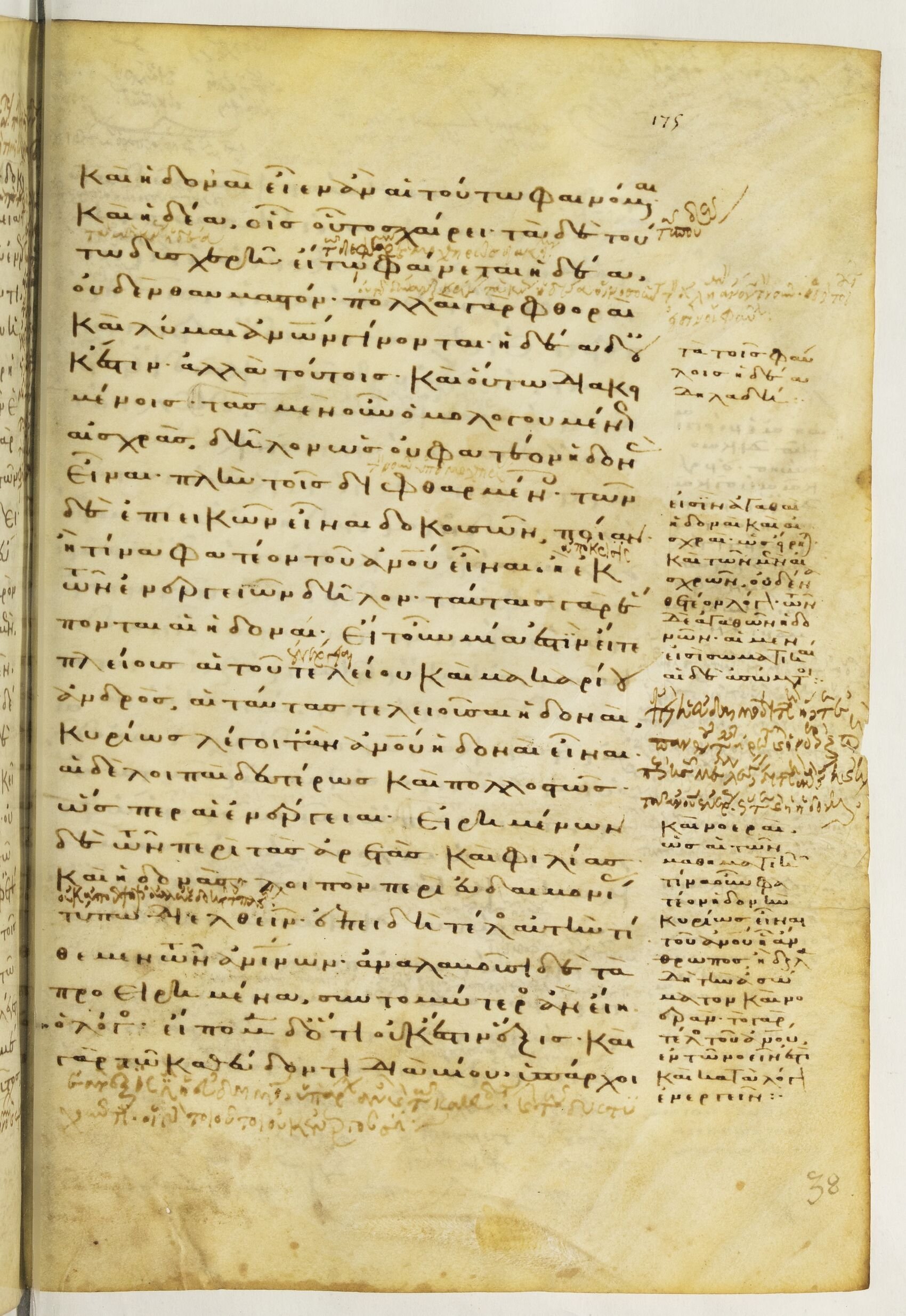
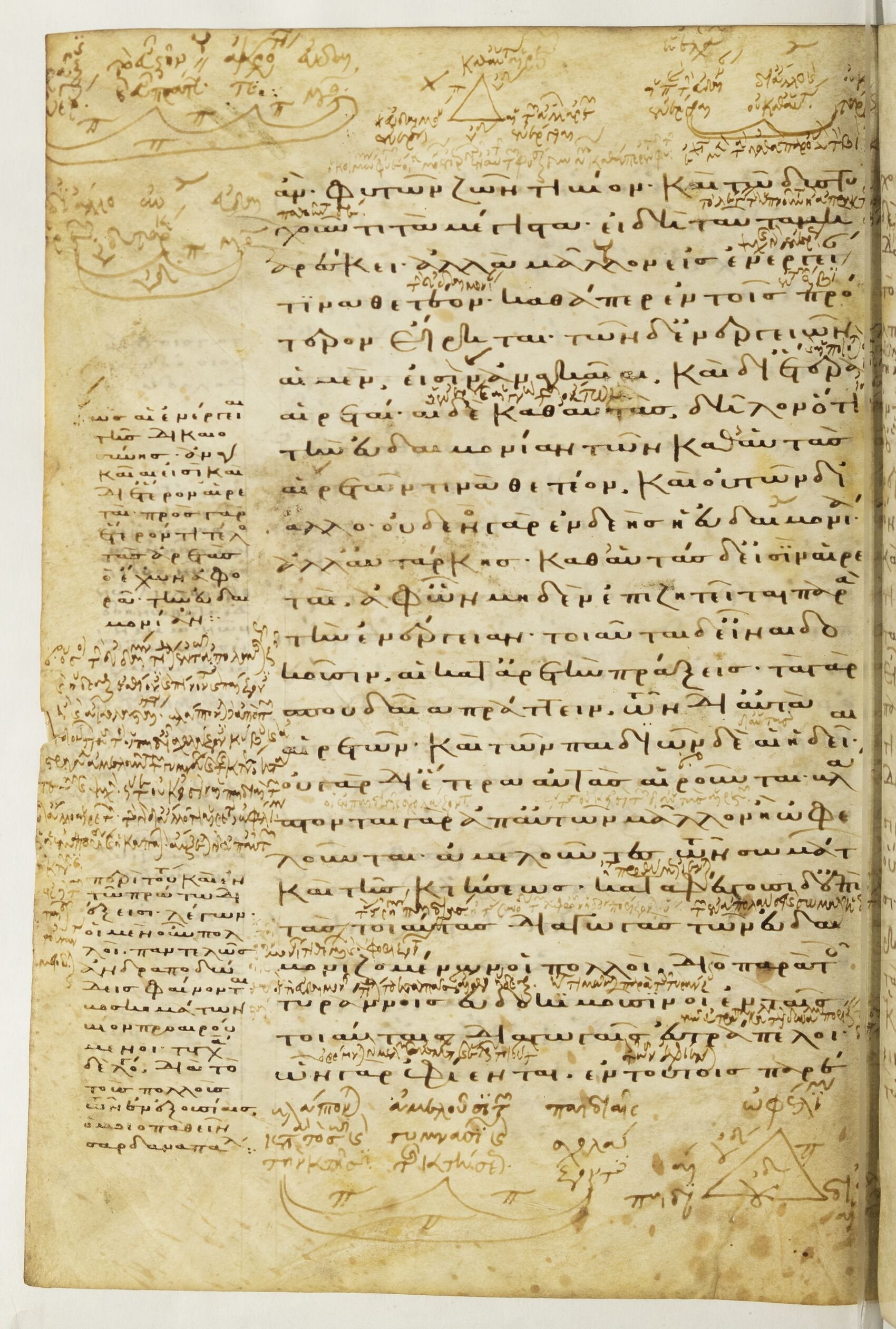
Kb lacks this chapter (loss between fol. 121r and 121v); it is shown on Lb. Paris gr. 1854 fol. 175r begins 'καὶ ἡδοναὶ εἶεν ἂν αἱ τούτῳ φαινόμεναι καὶ ἡδέα' (1176a18-19, chapter 5); chapter 10.6 ('εἰρημένων δὲ τῶν περί τε τὰς ἀρετάς', 1176a30) begins on this page, which ends 'εἴπομεν δὴ ὅτι οὐκ ἔστιν ἕξις· καὶ γὰρ τῷ καθεύδοντι διὰ βίου ὑπάρχοι' (1176a33-34). The margins carry scholia. Paris gr. 1854 fol. 175v begins 'ἄν, φυτῶν ζῶντι βίον' (1176a34) and ends 'παρὰ τοῖς τυράννοις εὐδοκιμοῦσιν οἱ ἐν ταῖς τοιαύταις διαγωγαῖς εὐτράπελοι· ὧν γὰρ ἐφίενται, ἐν τούτοις παρέ(χουσι)' (1176b12-14). Checked on the images. The Greek shown is Bywater's critical text; the copyists' wording differs from it in small details.
εἰρημένων δὲ τῶν περὶ τὰς ἀρετάς τε καὶ φιλίας καὶ ἡδονάς, λοιπὸν περὶ εὐδαιμονίας τύπῳ διελθεῖν, ἐπειδὴ τέλος αὐτὴν τίθεμεν τῶν ἀνθρωπίνων. ἀναλαβοῦσι δὴ τὰ προειρημένα συντομώτερος ἂν εἴη ὁ λόγος. εἴπομεν δὴ ὅτι οὐκ ἔστιν ἕξις· καὶ γὰρ τῷ καθεύδοντι διὰ βίου ὑπάρχοι ἄν, φυτῶν ζῶντι βίον, καὶ τῷ δυστυχοῦντι τὰ μέγιστα.
Having now discussed the various kinds of Virtue, of Friendship and of Pleasure, it remains for us to treat in outline of Happiness, inasmuch as we count this to be the End of human life. But it will shorten the discussion if we recapitulate what has been said already. Now we stated that happiness is not a certain disposition of character; since if it were it might be possessed by a man who passed the whole of his chosen life asleep, living the life of a vegetable, or by one who was plunged in the deepest misfortune.
Where on the image
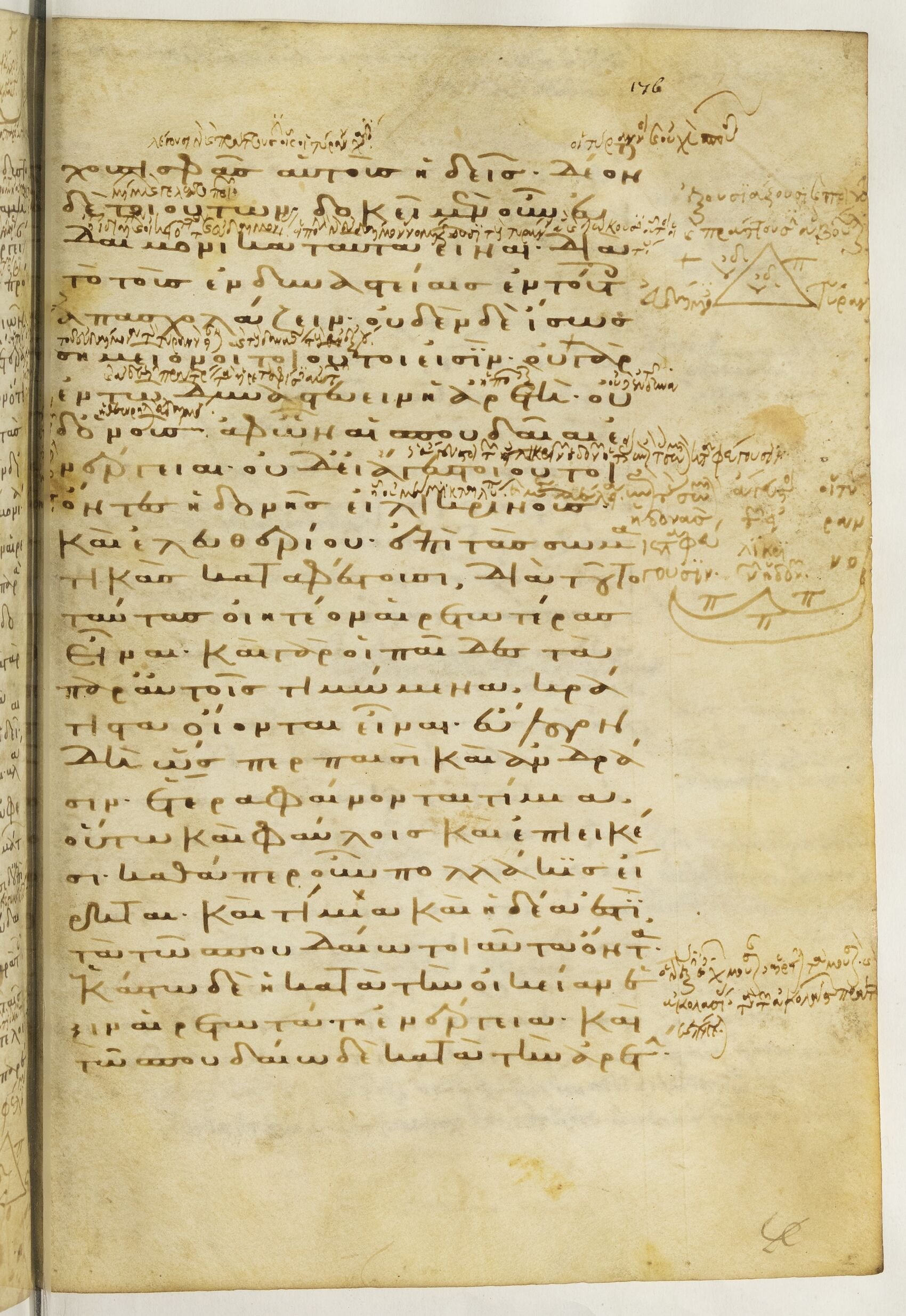
Kb lacks this chapter; it is shown on Lb. Paris gr. 1854 fol. 175v begins 'ἄν, φυτῶν ζῶντι βίον' (1176a34) and ends 'παρὰ τοῖς τυράννοις εὐδοκιμοῦσιν οἱ ἐν ταῖς τοιαύταις διαγωγαῖς εὐτράπελοι· ὧν γὰρ ἐφίενται, ἐν τούτοις παρέ(χουσι)' (1176b12-14). Paris gr. 1854 fol. 176r begins '(παρέ)χουσι σφᾶς αὐτοὺς ἡδεῖς' (1176b14) and ends 'καὶ τῷ σπουδαίῳ δὴ ἡ κατὰ τὴν ἀρετήν' (1176b26-27). Paris gr. 1854 fol. 176v begins 'οὐκ ἐν παιδιᾷ ἄρα ἡ εὐδαιμονία· καὶ γὰρ ἄτοπον τὸ τέλος εἶναι παιδιάν' (1176b27-28) and ends 'ἡ δὲ τοῦ βελτίονος κρείττων καὶ εὐδαι(μονικωτέρα)' (1177a5-6). Checked on the images. The Greek shown is Bywater's critical text; the copyists' wording differs from it in small details.
εἰ δὴ ταῦτα μὴ ἀρέσκει, ἀλλὰ μᾶλλον εἰς ἐνέργειάν τινα θετέον, καθάπερ ἐν τοῖς πρότερον εἴρηται, τῶν δʼ ἐνεργειῶν αἳ μέν εἰσιν ἀναγκαῖαι καὶ διʼ ἕτερα αἱρεταὶ αἳ δὲ καθʼ αὑτάς, δῆλον ὅτι τὴν εὐδαιμονίαν τῶν καθʼ αὑτὰς αἱρετῶν τινὰ θετέον καὶ οὐ τῶν διʼ ἄλλο· οὐδενὸς γὰρ ἐνδεὴς ἡ εὐδαιμονία ἀλλʼ αὐτάρκης. καθʼ αὑτὰς δʼ εἰσὶν αἱρεταὶ ἀφʼ ὧν μηδὲν ἐπιζητεῖται παρὰ τὴν ἐνέργειαν. τοιαῦται δʼ εἶναι δοκοῦσιν αἱ κατʼ ἀρετὴν πράξεις· τὰ γὰρ καλὰ καὶ σπουδαῖα πράττειν τῶν διʼ αὑτὰ αἱρετῶν. καὶ τῶν παιδιῶν δὲ αἱ ἡδεῖαι· οὐ γὰρ διʼ ἕτερα αὐτὰς αἱροῦνται· βλάπτονται γὰρ ἀπʼ αὐτῶν μᾶλλον ἢ ὠφελοῦνται, ἀμελοῦντες τῶν σωμάτων καὶ τῆς κτήσεως. καταφεύγουσι δʼ ἐπὶ τὰς τοιαύτας διαγωγὰς τῶν εὐδαιμονιζομένων οἱ πολλοί, διὸ παρὰ τοῖς τυράννοις εὐδοκιμοῦσιν οἱ ἐν ταῖς τοιαύταις διαγωγαῖς εὐτράπελοι· ὧν γὰρ ἐφίενται, ἐν τούτοις παρέχουσι σφᾶς αὐτοὺς ἡδεῖς, δέονται δὲ τοιούτων. δοκεῖ μὲν οὖν εὐδαιμονικὰ ταῦτα εἶναι διὰ τὸ τοὺς ἐν δυναστείαις ἐν τούτοις ἀποσχολάζειν, οὐδὲν δʼ ἴσως σημεῖον οἱ τοιοῦτοί εἰσιν· οὐ γὰρ ἐν τῷ δυναστεύειν ἡ ἀρετὴ οὐδʼ ὁ νοῦς, ἀφʼ ὧν αἱ σπουδαῖαι ἐνέργειαι· οὐδʼ εἰ ἄγευστοι οὗτοι ὄντες ἡδονῆς εἰλικρινοῦς καὶ ἐλευθερίου ἐπὶ τὰς σωματικὰς καταφεύγουσιν, διὰ τοῦτο ταύτας οἰητέον αἱρετωτέρας εἶναι· καὶ γὰρ οἱ παῖδες τὰ παρʼ αὑτοῖς τιμώμενα κράτιστα οἴονται εἶναι. εὔλογον δή, ὥσπερ παισὶ καὶ ἀνδράσιν ἕτερα φαίνεται τίμια, οὕτω καὶ φαύλοις καὶ ἐπιεικέσιν. καθάπερ οὖν πολλάκις εἴρηται, καὶ τίμια καὶ ἡδέα ἐστὶ τὰ τῷ σπουδαίῳ τοιαῦτα ὄντα· ἑκάστῳ δʼ ἡ κατὰ τὴν οἰκείαν ἕξιν αἱρετωτάτη ἐνέργεια, καὶ τῷ σπουδαίῳ δὴ ἡ κατὰ τὴν ἀρετήν. οὐκ ἐν παιδιᾷ ἄρα ἡ εὐδαιμονία· καὶ γὰρ ἄτοπον τὸ τέλος εἶναι παιδιάν, καὶ πραγματεύεσθαι καὶ κακοπαθεῖν τὸν βίον ἅπαντα τοῦ παίζειν χάριν. ἅπαντα γὰρ ὡς εἰπεῖν ἑτέρου ἕνεκα αἱρούμεθα πλὴν τῆς εὐδαιμονίας· τέλος γὰρ αὕτη. σπουδάζειν δὲ καὶ πονεῖν παιδιᾶς χάριν ἠλίθιον φαίνεται καὶ λίαν παιδικόν. παίζειν δʼ ὅπως σπουδάζῃ, κατʼ Ἀνάχαρσιν, ὀρθῶς ἔχειν δοκεῖ· ἀναπαύσει γὰρ ἔοικεν ἡ παιδιά, ἀδυνατοῦντες δὲ συνεχῶς πονεῖν ἀναπαύσεως δέονται. οὐ δὴ τέλος ἡ ἀνάπαυσις·
If then we reject this as unsatisfactory, and feel bound to class happiness rather as some form of activity, as has been said in the earlier part of this treatise, and if activities are of two kinds, some merely necessary means and desirable only for the sake of something else, others desirable in themselves, it is clear that happiness is to be classed among activities desirable in themselves, and not among those desirable as a means to something else; since happiness lacks nothing, and is self-sufficient. But those activities are desirable in themselves which do not aim at any result beyond the mere exercise of the activity. Now this is felt to be the nature of actions in conformity with virtue; for to do noble and virtuous deeds is a thing desirable for its own sake. But agreeable amusements also are desirable for not their own sake; we do not pursue them as a means to something else, for as a matter of fact they are more often harmful than beneficial, causing men to neglect their health and their estates. Yet persons whom the world counts happy usually have recourse to such pastimes; and this is why adepts in such pastimes stand in high favor with princes, because they make themselves agreeable in supplying what their patrons desire, and what they want is amusement. So it is supposed that amusements are a component part of happiness, because princes and potentates devote their leisure to them. But (i) perhaps princes and potentates are not good evidence. Virtue and intelligence, which are the sources of man’s higher activities, do not depend on the possession of power; and if these persons, having no taste for pure and liberal pleasure, have recourse to the pleasures of the body, we must not on that account suppose that bodily pleasures are the more desirable. Children imagine that the things they themselves value are actually the best; it is not surprising therefore that, as children and grown men have different standards of value, so also should the worthless and the virtuous. Therefore, as has repeatedly been said, those things are actually valuable and pleasant which appear so to the good man; but each man thinks that activity most desirable which suits his particular disposition, and there fore the good a man thinks virtuous activity most desirable. It follows therefore that happiness is not to be found in amusements. (ii)Indeed it would be strange that amusement should be our End—that we should toil and moil all our life long in order that we may amuse ourselves. For virtually every object we adopt is pursued as a means to something else, excepting happiness, which is an end in itself; to make amusement the object of our serious pursuits and our work seems foolish and childish to excess: Anacharsis’s motto, Play in order that you may work, is felt to be the right rule. For amusement is a form of rest; but we need rest because we are not able to go on working without a break, and therefore it is not an end,
Where on the image
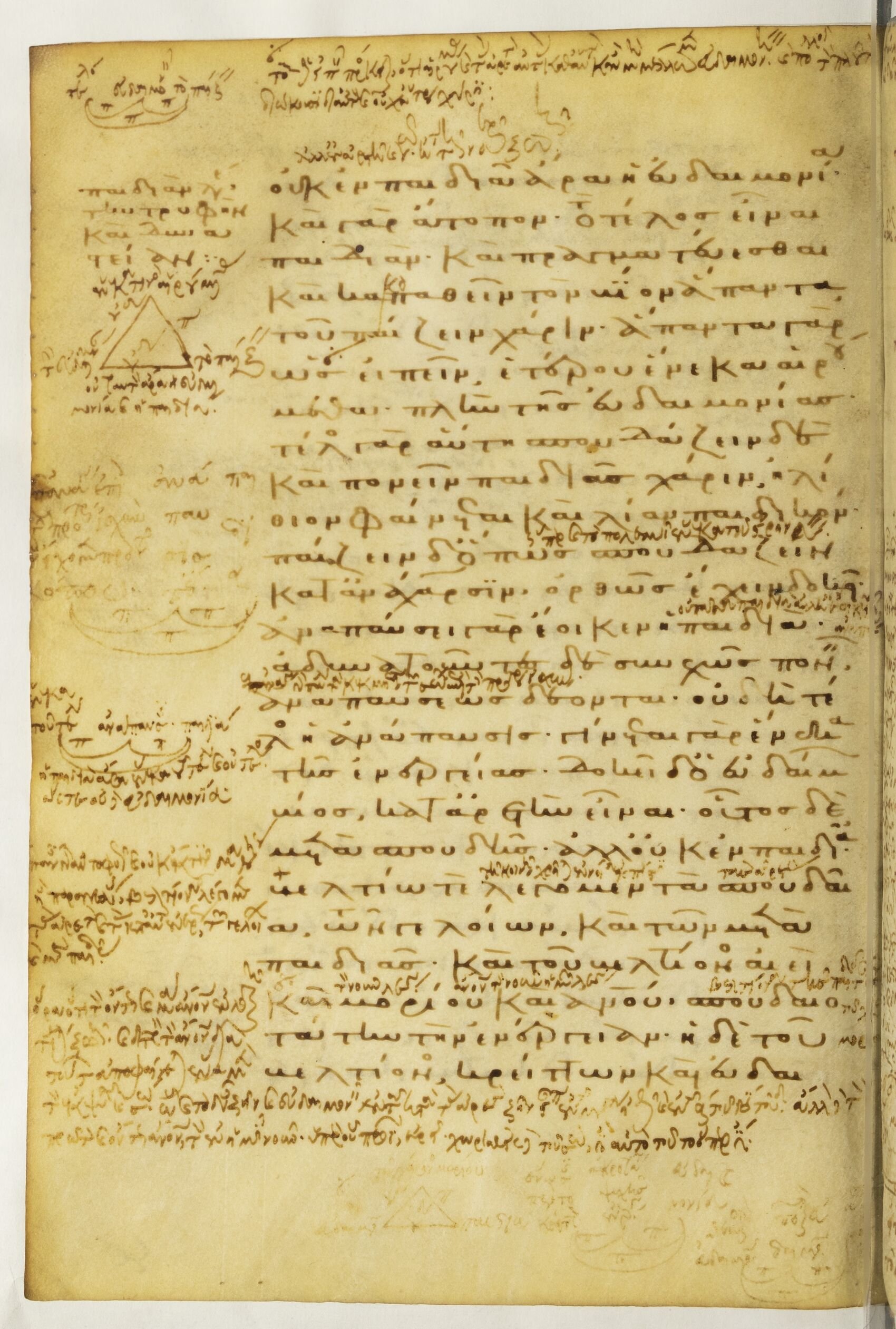
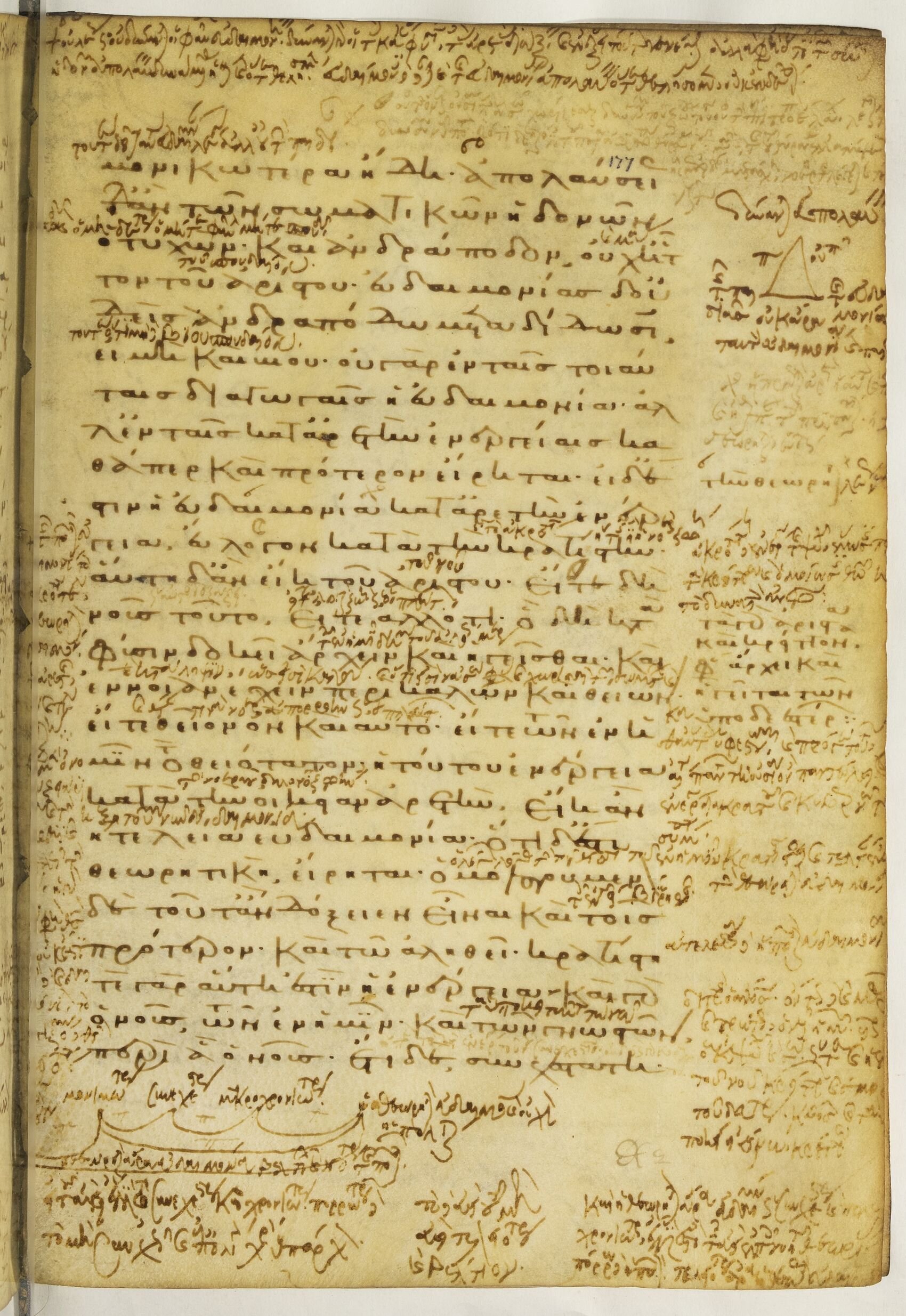
Kb lacks this chapter; it is shown on Lb. Paris gr. 1854 fol. 176v begins 'οὐκ ἐν παιδιᾷ ἄρα ἡ εὐδαιμονία· καὶ γὰρ ἄτοπον τὸ τέλος εἶναι παιδιάν' (1176b27-28) and ends 'ἡ δὲ τοῦ βελτίονος κρείττων καὶ εὐδαι(μονικωτέρα)' (1177a5-6). Paris gr. 1854 fol. 177r: the first line of text reads '(εὐδαι)μονικωτέρα ἤδη. ἀπολαύσειε' (1177a6); chapter 10.7 begins at the end of line 9 ('εἰ δʼ', with 'ἐστὶν ἡ εὐδαιμονία κατʼ ἀρετὴν ἐνέργεια' on line 10). The page ends in 1177a21, just before 'θεωρεῖν τε γὰρ δυνάμεθα', the first words of fol. 177v. The margins and the spaces between the lines carry scholia. Checked on the images. The Greek shown is Bywater's critical text; the copyists' wording differs from it in small details.
γίνεται γὰρ ἕνεκα τῆς ἐνεργείας. δοκεῖ δʼ ὁ εὐδαίμων βίος κατʼ ἀρετὴν εἶναι· οὗτος δὲ μετὰ σπουδῆς, ἀλλʼ οὐκ ἐν παιδιᾷ. βελτίω τε λέγομεν τὰ σπουδαῖα τῶν γελοίων καὶ μετὰ παιδιᾶς, καὶ τοῦ βελτίονος ἀεὶ καὶ μορίου καὶ ἀνθρώπου σπουδαιοτέραν τὴν ἐνέργειαν· ἡ δὲ τοῦ βελτίονος κρείττων καὶ εὐδαιμονικωτέρα ἤδη. ἀπολαύσειέ τʼ ἂν τῶν σωματικῶν ἡδονῶν ὁ τυχὼν καὶ ἀνδράποδον οὐχ ἧττον τοῦ ἀρίστου· εὐδαιμονίας δʼ οὐδεὶς ἀνδραπόδῳ μεταδίδωσιν, εἰ μὴ καὶ βίου. οὐ γὰρ ἐν ταῖς τοιαύταις διαγωγαῖς ἡ εὐδαιμονία, ἀλλʼ ἐν ταῖς κατʼ ἀρετὴν ἐνεργείαις, καθάπερ καὶ πρότερον εἴρηται.
since we take it as a means to further activity. (iii) And the life that conforms with virtue is thought to be a happy life; but virtuous life involves serious purpose, and does not consist in amusement. (iv) Also we pronounce serious things to be superior to things that are funny and amusing; and the nobler a faculty or a person is, the more serious, we think, are their activities; therefore, the activity of the nobler faculty or person is itself superior, and therefore more productive of happiness. (v) Also anybody can enjoy the pleasures of the body, a slave no less than the noblest of mankind; but no one allows a slave any measure of happiness, any more than a life of his own. Therefore happiness does not consist in pastimes and amusements, but in activities in accordance with virtue, as has been said already.
Where on the image
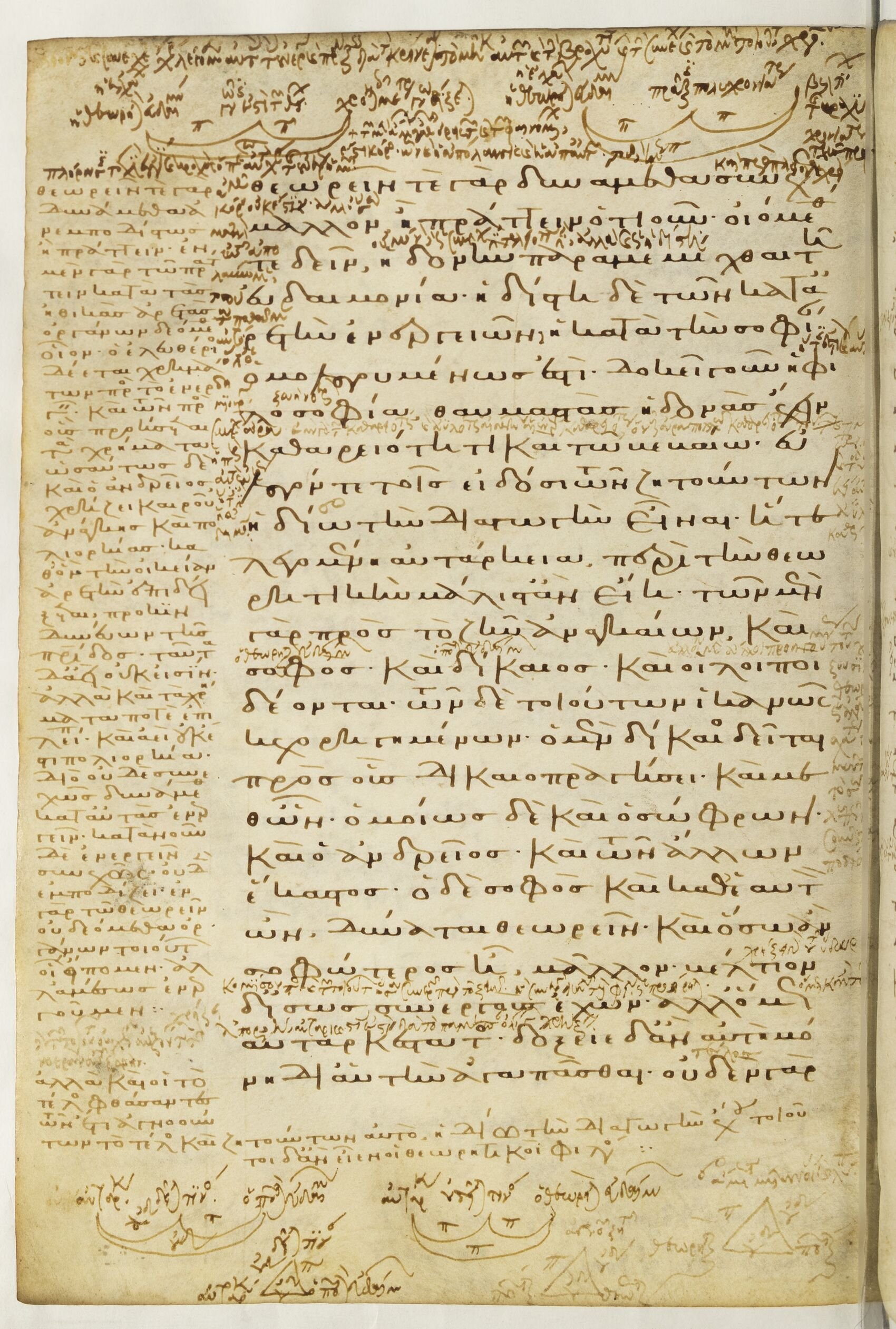
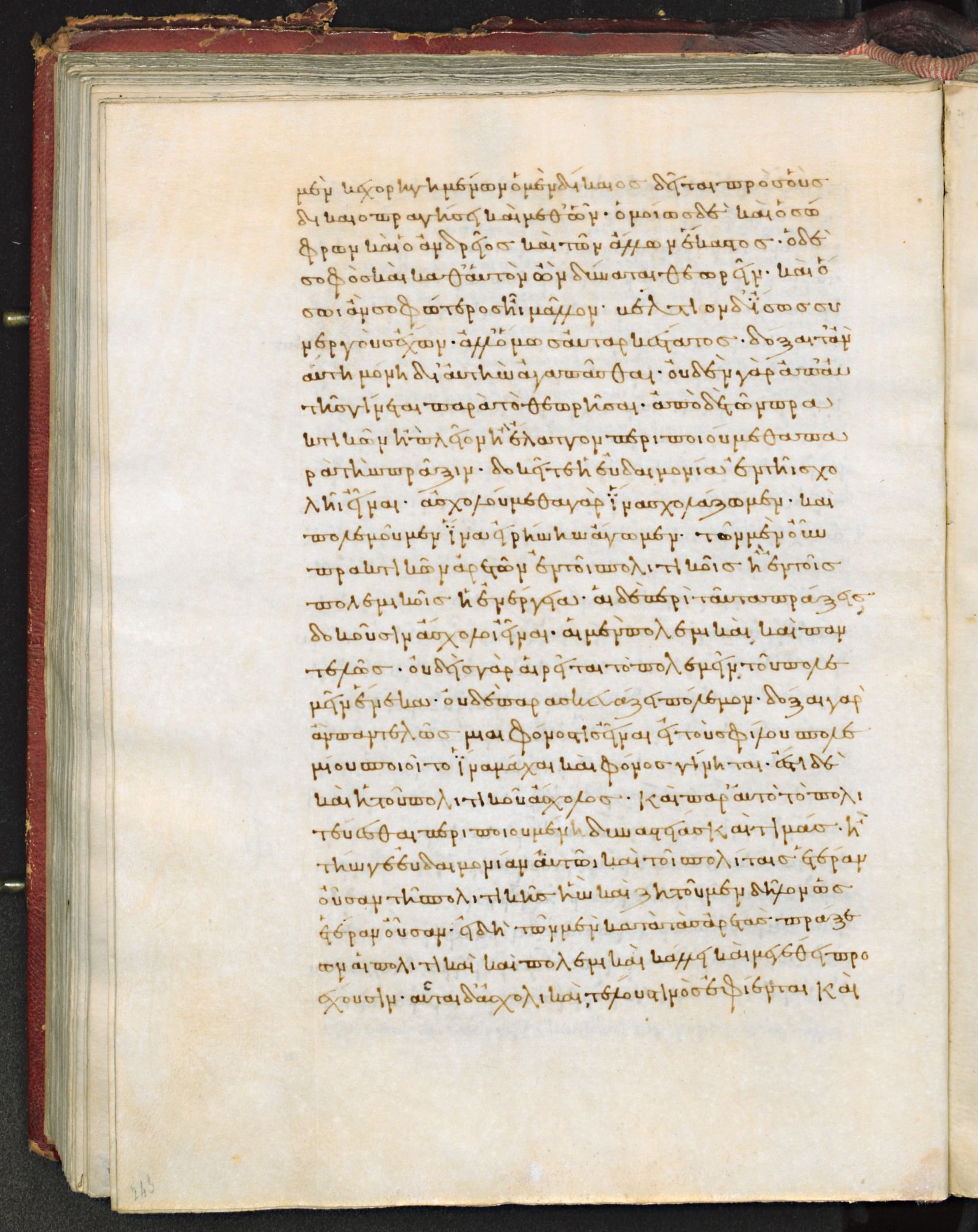
Kb lacks 1177a12-30 (loss between fol. 121r and 121v), so the start of the chapter is shown on Lb fol. 177r-177v; from 1177a30 ('-μένων ὁ μὲν δίκαιος') the text is on Kb fol. 121v. Paris gr. 1854 fol. 177r: the first line of text reads '(εὐδαι)μονικωτέρα ἤδη. ἀπολαύσειε' (1177a6); chapter 10.7 begins at the end of line 9 ('εἰ δʼ', with 'ἐστὶν ἡ εὐδαιμονία κατʼ ἀρετὴν ἐνέργεια' on line 10). The page ends in 1177a21, just before 'θεωρεῖν τε γὰρ δυνάμεθα', the first words of fol. 177v. The margins and the spaces between the lines carry scholia. Paris gr. 1854 fol. 177v begins 'θεωρεῖν τε γὰρ δυνάμεθα συνεχῶς μᾶλλον ἢ πράττειν ὁτιοῦν' (1177a21-22) and ends 'δόξειε δʼ ἂν αὐτὴ μόνη διʼ αὑτὴν ἀγαπᾶσθαι· οὐδὲν γὰρ' (1177b1-2). Laur. Plut. 81.11 fol. 121v begins '(κεχορηγη)μένων ὁ μὲν δίκαιος δεῖται πρὸς οὓς δικαιοπραγήσει' (1177a29-30) and ends 'αὗται δʼ ἄσχολοι καὶ τέλους τινὸς ἐφίενται καὶ' (1177b17-18). Checked on the images. The Greek shown is Bywater's critical text; the copyists' wording differs from it in small details.
εἰ δʼ ἐστὶν ἡ εὐδαιμονία κατʼ ἀρετὴν ἐνέργεια, εὔλογον κατὰ τὴν κρατίστην· αὕτη δʼ ἂν εἴη τοῦ ἀρίστου. εἴτε δὴ νοῦς τοῦτο εἴτε ἄλλο τι, ὃ δὴ κατὰ φύσιν δοκεῖ ἄρχειν καὶ ἡγεῖσθαι καὶ ἔννοιαν ἔχειν περὶ καλῶν καὶ θείων, εἴτε θεῖον ὂν καὶ αὐτὸ εἴτε τῶν ἐν ἡμῖν τὸ θειότατον, ἡ τούτου ἐνέργεια κατὰ τὴν οἰκείαν ἀρετὴν εἴη ἂν ἡ τελεία εὐδαιμονία. ὅτι δʼ ἐστὶ θεωρητική, εἴρηται. ὁμολογούμενον δὲ τοῦτʼ ἂν δόξειεν εἶναι καὶ τοῖς πρότερον καὶ τῷ ἀληθεῖ. κρατίστη τε γὰρ αὕτη ἐστὶν ἡ ἐνέργεια (καὶ γὰρ ὁ νοῦς τῶν ἐν ἡμῖν, καὶ τῶν γνωστῶν, περὶ ἃ ὁ νοῦς)· ἔτι δὲ συνεχεστάτη· θεωρεῖν [τε] γὰρ δυνάμεθα συνεχῶς μᾶλλον ἢ πράττειν ὁτιοῦν. οἰόμεθά τε δεῖν ἡδονὴν παραμεμῖχθαι τῇ εὐδαιμονίᾳ, ἡδίστη δὲ τῶν κατʼ ἀρετὴν ἐνεργειῶν ἡ κατὰ τὴν σοφίαν ὁμολογουμένως ἐστίν· δοκεῖ γοῦν ἡ φιλοσοφία θαυμαστὰς ἡδονὰς ἔχειν καθαρειότητι καὶ τῷ βεβαίῳ, εὔλογον δὲ τοῖς εἰδόσι τῶν ζητούντων ἡδίω τὴν διαγωγὴν εἶναι. ἥ τε λεγομένη αὐτάρκεια περὶ τὴν θεωρητικὴν μάλιστʼ ἂν εἴη· τῶν μὲν γὰρ πρὸς τὸ ζῆν ἀναγκαίων καὶ σοφὸς καὶ δίκαιος καὶ οἱ λοιποὶ δέονται, τοῖς δὲ τοιούτοις ἱκανῶς κεχορηγημένων ὁ μὲν δίκαιος δεῖται πρὸς οὓς δικαιοπραγήσει καὶ μεθʼ ὧν, ὁμοίως δὲ καὶ ὁ σώφρων καὶ ὁ ἀνδρεῖος καὶ τῶν ἄλλων ἕκαστος, ὁ δὲ σοφὸς καὶ καθʼ αὑτὸν ὢν δύναται θεωρεῖν, καὶ ὅσῳ ἂν σοφώτερος ᾖ, μᾶλλον· βέλτιον δʼ ἴσως συνεργοὺς ἔχων, ἀλλʼ ὅμως αὐταρκέστατος.
But if happiness consists in activity in accordance with virtue, it is reasonable that it should be activity in accordance with the highest virtue; and this will be the virtue of the best part of us. Whether then this be the intellect, or whatever else it be that is thought to rule and lead us by nature, and to have cognizance of what is noble and divine, either as being itself also actually divine, or as being relatively the divinest part of us, it is the activity of this part of us in accordance with the virtue proper to it that will constitute perfect happiness; and it has been stated already that this activity is the activity of contemplation. And that happiness consists in contemplation may be accepted as agreeing both with the results already reached and with the truth. For contemplation is at once the highest form of activity (since the intellect is the highest thing in us, and the objects with which the intellect deals are the highest things that can be known), and also it is the most continuous, for we can reflect more continuously than we can carry on any form of action. And again we suppose that happiness must contain an element of pleasure; now activity in accordance with wisdom is admittedly the most pleasant of the activities in accordance with virtue: at all events it is held that philosophy or the pursuit of wisdom contains pleasures of marvellous purity and permanence, and it is reasonable to suppose that the enjoyment of knowledge is a still pleasanter occupation than the pursuit of it. Also the activity of contemplation will be found to possess in the highest degree the quality that is termed self-sufficiency; for while it is true that the wise man equally with the just man and the rest requires the necessaries of life, yet, these being adequately supplied, whereas the just man needs other persons towards whom or with whose aid he may act justly, and so likewise do the temperate man and the brave man and the others, the wise man on the contrary can also contemplate by himself, and the more so the wiser he is; no doubt he will study better with the aid of fellow-workers, but still he is the most self-sufficient of men.
Where on the image
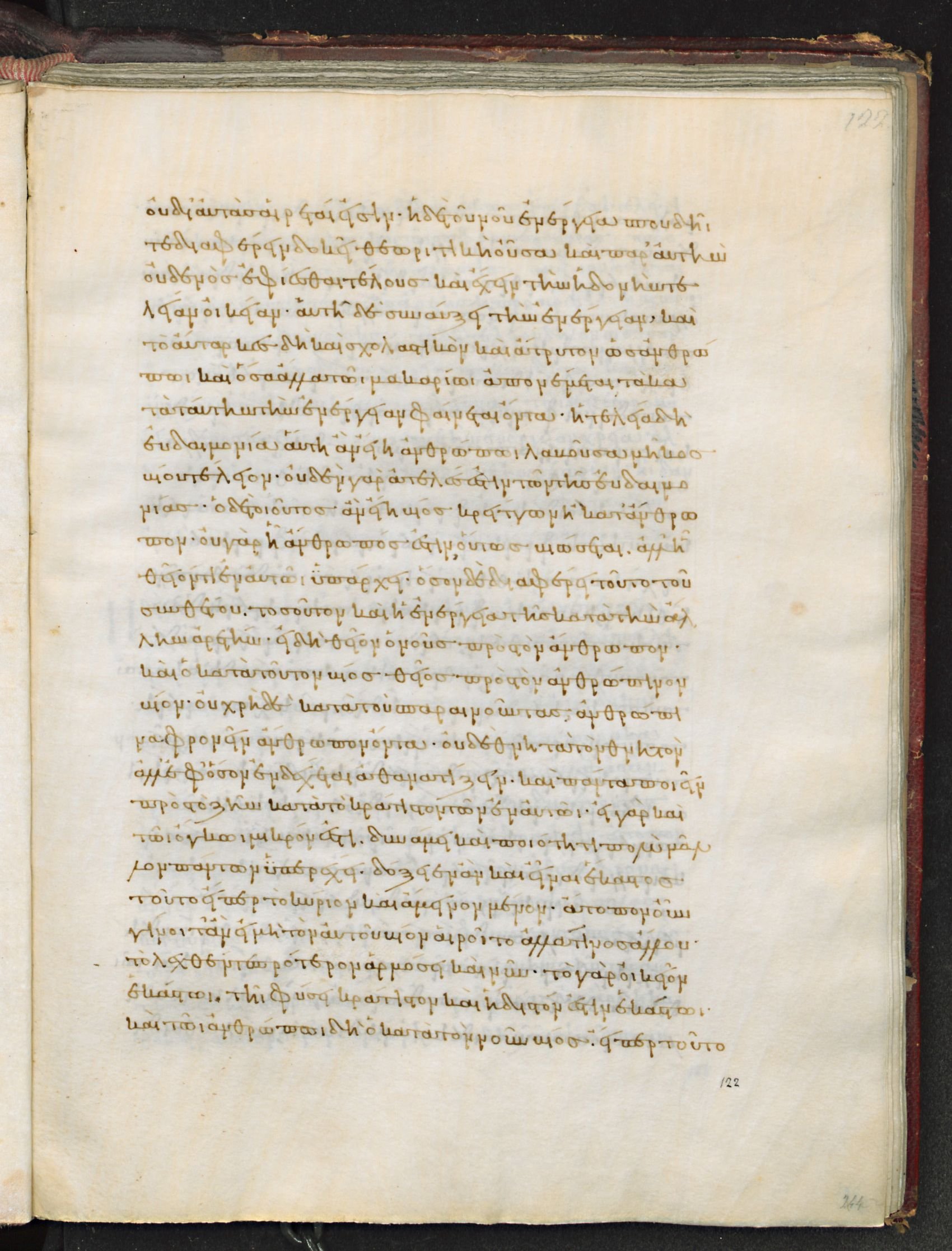
The words 'we ought so far as possible to achieve immortality' (ἐφʼ ὅσον ἐνδέχεται ἀθανατίζειν, 1177b33) are on fol. 122r. Laur. Plut. 81.11 fol. 121v begins '(κεχορηγη)μένων ὁ μὲν δίκαιος δεῖται πρὸς οὓς δικαιοπραγήσει' (1177a29-30) and ends 'αὗται δʼ ἄσχολοι καὶ τέλους τινὸς ἐφίενται καὶ' (1177b17-18). Laur. Plut. 81.11 fol. 122r begins 'οὐ διʼ αὑτὰς αἱρεταί εἰσιν, ἡ δὲ τοῦ νοῦ ἐνέργεια σπουδῇ' (1177b18-19) and ends 'καὶ τῷ ἀνθρώπῳ δὴ ὁ κατὰ τὸν νοῦν βίος, εἴπερ τοῦτο' (1178a6-7). Checked on the images. The Greek shown is Bywater's critical text; the copyists' wording differs from it in small details.
δόξαι τʼ ἂν αὐτὴ μόνη διʼ αὑτὴν ἀγαπᾶσθαι· οὐδὲν γὰρ ἀπʼ αὐτῆς γίνεται παρὰ τὸ θεωρῆσαι, ἀπὸ δὲ τῶν πρακτικῶν ἢ πλεῖον ἢ ἔλαττον περιποιούμεθα παρὰ τὴν πρᾶξιν. δοκεῖ τε ἡ εὐδαιμονία ἐν τῇ σχολῇ εἶναι· ἀσχολούμεθα γὰρ ἵνα σχολάζωμεν, καὶ πολεμοῦμεν ἵνʼ εἰρήνην ἄγωμεν. τῶν μὲν οὖν πρακτικῶν ἀρετῶν ἐν τοῖς πολιτικοῖς ἢ ἐν τοῖς πολεμικοῖς ἡ ἐνέργεια, αἱ δὲ περὶ ταῦτα πράξεις δοκοῦσιν ἄσχολοι εἶναι, αἱ μὲν πολεμικαὶ καὶ παντελῶς (οὐδεὶς γὰρ αἱρεῖται τὸ πολεμεῖν τοῦ πολεμεῖν ἕνεκα, οὐδὲ παρασκευάζει πόλεμον· δόξαι γὰρ ἂν παντελῶς μιαιφόνος τις εἶναι, εἰ τοὺς φίλους πολεμίους ποιοῖτο, ἵνα μάχαι καὶ φόνοι γίνοιντο)· ἔστι δὲ καὶ ἡ τοῦ πολιτικοῦ ἄσχολος, καὶ παρʼ αὐτὸ τὸ πολιτεύεσθαι περιποιουμένη δυναστείας καὶ τιμὰς ἢ τήν γε εὐδαιμονίαν αὑτῷ καὶ τοῖς πολίταις, ἑτέραν οὖσαν τῆς πολιτικῆς, ἣν καὶ ζητοῦμεν δῆλον ὡς ἑτέραν οὖσαν. εἰ δὴ τῶν μὲν κατὰ τὰς ἀρετὰς πράξεων αἱ πολιτικαὶ καὶ πολεμικαὶ κάλλει καὶ μεγέθει προέχουσιν, αὗται δʼ ἄσχολοι καὶ τέλους τινὸς ἐφίενται καὶ οὐ διʼ αὑτὰς αἱρεταί εἰσιν, ἡ δὲ τοῦ νοῦ ἐνέργεια σπουδῇ τε διαφέρειν δοκεῖ θεωρητικὴ οὖσα, καὶ παρʼ αὑτὴν οὐδενὸς ἐφίεσθαι τέλους, καὶ ἔχειν τὴν ἡδονὴν οἰκείαν (αὕτη δὲ συναύξει τὴν ἐνέργειαν), καὶ τὸ αὔταρκες δὴ καὶ σχολαστικὸν καὶ ἄτρυτον ὡς ἀνθρώπῳ, καὶ ὅσα ἄλλα τῷ μακαρίῳ ἀπονέμεται, τὰ κατὰ ταύτην τὴν ἐνέργειαν φαίνεται ὄντα· ἡ τελεία δὴ εὐδαιμονία αὕτη ἂν εἴη ἀνθρώπου, λαβοῦσα μῆκος βίου τέλειον· οὐδὲν γὰρ ἀτελές ἐστι τῶν τῆς εὐδαιμονίας. ὁ δὲ τοιοῦτος ἂν εἴη βίος κρείττων ἢ κατʼ ἄνθρωπον· οὐ γὰρ ᾗ ἄνθρωπός ἐστιν οὕτω βιώσεται, ἀλλʼ ᾗ θεῖόν τι ἐν αὐτῷ ὑπάρχει· ὅσον δὲ διαφέρει τοῦτο τοῦ συνθέτου, τοσοῦτον καὶ ἡ ἐνέργεια τῆς κατὰ τὴν ἄλλην ἀρετήν. εἰ δὴ θεῖον ὁ νοῦς πρὸς τὸν ἄνθρωπον, καὶ ὁ κατὰ τοῦτον βίος θεῖος πρὸς τὸν ἀνθρώπινον βίον. οὐ χρὴ δὲ κατὰ τοὺς παραινοῦντας ἀνθρώπινα φρονεῖν ἄνθρωπον ὄντα οὐδὲ θνητὰ τὸν θνητόν, ἀλλʼ ἐφʼ ὅσον ἐνδέχεται ἀθανατίζειν καὶ πάντα ποιεῖν πρὸς τὸ ζῆν κατὰ τὸ κράτιστον τῶν ἐν αὑτῷ· εἰ γὰρ καὶ τῷ ὄγκῳ μικρόν ἐστι,
Also the activity of contemplation may be held to be the only activity that is loved for its own sake: it produces no result beyond the actual act of contemplation, whereas from practical pursuits we look to secure some advantage, greater or smaller, beyond the action itself. Also happiness is thought to involve leisure; for we do business in order that we may have leisure, and carry on war in order that we may have peace. Now the practical virtues are exercised in politics or in warfare; but the pursuits of politics and war seem to be unleisured—those of war indeed entirely so, for no one desires to be at war for the sake of being at war, nor deliberately takes steps to cause a war: a man would be thought an utterly bloodthirsty character if he declared war on a friendly state for the sake of causing battles and massacres. But the activity of the politician also is unleisured, and aims at securing something beyond the mere participation in politics—positions of authority and honor, or, if the happiness of the politician himself and of his fellow-citizens, this happiness conceived as something distinct from political activity (indeed we are clearly investigating it as so distinct). If then among practical pursuits displaying the virtues, politics and war stand out preeminent in nobility and grandeur, and yet they are unleisured, and directed to some further end, not chosen for their own sakes: whereas the activity of the intellect is felt to excel in serious worth, consisting as it does in contemplation, and to aim at no end beyond itself, and also to contain a pleasure peculiar to itself, and therefore augmenting its activity: and if accordingly the attributes of this activity are found to be self-sufficiency, leisuredness, such freedom from fatigue as is possible for man, and all the other attributes of blessedness: it follows that it is the activity of the intellect that constitutes complete human happiness—provided it be granted a complete span of life, for nothing that belongs to happiness can be incomplete. Such a life as this however will be higher than the human level: not in virtue of his humanity will a man achieve it, but in virtue of something within him that is divine; and by as much as this something is superior to his composite nature, by so much is its activity superior to the exercise of the other forms of virtue. If then the intellect is something divine in comparison with man, so is the life of the intellect divine in comparison with human life. Nor ought we to obey those who enjoin that a man should have man’s thoughts and a mortal the thoughts of mortality, but we ought so far as possible to achieve immortality, and do all that man may to live in accordance with the highest thing in him; for though this be small in bulk,
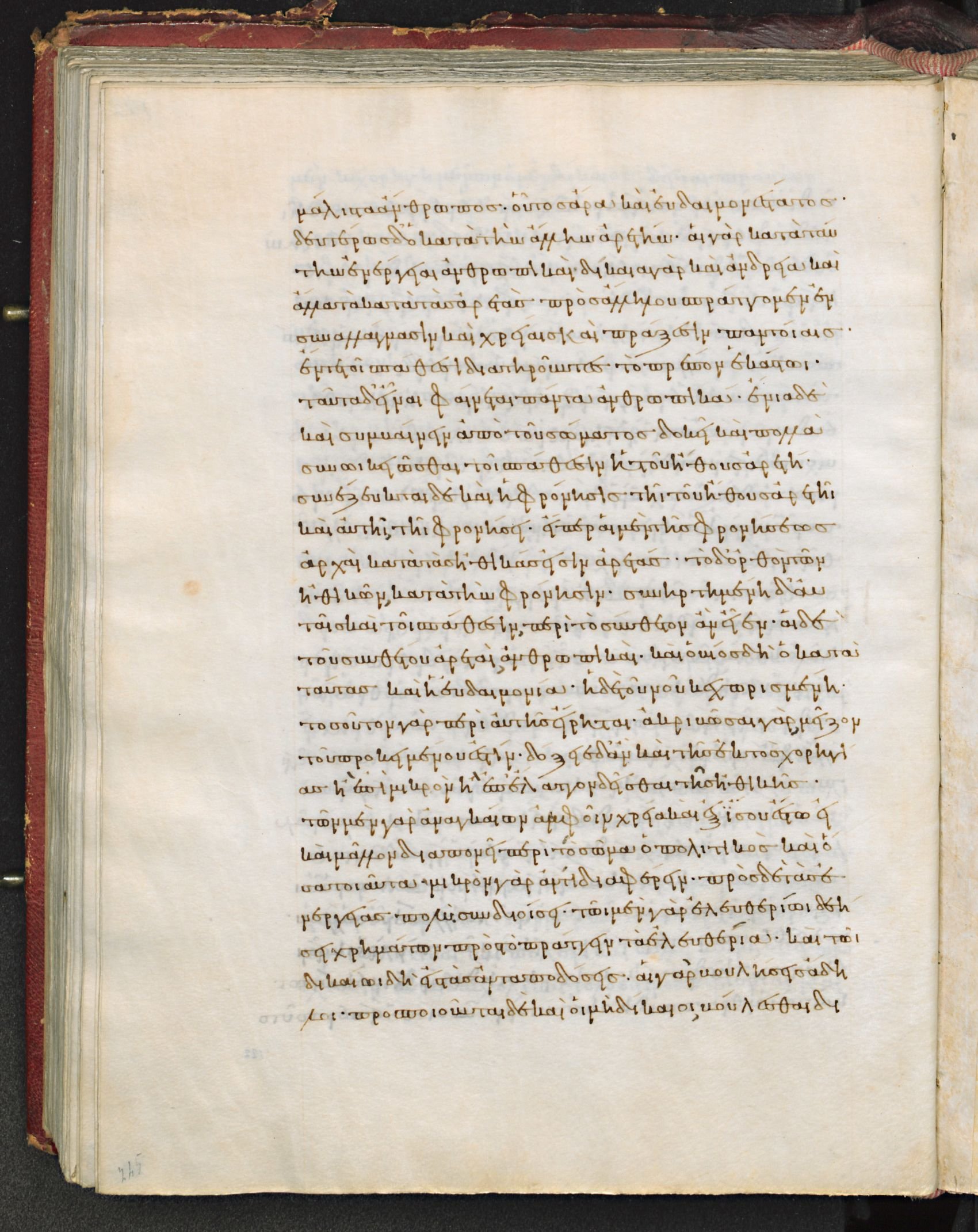
Where on the image
Laur. Plut. 81.11 fol. 122r begins 'οὐ διʼ αὑτὰς αἱρεταί εἰσιν, ἡ δὲ τοῦ νοῦ ἐνέργεια σπουδῇ' (1177b18-19) and ends 'καὶ τῷ ἀνθρώπῳ δὴ ὁ κατὰ τὸν νοῦν βίος, εἴπερ τοῦτο' (1178a6-7). Laur. Plut. 81.11 fol. 122v begins 'μάλιστα ἄνθρωπος. οὗτος ἄρα καὶ εὐδαιμονέστατος' (1178a7-8); chapter 10.8 begins on line 2 ('δευτέρως δʼ ὁ κατὰ τὴν ἄλλην ἀρετήν'); the page ends 'προσποιοῦνται δὲ καὶ οἱ μὴ δίκαιοι βούλεσθαι δι(καιοπραγεῖν)' (1178a30-31). Checked on the images. The Greek shown is Bywater's critical text; the copyists' wording differs from it in small details.
δυνάμει καὶ τιμιότητι πολὺ μᾶλλον πάντων ὑπερέχει. δόξειε δʼ ἂν καὶ εἶναι ἕκαστος τοῦτο, εἴπερ τὸ κύριον καὶ ἄμεινον. ἄτοπον οὖν γίνοιτʼ ἄν, εἰ μὴ τὸν αὑτοῦ βίον αἱροῖτο ἀλλά τινος ἄλλου. τὸ λεχθέν τε πρότερον ἁρμόσει καὶ νῦν· τὸ γὰρ οἰκεῖον ἑκάστῳ τῇ φύσει κράτιστον καὶ ἥδιστόν ἐστιν ἑκάστῳ· καὶ τῷ ἀνθρώπῳ δὴ ὁ κατὰ τὸν νοῦν βίος, εἴπερ τοῦτο μάλιστα ἄνθρωπος. οὗτος ἄρα καὶ εὐδαιμονέστατος.
in power and value it far surpasses all the rest. It may even be held that this is the true self of each, inasmuch as it is the dominant and better part; and therefore it would be a strange thing if a man should choose to live not his own life but the life of some other than himself. Moreover what was said before will apply here also: that which is best and most pleasant for each creature is that which is proper to the nature of each; accordingly the life of the intellect is the best and the pleasantest life for man, inasmuch as the intellect more than anything else is man; therefore this life will be the happiest.
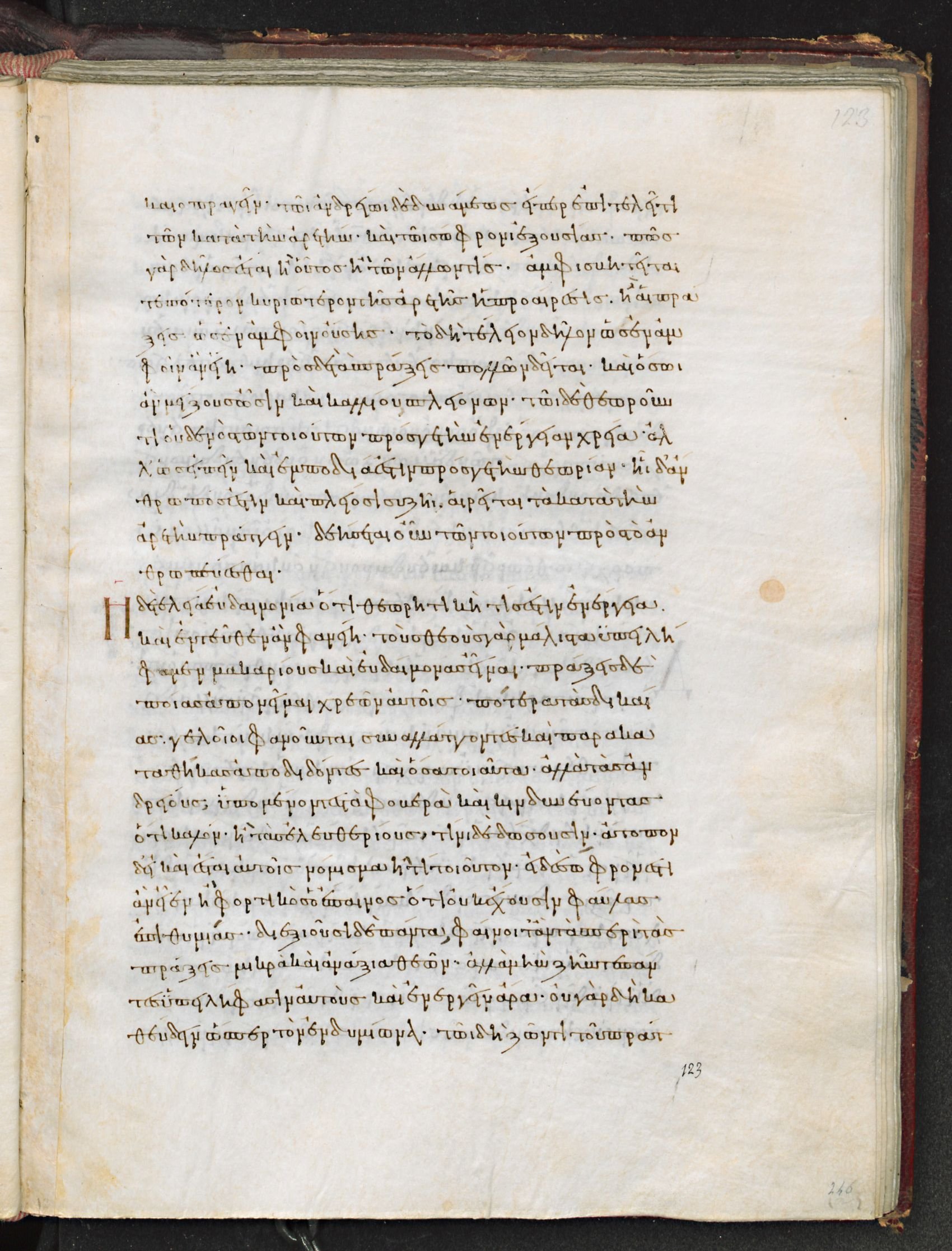
Where on the image
Laur. Plut. 81.11 fol. 122v begins 'μάλιστα ἄνθρωπος. οὗτος ἄρα καὶ εὐδαιμονέστατος' (1178a7-8); chapter 10.8 begins on line 2 ('δευτέρως δʼ ὁ κατὰ τὴν ἄλλην ἀρετήν'); the page ends 'προσποιοῦνται δὲ καὶ οἱ μὴ δίκαιοι βούλεσθαι δι(καιοπραγεῖν)' (1178a30-31). Laur. Plut. 81.11 fol. 123r begins '(δι)καιοπραγεῖν ... δυνάμεως, εἴπερ ἐπιτελεῖ τι' (1178a31-32) and ends 'καθεύδειν ὥσπερ τὸν Ἐνδυμίωνα. τῷ δὴ ζῶντι τοῦ πράτ(τειν)' (1178b19-20). Checked on the images. The Greek shown is Bywater's critical text; the copyists' wording differs from it in small details.
δευτέρως δʼ ὁ κατὰ τὴν ἄλλην ἀρετήν· αἱ γὰρ κατὰ ταύτην ἐνέργειαι ἀνθρωπικαί. δίκαια γὰρ καὶ ἀνδρεῖα καὶ τὰ ἄλλα τὰ κατὰ τὰς ἀρετὰς πρὸς ἀλλήλους πράττομεν ἐν συναλλάγμασι καὶ χρείαις καὶ πράξεσι παντοίαις ἔν τε τοῖς πάθεσι διατηροῦντες τὸ πρέπον ἑκάστῳ· ταῦτα δʼ εἶναι φαίνεται πάντα ἀνθρωπικά. ἔνια δὲ καὶ συμβαίνειν ἀπὸ τοῦ σώματος δοκεῖ, καὶ πολλὰ συνῳκειῶσθαι τοῖς πάθεσιν ἡ τοῦ ἤθους ἀρετή. συνέζευκται δὲ καὶ ἡ φρόνησις τῇ τοῦ ἤθους ἀρετῇ, καὶ αὕτη τῇ φρονήσει, εἴπερ αἱ μὲν τῆς φρονήσεως ἀρχαὶ κατὰ τὰς ἠθικάς εἰσιν ἀρετάς, τὸ δʼ ὀρθὸν τῶν ἠθικῶν κατὰ τὴν φρόνησιν. συνηρτημέναι δʼ αὗται καὶ τοῖς πάθεσι περὶ τὸ σύνθετον ἂν εἶεν· αἱ δὲ τοῦ συνθέτου ἀρεταὶ ἀνθρωπικαί· καὶ ὁ βίος δὴ ὁ κατὰ ταύτας καὶ ἡ εὐδαιμονία. ἡ δὲ τοῦ νοῦ κεχωρισμένη· τοσοῦτον γὰρ περὶ αὐτῆς εἰρήσθω· διακριβῶσαι γὰρ μεῖζον τοῦ προκειμένου ἐστίν. δόξειε δʼ ἂν καὶ τῆς ἐκτὸς χορηγίας ἐπὶ μικρὸν ἢ ἐπʼ ἔλαττον δεῖσθαι τῆς ἠθικῆς. τῶν μὲν γὰρ ἀναγκαίων ἀμφοῖν χρεία καὶ ἐξ ἴσου ἔστω, εἰ καὶ μᾶλλον διαπονεῖ περὶ τὸ σῶμα ὁ πολιτικός, καὶ ὅσα τοιαῦτα· μικρὸν γὰρ ἄν τι διαφέροι· πρὸς δὲ τὰς ἐνεργείας πολὺ διοίσει. τῷ μὲν γὰρ ἐλευθερίῳ δεήσει χρημάτων πρὸς τὸ πράττειν τὰ ἐλευθέρια, καὶ τῷ δικαίῳ δὴ εἰς τὰς ἀνταποδόσεις (αἱ γὰρ βουλήσεις ἄδηλοι, προσποιοῦνται δὲ καὶ οἱ μὴ δίκαιοι βούλεσθαι δικαιοπραγεῖν), τῷ ἀνδρείῳ δὲ δυνάμεως, εἴπερ ἐπιτελεῖ τι τῶν κατὰ τὴν ἀρετήν, καὶ τῷ σώφρονι ἐξουσίας· πῶς γὰρ δῆλος ἔσται ἢ οὗτος ἢ τῶν ἄλλων τις; ἀμφισβητεῖταί τε πότερον κυριώτερον τῆς ἀρετῆς ἡ προαίρεσις ἢ αἱ πράξεις, ὡς ἐν ἀμφοῖν οὔσης·
The life of moral virtue, on the other hand, is happy only in a secondary degree. For the moral activities are purely human: Justice, I mean, Courage and the other virtues we display in our intercourse with our fellows, when we observe what is due to each in contracts and services and in our various actions, and in our emotions also; and all of these things seem to be purely human affairs. And some moral actions are thought to be the outcome of the physical constitution, and moral virtue is thought to have a close affinity in many respects with the passions. Moreover, Prudence is intimately connected with Moral Virtue, and this with Prudence, inasmuch as the first Principles which Prudence employs are determined by the Moral Virtues, and the right standard for the Moral Virtues is determined by Prudence. But these being also connected with the passions are related to our composite nature; now the virtues of our composite nature are purely human; so therefore also is the life that manifests these virtues, and the happiness that belongs to it. Whereas the happiness that belongs to the intellect is separate: so much may be said about it here, for a full discussion of the matter is beyond the scope of our present purpose. And such happiness would appear to need but little external equipment, or less than the happiness based on moral virtue. Both, it may be granted, require the mere necessaries of life, and that in an equal degree (though the politician does as a matter of fact take more trouble about bodily requirements and so forth than the philosopher); for in this respect there may be little difference between them. But for the purpose of their special activities their requirements will differ widely. The liberal man will need wealth in order to do liberal actions, and so indeed will the just man in order to discharge his obligations (since mere intentions are invisible, and even the unjust pretend to wish to act justly); and the brave man will need strength if he is to perform any action displaying his virtue; and the temperate man opportunity for indulgence: otherwise how can he, or the possessor of any other virtue, show that he is virtuous? It is disputed also whether purpose or performance is the more important factor in virtue, as it is alleged to depend on both;
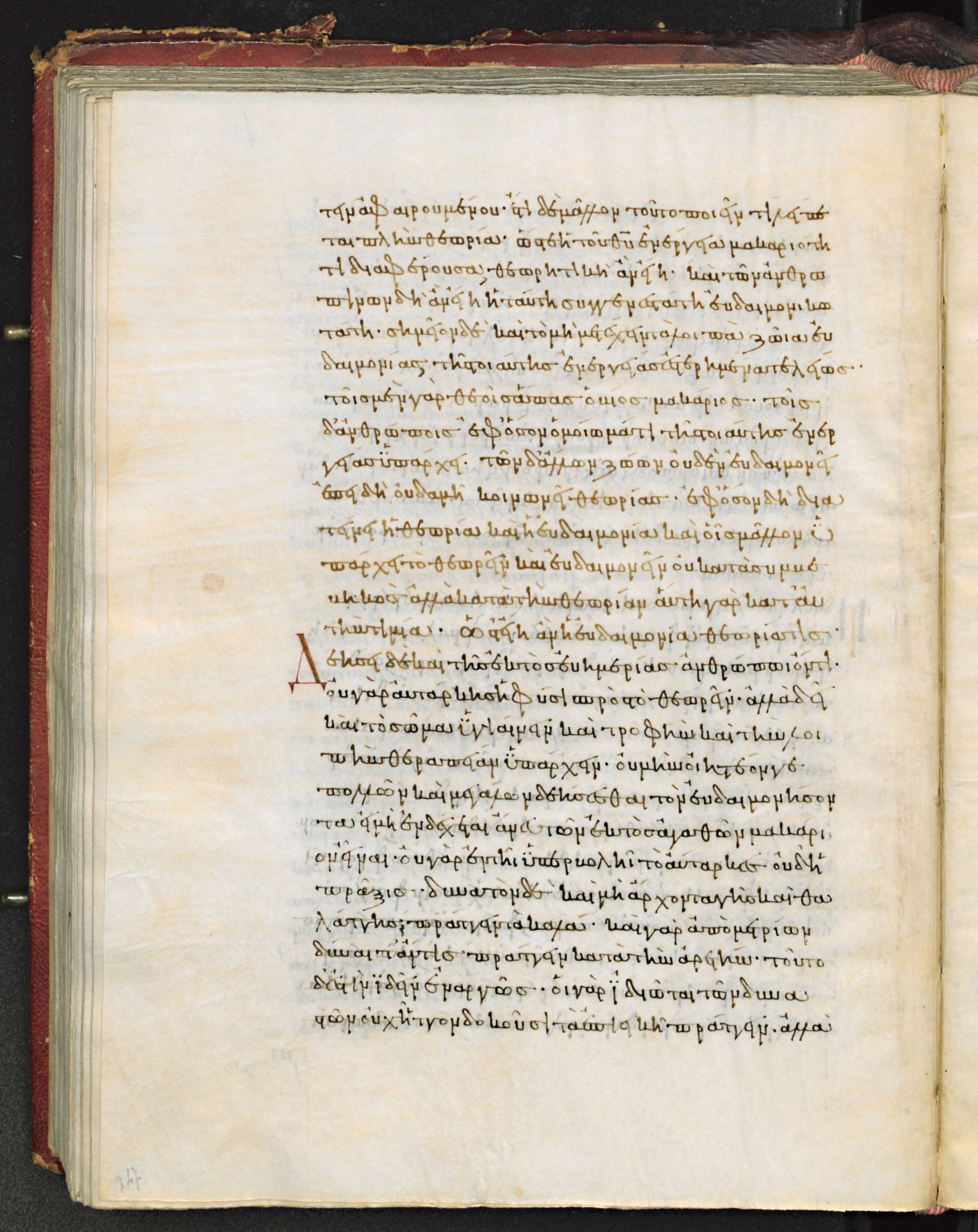
Where on the image
Laur. Plut. 81.11 fol. 123r begins '(δι)καιοπραγεῖν ... δυνάμεως, εἴπερ ἐπιτελεῖ τι' (1178a31-32) and ends 'καθεύδειν ὥσπερ τὸν Ἐνδυμίωνα. τῷ δὴ ζῶντι τοῦ πράτ(τειν)' (1178b19-20). Laur. Plut. 81.11 fol. 123v begins '(πράτ)τειν ἀφαιρουμένου, ἔτι δὲ μᾶλλον τοῦ ποιεῖν, τί λείπεται πλὴν θεωρία' (1178b20-21) and ends 'οὐχ ἧττον δοκοῦσι τὰ ἐπιεικῆ πράττειν, ἀλλὰ' (1179a7-8). Checked on the images. The Greek shown is Bywater's critical text; the copyists' wording differs from it in small details.
τὸ δὴ τέλειον δῆλον ὡς ἐν ἀμφοῖν ἂν εἴη· πρὸς δὲ τὰς πράξεις πολλῶν δεῖται, καὶ ὅσῳ ἂν μείζους ὦσι καὶ καλλίους, πλειόνων. τῷ δὲ θεωροῦντι οὐδενὸς τῶν τοιούτων πρός γε τὴν ἐνέργειαν χρεία, ἀλλʼ ὡς εἰπεῖν καὶ ἐμπόδιά ἐστι πρός γε τὴν θεωρίαν· ᾗ δʼ ἄνθρωπός ἐστι καὶ πλείοσι συζῇ, αἱρεῖται τὰ κατὰ τὴν ἀρετὴν πράττειν· δεήσεται οὖν τῶν τοιούτων πρὸς τὸ ἀνθρωπεύεσθαι. ἡ δὲ τελεία εὐδαιμονία ὅτι θεωρητική τις ἐστὶν ἐνέργεια, καὶ ἐντεῦθεν ἂν φανείη. τοὺς θεοὺς γὰρ μάλιστα ὑπειλήφαμεν μακαρίους καὶ εὐδαίμονας εἶναι· πράξεις δὲ ποίας ἀπονεῖμαι χρεὼν αὐτοῖς; πότερα τὰς δικαίας; ἢ γελοῖοι φανοῦνται συναλλάττοντες καὶ παρακαταθήκας ἀποδιδόντες καὶ ὅσα τοιαῦτα; ἀλλὰ τὰς ἀνδρείους ὑπομένοντας τὰ φοβερὰ καὶ κινδυνεύοντας ὅτι καλόν; ἢ τὰς ἐλευθερίους; τίνι δὲ δώσουσιν; ἄτοπον δʼ εἰ καὶ ἔσται αὐτοῖς νόμισμα ἤ τι τοιοῦτον. αἱ δὲ σώφρονες τί ἂν εἶεν; ἢ φορτικὸς ὁ ἔπαινος, ὅτι οὐκ ἔχουσι φαύλας ἐπιθυμίας; διεξιοῦσι δὲ πάντα φαίνοιτʼ ἂν τὰ περὶ τὰς πράξεις μικρὰ καὶ ἀνάξια θεῶν. ἀλλὰ μὴν ζῆν γε πάντες ὑπειλήφασιν αὐτοὺς καὶ ἐνεργεῖν ἄρα· οὐ γὰρ δὴ καθεύδειν ὥσπερ τὸν Ἐνδυμίωνα. τῷ δὴ ζῶντι τοῦ πράττειν ἀφαιρουμένου, ἔτι δὲ μᾶλλον τοῦ ποιεῖν, τί λείπεται πλὴν θεωρία; ὥστε ἡ τοῦ θεοῦ ἐνέργεια, μακαριότητι διαφέρουσα, θεωρητικὴ ἂν εἴη· καὶ τῶν ἀνθρωπίνων δὴ ἡ ταύτῃ συγγενεστάτη εὐδαιμονικωτάτη. σημεῖον δὲ καὶ τὸ μὴ μετέχειν τὰ λοιπὰ ζῷα εὐδαιμονίας, τῆς τοιαύτης ἐνεργείας ἐστερημένα τελείως. τοῖς μὲν γὰρ θεοῖς ἅπας ὁ βίος μακάριος, τοῖς δʼ ἀνθρώποις, ἐφʼ ὅσον ὁμοίωμά τι τῆς τοιαύτης ἐνεργείας ὑπάρχει· τῶν δʼ ἄλλων ζῴων οὐδὲν εὐδαιμονεῖ, ἐπειδὴ οὐδαμῇ κοινωνεῖ θεωρίας. ἐφʼ ὅσον δὴ διατείνει ἡ θεωρία, καὶ ἡ εὐδαιμονία, καὶ οἷς μᾶλλον ὑπάρχει τὸ θεωρεῖν, καὶ εὐδαιμονεῖν, οὐ κατὰ συμβεβηκὸς ἀλλὰ κατὰ τὴν θεωρίαν· αὕτη γὰρ καθʼ αὑτὴν τιμία. ὥστʼ εἴη ἂν ἡ εὐδαιμονία θεωρία τις. δεήσει δὲ καὶ τῆς ἐκτὸς εὐημερίας ἀνθρώπῳ ὄντι· οὐ γὰρ αὐτάρκης ἡ φύσις πρὸς τὸ θεωρεῖν, ἀλλὰ δεῖ καὶ τὸ σῶμα ὑγιαίνειν καὶ τροφὴν καὶ τὴν λοιπὴν θεραπείαν ὑπάρχειν.
now the perfection of virtue will clearly consist in both; but the performance of virtuous actions requires much outward equipment, and the more so the greater and more noble the actions are. But the student, so far as the pursuit of his activity is concerned, needs no external apparatus: on the contrary, worldly goods may almost be said to be a hindrance to contemplation; though it is true that, being a man and living in the society of others, he chooses to engage in virtuous action, and so will need external goods to carry on his life as a human being. The following considerations also will show that perfect happiness is some form of contemplative activity. The gods, as we conceive them, enjoy supreme felicity and happiness. But what sort of actions can we attribute to them? Just actions? but will it not seem ridiculous to think of them as making contracts, restoring deposits and the like? Then brave actions—enduring terrors and running risks for the nobility of so doing? Or liberal actions? but to whom will they give? Besides, it would be absurd to suppose that they actually have a coinage or currency of some sort! And temperate actions—what will these mean in their case? surely it would be derogatory to praise them for not having evil desires! If we go through the list we shall find that all forms of virtuous conduct seem trifling and unworthy of the gods. Yet nevertheless they have always been conceived as, at all events, living, and therefore living actively, for we cannot suppose they are always asleep like Endymion. But for a living being, if we eliminate action, and a fortiori creative action, what remains save contemplation? It follows that the activity of God, which is transcendent in blessedness, is the activity of contemplation; and therefore among human activities that which is most akin to the divine activity of contemplation will be the greatest source of happiness. A further confirmation is that the lower animals cannot partake of happiness, because they are completely devoid of the contemplative activity. The whole of the life of the gods is blessed, and that of man is so in so far as it contains some likeness to the divine activity; but none of the other animals possess happiness, because they are entirely incapable of contemplation. Happiness therefore is co-extensive in its range with contemplation: the more a class of beings possesses the faculty of contemplation, the more it enjoys happiness, not as an accidental concomitant of contemplation but as inherent in it, since contemplation is valuable in itself. It follows that happiness is some form of contemplation. But the philosopher being a man will also need external well—being, since man’s nature is not self—sufficient for the activity of contemplation, but he must also have bodily health and a supply of food and other requirements.
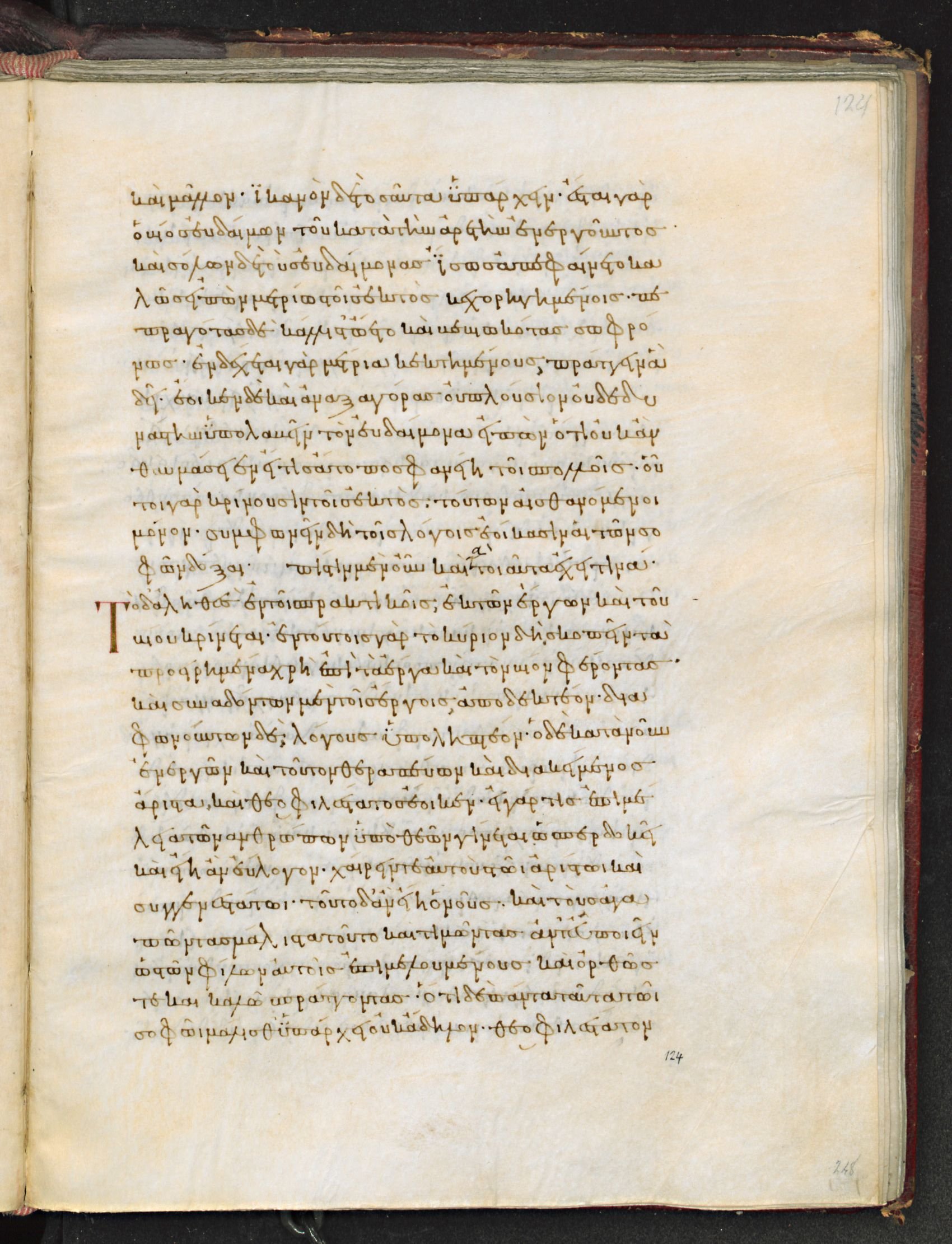
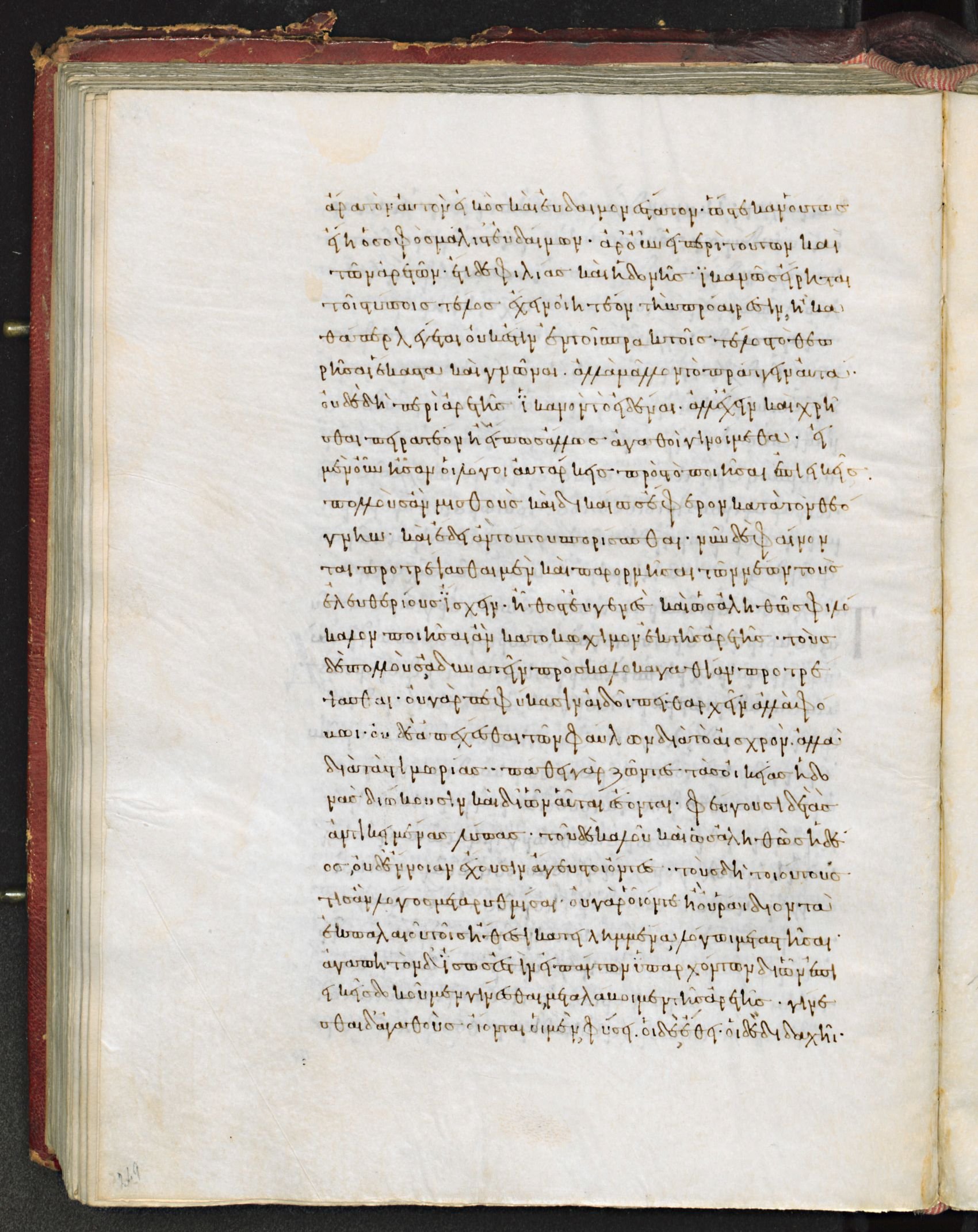
Where on the image
Laur. Plut. 81.11 fol. 123v begins '(πράτ)τειν ἀφαιρουμένου, ἔτι δὲ μᾶλλον τοῦ ποιεῖν, τί λείπεται πλὴν θεωρία' (1178b20-21) and ends 'οὐχ ἧττον δοκοῦσι τὰ ἐπιεικῆ πράττειν, ἀλλὰ' (1179a7-8). Laur. Plut. 81.11 fol. 124r begins '(καὶ) μᾶλλον. ἱκανὸν δὲ τοσαῦθʼ ὑπάρχειν· ἔσται γὰρ' (1179a8-9) and ends 'σοφῷ μάλισθʼ ὑπάρχει, οὐκ ἄδηλον. θεοφιλέστατος' (1179a29-30). Laur. Plut. 81.11 fol. 124v begins 'ἄρα. τὸν αὐτὸν δʼ εἰκὸς καὶ εὐδαιμονέστατον· ὥστε κἂν οὕτως' (1179a30-31); chapter 10.8 ends on line 2 ('εἴη ὁ σοφὸς μάλιστʼ εὐδαίμων'), where chapter 10.9 begins ('ἆρʼ οὖν εἰ περὶ τούτων'). Checked on the images. The Greek shown is Bywater's critical text; the copyists' wording differs from it in small details.
οὐ μὴν οἰητέον γε πολλῶν καὶ μεγάλων δεήσεσθαι τὸν εὐδαιμονήσοντα, εἰ μὴ ἐνδέχεται ἄνευ τῶν ἐκτὸς ἀγαθῶν μακάριον εἶναι· οὐ γὰρ ἐν τῇ ὑπερβολῇ τὸ αὔταρκες οὐδʼ ἡ πρᾶξις, δυνατὸν δὲ καὶ μὴ ἄρχοντα γῆς καὶ θαλάττης πράττειν τὰ καλά· καὶ γὰρ ἀπὸ μετρίων δύναιτʼ ἄν τις πράττειν κατὰ τὴν ἀρετήν (τοῦτο δʼ ἔστιν ἰδεῖν ἐναργῶς· οἱ γὰρ ἰδιῶται τῶν δυναστῶν οὐχ ἧττον δοκοῦσι τὰ ἐπιεικῆ πράττειν, ἀλλὰ καὶ μᾶλλον)· ἱκανὸν δὲ τοσαῦθʼ ὑπάρχειν· ἔσται γὰρ ὁ βίος εὐδαίμων τοῦ κατὰ τὴν ἀρετὴν ἐνεργοῦντος. καὶ Σόλων δὲ τοὺς εὐδαίμονας ἴσως ἀπεφαίνετο καλῶς, εἰπὼν μετρίως τοῖς ἐκτὸς κεχορηγημένους, πεπραγότας δὲ τὰ κάλλισθʼ, ὡς ᾤετο, καὶ βεβιωκότας σωφρόνως· ἐνδέχεται γὰρ μέτρια κεκτημένους πράττειν ἃ δεῖ. ἔοικε δὲ καὶ Ἀναξαγόρας οὐ πλούσιον οὐδὲ δυνάστην ὑπολαβεῖν τὸν εὐδαίμονα, εἰπὼν ὅτι οὐκ ἂν θαυμάσειεν εἴ τις ἄτοπος φανείη τοῖς πολλοῖς· οὗτοι γὰρ κρίνουσι τοῖς ἐκτός, τούτων αἰσθανόμενοι μόνον. συμφωνεῖν δὴ τοῖς λόγοις ἐοίκασιν αἱ τῶν σοφῶν δόξαι. πίστιν μὲν οὖν καὶ τὰ τοιαῦτα ἔχει τινά, τὸ δʼ ἀληθὲς ἐν τοῖς πρακτικοῖς ἐκ τῶν ἔργων καὶ τοῦ βίου κρίνεται· ἐν τούτοις γὰρ τὸ κύριον. σκοπεῖν δὴ τὰ προειρημένα χρὴ ἐπὶ τὰ ἔργα καὶ τὸν βίον φέροντας, καὶ συνᾳδόντων μὲν τοῖς ἔργοις ἀποδεκτέον, διαφωνούντων δὲ λόγους ὑποληπτέον. ὁ δὲ κατὰ νοῦν ἐνεργῶν καὶ τοῦτον θεραπεύων καὶ διακείμενος ἄριστα καὶ θεοφιλέστατος ἔοικεν. εἰ γάρ τις ἐπιμέλεια τῶν ἀνθρωπίνων ὑπὸ θεῶν γίνεται, ὥσπερ δοκεῖ, καὶ εἴη ἂν εὔλογον χαίρειν τε αὐτοὺς τῷ ἀρίστῳ καὶ συγγενεστάτῳ (τοῦτο δʼ ἂν εἴη ὁ νοῦς) καὶ τοὺς ἀγαπῶντας μάλιστα τοῦτο καὶ τιμῶντας ἀντευποιεῖν ὡς τῶν φίλων αὐτοῖς ἐπιμελουμένους καὶ ὀρθῶς τε καὶ καλῶς πράττοντας. ὅτι δὲ πάντα ταῦτα τῷ σοφῷ μάλισθʼ ὑπάρχει, οὐκ ἄδηλον. θεοφιλέστατος ἄρα. τὸν αὐτὸν δʼ εἰκὸς καὶ εὐδαιμονέστατον· ὥστε κἂν οὕτως εἴη ὁ σοφὸς μάλιστʼ εὐδαίμων.
Yet if supreme blessedness is not possible without external goods, it must not be supposed that happiness will demand many or great possessions; for self-sufficiency does not depend on excessive abundance, nor does moral conduct, and it is possible to perform noble deeds even without being ruler of land and sea: one can do virtuous acts with quite moderate resources. This may be clearly observed in experience: private citizens do not seem to be less but more given to doing virtuous actions than princes and potentates. It is sufficient then if moderate resources are forthcoming; for a life of virtuous activity will be essentially a happy life. Solon also doubtless gave a good description of happiness, when he said that in his opinion those men were happy who, being moderately equipped with external goods, had performed noble exploits and had lived temperately; for it is possible for a man of but moderate possessions to do what is right. Anaxagoras again does not seem to have conceived the happy man as rich or powerful, since he says that he would not be surprised if he were to appear a strange sort of person in the eyes of the many; for most men judge by externals, which are all that they can perceive. So our theories seem to be in agreement with the opinions of the wise. Such arguments then carry some degree of conviction; but it is by the practical experience of life and conduct that the truth is really tested, since it is ther that the final decision lies. We must therefore examine the conclusions we have advanced by bringing them to the test of the facts of life. If they are in harmony with the facts, we may accept them; if found to disagree, we must deem them mere theories. And it seems likely that the man who pursues intellectual activity, and who cultivates his intellect and keeps that in the best condition, is also the man most beloved of the gods. For if, as is generally believed, the gods exercise some superintendence over human affairs, then it will be reasonable to suppose that they take pleasure in that part of man which is best and most akin to themselves, namely the intellect, and that they recompense with their favors those men who esteem and honor this most, because these care for the things dear to themselves, and act rightly and nobly. Now it is clear that all these attributes belong most of all to the wise man. He therefore is most beloved by the gods; and if so, he is naturally most happy. Here is another proof that the wise man is the happiest.
Notes
- Greek: I. Bywater, Aristotelis Ethica Nicomachea (Oxford Classical Texts, 1894), Perseus digital text. Square brackets mark words Bywater deletes.
- English: H. Rackham, The Nicomachean Ethics (Loeb Classical Library, 1926), Perseus digital text. The English is divided at Rackham's own Bekker page markers, so a few words may fall on the neighbouring side of a break compared with the Greek.
Cite
Sources
- Source: Laur. Plut. 81.11 fol. 121v-124v (Teca Digitale, 10th c.) and Paris gr. 1854 fol. 175r-177v (Gallica, 12th c.) + Bywater Greek (Perseus) + H. Rackham English (Perseus) (holding institution)
- Critical edition: Bywater, Ethica Nicomachea (1894), via Perseus
← previous · → next · v cycle view · l back to library