Aristotle, Metaphysics 12.6-10 (Lambda): the unmoved mover and the life of god
Introduction
Book 12 (Lambda) of the Metaphysics is Aristotle's theology. Chapter 6 argues that since motion and time are eternal there must be an eternal substance that is pure activity, without matter. Chapter 7 describes it: it moves the heavens without being moved, and 'produces motion as being loved'; its activity is thinking, and 'the actuality of thought is life, and God is that actuality; and God's self-dependent actuality is life most good and eternal' (1072b26-28). Chapter 8 asks how many such movers there are, using the astronomy of Eudoxus and Callippus, and mentions the ancient tradition that the heavenly bodies are gods. Chapter 9 concludes that divine thought thinks itself, 'its thinking is a thinking on thinking' (1074b34). Chapter 10 asks how the good is present in the universe, both as its order and as its ruler, and ends with Homer's line 'The rule of many is not good; one ruler let there be.' Ancient and medieval readers, pagan, Jewish, Christian and Muslim, built on these chapters when they spoke of God as mind and of the human mind's likeness to him.
The pages shown are from Paris, Bibliotheque nationale de France, grec 1853 (siglum E), a 10th-century collection of Aristotle's works with scholia, fol. 293r-296v, about 47 lines to the page. Each section below is one chapter, linked to the pages that carry it; the pages were identified by reading the first and last lines of each page on the images. Chapters are used because the English translation used here has no Bekker line markers. The Greek is Ross's critical text, not a transcription of the manuscript.
How was this verified? (Provenance)
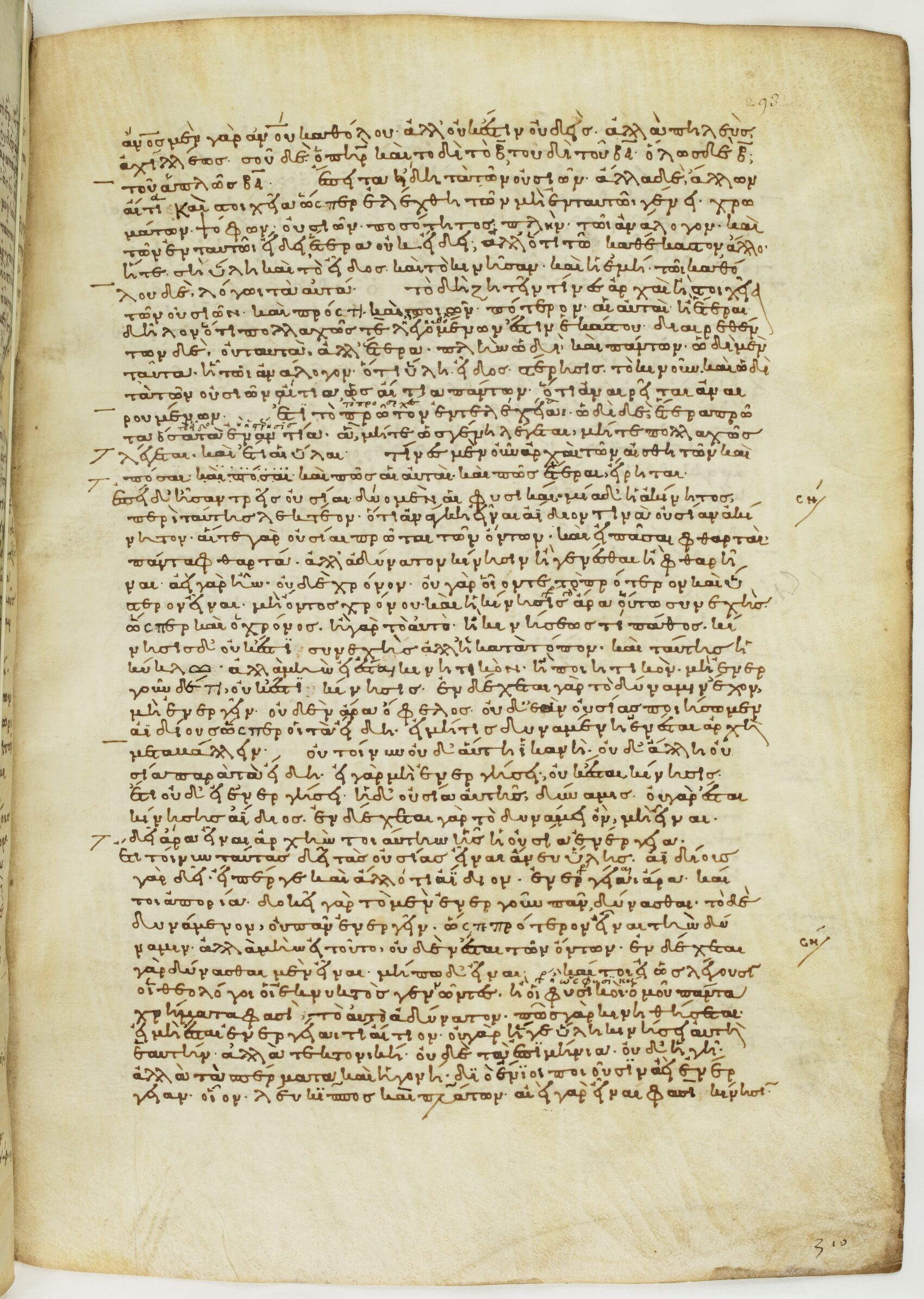
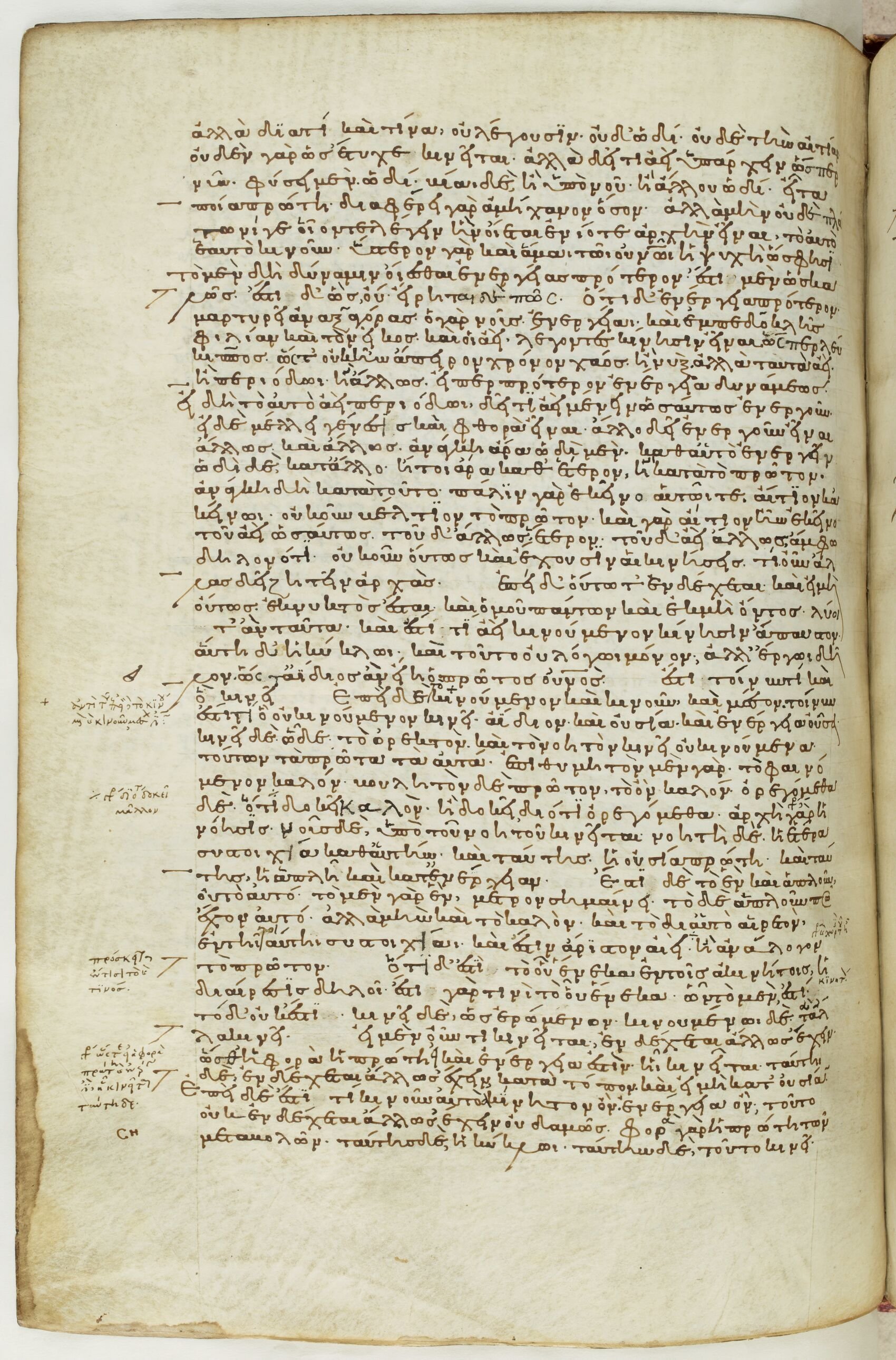
Where on the image
Paris gr. 1853 fol. 293r begins 'ἄνθρωπος μὲν γὰρ ἀνθρώπου καθόλου, ἀλλʼ οὐκ ἔστιν οὐδείς, ἀλλὰ Πηλεὺς Ἀχιλλέως' (1071a20-22) and ends 'οἷον Λεύκιππος καὶ Πλάτων· ἀεὶ γὰρ εἶναί φασι κίνησιν' (1071b32-33); chapter 6 ('ἐπεὶ δʼ ἦσαν τρεῖς οὐσίαι') begins on this page. Paris gr. 1853 fol. 293v begins 'ἀλλὰ διὰ τί καὶ τίνα οὐ λέγουσιν, οὐδʼ ὡδί, οὐδὲ τὴν αἰτίαν' (1071b33-35) and ends 'φορὰ γὰρ ἡ πρώτη τῶν μεταβολῶν, ταύτης δὲ ἡ κύκλῳ· ταύτην δὲ τοῦτο κινεῖ' (1072b8-10). Checked on the images; viewer https://gallica.bnf.fr/ark:/12148/btv1b84192492/f591.item , https://gallica.bnf.fr/ark:/12148/btv1b84192492/f592.item . The Greek shown is Ross's critical text; the copyist's wording differs from it in places.
ἐπεὶ δʼ ἦσαν τρεῖς οὐσίαι, δύο μὲν αἱ φυσικαὶ μία δʼ ἡ ἀκίνητος, περὶ ταύτης λεκτέον ὅτι ἀνάγκη εἶναι ἀΐδιόν τινα οὐσίαν ἀκίνητον. αἵ τε γὰρ οὐσίαι πρῶται τῶν ὄντων, καὶ εἰ πᾶσαι φθαρταί, πάντα φθαρτά· ἀλλʼ ἀδύνατον κίνησιν ἢ γενέσθαι ἢ φθαρῆναι (ἀεὶ γὰρ ἦν), οὐδὲ χρόνον. οὐ γὰρ οἷόν τε τὸ πρότερον καὶ ὕστερον εἶναι μὴ ὄντος χρόνου· καὶ ἡ κίνησις ἄρα οὕτω συνεχὴς ὥσπερ καὶ ὁ χρόνος· ἢ γὰρ τὸ αὐτὸ ἢ κινήσεώς τι πάθος. κίνησις δʼ οὐκ ἔστι συνεχὴς ἀλλʼ ἢ ἡ κατὰ τόπον, καὶ ταύτης ἡ κύκλῳ. ἀλλὰ μὴν εἰ ἔστι κινητικὸν ἢ ποιητικόν, μὴ ἐνεργοῦν δέ τι, οὐκ ἔσται κίνησις· ἐνδέχεται γὰρ τὸ δύναμιν ἔχον μὴ ἐνεργεῖν. οὐθὲν ἄρα ὄφελος οὐδʼ ἐὰν οὐσίας ποιήσωμεν ἀϊδίους, ὥσπερ οἱ τὰ εἴδη, εἰ μή τις δυναμένη ἐνέσται ἀρχὴ μεταβάλλειν· οὐ τοίνυν οὐδʼ αὕτη ἱκανή, οὐδʼ ἄλλη οὐσία παρὰ τὰ εἴδη· εἰ γὰρ μὴ ἐνεργήσει, οὐκ ἔσται κίνησις. ἔτι οὐδʼ εἰ ἐνεργήσει, ἡ δʼ οὐσία αὐτῆς δύναμις· οὐ γὰρ ἔσται κίνησις ἀΐδιος· ἐνδέχεται γὰρ τὸ δυνάμει ὂν μὴ εἶναι. δεῖ ἄρα εἶναι ἀρχὴν τοιαύτην ἧς ἡ οὐσία ἐνέργεια. ἔτι τοίνυν ταύτας δεῖ τὰς οὐσίας εἶναι ἄνευ ὕλης· ἀϊδίους γὰρ δεῖ, εἴπερ γε καὶ ἄλλο τι ἀΐδιον. ἐνέργεια ἄρα. καίτοι ἀπορία· δοκεῖ γὰρ τὸ μὲν ἐνεργοῦν πᾶν δύνασθαι τὸ δὲ δυνάμενον οὐ πᾶν ἐνεργεῖν, ὥστε πρότερον εἶναι τὴν δύναμιν. ἀλλὰ μὴν εἰ τοῦτο, οὐθὲν ἔσται τῶν ὄντων· ἐνδέχεται γὰρ δύνασθαι μὲν εἶναι μήπω δʼ εἶναι. καίτοι εἰ ὡς λέγουσιν οἱ θεολόγοι οἱ ἐκ νυκτὸς γεννῶντες, ἢ ὡς οἱ φυσικοὶ ὁμοῦ πάντα χρήματά φασι, τὸ αὐτὸ ἀδύνατον. πῶς γὰρ κινηθήσεται, εἰ μὴ ἔσται ἐνεργείᾳ τι αἴτιον; οὐ γὰρ ἥ γε ὕλη κινήσει αὐτὴ ἑαυτήν, ἀλλὰ τεκτονική, οὐδὲ τὰ ἐπιμήνια οὐδʼ ἡ γῆ, ἀλλὰ τὰ σπέρματα καὶ ἡ γονή. διὸ ἔνιοι ποιοῦσιν ἀεὶ ἐνέργειαν, οἷον Λεύκιππος καὶ Πλάτων· ἀεὶ γὰρ εἶναί φασι κίνησιν. ἀλλὰ διὰ τί καὶ τίνα οὐ λέγουσιν, οὐδʼ, εἰ ὡδὶ ἢ ὡδί, τὴν αἰτίαν. οὐδὲν γὰρ ὡς ἔτυχε κινεῖται, ἀλλὰ δεῖ τι ἀεὶ ὑπάρχειν, ἕσπερ νῦν φύσει μὲν ὡδί, βίᾳ δὲ ἢ ὑπὸ νοῦ ἢ ἄλλου ὡδί. (εἶτα ποία πρώτη; διαφέρει γὰρ ἀμήχανον ὅσον). ἀλλὰ μὴν οὐδὲ Πλάτωνί γε οἷόν τε λέγειν ἣν οἴεται ἐνίοτε ἀρχὴν εἶναι, τὸ αὐτὸ ἑαυτὸ κινοῦν· ὕστερον γὰρ καὶ ἅμα τῷ οὐρανῷ ἡ ψυχή, ὡς φησίν. τὸ μὲν δὴ δύναμιν οἴεσθαι ἐνεργείας πρότερον ἔστι μὲν ὡς καλῶς ἔστι δʼ ὡς οὔ (εἴρηται δὲ πῶς)· ὅτι δʼ ἐνέργεια πρότερον, μαρτυρεῖ Ἀναξαγόρας (ὁ γὰρ νοῦς ἐνέργεια) καὶ Ἐμπεδοκλῆς φιλίαν καὶ τὸ νεῖκος, καὶ οἱ ἀεὶ λέγοντες κίνησιν εἶναι, ὥσπερ Λεύκιππος· ὥστʼ οὐκ ἦν ἄπειρον χρόνον χάος ἢ νύξ, ἀλλὰ ταὐτὰ ἀεὶ ἢ περιόδῳ ἢ ἄλλως, εἴπερ πρότερον ἐνέργεια δυνάμεως. εἰ δὴ τὸ αὐτὸ ἀεὶ περιόδῳ, δεῖ τι ἀεὶ μένειν ὡσαύτως ἐνεργοῦν. εἰ δὲ μέλλει γένεσις καὶ φθορὰ εἶναι, ἄλλο δεῖ εἶναι ἀεὶ ἐνεργοῦν ἄλλως καὶ ἄλλως. ἀνάγκη ἄρα ὡδὶ μὲν καθʼ αὑτὸ ἐνεργεῖν ὡδὶ δὲ κατʼ ἄλλο· ἤτοι ἄρα καθʼ ἕτερον ἢ κατὰ τὸ πρῶτον. ἀνάγκη δὴ κατὰ τοῦτο· πάλιν γὰρ ἐκεῖνο αὐτῷ τε αἴτιον κἀκείνῳ. οὐκοῦν βέλτιον τὸ πρῶτον· καὶ γὰρ αἴτιον ἦν ἐκεῖνο τοῦ ἀεὶ ὡσαύτως· τοῦ δʼ ἄλλως ἕτερον, τοῦ δʼ ἀεὶ ἄλλως ἄμφω δηλονότι. οὐκοῦν οὕτως καὶ ἔχουσιν αἱ κινήσεις. τί οὖν ἄλλας δεῖ ζητεῖν ἀρχάς;
Since there were three kinds of substance, two of them physical and one unmovable, regarding the latter we must assert that it is necessary that there should be an eternal unmovable substance. For substances are the first of existing things, and if they are all destructible, all things are destructible. But it is impossible that movement should either have come into being or cease to be (for it must always have existed), or that time should. For there could not be a before and an after if time did not exist. Movement also is continuous, then, in the sense in which time is; for time is either the same thing as movement or an attribute of movement. And there is no continuous movement except movement in place, and of this only that which is circular is continuous.
But if there is something which is capable of moving things or acting on them, but is not actually doing so, there will not necessarily be movement; for that which has a potency need not exercise it. Nothing, then, is gained even if we suppose eternal substances, as the believers in the Forms do, unless there is to be in them some principle which can cause change; nay, even this is not enough, nor is another substance besides the Forms enough; for if it is not to act, there will be no movement. Further even if it acts, this will not be enough, if its essence is potency; for there will not be eternal movement, since that which is potentially may possibly not be. There must, then, be such a principle, whose very essence is actuality. Further, then, these substances must be without matter; for they must be eternal, if anything is eternal. Therefore they must be actuality.
Yet there is a difficulty; for it is thought that everything that acts is able to act, but that not everything that is able to act acts, so that the potency is prior. But if this is so, nothing that is need be; for it is possible for all things to be capable of existing but not yet to exist.
Yet if we follow the theologians who generate the world from night, or the natural philosophers who say that 'all things were together', the same impossible result ensues. For how will there be movement, if there is no actually existing cause? Wood will surely not move itself-the carpenter's art must act on it; nor will the menstrual blood nor the earth set themselves in motion, but the seeds must act on the earth and the semen on the menstrual blood.
This is why some suppose eternal actuality-e.g. Leucippus and Plato; for they say there is always movement. But why and what this movement is they do say, nor, if the world moves in this way or that, do they tell us the cause of its doing so. Now nothing is moved at random, but there must always be something present to move it; e.g. as a matter of fact a thing moves in one way by nature, and in another by force or through the influence of reason or something else. (Further, what sort of movement is primary? This makes a vast difference.) But again for Plato, at least, it is not permissible to name here that which he sometimes supposes to be the source of movement-that which moves itself; for the soul is later, and coeval with the heavens, according to his account. To suppose potency prior to actuality, then, is in a sense right, and in a sense not; and we have specified these senses. That actuality is prior is testified by Anaxagoras (for his 'reason' is actuality) and by Empedocles in his doctrine of love and strife, and by those who say that there is always movement, e.g. Leucippus. Therefore chaos or night did not exist for an infinite time, but the same things have always existed (either passing through a cycle of changes or obeying some other law), since actuality is prior to potency. If, then, there is a constant cycle, something must always remain, acting in the same way. And if there is to be generation and destruction, there must be something else which is always acting in different ways. This must, then, act in one way in virtue of itself, and in another in virtue of something else-either of a third agent, therefore, or of the first. Now it must be in virtue of the first. For otherwise this again causes the motion both of the second agent and of the third. Therefore it is better to say 'the first'. For it was the cause of eternal uniformity; and something else is the cause of variety, and evidently both together are the cause of eternal variety. This, accordingly, is the character which the motions actually exhibit. What need then is there to seek for other principles?
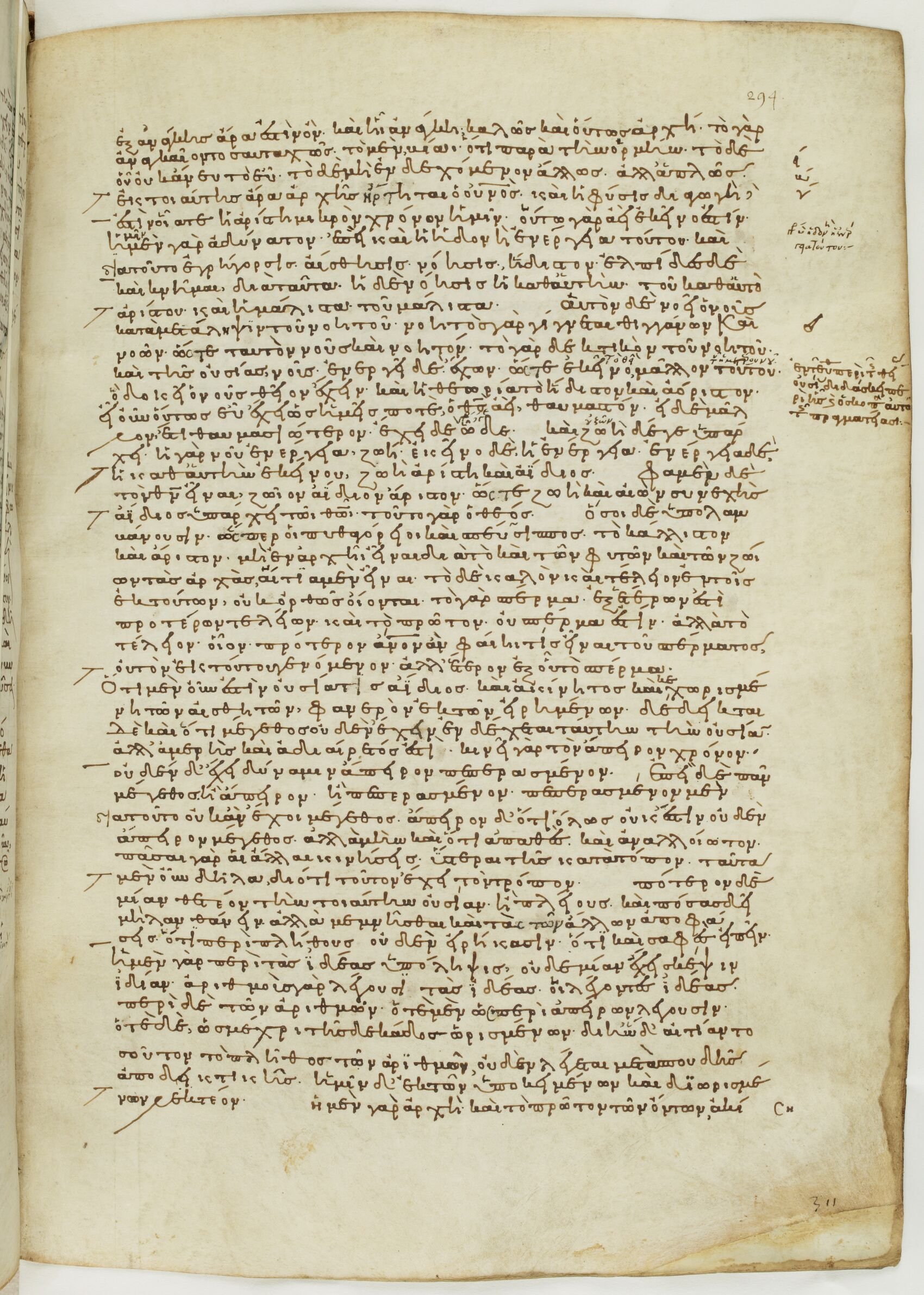
Where on the image
Paris gr. 1853 fol. 293v begins 'ἀλλὰ διὰ τί καὶ τίνα οὐ λέγουσιν, οὐδʼ ὡδί, οὐδὲ τὴν αἰτίαν' (1071b33-35) and ends 'φορὰ γὰρ ἡ πρώτη τῶν μεταβολῶν, ταύτης δὲ ἡ κύκλῳ· ταύτην δὲ τοῦτο κινεῖ' (1072b8-10). Paris gr. 1853 fol. 294r begins 'ἐξ ἀνάγκης ἄρα ἐστὶν ὄν· καὶ ᾗ ἀνάγκῃ, καλῶς, καὶ οὕτως ἀρχή' (1072b10-11) and ends 'ἡ μὲν γὰρ ἀρχὴ καὶ τὸ πρῶτον τῶν ὄντων ἀκί(νητον)' (1073a23-24); chapter 8 ('πότερον δὲ μίαν θετέον', 1073a14) begins on this page. Checked on the images; viewer https://gallica.bnf.fr/ark:/12148/btv1b84192492/f592.item , https://gallica.bnf.fr/ark:/12148/btv1b84192492/f593.item . The Greek shown is Ross's critical text; the copyist's wording differs from it in places.
ἐπεὶ δʼ οὕτω τʼ ἐνδέχεται, καὶ εἰ μὴ οὕτως, ἐκ νυκτὸς ἔσται καὶ ὁμοῦ πάντων καὶ ἐκ μὴ ὄντος, λύοιτʼ ἂν ταῦτα, καὶ ἔστι τι ἀεὶ κινούμενον κίνησιν ἄπαυστον, αὕτη δʼ ἡ κύκλῳ (καὶ τοῦτο οὐ λόγῳ μόνον ἀλλʼ ἔργῳ δῆλον), ὥστʼ ἀΐδιος ἂν εἴη ὁ πρῶτος οὐρανός. ἔστι τοίνυν τι καὶ ὃ κινεῖ. ἐπεὶ δὲ τὸ κινούμενον καὶ κινοῦν [καὶ] μέσον, †τοίνυν† ἔστι τι ὃ οὐ κινούμενον κινεῖ, ἀΐδιον καὶ οὐσία καὶ ἐνέργεια οὖσα. κινεῖ δὲ ὧδε τὸ ὀρεκτὸν καὶ τὸ νοητόν· κινεῖ οὐ κινούμενα. τούτων τὰ πρῶτα τὰ αὐτά. ἐπιθυμητὸν μὲν γὰρ τὸ φαινόμενον καλόν, βουλητὸν δὲ πρῶτον τὸ ὂν καλόν· ὀρεγόμεθα δὲ διότι δοκεῖ μᾶλλον ἢ δοκεῖ διότι ὀρεγόμεθα· ἀρχὴ γὰρ ἡ νόησις. νοῦς δὲ ὑπὸ τοῦ νοητοῦ κινεῖται, νοητὴ δὲ ἡ ἑτέρα συστοιχία καθʼ αὑτήν· καὶ ταύτης ἡ οὐσία πρώτη, καὶ ταύτης ἡ ἁπλῆ καὶ κατʼ ἐνέργειαν (ἔστι δὲ τὸ ἓν καὶ τὸ ἁπλοῦν οὐ τὸ αὐτό· τὸ μὲν γὰρ ἓν μέτρον σημαίνει, τὸ δὲ ἁπλοῦν πὼς ἔχον αὐτό). ἀλλὰ μὴν καὶ τὸ καλὸν καὶ τὸ διʼ αὑτὸ αἱρετὸν ἐν τῇ αὐτῇ συστοιχίᾳ· καὶ ἔστιν ἄριστον ἀεὶ ἢ ἀνάλογον τὸ πρῶτον. ὅτι δʼ ἔστι τὸ οὗ ἕνεκα ἐν τοῖς ἀκινήτοις, ἡ διαίρεσις δηλοῖ· ἔστι γὰρ τινὶ τὸ οὗ ἕνεκα καὶ τινός, ὧν τὸ μὲν ἔστι τὸ δʼ οὐκ ἔστι. κινεῖ δὴ ὡς ἐρώμενον, κινούμενα δὲ τἆλλα κινεῖ. εἰ μὲν οὖν τι κινεῖται, ἐνδέχεται καὶ ἄλλως ἔχειν, ὥστʼ εἰ [ἡ] φορὰ πρώτη ἡ ἐνέργειά ἐστιν, ᾗ κινεῖται ταύτῃ γε ἐνδέχεται ἄλλως ἔχειν, κατὰ τόπον, καὶ εἰ μὴ κατʼ οὐσίαν· ἐπεὶ δὲ ἔστι τι κινοῦν αὐτὸ ἀκίνητον ὄν, ἐνεργείᾳ ὄν, τοῦτο οὐκ ἐνδέχεται ἄλλως ἔχειν οὐδαμῶς. φορὰ γὰρ ἡ πρώτη τῶν μεταβολῶν, ταύτης δὲ ἡ κύκλῳ· ταύτην δὲ τοῦτο κινεῖ. ἐξ ἀνάγκης ἄρα ἐστὶν ὄν· καὶ ᾗ ἀνάγκῃ, καλῶς, καὶ οὕτως ἀρχή. τὸ γὰρ ἀναγκαῖον τοσαυταχῶς, τὸ μὲν βίᾳ ὅτι παρὰ τὴν ὁρμήν, τὸ δὲ οὗ οὐκ ἄνευ τὸ εὖ, τὸ δὲ μὴ ἐνδεχόμενον ἄλλως ἀλλʼ ἁπλῶς.—ἐκ τοιαύτης ἄρα ἀρχῆς ἤρτηται ὁ οὐρανὸς καὶ ἡ φύσις. διαγωγὴ δʼ ἐστὶν οἵα ἡ ἀρίστη μικρὸν χρόνον ἡμῖν (οὕτω γὰρ ἀεὶ ἐκεῖνο· ἡμῖν μὲν γὰρ ἀδύνατον), ἐπεὶ καὶ ἡδονὴ ἡ ἐνέργεια τούτου (καὶ διὰ τοῦτο ἐγρήγορσις αἴσθησις νόησις ἥδιστον, ἐλπίδες δὲ καὶ μνῆμαι διὰ ταῦτα). ἡ δὲ νόησις ἡ καθʼ αὑτὴν τοῦ καθʼ αὑτὸ ἀρίστου, καὶ ἡ μάλιστα τοῦ μάλιστα. αὑτὸν δὲ νοεῖ ὁ νοῦς κατὰ μετάληψιν τοῦ νοητοῦ· νοητὸς γὰρ γίγνεται θιγγάνων καὶ νοῶν, ὥστε ταὐτὸν νοῦς καὶ νοητόν. τὸ γὰρ δεκτικὸν τοῦ νοητοῦ καὶ τῆς οὐσίας νοῦς, ἐνεργεῖ δὲ ἔχων, ὥστʼ ἐκείνου μᾶλλον τοῦτο ὃ δοκεῖ ὁ νοῦς θεῖον ἔχειν, καὶ ἡ θεωρία τὸ ἥδιστον καὶ ἄριστον. εἰ οὖν οὕτως εὖ ἔχει, ὡς ἡμεῖς ποτέ, ὁ θεὸς ἀεί, θαυμαστόν· εἰ δὲ μᾶλλον, ἔτι θαυμασιώτερον. ἔχει δὲ ὧδε. καὶ ζωὴ δέ γε ὑπάρχει· ἡ γὰρ νοῦ ἐνέργεια ζωή, ἐκεῖνος δὲ ἡ ἐνέργεια· ἐνέργεια δὲ ἡ καθʼ αὑτὴν ἐκείνου ζωὴ ἀρίστη καὶ ἀΐδιος. φαμὲν δὴ τὸν θεὸν εἶναι ζῷον ἀΐδιον ἄριστον, ὥστε ζωὴ καὶ αἰὼν συνεχὴς καὶ ἀΐδιος ὑπάρχει τῷ θεῷ· τοῦτο γὰρ ὁ θεός. ὅσοι δὲ ὑπολαμβάνουσιν, ὥσπερ οἱ Πυθαγόρειοι καὶ Σπεύσιππος τὸ κάλλιστον καὶ ἄριστον μὴ ἐν ἀρχῇ εἶναι, διὰ τὸ καὶ τῶν φυτῶν καὶ τῶν ζῴων τὰς ἀρχὰς αἴτια μὲν εἶναι τὸ δὲ καλὸν καὶ τέλειον ἐν τοῖς ἐκ τούτων, οὐκ ὀρθῶς οἴονται. τὸ γὰρ σπέρμα ἐξ ἑτέρων ἐστὶ προτέρων τελείων, καὶ τὸ πρῶτον οὐ σπέρμα ἐστὶν ἀλλὰ τὸ τέλειον· οἷον πρότερον ἄνθρωπον ἂν φαίη τις εἶναι τοῦ σπέρματος, οὐ τὸν ἐκ τούτου γενόμενον ἀλλʼ ἕτερον ἐξ οὗ τὸ σπέρμα. ὅτι μὲν οὖν ἔστιν οὐσία τις ἀΐδιος καὶ ἀκίνητος καὶ κεχωρισμένη τῶν αἰσθητῶν, φανερὸν ἐκ τῶν εἰρημένων· δέδεικται δὲ καὶ ὅτι μέγεθος οὐδὲν ἔχειν ἐνδέχεται ταύτην τὴν οὐσίαν ἀλλʼ ἀμερὴς καὶ ἀδιαίρετός ἐστιν (κινεῖ γὰρ τὸν ἄπειρον χρόνον, οὐδὲν δʼ ἔχει δύναμιν ἄπειρον πεπερασμένον· ἐπεὶ δὲ πᾶν μέγεθος ἢ ἄπειρον ἢ πεπερασμένον, πεπερασμένον μὲν διὰ τοῦτο οὐκ ἂν ἔχοι μέγεθος, ἄπειρον δʼ ὅτι ὅλως οὐκ ἔστιν οὐδὲν ἄπειρον μέγεθος)· ἀλλὰ μὴν καὶ ὅτι ἀπαθὲς καὶ ἀναλλοίωτον· πᾶσαι γὰρ αἱ ἄλλαι κινήσεις ὕστεραι τῆς κατὰ τόπον. ταῦτα μὲν οὖν δῆλα διότι τοῦτον ἔχει τὸν τρόπον.
Since (1) this is a possible account of the matter, and (2) if it were not true, the world would have proceeded out of night and 'all things together' and out of non-being, these difficulties may be taken as solved. There is, then, something which is always moved with an unceasing motion, which is motion in a circle; and this is plain not in theory only but in fact. Therefore the first heaven must be eternal. There is therefore also something which moves it. And since that which moves and is moved is intermediate, there is something which moves without being moved, being eternal, substance, and actuality. And the object of desire and the object of thought move in this way; they move without being moved. The primary objects of desire and of thought are the same. For the apparent good is the object of appetite, and the real good is the primary object of rational wish. But desire is consequent on opinion rather than opinion on desire; for the thinking is the starting-point. And thought is moved by the object of thought, and one of the two columns of opposites is in itself the object of thought; and in this, substance is first, and in substance, that which is simple and exists actually. (The one and the simple are not the same; for 'one' means a measure, but 'simple' means that the thing itself has a certain nature.) But the beautiful, also, and that which is in itself desirable are in the same column; and the first in any class is always best, or analogous to the best.
That a final cause may exist among unchangeable entities is shown by the distinction of its meanings. For the final cause is (a) some being for whose good an action is done, and (b) something at which the action aims; and of these the latter exists among unchangeable entities though the former does not. The final cause, then, produces motion as being loved, but all other things move by being moved. Now if something is moved it is capable of being otherwise than as it is. Therefore if its actuality is the primary form of spatial motion, then in so far as it is subject to change, in this respect it is capable of being otherwise,-in place, even if not in substance. But since there is something which moves while itself unmoved, existing actually, this can in no way be otherwise than as it is. For motion in space is the first of the kinds of change, and motion in a circle the first kind of spatial motion; and this the first mover produces. The first mover, then, exists of necessity; and in so far as it exists by necessity, its mode of being is good, and it is in this sense a first principle. For the necessary has all these senses-that which is necessary perforce because it is contrary to the natural impulse, that without which the good is impossible, and that which cannot be otherwise but can exist only in a single way.
On such a principle, then, depend the heavens and the world of nature. And it is a life such as the best which we enjoy, and enjoy for but a short time (for it is ever in this state, which we cannot be), since its actuality is also pleasure. (And for this reason are waking, perception, and thinking most pleasant, and hopes and memories are so on account of these.) And thinking in itself deals with that which is best in itself, and that which is thinking in the fullest sense with that which is best in the fullest sense. And thought thinks on itself because it shares the nature of the object of thought; for it becomes an object of thought in coming into contact with and thinking its objects, so that thought and object of thought are the same. For that which is capable of receiving the object of thought, i.e. the essence, is thought. But it is active when it possesses this object. Therefore the possession rather than the receptivity is the divine element which thought seems to contain, and the act of contemplation is what is most pleasant and best. If, then, God is always in that good state in which we sometimes are, this compels our wonder; and if in a better this compels it yet more. And God is in a better state. And life also belongs to God; for the actuality of thought is life, and God is that actuality; and God's self-dependent actuality is life most good and eternal. We say therefore that God is a living being, eternal, most good, so that life and duration continuous and eternal belong to God; for this is God.
Those who suppose, as the Pythagoreans and Speusippus do, that supreme beauty and goodness are not present in the beginning, because the beginnings both of plants and of animals are causes, but beauty and completeness are in the effects of these, are wrong in their opinion. For the seed comes from other individuals which are prior and complete, and the first thing is not seed but the complete being; e.g. we must say that before the seed there is a man,-not the man produced from the seed, but another from whom the seed comes.
It is clear then from what has been said that there is a substance which is eternal and unmovable and separate from sensible things. It has been shown also that this substance cannot have any magnitude, but is without parts and indivisible (for it produces movement through infinite time, but nothing finite has infinite power; and, while every magnitude is either infinite or finite, it cannot, for the above reason, have finite magnitude, and it cannot have infinite magnitude because there is no infinite magnitude at all). But it has also been shown that it is impassive and unalterable; for all the other changes are posterior to change of place.
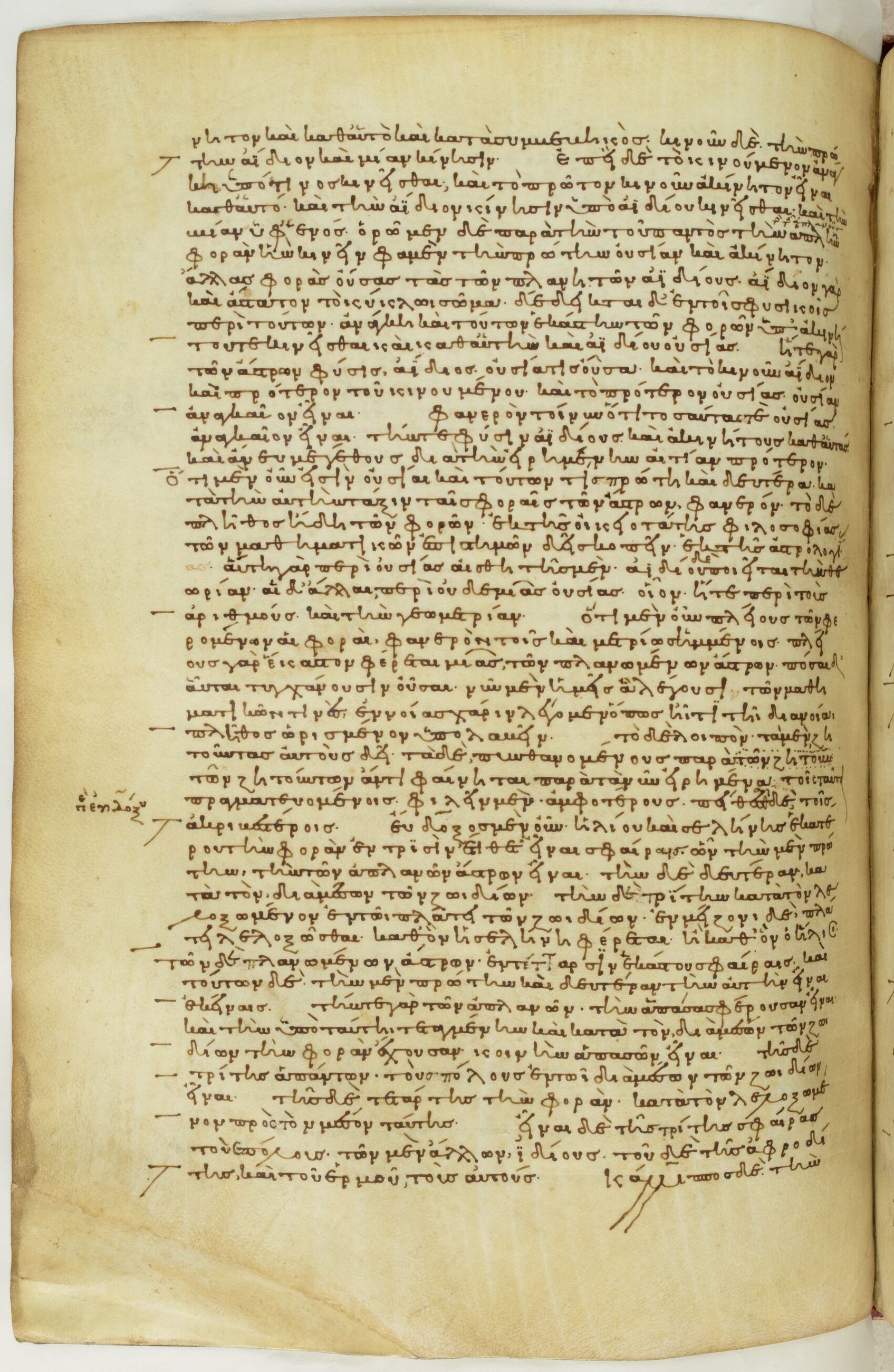
Where on the image
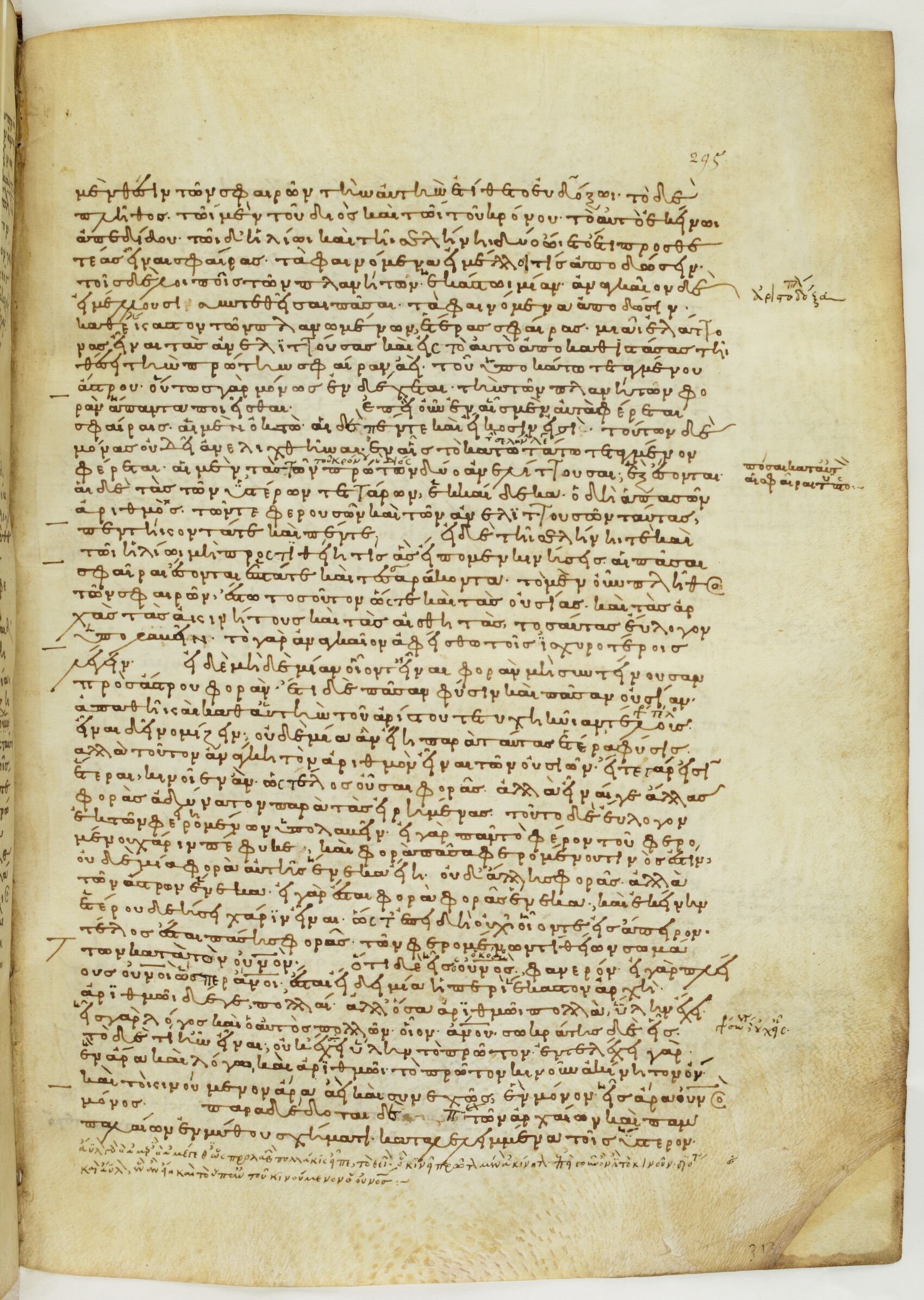
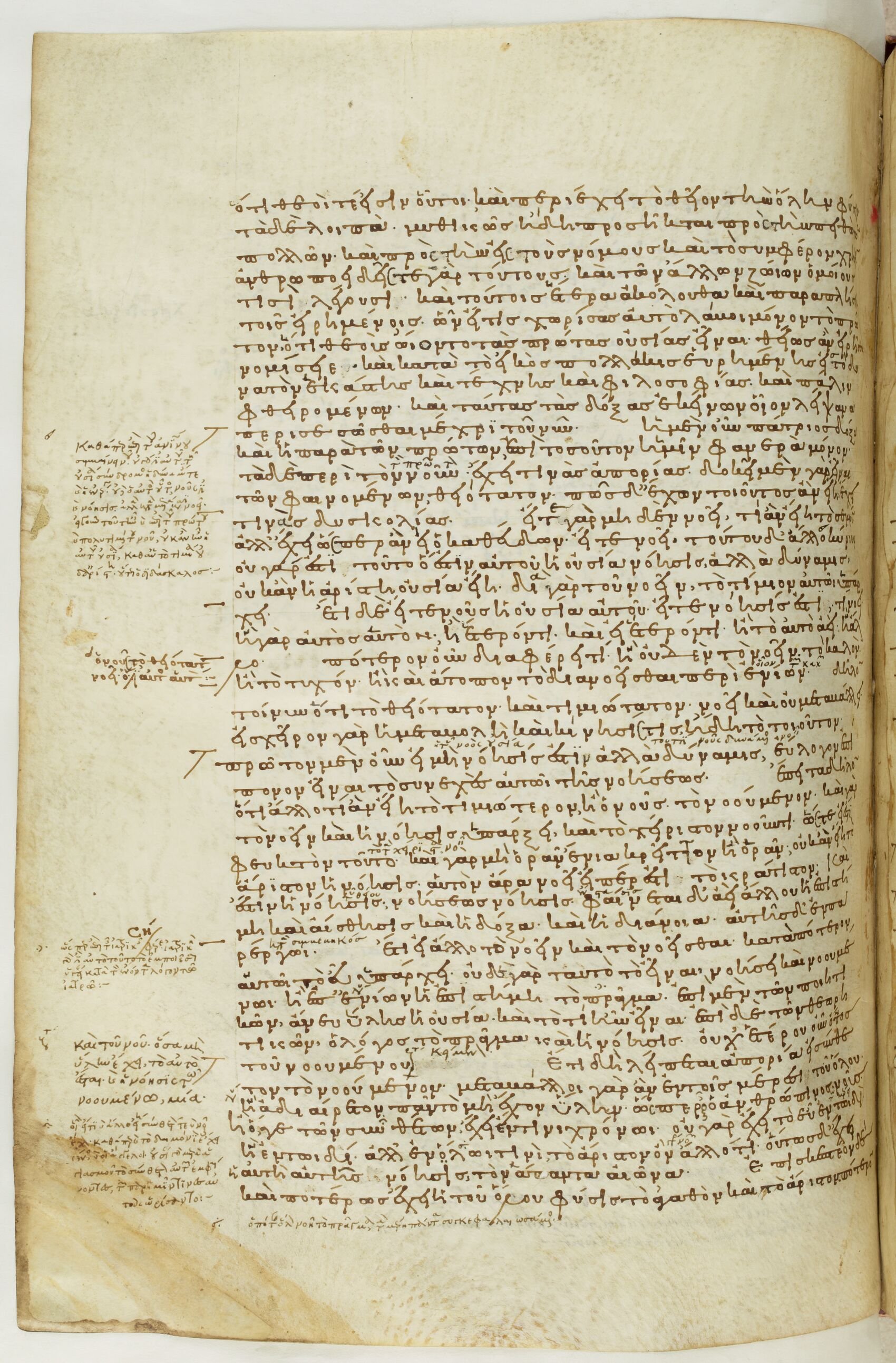
Paris gr. 1853 fol. 294r begins 'ἐξ ἀνάγκης ἄρα ἐστὶν ὄν· καὶ ᾗ ἀνάγκῃ, καλῶς, καὶ οὕτως ἀρχή' (1072b10-11) and ends 'ἡ μὲν γὰρ ἀρχὴ καὶ τὸ πρῶτον τῶν ὄντων ἀκί(νητον)' (1073a23-24); chapter 8 ('πότερον δὲ μίαν θετέον', 1073a14) begins on this page. Paris gr. 1853 fol. 294v begins '(ἀκί)νητον καὶ καθʼ αὑτὸ καὶ κατὰ συμβεβηκός, κινοῦν δὲ τὴν πρώτην ἀΐδιον καὶ μίαν κίνησιν' (1073a24-25) and ends 'τοῦ δὲ τῆς Ἀφροδίτης καὶ τοῦ Ἑρμοῦ τοὺς αὐτούς. Κάλλιππος δὲ τὴν' (1073b31-33). Paris gr. 1853 fol. 295r begins 'μὲν θέσιν τῶν σφαιρῶν τὴν αὐτὴν ἐτίθετο Εὐδόξῳ' (1073b33) and ends 'παραδέδοται δὲ ... ἐν μύθου σχήματι καταλελειμμένα τοῖς ὕστερον' (1074b1-3). Paris gr. 1853 fol. 295v begins 'ὅτι θεοί τέ εἰσιν οὗτοι καὶ περιέχει τὸ θεῖον τὴν ὅλην φύσιν' (1074b3) and ends with the opening of chapter 10, 'ἐπισκεπτέον δὲ καὶ ποτέρως ἔχει ἡ τοῦ ὅλου φύσις τὸ ἀγαθὸν καὶ τὸ ἄριστον' (1075a11-12); chapter 9 lies wholly on this page. Checked on the images; viewer https://gallica.bnf.fr/ark:/12148/btv1b84192492/f593.item , https://gallica.bnf.fr/ark:/12148/btv1b84192492/f594.item , https://gallica.bnf.fr/ark:/12148/btv1b84192492/f595.item , https://gallica.bnf.fr/ark:/12148/btv1b84192492/f596.item . The Greek shown is Ross's critical text; the copyist's wording differs from it in places.
πότερον δὲ μίαν θετέον τὴν τοιαύτην οὐσίαν ἢ πλείους, καὶ πόσας, δεῖ μὴ λανθάνειν, ἀλλὰ μεμνῆσθαι καὶ τὰς τῶν ἄλλων ἀποφάσεις, ὅτι περὶ πλήθους οὐθὲν εἰρήκασιν ὅ τι καὶ σαφὲς εἰπεῖν. ἡ μὲν γὰρ περὶ τὰς ἰδέας ὑπόληψις οὐδεμίαν ἔχει σκέψιν ἰδίαν (ἀριθμοὺς γὰρ λέγουσι τὰς ἰδέας οἱ λέγοντες ἰδέας, περὶ δὲ τῶν ἀριθμῶν ὁτὲ μὲν ὡς περὶ ἀπείρων λέγουσιν ὁτὲ δὲ ὡς μέχρι τῆς δεκάδος ὡρισμένων· διʼ ἣν δʼ αἰτίαν τοσοῦτον τὸ πλῆθος τῶν ἀριθμῶν, οὐδὲν λέγεται μετὰ σπουδῆς ἀποδεικτικῆς)· ἡμῖν δʼ ἐκ τῶν ὑποκειμένων καὶ διωρισμένων λεκτέον. ἡ μὲν γὰρ ἀρχὴ καὶ τὸ πρῶτον τῶν ὄντων ἀκίνητον καὶ καθʼ αὑτὸ καὶ κατὰ συμβεβηκός, κινοῦν δὲ τὴν πρώτην ἀΐδιον καὶ μίαν κίνησιν· ἐπεὶ δὲ τὸ κινούμενον ἀνάγκη ὑπό τινος κινεῖσθαι, καὶ τὸ πρῶτον κινοῦν ἀκίνητον εἶναι καθʼ αὑτό, καὶ τὴν ἀΐδιον κίνησιν ὑπὸ ἀϊδίου κινεῖσθαι καὶ τὴν μίαν ὑφʼ ἑνός, ὁρῶμεν δὲ παρὰ τὴν τοῦ παντὸς τὴν ἁπλῆν φοράν, ἣν κινεῖν φαμὲν τὴν πρώτην οὐσίαν καὶ ἀκίνητον, ἄλλας φορὰς οὔσας τὰς τῶν πλανήτων ἀϊδίους (ἀΐδιον γὰρ καὶ ἄστατον τὸ κύκλῳ σῶμα· δέδεικται δʼ ἐν τοῖς φυσικοῖς περὶ τούτων), ἀνάγκη καὶ τούτων ἑκάστην τῶν φορῶν ὑπʼ ἀκινήτου τε κινεῖσθαι καθʼ αὑτὴν καὶ ἀϊδίου οὐσίας. ἥ τε γὰρ τῶν ἄστρων φύσις ἀΐδιος οὐσία τις οὖσα, καὶ τὸ κινοῦν ἀΐδιον καὶ πρότερον τοῦ κινουμένου, καὶ τὸ πρότερον οὐσίας οὐσίαν ἀναγκαῖον εἶναι. φανερὸν τοίνυν ὅτι τοσαύτας τε οὐσίας ἀναγκαῖον εἶναι τήν τε φύσιν ἀϊδίους καὶ ἀκινήτους καθʼ αὑτάς, καὶ ἄνευ μεγέθους διὰ τὴν εἰρημένην αἰτίαν πρότερον. —ὅτι μὲν οὖν εἰσὶν οὐσίαι, καὶ τούτων τις πρώτη καὶ δευτέρα κατὰ τὴν αὐτὴν τάξιν ταῖς φοραῖς τῶν ἄστρων, φανερόν· τὸ δὲ πλῆθος ἤδη τῶν φορῶν ἐκ τῆς οἰκειοτάτης φιλοσοφίᾳ τῶν μαθηματικῶν ἐπιστημῶν δεῖ σκοπεῖν, ἐκ τῆς ἀστρολογίας· αὕτη γὰρ περὶ οὐσίας αἰσθητῆς μὲν ἀϊδίου δὲ ποιεῖται τὴν θεωρίαν, αἱ δʼ ἄλλαι περὶ οὐδεμιᾶς οὐσίας, οἷον ἥ τε περὶ τοὺς ἀριθμοὺς καὶ τὴν γεωμετρίαν. ὅτι μὲν οὖν πλείους τῶν φερομένων αἱ φοραί, φανερὸν τοῖς καὶ μετρίως ἡμμένοις (πλείους γὰρ ἕκαστον φέρεται μιᾶς τῶν πλανωμένων ἄστρων)· πόσαι δʼ αὗται τυγχάνουσιν οὖσαι, νῦν μὲν ἡμεῖς ἃ λέγουσι τῶν μαθηματικῶν τινὲς ἐννοίας χάριν λέγομεν, ὅπως ᾖ τι τῇ διανοίᾳ πλῆθος ὡρισμένον ὑπολαβεῖν· τὸ δὲ λοιπὸν τὰ μὲν ζητοῦντας αὐτοὺς δεῖ τὰ δὲ πυνθανομένους παρὰ τῶν ζητούντων, ἄν τι φαίνηται παρὰ τὰ νῦν εἰρημένα τοῖς ταῦτα πραγματευομένοις, φιλεῖν μὲν ἀμφοτέρους, πείθεσθαι δὲ τοῖς ἀκριβεστέροις.—Εὔδοξος μὲν οὖν ἡλίου καὶ σελήνης ἑκατέρου τὴν φορὰν ἐν τρισὶν ἐτίθετʼ εἶναι σφαίραις, ὧν τὴν μὲν πρώτην τὴν τῶν ἀπλανῶν ἄστρων εἶναι, τὴν δὲ δευτέραν κατὰ τὸν διὰ μέσων τῶν ζῳδίων, τὴν δὲ τρίτην κατὰ τὸν λελοξωμένον ἐν τῷ πλάτει τῶν ζῳδίων (ἐν μείζονι δὲ πλάτει λελοξῶσθαι καθʼ ὃν ἡ σελήνη φέρεται ἢ καθʼ ὃν ὁ ἥλιος), τῶν δὲ πλανωμένων ἄστρων ἐν τέτταρσιν ἑκάστου σφαίραις, καὶ τούτων δὲ τὴν μὲν πρώτην καὶ δευτέραν τὴν αὐτὴν εἶναι ἐκείναις (τήν τε γὰρ τῶν ἀπλανῶν τὴν ἁπάσας φέρουσαν εἶναι, καὶ τὴν ὑπὸ ταύτῃ τεταγμένην καὶ κατὰ τὸν διὰ μέσων τῶν ζῳδίων τὴν φορὰν ἔχουσαν κοινὴν ἁπασῶν εἶναι), τῆς δὲ τρίτης ἁπάντων τοὺς πόλους ἐν τῷ διὰ μέσων τῶν ζῳδίων εἶναι, τῆς δὲ τετάρτης τὴν φορὰν κατὰ τὸν λελοξωμένον πρὸς τὸν μέσον ταύτης· εἶναι δὲ τῆς τρίτης σφαίρας τοὺς πόλους τῶν μὲν ἄλλων ἰδίους, τοὺς δὲ τῆς Ἀφροδίτης καὶ τοῦ Ἑρμοῦ τοὺς αὐτούς· Κάλλιππος δὲ τὴν μὲν θέσιν τῶν σφαιρῶν τὴν αὐτὴν ἐτίθετο Εὐδόξῳ [τοῦτʼ ἔστι τῶν ἀποστημάτων τὴν τάξιν], τὸ δὲ πλῆθος τῷ μὲν τοῦ Διὸς καὶ τῷ τοῦ Κρόνου τὸ αὐτὸ ἐκείνῳ ἀπεδίδου, τῷ δʼ ἡλίῳ καὶ τῇ σελήνῃ δύο ᾤετο ἔτι προσθετέας εἶναι σφαίρας, τὰ φαινόμενα εἰ μέλλει τις ἀποδώσειν, τοῖς δὲ λοιποῖς τῶν πλανήτων ἑκάστῳ μίαν. ἀναγκαῖον δέ, εἰ μέλλουσι συντεθεῖσαι πᾶσαι τὰ φαινόμενα ἀποδώσειν, καθʼ ἕκαστον τῶν πλανωμένων ἑτέρας σφαίρας μιᾷ ἐλάττονας εἶναι τὰς ἀνελιττούσας καὶ εἰς τὸ αὐτὸ ἀποκαθιστάσας τῇ θέσει τὴν πρώτην σφαῖραν ἀεὶ τοῦ ὑποκάτω τεταγμένου ἄστρου· οὕτω γὰρ μόνως ἐνδέχεται τὴν τῶν πλανήτων φορὰν ἅπαντα ποιεῖσθαι. ἐπεὶ οὖν ἐν αἷς μὲν αὐτὰ φέρεται σφαίραις αἱ μὲν ὀκτὼ αἱ δὲ πέντε καὶ εἴκοσίν εἰσιν, τούτων δὲ μόνας οὐ δεῖ ἀνελιχθῆναι ἐν αἷς τὸ κατωτάτω τεταγμένον φέρεται, αἱ μὲν τὰς τῶν πρώτων δύο ἀνελίττουσαι ἓξ ἔσονται, αἱ δὲ τὰς τῶν ὕστερον τεττάρων ἑκκαίδεκα· ὁ δὴ ἁπασῶν ἀριθμὸς τῶν τε φερουσῶν καὶ τῶν ἀνελιττουσῶν ταύτας πεντήκοντά τε καὶ πέντε. εἰ δὲ τῇ σελήνῃ τε καὶ τῷ ἡλίῳ μὴ προστιθείη τις ἃς εἴπομεν κινήσεις, αἱ πᾶσαι σφαῖραι ἔσονται ἑπτά τε καὶ τεσσαράκοντα.—τὸ μὲν οὖν πλῆθος τῶν σφαιρῶν ἔστω τοσοῦτον, ὥστε καὶ τὰς οὐσίας καὶ τὰς ἀρχὰς τὰς ἀκινήτους [καὶ τὰς αἰσθητὰς] τοσαύτας εὔλογον ὑπολαβεῖν (τὸ γὰρ ἀναγκαῖον ἀφείσθω τοῖς ἰσχυροτέροις λέγειν)· εἰ δὲ μηδεμίαν οἷόν τʼ εἶναι φορὰν μὴ συντείνουσαν πρὸς ἄστρου φοράν, ἔτι δὲ πᾶσαν φύσιν καὶ πᾶσαν οὐσίαν ἀπαθῆ καὶ καθʼ αὑτὴν τοῦ ἀρίστου τετυχηκυῖαν τέλος εἶναι δεῖ νομίζειν, οὐδεμία ἂν εἴη παρὰ ταύτας ἑτέρα φύσις, ἀλλὰ τοῦτον ἀνάγκη τὸν ἀριθμὸν εἶναι τῶν οὐσιῶν. εἴτε γὰρ εἰσὶν ἕτεραι, κινοῖεν ἂν ὡς τέλος οὖσαι φορᾶς· ἀλλὰ εἶναί γε ἄλλας φορὰς ἀδύνατον παρὰ τὰς εἰρημένας. τοῦτο δὲ εὔλογον ἐκ τῶν φερομένων ὑπολαβεῖν. εἰ γὰρ πᾶν τὸ φέρον τοῦ φερομένου χάριν πέφυκε καὶ φορὰ πᾶσα φερομένου τινός ἐστιν, οὐδεμία φορὰ αὑτῆς ἂν ἕνεκα εἴη οὐδʼ ἄλλης φορᾶς, ἀλλὰ τῶν ἄστρων ἕνεκα. εἰ γὰρ ἔσται φορὰ φορᾶς ἕνεκα, καὶ ἐκείνην ἑτέρου δεήσει χάριν εἶναι· ὥστʼ ἐπειδὴ οὐχ οἷόν τε εἰς ἄπειρον, τέλος ἔσται πάσης φορᾶς τῶν φερομένων τι θείων σωμάτων κατὰ τὸν οὐρανόν. ὅτι δὲ εἷς οὐρανός, φανερόν. εἰ γὰρ πλείους οὐρανοὶ ὥσπερ ἄνθρωποι, ἔσται εἴδει μία ἡ περὶ ἕκαστον ἀρχή, ἀριθμῷ δέ γε πολλαί. ἀλλʼ ὅσα ἀριθμῷ πολλά, ὕλην ἔχει (εἷς γὰρ λόγος καὶ ὁ αὐτὸς πολλῶν, οἷον ἀνθρώπου, Σωκράτης δὲ εἷς)· τὸ δὲ τί ἦν εἶναι οὐκ ἔχει ὕλην τὸ πρῶτον· ἐντελέχεια γάρ. ἓν ἄρα καὶ λόγῳ καὶ ἀριθμῷ τὸ πρῶτον κινοῦν ἀκίνητον ὄν· καὶ τὸ κινούμενον ἄρα ἀεὶ καὶ συνεχῶς· εἷς ἄρα οὐρανὸς μόνος. παραδέδοται δὲ παρὰ τῶν ἀρχαίων καὶ παμπαλαίων ἐν μύθου σχήματι καταλελειμμένα τοῖς ὕστερον ὅτι θεοί τέ εἰσιν οὗτοι καὶ περιέχει τὸ θεῖον τὴν ὅλην φύσιν. τὰ δὲ λοιπὰ μυθικῶς ἤδη προσῆκται πρὸς τὴν πειθὼ τῶν πολλῶν καὶ πρὸς τὴν εἰς τοὺς νόμους καὶ τὸ συμφέρον χρῆσιν· ἀνθρωποειδεῖς τε γὰρ τούτους καὶ τῶν ἄλλων ζῴων ὁμοίους τισὶ λέγουσι, καὶ τούτοις ἕτερα ἀκόλουθα καὶ παραπλήσια τοῖς εἰρημένοις, ὧν εἴ τις χωρίσας αὐτὸ λάβοι μόνον τὸ πρῶτον, ὅτι θεοὺς ᾤοντο τὰς πρώτας οὐσίας εἶναι, θείως ἂν εἰρῆσθαι νομίσειεν, καὶ κατὰ τὸ εἰκὸς πολλάκις εὑρημένης εἰς τὸ δυνατὸν ἑκάστης καὶ τέχνης καὶ φιλοσοφίας καὶ πάλιν φθειρομένων καὶ ταύτας τὰς δόξας ἐκείνων οἷον λείψανα περισεσῶσθαι μέχρι τοῦ νῦν. ἡ μὲν οὖν πάτριος δόξα καὶ ἡ παρὰ τῶν πρώτων ἐπὶ τοσοῦτον ἡμῖν φανερὰ μόνον.
It is clear, then, why these things are as they are. But we must not ignore the question whether we have to suppose one such substance or more than one, and if the latter, how many; we must also mention, regarding the opinions expressed by others, that they have said nothing about the number of the substances that can even be clearly stated. For the theory of Ideas has no special discussion of the subject; for those who speak of Ideas say the Ideas are numbers, and they speak of numbers now as unlimited, now as limited by the number 10; but as for the reason why there should be just so many numbers, nothing is said with any demonstrative exactness. We however must discuss the subject, starting from the presuppositions and distinctions we have mentioned. The first principle or primary being is not movable either in itself or accidentally, but produces the primary eternal and single movement. But since that which is moved must be moved by something, and the first mover must be in itself unmovable, and eternal movement must be produced by something eternal and a single movement by a single thing, and since we see that besides the simple spatial movement of the universe, which we say the first and unmovable substance produces, there are other spatial movements-those of the planets-which are eternal (for a body which moves in a circle is eternal and unresting; we have proved these points in the physical treatises), each of these movements also must be caused by a substance both unmovable in itself and eternal. For the nature of the stars is eternal just because it is a certain kind of substance, and the mover is eternal and prior to the moved, and that which is prior to a substance must be a substance. Evidently, then, there must be substances which are of the same number as the movements of the stars, and in their nature eternal, and in themselves unmovable, and without magnitude, for the reason before mentioned. That the movers are substances, then, and that one of these is first and another second according to the same order as the movements of the stars, is evident. But in the number of the movements we reach a problem which must be treated from the standpoint of that one of the mathematical sciences which is most akin to philosophy-viz. of astronomy; for this science speculates about substance which is perceptible but eternal, but the other mathematical sciences, i.e. arithmetic and geometry, treat of no substance. That the movements are more numerous than the bodies that are moved is evident to those who have given even moderate attention to the matter; for each of the planets has more than one movement. But as to the actual number of these movements, we now-to give some notion of the subject-quote what some of the mathematicians say, that our thought may have some definite number to grasp; but, for the rest, we must partly investigate for ourselves, Partly learn from other investigators, and if those who study this subject form an opinion contrary to what we have now stated, we must esteem both parties indeed, but follow the more accurate.
Eudoxus supposed that the motion of the sun or of the moon involves, in either case, three spheres, of which the first is the sphere of the fixed stars, and the second moves in the circle which runs along the middle of the zodiac, and the third in the circle which is inclined across the breadth of the zodiac; but the circle in which the moon moves is inclined at a greater angle than that in which the sun moves. And the motion of the planets involves, in each case, four spheres, and of these also the first and second are the same as the first two mentioned above (for the sphere of the fixed stars is that which moves all the other spheres, and that which is placed beneath this and has its movement in the circle which bisects the zodiac is common to all), but the poles of the third sphere of each planet are in the circle which bisects the zodiac, and the motion of the fourth sphere is in the circle which is inclined at an angle to the equator of the third sphere; and the poles of the third sphere are different for each of the other planets, but those of Venus and Mercury are the same.
Callippus made the position of the spheres the same as Eudoxus did, but while he assigned the same number as Eudoxus did to Jupiter and to Saturn, he thought two more spheres should be added to the sun and two to the moon, if one is to explain the observed facts; and one more to each of the other planets.
But it is necessary, if all the spheres combined are to explain the observed facts, that for each of the planets there should be other spheres (one fewer than those hitherto assigned) which counteract those already mentioned and bring back to the same position the outermost sphere of the star which in each case is situated below the star in question; for only thus can all the forces at work produce the observed motion of the planets. Since, then, the spheres involved in the movement of the planets themselves are--eight for Saturn and Jupiter and twenty-five for the others, and of these only those involved in the movement of the lowest-situated planet need not be counteracted the spheres which counteract those of the outermost two planets will be six in number, and the spheres which counteract those of the next four planets will be sixteen; therefore the number of all the spheres--both those which move the planets and those which counteract these--will be fifty-five. And if one were not to add to the moon and to the sun the movements we mentioned, the whole set of spheres will be forty-seven in number.
Let this, then, be taken as the number of the spheres, so that the unmovable substances and principles also may probably be taken as just so many; the assertion of necessity must be left to more powerful thinkers. But if there can be no spatial movement which does not conduce to the moving of a star, and if further every being and every substance which is immune from change and in virtue of itself has attained to the best must be considered an end, there can be no other being apart from these we have named, but this must be the number of the substances. For if there are others, they will cause change as being a final cause of movement; but there cannot he other movements besides those mentioned. And it is reasonable to infer this from a consideration of the bodies that are moved; for if everything that moves is for the sake of that which is moved, and every movement belongs to something that is moved, no movement can be for the sake of itself or of another movement, but all the movements must be for the sake of the stars. For if there is to be a movement for the sake of a movement, this latter also will have to be for the sake of something else; so that since there cannot be an infinite regress, the end of every movement will be one of the divine bodies which move through the heaven.
(Evidently there is but one heaven. For if there are many heavens as there are many men, the moving principles, of which each heaven will have one, will be one in form but in number many. But all things that are many in number have matter; for one and the same definition, e.g. that of man, applies to many things, while Socrates is one. But the primary essence has not matter; for it is complete reality. So the unmovable first mover is one both in definition and in number; so too, therefore, is that which is moved always and continuously; therefore there is one heaven alone.) Our forefathers in the most remote ages have handed down to their posterity a tradition, in the form of a myth, that these bodies are gods, and that the divine encloses the whole of nature. The rest of the tradition has been added later in mythical form with a view to the persuasion of the multitude and to its legal and utilitarian expediency; they say these gods are in the form of men or like some of the other animals, and they say other things consequent on and similar to these which we have mentioned. But if one were to separate the first point from these additions and take it alone-that they thought the first substances to be gods, one must regard this as an inspired utterance, and reflect that, while probably each art and each science has often been developed as far as possible and has again perished, these opinions, with others, have been preserved until the present like relics of the ancient treasure. Only thus far, then, is the opinion of our ancestors and of our earliest predecessors clear to us.
Where on the image
Paris gr. 1853 fol. 295v begins 'ὅτι θεοί τέ εἰσιν οὗτοι καὶ περιέχει τὸ θεῖον τὴν ὅλην φύσιν' (1074b3) and ends with the opening of chapter 10, 'ἐπισκεπτέον δὲ καὶ ποτέρως ἔχει ἡ τοῦ ὅλου φύσις τὸ ἀγαθὸν καὶ τὸ ἄριστον' (1075a11-12); chapter 9 lies wholly on this page. Checked on the images; viewer https://gallica.bnf.fr/ark:/12148/btv1b84192492/f596.item . The Greek shown is Ross's critical text; the copyist's wording differs from it in places.
τὰ δὲ περὶ τὸν νοῦν ἔχει τινὰς ἀπορίας· δοκεῖ μὲν γὰρ εἶναι τῶν φαινομένων θειότατον, πῶς δʼ ἔχων τοιοῦτος ἂν εἴη, ἔχει τινὰς δυσκολίας. εἴτε γὰρ μηδὲν νοεῖ, τί ἂν εἴη τὸ σεμνόν, ἀλλʼ ἔχει ὥσπερ ἂν εἰ ὁ καθεύδων· εἴτε νοεῖ, τούτου δʼ ἄλλο κύριον, οὐ γάρ ἐστι τοῦτο ὅ ἐστιν αὐτοῦ ἡ οὐσία νόησις, ἀλλὰ δύναμις, οὐκ ἂν ἡ ἀρίστη οὐσία εἴη· διὰ γὰρ τοῦ νοεῖν τὸ τίμιον αὐτῷ ὑπάρχει. ἔτι δὲ εἴτε νοῦς ἡ οὐσία αὐτοῦ εἴτε νόησίς ἐστι, τί νοεῖ; ἢ γὰρ αὐτὸς αὑτὸν ἢ ἕτερόν τι· καὶ εἰ ἕτερόν τι, ἢ τὸ αὐτὸ ἀεὶ ἢ ἄλλο. πότερον οὖν διαφέρει τι ἢ οὐδὲν τὸ νοεῖν τὸ καλὸν ἢ τὸ τυχόν; ἢ καὶ ἄτοπον τὸ διανοεῖσθαι περὶ ἐνίων; δῆλον τοίνυν ὅτι τὸ θειότατον καὶ τιμιώτατον νοεῖ, καὶ οὐ μεταβάλλει· εἰς χεῖρον γὰρ ἡ μεταβολή, καὶ κίνησίς τις ἤδη τὸ τοιοῦτον. πρῶτον μὲν οὖν εἰ μὴ νόησίς ἐστιν ἀλλὰ δύναμις, εὔλογον ἐπίπονον εἶναι τὸ συνεχὲς αὐτῷ τῆς νοήσεως· ἔπειτα δῆλον ὅτι ἄλλο τι ἂν εἴη τὸ τιμιώτερον ἢ ὁ νοῦς, τὸ νοούμενον. καὶ γὰρ τὸ νοεῖν καὶ ἡ νόησις ὑπάρξει καὶ τὸ χείριστον νοοῦντι, ὥστʼ εἰ φευκτὸν τοῦτο (καὶ γὰρ μὴ ὁρᾶν ἔνια κρεῖττον ἢ ὁρᾶν), οὐκ ἂν εἴη τὸ ἄριστον ἡ νόησις. αὑτὸν ἄρα νοεῖ, εἴπερ ἐστὶ τὸ κράτιστον, καὶ ἔστιν ἡ νόησις νοήσεως νόησις. φαίνεται δʼ ἀεὶ ἄλλου ἡ ἐπιστήμη καὶ ἡ αἴσθησις καὶ ἡ δόξα καὶ ἡ διάνοια, αὑτῆς δʼ ἐν παρέργῳ. ἔτι εἰ ἄλλο τὸ νοεῖν καὶ τὸ νοεῖσθαι, κατὰ πότερον αὐτῷ τὸ εὖ ὑπάρχει; οὐδὲ γὰρ ταὐτὸ τὸ εἶναι νοήσει καὶ νοουμένῳ. ἢ ἐπʼ ἐνίων ἡ ἐπιστήμη τὸ πρᾶγμα, ἐπὶ μὲν τῶν ποιητικῶν ἄνευ ὕλης ἡ οὐσία καὶ τὸ τί ἦν εἶναι, ἐπὶ δὲ τῶν θεωρητικῶν ὁ λόγος τὸ πρᾶγμα καὶ ἡ νόησις; οὐχ ἑτέρου οὖν ὄντος τοῦ νοουμένου καὶ τοῦ νοῦ, ὅσα μὴ ὕλην ἔχει, τὸ αὐτὸ ἔσται, καὶ ἡ νόησις τῷ νοουμένῳ μία. ἔτι δὴ λείπεται ἀπορία, εἰ σύνθετον τὸ νοούμενον· μεταβάλλοι γὰρ ἂν ἐν τοῖς μέρεσι τοῦ ὅλου. ἢ ἀδιαίρετον πᾶν τὸ μὴ ἔχον ὕλην—ὥσπερ ὁ ἀνθρώπινος νοῦς ἢ ὅ γε τῶν συνθέτων ἔχει ἔν τινι χρόνῳ (οὐ γὰρ ἔχει τὸ εὖ ἐν τῳδὶ ἢ ἐν τῳδί, ἀλλʼ ἐν ὅλῳ τινὶ τὸ ἄριστον, ὂν ἄλλο τι)—οὕτως δʼ ἔχει αὐτὴ αὑτῆς ἡ νόησις τὸν ἅπαντα αἰῶνα;
The nature of the divine thought involves certain problems; for while thought is held to be the most divine of things observed by us, the question how it must be situated in order to have that character involves difficulties. For if it thinks of nothing, what is there here of dignity? It is just like one who sleeps. And if it thinks, but this depends on something else, then (since that which is its substance is not the act of thinking, but a potency) it cannot be the best substance; for it is through thinking that its value belongs to it. Further, whether its substance is the faculty of thought or the act of thinking, what does it think of? Either of itself or of something else; and if of something else, either of the same thing always or of something different. Does it matter, then, or not, whether it thinks of the good or of any chance thing? Are there not some things about which it is incredible that it should think? Evidently, then, it thinks of that which is most divine and precious, and it does not change; for change would be change for the worse, and this would be already a movement. First, then, if 'thought' is not the act of thinking but a potency, it would be reasonable to suppose that the continuity of its thinking is wearisome to it. Secondly, there would evidently be something else more precious than thought, viz. that which is thought of. For both thinking and the act of thought will belong even to one who thinks of the worst thing in the world, so that if this ought to be avoided (and it ought, for there are even some things which it is better not to see than to see), the act of thinking cannot be the best of things. Therefore it must be of itself that the divine thought thinks (since it is the most excellent of things), and its thinking is a thinking on thinking.
But evidently knowledge and perception and opinion and understanding have always something else as their object, and themselves only by the way. Further, if thinking and being thought of are different, in respect of which does goodness belong to thought? For to he an act of thinking and to he an object of thought are not the same thing. We answer that in some cases the knowledge is the object. In the productive sciences it is the substance or essence of the object, matter omitted, and in the theoretical sciences the definition or the act of thinking is the object. Since, then, thought and the object of thought are not different in the case of things that have not matter, the divine thought and its object will be the same, i.e. the thinking will be one with the object of its thought.
A further question is left-whether the object of the divine thought is composite; for if it were, thought would change in passing from part to part of the whole. We answer that everything which has not matter is indivisible-as human thought, or rather the thought of composite beings, is in a certain period of time (for it does not possess the good at this moment or at that, but its best, being something different from it, is attained only in a whole period of time), so throughout eternity is the thought which has itself for its object.
Where on the image
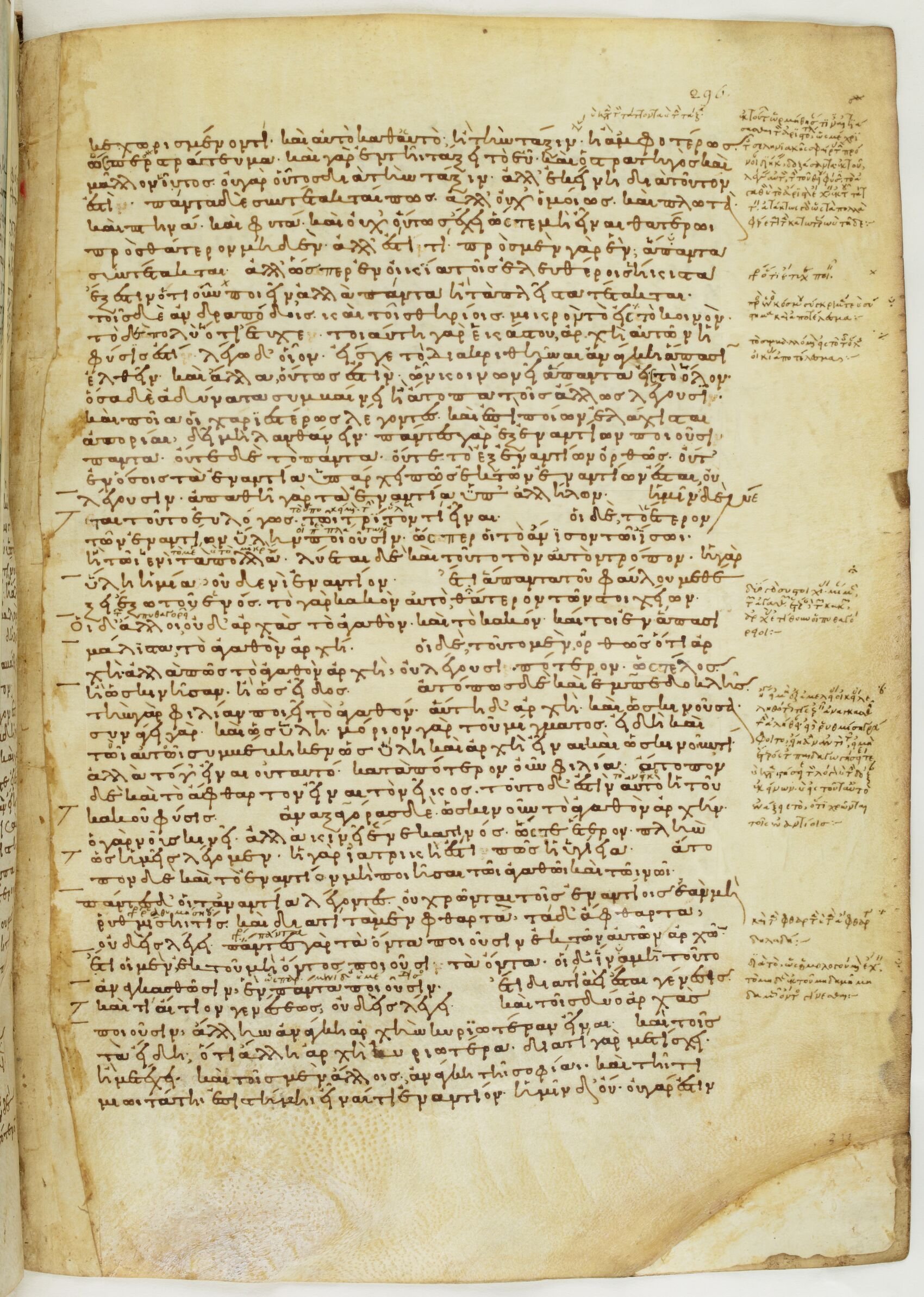
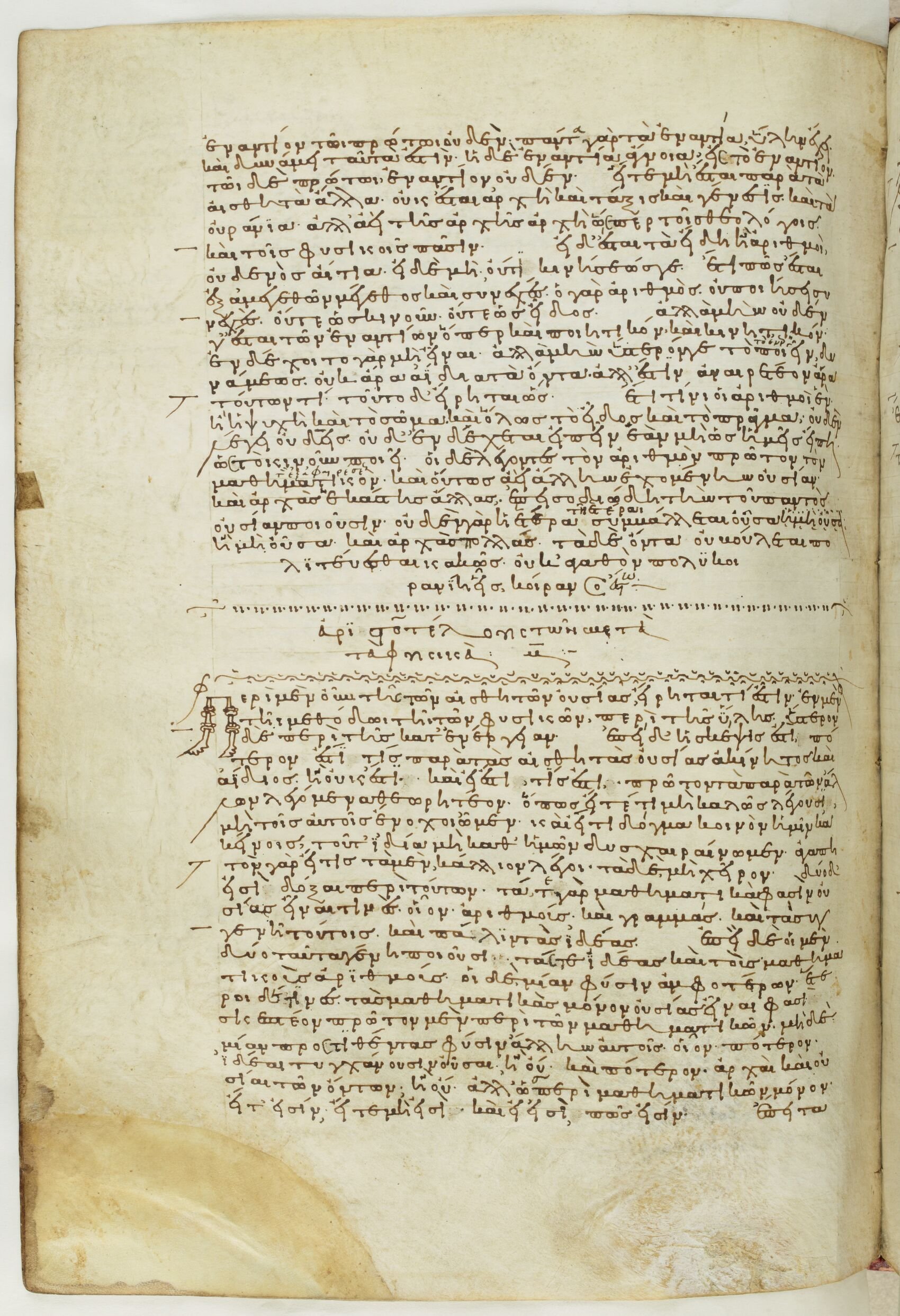
Paris gr. 1853 fol. 295v begins 'ὅτι θεοί τέ εἰσιν οὗτοι καὶ περιέχει τὸ θεῖον τὴν ὅλην φύσιν' (1074b3) and ends with the opening of chapter 10, 'ἐπισκεπτέον δὲ καὶ ποτέρως ἔχει ἡ τοῦ ὅλου φύσις τὸ ἀγαθὸν καὶ τὸ ἄριστον' (1075a11-12); chapter 9 lies wholly on this page. Paris gr. 1853 fol. 296r begins '(πότερον) κεχωρισμένον τι καὶ αὐτὸ καθʼ αὑτό, ἢ τὴν τάξιν, ἢ ἀμφοτέρως' (1075a12-13) and ends 'καὶ τοῖς μὲν ἄλλοις ἀνάγκη τῇ σοφίᾳ καὶ τῇ τιμιωτάτῃ ἐπιστήμῃ εἶναί τι ἐναντίον, ἡμῖν δʼ οὔ· οὐ γάρ ἐστιν' (1075b20-21). Paris gr. 1853 fol. 296v begins 'ἐναντίον τῷ πρώτῳ οὐθέν. πάντα γὰρ τὰ ἐναντία ὕλην ἔχει' (1075b22) and ends in the first chapter of book 13 (Mu, 1076a), so the end of book 12 ('εἷς κοίρανος ἔστω', 1076a4) is on this page. Checked on the images; viewer https://gallica.bnf.fr/ark:/12148/btv1b84192492/f596.item , https://gallica.bnf.fr/ark:/12148/btv1b84192492/f597.item , https://gallica.bnf.fr/ark:/12148/btv1b84192492/f598.item . The Greek shown is Ross's critical text; the copyist's wording differs from it in places.
ἐπισκεπτέον δὲ καὶ ποτέρως ἔχει ἡ τοῦ ὅλου φύσις τὸ ἀγαθὸν καὶ τὸ ἄριστον, πότερον κεχωρισμένον τι καὶ αὐτὸ καθʼ αὑτό, ἢ τὴν τάξιν. ἢ ἀμφοτέρως ὥσπερ στράτευμα; καὶ γὰρ ἐν τῇ τάξει τὸ εὖ καὶ ὁ στρατηγός, καὶ μᾶλλον οὗτος· οὐ γὰρ οὗτος διὰ τὴν τάξιν ἀλλʼ ἐκείνη διὰ τοῦτόν ἐστιν. πάντα δὲ συντέτακταί πως, ἀλλʼ οὐχ ὁμοίως, καὶ πλωτὰ καὶ πτηνὰ καὶ φυτά· καὶ οὐχ οὕτως ἔχει ὥστε μὴ εἶναι θατέρῳ πρὸς θάτερον μηδέν, ἀλλʼ ἔστι τι. πρὸς μὲν γὰρ ἓν ἅπαντα συντέτακται, ἀλλʼ ὥσπερ ἐν οἰκίᾳ τοῖς ἐλευθέροις ἥκιστα ἔξεστιν ὅ τι ἔτυχε ποιεῖν, ἀλλὰ πάντα ἢ τὰ πλεῖστα τέτακται, τοῖς δὲ ἀνδραπόδοις καὶ τοῖς θηρίοις μικρὸν τὸ εἰς τὸ κοινόν, τὸ δὲ πολὺ ὅ τι ἔτυχεν· τοιαύτη γὰρ ἑκάστου ἀρχὴ αὐτῶν ἡ φύσις ἐστίν. λέγω δʼ οἷον εἴς γε τὸ διακριθῆναι ἀνάγκη ἅπασιν ἐλθεῖν, καὶ ἄλλα οὕτως ἔστιν ὧν κοινωνεῖ ἅπαντα εἰς τὸ ὅλον.—ὅσα δὲ ἀδύνατα συμβαίνει ἢ ἄτοπα τοῖς ἄλλως λέγουσι, καὶ ποῖα οἱ χαριεστέρως λέγοντες, καὶ ἐπὶ ποίων ἐλάχισται ἀπορίαι, δεῖ μὴ λανθάνειν. πάντες γὰρ ἐξ ἐναντίων ποιοῦσι πάντα. οὔτε δὲ τὸ πάντα οὔτε τὸ ἐξ ἐναντίων ὀρθῶς, οὔτʼ ἐν ὅσοις τὰ ἐναντία ὑπάρχει, πῶς ἐκ τῶν ἐναντίων ἔσται, οὐ λέγουσιν· ἀπαθῆ γὰρ τὰ ἐναντία ὑπʼ ἀλλήλων. ἡμῖν δὲ λύεται τοῦτο εὐλόγως τῷ τρίτον τι εἶναι. οἱ δὲ τὸ ἕτερον τῶν ἐναντίων ὕλην ποιοῦσιν, ὥσπερ οἱ τὸ ἄνισον τῷ ἴσῳ ἢ τῷ ἑνὶ τὰ πολλά. λύεται δὲ καὶ τοῦτο τὸν αὐτὸν τρόπον· ἡ γὰρ ὕλη ἡ μία οὐδενὶ ἐναντίον. ἔτι ἅπαντα τοῦ φαύλου μεθέξει ἔξω τοῦ ἑνός· τὸ γὰρ κακὸν αὐτὸ θάτερον τῶν στοιχείων. οἱ δʼ ἄλλοι οὐδʼ ἀρχὰς τὸ ἀγαθὸν καὶ τὸ κακόν· καίτοι ἐν ἅπασι μάλιστα τὸ ἀγαθὸν ἀρχή. οἱ δὲ τοῦτο μὲν ὀρθῶς ὅτι ἀρχήν, ἀλλὰ πῶς τὸ ἀγαθὸν ἀρχὴ οὐ λέγουσιν, πότερον ὡς τέλος ἢ ὡς κινῆσαν ἢ ὡς εἶδος. ἀτόπως δὲ καὶ Ἐμπεδοκλῆς· τὴν γὰρ φιλίαν ποιεῖ τὸ ἀγαθόν, αὕτη δʼ ἀρχὴ καὶ ὡς κινοῦσα (συνάγει γάρ) καὶ ὡς ὕλη· μόριον γὰρ τοῦ μίγματος. εἰ δὴ καὶ τῷ αὐτῷ συμβέβηκεν καὶ ὡς ὕλῃ ἀρχῇ εἶναι καὶ ὡς κινοῦντι, ἀλλὰ τό γʼ εἶναι οὐ ταὐτό. κατὰ πότερον οὖν φιλία; ἄτοπον δὲ καὶ τὸ ἄφθαρτον εἶναι τὸ νεῖκος· τοῦτο δʼ ἐστὶν αὐτῷ ἡ τοῦ κακοῦ φύσις. Ἀναξαγόρας δὲ ὡς κινοῦν τὸ ἀγαθὸν ἀρχήν· ὁ γὰρ νοῦς κινεῖ. ἀλλὰ κινεῖ ἕνεκά τινος, ὥστε ἕτερον, πλὴν ὡς ἡμεῖς λέγομεν· ἡ γὰρ ἰατρική ἐστί πως ἡ ὑγίεια. ἄτοπον δὲ καὶ τὸ ἐναντίον μὴ ποιῆσαι τῷ ἀγαθῷ καὶ τῷ νῷ. πάντες δʼ οἱ τἀναντία λέγοντες οὐ χρῶνται τοῖς ἐναντίοις, ἐὰν μὴ ῥυθμίσῃ τις. καὶ διὰ τί τὰ μὲν φθαρτὰ τὰ δʼ ἄφθαρτα, οὐδεὶς λέγει· πάντα γὰρ τὰ ὄντα ποιοῦσιν ἐκ τῶν αὐτῶν ἀρχῶν. ἔτι οἱ μὲν ἐκ τοῦ μὴ ὄντος ποιοῦσι τὰ ὄντα· οἱ δʼ ἵνα μὴ τοῦτο ἀναγκασθῶσιν, ἓν πάντα ποιοῦσιν.—ἔτι διὰ τί ἀεὶ ἔσται γένεσις καὶ τί αἴτιον γενέσεως, οὐδεὶς λέγει. καὶ τοῖς δύο ἀρχὰς ποιοῦσιν ἄλλην ἀνάγκη ἀρχὴν κυριωτέραν εἶναι, καὶ τοῖς τὰ εἴδη ἔτι ἄλλη ἀρχὴ κυριωτέρα· διὰ τί γὰρ μετέσχεν ἢ μετέχει; καὶ τοῖς μὲν ἄλλοις ἀνάγκη τῇ σοφίᾳ καὶ τῇ τιμιωτάτῃ ἐπιστήμῃ εἶναί τι ἐναντίον, ἡμῖν δʼ οὔ. οὐ γάρ ἐστιν ἐναντίον τῷ πρώτῳ οὐδέν· πάντα γὰρ τὰ ἐναντία ὕλην ἔχει, καὶ δυνάμει ταῦτα ἔστιν· ἡ δὲ ἐναντία ἄγνοια εἰς τὸ ἐναντίον, τῷ δὲ πρώτῳ ἐναντίον οὐδέν. εἴ τε μὴ ἔσται παρὰ τὰ αἰσθητὰ ἄλλα, οὐκ ἔσται ἀρχὴ καὶ τάξις καὶ γένεσις καὶ τὰ οὐράνια, ἀλλʼ ἀεὶ τῆς ἀρχῆς ἀρχή, ὥσπερ τοῖς θεολόγοις καὶ τοῖς φυσικοῖς πᾶσιν. εἰ δʼ ἔσται τὰ εἴδη· ἢ οἱ ἀριθμοί, οὐδενὸς αἴτια· εἰ δὲ μή, οὔτι κινήσεώς γε. ἔτι πῶς ἔσται ἐξ ἀμεγεθῶν μέγεθος καὶ συνεχές; ὁ γὰρ ἀριθμὸς οὐ ποιήσει συνεχές, οὔτε ὡς κινοῦν οὔτε ὡς εἶδος. ἀλλὰ μὴν οὐδέν γʼ ἔσται τῶν ἐναντίων ὅπερ καὶ ποιητικὸν καὶ κινητικόν; ἐνδέχοιτο γὰρ ἂν μὴ εἶναι. ἀλλὰ μὴν ὕστερόν γε τὸ ποιεῖν δυνάμεως. οὐκ ἄρα ἀΐδια τὰ ὄντα. ἀλλʼ ἔστιν· ἀναιρετέον ἄρα τούτων τι. τοῦτο δʼ εἴρηται πῶς. ἔτι τίνι οἱ ἀριθμοὶ ἓν ἢ ἡ ψυχὴ καὶ τὸ σῶμα καὶ ὅλως τὸ εἶδος καὶ τὸ πρᾶγμα, οὐδὲν λέγει οὐδείς· οὐδʼ ἐνδέχεται εἰπεῖν, ἐὰν μὴ ὡς ἡμεῖς εἴπῃ, ὡς τὸ κινοῦν ποιεῖ. οἱ δὲ λέγοντες τὸν ἀριθμὸν πρῶτον τὸν μαθηματικὸν καὶ οὕτως ἀεὶ ἄλλην ἐχομένην οὐσίαν καὶ ἀρχὰς ἑκάστης ἄλλας, ἐπεισοδιώδη τὴν τοῦ παντὸς οὐσίαν ποιοῦσιν (οὐδὲν γὰρ ἡ ἑτέρα τῇ ἑτέρᾳ συμβάλλεται οὖσα ἢ μὴ οὖσα) καὶ ἀρχὰς πολλάς· τὰ δὲ ὄντα οὐ βούλεται πολιτεύεσθαι κακῶς. οὐκ ἀγαθὸν πολυκοιρανίη· εἷς κοίρανος ἔστω.
We must consider also in which of two ways the nature of the universe contains the good, and the highest good, whether as something separate and by itself, or as the order of the parts. Probably in both ways, as an army does; for its good is found both in its order and in its leader, and more in the latter; for he does not depend on the order but it depends on him. And all things are ordered together somehow, but not all alike,-both fishes and fowls and plants; and the world is not such that one thing has nothing to do with another, but they are connected. For all are ordered together to one end, but it is as in a house, where the freemen are least at liberty to act at random, but all things or most things are already ordained for them, while the slaves and the animals do little for the common good, and for the most part live at random; for this is the sort of principle that constitutes the nature of each. I mean, for instance, that all must at least come to be dissolved into their elements, and there are other functions similarly in which all share for the good of the whole.
We must not fail to observe how many impossible or paradoxical results confront those who hold different views from our own, and what are the views of the subtler thinkers, and which views are attended by fewest difficulties. All make all things out of contraries. But neither 'all things' nor 'out of contraries' is right; nor do these thinkers tell us how all the things in which the contraries are present can be made out of the contraries; for contraries are not affected by one another. Now for us this difficulty is solved naturally by the fact that there is a third element. These thinkers however make one of the two contraries matter; this is done for instance by those who make the unequal matter for the equal, or the many matter for the one. But this also is refuted in the same way; for the one matter which underlies any pair of contraries is contrary to nothing. Further, all things, except the one, will, on the view we are criticizing, partake of evil; for the bad itself is one of the two elements. But the other school does not treat the good and the bad even as principles; yet in all things the good is in the highest degree a principle. The school we first mentioned is right in saying that it is a principle, but how the good is a principle they do not say-whether as end or as mover or as form.
Empedocles also has a paradoxical view; for he identifies the good with love, but this is a principle both as mover (for it brings things together) and as matter (for it is part of the mixture). Now even if it happens that the same thing is a principle both as matter and as mover, still the being, at least, of the two is not the same. In which respect then is love a principle? It is paradoxical also that strife should be imperishable; the nature of his 'evil' is just strife.
Anaxagoras makes the good a motive principle; for his 'reason' moves things. But it moves them for an end, which must be something other than it, except according to our way of stating the case; for, on our view, the medical art is in a sense health. It is paradoxical also not to suppose a contrary to the good, i.e. to reason. But all who speak of the contraries make no use of the contraries, unless we bring their views into shape. And why some things are perishable and others imperishable, no one tells us; for they make all existing things out of the same principles. Further, some make existing things out of the nonexistent; and others to avoid the necessity of this make all things one.
Further, why should there always be becoming, and what is the cause of becoming?-this no one tells us. And those who suppose two principles must suppose another, a superior principle, and so must those who believe in the Forms; for why did things come to participate, or why do they participate, in the Forms? And all other thinkers are confronted by the necessary consequence that there is something contrary to Wisdom, i.e. to the highest knowledge; but we are not. For there is nothing contrary to that which is primary; for all contraries have matter, and things that have matter exist only potentially; and the ignorance which is contrary to any knowledge leads to an object contrary to the object of the knowledge; but what is primary has no contrary.
Again, if besides sensible things no others exist, there will be no first principle, no order, no becoming, no heavenly bodies, but each principle will have a principle before it, as in the accounts of the theologians and all the natural philosophers. But if the Forms or the numbers are to exist, they will be causes of nothing; or if not that, at least not of movement. Further, how is extension, i.e. a continuum, to be produced out of unextended parts? For number will not, either as mover or as form, produce a continuum. But again there cannot be any contrary that is also essentially a productive or moving principle; for it would be possible for it not to be. Or at least its action would be posterior to its potency. The world, then, would not be eternal. But it is; one of these premisses, then, must be denied. And we have said how this must be done. Further, in virtue of what the numbers, or the soul and the body, or in general the form and the thing, are one-of this no one tells us anything; nor can any one tell, unless he says, as we do, that the mover makes them one. And those who say mathematical number is first and go on to generate one kind of substance after another and give different principles for each, make the substance of the universe a mere series of episodes (for one substance has no influence on another by its existence or nonexistence), and they give us many governing principles; but the world refuses to be governed badly.
'The rule of many is not good; one ruler let there be.'
Notes
- Greek: W. D. Ross, Aristotle's Metaphysics (Oxford, 1924), Perseus digital text. Square brackets mark words Ross deletes.
- English: W. D. Ross's translation in the revised Oxford edition (1928), as given by the MIT Internet Classics Archive. The archive's quotation marks around each paragraph are formatting and have been removed.
- Ross's translation begins chapter 8 with the sentence 'It is clear, then, why these things are as they are', which the Greek edition prints as the last sentence of chapter 7 (1073a13); the English sections follow the translation's own chapter divisions.
Cite
Sources
- Source: Paris gr. 1853 fol. 293r-296v (Gallica, 10th c.) + Ross Greek (Perseus) + W. D. Ross English (1928, MIT Internet Classics Archive) (holding institution)
- Critical edition: Ross, Aristotle's Metaphysics (1924), via Perseus
← previous · → next · v cycle view · l back to library