Atrahasis, Old Babylonian Tablet I: the rebellion of the gods and the creation of humankind
Introduction
When the gods worked like men, the lesser gods dug the rivers and canals for the great gods. They rebel and surround Enlil's house. Enki proposes that a human being be made to bear the work; the mother goddess forms humankind from clay mixed with the flesh and blood of the slain god We. People multiply, their noise disturbs Enlil, and he sends a plague, which Atrahasis averts on Enki's advice.
Atrahasis ('Exceedingly Wise') is the Babylonian story of humanity from its creation to the Flood. The lesser gods rebel against their labour; humankind is created from clay and the flesh and blood of a slain god to do the work instead; when people multiply and their noise disturbs Enlil, he sends plague, drought and famine, and finally the Flood, which Atrahasis survives in a boat on the advice of Enki (Ea). The oldest near-complete copy was written at Sippar by the scribe Ipiq-Aya in the 17th century BCE. This page follows the line numbering of the electronic Babylonian Library edition.
How this page is built. Each section is a run of consecutive lines as written on one photographed clay tablet. For every line the eBL edition (https://www.ebl.lmu.de/corpus/L/1/1/OB/I) lists the manuscripts that carry it, with each tablet's own column and line numbers; the tablet chosen for each run is the photographed copy of the work with the most signs preserved there. Commentaries and texts that only quote a line are never chosen. School and excerpt tablets are used only for lines that no photographed library copy preserves as well, and only where they carry the line as text; their sections say so. The original text is eBL's transliteration of that tablet's signs (not a modern composite text): square brackets mark broken signs, x an illegible sign, # a damaged sign, ? an uncertain reading, and words in {braces} are determinatives; the notes give a key to every sign used on this page, and eBL's layout codes are written out in words (for example '(line break)' or '(blank space)'). Superscript numbers are the line numbers of the eBL edition, used in both the Akkadian and the English. The English is B. R. Foster's translation in the eBL edition (CC BY-NC-SA 4.0), one line of English per line of the text; italics mark uncertain renderings, as in the source. Where the tablet is broken, the English still translates the whole line of eBL's composite text; each section's note names the lines that are broken on its tablet.
Finding a line on the photograph. Each section names the tablet, the face and column, and the tablet's own line numbers (a prime, as in 5', counts from the first preserved line of a broken column). On a tablet with six columns the obverse carries columns i-iii from left to right; the reverse, turned over from bottom to top, carries columns iv-vi from right to left. The photographs often show the obverse above the reverse with the edges around them; a fragment preserves only part of this layout.
This page shows 31 of the 321 lines of the eBL edition (10%), from 1 tablet in the British Museum: BM.17596.A.
Lines not shown. 290 of the 321 lines of the eBL edition are not shown, because no photographed copy of the work used here carries them: 1-26 (no photograph in eBL: BM.78941); 37-102 (no photograph in eBL: BM.78941); 125-143 (no photograph in eBL: BM.78941, BM.92608); 144-146 (no photograph in eBL: BM.78941, BM.92608, BM.78257); 147-148 to 153 (no photograph in eBL: BM.78941, BM.78257); 154-170 (no photograph in eBL: BM.78941); 171-173 (no manuscript preserves it); 174-179 (no photograph in eBL: BM.78257); 180-181 (no photograph in eBL: BM.92608, BM.78257); 182 (no photograph in eBL: BM.92608); 183-185 (no photograph in eBL: BM.78257); 186-190 (no photograph in eBL: BM.92608, BM.78257); 191 (no photograph in eBL: BM.78257, BM.22714.B); 192 (no photograph in eBL: BM.92608, BM.78257, BM.22714.B); 193-195 (no photograph in eBL: BM.92608, BM.22714.B); 196-201 (no photograph in eBL: BM.92608); 202-204 (no photograph in eBL: BM.92608, BM.22714.B); 205-211 (no photograph in eBL: BM.78941, BM.92608, BM.22714.B); 212 to 215-216 (no photograph in eBL: BM.78941, BM.92608); 217 to 233-234 (no photograph in eBL: BM.78941); 235-246 (no photograph in eBL: BM.78941, BM.78257); 247 (no photograph in eBL: BM.78941); 248-270 (no manuscript preserves it); 271-280 (no photograph in eBL: BM.92608); 281-300 (no photograph in eBL: BM.78941, BM.92608); 301-333 (no photograph in eBL: BM.78941). A line is shown only on a photographed tablet that carries it as text. Commentaries and other texts that quote a line (letters, rituals, god lists) are not used as witnesses, because they carry it with explanations or inside another text; tablets without a photograph in eBL are not used, because the line could not be shown on its tablet.
How was this verified? (Provenance)
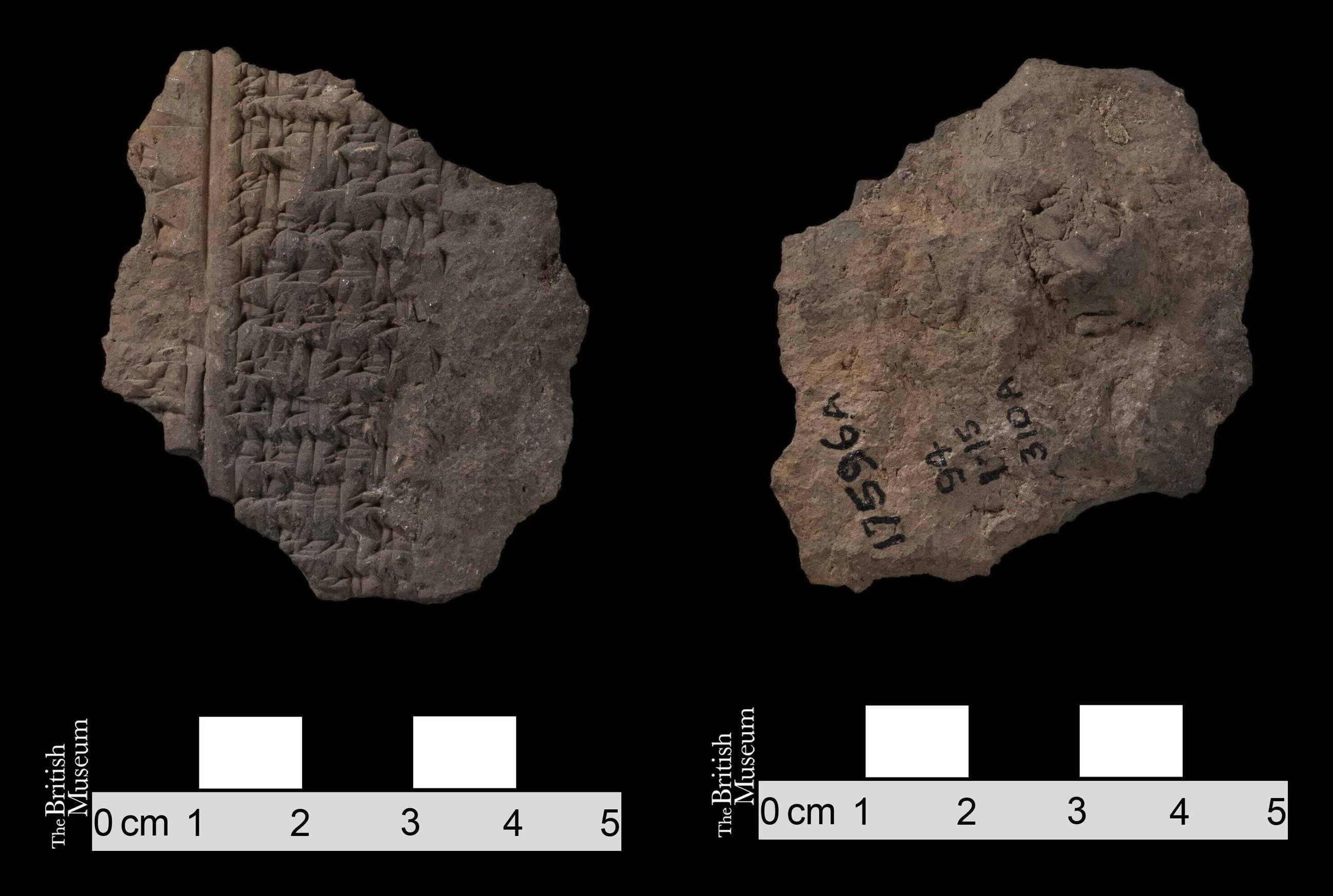
Where on the image
British Museum BM.17596.A: column i, the tablet's own lines 1' to 10'. eBL's corpus edition (https://www.ebl.lmu.de/corpus/L/1/1/OB/I) attributes OB I 27-36 to this manuscript at these column and line numbers. Photograph checked: inscribed face and blank back (inks 17596A and 94-1-15,310A on the back), fragment about 5 cm high. A double vertical ruling with line-end traces to its left (column i) and about 15 lines to its right; broadly consistent with eBL's columns i (10) and ii (21) once broken lines are counted. On this tablet of lines 27-36 only one to three signs survive. The English of these lines translates eBL's composite text, so it includes words that are not preserved on this tablet but are restored from other manuscripts or by the editors. Square brackets in the English mark eBL's restorations in its composite text; words that survive on other tablets carry no brackets even where this tablet is broken.
27[x x x x x x na-ag-b]i
28[x x x x x x iš-ta-ka-n]u!
29[x x x x x x x x x x]-a#
30[x x x x x ma-ti]m
31[x x x x x x qe₂-re-eb-š]u
32[x x x x x x re-ši-š]u?
33[x x x x x x x ša-di]-i?#
34[... {gi}DU]SU
35[x x x x x x x ra-bi-a-a]m
36[x x x x x x x {gi}DUS]U
27[Springs they opened up from] the depths,
28[Wells …] they established.
29[…] the depth
30[…] … of the land
31[…] … within it
32[…] they lifted up,
33[They heaped up] all the mountains.
34[They built …] of drudgery,
35[…] … the vast marsh.
36They built … of drudgery,
Where on the image
British Museum BM.17596.A: column ii, the tablet's own lines 1' to 12'. eBL's corpus edition (https://www.ebl.lmu.de/corpus/L/1/1/OB/I) attributes OB I 103-124 to this manuscript at these column and line numbers. Photograph checked: inscribed face and blank back (inks 17596A and 94-1-15,310A on the back), fragment about 5 cm high. A double vertical ruling with line-end traces to its left (column i) and about 15 lines to its right; broadly consistent with eBL's columns i (10) and ii (21) once broken lines are counted. On this tablet lines 105-106, 108, 110, 112, 117, 119, 121, 123 are entirely broken, of lines 103, 113-114 to 116 only one to three signs survive and lines 104, 107, 109, 111, 118, 120, 122, 124 are partly broken (square brackets and x in the Akkadian). The English of these lines translates eBL's composite text, so it includes words that are not preserved on this tablet but are restored from other manuscripts or by the editors. Square brackets in the English mark eBL's restorations in its composite text; words that survive on other tablets carry no brackets even where this tablet is broken.
103ra-bu-t[um x x x x x x x x]
104{d}+en-lil₂ it-b[e₂-ma x x x x x ( : )]
105[x x x x x x x x x x ( : )]
106[x x x x x x x x x]
107ia-ši-im-ma-[a x x x x x x ( : )]
108[x x x x x x x x x x x]
109i-ni mi-na a#-mu#-[ur x x x ( : )]
110[x x x x x x x x x x x]
111AN-nu pa-a-šu# [x x x x x ( : )]
112[x x x x x x x x x x x]
113-114zi-ik-ra [x x x x x x x x x x x]
115li-ṣi-ma# [x x x x x x x x x]
116te-er-t[a x x x x x x x ( : )]
117[x x x x x x x x x]
118{d}+en-lil₂ pa-a#-šu# [x x x x x]
119[x x x x x x x x]
120{d}nuska pi₂-te# [x x x]
121[x x x x x x x x x x x x x x x]
122i#+na# pu-hu-ur# k[a-la x x x]
123[x x x x x x x x x x x x]
124[iš]-p[u]-ra#-an#-n[i-mi x x x x x x]
103With the great Anunna-gods present,
104Enlil arose, the debate [was underway].
105Enlil made ready to speak,
106And said to the great [gods],
107“Against me, will they dare rise?
108“Shall I take on a battle that …?
109“Alas, what have I seen?
110“Battle ran right up to my gate!”
111Anu made ready to speak,
112And said to the warrior Enlil,
113-114“The reason why the Igigi-gods surrounded your gate,
115“Let Nusku go out, [let him learn their cause],
116“[Your great] command […]”
117“[Let him take] to [your] so[ns]
118Enlil made ready to speak,
119And said to the [courier Nusku],
120“Nusku, open [your gate],
121“Take your weapons, [go out to the group].
122“In the group of [all the gods]
123“Bow down, stand up, [and repeat to them] our [command]:
124‘Anu, [your father],
Notes
- Akkadian: eBL transliteration of the signs on the photographed tablet (manuscript-level ATF), not a composite text.
- English: B. R. Foster's translation in the eBL edition; it renders eBL's composite text, including restorations from other tablets.
- Line numbers: eBL edition. Each section also gives the tablet's own column and line numbers.
- Signs in the Akkadian: [ ] broken away; x illegible sign; # damaged sign; ? uncertain reading; ! sign corrected by the editor; ... broken signs of unknown number; ( ) signs perhaps broken away; { } determinative; : divider sign written on the tablet.
Cite
Sources
- Source: British Museum tablet photographs + eBL manuscript transliterations (eBL corpus edition L I.1, Story of the Flood (Atrahasis) (ed. E. Jiménez and G. Rozzi), OB I) + English of the eBL edition (B. R. Foster (eBL edition)) (holding institution)
- Critical edition: electronic Babylonian Library, Story of the Flood (Atrahasis) (ed. E. Jiménez and G. Rozzi), manuscript transliterations
← previous · → next · v cycle view · l back to library