Atrahasis, Standard Babylonian Tablet II
Introduction
The later version of the middle of the story: the noise of humankind, and Enlil's plagues, drought and famine.
Atrahasis ('Exceedingly Wise') is the Babylonian story of humanity from its creation to the Flood. The lesser gods rebel against their labour; humankind is created from clay and the flesh and blood of a slain god to do the work instead; when people multiply and their noise disturbs Enlil, he sends plague, drought and famine, and finally the Flood, which Atrahasis survives in a boat on the advice of Enki (Ea). The oldest near-complete copy was written at Sippar by the scribe Ipiq-Aya in the 17th century BCE. This page follows the line numbering of the electronic Babylonian Library edition.
How this page is built. Each section is a run of consecutive lines as written on one photographed clay tablet. For every line the eBL edition (https://www.ebl.lmu.de/corpus/L/1/1/SB/II) lists the manuscripts that carry it, with each tablet's own column and line numbers; the tablet chosen for each run is the photographed copy of the work with the most signs preserved there. Commentaries and texts that only quote a line are never chosen. School and excerpt tablets are used only for lines that no photographed library copy preserves as well, and only where they carry the line as text; their sections say so. The original text is eBL's transliteration of that tablet's signs (not a modern composite text): square brackets mark broken signs, x an illegible sign, # a damaged sign, ? an uncertain reading, and words in {braces} are determinatives; the notes give a key to every sign used on this page, and eBL's layout codes are written out in words (for example '(line break)' or '(blank space)'). Superscript numbers are the line numbers of the eBL edition, used in both the Akkadian and the English. The English is B. R. Foster's translation in the eBL edition (CC BY-NC-SA 4.0), one line of English per line of the text; italics mark uncertain renderings, as in the source. Where the tablet is broken, the English still translates the whole line of eBL's composite text; each section's note names the lines that are broken on its tablet.
Finding a line on the photograph. Each section names the tablet, the face and column, and the tablet's own line numbers (a prime, as in 5', counts from the first preserved line of a broken column). On a tablet with six columns the obverse carries columns i-iii from left to right; the reverse, turned over from bottom to top, carries columns iv-vi from right to left. The photographs often show the obverse above the reverse with the edges around them; a fragment preserves only part of this layout.
This page shows 62 of the 116 lines of the eBL edition (53%), from 5 tablets in the British Museum: BM.41330, K.6235 (Nineveh), K.6634 (Nineveh), K.17853 (Nineveh), K.14697 (Nineveh).
Lines not shown. 54 of the 116 lines of the eBL edition are not shown, because no photographed copy of the work used here carries them: 1-29 (not in the eBL Fragmentarium (no photograph there): IM.124649); 44-47 (not in the eBL Fragmentarium (no photograph there): IM.124649); 75-84 (not in the eBL Fragmentarium (no photograph there): IM.124649); 92-101 (not in the eBL Fragmentarium (no photograph there): IM.124649); 116 (no photograph in eBL: Ist-B.116 (Istanbul Archaeological Museum); not in the eBL Fragmentarium (no photograph there): IM.124649). A line is shown only on a photographed tablet that carries it as text. Commentaries and other texts that quote a line (letters, rituals, god lists) are not used as witnesses, because they carry it with explanations or inside another text; tablets without a photograph in eBL are not used, because the line could not be shown on its tablet.
How was this verified? (Provenance)
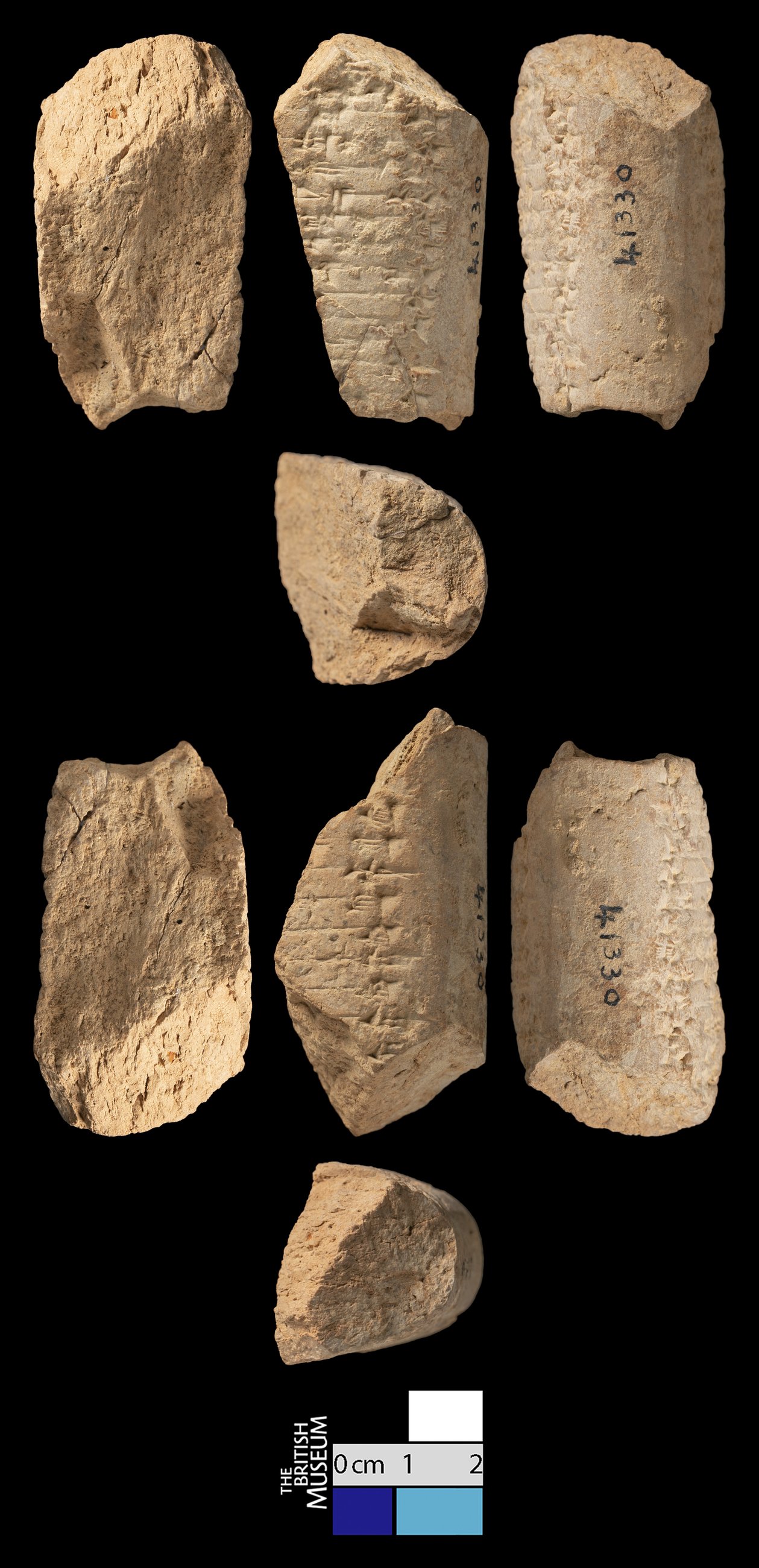
Where on the image
British Museum BM.41330: obverse, the tablet's own lines 1' to 14'. eBL's corpus edition (https://www.ebl.lmu.de/corpus/L/1/1/SB/II) attributes SB II 30-43 to this manuscript at these column and line numbers. Photograph checked: obverse, reverse and edges of a narrow fragment about 3.5 cm long, ink 41330 on the edge. About 14 faint lines on one face and about 9 on the other, consistent with eBL's obverse 14 and reverse 9. On this tablet of lines 30-43 only one to three signs survive. The English of these lines translates eBL's composite text, so it includes words that are not preserved on this tablet but are restored from other manuscripts or by the editors. Square brackets in the English mark eBL's restorations in its composite text; words that survive on other tablets carry no brackets even where this tablet is broken.
30[x x x x x x x ab-ba-a]-a[b x x x]
31[x x x x x x x {d}]i#-gi₄#-g[i₄]
32[x x x x x x x x] iš#-si#
33[x x x x x x x x x] tu-qu[m]-tu₂
34[x x x x x x x x x ka-la-a]k-ka
35[x x x x x id-du-uk-n]i-a-ti
36[x x x x x x x x x x ša-ap]-ša-qi₂
37[x x x x x x i-l]i-i#-[m]a
38[x x x x x x x x x x x {d}+e]n-lil₂
39[x x x x x x te-er]-tu₂
40[x x x x x x ab-be-li₂]-šu₂
41[x x x x taš-pu-ra-a]n-ni#
42[x x x x x x x x x x ad-di]-in#
43[x x x x x x x x ra-bi]-tu₂#
30“‘That battle has run right up to the gate of [Enlil]?’”
31[The Igigi-gods] answered [in the gro]up,
32They were defiant, the labor gang cried out,
33“Every one of us had declared [war],
34“We formed our group in the ditch.
35“The drudgery has killed us,
36“Our forced labor was heavy, (our) misery too much!
37“And so everyone of us gods
38“Has resolved to do battle with Enlil!”
39Nusku took the command,
40He went back and said [to] his [lord],
41“My lord, where you sent me,
42“I betook myself, I stood up and I gave the command,
43“They heard your great command.
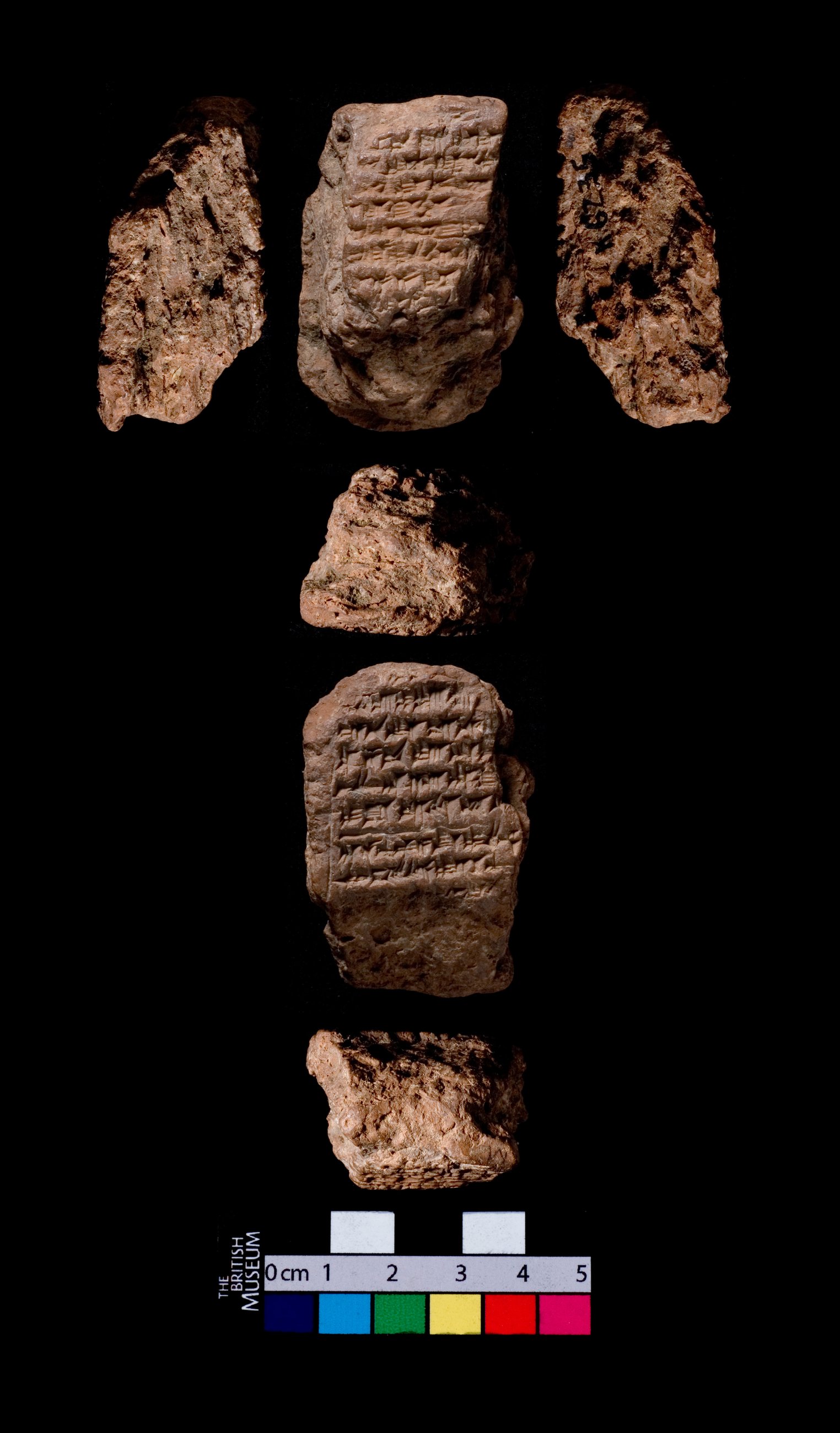
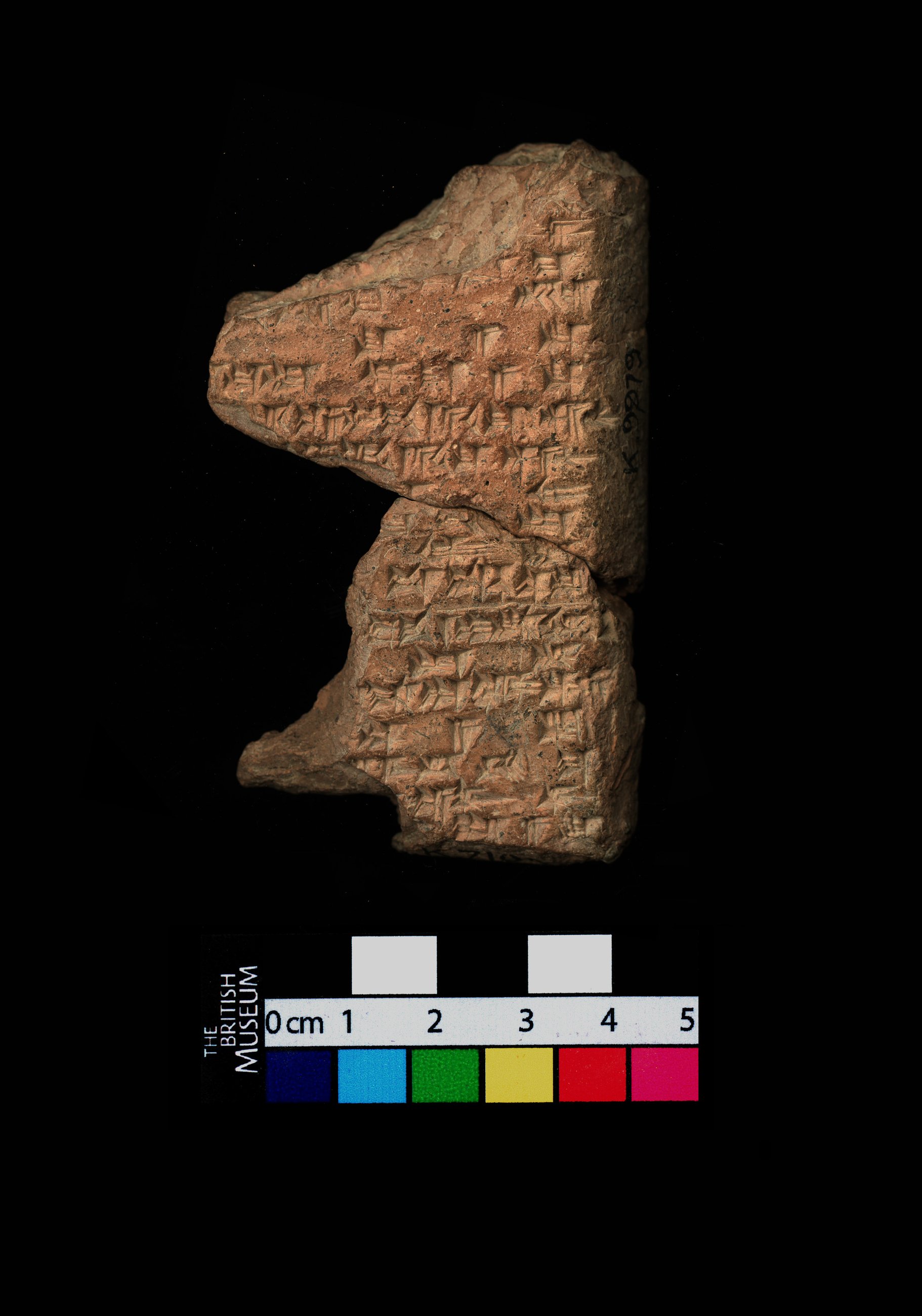
Where on the image
British Museum K.6235: reverse, column i, the tablet's own lines 1' to 17'. eBL's corpus edition (https://www.ebl.lmu.de/corpus/L/1/1/SB/II) attributes SB II 48-67 to this manuscript at these column and line numbers. Photograph checked: obverse, reverse and edges of a fragment about 3 x 5 cm, about 10 lines on each face, no ink number visible. Alone it holds about 20 of eBL's 37 lines; with the linked piece K.7109+K.9979 (about 16 lines) the total fits eBL's column ii and reverse column i. eBL treats K.6235 + K.7109 as one manuscript and holds a separate photograph of each of these pieces; it does not say which piece carries which line, so the photographs of K.6235 + K.7109 are linked, and the lines are on one or more of them. On this tablet of lines 48-49, 51, 65 only one to three signs survive and lines 50, 52-64, 66-67 are partly broken (square brackets and x in the Akkadian). The English of these lines translates eBL's composite text, so it includes words that are not preserved on this tablet but are restored from other manuscripts or by the editors. Square brackets in the English mark eBL's restorations in its composite text; words that survive on other tablets carry no brackets even where this tablet is broken.
48[x x x x x x x x x x x ša-ap-sa-a]q-ni
49[x x x x x x] i#-li#-ma
50[x x x x x] mit*#-hu*#-ṣa# KI# {d}+en!-lil₂
51[x x x x x x] šu-a-tu
52[x x x x x i]l-la-ka di-ma-a-šu
53[{d}+en-li]l₂* i*#-t[a*-dir mu-u₂-du-us-s]u :
54iz-za-ak-kar₃ a-na a-hi-šu (erased: x) {d}a-nu
55{d#}+en-lil₂ i-ta-dir m[u?-u₂-du-us-su]
56[i]z-za#-ak#-kar₃# a-na a-hi-šu {d}a-nu
57e-tel-li iš-ti-k[a x x ša₂-m]a-mi
58par-ṣa-am ta-ba-a[l-ma? x (x) x-q]e₂?-et#-ka
59aš-bu {d}a-nun-na-k[i ma]-har-ka#
60i-lu iš-te-en š[i-si-ma lu-u₂ u₂-t]e?-ed-du-šu₂ par-ṣi*
61{d}a-nu pa-a-šu i-pu-ša₂-[am-ma : ]
62[iz-za]-ak-kar₃ ana i-li ah-he#-šu₂#
63mi-nam kar-ṣi-šu₂-nu n[i-ik]-ka-al
64ka#-bi#-it#-ma# du#-ul-l[a-šu₂-nu ma-a-a]d ša-ap-šaq-šu-un#
65[x x x x x x x x x (x)] x-na-a-ṭu
66[x x x x x x x x ni-še-e]m-me ri-ig-ma
67[x x x x x x x a-n]a e-pe-ši
48‘Our forced labor was heavy, our misery too much,
49‘[And so] every one of us gods
50‘[Has resolved] to do battle with Enlil!’“
51When he had heard [that] speech,
52[Then] Enlil’s tears flowed down,
53[Enlil] became disturbed at what [he] had learned,
54He said to his brother [Anu],
55Enlil became disturbed at what [he] had learned,
56He said to his brother [Anu],
57“Noble one, you should take authority off with you to heaven.
58“Take away the power, strip away your design!
59“The Anunna-gods are present before you,
60“Summon one god, [let] a new order be made.”
61Anu made ready [to speak],
62And said to the gods his brothers,
63“What do we denounce them for?
64“Their forced labor was heavy, their misery was too much.
65“Every day, as we survey the earth,
66“The forced labor was heavy and we could hear the clamor.
67“There is a task to be done.
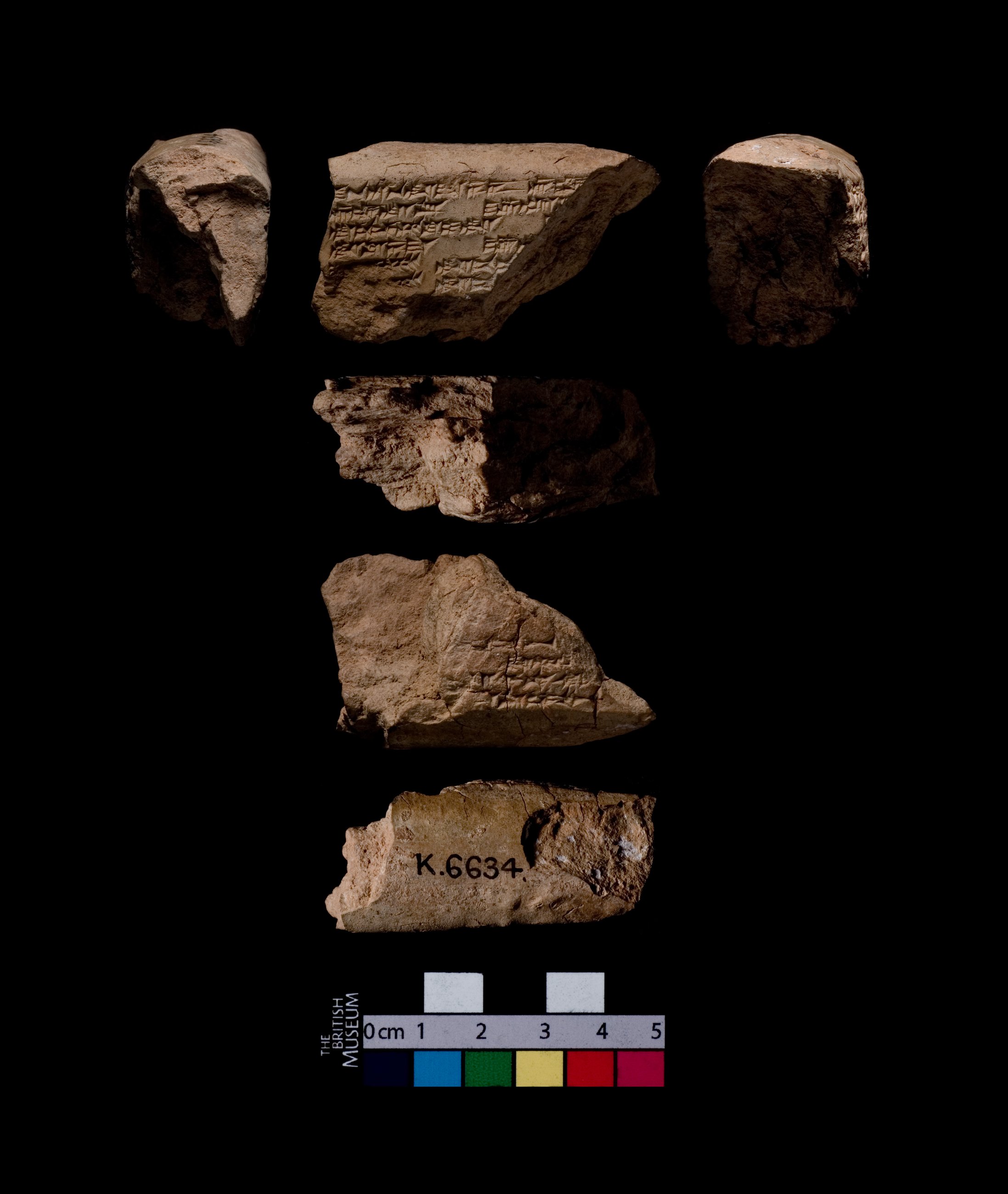
Where on the image
British Museum K.6634: obverse, the tablet's own lines 1' to 7'. eBL's corpus edition (https://www.ebl.lmu.de/corpus/L/1/1/SB/II) attributes SB II 68-74 to this manuscript at these column and line numbers. Photograph checked: obverse, reverse and edges, ink K.6634 on the edge. About 7 lines on the obverse of a fragment about 4 cm wide, consistent with eBL's obverse 7. On this tablet of line 74 only one to three signs survive and lines 68-73 are partly broken (square brackets and x in the Akkadian). The English of these lines translates eBL's composite text, so it includes words that are not preserved on this tablet but are restored from other manuscripts or by the editors. Square brackets in the English mark eBL's restorations in its composite text; words that survive on other tablets carry no brackets even where this tablet is broken.
68[a]š₂-bat {d}be-le-et-i₃-li₂ sa-as#-[su-ra-tu₄]
69sa-as-su-ru LU₂.U₁₈.L[U-a x x x x]
70tu-up-ši-ik-ku i-li a#-[me-lu x x]
71li-ib-ni-ma LU₂.U₁₈#.[LU-a x x x]
72ab#-ša₂#-a-nam li-bi-i[l x x x x x x x]
73[ab-ša₂-a-n]am li-bi-i[l x x x x x x]
74[x x x x i]-li# [x x x x x x]
68“Belet-ili [is present], the mother goddess,
69“Let the mother goddess create humanity,
70“Let man bear the drudgery of god.
71“Let her create humanity,
72“Let him bear the yoke, lordship’s task,
73“Let him bear the yoke, Enlil’s task,
74“Let man assume the drudgery of god.”
Where on the image
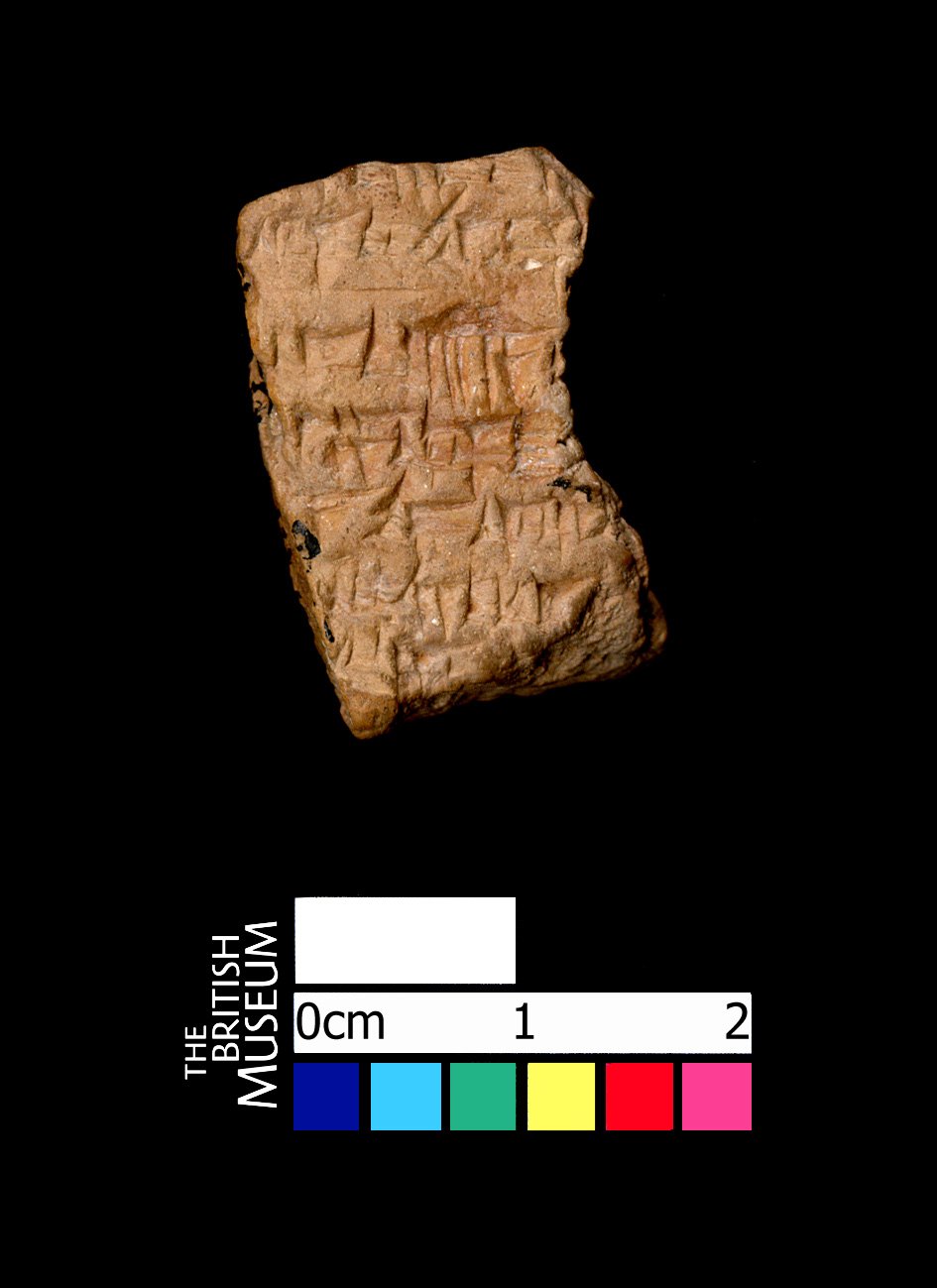
British Museum K.17853: the inscribed face, the tablet's own lines 1' to 7'. eBL's corpus edition (https://www.ebl.lmu.de/corpus/L/1/1/SB/II) attributes SB II 85-91 to this manuscript at these column and line numbers. Photograph checked: one face of a fragment about 2 cm high with 6 or 7 lines; no ink number visible. Consistent with eBL's 7 lines. On this tablet of lines 85-86, 89, 91 only one to three signs survive and lines 87-88, 90 are partly broken (square brackets and x in the Akkadian). The English of these lines translates eBL's composite text, so it includes words that are not preserved on this tablet but are restored from other manuscripts or by the editors. Square brackets in the English mark eBL's restorations in its composite text; words that survive on other tablets carry no brackets even where this tablet is broken.
85[š]u-u₂#-ma# [x x x x x x]
86ṭi-iṭ-ṭi# [x x x x x x x x x x x]
87{d#}e₂-a p[a-a-šu x x x x x]
88[i]z-za-ak-k[ar₃ x x x x x x x x]
89e#-wa-ar#-[hi x x x x x x x x x]
90[t]e-li-il-t[u₄ x x x x x x x x]
91[i]-lam# iš#-[te-en x x x x x]
85“He is the one who begets everything,
86“Let him give me the clay so I can do the making.”
87Ea made ready to speak
88And said to the gods his brothers,
89“On the first, seventh, and fifteenth days of the month,
90“I will establish a purification, a bath.
91“Let one god be slaughtered,
Where on the image
British Museum BM.41330: reverse, the tablet's own lines 1' to 4'. eBL's corpus edition (https://www.ebl.lmu.de/corpus/L/1/1/SB/II) attributes SB II 102-105 to this manuscript at these column and line numbers. Photograph checked: obverse, reverse and edges of a narrow fragment about 3.5 cm long, ink 41330 on the edge. About 14 faint lines on one face and about 9 on the other, consistent with eBL's obverse 14 and reverse 9. On this tablet of lines 102-105 only one to three signs survive. The English of these lines translates eBL's composite text, so it includes words that are not preserved on this tablet but are restored from other manuscripts or by the editors. Square brackets in the English mark eBL's restorations in its composite text; words that survive on other tablets carry no brackets even where this tablet is broken.
102[x x x x x x x x ri-im]-ki#
103[x x x x x x x x ṭe₃]-e#-ma#
104[x x x x x x x x x ma-ah-ri]-ti₃
105[x x x x x da-mi]-i#-šu
102He instituted a purification, a bath.
103They slaughtered Alla, the god who had the inspiration,
104Alla, an Enlil of former time (?).
105With his flesh and blood.
Where on the image
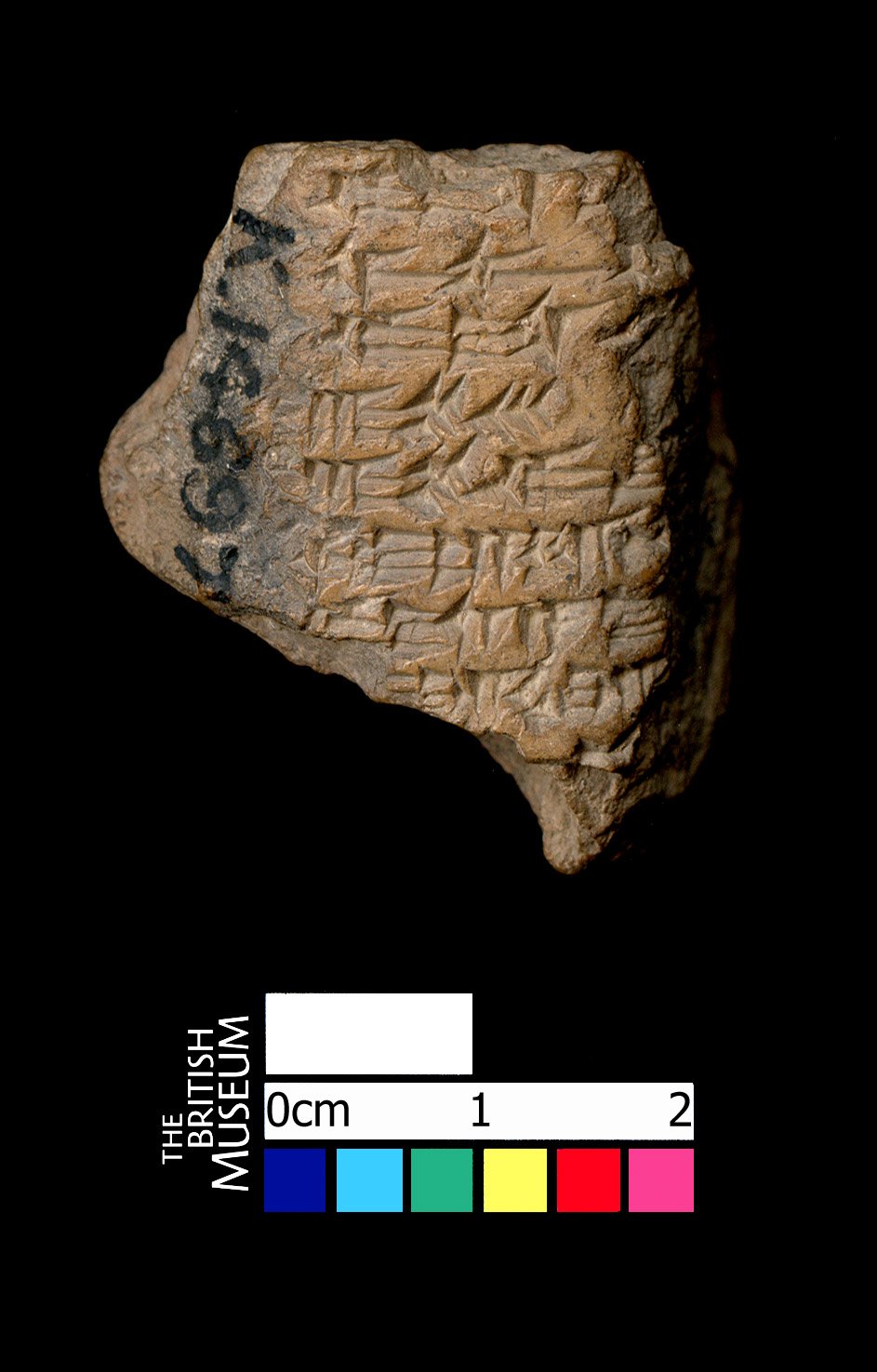
British Museum K.14697: the inscribed face, the tablet's own lines 1' to 9'. eBL's corpus edition (https://www.ebl.lmu.de/corpus/L/1/1/SB/II) attributes SB II 106-115 to this manuscript at these column and line numbers. Photograph checked: one face of a fragment about 2.5 cm high with about 9 lines, ink K.14697 on the left edge. Consistent with eBL's 10 lines. On this tablet line 110 is entirely broken, of lines 106-108, 114-115 only one to three signs survive and lines 109, 111-113 are partly broken (square brackets and x in the Akkadian). The English of these lines translates eBL's composite text, so it includes words that are not preserved on this tablet but are restored from other manuscripts or by the editors. Square brackets in the English mark eBL's restorations in its composite text; words that survive on other tablets carry no brackets even where this tablet is broken.
106[x x x x x x x x x] ṭi-iṭ#-ṭ[a]
107[x x x x] a₃-wi-l[u₄]
108[x x x x x x x x i?-na?] ṭi-iṭ-ṭ[i]
109[x x x x x x x x] u₂-še-eš-m[e]
110[x x x x x x x x x x ( : )]
111[x x x x x x] u₂#-še-di-i-š[u]
112[x x x mu-uš]-ši-i e-ṭem₂-m[u]
113[x x x x x x] ṭi#-ṭa-a-š[a]
114[x x x x x x x x x {d}]i#-gi₄-g[i₄]
115[x x x x x x ra]-bu#-t[u₄]
106Belet-ili mixed the clay
107That same [god] and man
108Were thoroughly mixed together in the clay.
109“For the rest of time, let him (scil. the man) appear, so that she (scil. Belet-ili) can hear (him).
110From the flesh of the god a spirit remained.
111It would make the living know its sign,
112[A sign] not to be forgotten, a spirit.
113[After] she had mixed her clay,
114[He summoned] the Anunnaki and all the Igigi,
115[The Igigi], the great gods,
Notes
- Akkadian: eBL transliteration of the signs on the photographed tablet (manuscript-level ATF), not a composite text.
- English: B. R. Foster's translation in the eBL edition; it renders eBL's composite text, including restorations from other tablets.
- Line numbers: eBL edition. Each section also gives the tablet's own column and line numbers.
- Signs in the Akkadian: [ ] broken away; x illegible sign; # damaged sign; ? uncertain reading; ! sign corrected by the editor; * collated sign; ( ) signs perhaps broken away; { } determinative; : divider sign written on the tablet.
Cite
Sources
- Source: British Museum tablet photographs + eBL manuscript transliterations (eBL corpus edition L I.1, Story of the Flood (Atrahasis) (ed. E. Jiménez and G. Rozzi), SB II) + English of the eBL edition (B. R. Foster (eBL edition)) (holding institution)
- Critical edition: electronic Babylonian Library, Story of the Flood (Atrahasis) (ed. E. Jiménez and G. Rozzi), manuscript transliterations
← previous · → next · v cycle view · l back to library