Matthew, Chapter 1 (Codex Bezae)
Introduction
Matthew 1 from Codex Bezae (Codex Cantabrigiensis, 5th c.), the most important Western text manuscript. A bilingual Greek/Latin codex containing the Gospels and Acts, held at Cambridge University Library.
Codex Bezae is bilingual: at each opening the Greek is on the left-hand (verso) page and the Latin on the facing right-hand (recto) page. Only the Greek pages are shown here; the Latin column is not included.
Page check: The NTVMR transcription of this chapter comes partly from pages whose files state "All rights reserved by the INTF", so the Greek shown is Tischendorf's edition. The sections were re-checked against the page on which the transcription places each verse, so every section shows the page(s) that carry it.
What survives and what is shown: Codex Bezae has lost leaves. In the Greek pages Matthew 1:1-20 (to μη φοβηθης), 6:20-9:2, 27:2-12 and John 1:16-3:26 are missing in whole or in part: Matthew 1:20, 6:20, 9:2, 27:12, John 1:16 and 3:26 survive only in part, and Matthew 27:2 only as a torn fragment. The surviving part of each edge verse is marked in both columns, and the verses in between are not shown. A few leaves were replaced by a later scribe; pages from these supplementary leaves are marked "supplement". This library so far shows only Matthew and John from the codex; its Mark, Luke and Acts are not included.
How was this verified? (Provenance)
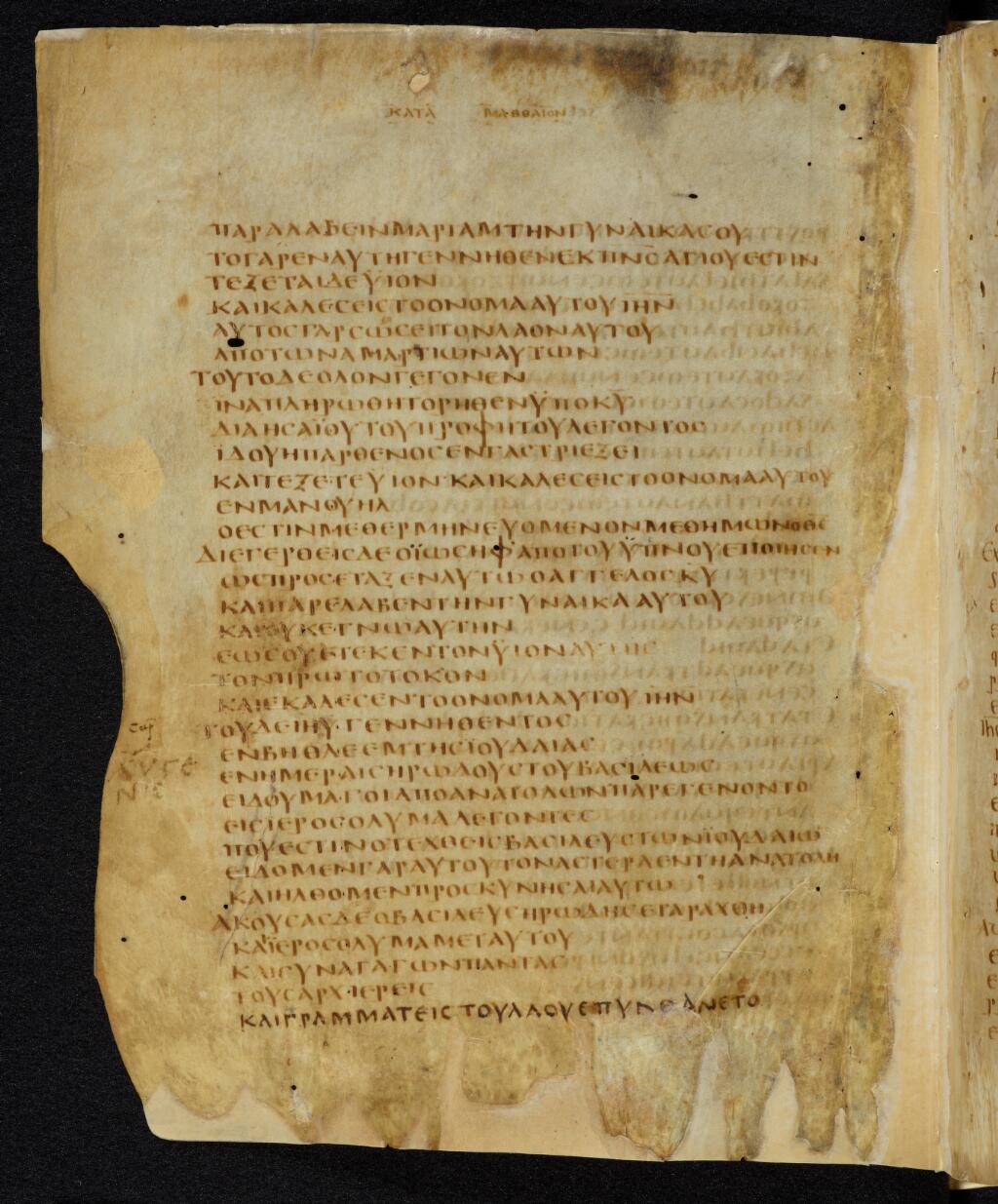
Where on the image
Page from the NTVMR transcription (docID 20005): verses 20-25 on fol. 3v. Checked on the image: fol. 3v line 1 reads ΠΑΡΑΛΑΒΕΙΝ ΜΑΡΙΑΜ ΤΗΝ ΓΥΝΑΙΚΑ ϹΟΥ, inside 1:20; the start of the verse was on a lost leaf.
20[the first part of this verse, to μὴ φοβηθῇς, is lost with the missing leaves; fol. 3v begins with παραλαβειν] παραλαβεῖν Μαρίαμ τὴν γυναῖκά σου, τὸ γὰρ ἐν αὐτῇ γεννηθὲν ἐκ πνεύματός ἐστιν ἁγίου· 21τέξεται δὲ υἱὸν καὶ καλέσεις τὸ ὄνομα αὐτοῦ Ἰησοῦν, αὐτὸς γὰρ σώσει τὸν λαὸν αὐτοῦ ἀπὸ τῶν ἁμαρτιῶν αὐτῶν. 22τοῦτο δὲ ὅλον γέγονεν ἵνα πληρωθῇ τὸ ῥηθὲν ὑπὸ κυρίου διὰ τοῦ προφήτου λέγοντος, 23ἰδοὺ ἡ παρθένος ἐν γαστρὶ ἕξει καὶ τέξεται υἱόν, καὶ καλέσουσιν τὸ ὄνομα αὐτοῦ Ἐμμανουήλ, ὅ ἐστιν μεθερμηνευόμενον μεθ’ ἡμῶν ὁ θεός. 24ἐγερθεὶς δὲ Ἰωσὴφ ἀπὸ τοῦ ὕπνου ἐποίησεν ὡς προσέταξεν αὐτῷ ὁ ἄγγελος κυρίου καὶ παρέλαβεν τὴν γυναῖκα αὐτοῦ· 25καὶ οὐκ ἐγίνωσκεν αὐτὴν ἕως οὗ ἔτεκεν υἱόν· καὶ ἐκάλεσεν τὸ ὄνομα αὐτοῦ Ἰησοῦν.
20[The beginning of this verse, "But while he thought on these things, behold, the angel of the Lord appeared unto him in a dream, saying, Joseph, thou son of David, fear not", is lost with the missing leaves.] to take unto thee Mary thy wife: for that which is conceived in her is of the Holy Ghost. 21And she shall bring forth a son, and thou shalt call his name JESUS: for he shall save his people from their sins. 22Now all this was done, that it might be fulfilled which was spoken of the Lord by the prophet, saying, 23Behold, a virgin shall be with child, and shall bring forth a son, and they shall call his name Emmanuel, which being interpreted is, God with us. 24Then Joseph being raised from sleep did as the angel of the Lord had bidden him, and took unto him his wife: 25And knew her not till she had brought forth her firstborn son: and he called his name JESUS.
Notes
- Codex Bezae is bilingual: at each opening the Greek is on the left-hand (verso) page and the Latin on the facing right-hand (recto) page. Only the Greek pages are shown here; the Latin column is not included.
Cite
Sources
- Source: Codex Bezae (5th c.) via Cambridge IIIF + NTVMR mapping + Tischendorf + KJV (holding institution)
- Critical edition: Tischendorf 8th edition (1869)
← previous · → next · v cycle view · l back to library