Matthew, Chapter 9 (Codex Bezae)
Introduction
Matthew 9 from Codex Bezae (Codex Cantabrigiensis, 5th c.), the most important Western text manuscript. A bilingual Greek/Latin codex containing the Gospels and Acts, held at Cambridge University Library.
Codex Bezae is bilingual: at each opening the Greek is on the left-hand (verso) page and the Latin on the facing right-hand (recto) page. Only the Greek pages are shown here; the Latin column is not included.
Greek text: a diplomatic transcription of Codex Bezae made by the Institut für Neutestamentliche Textforschung (INTF), Münster, for the New Testament Virtual Manuscript Room (NTVMR), published under a Creative Commons Attribution 4.0 licence. It gives the letters as the first scribe wrote them: no accents or breathings, the scribe's own spelling, and the sacred names in their contracted form (θς for θεος, ις for ιησους, κς for κυριος; the overline is not reproduced). Corrections by later hands are not shown. Letters in square brackets are not legible on the page and were restored by the transcribers, a dot under a letter marks an uncertain reading, and [...] marks text lost to damage. Beneath each section, for comparison, is Tischendorf's 8th critical edition (1869). Where the two differ, the transcription is what the manuscript says. Each section is shown with the page on which the transcription places its verses.
Manuscript note: Not written in Codex Bezae: verse 34. The English is shown with a bracketed note in the Greek column.
What survives and what is shown: Codex Bezae has lost leaves. In the Greek pages Matthew 1:1-20 (to μη φοβηθης), 6:20-9:2, 27:2-12 and John 1:16-3:26 are missing in whole or in part: Matthew 1:20, 6:20, 9:2, 27:12, John 1:16 and 3:26 survive only in part, and Matthew 27:2 only as a torn fragment. The surviving part of each edge verse is marked in both columns, and the verses in between are not shown. A few leaves were replaced by a later scribe; pages from these supplementary leaves are marked "supplement". This library so far shows only Matthew and John from the codex; its Mark, Luke and Acts are not included.
How was this verified? (Provenance)
Where on the image
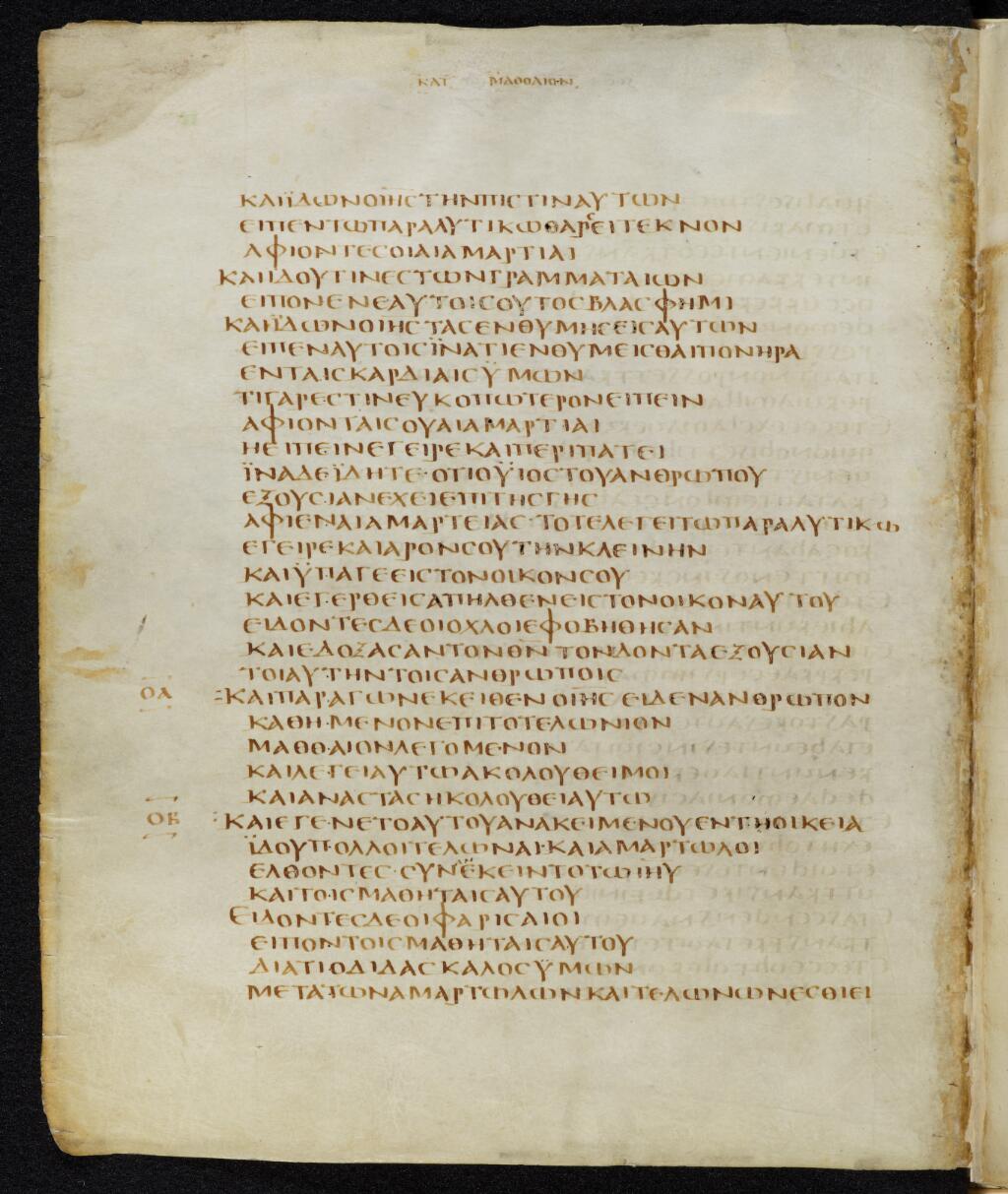
Page from the NTVMR transcription (docID 20005): verses 2-11 on fol. 25v.
2[the beginning of this verse is lost with the missing leaves (Matthew 6:20-9:2)] και ιδων ο ιης την πιστιν αυτων ειπεν τω παραλυτικω θαρει τεκνον αφιοντε σοι αι αμαρτιαι 3και ιδου τινες των γραμματαιων ειπον εν εαυτοις ουτος βλασφημι 4και ιδων ο ιης τας ενθυμησεις αυτων ειπεν αυτοις ινατι ενθυμεισθαι πονηρα εν ταις καρδιαις υμων 5τι γαρ εστιν ευκοπωτερον ειπειν αφιονται σου αι αμαρτιαι η ειπειν εγειρε και περιπατει 6ινα δε ιδητε · οτι ο υιος του ανθρωπου εξουσιαν εχει επι της γης αφιεναι αμαρτειας · τοτε λεγει τω παραλυτικω εγειρε και αρον σου την κλεινην και υπαγε εις τον οικον σου 7και εγερθεις απηλθεν εις τον οικον αυτου 8ειδοντες δε οι οχλοι εφοβηθησαν και εδοξασαν τον θν τον δοντα εξουσιαν τοιαυτην τοις ανθρωποις 9και παραγων εκειθεν ο ιης ειδεν ανθρωπον καθημενον επι το τελωνιον μαθθαιον λεγομενον και λεγει αυτω ακολουθει μοι και αναστας ηκολουθει αυτω 10και εγενετο αυτου ανακειμενου εν τη οικεια ιδου πολλοι τελωναι · και αμαρτωλοι ελθοντες · συνεκειντο τω ιηυ και τοις μαθηταις αυτου 11ειδοντες δε οι φαρισαιοι ειπον τοις μαθηταις αυτου δια τι ο διδασκαλος υμων μετα των αμαρτωλων και τελωνων εσθιει
Compare: Tischendorf 8th edition (1869)
2καὶ ἰδοὺ προσέφερον αὐτῷ παραλυτικὸν ἐπὶ κλίνης βεβλημένον. καὶ ἰδὼν ὁ Ἰησοῦς τὴν πίστιν αὐτῶν εἶπεν τῷ παραλυτικῷ· θάρσει, τέκνον· ἀφίενταί σου αἱ ἁμαρτίαι. 3καὶ ἰδού τινες τῶν γραμματέων εἶπον ἐν ἑαυτοῖς· οὗτος βλασφημεῖ. 4καὶ ἰδὼν ὁ Ἰησοῦς τὰς ἐνθυμήσεις αὐτῶν εἶπεν, ἱνατί ἐνθυμεῖσθε πονηρὰ ἐν ταῖς καρδίαις ὑμῶν; 5τί γάρ ἐστιν εὐκοπώτερον, εἰπεῖν, ἀφίενταί σου αἱ ἁμαρτίαι, ἢ εἰπεῖν, ἔγειρε καὶ περιπάτει; 6ἵνα δὲ εἰδῆτε ὅτι ἐξουσίαν ἔχει ὁ υἱὸς τοῦ ἀνθρώπου ἐπὶ τῆς γῆς ἀφιέναι ἁμαρτίας, τότε λέγει τῷ παραλυτικῷ, ἐγερθεὶς ἆρόν σου τὴν κλίνην καὶ ὕπαγε εἰς τὸν οἶκόν σου. 7καὶ ἐγερθεὶς ἀπῆλθεν εἰς τὸν οἶκον αὐτοῦ. 8ἰδόντες δὲ οἱ ὄχλοι ἐφοβήθησαν καὶ ἐδόξασαν τὸν θεὸν τὸν δόντα ἐξουσίαν τοιαύτην τοῖς ἀνθρώποις. 9Καὶ παράγων ὁ Ἰησοῦς ἐκεῖθεν εἶδεν ἄνθρωπον καθήμενον ἐπὶ τὸ τελώνιον, Μαθθαῖον λεγόμενον, καὶ λέγει αὐτῷ, ἀκολούθει μοι. καὶ ἀναστὰς ἠκολούθει αὐτῷ. 10καὶ ἐγένετο αὐτοῦ ἀνακειμένου ἐν τῇ οἰκίᾳ, ἰδοὺ πολλοὶ τελῶναι καὶ ἁμαρτωλοὶ ἐλθόντες συνανέκειντο τῷ Ἰησοῦ καὶ τοῖς μαθηταῖς αὐτοῦ. 11καὶ ἰδόντες οἱ Φαρισαῖοι ἔλεγον τοῖς μαθηταῖς αὐτοῦ, διατί μετὰ τῶν τελωνῶν καὶ ἁμαρτωλῶν ἐσθίει ὁ διδάσκαλος ὑμῶν;
2[The beginning of this verse, "And, behold, they brought to him a man sick of the palsy, lying on a bed:", is lost with the missing leaves.] and Jesus seeing their faith said unto the sick of the palsy; Son, be of good cheer; thy sins be forgiven thee. 3And, behold, certain of the scribes said within themselves, This man blasphemeth. 4And Jesus knowing their thoughts said, Wherefore think ye evil in your hearts? 5For whether is easier, to say, Thy sins be forgiven thee; or to say, Arise, and walk? 6But that ye may know that the Son of man hath power on earth to forgive sins, (then saith he to the sick of the palsy,) Arise, take up thy bed, and go unto thine house. 7And he arose, and departed to his house. 8But when the multitudes saw it, they marvelled, and glorified God, which had given such power unto men. 9And as Jesus passed forth from thence, he saw a man, named Matthew, sitting at the receipt of custom: and he saith unto him, Follow me. And he arose, and followed him. 10And it came to pass, as Jesus sat at meat in the house, behold, many publicans and sinners came and sat down with him and his disciples. 11And when the Pharisees saw it, they said unto his disciples, Why eateth your Master with publicans and sinners?
Where on the image
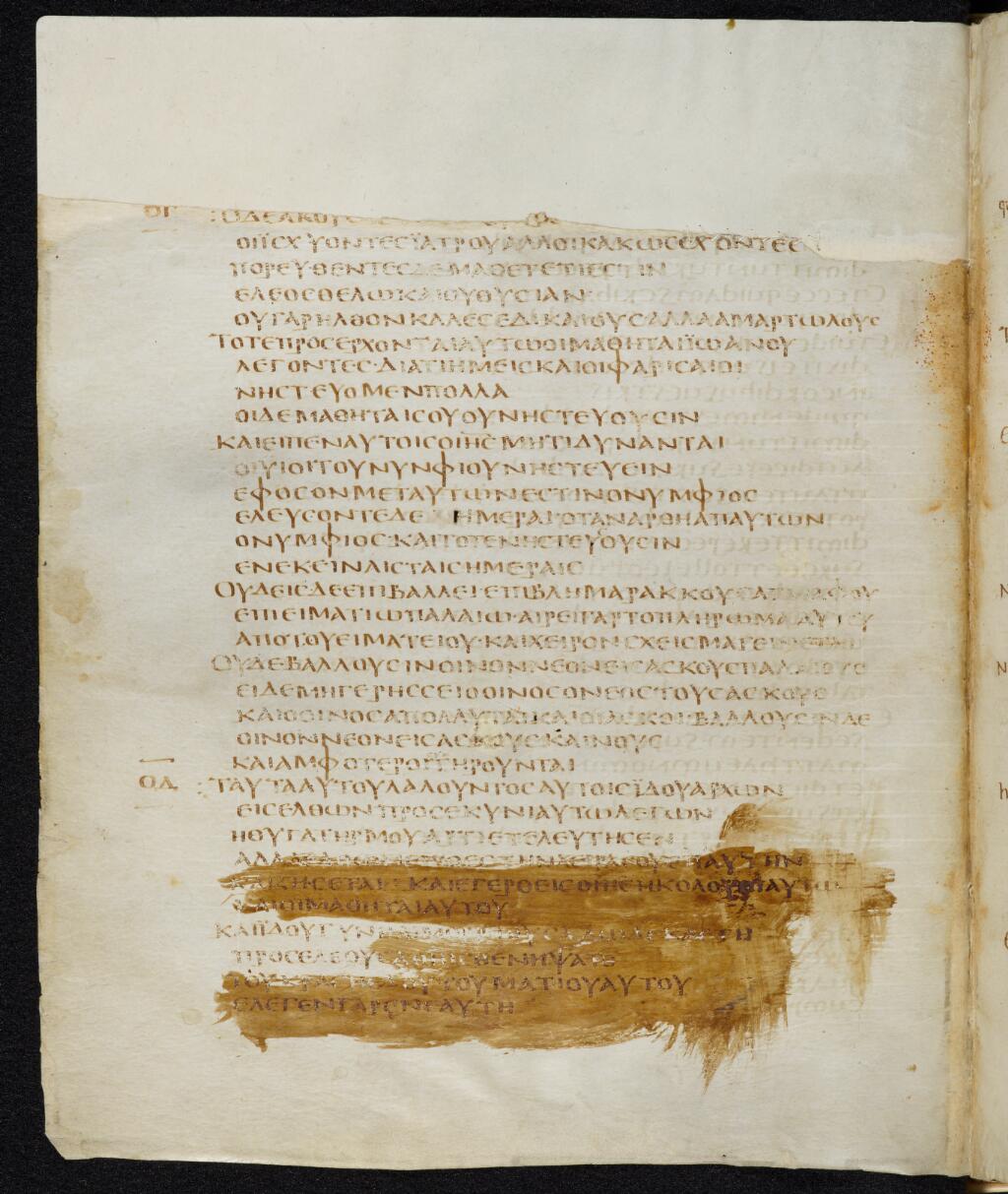
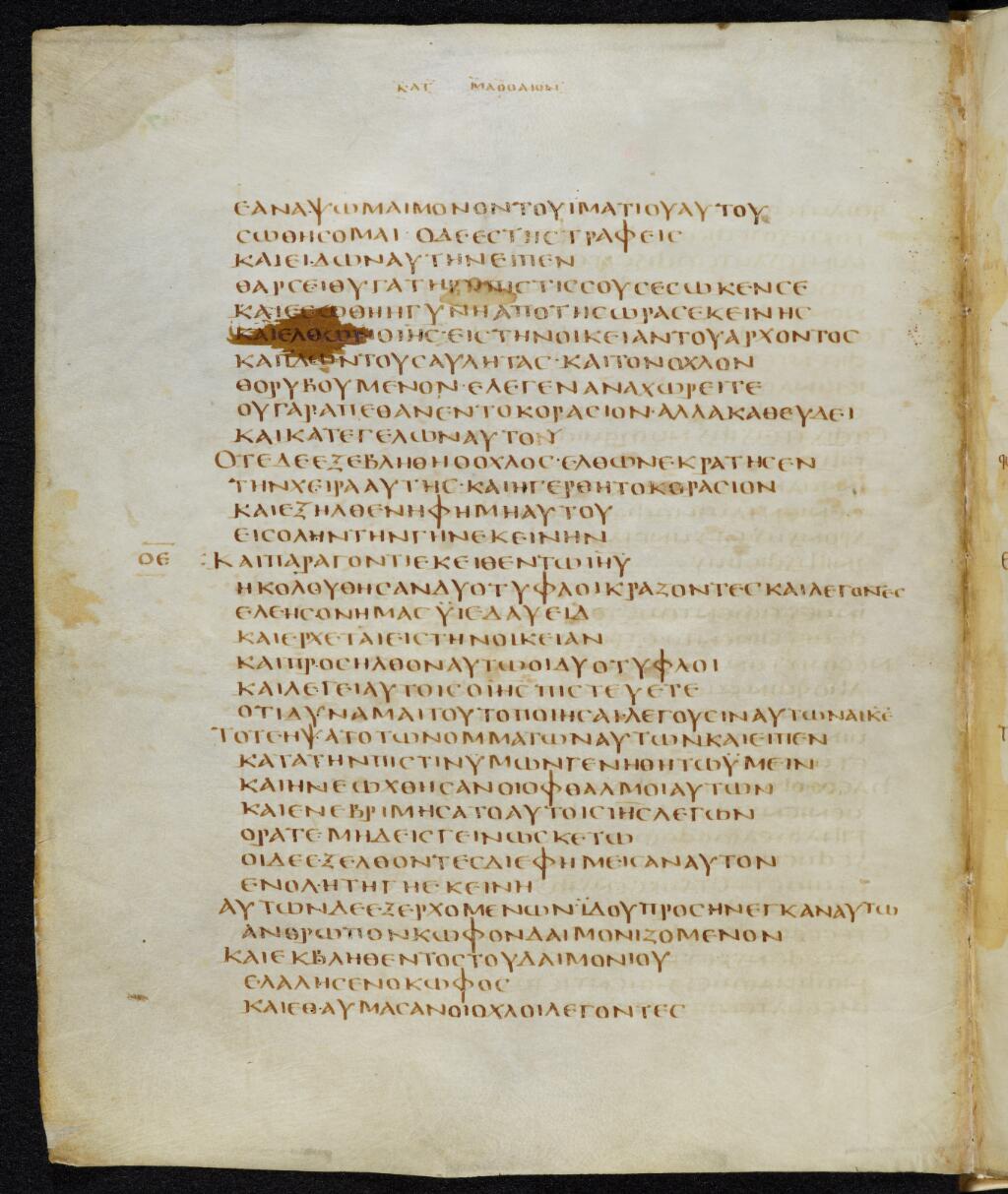
Page from the NTVMR transcription (docID 20005): verses 12-21 on fol. 26v; verse 21 continues on fol. 27v (which begins 'εαν αψωμαι μονον').
12ο δε ακου̣σ̣α̣ς̣ [ειπεν] ο̣υ̣ χ̣ρ̣ε̣[ιαν] [εχουσιν] οι ισχυοντες ιατρου αλλ οι κακως εχοντες 13πορευθεντες δε μαθετε τι εστιν ελεος θελω και ου θυσιαν · ου γαρ ηλθον καλεσε δικαιους αλλα αμαρτωλους 14τοτε προσερχονται αυτω οι μαθηται ιωανου λεγοντες · δια τι ημεις και οι φαρισαιοι νηστευομεν πολλα οι δε μαθηται σου ου νηστευουσιν 15και ειπεν αυτοις ο ιης μητι δυνανται οι υιοι του νυνφιου νηστευειν εφ οσον μετ αυτων εστιν ο νυμφιος ελευσοντε δε αι ημεραι οταν αρθη απ αυτων ο νυμφιος · και τοτε νηστευουσιν εν εκειναις ταις ημεραις 16ουδεις δε επιβαλλει · επιβλημα ρακκους αγ̣ν̣αφου επι ειματιω παλαιω · αιρει γαρ το πληρωμα αυτου απο του ειματειου · και χειρον σχεισμα γεινεται 17ουδε βαλλουσιν οινον νεον εις ασκους παλαιους ει δε μη γε ρησσει ο οινος ο νεος τους ασκους και ο οινος απολλυται και οι ασκοι βαλλουσιν δε οινον νεον εις ασκους καινους και αμφοτεροι τηρουνται 18ταυτα αυτου λαλουντος αυτοις ιδου αρχων εις ελθων προσεκυνι αυτω λεγων η θυγατηρ μου αρτι ετελευτησεν αλλα ελθ̣ων επιθες την χειρα σου ε̣π αυτην και ζησεται · 19και εγερθεις ο ιης ηκολουθι αυτω και οι μαθηται αυτου 20και ιδου γυνη αιμορροουσα δωδεκα ετη προσελθουσα οπισθεν ηψατο του κρασπ̣εδου του ματιου αυτου 21ελεγεν γαρ εν εαυτη εαν αψωμαι μονον του ιματιου αυτου σωθησομαι ·
Compare: Tischendorf 8th edition (1869)
12ὁ δὲ ἀκούσας εἶπεν, οὐ χρείαν ἔχουσιν οἱ ἰσχύοντες ἰατροῦ ἀλλ’ οἱ κακῶς ἔχοντες. 13πορευθέντες δὲ μάθετε τί ἐστιν, ἔλεος θέλω καὶ οὐ θυσίαν· οὐ γὰρ ἦλθον καλέσαι δικαίους ἀλλὰ ἁμαρτωλούς. 14Τότε προσέρχονται αὐτῷ οἱ μαθηταὶ Ἰωάννου λέγοντες· διατί ἡμεῖς καὶ οἱ Φαρισαῖοι νηστεύομεν, οἱ δὲ μαθηταί σου οὐ νηστεύουσιν; 15καὶ εἶπεν αὐτοῖς ὁ Ἰησοῦς, μὴ δύνανται οἱ υἱοὶ τοῦ νυμφῶνος πενθεῖν ἐφ’ ὅσον μετ’ αὐτῶν ἐστιν ὁ νυμφίος; ἐλεύσονται δὲ ἡμέραι ὅταν ἀπαρθῇ ἀπ’ αὐτῶν ὁ νυμφίος, καὶ τότε νηστεύσουσιν. 16οὐδεὶς δὲ ἐπιβάλλει ἐπίβλημα ῥάκους ἀγνάφου ἐπὶ ἱματίῳ παλαιῷ· αἴρει γὰρ τὸ πλήρωμα αὐτοῦ ἀπὸ τοῦ ἱματίου, καὶ χεῖρον σχίσμα γίνεται. 17οὐδὲ βάλλουσιν οἶνον νέον εἰς ἀσκοὺς παλαιούς· εἰ δὲ μήγε, ῥήγνυνται οἱ ἀσκοί, καὶ ὁ οἶνος ἐκχεῖται καὶ οἱ ἀσκοὶ ἀπόλλυνται· ἀλλὰ βάλλουσιν οἶνον νέον εἰς ἀσκοὺς καινούς, καὶ ἀμφότεροι συντηροῦνται. 18Ταῦτα αὐτοῦ λαλοῦντος αὐτοῖς, ἰδοὺ ἄρχων εἰσελθὼν προσεκύνει αὐτῷ, λέγων· ἡ θυγάτηρ μου ἄρτι ἐτελεύτησεν, ἀλλὰ ἐλθὼν ἐπίθες τὴν χεῖρά σου ἐπ’ αὐτήν, καὶ ζήσεται. 19καὶ ἐγερθεὶς ὁ Ἰησοῦς ἠκολούθει αὐτῷ καὶ οἱ μαθηταὶ αὐτοῦ. 20καὶ ἰδοὺ γυνὴ αἱμορροοῦσα δώδεκα ἔτη προσελθοῦσα ὄπισθεν ἥψατο τοῦ κρασπέδου τοῦ ἱματίου αὐτοῦ· 21ἔλεγεν γὰρ ἐν ἑαυτῇ, ἐὰν μόνον ἅψωμαι τοῦ ἱματίου αὐτοῦ σωθήσομαι.
12But when Jesus heard that, he said unto them, They that be whole need not a physician, but they that are sick. 13But go ye and learn what that meaneth, I will have mercy, and not sacrifice: for I am not come to call the righteous, but sinners to repentance. 14Then came to him the disciples of John, saying, Why do we and the Pharisees fast oft, but thy disciples fast not? 15And Jesus said unto them, Can the children of the bridechamber mourn, as long as the bridegroom is with them? but the days will come, when the bridegroom shall be taken from them, and then shall they fast. 16No man putteth a piece of new cloth unto an old garment, for that which is put in to fill it up taketh from the garment, and the rent is made worse. 17Neither do men put new wine into old bottles: else the bottles break, and the wine runneth out, and the bottles perish: but they put new wine into new bottles, and both are preserved. 18While he spake these things unto them, behold, there came a certain ruler, and worshipped him, saying, My daughter is even now dead: but come and lay thy hand upon her, and she shall live. 19And Jesus arose, and followed him, and so did his disciples. 20And, behold, a woman, which was diseased with an issue of blood twelve years, came behind him, and touched the hem of his garment: 21For she said within herself, If I may but touch his garment, I shall be whole.
Where on the image
Page from the NTVMR transcription (docID 20005): verses 22-33 on fol. 27v; verse 33 continues on fol. 28v (which begins 'ουδεποτε ουτως εφανη').
22ο δε εστη στραφεις και ειδων αυτην ειπεν θαρσει θυγατηρ η πιστις σου σεσωκεν σε και εσωθη η γυνη απο της ωρας εκεινης 23και ελθων ο ιης · εις την οικειαν του αρχοντος και ιδων τους αυλητας · και τον οχλον θορυβουμενον · 24ελεγεν αναχωρειτε ου γαρ απεθανεν το κορασιον · αλλα καθευδει και κατεγελων αυτον 25οτε δε εξεβληθη ο οχλος · ελθων εκρατησεν την χειρα αυτης · και ηγερθη το κορασιον 26και εξηλθεν η φημη αυτου εις ολην την γην εκεινην 27και παραγοντι εκειθεν τω ιηυ ηκολουθησαν δυο τυφλοι κραζοντες και λεγοντες ελεησον ημας υιε δαυειδ 28και ερχεται εις την οικειαν και προσηλθον αυτω οι δυο τυφλοι και λεγει αυτοις ο ιης πιστευετε οτι δυναμαι τουτο ποιησαι · λεγουσιν αυτω ναι κε 29τοτε ηψατο των ομματων αυτων και ειπεν κατα την πιστιν υμων γενηθητω υμειν 30και ηνεωχθησαν οι οφθαλμοι αυτων και ενεβριμησατο αυτοις ιης λεγων ορατε μηδεις γεινωσκετω 31οι δε εξελθοντες διεφημεισαν αυτον εν ολη τη γη εκεινη 32αυτων δε εξερχομενων · ιδου προσηνεγκαν αυτω ανθρωπον κωφον δαιμονιζομενον 33και εκβληθεντος του δαιμονιου ελαλησεν ο κωφος και εθαυμασαν οι οχλοι λεγοντες ουδεποτε ουτως εφανη εν ισραηλ
Compare: Tischendorf 8th edition (1869)
22ὁ δὲ στραφεὶς καὶ ἰδὼν αὐτὴν εἶπεν· θάρσει θύγατερ, ἡ πίστις σου σέσωκέν σε. καὶ ἐσώθη ἡ γυνὴ ἀπὸ τῆς ὥρας ἐκείνης. 23καὶ ἐλθὼν ὁ Ἰησοῦς εἰς τὴν οἰκίαν τοῦ ἄρχοντος καὶ ἰδὼν τοὺς αὐλητὰς καὶ τὸν ὄχλον θορυβούμενον ἔλεγεν· 24ἀναχωρεῖτε· οὐ γὰρ ἀπέθανεν τὸ κοράσιον ἀλλὰ καθεύδει. καὶ κατεγέλων αὐτοῦ. 25ὅτε δὲ ἐξεβλήθη ὁ ὄχλος, εἰσελθὼν ἐκράτησεν τῆς χειρὸς αὐτῆς, καὶ ἠγέρθη τὸ κοράσιον. 26καὶ ἐξῆλθεν ἡ φήμη αὕτη εἰς ὅλην τὴν γῆν ἐκείνην. 27Καὶ παράγοντι ἐκεῖθεν τῷ Ἰησοῦ, ἠκολούθησαν αὐτῷ δύο τυφλοὶ κράζοντες καὶ λέγοντες· ἐλέησον ἡμᾶς, υἱὸς Δαυείδ. 28ἐλθόντι δὲ εἰς τὴν οἰκίαν προσῆλθον αὐτῷ οἱ τυφλοί, καὶ λέγει αὐτοῖς ὁ Ἰησοῦς, πιστεύετε ὅτι δύναμαι τοῦτο ποιῆσαι; λέγουσιν αὐτῷ· ναί, κύριε. 29τότε ἥψατο τῶν ὀφθαλμῶν αὐτῶν λέγων· Κατὰ τὴν πίστιν ὑμῶν γενηθήτω ὑμῖν. 30καὶ ἀνεῴχθησαν αὐτῶν οἱ ὀφθαλμοί. καὶ ἐνεβριμήθη αὐτοῖς ὁ Ἰησοῦς λέγων· ὁρᾶτε μηδεὶς γινωσκέτω. 31οἱ δὲ ἐξελθόντες διεφήμισαν αὐτὸν ἐν ὅλῃ τῇ γῇ ἐκείνῃ. 32Αὐτῶν δὲ ἐξερχομένων, ἰδοὺ προσήνεγκαν αὐτῷ ἄνθρωπον κωφὸν δαιμονιζόμενον· 33καὶ ἐκβληθέντος τοῦ δαιμονίου ἐλάλησεν ὁ κωφός. καὶ ἐθαύμασαν οἱ ὄχλοι λέγοντες· οὐδέποτε ἐφάνη οὕτως ἐν τῷ Ἰσραήλ.
22But Jesus turned him about, and when he saw her, he said, Daughter, be of good comfort; thy faith hath made thee whole. And the woman was made whole from that hour. 23And when Jesus came into the ruler’s house, and saw the minstrels and the people making a noise, 24He said unto them, Give place: for the maid is not dead, but sleepeth. And they laughed him to scorn. 25But when the people were put forth, he went in, and took her by the hand, and the maid arose. 26And the fame hereof went abroad into all that land. 27And when Jesus departed thence, two blind men followed him, crying, and saying, Thou Son of David, have mercy on us. 28And when he was come into the house, the blind men came to him: and Jesus saith unto them, Believe ye that I am able to do this? They said unto him, Yea, Lord. 29Then touched he their eyes, saying, According to your faith be it unto you. 30And their eyes were opened; and Jesus straitly charged them, saying, See that no man know it. 31But they, when they were departed, spread abroad his fame in all that country. 32As they went out, behold, they brought to him a dumb man possessed with a devil. 33And when the devil was cast out, the dumb spake: and the multitudes marvelled, saying, It was never so seen in Israel.
Where on the image
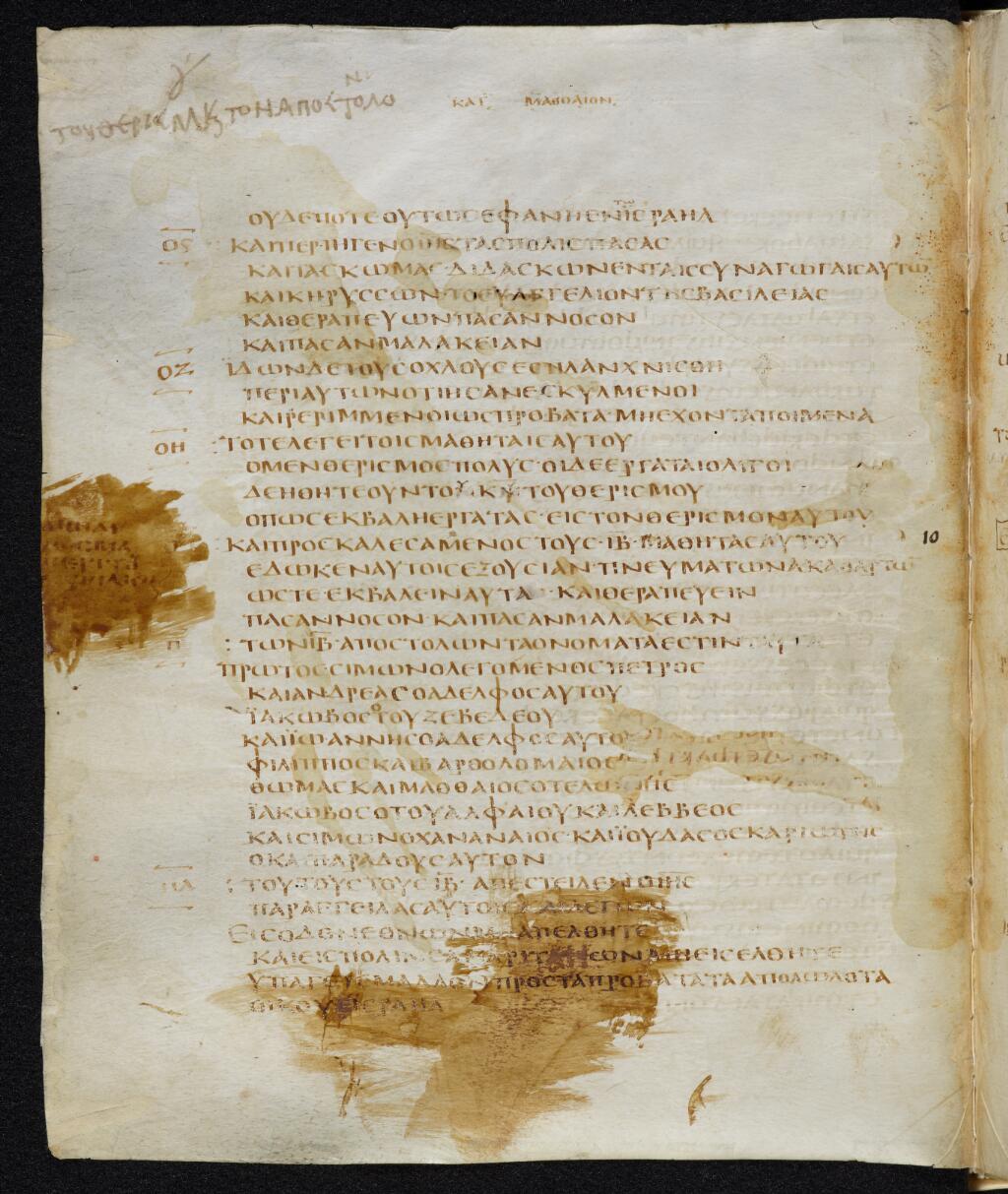
Page from the NTVMR transcription (docID 20005): verses 35-38 on fol. 28v. Verse 34 is not in Codex Bezae; the NTVMR transcription (docID 20005) shows the text passing over it on fol. 28v.
34[not in Codex Bezae] 35και περιηγεν ο ιης τας πολις πασας και τας κωμας διδασκων εν ταις συναγωγαις αυτων και κηρυσσων το ευαγγελιον της βασιλειας και θεραπευων πασαν νοσον και πασαν μαλακειαν 36ιδων δε τους οχλους εσπλανχνισθη περι αυτων οτι ησαν εα̣κυλμενοι και ρεριμμενοι ως προβατα · μη εχοντα ποιμενα 37τοτε λεγει τοις μαθηταις αυτου ο μεν θερισμος πολυς · οι δε εργαται ολιγοι · 38δεηθητε ουν τον κν του θερισμου οπως εκβαλη εργατας · εις τον θερισμον αυτου
Compare: Tischendorf 8th edition (1869)
34οἱ δὲ Φαρισαῖοι ἔλεγον· ἐν τῷ ἄρχοντι τῶν δαιμονίων ἐκβάλλει τὰ δαιμόνια. 35Καὶ περιῆγεν ὁ Ἰησοῦς τὰς πόλεις πάσας καὶ τὰς κώμας, διδάσκων ἐν ταῖς συναγωγαῖς αὐτῶν καὶ κηρύσσων τὸ εὐαγγέλιον τῆς βασιλείας καὶ θεραπεύων πᾶσαν νόσον καὶ πᾶσαν μαλακίαν. 36ἰδὼν δὲ τοὺς ὄχλους ἐσπλαγχνίσθη περὶ αὐτῶν, ὅτι ἦσαν ἐσκυλμένοι καὶ ἐρριμμένοι ὡσεὶ πρόβατα μὴ ἔχοντα ποιμένα. 37τότε λέγει τοῖς μαθηταῖς αὐτοῦ· ὁ μὲν θερισμὸς πολύς, οἱ δὲ ἐργάται ὀλίγοι· 38δεήθητε οὖν τοῦ κυρίου τοῦ θερισμοῦ ὅπως ἐκβάλῃ ἐργάτας εἰς τὸν θερισμὸν αὐτοῦ.
34But the Pharisees said, He casteth out devils through the prince of the devils. 35And Jesus went about all the cities and villages, teaching in their synagogues, and preaching the gospel of the kingdom, and healing every sickness and every disease among the people. 36But when he saw the multitudes, he was moved with compassion on them, because they fainted, and were scattered abroad, as sheep having no shepherd. 37Then saith he unto his disciples, The harvest truly is plenteous, but the labourers are few; 38Pray ye therefore the Lord of the harvest, that he will send forth labourers into his harvest.
Notes
- Codex Bezae is bilingual: at each opening the Greek is on the left-hand (verso) page and the Latin on the facing right-hand (recto) page. Only the Greek pages are shown here; the Latin column is not included.
Cite
Sources
- Source: Codex Bezae page images + NTVMR transcription (CC BY 4.0) + Tischendorf 8th edition + KJV (holding institution)
- Critical edition: Codex Bezae transcription, NTVMR (INTF Münster, CC BY 4.0); Tischendorf 8th edition for comparison
← previous · → next · v cycle view · l back to library