Bhagavad Gita, Chapter 1: The Despondency of Arjuna
Introduction
The Bhagavad Gita ("Song of the Lord") is a dialogue of 700 verses between the prince Arjuna and Krishna, set on the battlefield of Kurukshetra in book 6 (Bhishmaparvan) of the Mahabharata. Its date of composition is debated; many scholars place it in the last centuries BCE. This is chapter 1, The Despondency of Arjuna (47 verses as numbered in the manuscript and in Besant's edition).
The pages shown are from a complete Sanskrit manuscript of the Gita at the University of Pennsylvania (Penn Ms. Coll. 390 Item 559), 90 paper leaves of 7 lines in Devanagari, with speaker headings, colophons and verse-end marks in red. Its final colophon (fol. 90r) dates the copy to Saṃvat 1851, the third day of the bright half of Caitra (1794 CE). Chapter 1 runs from fol. 4r to the chapter colophon on fol. 9v.
Each section below is one manuscript page: the verses whose text ends on that page, located by reading the scribe's verse numbers and the first and last words on the image. When a verse begins at the foot of one page and ends on the next, both pages are shown. The Sanskrit and English are from Annie Besant's edition and translation (4th edition, 1922), which prints each verse in Devanagari with its English; the manuscript's spelling differs from the printed text in small details.
How was this verified? (Provenance)
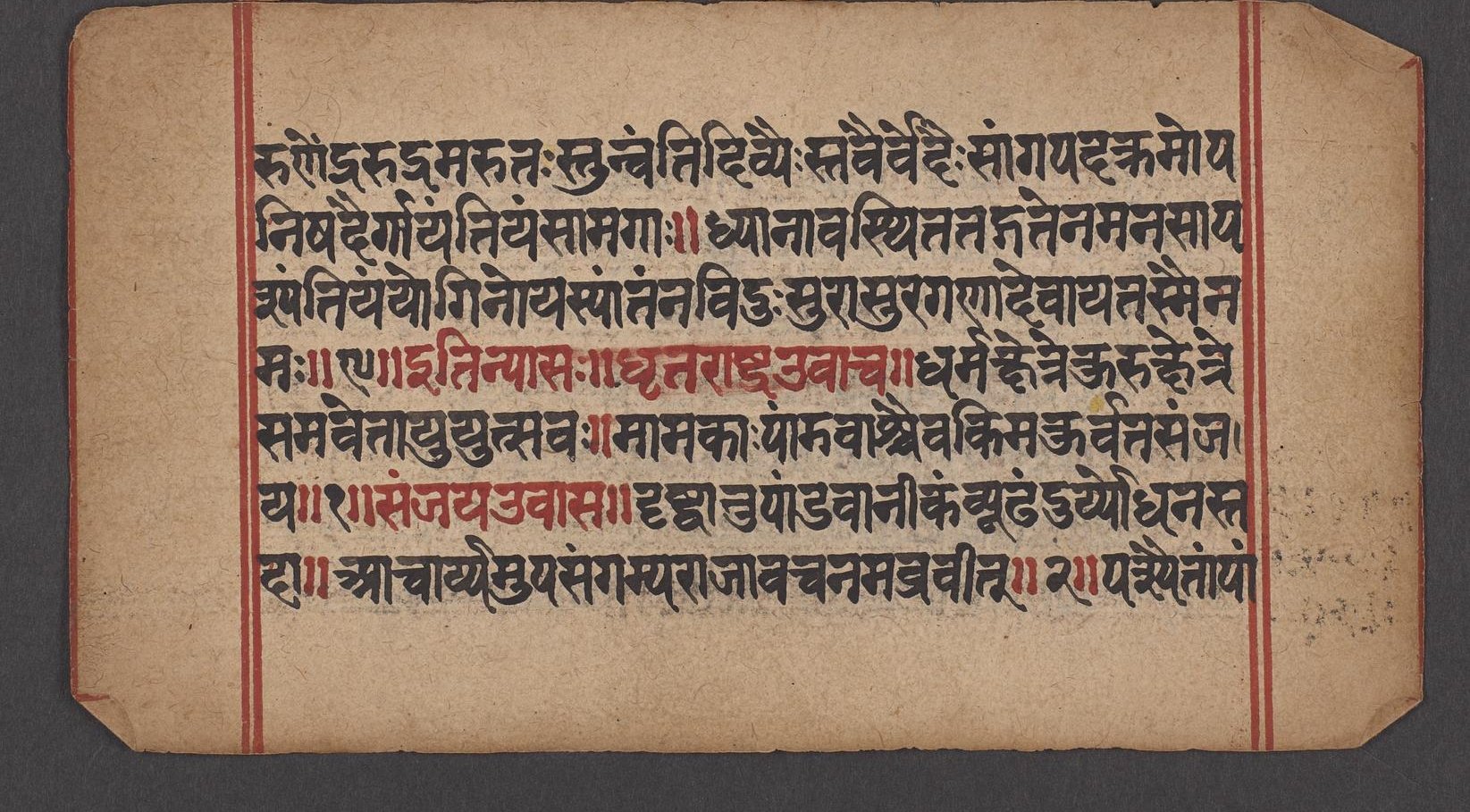
Where on the image
fol. 4r, OPenn image 6555_0003 (lower leaf). Checked on the image: lines 1-4: end of dhyāna verse 9 (||9||); line 4 'iti nyāsaḥ' then dhṛtarāṣṭra uvāca and 1.1 begins (dharmakṣetre kurukṣetre); line 5 ends 'kim akurvata saṃja-'; 1.1 ends at the start of line 6 ('-ya ||1||', rechecked 2026-11-12), then saṃjaya uvāca and 1.2; 1.2 ends line 7 (||2||), 1.3 begins at the end of line 7 (paśyaitāṃ).
1धृतराष्ट्र उवाच ।
धर्मक्षेत्रे कुरुक्षेत्रे समवेता युयुत्सवः ।
मामकाः पाण्डवाश्चैव किमकुर्वत सञ्जय ॥ १ ॥
2सञ्जय उवाच ।
दृष्ट्वा तु पाण्डवानीकं व्यूढं दुर्योधनस्तदा ।
आचार्यमुपसङ्गम्य राजा वचनमब्रवीत् ॥ २ ॥
1Dhritarâshtra said:
On the holy plain, on the field of Kuru, gathered together, eager for battle, what did they, O Sanjaya, my people and the Pândavas?
2Sanjaya said:
Having seen arrayed the army of the Pândavas, the Prince Duryodhana approached his teacher, and spake these words:
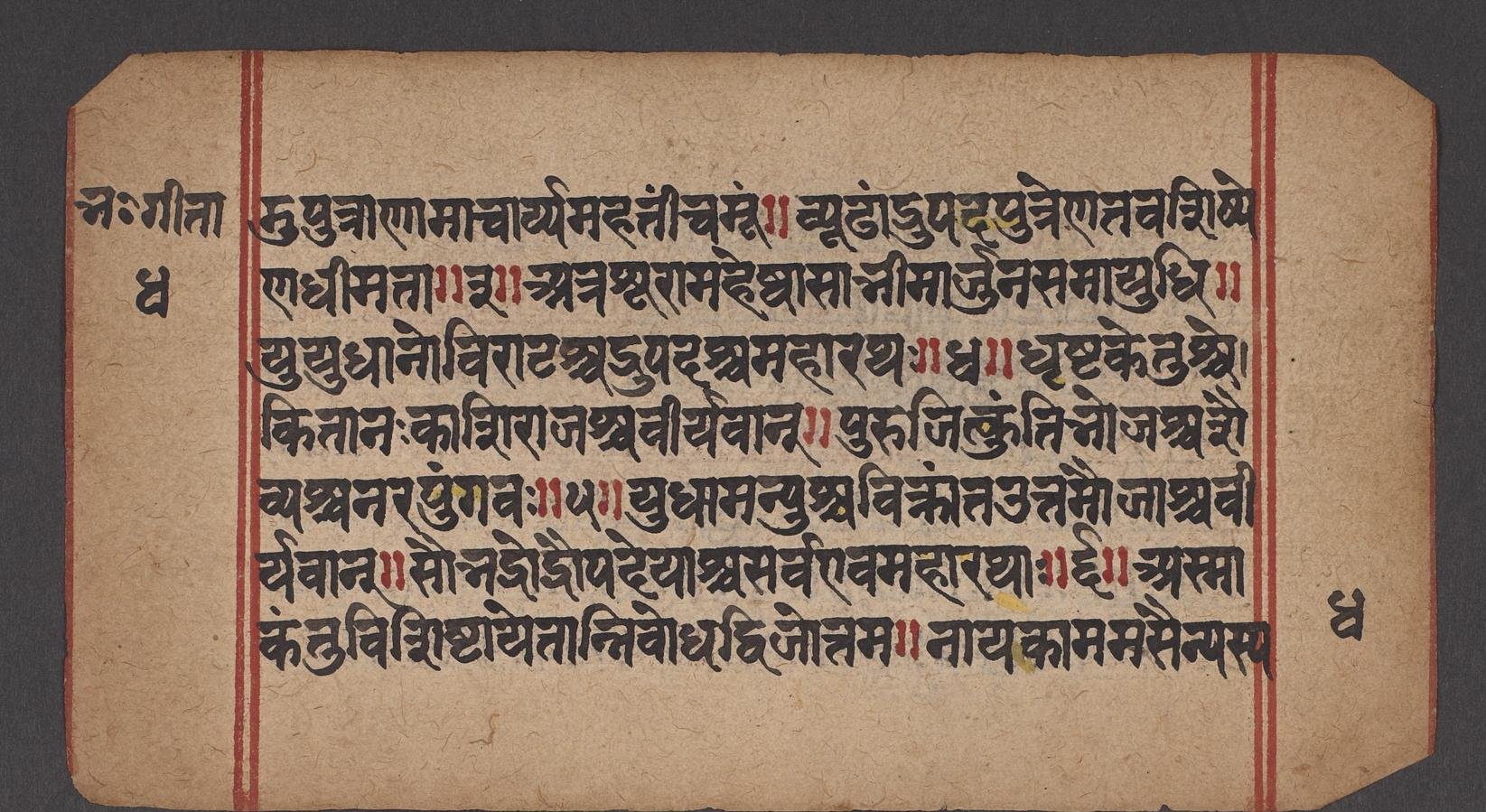
Where on the image
fol. 4v, OPenn image 6555_0004 (upper leaf). Checked on the image: ||3|| line 2 ... ||6|| line 6; 1.7 begins line 6-7. Verse 1.3 begins on the previous page, fol. 4r, so both pages are shown.
3पश्यैतां पाण्डुपुत्राणामाचार्य महतीं चमूम् ।
व्यूढां द्रुपदपुत्रेण तव शिष्येण धीमता ॥ ३ ॥
4अत्र शूरा महेष्वासा भीमार्जुनसमा युधि ।
युयुधानो विराटश्च द्रुपदश्च महारथः ॥ ४ ॥
5धृष्टकेतुश्चेकितानः काशिराजश्च वीर्यवान् ।
पुरुजित्कुन्तिभोजश्च शैब्यश्च नरपुङ्गवः ॥ ५ ॥
6युधामन्युश्च विक्रान्त उत्तमौजाश्च वीर्यवान् ।
सौभद्रो द्रौपदेयाश्च सर्व एव महारथाः ॥ ६ ॥
3"Behold this mighty host of the sons of Pându, O teacher, arrayed by the son of Drupada, thy wise disciple.
4Heroes are these, mighty bowmen, to Bhîma and Arjuna equal in battle: Yuyudhâna, Virâta, and Drupada of the great car.
5Drishtaketu, Chekitâna and the valiant King of Kâshi, Purujit and Kuntibhoja, and Shaivya, bull among men;
6Yudhâmanyu the strong, and Uttamaujas the brave; Saubhadra and the Draupadeyas, all of great cars.
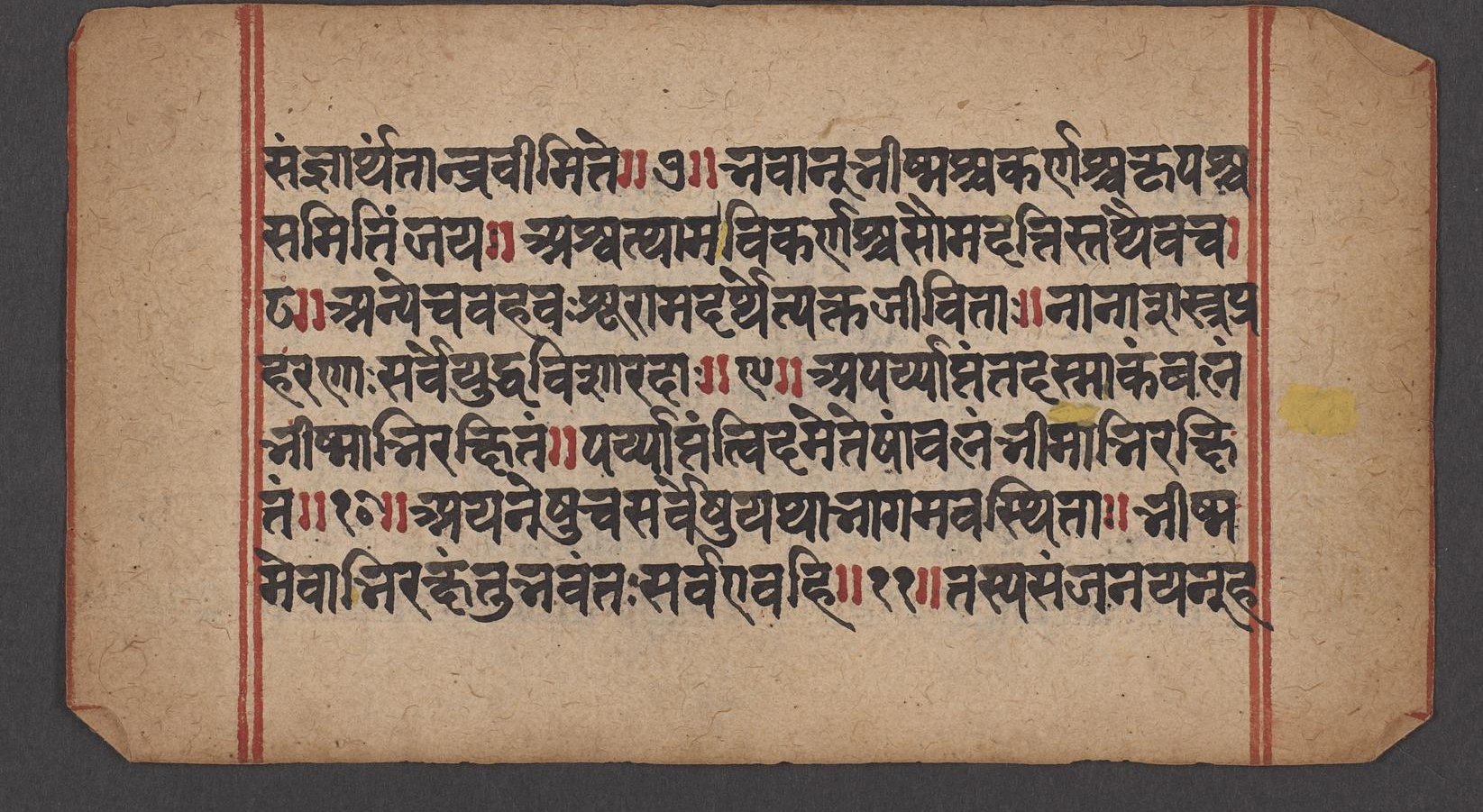
Where on the image
fol. 5r, OPenn image 6555_0004 (lower leaf). Checked on the image: ||7|| line 1 ... ||11|| line 7. Verse 1.7 begins on the previous page, fol. 4v, so both pages are shown.
7अस्माकं तु विशिष्टा ये तान्निबोध द्विजोत्तम ।
नायका मम सैन्यस्य संज्ञार्थं तान्ब्रवीमि ते ॥ ७ ॥
8भवान्भीष्मश्च कर्णश्च कृपश्च समितिञ्जयः ।
अश्वत्थामा विकर्णश्च सौमदत्तिस्तथैव च ॥ ८ ॥
9अन्ये च बहवः शूरा मदर्थे त्यक्तजीविताः ।
नानाशस्त्रप्रहरणाः सर्वे युद्धविशारदाः ॥ ९ ॥
10अपर्याप्तं तदस्माकं बलं भीष्माभिरक्षितम् ।
पर्याप्तं त्विदमेतेषां बलं भीमाभिरक्षितम् ॥ १० ॥
11अयनेषु च सर्वेषु यथाभागमवस्थिताः ।
भीष्ममेवाभिरक्षन्तु भवन्तः सर्व एव हि ॥ ॥ ११ ॥
7Know further all those who are our chiefs, O best of the twice-born, the leaders of my army; these I name to thee for thy information:
8Thou, Lord, and Bhîshma, and Karna and Kripa, conquering in battle; Ashvatthâmâ, Vikarna, and Saumadatti also;
9And many others, heroes, for my sake renouncing their lives, with divers weapons and missiles, and all well-skilled in war.
10Yet insufficient seems this army of ours, though marshalled by Bhîshma, while that army of theirs seems sufficient, though marshalled by Bhîma;
11Therefore in the rank and file let all, standing firmly in their respective divisions, guard Bhîshma, even all ye generals.
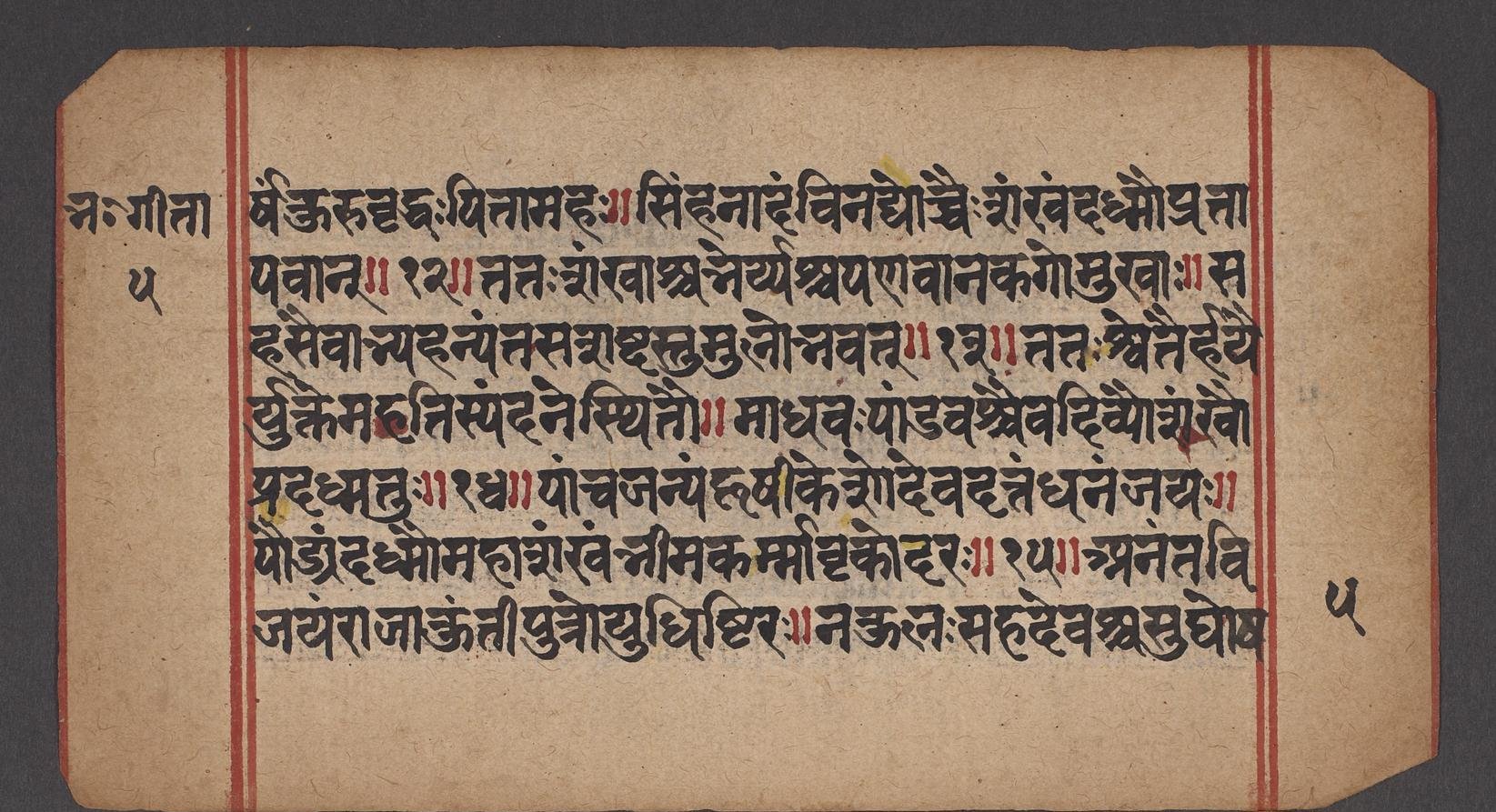
Where on the image
fol. 5v, OPenn image 6555_0005 (upper leaf). Checked on the image: ||12|| line 2 ... ||15|| line 6; 1.16 begins. Verse 1.12 begins on the previous page, fol. 5r, so both pages are shown.
12तस्य सञ्जनयन्हर्षं कुरुवृद्धः पितामहः ।
सिंहनादं विनद्योच्चैः शङ्खं दध्मौ प्रतापवान् ॥ १२ ॥
13ततः शङ्खाश्च भेर्यश्च पणवानकगोमुखाः ।
सहसैवाभ्यहन्यन्त स शब्दस्तुमुलोऽभवत् ॥ १३ ॥
14ततः श्वेतैर्हयैर्युक्ते महति स्यन्दने स्थितौ ।
माधवः पाण्डवश्चैव दिव्यौ शङ्खौ प्रदध्मतुः ॥ १४ ॥
15पाञ्चजन्यं हृषीकेशो देवदत्तं धनञ्जयः ।
पौण्ड्रं दध्मौ महाशङ्खं भीमकर्मा वृकोदरः ॥ १५ ॥
12To enhearten him, the Ancient of the Kurus, the Grandsire, the glorious, blew his conch, sounding on high a lion's roar.
13Then conches and kettledrums, tabors and drums and cowhorns, suddenly blared forth, and the sound was tumultuous.
14Then, stationed in their great war-chariot, yoked to white horses, Mâdhava and the son of Pându blew their divine conches.
15Pânchajanya by Hrishîkesha, and Devadatta by Dhananjaya. Vrikodara of terrible deeds blew his mighty conch, Paundra;
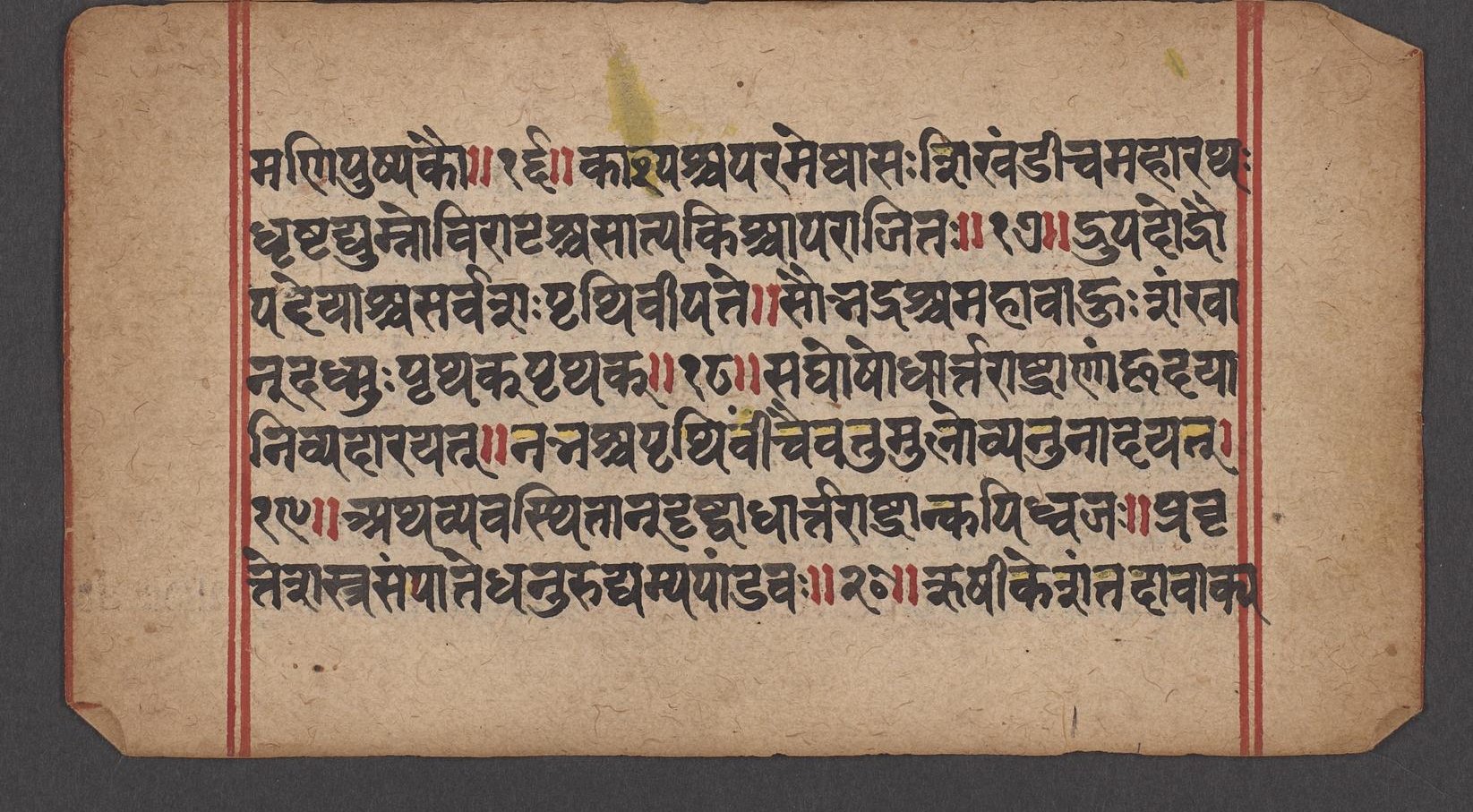
Where on the image
fol. 6r, OPenn image 6555_0005 (lower leaf). Checked on the image: ||16|| line 1 ... ||20|| line 7. Verse 1.16 begins on the previous page, fol. 5v, so both pages are shown.
16अनन्तविजयं राजा कुन्तीपुत्रो युधिष्ठिरः ।
नकुलः सहदेवश्च सुघोषमणिपुष्पकौ ॥ १६ ॥
17काश्यश्च परमेष्वासः शिखण्डी च महारथः ।
धृष्टद्युम्नो विराटश्च सात्यकिश्चापराजितः ॥ १७ ॥
18द्रुपदो द्रौपदेयाश्च सर्वशः पृथिवीपते ।
सौभद्रश्च महाबाहुः शङ्खान्दध्मुः पृथक्पृथक् ॥ १८ ॥
19स घोषो धार्तराष्ट्राणां हृदयानि व्यदारयत् ।
नभश्च पृथिवीं चैव तुमुलो व्यनुनादयन् ॥ १९ ॥
20अथ व्यवस्थितान्दृष्ट्वा धार्तराष्ट्रान्कपिध्वजः ।
प्रवृत्ते शस्त्रसम्पाते धनुरुद्यम्य पाण्डवः ॥ २० ॥
16The King Yudhishthira, the son of Kuntî, blew Anantavijaya; Nakula and Sahadeva, Sughosha and Manipushpaka.
17And Kâshya, of the great bow and Shikhandî, the mighty car-warrior, Drishtadyumna and Virâta and Sâtyaki, the unconquered.
18Drupada and the Draupadeyas, O Lord of earth, and Saubhadra, the mighty-armed, on all sides their several conches blew.
19That tumultuous uproar rent the hearts of the sons of Dhritarâshtra, filling the earth and sky with sound.
20Then, beholding the sons of Dhritarâshtra standing arrayed, and flight of missiles about to begin, he whose crest is an ape, the son of Pându, took up his bow,
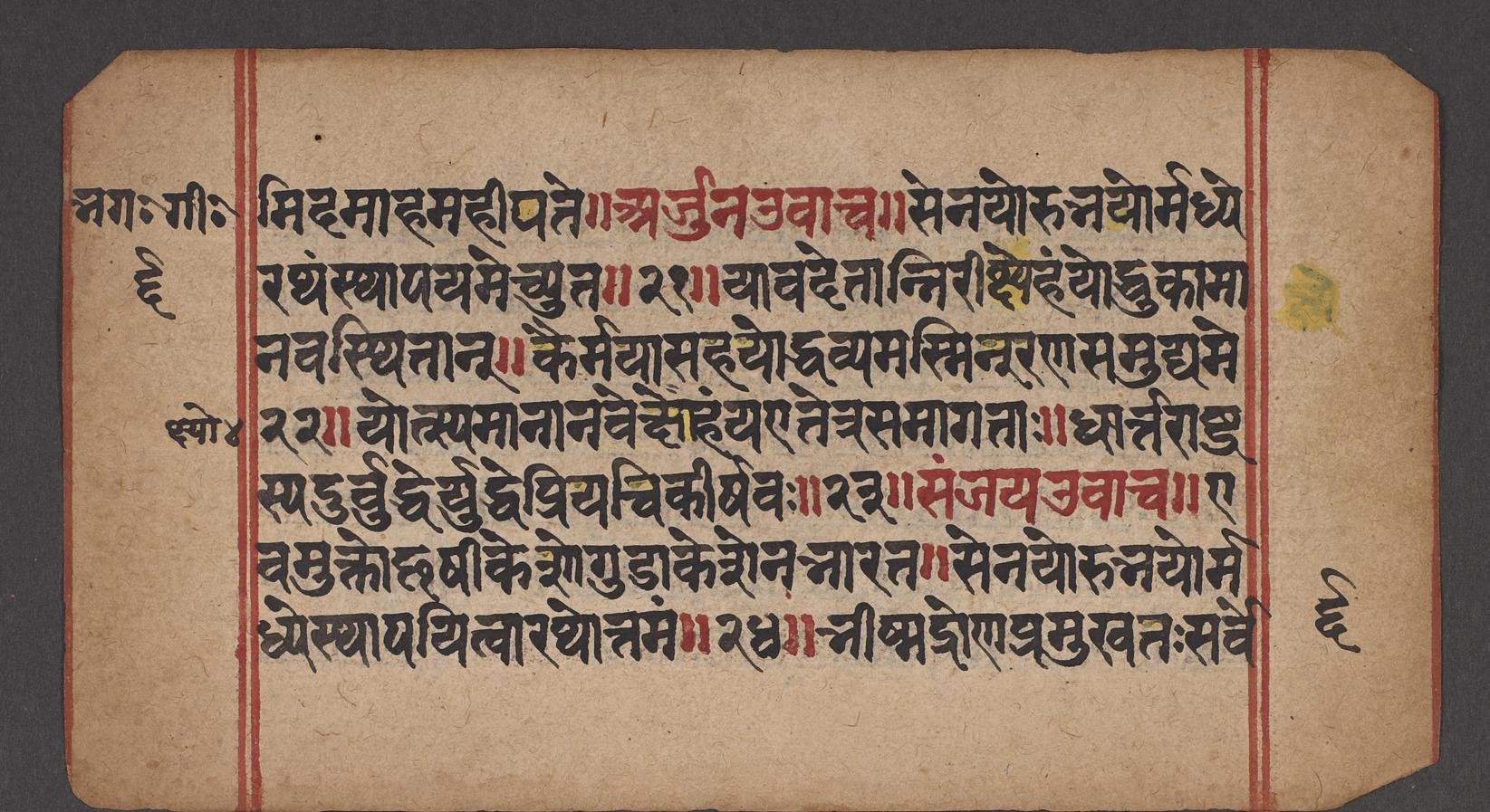
Where on the image
fol. 6v, OPenn image 6555_0006 (upper leaf). Checked on the image: arjuna uvāca line 1; ||21|| line 2 ... ||24|| line 7. Verse 1.21 begins on the previous page, fol. 6r, so both pages are shown.
21हृषीकेशं तदा वाक्यमिदमाह महीपते ।
अर्जुन उवाच ।
सेनयोरुभयोर्मध्ये रथं स्थापय मेऽच्युत ॥ २१ ॥
22यावदेतान्निरीक्षेऽहं योद्धुकामानवस्थितान् ।
कैर्मया सह योद्धव्यमस्मिन्रणसमुद्यमे ॥ २२ ॥
23योत्स्यमानानवेक्षेऽहं य एतेऽत्र समागताः ।
धार्तराष्ट्रस्य दुर्बुद्धेर्युद्धे प्रियचिकीर्षवः ॥ २३ ॥
24सञ्जय उवाच ।
एवमुक्तो हृषीकेशो गुडाकेशेन भारत ।
सेनयोरुभयोर्मध्ये स्थापयित्वा रथोत्तमम् ॥ २४ ॥
21And spake this word to Hrishîkesha, O Lord of Earth:
Arjuna said:
In the midst, between the two armies, stay my chariot, O Achyuta,
22That I may behold these standing, longing for battle, with whom I must strive in this outbreaking war,
23And gaze on those here gathered together ready to fight, desirous of pleasing in battle the evil-minded son of Dhritarâshtra.
24Sanjaya said:
Thus addressed by Gudâkesha, Hrishîkesha, O Bhârata, having stayed that best of chariots in the midst, between the two armies,
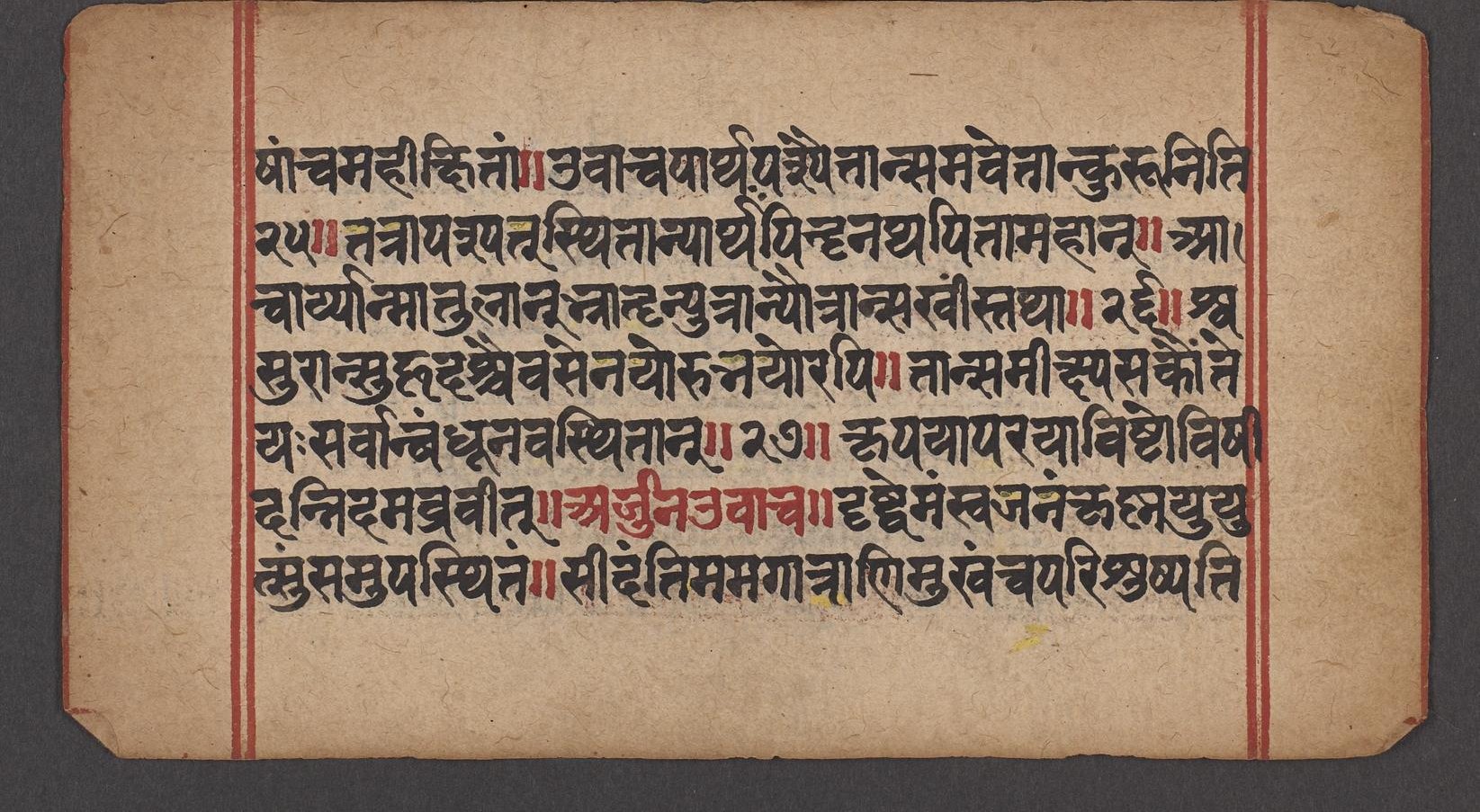
Where on the image
fol. 7r, OPenn image 6555_0006 (lower leaf). Checked on the image: ||25|| line 2, ||26|| line 3, ||27|| line 5; 1.28 kṛpayā ... samupasthitaṃ ends line 7 without a number (scribe omits ||28||), 1.29 sīdanti begins line 7. Verse 1.25 begins on the previous page, fol. 6v, so both pages are shown.
25भीष्मद्रोणप्रमुखतः सर्वेषां च महीक्षिताम् ।
उवाच पार्थ पश्यैतान्समवेतान्कुरूनिति ॥ २५ ॥
26तत्रापश्यत्स्थितान्पार्थः पितॄनथ पितामहान् ।
आचार्यान्मातुलान्भ्रातॄन्पुत्रान्पौत्रान्सखींस्तथा ॥ २६ ॥
27श्वशुरान्सुहृदश्चैव सेनयोरुभयोरपि ।
तान्समीक्ष्य स कौन्तेयः सर्वान्बन्धूनवस्थितान् ॥ २७ ॥
28कृपया परयाऽऽविष्टो विषीदन्निदमब्रवीत् ।
अर्जुन उवाच ।
दृष्ट्वेमं स्वजनं कृष्ण युयुत्सुं समुपस्थितम् ॥ २८ ॥
25Over against Bhîshma, Drona and all the rulers of the world, said: "O Pârtha, behold these Kurus gathered together."
26Then saw Pârtha standing there, uncles and grandfathers, teachers, mother's brothers, cousins, sons and grandsons, comrades,
27Fathers-in-law and benefactors also in both armies; seeing all these kinsmen thus standing arrayed, Kaunteya,
28Deeply moved to pity, thus uttered in sadness:
Arjuna said:
Seeing these my kinsmen, O Krishna, arrayed, eager to fight,
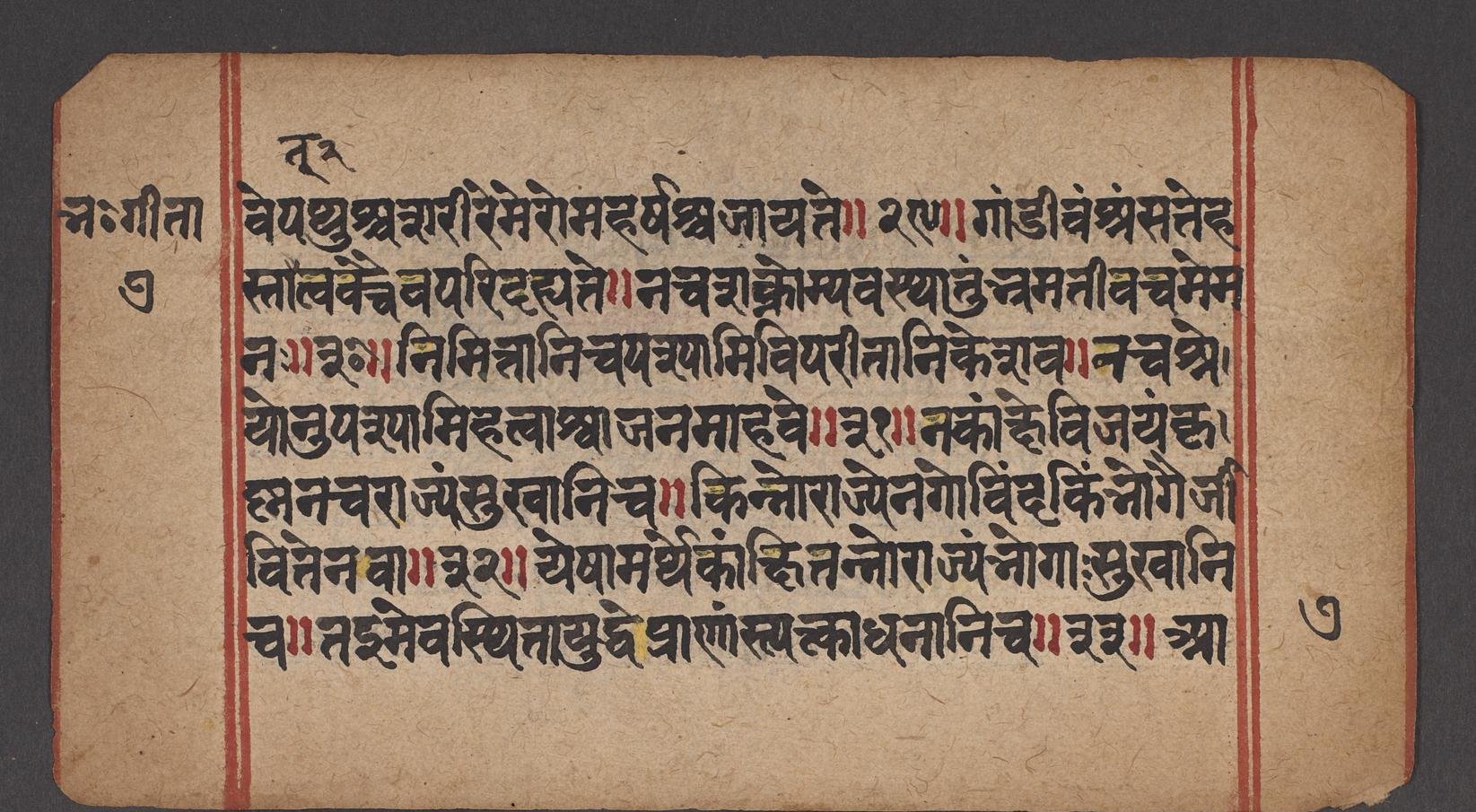
Where on the image
fol. 7v, OPenn image 6555_0007 (upper leaf). Checked on the image: ||29|| line 1 ... ||33|| line 7. Verse 1.29 begins on the previous page, fol. 7r, so both pages are shown.
29सीदन्ति मम गात्राणि मुखं च परिशुष्यति ।
वेपथुश्च शरीरे मे रोमहर्षश्च जायते ॥ २९ ॥
30गाण्डीवं स्रंसते हस्तात्त्वक्चैव परिदह्यते ।
न च शक्नोम्यवस्थातुं भ्रमतीव च मे मनः ॥ ३० ॥
31निमित्तानि च पश्यामि विपरीतानि केशव ।
न च श्रेयोऽनुपश्यामि हत्वा स्वजनमाहवे ॥ ३१ ॥
32न काङ्क्षे विजयं कृष्ण न च राज्यं सुखानि च ।
किं नो राज्येन गोविन्द किं भोगैर्जीवितेन वा ॥ ३२ ॥
33येषामर्थे काङ्क्षितं नो राज्यं भोगाः सुखानि च ।
त इमेऽवस्थिता युद्धे प्राणांस्त्यक्त्वा धनानि च ॥ ३३ ॥
29My limbs fail and my mouth is parched, my body quivers, and my hair stands on end,
30Gândîva slips from my hand, and my skin burns all over, I am not able to stand, my mind is whirling,
31And I see adverse omens, O Keshava. Nor do I foresee any advantage from slaying kinsmen in battle.
32For I desire not victory, O Krishna, nor kingdom, nor pleasures; what is kingdom to us, O Govinda, what enjoyment or even life?
33Those for whose sake we desire kingdom, enjoyments and pleasures, they stand here in battle, abandoning life and riches—
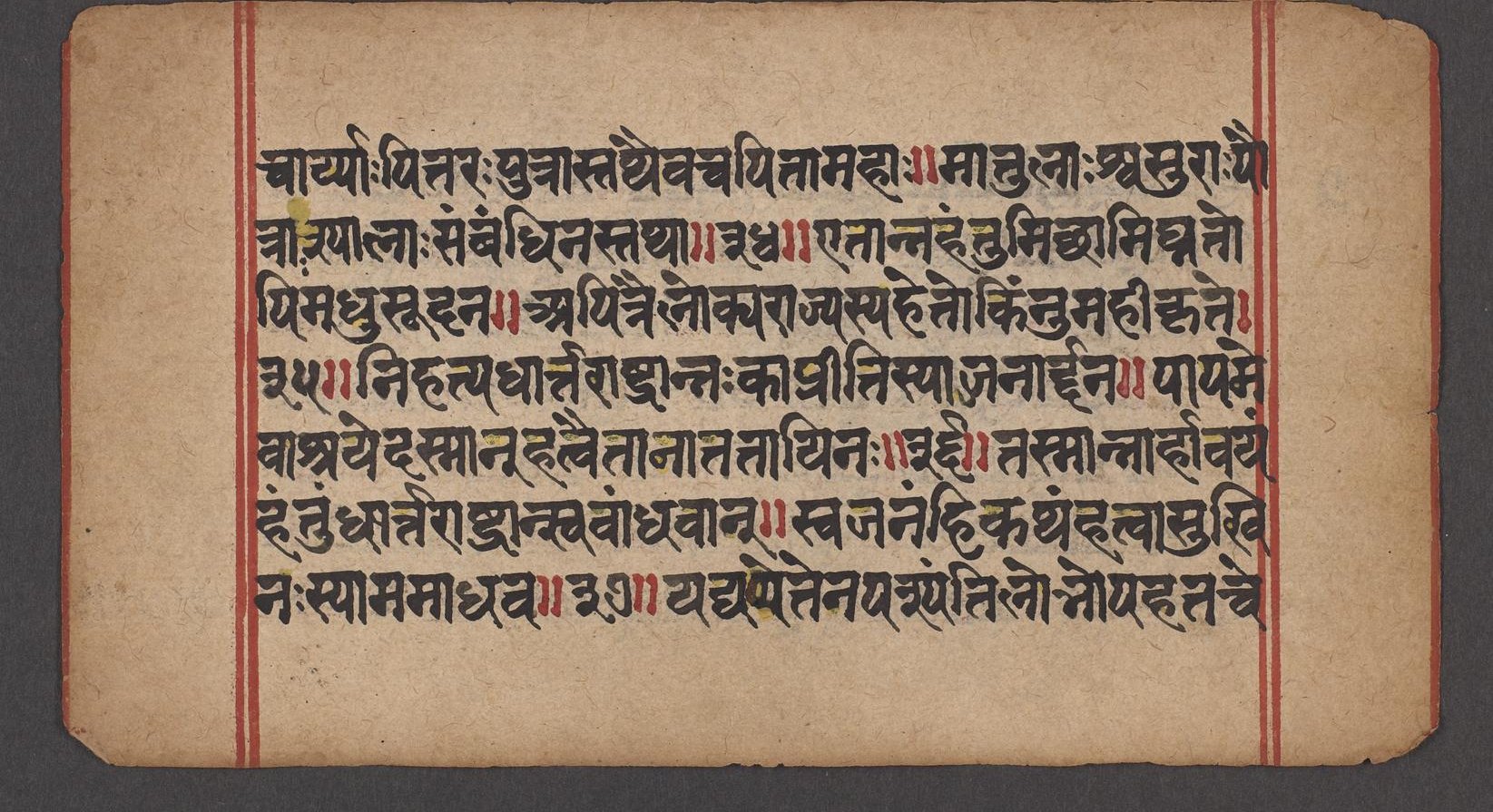
Where on the image
fol. 8r, OPenn image 6555_0007 (lower leaf). Checked on the image: ||34|| line 2 ... ||37|| line 6. Verse 1.34 begins on the previous page, fol. 7v, so both pages are shown.
34आचार्याः पितरः पुत्रास्तथैव च पितामहाः ।
मातुलाः श्वशुराः पौत्राः श्यालाः सम्बन्धिनस्तथा ॥ ३४ ॥
35एतान्न हन्तुमिच्छामि घ्नतोऽपि मधुसूदन ।
अपि त्रैलोक्यराज्यस्य हेतोः किं नु महीकृते ॥ ३५ ॥
36निहत्य धार्तराष्ट्रान्नः का प्रीतिः स्याज्जनार्दन ।
पापमेवाश्रयेदस्मान्हत्वैतानाततायिनः ॥ ३६ ॥
37तस्मान्नार्हा वयं हन्तुं धार्तराष्ट्रान्स्वबान्धवान् ।
स्वजनं हि कथं हत्वा सुखिनः स्याम माधव ॥ ३७ ॥
34Teachers, fathers, sons, as well as grandfathers, mother's brothers, fathers-in-law, grandsons, brothers-in-law, and other relatives.
35These I do not wish to kill, though myself slain, O Madhusûdana, even for the sake of the kingship of the three worlds; how then for earth?
36Slaying these sons of Dhritarâshtra, what pleasure can be ours, O Janârdana? Killing these desperadoes, sin will but take hold of us.
37Therefore we should not kill the sons of Dhritarâshtra, our relatives; for how, killing our kinsmen, may we be happy, O Mâdhava?
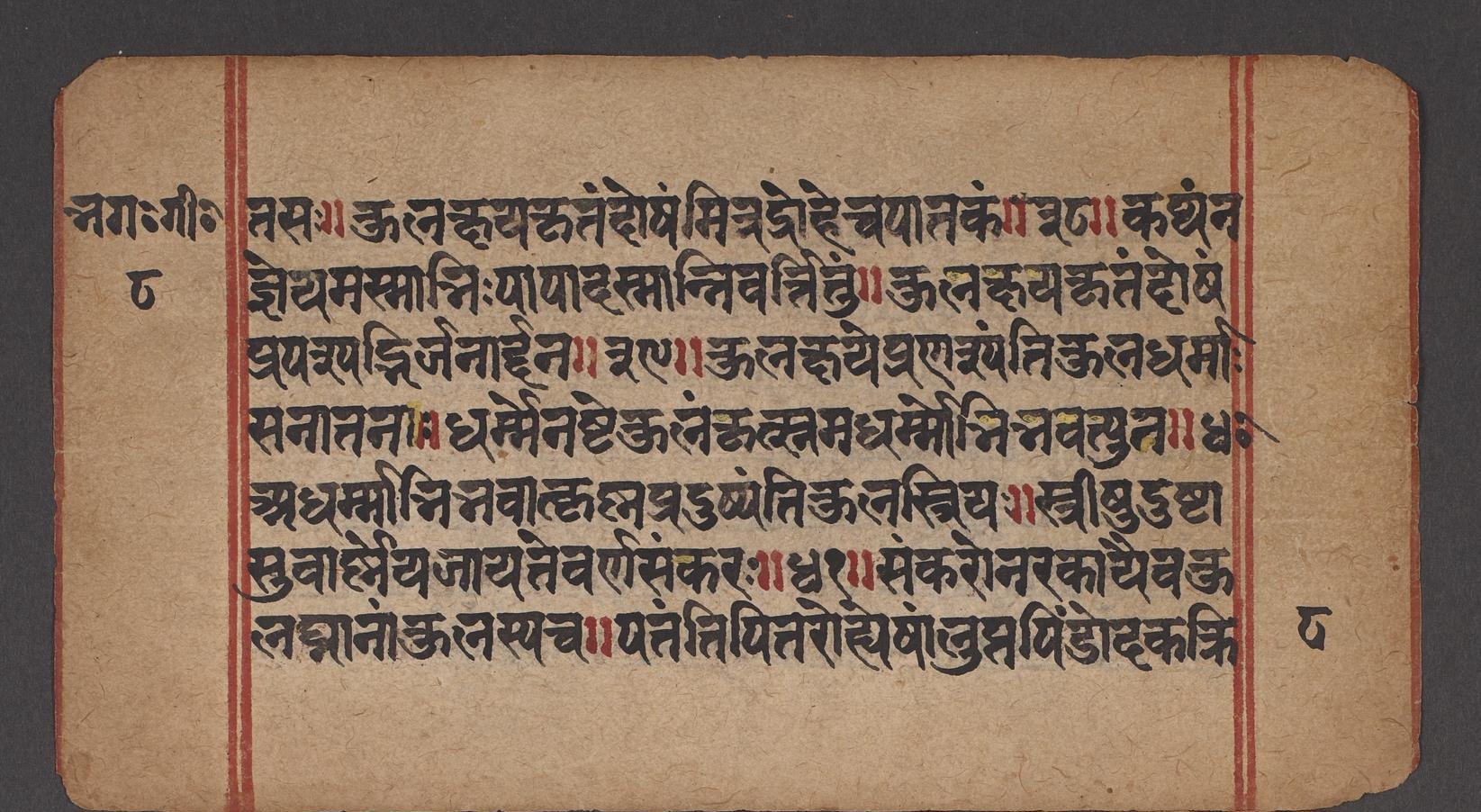
Where on the image
fol. 8v, OPenn image 6555_0008 (upper leaf). Checked on the image: ||38|| line 1 ... ||41|| line 6. Verse 1.38 begins on the previous page, fol. 8r, so both pages are shown.
38यद्यप्येते न पश्यन्ति लोभोपहतचेतसः ।
कुलक्षयकृतं दोषं मित्रद्रोहे च पातकम् ॥ ३८ ॥
39कथं न ज्ञेयमस्माभिः पापादस्मान्निवर्तितुम् ।
कुलक्षयकृतं दोषं प्रपश्यद्भिर्जनार्दन ॥ ३९ ॥
40कुलक्षये प्रणश्यन्ति कुलधर्माः सनातनाः ।
धर्मे नष्टे कुलं कृत्स्नमधर्मोऽभिभवत्युत ॥ ४० ॥
41अधर्माभिभवात्कृष्ण प्रदुष्यन्ति कुलस्त्रियः ।
स्त्रीषु दुष्टासु वार्ष्णेय जायते वर्णसङ्करः ॥ ४१ ॥
38Although these, with intelligence overpowered by greed, see no guilt in the destruction of a family, no crime in hostility to friends,
39Why should not we learn to turn away from such a sin, O Janârdana, who see the evils in the destruction of a family?
40In the destruction of a family the immemorial family traditions perish; in the perishing of tradition, lawlessness overcomes the whole family;
41Owing to predominance of lawlessness, O Krishna, the women of the family become corrupt; women corrupted, O Vârshneya, there ariseth caste confusion;
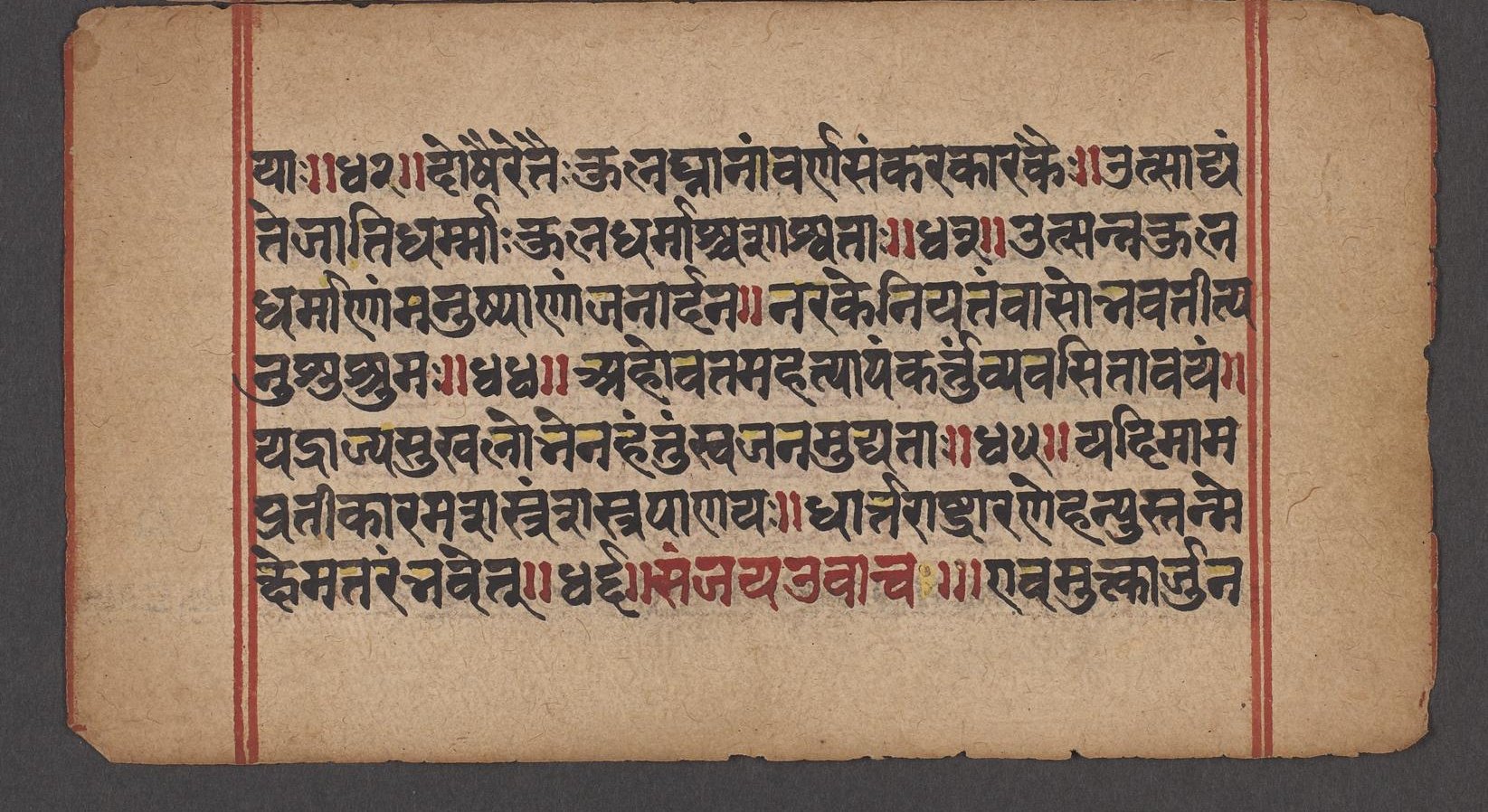
Where on the image
fol. 9r, OPenn image 6555_0008 (lower leaf). Checked on the image: ||42|| line 1 ... ||46|| line 7, saṃjaya uvāca line 7. Verse 1.42 begins on the previous page, fol. 8v, so both pages are shown.
42सङ्करो नरकायैव कुलघ्नानां कुलस्य च ।
पतन्ति पितरो ह्येषां लुप्तपिण्डोदकक्रियाः ॥ ४२ ॥
43दोषैरेतैः कुलघ्नानां वर्णसङ्करकारकैः ।
उत्साद्यन्ते जातिधर्माः कुलधर्माश्च शाश्वताः ॥ ४३ ॥
44उत्सन्नकुलधर्माणां मनुष्याणां जनार्दन ।
नरके नियतं वासो भवतीत्यनुशुश्रुम ॥ ४४ ॥
45अहो बत महत्पापं कर्तुं व्यवसिता वयम् ।
यद्राज्यसुखलोभेन हन्तुं स्वजनमुद्यताः ॥ ४५ ॥
46यदि मामप्रतीकारमशस्त्रं शस्त्रपाणयः ।
धार्तराष्ट्रा रणे हन्युस्तन्मे क्षेमतरं भवेत् ॥ ४६ ॥
42This confusion draggeth to hell the slayers of the family, and the family; for their ancestors fall, deprived of rice-balls and libations.
43By these caste-confusing misdeeds of the slayers of the family, the everlasting caste customs and family customs are abolished.
44The abode of the men whose family customs are extinguished, O Janârdana, is everlastingly in hell. Thus have we heard.
45Alas! in committing a great sin are we engaged, we who are endeavouring to kill our kindred from greed of the pleasures of kingship.
46If the sons of Dhritarâshtra, weapon in hand, should slay me, unresisting, unarmed, in the battle, that would for me be the better.
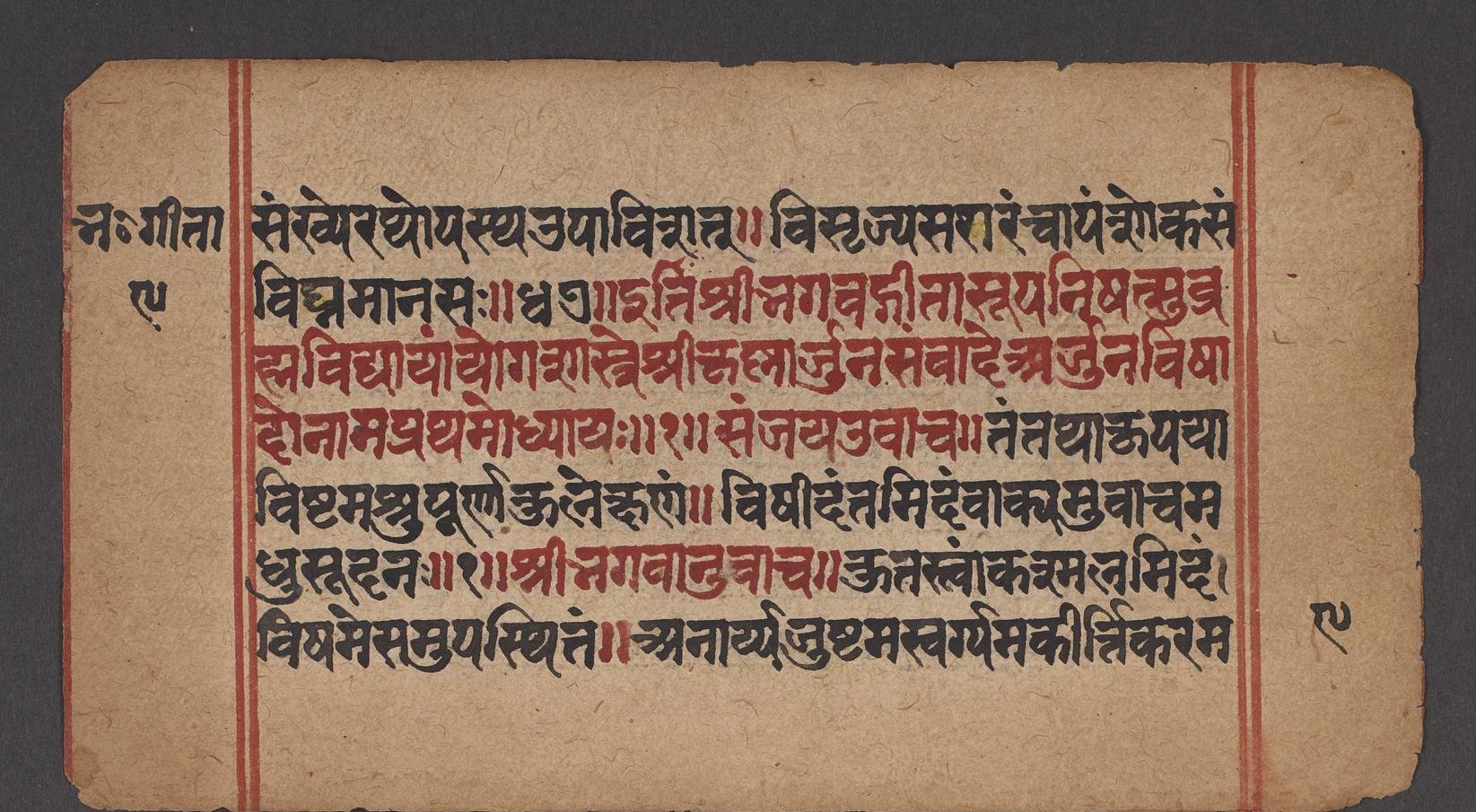
Where on the image
fol. 9v, OPenn image 6555_0009 (upper leaf). Checked on the image: ||47|| line 2; colophon lines 2-4 'iti śrībhagavadgītāsūpaniṣatsu ... arjunaviṣādo nāma prathamo 'dhyāyaḥ ||1||'; 2.1 ends line 6 (||1||); śrībhagavān uvāca, 2.2 begins line 6. Verse 1.47 begins on the previous page, fol. 9r, so both pages are shown.
47सञ्जय उवाच ।
एवमुक्त्वाऽर्जुनः सङ्ख्ये रथोपस्थ उपाविशत् ।
विसृज्य सशरं चापं शोकसंविग्नमानसः ॥ ४७ ॥
47Sanjaya said:
Having thus spoken on the battle-field, Arjuna sank down on the seat of the chariot, casting away his bow and arrow, his mind overborne by grief.
Where on the image
fol. 9v: ||47|| line 2; colophon lines 2-4 'iti śrībhagavadgītāsūpaniṣatsu ... arjunaviṣādo nāma prathamo 'dhyāyaḥ ||1||'; 2.1 ends line 6 (||1||); śrībhagavān uvāca, 2.2 begins line 6. The manuscript names the chapter arjunaviṣāda; the Sanskrit and English shown are the colophon printed in Besant's edition, whose wording differs in places from the manuscript's.
इति श्रीमद्भगवद्गीतासूपनिषत्सु ब्रह्मविद्यायां योगशास्त्रे
श्रीकृष्णार्जुनसंवादेऽर्जुनविषादयोगो नाम
प्रथमोऽध्यायः ।
Thus in the glorious Upanishads of the Bhagavad-Gita, the science of the Eternal, the scripture of Yoga, the dialogue between Shri Krishna and Arjuna, the first discourse, entitled: THE DESPONDENCY OF ARJUNA.
Notes
- Sanskrit and English: Annie Besant, The Bhagavad-Gita, 4th edition (Madras: G. A. Natesan, 1922), transcription validated on English Wikisource. Besant's footnotes are not reproduced.
- Verse numbers follow Besant and the manuscript, which agree throughout: chapter 13 counts Arjuna's opening question ('prakṛtiṃ puruṣaṃ caiva...') as verse 1, so it has 35 verses and the whole text 701.
- K. T. Telang's translation (Sacred Books of the East 8, 1882) was the first choice for the English, but it is continuous prose without verse divisions, so it cannot be matched to manuscript pages verse by verse; Besant's verse-numbered translation is used instead.
- The last section of each chapter is the chapter colophon. Besant prints most Sanskrit colophons in shortened form (marked with ॰) while her English gives the full formula; the manuscript writes the colophon out in full, and its chapter names differ in places from Besant's (see the scan note).
- Before chapter 1 the manuscript has a ritual preface (Gītā-nyāsa) and nine meditation verses (dhyāna), fol. 1v-4r; they are not part of the 700-verse text and are not reproduced here.
- In chapter 1 the scribe wrote no number after verse 28 (fol. 7r line 7); the verse is placed by its words ('kṛpayā parayāviṣṭo ... samupasthitam').
Cite
Sources
- Source: Penn Ms. Coll. 390 Item 559 (dated 1794) via OPenn + Sanskrit and English of Annie Besant, The Bhagavad-Gita (4th ed. 1922), Wikisource (holding institution)
- Critical edition: Annie Besant, The Bhagavad-Gita, 4th ed. (1922), Sanskrit text, via Wikisource
← previous · → next · v cycle view · l back to library