Bhagavad Gita, Chapter 4: The Yoga of Wisdom
Introduction
The Bhagavad Gita ("Song of the Lord") is a dialogue of 700 verses between the prince Arjuna and Krishna, set on the battlefield of Kurukshetra in book 6 (Bhishmaparvan) of the Mahabharata. Its date of composition is debated; many scholars place it in the last centuries BCE. This is chapter 4, The Yoga of Wisdom (42 verses as numbered in the manuscript and in Besant's edition).
The pages shown are from a complete Sanskrit manuscript of the Gita at the University of Pennsylvania (Penn Ms. Coll. 390 Item 559), 90 paper leaves of 7 lines in Devanagari, with speaker headings, colophons and verse-end marks in red. Its final colophon (fol. 90r) dates the copy to Saṃvat 1851, the third day of the bright half of Caitra (1794 CE). Chapter 4 runs from fol. 23r to the chapter colophon on fol. 28r.
Each section below is one manuscript page: the verses whose text ends on that page, located by reading the scribe's verse numbers and the first and last words on the image. When a verse begins at the foot of one page and ends on the next, both pages are shown. The Sanskrit and English are from Annie Besant's edition and translation (4th edition, 1922), which prints each verse in Devanagari with its English; the manuscript's spelling differs from the printed text in small details.
How was this verified? (Provenance)
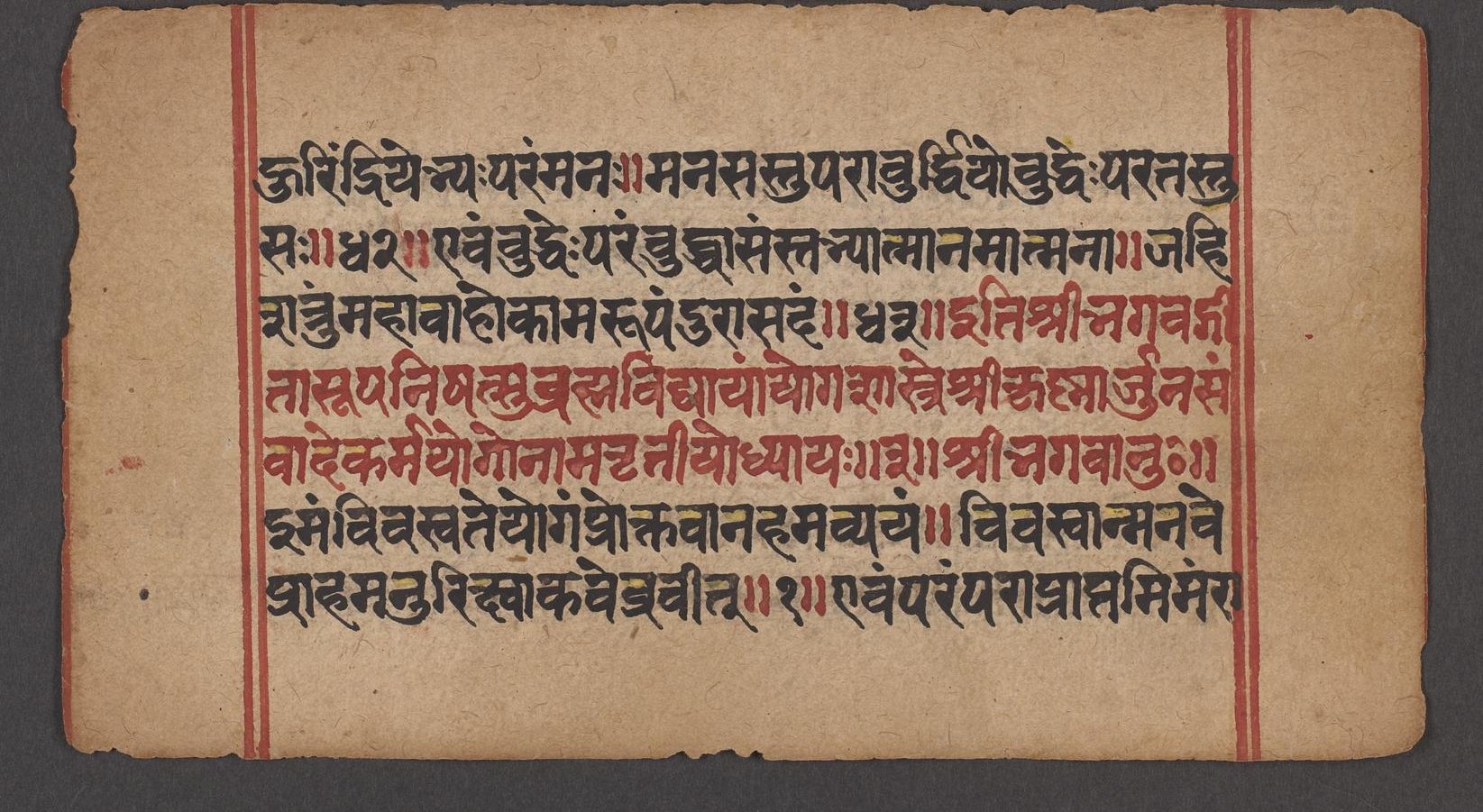
Where on the image
fol. 23r, OPenn image 6555_0022 (lower leaf). Checked on the image: ||42|| line 2, ||43|| line 3; colophon lines 3-5 '... karmayogo nāma tṛtīyo 'dhyāyaḥ ||3||'; śrībhagavān uvāca; 4.1 ends line 7 (||1||), 4.2 begins line 7.
1श्रीभगवानुवाच ।
इमं विवस्वते योगं प्रोक्तवानहमव्ययम् ।
विवस्वान्मनवे प्राह मनुरिक्ष्वाकवेऽब्रवीत् ॥ १ ॥
1The Blessed Lord said:
This imperishable yoga I declared to Vivasvân; Vivasvân taught it to Manu; Manu to Ikshvâku told it.
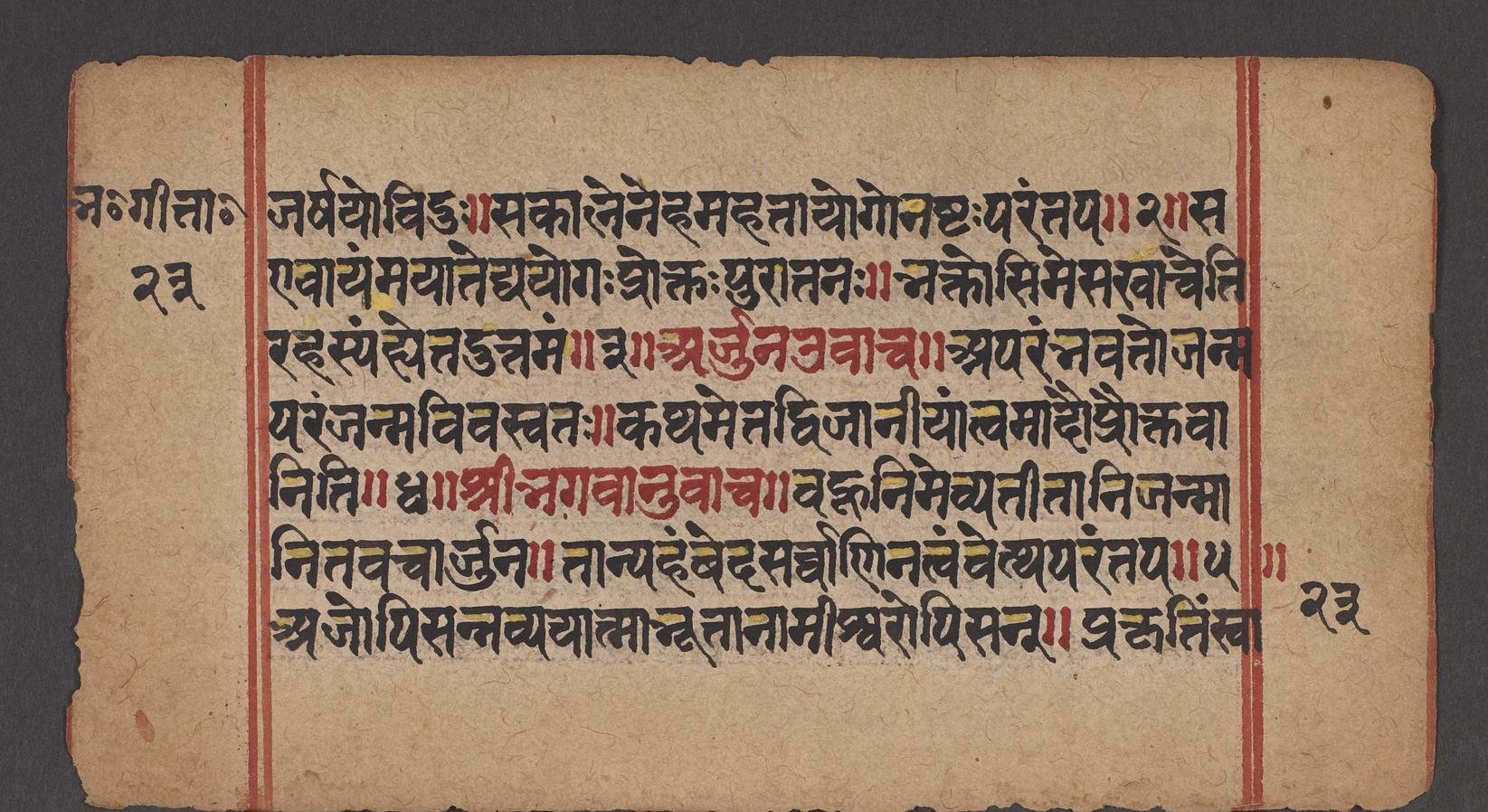
Where on the image
fol. 23v, OPenn image 6555_0023 (upper leaf). Checked on the image: ||2|| line 1 ... ||5|| line 6. Verse 4.2 begins on the previous page, fol. 23r, so both pages are shown.
2एवं परम्पराप्राप्तमिमं राजर्षयो विदुः ।
स कालेनेह महता योगो नष्टः परन्तप ॥ २ ॥
3स एवाऽयं मया तेऽद्य योगः प्रोक्तः पुरातनः ।
भक्तोऽसि मे सखा चेति रहस्यं ह्येतदुत्तमम् ॥ ३ ॥
4अर्जुन उवाच ।
अपरं भवतो जन्म परं जन्म विवस्वतः ।
कथमेतद्विजानीयां त्वमादौ प्रोक्तवानिति ॥ ४ ॥
5श्रीभगवानुवाच ।
बहूनि मे व्यतीतानि जन्मानि तव चार्जुन ।
तान्यहं वेद सर्वाणि न त्वं वेत्थ परन्तप ॥ ५ ॥
2This, handed on down the line, the King-Sages knew. This yoga by great efflux of time decayed in the world, O Parantapa.
3This same ancient yoga hath been to-day declared to thee by Me, for thou art My devotee and My friend; it is the supreme Secret.
4Arjuna said:
Later was Thy birth, earlier the birth of Vivasvân; how then am I to understand that Thou declaredst it in the beginning?
5The Blessed Lord said:
Many births have been left behind by Me and by thee, O Arjuna. I know them all, but thou knowest not thine, O Parantapa.
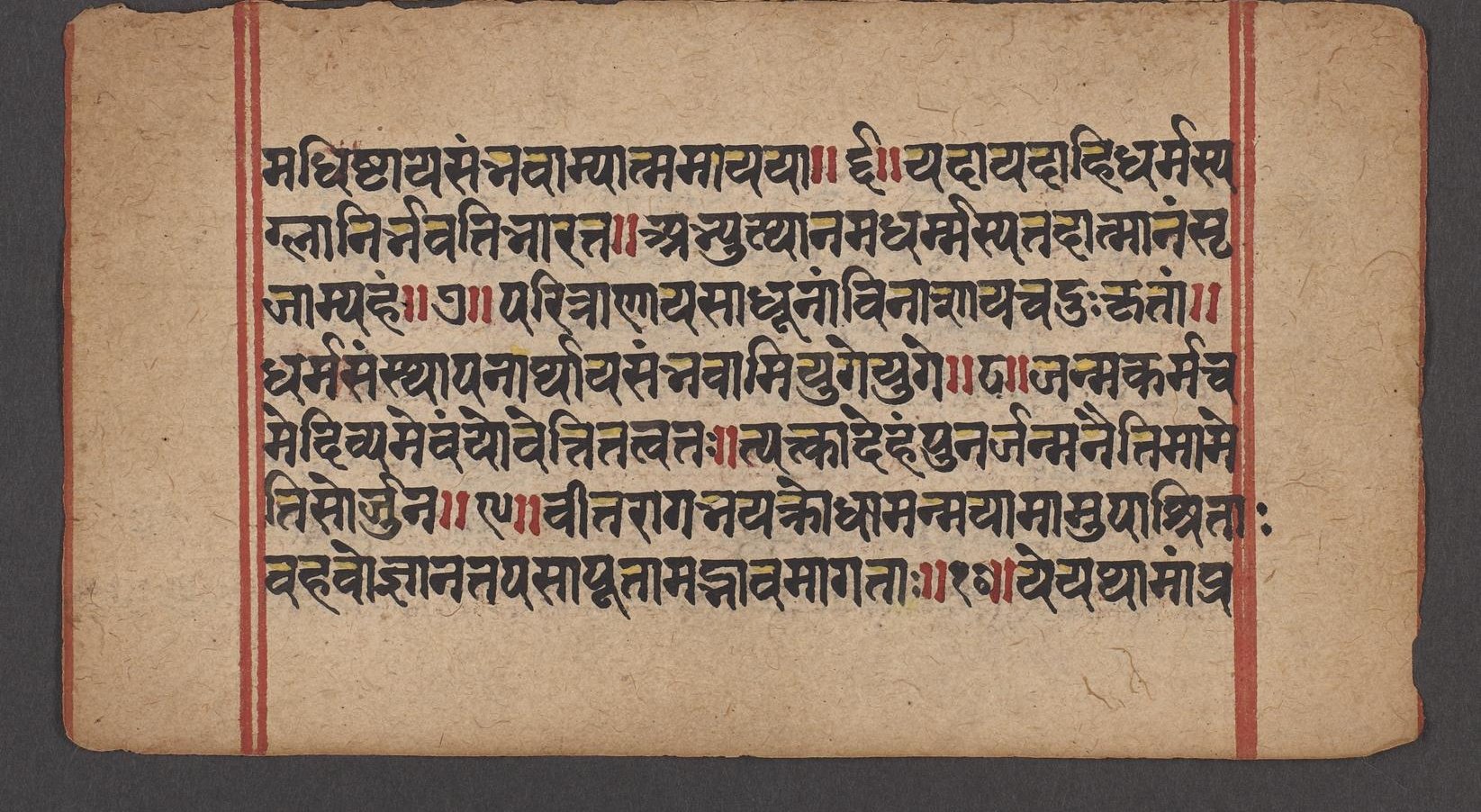
Where on the image
fol. 24r, OPenn image 6555_0023 (lower leaf). Checked on the image: ||6|| line 1 ... ||10|| line 7. Verse 4.6 begins on the previous page, fol. 23v, so both pages are shown.
6अजोऽपि सन्नव्ययात्मा भूतानामीश्वरोऽपि सन् ।
प्रकृतिं स्वामधिष्टाय सम्भवाम्यात्ममायया ॥ ६ ॥
7यदा यदा हि धर्मस्य ग्लानिर्भवति भारत ।
अभ्युत्थानमधर्मस्य तदाऽऽत्मानं सृजाम्यहम् ॥ ७ ॥
8परित्राणाय साधूनां विनाशाय च दुष्कृताम् ।
धर्मसंस्थापनार्थाय सम्भवामि युगे युगे ॥ ८ ॥
9जन्म कर्म च मे दिव्यमेवं यो वेत्ति तत्त्वतः ।
त्यक्त्वा देहं पुनर्जन्म नैति मामेति सोऽर्जुन ॥ ९ ॥
10वीतरागभयक्रोधा मन्मया मामुपाश्रिताः ।
बहवो ज्ञानतपसा पूता मद्भावमागताः ॥ १० ॥
6Though unborn, the imperishable Self, and also the Lord of all beings, brooding over nature which is Mine own, yet I am born through My own Power.
7Whenever there is decay of righteousness, O Bhârata, and there is exaltation of unrighteousness, then I Myself come forth;
8For the protection of the good, for the destruction of evil-doers, for the sake of firmly establishing righteousness, I am born from age to age.
9He who thus knoweth My divine birth and action, in its essence, having abandoned the body, cometh not to birth again, but cometh unto Me, O Arjuna.
10Freed from passion, fear and anger, filled with Me, taking refuge in Me, purified in the fire of wisdom, many have entered into My Being.
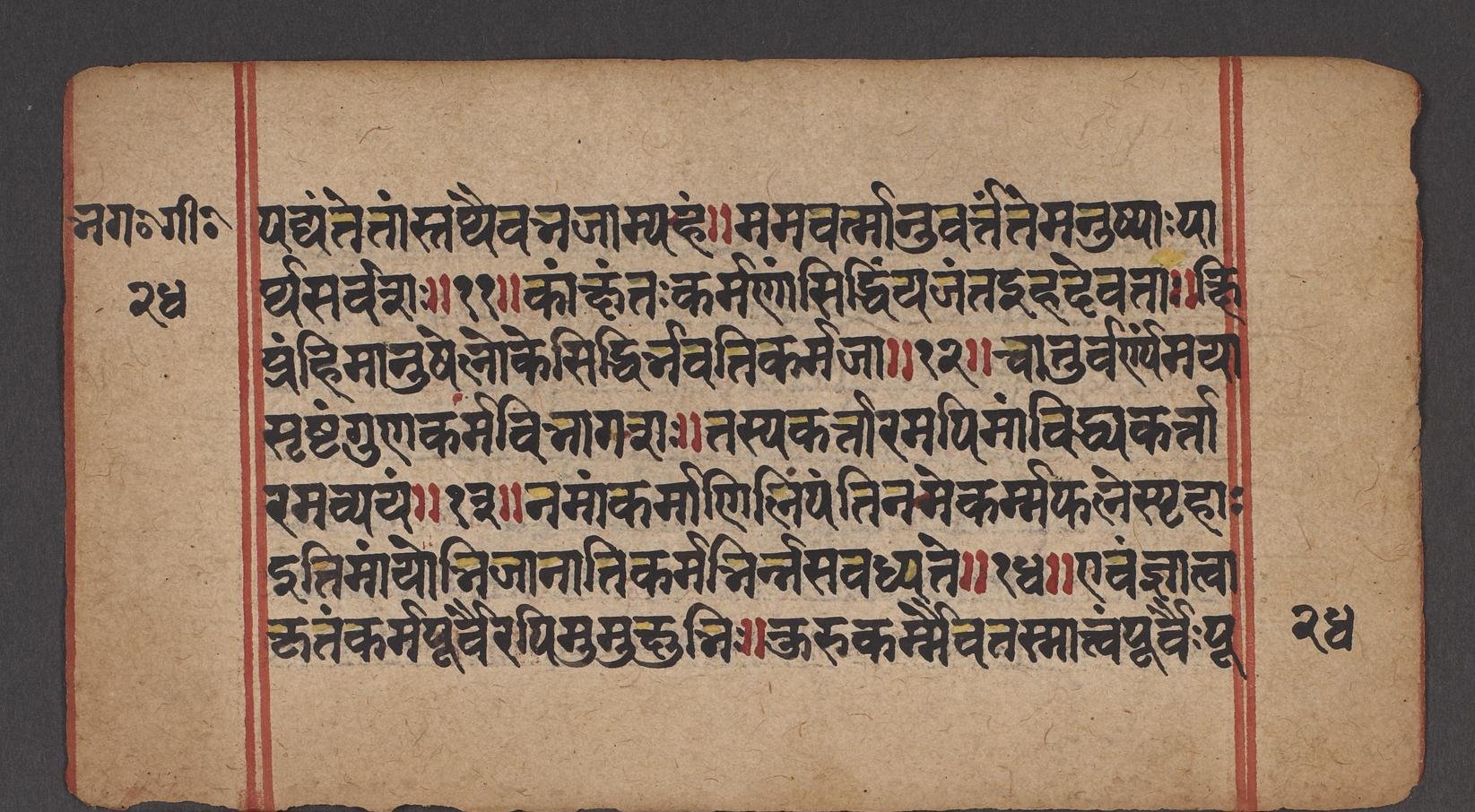
Where on the image
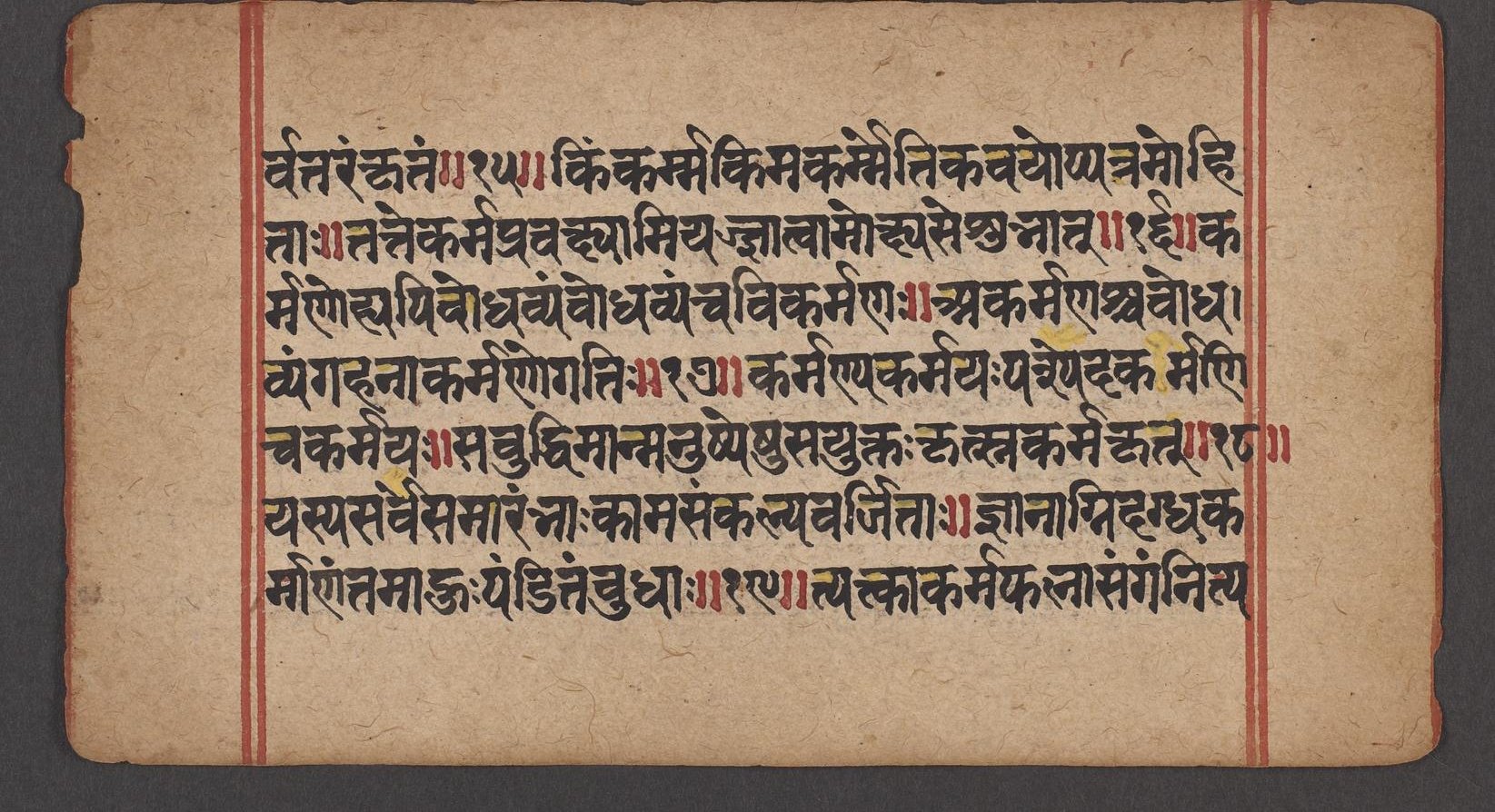
fol. 24v, OPenn image 6555_0024 (upper leaf). Checked on the image: ||11|| line 2 ... ||14|| line 6. Verse 4.11 begins on the previous page, fol. 24r, so both pages are shown.
11ये यथा मां प्रपद्यन्ते तांस्तथैव भजाम्यहम् ।
मम वर्त्मानुवर्तन्ते मनुष्याः पार्थ सर्वशः ॥ ११ ॥
12काङ्क्षन्तः कर्मणां सिद्धिं यजन्त इह देवताः ।
क्षिप्रं हि मानुषे लोके सिद्धिर्भवति कर्मजा ॥ १२ ॥
13चातुर्वर्ण्यं मया सृष्टं गुणकर्मविभागशः ।
तस्य कर्तारमपि मां विद्ध्यकर्तारमव्ययम् ॥ १३ ॥
14न मां कर्माणि लिम्पन्ति न मे कर्मफले स्पृहा ।
इति मां योऽभिजानाति कर्मभिर्न स बद्ध्यते ॥ १४ ॥
11However men approach Me, even so do I welcome them, for the path men take from every side is Mine, O Pârtha.
12They who long after success in action on earth worship the Shining Ones; for in brief space verily, in this world of men, success is born of action.
13The four castes were emanated by Me, by the different distribution of qualities and actions; know Me to be the author of them, though the actionless and inexhaustible.
14Nor do actions affect Me, nor is the fruit of action desired by Me. He who thus knoweth Me is not bound by actions.
Where on the image
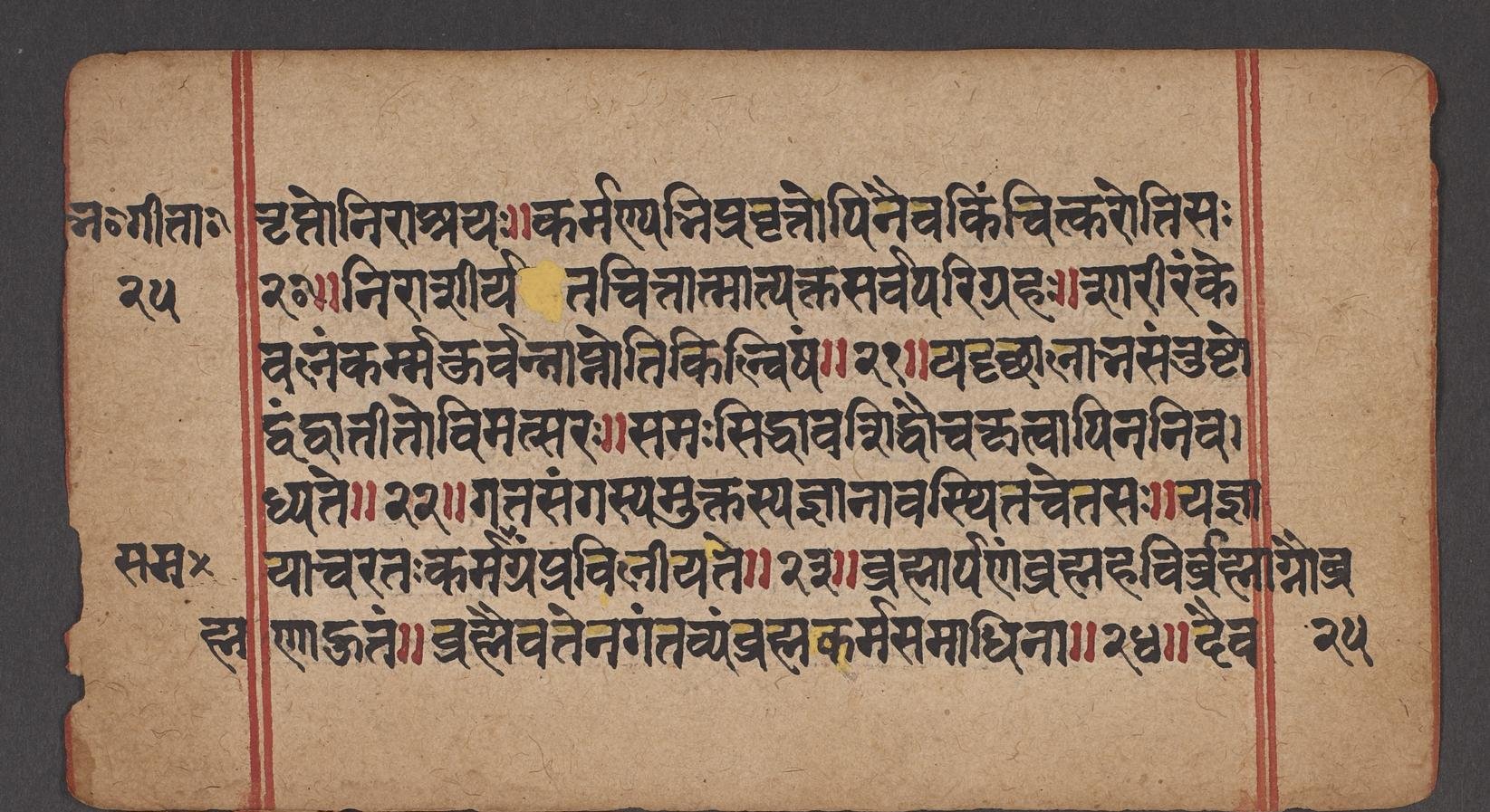
fol. 25r, OPenn image 6555_0024 (lower leaf). Checked on the image: ||15|| line 1 ... ||19|| line 7. Verse 4.15 begins on the previous page, fol. 24v, so both pages are shown.
15एवं ज्ञात्वा कृतं कर्म पूर्वैरपि मुमुक्षुभिः ।
कुरु कर्मैव तस्मात्त्वं पूर्वैः पूर्वतरं कृतम् ॥ १५ ॥
16किं कर्म किमकर्मेति कवयोऽप्यत्र मोहिताः ।
तत्ते कर्म प्रवक्ष्यामि यज्ज्ञात्वा मोक्ष्यसेऽशुभात् ॥ १६ ॥
17कर्मणो ह्यपि बोद्धव्यं बोद्धव्यं च विकर्मणः ।
अकर्मणश्च बोद्धव्यं गहना कर्मणो गतिः ॥ १७ ॥
18कर्मण्यकर्म यः पश्येदकर्मणि च कर्म यः ।
स बुद्धिमान्मनुष्येषु स युक्तः कृत्स्नकर्मकृत् ॥ १८ ॥
19यस्य सर्वे समारम्भाः कामसङ्कल्पवर्जिताः ।
ज्ञानाग्निदग्धकर्माणं तमाहुः पण्डितं बुधाः ॥ १९ ॥
15Having thus known, our forefathers, ever seeking liberation, performed action; therefore do thou also perform action, as did our forefathers in the olden time.
16"What is action, what inaction"? Even the wise are herein perplexed. Therefore I will declare to thee the action by knowing which thou shalt be loosed from evil.
17It is needful to discriminate action, to discriminate unlawful action, and to discriminate inaction; mysterious is the path of action.
18He who seeth inaction in action, and action in inaction, he is wise among men, he is harmonious, even while performing all action.
19Whose works are all free from the moulding of desire, whose actions are burned up by the fire of wisdom, him the wise have called a Sage.
Where on the image
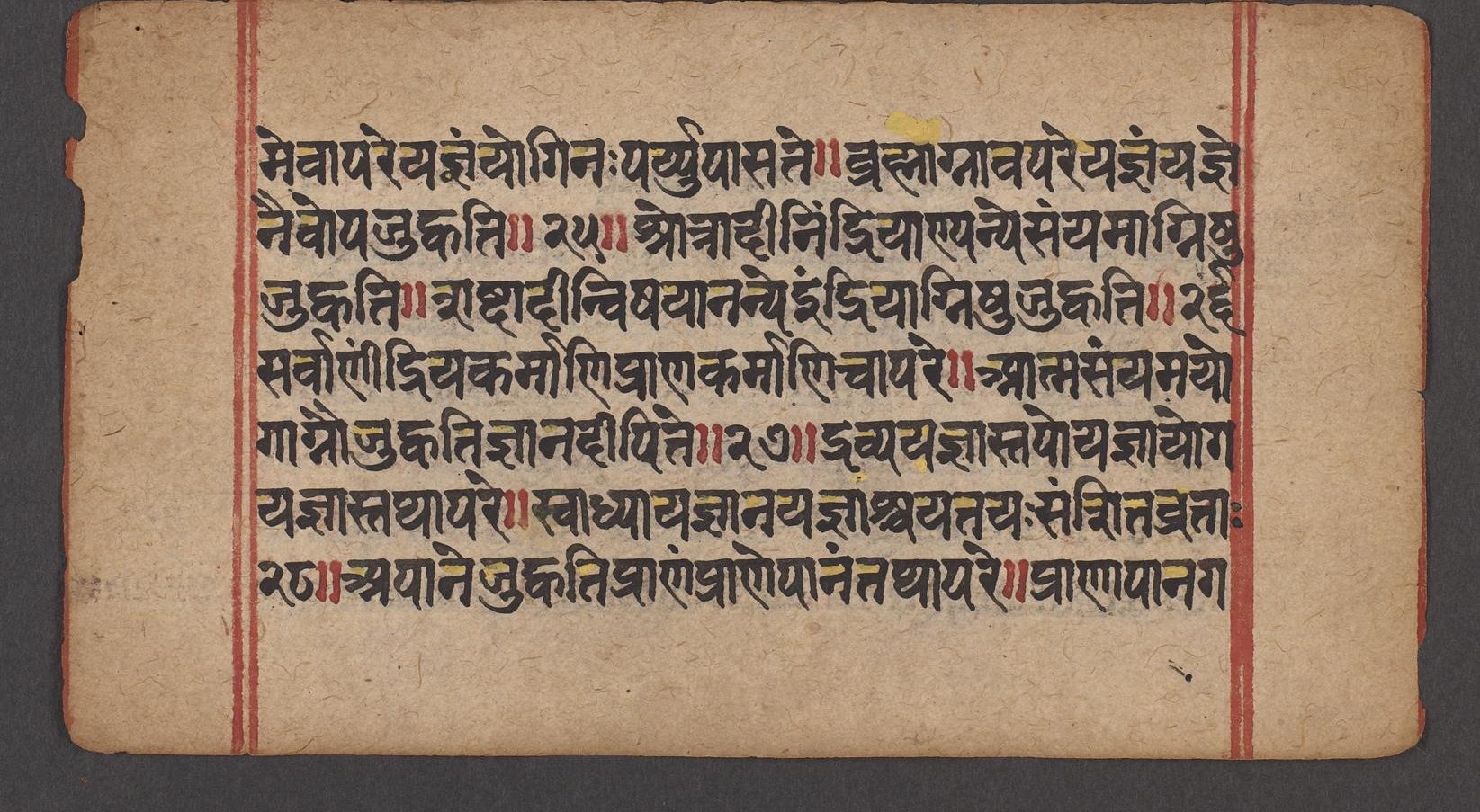
fol. 25v, OPenn image 6555_0025 (upper leaf). Checked on the image: ||20|| line 2 ... ||24|| line 7. Verse 4.20 begins on the previous page, fol. 25r, so both pages are shown.
20त्यक्त्वा कर्मफलासङ्गं नित्यतृप्तो निराश्रयः ।
कर्मण्यभिप्रवृत्तोऽपि नैव किञ्चित्करोति सः ॥ २० ॥
21निराशीर्यतचित्तात्मा त्यक्तसर्वपरिग्रहः ।
शारीरं केवलं कर्म कुर्वन्नाप्नोति किल्बिषम् ॥ २१ ॥
22यदृच्छालाभसन्तुष्टो द्वन्द्वातीतो विमत्सरः ।
समः सिद्धावसिद्धौ च कृत्वाऽपि न निबध्यते ॥ २२ ॥
23गतसङ्गस्य मुक्तस्य ज्ञानावस्थितचेतसः ।
यज्ञायाचरतः कर्म समग्रं प्रविलीयते ॥ २३ ॥
24ब्रह्मार्पणं ब्रह्म हविर्ब्रह्माग्नौ ब्रह्मणा हुतम् ।
ब्रह्मैव तेन गन्तव्यं ब्रह्मकर्मसमाधिना ॥ २४ ॥
20Having abandoned attachment to the fruit of action, always content, nowhere seeking refuge, he is not doing anything, although doing actions.
21Hoping for naught, his mind and self controlled, having abandoned all greed, performing action by the body alone, he doth not commit sin.
22Content with whatsoever he obtaineth without effort, free from the pairs of opposites, without envy, balanced in success and failure, though
acting he is not bound.
23Of one with attachment dead, harmonious, with his thoughts established in wisdom, his works sacrifices, all action melts away.
24The Eternal the oblation, the Eternal the clarified butter, are offered in the Eternal the fire by the Eternal; unto the Eternal verily shall he go who in his action meditateth wholly upon the Eternal.
Where on the image
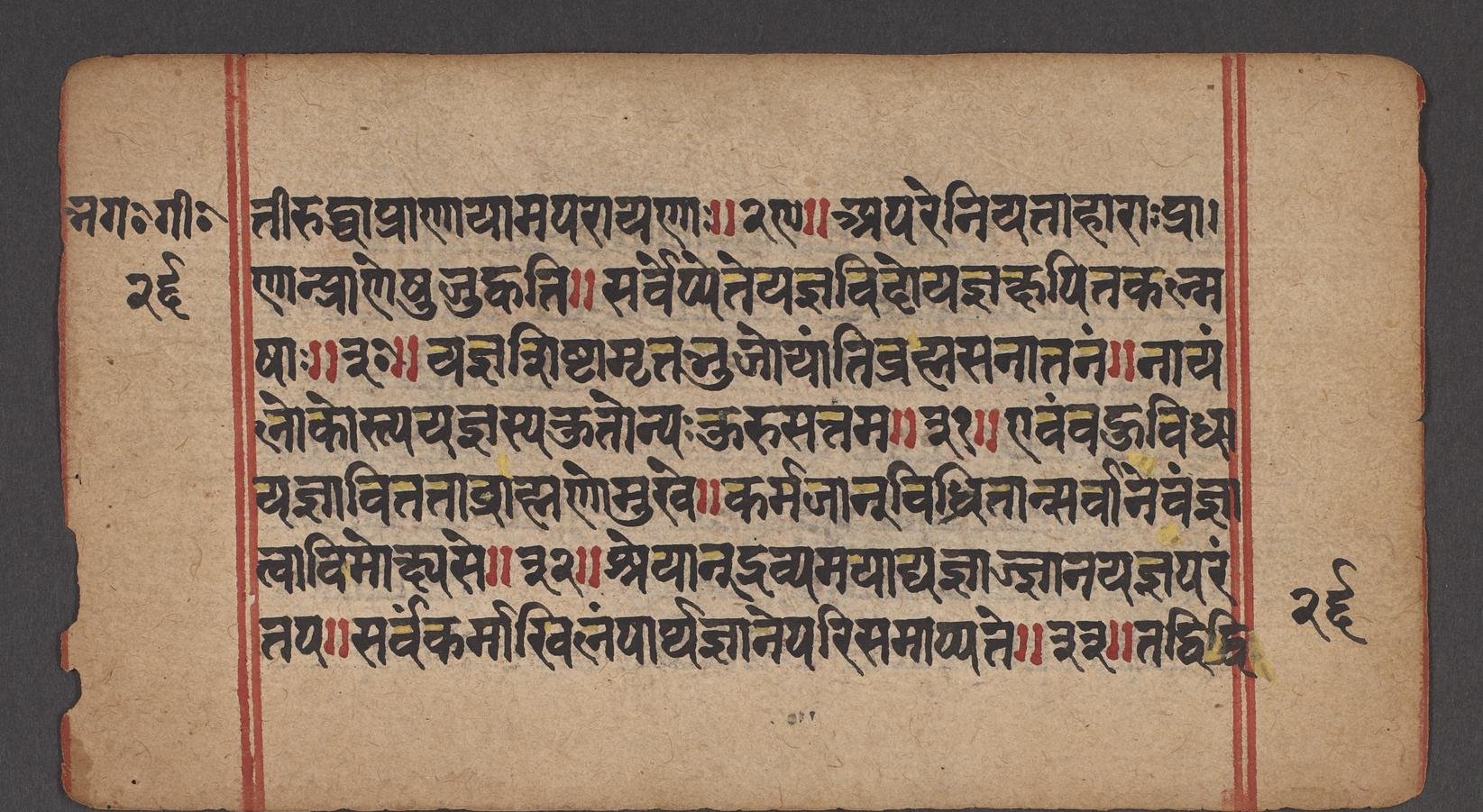
fol. 26r, OPenn image 6555_0025 (lower leaf). Checked on the image: ||25|| line 2 ... ||28|| line 7. Verse 4.25 begins on the previous page, fol. 25v, so both pages are shown.
25दैवमेवापरे यज्ञं योगिनः पर्युपासते ।
ब्रह्माग्नावपरे यज्ञं यज्ञेनैवोपजुह्वति ॥ २५ ॥
26श्रोत्रादीनीन्द्रियाण्यन्ये संयमाग्निषु जुह्वति ।
शब्दादीन्विषयानन्य इन्द्रियाग्निषु जुह्वति ॥ २६ ॥
27सर्वाणीन्द्रियकर्माणि प्राणकर्माणि चापरे ।
आत्मसंयमयोगाग्नौ जुह्वति ज्ञानदीपिते ॥ २७ ॥
28द्रव्ययज्ञास्तपोयज्ञा योगयज्ञास्तथाऽपरे ।
स्वाध्यायज्ञानयज्ञाश्च यतयः संशितव्रताः ॥ २८ ॥
25Some Yogis offer up sacrifice to the Shining Ones; others sacrifice only by pouring sacrifice into the fire of the Eternal;
26Some pour as sacrifice hearing and the other senses into the fires of restraint; some pour sound and the other objects of sense into the fires of the senses as sacrifice;
27Others again into the wisdom-kindled fire of union attained by self-control, pour as sacrifice all the functions of the senses and the functions of life;
28Yet others the sacrifice of wealth, the sacrifice of austerity, the sacrifice of yoga, the sacrifice of silent reading and wisdom, men concentrated and of effectual vows;
Where on the image
fol. 26v, OPenn image 6555_0026 (upper leaf). Checked on the image: ||29|| line 1 ... ||33|| line 7. Verse 4.29 begins on the previous page, fol. 26r, so both pages are shown.
29अपाने जुह्वति प्राणं प्राणेऽपानं तथाऽपरे ।
प्राणापानगती रुध्वा प्राणायामपरायणाः ॥ २९ ॥
30अपरे नियताहाराः प्राणान्प्राणेषु जुह्वति ।
सर्वेऽप्येते यज्ञविदो यज्ञक्षपितकल्मषाः ॥ ३० ॥
31यज्ञशिष्टामृतभुजो यान्ति ब्रह्म सनातनम् ।
नायं लोकोऽस्त्ययज्ञस्य कुतोऽन्यः कुरुसत्तम ॥ ३१ ॥
32एवं बहुविधा यज्ञा वितता ब्रह्मणो मुखे ।
कर्मजान्विद्धि तान्सर्वानेवं ज्ञात्वा विमोक्ष्यसे ॥ ३२ ॥
33श्रेयान्द्रव्यमयाद्यज्ञाज्ज्ञानयज्ञः परन्तप ।
सर्वं कर्माखिलं पार्थ ज्ञाने परिसमाप्यते ॥ ३३ ॥
29Yet others pour as sacrifice the outgoing breath in the incoming, and the incoming in the outgoing, restraining the flow of the outgoing and incoming breaths, solely absorbed in the control of breathing.
30Others regular in food, pour as sacrifice their life-breaths in life-breaths. All these are knowers of sacrifice, and by sacrifice have destroyed their sins.
31The eaters of the life-giving remains of sacrifice go to the changeless Eternal. This world is not for the non-sacrificer, much less the other, O best of the Kurus.
32Many and various sacrifices are thus spread out before the Eternal. Know thou that all
these are born of action, and thus knowing thou shalt be free.
33Better than the sacrifice of any objects is the sacrifice of wisdom, O Parantapa. All actions in their entirety, O Pârtha, culminate in wisdom.
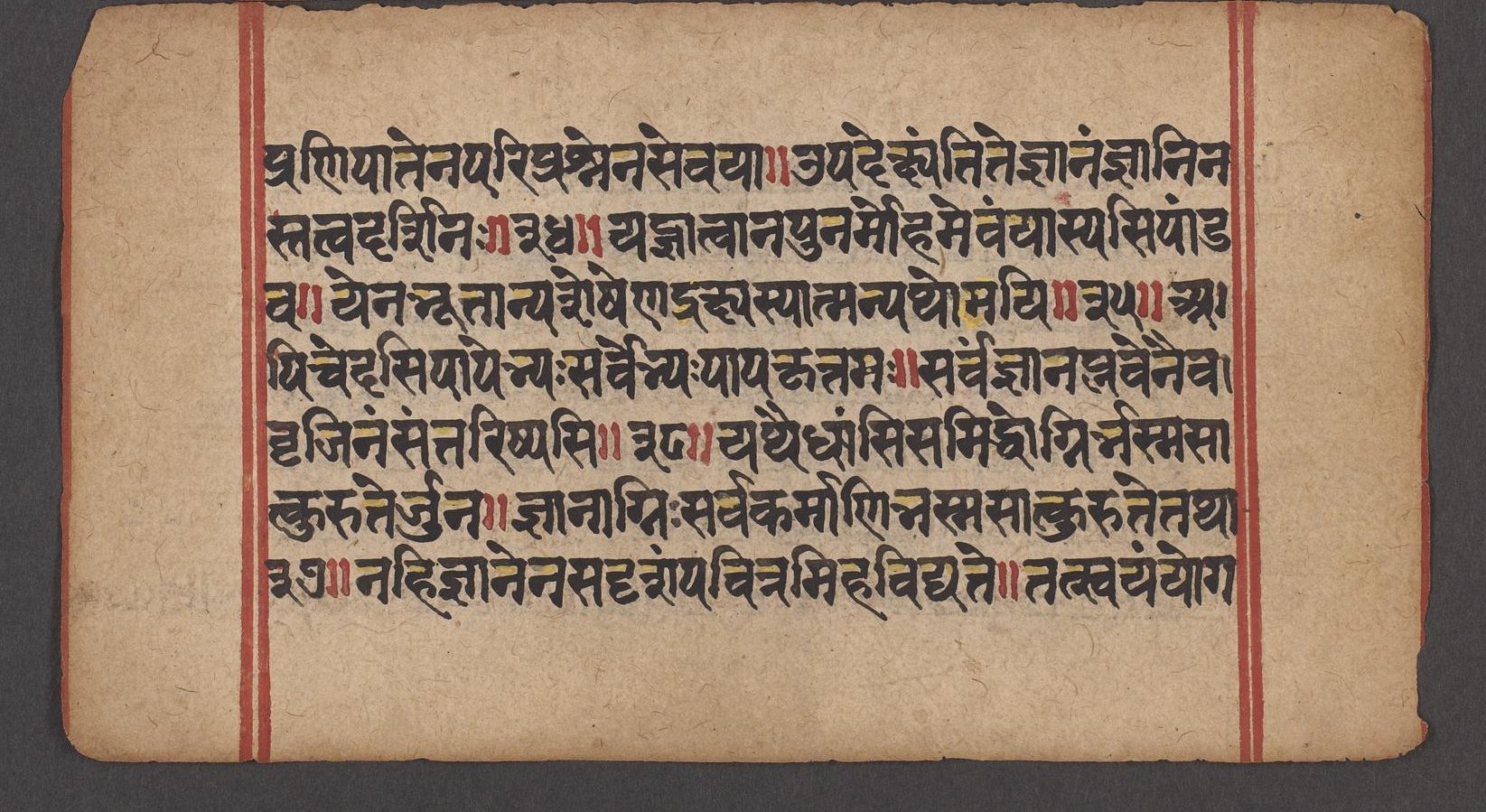
Where on the image
fol. 27r, OPenn image 6555_0026 (lower leaf). Checked on the image: ||34|| line 2 ... ||37|| line 7. Verse 4.34 begins on the previous page, fol. 26v, so both pages are shown.
34तद्विद्धि प्रणिपातेन परिप्रश्नेन सेवया ।
उपदेक्ष्यन्ति ते ज्ञानं ज्ञानिनस्तत्त्वदर्शिनः ॥ ३४ ॥
35यज्ज्ञात्वा न पुनर्मोहमेवं यास्यसि पाण्डव ।
येन भूतान्यशेषेण द्रक्ष्यस्यात्मन्यथो मयि ॥ ३५ ॥
36अपि चेदसि पापेभ्यः सर्वेभ्यः पापकृत्तमः ।
सर्वं ज्ञानप्लवेनैव वृजिनं सन्तरिष्यसि ॥ ३६ ॥
37यथैधांसि समिद्धोऽग्निर्भस्मसात्कुरुतेऽर्जुन ।
ज्ञानाग्निः सर्वकर्माणि भस्मसात्कुरुते तथा ॥ ३७ ॥
34Learn thou this by discipleship, by investigation, and by service. The wise, the seers of the essence of things, will instruct thee in wisdom.
35And having known this, thou shalt not again fall into this confusion, O Pândava; for by this thou wilt see all beings without exception in the Self, and thus in Me.
36Even if thou art the most sinful of all sinners, yet shalt thou cross over all sin by the raft of wisdom.
37As the burning fire reduces fuel to ashes, O Arjuna, so doth the fire of wisdom reduce all actions to ashes.
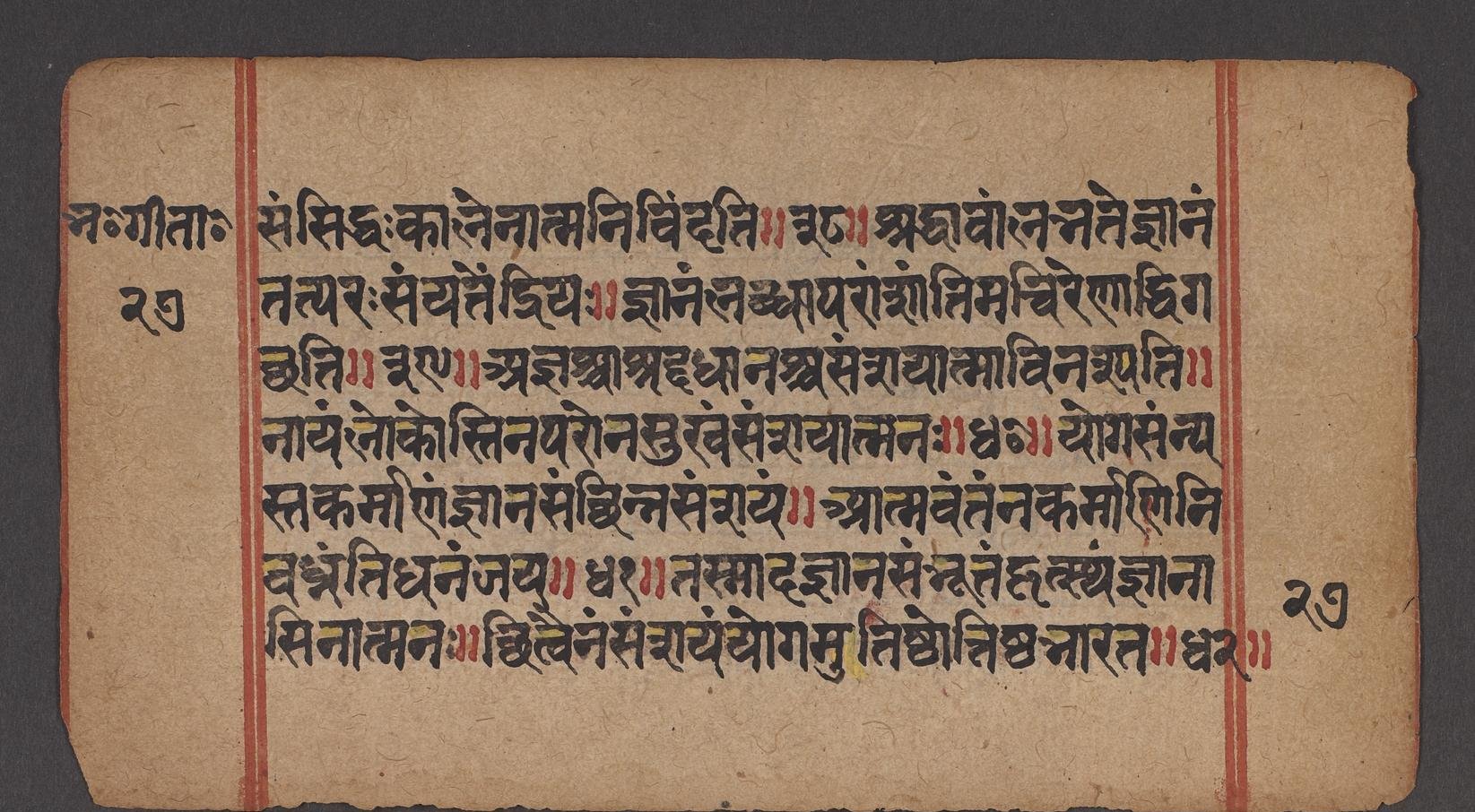
Where on the image
fol. 27v, OPenn image 6555_0027 (upper leaf). Checked on the image: ||38|| line 1 ... ||42|| end of line 7. Verse 4.38 begins on the previous page, fol. 27r, so both pages are shown.
38न हि ज्ञानेन सदृशं पवित्रमिह विद्यते ।
तत्स्वयं योगसंसिद्धः कालेनात्मनि विन्दति ॥ ३८ ॥
39श्रद्धावाँल्लभते ज्ञानं तत्परः संयतेन्द्रियः ।
ज्ञानं लब्ध्वा परां शान्तिमचिरेणाधिगच्छति ॥ ३९ ॥
40अज्ञश्चाश्रद्दधानश्च संशयात्मा विनश्यति ।
नायं लोकोऽस्ति न परो न सुखं संशयात्मनः ॥ ४० ॥
41योगसंन्यस्तकर्माणं ज्ञानसञ्छिन्नसंशयम् ।
आत्मवन्तं न कर्माणि निबध्नन्ति धनञ्जय ॥ ४१ ॥
42तस्मादज्ञानसम्भूतं हृत्स्थं ज्ञानासिनाऽऽत्मनः ।
छित्त्वैनं संशयं योगमातिष्ठोत्तिष्ठ भारत ॥ ४२ ॥
38Verily there is no purifier in this world like wisdom; he that is perfected in yoga finds it in the Self in due season.
39The man who is full of faith obtaineth wisdom, and he also who hath mastery over his senses; and, having obtained wisdom, he goeth swiftly to the supreme Peace.
40But the ignorant, faithless, doubting self goeth to destruction; nor this world, nor that beyond, nor happiness, is there for the doubting self.
41He who hath renounced actions by yoga, who hath cloven asunder doubt by wisdom, who is ruled by the Self, actions do not bind him, O Dhananjaya.
42Therefore, with the sword of the wisdom of the Self cleaving asunder this ignorance-born doubt dwelling in thy heart, be established in yoga. Stand up, O Bhârata.
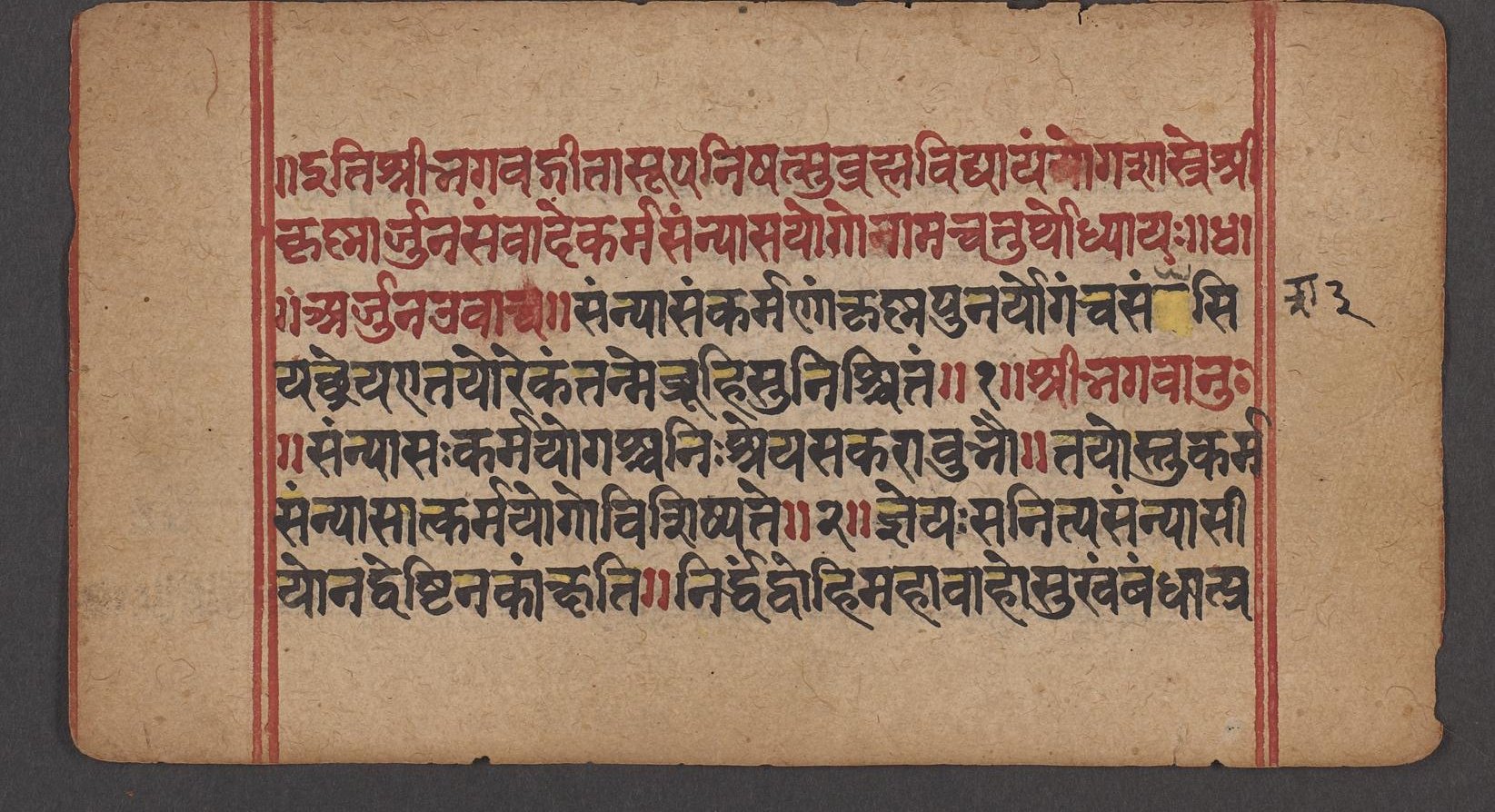
Where on the image
fol. 28r: colophon lines 1-3 '... karmasaṃnyāsayogo nāma caturtho 'dhyāyaḥ ||4||'; arjuna uvāca line 3; 5.1 ends line 4 (||1||), 5.2 ends line 6 (||2||), 5.3 begins line 6. The manuscript names the chapter karmasaṃnyāsayoga; the Sanskrit and English shown are the colophon printed in Besant's edition, whose wording differs in places from the manuscript's.
इति श्रीमद्भगवद्गीतासूप॰ ज्ञानविभागयोगो नाम चतुर्थोऽध्यायः ।
Thus in the glorious Upanishads of the Bhagavad-Gita, the science of the Eternal, the scripture of Yoga the dialogue between Shri Krishna and Arjuna, the fourth discourse, entitled: THE YOGA OF WISDOM.
Notes
- Sanskrit and English: Annie Besant, The Bhagavad-Gita, 4th edition (Madras: G. A. Natesan, 1922), transcription validated on English Wikisource. Besant's footnotes are not reproduced.
- Verse numbers follow Besant and the manuscript, which agree throughout: chapter 13 counts Arjuna's opening question ('prakṛtiṃ puruṣaṃ caiva...') as verse 1, so it has 35 verses and the whole text 701.
- K. T. Telang's translation (Sacred Books of the East 8, 1882) was the first choice for the English, but it is continuous prose without verse divisions, so it cannot be matched to manuscript pages verse by verse; Besant's verse-numbered translation is used instead.
- The last section of each chapter is the chapter colophon. Besant prints most Sanskrit colophons in shortened form (marked with ॰) while her English gives the full formula; the manuscript writes the colophon out in full, and its chapter names differ in places from Besant's (see the scan note).
Cite
Sources
- Source: Penn Ms. Coll. 390 Item 559 (dated 1794) via OPenn + Sanskrit and English of Annie Besant, The Bhagavad-Gita (4th ed. 1922), Wikisource (holding institution)
- Critical edition: Annie Besant, The Bhagavad-Gita, 4th ed. (1922), Sanskrit text, via Wikisource
← previous · → next · v cycle view · l back to library