Bhagavad Gita, Chapter 18: The Yoga of Liberation by Renunciation
Introduction
The Bhagavad Gita ("Song of the Lord") is a dialogue of 700 verses between the prince Arjuna and Krishna, set on the battlefield of Kurukshetra in book 6 (Bhishmaparvan) of the Mahabharata. Its date of composition is debated; many scholars place it in the last centuries BCE. This is chapter 18, The Yoga of Liberation by Renunciation (78 verses as numbered in the manuscript and in Besant's edition).
The pages shown are from a complete Sanskrit manuscript of the Gita at the University of Pennsylvania (Penn Ms. Coll. 390 Item 559), 90 paper leaves of 7 lines in Devanagari, with speaker headings, colophons and verse-end marks in red. Its final colophon (fol. 90r) dates the copy to Saṃvat 1851, the third day of the bright half of Caitra (1794 CE). Chapter 18 runs from fol. 80v to the chapter colophon on fol. 90r.
Each section below is one manuscript page: the verses whose text ends on that page, located by reading the scribe's verse numbers and the first and last words on the image. When a verse begins at the foot of one page and ends on the next, both pages are shown. The Sanskrit and English are from Annie Besant's edition and translation (4th edition, 1922), which prints each verse in Devanagari with its English; the manuscript's spelling differs from the printed text in small details.
How was this verified? (Provenance)
Where on the image
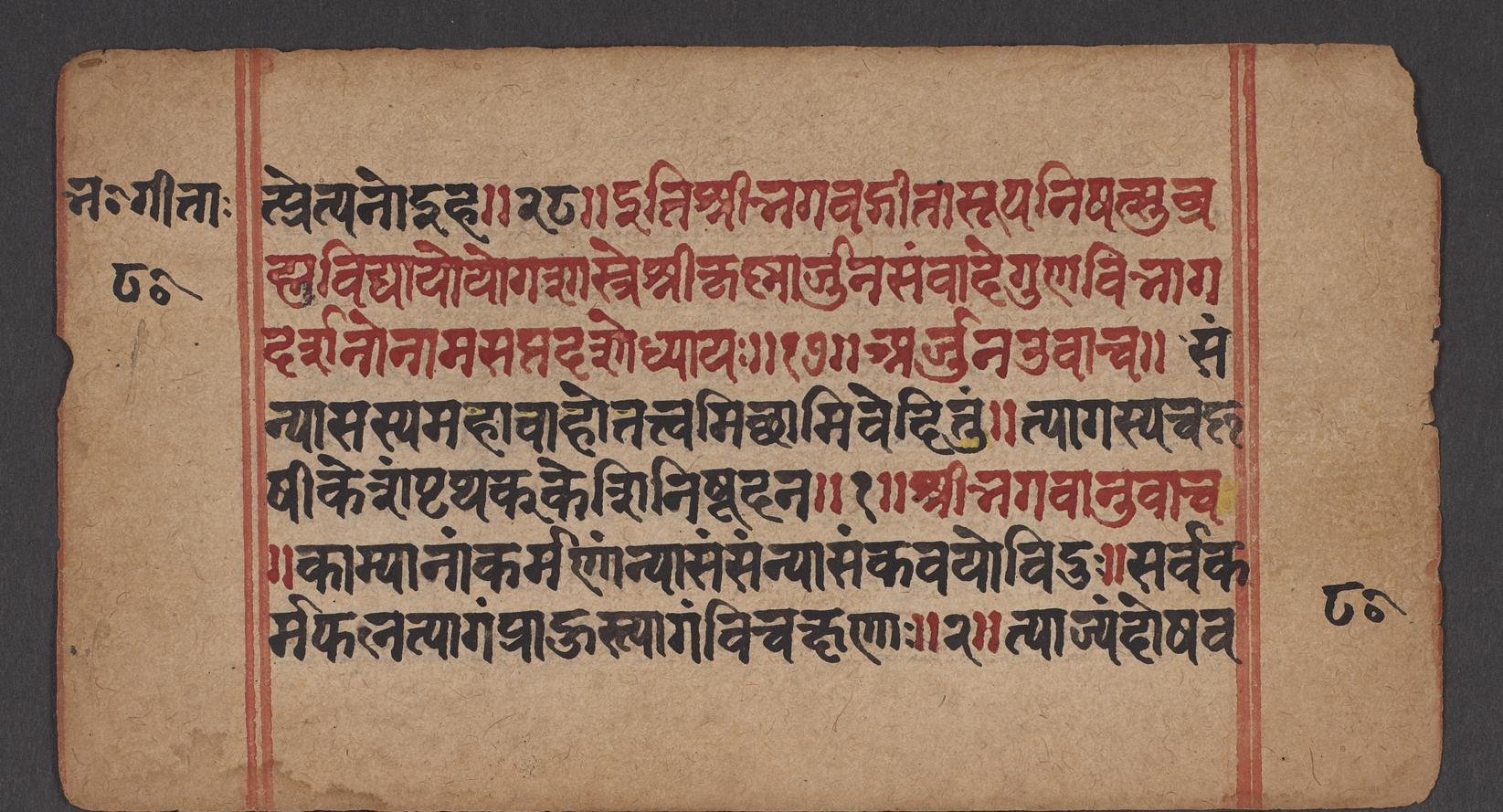
fol. 80v, OPenn image 6555_0080 (upper leaf). Checked on the image: ||28|| line 1; colophon lines 1-3 '... guṇavibhāgadarśano nāma saptadaśo 'dhyāyaḥ ||17||'; arjuna uvāca line 3; 18.1 ends line 5 (||1||), 18.2 ends line 7 (||2||); 18.3 begins line 7.
1अर्जुन उवाच ।
संन्यासस्य महाबाहो तत्त्वमिच्छामि वेदितुम् ।
त्यागस्य च हृषीकेश पृथक्केशिनिषूदन ॥ १ ॥
2श्रीभगवानुवाच ।
काम्यानां कर्मणां न्यासं संन्यासं कवयो विदुः ।
सर्वकर्मफलत्यागं प्राहुस्त्यागं विचक्षणाः ॥ २ ॥
1Arjuna said:
I desire, O mighty-armed, to know severally the essence of renunciation, O Hrishîkesha, and of relinquishment, O Keshinishûdana.
2The Blessed Lord said:
Sages have known as renunciation the renouncing of works with desire; the relinquishing of the fruit of all actions is called relinquishment by the wise.
Where on the image
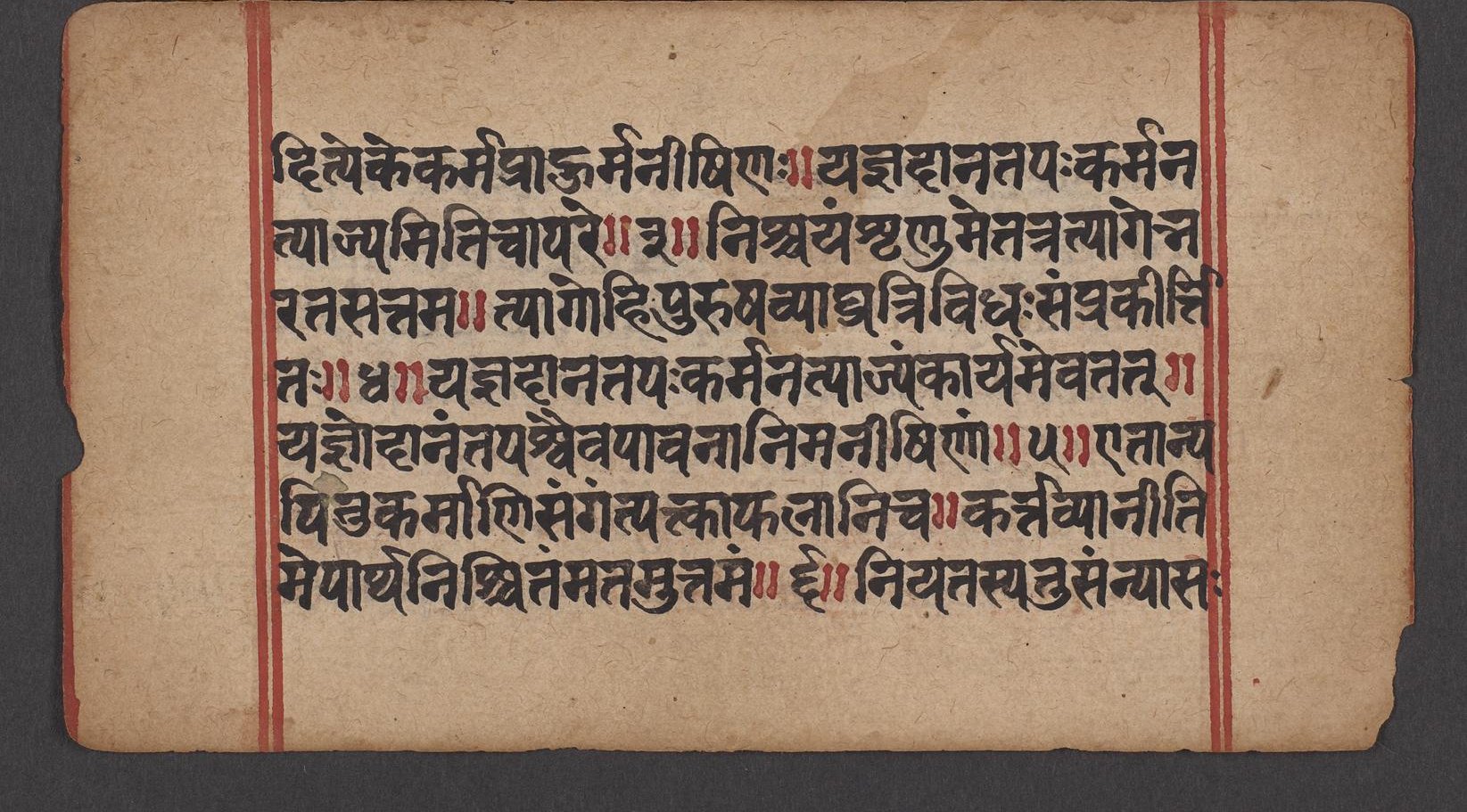
fol. 81r, OPenn image 6555_0080 (lower leaf). Checked on the image: ||3|| line 2 ... ||6|| line 7. Verse 18.3 begins on the previous page, fol. 80v, so both pages are shown.
3त्याज्यं दोषवदित्येके कर्म प्राहुर्मनीषिणः ।
यज्ञदानतपः कर्म न त्याज्यमिति चापरे ॥ ३ ॥
4निश्चयं शृणु मे तत्र त्यागे भरतसत्तम ।
त्यागो हि पुरुषव्याघ्र त्रिविधः सम्प्रकीर्तितः ॥ ४ ॥
5यज्ञदानतपः कर्म न त्याज्यं कार्यमेव तत् ।
यज्ञो दानं तपश्चैव पावनानि मनीषिणाम् ॥ ५ ॥
6एतान्यपि तु कर्माणि सङ्गं त्यक्त्वा फलानि च ।
कर्तव्यानीति मे पार्थ निश्चितं मतमुत्तमम् ॥ ६ ॥
3"Action should be relinquished as an evil," declare some thoughtful men; "acts of sacrifice, gift and austerity should not be relinquished," say others.
4Hear my conclusions as to that relinquishment, O best of the Bhâratas; since relinquishment, O tiger of men, has been explained as threefold.
5Acts of sacrifice, gift and austerity should not be relinquished, but should be performed; sacrifice, gift and also austerity are the purifiers of the intelligent.
6But even these actions should be done leaving aside attachment and fruit, O Pârtha; that is my certain and best belief.
Where on the image
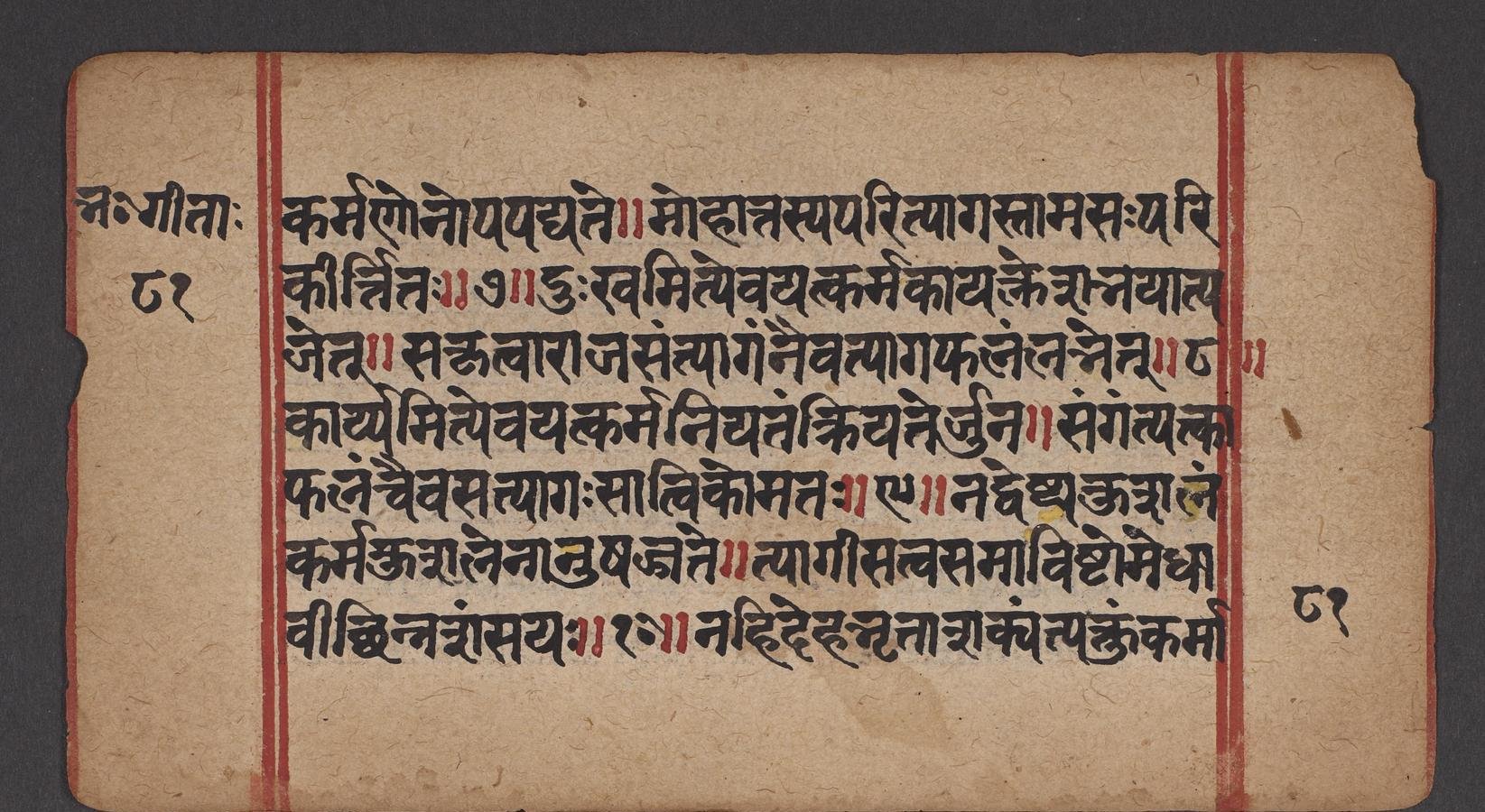
fol. 81v, OPenn image 6555_0081 (upper leaf). Checked on the image: ||7|| line 2 ... ||10|| line 7. Verse 18.7 begins on the previous page, fol. 81r, so both pages are shown.
7नियतस्य तु संन्यासः कर्मणो नोपपद्यते ।
मोहात्तस्य परित्यागस्तामसः परिकीर्तितः ॥ ७ ॥
8दुःखमित्येव यत्कर्म कायक्लेशभयात्त्यजेत् ।
स कृत्वा राजसं त्यागं नैव त्यागफलं लभेत् ॥ ८ ॥
9कार्यमित्येव यत्कर्म नियतं क्रियतेऽर्जुन ।
सङ्गं त्यक्त्वा फलं चैव स त्यागः सात्त्विको मतः ॥ ९ ॥
10न द्वेष्ट्यकुशलं कर्म कुशले नानुषज्जते ।
त्यागी सत्त्वसमाविष्टो मेधावी छिन्नसंशयः ॥ १० ॥
7Verily renunciation of actions that are prescribed is not proper; the relinquishment thereof from delusion is said to be of darkness.
8He who relinquisheth an action from fear of physical suffering, saying "Painful," thus performing a passionate relinquishment, obtaineth not the fruit of relinquishment.
9He who performeth a prescribed action, saying, "it ought to be done," O Arjuna, relinquishing attachment and also fruit, that relinquishment is regarded as pure.
10The relinquisher pervaded by purity, intelligent and with doubts cut away, hateth not unpleasurable action nor is attached to pleasurable.
Where on the image
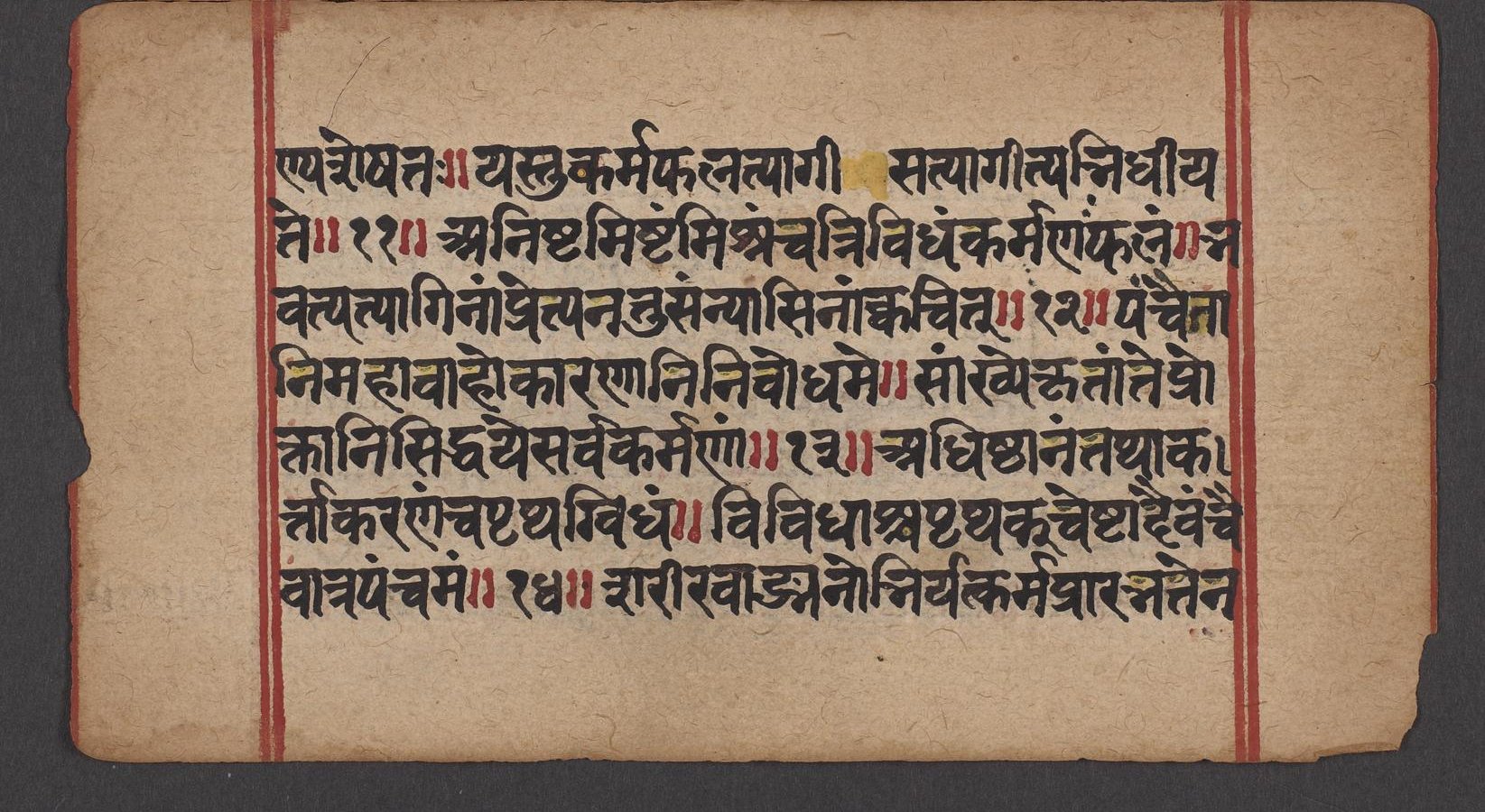
fol. 82r, OPenn image 6555_0081 (lower leaf). Checked on the image: ||11|| line 2 ... ||14|| line 7. Verse 18.11 begins on the previous page, fol. 81v, so both pages are shown.
11न हि देहभृता शक्यं त्यक्तुं कर्माण्यशेषतः ।
यस्तु कर्मफलत्यागी स त्यागीत्यभिधीयते ॥ ११ ॥
12अनिष्टमिष्टं मिश्रं च त्रिविधं कर्मणः फलम् ।
भवत्यत्यागिनां प्रेत्य न तु संन्यासिनां क्वचित् ॥ १२ ॥
13पञ्चैतानि महाबाहो कारणानि निबोध मे ।
साङ्ख्ये कृतान्ते प्रोक्तानि सिद्धये सर्वकर्मणाम् ॥ १३ ॥
14अधिष्ठानं तथा कर्ता करणं च पृथग्विधम् ।
विविधाश्च पृथक्चेष्टा दैवं चैवात्र पञ्चमम् ॥ १४ ॥
11Nor indeed can embodied beings completely relinquish action; verily he who relinquisheth the fruit of action, he is said to be a relinquisher.
12Good, evil and mixed—threefold is the fruit of action hereafter for the non-relinquisher; but there is none ever for the renouncer.
13These five causes, O mighty-armed, learn of Me as declared in the Sâñkhya system for the accomplishment of all actions:
14The body, the actor, the various organs, the diverse kinds of energies, and the presiding deities also, the fifth.
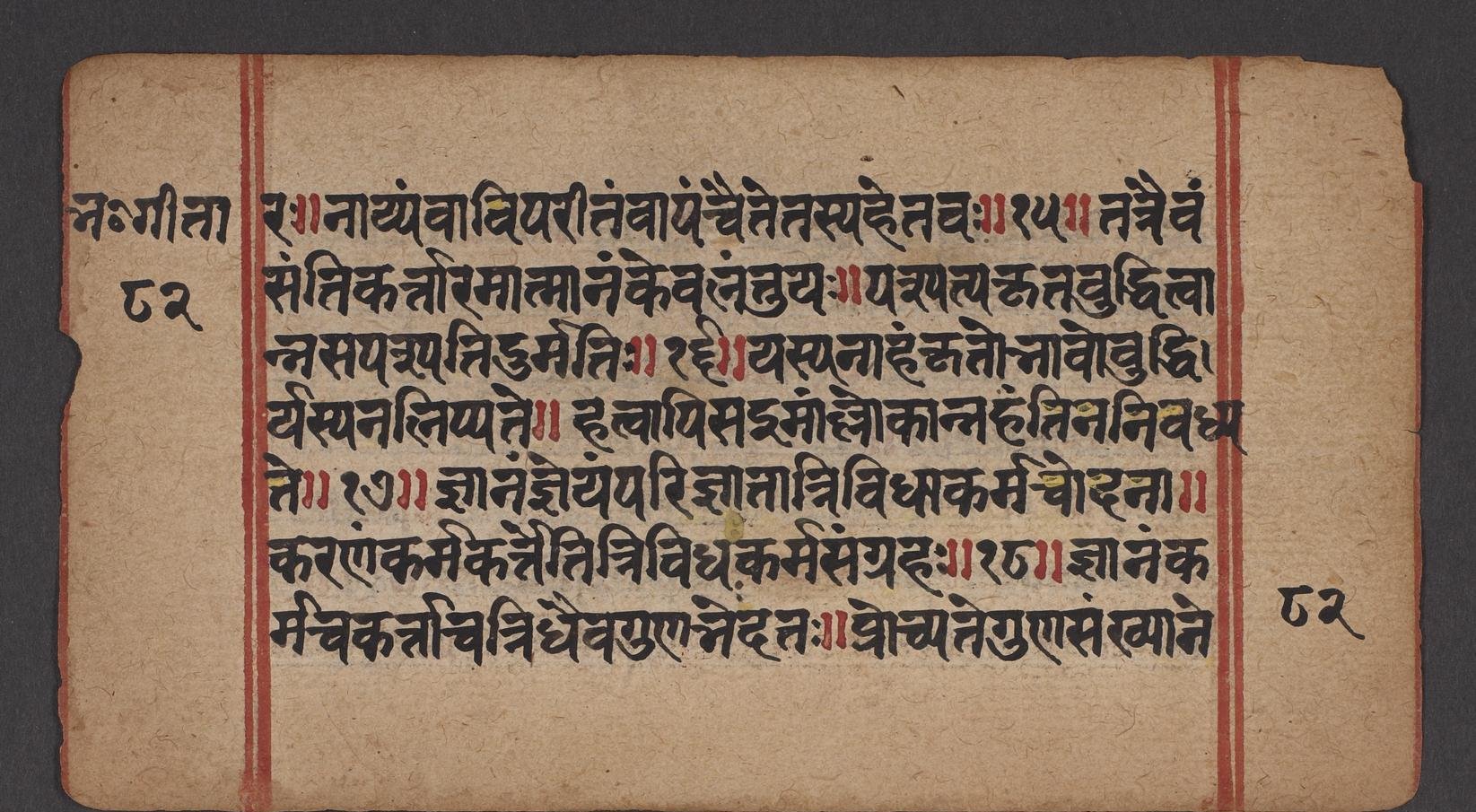
Where on the image
fol. 82v, OPenn image 6555_0082 (upper leaf). Checked on the image: ||15|| line 1 ... ||18|| line 6. Verse 18.15 begins on the previous page, fol. 82r, so both pages are shown.
15शरीरवाङ्मनोभिर्यत्कर्म प्रारभते नरः ।
न्याय्यं वा विपरीतं वा पञ्चैते तस्य हेतवः ॥ १५ ॥
16तत्रैवं सति कर्तारमात्मानं केवलं तु यः ।
पश्यत्यकृतबुद्धित्वान्न स पश्यति दुर्मतिः ॥ १६ ॥
17यस्य नाहंकृतो भावो बुद्धिर्यस्य न लिप्यते ।
हत्वाऽपि स इमाँल्लोकान्न हन्ति न निबध्यते ॥ १७ ॥
18ज्ञानं ज्ञेयं परिज्ञाता त्रिविधा कर्मचोदना ।
करणं कर्म कर्तेति त्रिविधः कर्मसङ्ग्रहः ॥ १८ ॥
15Whatever action a man performeth by his body, speech and mind, whether right or the reverse, these five are the cause thereof.
16That being so, he verily who—owing to untrained Reason—looketh on his Self, which is isolated, as the actor, he of perverted intelligence, seeth not.
17He who is free from the egoistic notion, whose Reason is not affected, though he slay these peoples, he slayeth not, nor is bound.
18Knowledge, the knowable and the knower, the threefold impulse to action; the organ, the action, the actor, the threefold constituents of action.
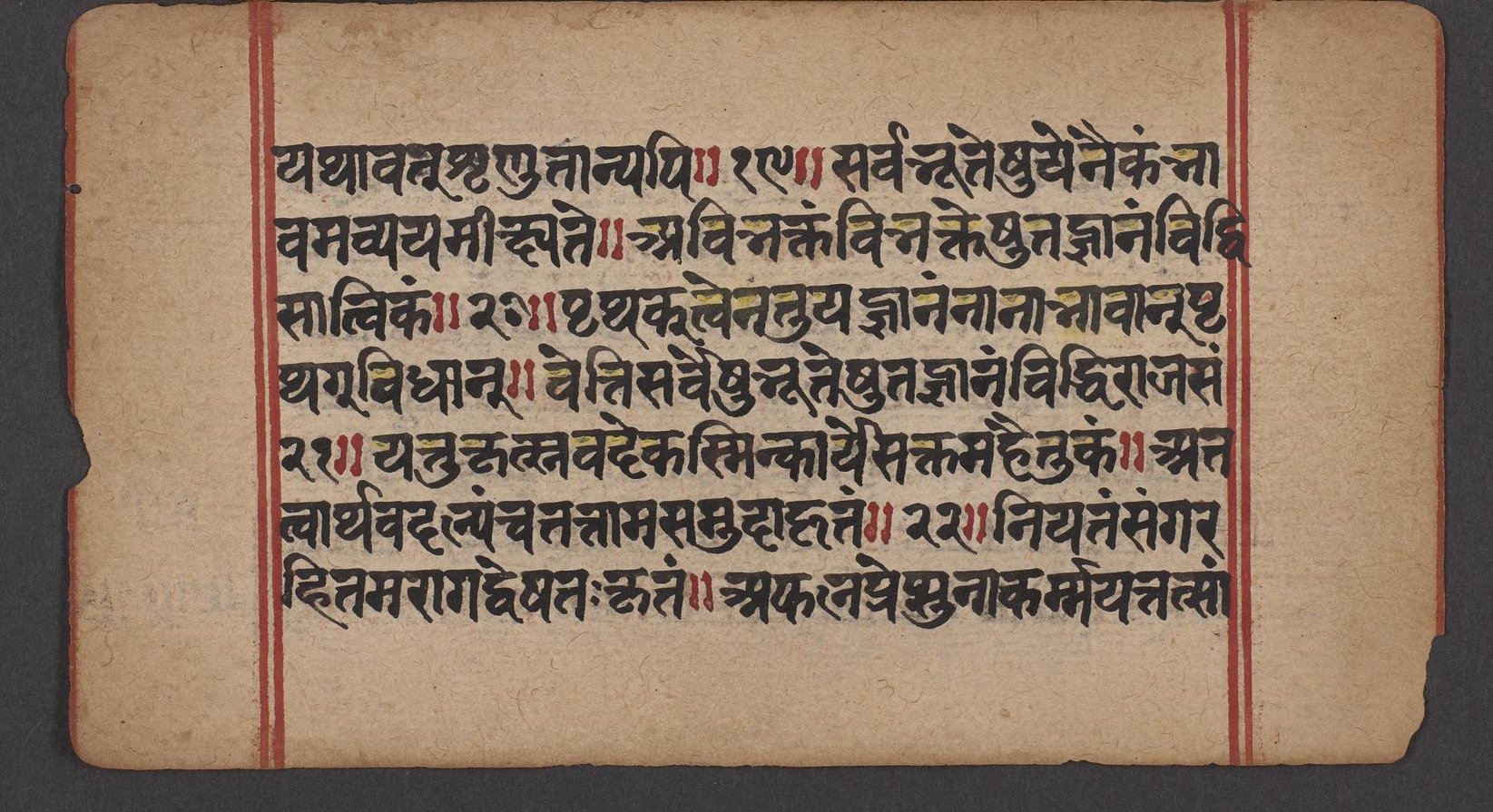
Where on the image
fol. 83r, OPenn image 6555_0082 (lower leaf). Checked on the image: ||19|| line 1 ... ||22|| line 6. Verse 18.19 begins on the previous page, fol. 82v, so both pages are shown.
19ज्ञानं कर्म च कर्ता च त्रिधैव गुणभेदतः ।
प्रोच्यते गुणसङ्ख्याने यथावच्छृणु तान्यपि ॥ १९ ॥
20सर्वभूतेषु येनैकं भावमव्ययमीक्षते ।
अविभक्तं विभक्तेषु तज्ज्ञानं विद्धि सात्त्विकम् ॥ २० ॥
21पृथक्त्वेन तु यज्ज्ञानं नानाभावान्पृथग्विधान् ।
वेत्ति सर्वेषु भूतेषु तज्ज्ञानं विद्धि राजसम् ॥ २१ ॥
22यत्तु कृत्स्नवदेकस्मिन् कार्ये सक्तमहैतुकम् ।
अतत्त्वार्थवदल्पं च तत्तामसमुदाहृतम् ॥ २२ ॥
19Knowledge, action and actor in the category of qualities are also said to be severally threefold, from the difference of qualities; hear thou duly these also.
20That by which one indestructible Being is seen in all beings, inseparate in the separated, know thou that knowledge as pure.
21But that knowledge which regardeth the several manifold existences in all beings as separate, that knowledge know thou as of passion;
22While that which clingeth to each one thing as if it were the whole, without reason, without grasping the reality, narrow, that is declared to be dark.
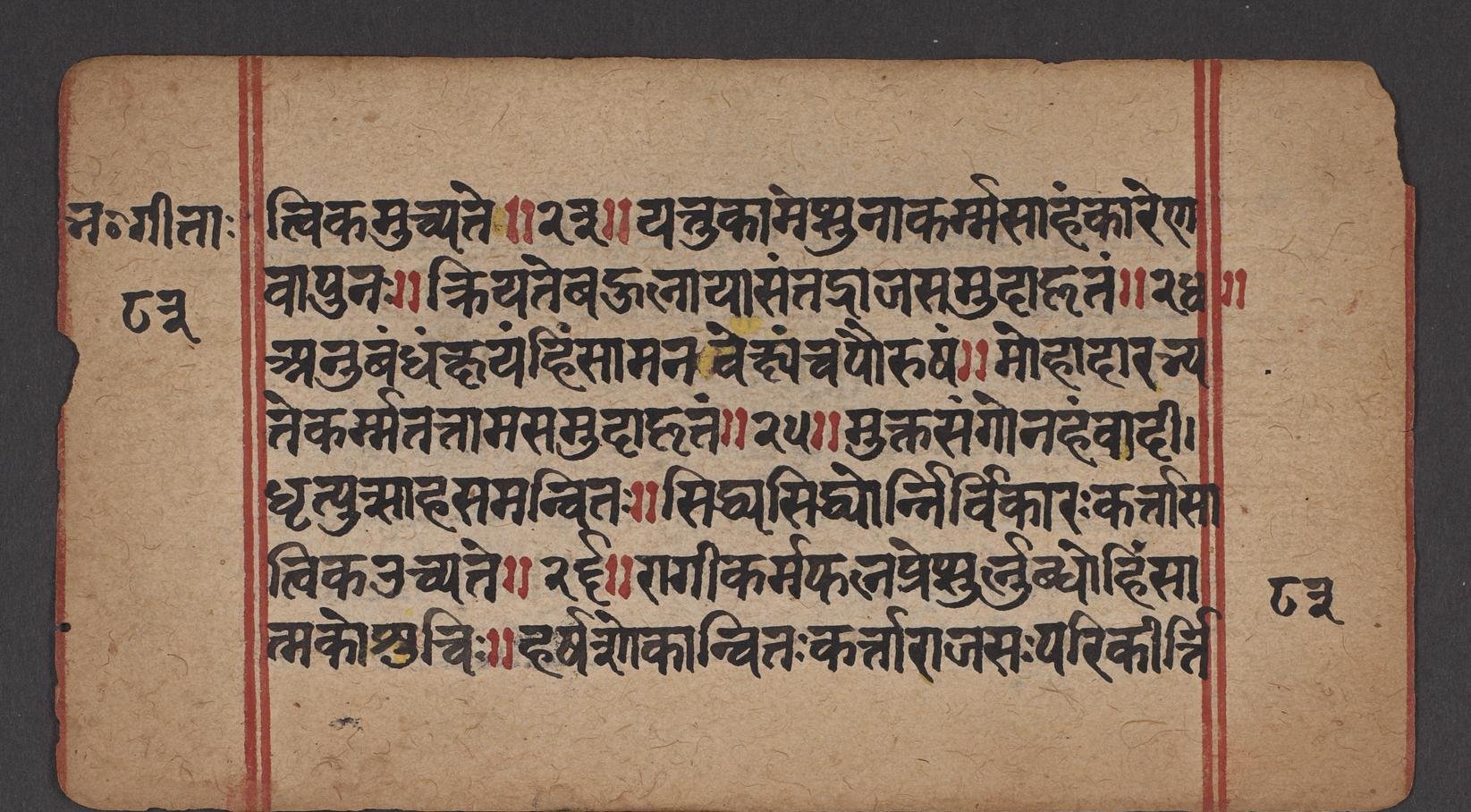
Where on the image
fol. 83v, OPenn image 6555_0083 (upper leaf). Checked on the image: ||23|| line 1 ... ||26|| line 6. Verse 18.23 begins on the previous page, fol. 83r, so both pages are shown.
23नियतं सङ्गरहितमरागद्वेषतः कृतम् ।
अफलप्रेप्सुना कर्म यत्तत्सात्त्विकमुच्यते ॥ २३ ॥
24यत्तु कामेप्सुना कर्म साहङ्कारेण वा पुनः ।
क्रियते बहुलायासं तद्राजसमुदाहृतम् ॥ २४ ॥
25अनुबन्धं क्षयं हिंसामनपेक्ष्य च पौरुषम् ।
मोहादारभ्यते कर्म यत्तत्तामसमुच्यते ॥ २५ ॥
26मुक्तसङ्गोऽनहंवादी धृत्युत्साहसमन्वितः ।
सिद्ध्यसिद्ध्योर्निर्विकारः कर्त्ता सात्त्विक उच्यते ॥ २६ ॥
23An action which is ordained, done by one undesirous of fruit, devoid of attachment, without love or hate, that is called pure.
24But that action that is done by one longing for desires, or again with egoism, or with much effort, that is declared to be passionate.
25The action undertaken from delusion, without regard to capacity and consequences—loss and injury to others—that is declared to be dark.
26Liberated from attachment, not egoistic, endued with firmness and confidence, unchanged by success or failure, that actor is called pure.
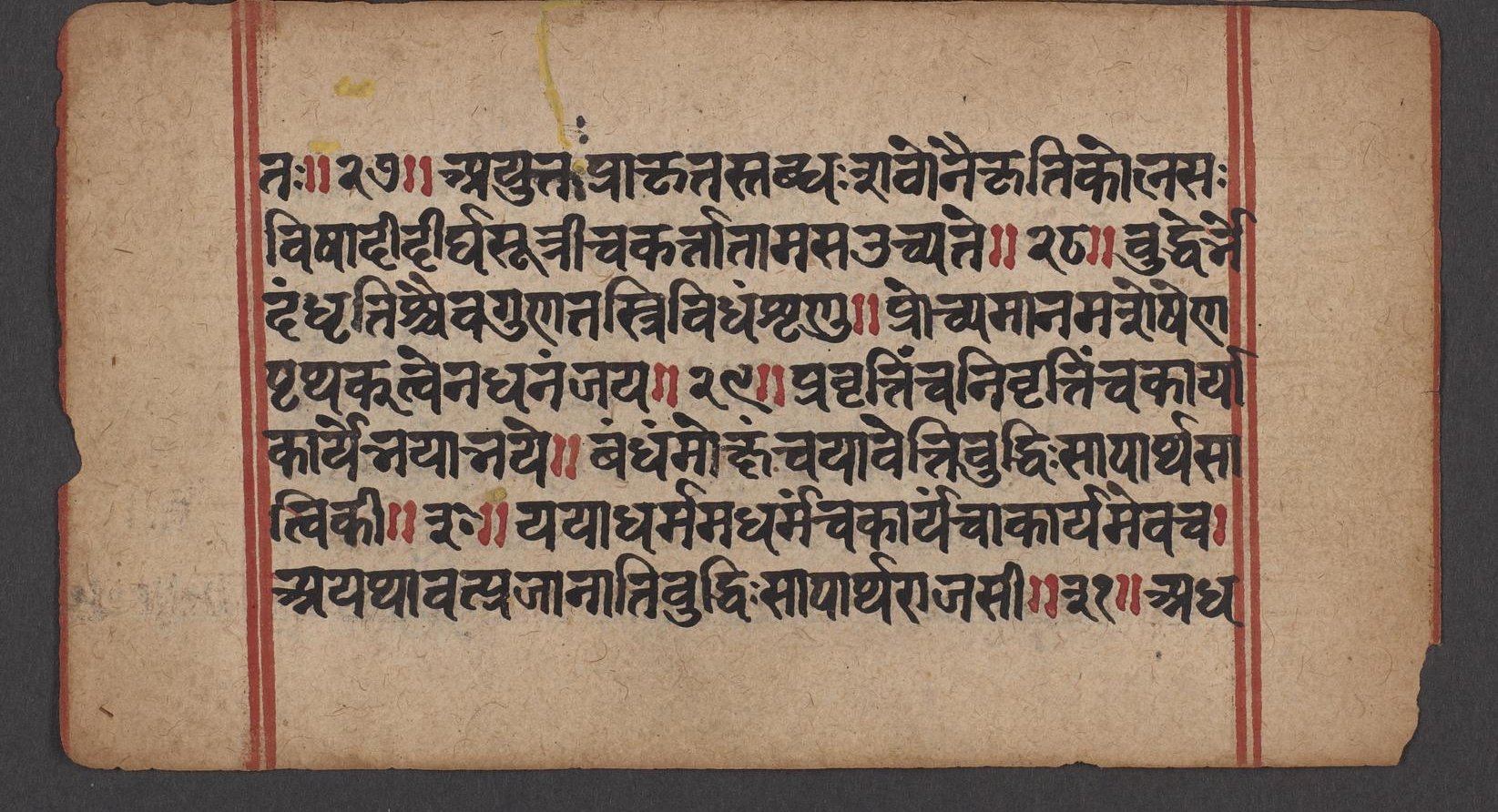
Where on the image
fol. 84r, OPenn image 6555_0083 (lower leaf). Checked on the image: ||27|| line 1 ... ||31|| line 7. Verse 18.27 begins on the previous page, fol. 83v, so both pages are shown.
27रागी कर्मफलप्रेप्सुर्लुब्धो हिंसात्मकोऽशुचिः ।
हर्षशोकान्वितः कर्ता राजसः परिकीर्तितः ॥ २७ ॥
28अयुक्तः प्राकृतः स्तब्धः शठो नैष्कृतिकोऽलसः ।
विषादी दीर्घसूत्री च कर्ता तामस उच्यते ॥ २८ ॥
29बुद्धेर्भेदं धृतेश्चैव गुणतस्त्रिविधं शृणु ।
प्रोच्यमानमशेषेण पृथक्त्वेन धनञ्जय ॥ २९ ॥
30प्रवृत्तिं च निवृत्तिं च कार्याकार्ये भयाभये ।
बन्धं मोक्षं च या वेत्ति बुद्धिः सा पार्थ सात्त्विकी ॥ ३० ॥
31यया धर्ममधर्मं च कार्यं चाकार्यमेव च ।
अयथावत्प्रजानाति बुद्धिः सा पार्थ राजसी ॥ ३१ ॥
27Impassioned, desiring to obtain the fruit of actions, greedy, harmful, impure, moved by joy and sorrow, such an actor is pronounced passionate.
28Discordant, vulgar, stubborn, cheating, malicious, indolent, despairful, procrastinating, that actor is called dark.
29The division of Reason and of firmness also, threefold according to the qualities, hear thou related, unreservedly and severally, O Dhananjaya.
30That which knoweth energy and abstinence, what ought to be done and what ought not to be done, fear and fearlessness, bondage and liberation, that Reason is pure, O Pârtha.
31That by which one understandeth away Right and Wrong and also what ought to be done and what ought not to be done, that Reason, O Pârtha, is passionate.
Where on the image
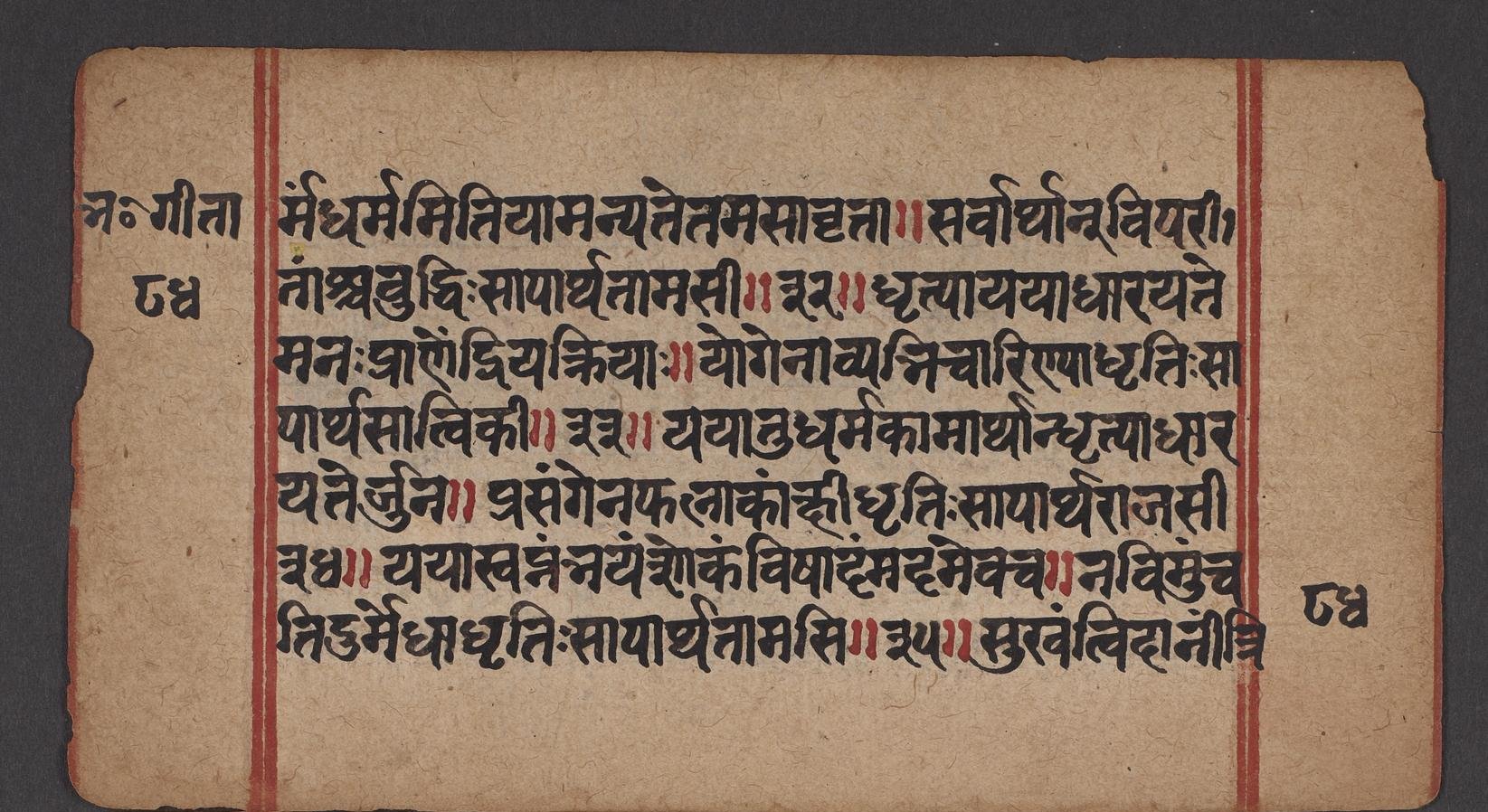
fol. 84v, OPenn image 6555_0084 (upper leaf). Checked on the image: ||32|| line 2 ... ||35|| line 7. Verse 18.32 begins on the previous page, fol. 84r, so both pages are shown.
32अधर्मं धर्ममिति या मन्यते तमसा वृता ।
सर्वार्थान् विपरीतांश्च बुद्धिः सा पार्थ तामसी ॥ ३२ ॥
33धृत्या यया धारयते मनःप्राणेन्द्रियक्रियाः ।
योगेनाव्यभिचारिण्या धृतिः सा पार्थ सात्त्विकी ॥ ३३ ॥
34यया तु धर्मकामार्थान् धृत्या धारयतेऽर्जुन ।
प्रसङ्गेन फलाकाङ्क्षी धृतिः सा पार्थ राजसी ॥ ३४ ॥
35यया स्वप्नं भयं शोकं विषादं मदमेव च ।
न विमुञ्चति दुर्मेधा धृतिः सा पार्थ तामसी ॥ ३५ ॥
32That which, enwrapped in darkness, thinketh wrong to be right and seeth all things subverted, that Reason, O Pârtha, is of darkness.
33The unwavering firmness by which, through Yoga, one restraineth the activity of the mind, of the life breaths and of the sense-organs, that firmness, O Pârtha, is pure.
34But the firmness, O Arjuna, by which, from attachment desirous of fruit, one holdeth fast duty, desire and wealth, that firmness, O Pârtha, is passionate.
35That by which one from stupidity doth not abandon sleep, fear, grief, despair, and also vanity, that firmness, O Pârtha, is dark.
Where on the image
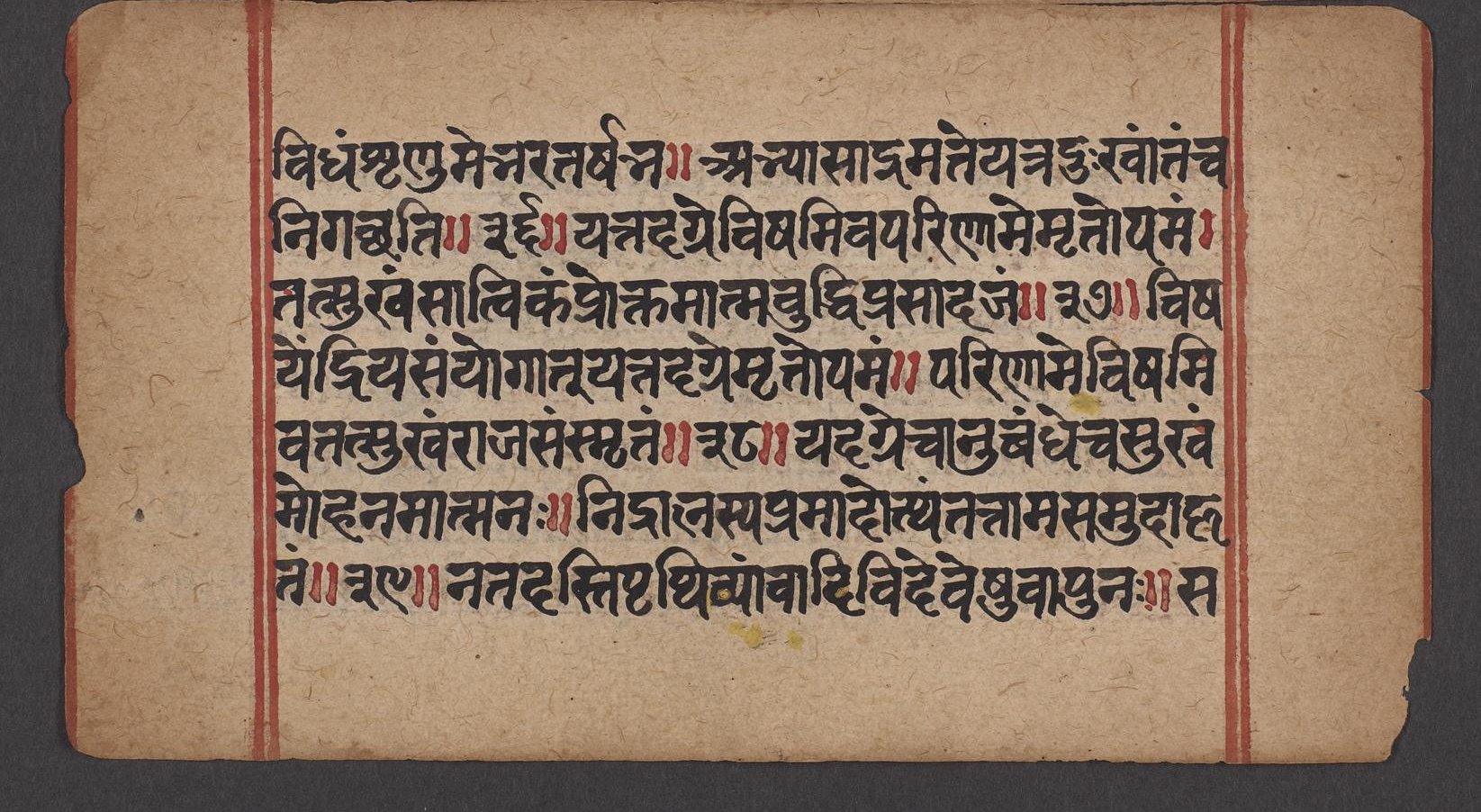
fol. 85r, OPenn image 6555_0084 (lower leaf). Checked on the image: ||36|| line 2 ... ||39|| line 7. Verse 18.36 begins on the previous page, fol. 84v, so both pages are shown.
36सुखं त्विदानीं त्रिविधं शृणु मे भरतर्षभ ।
अभ्यासाद्रमते यत्र दुःखान्तं च निगच्छति ॥ ३६ ॥
37यत्तदग्रे विषमिव परिणामेऽमृतोपमम् ।
तत्सुखं सात्त्विकं प्रोक्तमात्मबुद्धिप्रसादजम् ॥ ३७ ॥
38विषयेन्द्रियसंयोगाद्यत्तदग्रेऽमृतोपमम् ।
परिणामे विषमिव तत्सुखं राजसं स्मृतम् ॥ ३८ ॥
39यदग्रे चानुबन्धे च सुखं मोहनमात्मनः ।
निद्रालस्यप्रमादोत्थं तत्तामसमुदाहृतम् ॥ ३९ ॥
36And now the threefold kinds of pleasure hear thou from Me, O bull of the Bhâratas. That in which one by practice rejoiceth, and which putteth an end to pain;
37Which at first is as venom but in the end is as nectar; that pleasure is said to be pure, born of the blissful knowledge of the Self.
38That which from the union of the senses with their objects at first is as nectar, but in the end is like venom, that pleasure is accounted passionate.
39That pleasure which both at first and afterwards is delusive of the self, arising from sleep, indolence and heedlessness, that is declared dark.
Where on the image
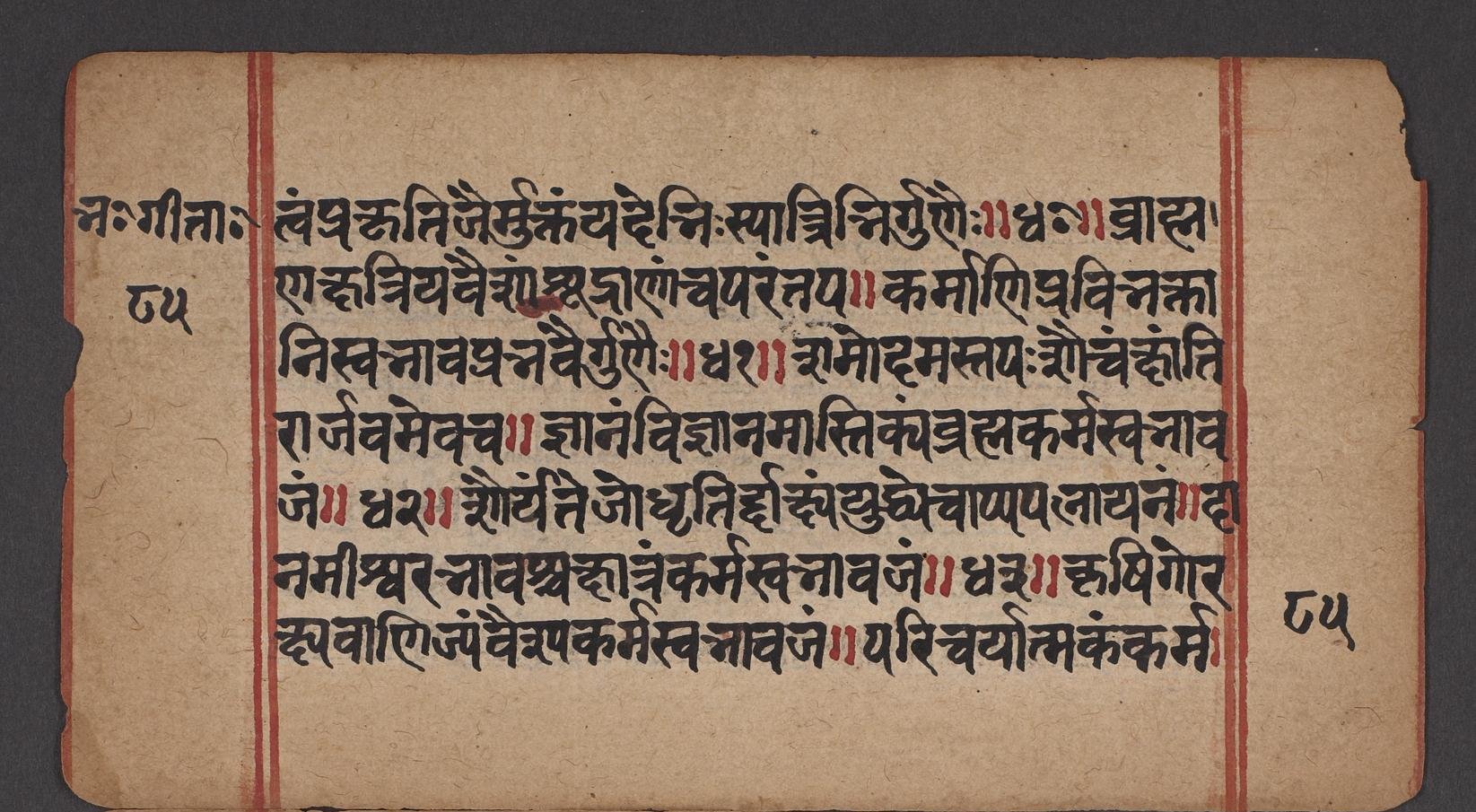
fol. 85v, OPenn image 6555_0085 (upper leaf). Checked on the image: ||40|| line 1 ... ||43|| line 6. Verse 18.40 begins on the previous page, fol. 85r, so both pages are shown.
40न तदस्ति पृथिव्यां वा दिवि देवेषु वा पुनः ।
सत्त्वं प्रकृतिजैर्मुक्तं यदेभिः स्यात्त्रिभिर्गुणैः ॥ ४० ॥
41ब्राह्मणक्षत्रियविशां शूद्राणां च परन्तप ।
कर्माणि प्रविभक्तानि स्वभावप्रभवैर्गुणैः ॥ ४१ ॥
42शमो दमस्तपः शौचं क्षान्तिरार्जवमेव च ।
ज्ञानं विज्ञानमास्तिक्यं ब्रह्मकर्म स्वभावजम् ॥ ४२ ॥
43शौर्यं तेजो धृतिर्दाक्ष्यं युद्धे चाप्यपलायनम् ।
दानमीश्वरभावश्च क्षात्रं कर्म स्वभावजम् ॥ ४३ ॥
40There is not an entity, either on the earth or again in heaven among the Shining Ones, that is liberated from these three qualities, born of Matter.
41Of Brâhmanas, Kshattriyas, Vaishyas and Shûdras, O Parantapa, the duties have been distributed, according to the qualities born of their own natures.
42Serenity, self-restraint, austerity, purity, forgiveness and also uprightness, wisdom, knowledge, belief in God, are the Brâhmana duty, born of his own nature.
43Prowess, splendour, firmness, dexterity, and also not flying from battle, generosity, the nature of a ruler, are the Kshattriya duty, born of his own nature.
Where on the image
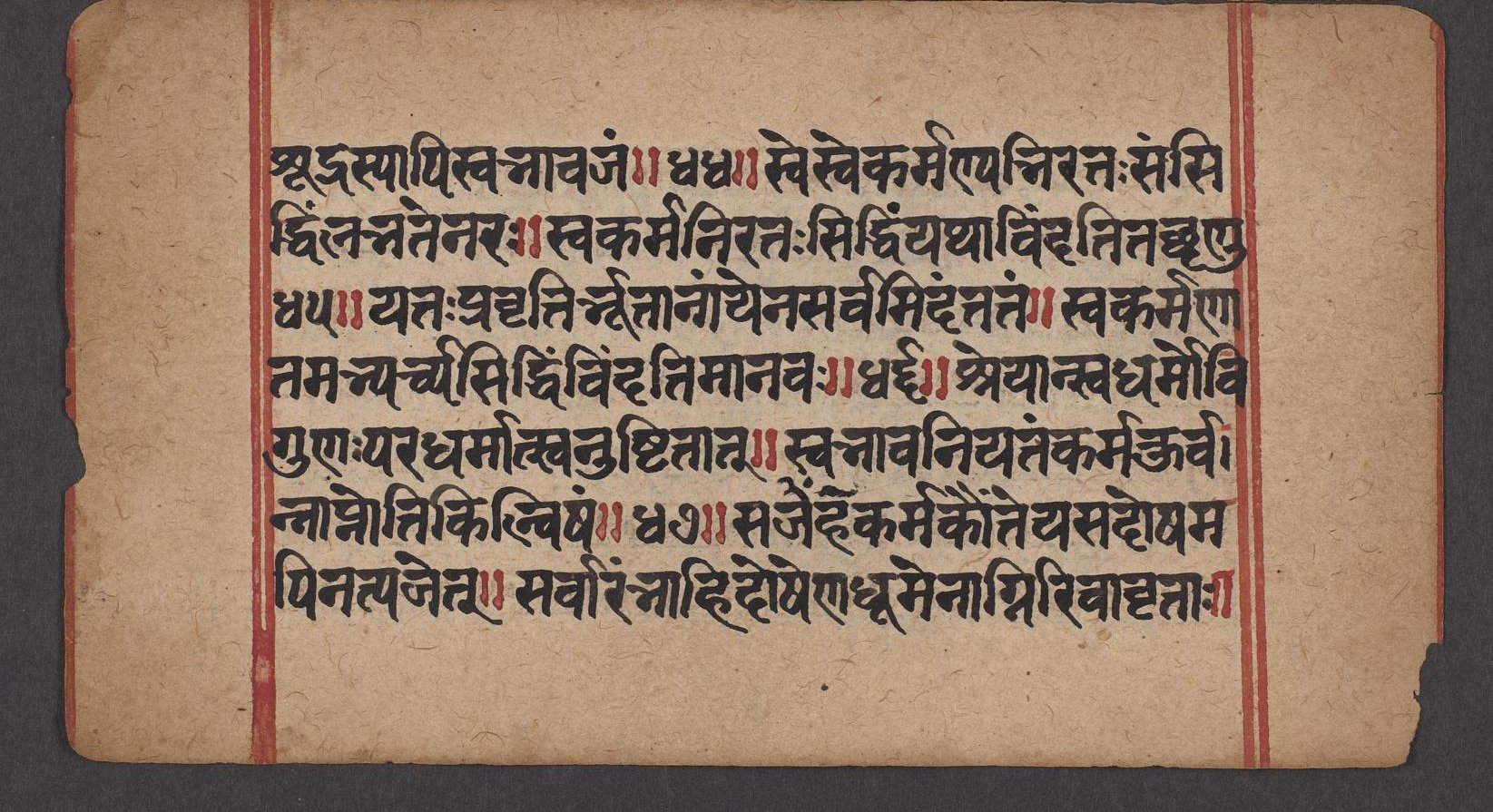
fol. 86r, OPenn image 6555_0085 (lower leaf). Checked on the image: ||44|| line 1 ... ||47|| line 6; 18.48 'sahajaṃ karma' text ends at the end of line 7; its number 48 stands at the start of 86v. Verse 18.44 begins on the previous page, fol. 85v, so both pages are shown.
44कृषिगौरक्ष्यवाणिज्यं वैश्यकर्म स्वभावजम् ।
परिचर्यात्मकं कर्म शूद्रस्यापि स्वभावजम् ॥ ४४ ॥
45स्वे स्वे कर्मण्यभिरतः संसिद्धिं लभते नरः ।
स्वकर्मनिरतः सिद्धिं यथा विन्दति तच्छृणु ॥ ४५ ॥
46यतः प्रवृत्तिर्भूतानां येन सर्वमिदं ततम् ।
स्वकर्मणा तमभ्यर्च्य सिद्धिं विन्दति मानवः ॥ ४६ ॥
47श्रेयान् स्वधर्मो विगुणः परधर्मात्स्वनुष्ठितात् ।
स्वभावनियतं कर्म कुर्वन्नाप्नोति किल्बिषम् ॥ ४७ ॥
48सहजं कर्म कौन्तेय सदोषमपि न त्यजेत् ।
सर्वारम्भा हि दोषेण धूमेनाग्निरिवावृताः ॥ ४८ ॥
44Ploughing, protection of kine, and trade are the Vaishya duty, born of his own nature. Action of the nature of service is the Shûdra duty, born of his own nature.
45Man reacheth perfection by each being intent on his own duty. Listen thou how perfection is won by him who is intent on his own duty.
46He from whom is the emanation of beings, by Whom all This is pervaded, by worshipping Him in his own duty a man winneth perfection.
47Better is one's own duty though destitute of merits than the well-executed duty of another. He who doeth the duty laid down by his own nature incurreth not sin.
48Congenital duty, O son of Kunti, though defective, ought not to be abandoned. All undertakings indeed are clouded by defects as fire by smoke.
Where on the image
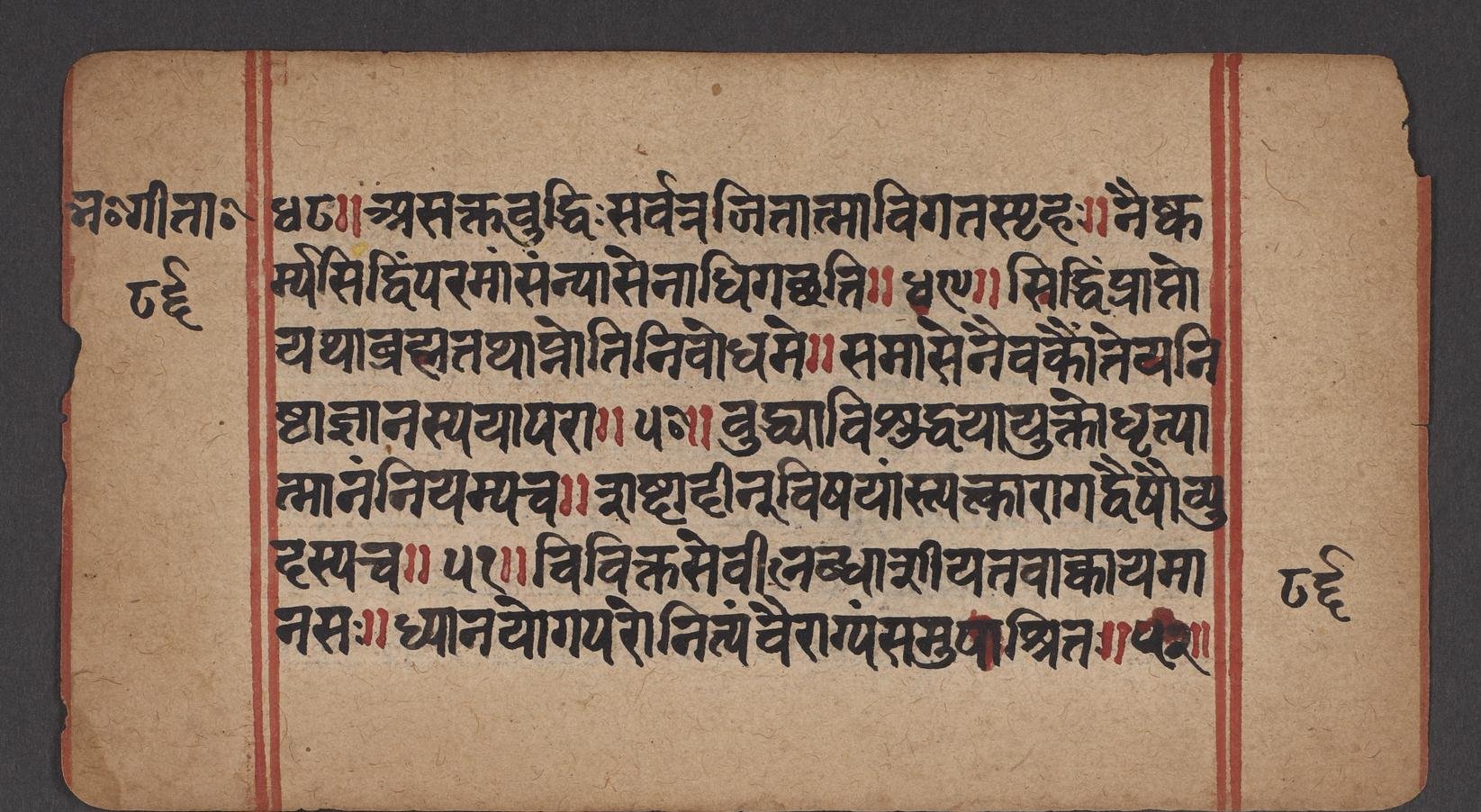
fol. 86v, OPenn image 6555_0086 (upper leaf). Checked on the image: '48||' at start of line 1; ||49|| line 2 ... ||52|| end of line 7.
49असक्तबुद्धिः सर्वत्र जितात्मा विगतस्पृहः ।
नैष्कर्म्यसिद्धिं परमां संन्यासेनाधिगच्छति ॥ ४९ ॥
50सिद्धिं प्राप्तो यथा ब्रह्म तथाऽऽप्नोति निबोध मे ।
समासेनैव कौन्तेय निष्ठा ज्ञानस्य या परा ॥ ५० ॥
51बुद्ध्या विशुद्धया युक्तो धृत्याऽऽत्मानं नियस्य च ।
शब्दादीन्विषयांस्त्यक्त्वा रागद्वेषौ व्युदस्य च ॥ ५१ ॥
52विविक्तसेवी लघ्वाशी यतवाक्कायमानसः ।
ध्यानयोगपरो नित्यं वैराग्यं समुपाश्रितः ॥ ५२ ॥
49He whose Reason is everywhere unattached, the self-subdued, dead to desires, he goeth by renunciation to the supreme perfection of freedom from obligation.
50How he who hath attained perfection obtaineth the Eternal, that highest state of wisdom, learn thou from Me only succinctly, O Kaunteya.
51United to this Reason, purified, controlling the self by firmness, having abandoned sound and the other objects of the senses, having laid aside passion and malice,
52Dwelling in solitude, abstemious, speech, body and mind subdued, constantly fixed in meditation and yoga, taking refuge in dispassion,
Where on the image
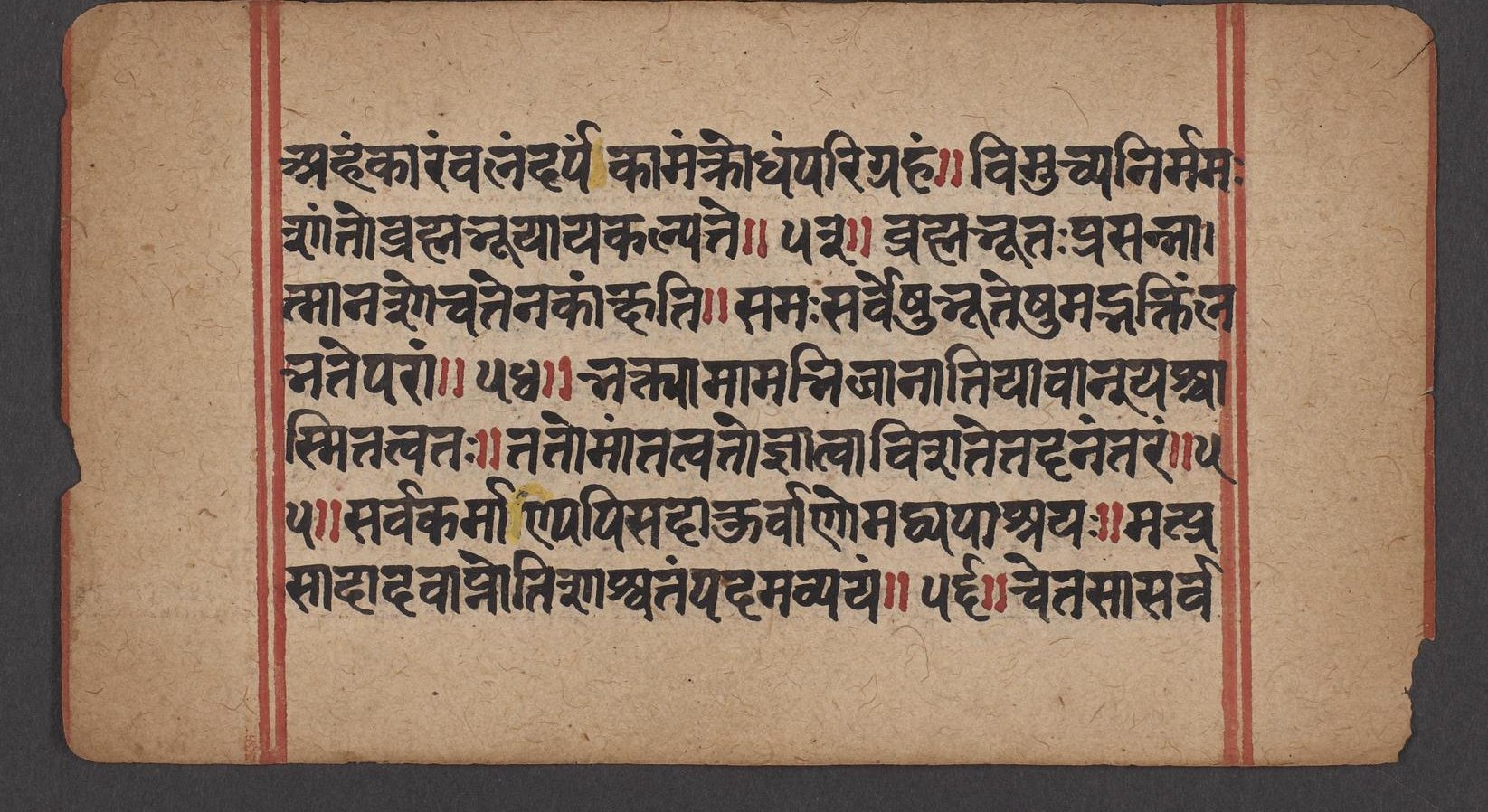
fol. 87r, OPenn image 6555_0086 (lower leaf). Checked on the image: ||53|| line 2 ... ||56|| line 7.
53अहङ्कारं बलं दर्पं कामं क्रोधं परिग्रहम् ।
विमुच्य निर्ममः शान्तो ब्रह्मभूयाय कल्पते ॥ ५३ ॥
54ब्रह्मभूतः प्रसन्नात्मा न शोचति न काङ्क्षति ।
समः सर्वेषु भूतेषु मद्भक्तिं लभते पराम् ॥ ५४ ॥
55भक्त्या मामभिजानाति यावान्यश्चास्मि तत्त्वतः ।
ततो मां तत्त्वतो ज्ञात्वा विशते तदनन्तरम् ॥ ५५ ॥
56सर्वकर्माण्यपि सदा कुर्वाणो मद्व्यपाश्रयः ।
मत्प्रसादादवाप्नोति शाश्वतं पदमव्ययम् ॥ ५६ ॥
53Having cast aside egoism, violence, arrogance, desire, wrath, covetousness, selfless and peaceful—he is fit to become the Eternal.
54Becoming the Eternal, serene in the Self, he neither grieveth nor desireth; the same to all beings, he obtaineth supreme devotion unto Me.
55By devotion he knoweth Me in essence, who and what I am; having thus known Me in essence he forthwith entereth into the Supreme.
56Though ever performing all actions, taking refuge in Me, by My grace he obtaineth the eternal indestructible abode.
Where on the image
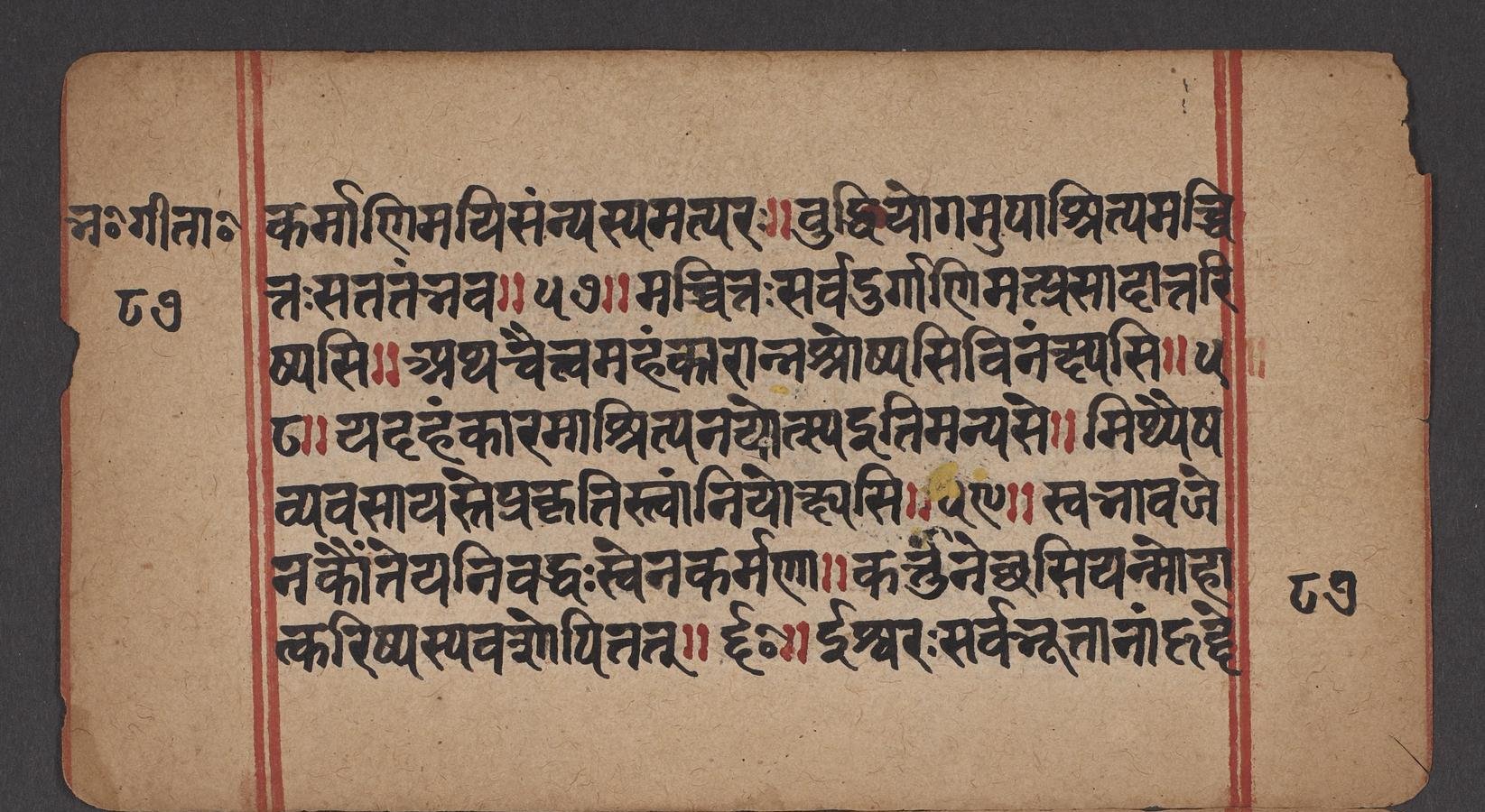
fol. 87v, OPenn image 6555_0087 (upper leaf). Checked on the image: ||57|| line 2 ... ||60|| line 7. Verse 18.57 begins on the previous page, fol. 87r, so both pages are shown.
57चेतसा सर्वकर्माणि मयि संन्यस्य मत्परः ।
बुद्धियोगमुपाश्रित्य मच्चित्तः सततं भव ॥ ५७ ॥
58मच्चित्तः सर्वदुर्गाणि मत्प्रसादात्तरिष्यसि ।
अथ चेत्त्वमहङ्कारान्न श्रोष्यसि विनङ्क्ष्यसि ॥ ५८ ॥
59यदहङ्कारमाश्रित्य न योत्स्य इति मन्यसे ।
मिथ्यैष व्यवसायस्ते प्रकृतिस्त्वां नियोक्ष्यति ॥ ५९ ॥
60स्वभावजेन कौन्तेय निबद्धः स्वेन कर्मणा ।
कर्तुं नेच्छसि यन्मोहात्करिष्यस्यवशोऽपि तत् ॥ ६० ॥
57Renouncing mentally all works in Me, intent on Me, resorting to the yoga of discrimination, have thy thought ever on Me.
58Thinking on Me, thou shalt overcome all obstacles by My grace: but if from egoism thou wilt not listen, thou shalt be destroyed utterly.
59Entrenched in egoism, thou thinkest, "I will not fight;" to no purpose thy determination; nature will constrain thee.
60O son of Kuntî, bound by thine own duty born of thine own nature, that which from delusion thou desirest not to do, even that helplessly thou shalt perform.
Where on the image
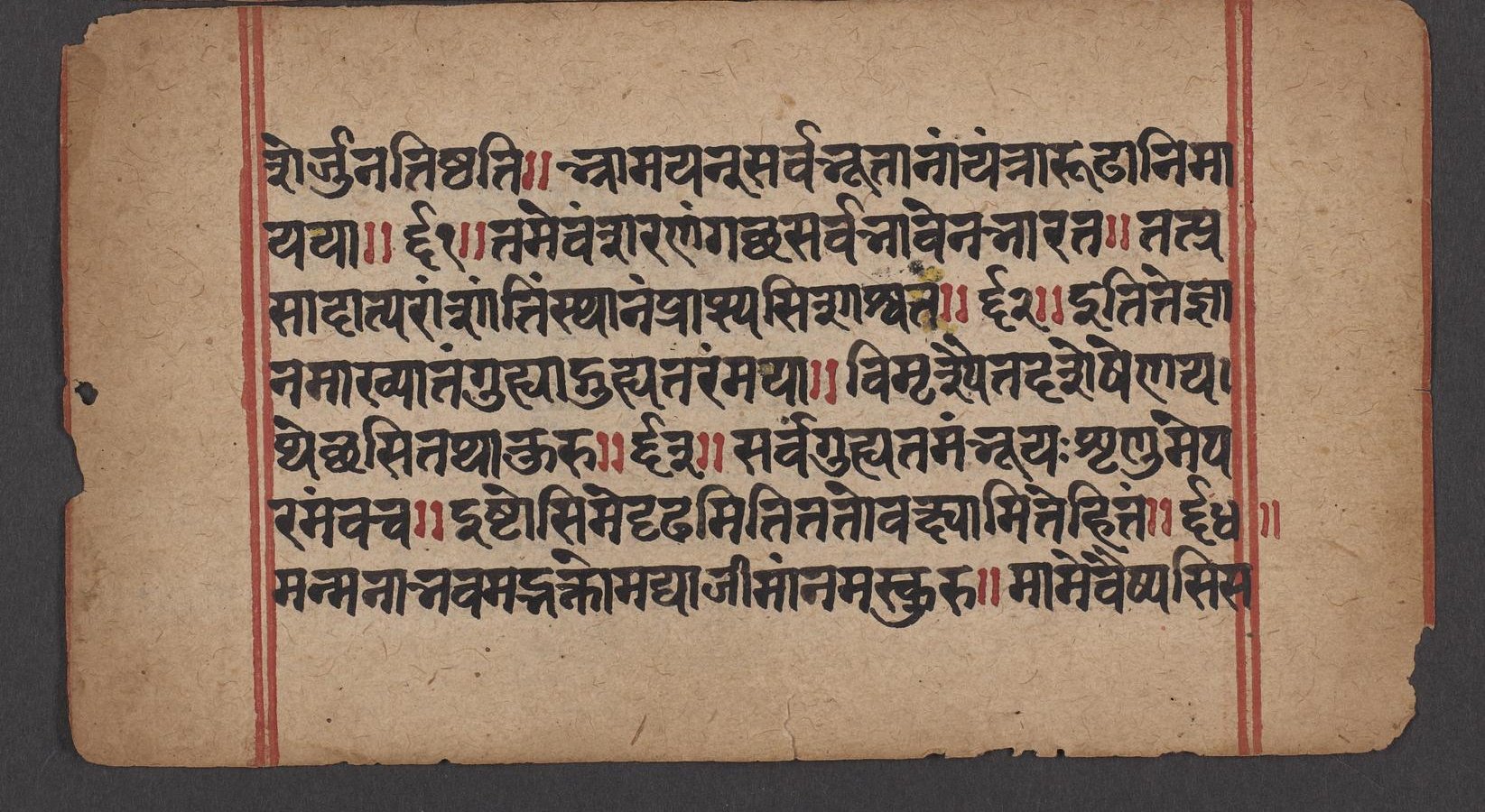
fol. 88r, OPenn image 6555_0087 (lower leaf). Checked on the image: ||61|| line 2 ... ||64|| line 6. Verse 18.61 begins on the previous page, fol. 87v, so both pages are shown.
61ईश्वरः सर्वभूतानां हृद्देशेऽर्जुन तिष्ठति ।
भ्रामयन्सर्वभूतानि यन्त्रारूढानि मायया ॥ ६१ ॥
62तमेव शरणं गच्छ सर्वभावेन भारत ।
तत्प्रसादात्परां शान्तिं स्थानं प्राप्स्यसि शाश्वतम् ॥ ६२ ॥
63इति ते ज्ञानमाख्यातं गुह्याद्गुह्यतरं मया ।
विमृश्यैतदशेषेण यथेच्छसि तथा कुरु ॥ ६३ ॥
64सर्वगुह्यतमं भूयः शृणु मे परमं वचः ।
इष्टोऽसि मे दृढमिति ततो वक्ष्यामि ते हितम् ॥ ६४ ॥
61The Lord dwelleth in the hearts of all beings, O Arjuna, by His illusive Power causing all beings to revolve, as though mounted on a potter's wheel.
62Flee unto Him for shelter with all thy being, O Bhârata; by His grace thou shalt obtain supreme peace, the everlasting dwelling-place.
63Thus hath wisdom, more secret than secrecy itself, been declared unto thee by Me; having reflected on it fully, then act thou as thou listest.
64Listen thou again to My supreme word, most secret of all; beloved art thou of Me, and steadfast of heart, therefore will I speak for thy benefit.
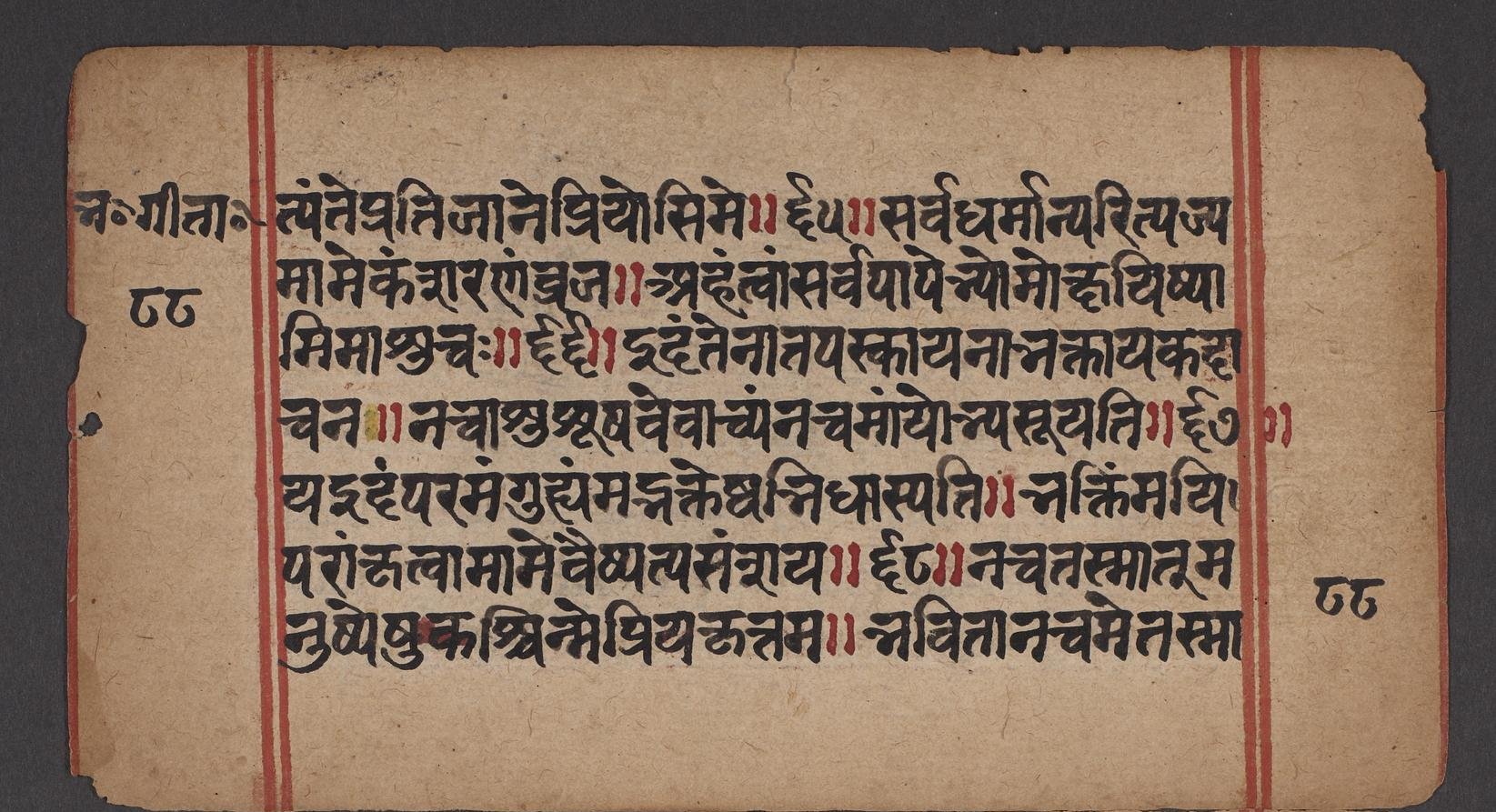
Where on the image
fol. 88v, OPenn image 6555_0088 (upper leaf). Checked on the image: ||65|| line 1 ... ||68|| line 6. Verse 18.65 begins on the previous page, fol. 88r, so both pages are shown.
65मन्मना भव मद्भक्तो मद्याजी मां नमस्कुरु ।
मामेवैष्यसि सत्यं ते प्रतिजाने प्रियोऽसि मे ॥ ६५ ॥
66सर्वधर्मान्परित्यज्य मामेकं शरणं व्रज ।
अहं त्वां सर्वपापेभ्यो मोक्षयिष्यामि मा शुचः ॥ ६६ ॥
67इदं ते नातपस्काय नाभक्ताय कदाचन ।
न चाशुश्रूषवे वाच्यं न च मां योऽभ्यसूयति ॥ ६७ ॥
68य इदं परमं गुह्यं मद्भक्तेष्वभिधास्यति ।
भक्तिं मयि परां कृत्वा मामेवैष्यत्यसंशयम् ॥ ६८ ॥
65Merge thy mind in Me, be my devotee, sacrifice to Me, prostrate thyself before Me, thou shalt come even to Me. I pledge thee My troth; thou art dear to Me.
66Abandoning all duties come unto Me alone for shelter; sorrow not, I will liberate thee from all sins.
67Never is this to be spoken by thee to anyone who is without asceticism, nor without devotion, nor to one who desireth not to listen, nor yet to him who speaketh evil of Me.
68He who shall declare this supreme secret among My devotees, having shown the highest devotion for Me, without doubt he shall come to Me.
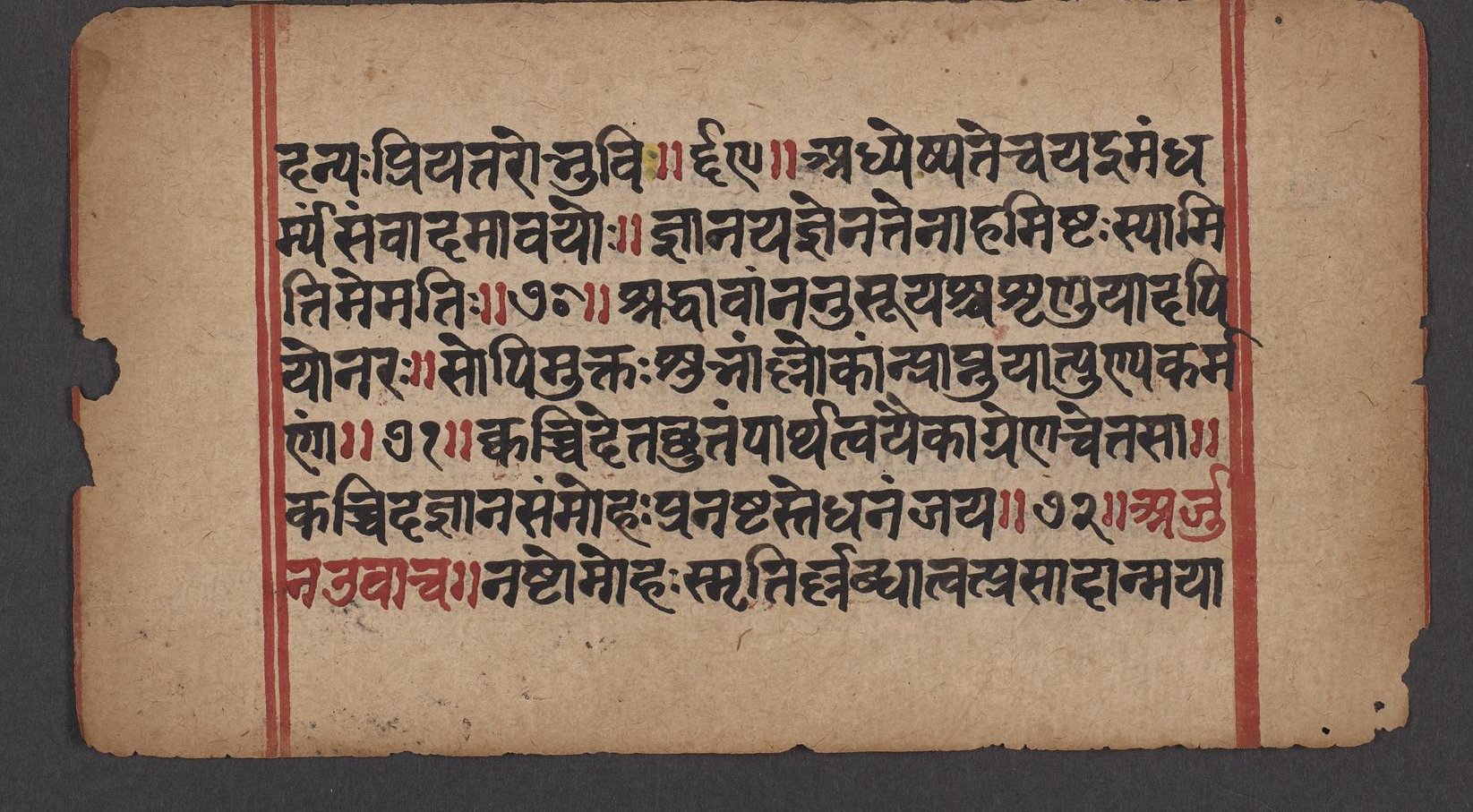
Where on the image
fol. 89r, OPenn image 6555_0088 (lower leaf). Checked on the image: ||69|| line 1 ... ||72|| line 6; arjuna uvāca line 6-7, 18.73 begins line 7. Verse 18.69 begins on the previous page, fol. 88v, so both pages are shown.
69न च तस्मान्मनुष्येषु कश्चिन्मे प्रियकृत्तमः ।
भविता न च मे तस्मादन्यः प्रियतरो भुवि ॥ ६९ ॥
70अध्येष्यते च य इमं धर्म्यं संवादमावयोः ।
ज्ञानयज्ञेन तेनाहमिष्टः स्यामिति मे मतिः ॥ ७० ॥
71श्रद्धावाननसूयश्च शृणुयादपि यो नरः ।
सोऽपि मुक्तः शुभांल्लोकान्प्राप्नुयात्पुण्यकर्मणाम् ॥ ७१ ॥
72कच्चिदेतच्छ्रुतं पार्थ त्वयैकाग्रेण चेतसा ।
कच्चिदज्ञानसम्मोहः प्रणष्टस्ते धनञ्जय ॥ ७२ ॥
69Nor is there any among men who performeth dearer service to Me than he, nor any other shall be more beloved by Me on earth than he.
70And he who shall study this sacred dialogue of ours, by him I shall be worshipped with the sacrifice of wisdom. Such is My mind.
71The man also who, full of faith, merely heareth it unreviling, even he, freed from evil, obtaineth the radiant worlds of the righteous.
72Hath this been heard, O son of Prithâ, with one-pointed mind? Has thy delusion, caused by unwisdom, been destroyed, O Dhananjaya?
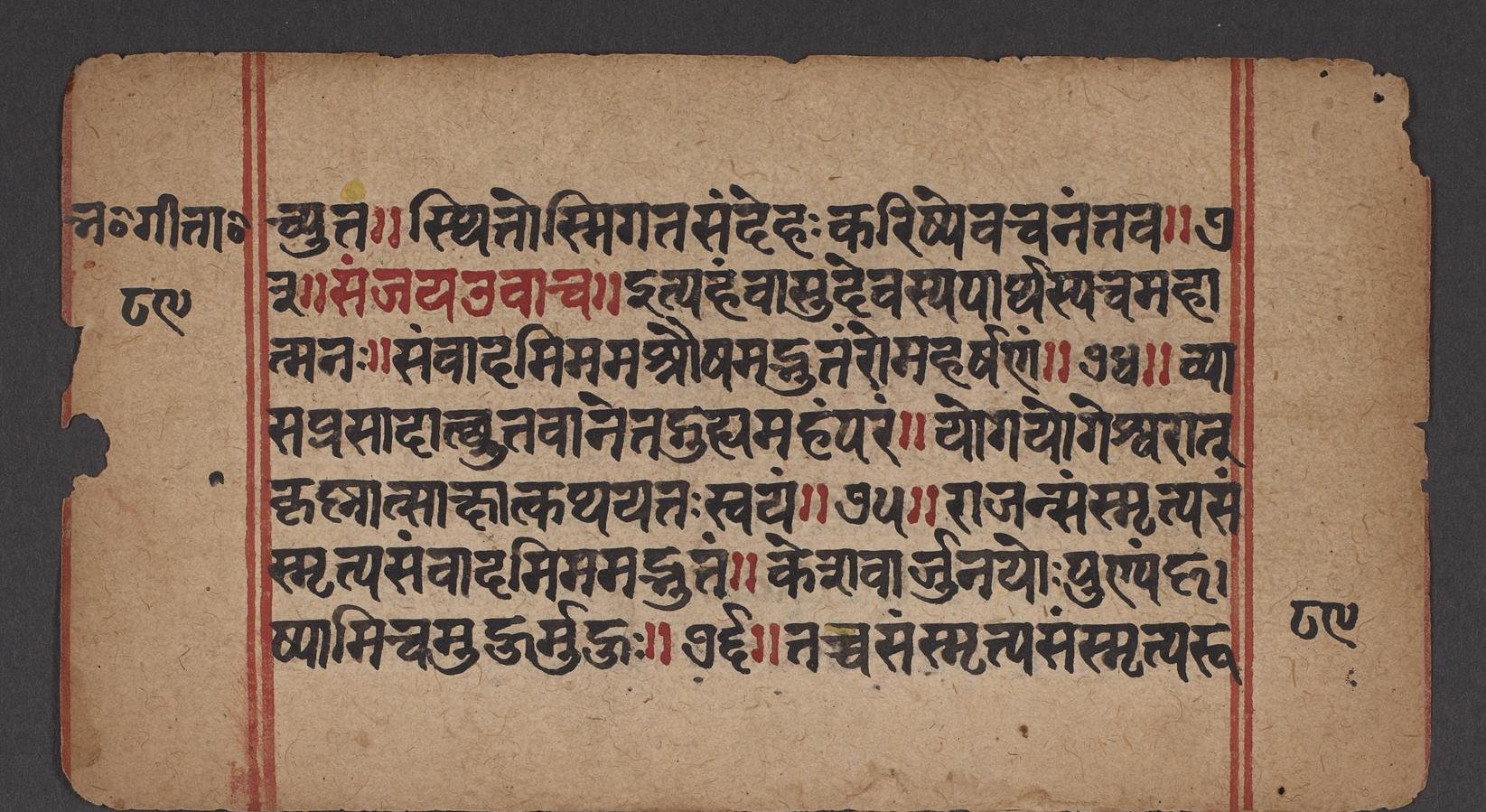
Where on the image
fol. 89v, OPenn image 6555_0089 (upper leaf). Checked on the image: ||73|| line 1 ... ||76|| line 7. Verse 18.73 begins on the previous page, fol. 89r, so both pages are shown.
73अर्जुन उवाच ।
नष्टो मोहः स्मूतिर्लब्धा त्वत्प्रसादान्मयाऽच्युत ।
स्थितोऽस्मि गतसन्देहः करिष्ये वचनं तव ॥ ७३ ॥
74सञ्जय उवाच ।
इत्यहं वासुदेवस्य पार्थस्य च महात्मनः ।
संवादमिममश्रौषमद्भुतं रोमहर्षणम् ॥ ७४ ॥
75व्यासप्रसादाच्छ्रुतवानेतद् गुह्यमहं परम् ।
योगं योगेश्वरात्कृष्णात्साक्षात्कथयतः स्वयम् ॥ ७५ ॥
76राजन्संस्मृत्य संस्मृत्य संवादमिममद्भुतम् ।
केशवार्जुनयोः पुण्यं हृष्यामि च मुहुर्मुहुः ॥ ७६ ॥
73Arjuna said:
Destroyed is my delusion. I have gained knowledge through Thy grace, O Immutable one. I am firm, my doubts have fled away. I will do according to Thy word.
74Sanjaya said:
I heard this marvellous dialogue of Vâsudeva, and of the great-souled Partha, causing my hair to stand on end.
75By the favour of Vyâsa I listened to this secret and supreme yoga from the Lord of Yoga, Krishna Himself, speaking before mine eyes.
76O King, remembering, remembering this marvellous and holy dialogue between Keshava and Arjuna, I rejoice again and again.
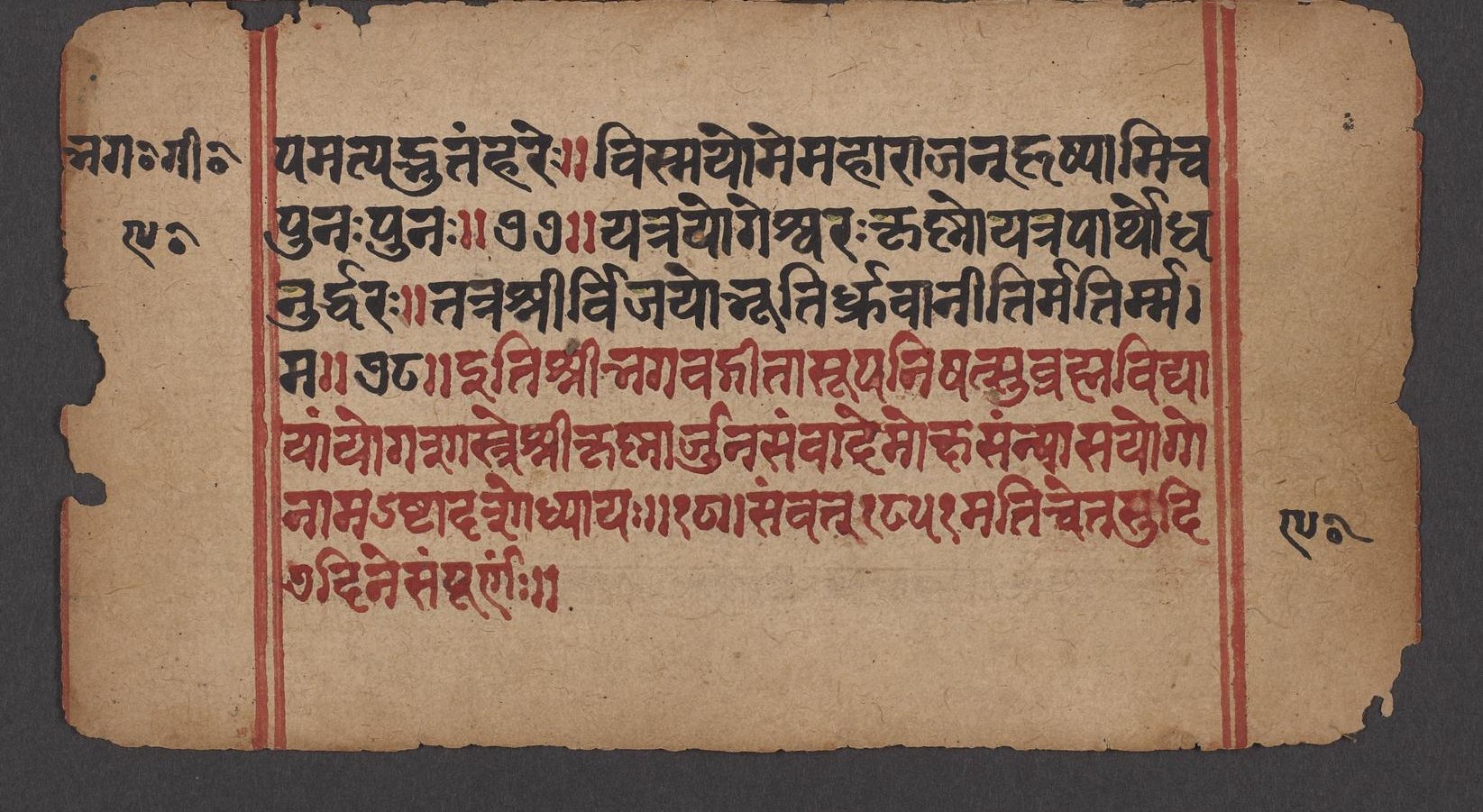
Where on the image
fol. 90r, OPenn image 6555_0089 (lower leaf). Checked on the image: ||77|| line 2, ||78|| line 4; colophon lines 4-7 '... mokṣasaṃnyāsayogo nāma aṣṭādaśo 'dhyāyaḥ ||18|| saṃvat 1851 ... caitra sudi 3 dine saṃpūrṇaṃ ||'. Verse 18.77 begins on the previous page, fol. 89v, so both pages are shown.
77तच्च संस्मृत्य संस्मृत्य रूपमत्यद्भुतं हरेः ।
विस्मयो मे महान् राजन् हृष्यामि च पुनः पुनः ॥ ७७ ॥
78यत्र योगेश्वरः कृष्णो यत्र पार्थो धनुर्धरः ।
तत्र श्रीर्विजयो भूतिर्ध्रुवा नीतिर्मतिर्मम ॥ ७८ ॥
77Remembering, remembering, also that most marvellous form of Hari, great is my wonder, O King. I rejoice, again and again.
78Wherever is Krishna, Yoga's Lord, wherever is Pârtha, the archer, assured are there prosperity, victory and happiness. So I think.
Where on the image
fol. 90r: ||77|| line 2, ||78|| line 4; colophon lines 4-7 '... mokṣasaṃnyāsayogo nāma aṣṭādaśo 'dhyāyaḥ ||18|| saṃvat 1851 ... caitra sudi 3 dine saṃpūrṇaṃ ||'. The manuscript names the chapter mokṣasaṃnyāsayoga; the Sanskrit and English shown are the colophon printed in Besant's edition, whose wording differs in places from the manuscript's.
इति श्रीमद्भगवद्गीतासूपनिषत्सु ब्रह्मविद्यायां योगशास्त्रे
श्रीकृष्णार्जुनसंवादे संन्यासयोगो नामाष्टादशोऽध्यायः ॥१८॥
Thus in the glorious Upanishads of the Bhagavad-Gita, the science of the Eternal, the scripture of Yoga, the dialogue between Shrî Krishna and Arjuna, the eighteenth discourse, entitled: THE YOGA OF LIBERATION BY RENUNCIATION.
Notes
- Sanskrit and English: Annie Besant, The Bhagavad-Gita, 4th edition (Madras: G. A. Natesan, 1922), transcription validated on English Wikisource. Besant's footnotes are not reproduced.
- Verse numbers follow Besant and the manuscript, which agree throughout: chapter 13 counts Arjuna's opening question ('prakṛtiṃ puruṣaṃ caiva...') as verse 1, so it has 35 verses and the whole text 701.
- K. T. Telang's translation (Sacred Books of the East 8, 1882) was the first choice for the English, but it is continuous prose without verse divisions, so it cannot be matched to manuscript pages verse by verse; Besant's verse-numbered translation is used instead.
- The last section of each chapter is the chapter colophon. Besant prints most Sanskrit colophons in shortened form (marked with ॰) while her English gives the full formula; the manuscript writes the colophon out in full, and its chapter names differ in places from Besant's (see the scan note).
- In the Wikisource transcription of Besant's edition, the verse-number label is irregular at 18.14 (printed or transcribed as '(15)'). The verses are counted in sequence and checked against the Sanskrit numbers, which are regular.
Cite
Sources
- Source: Penn Ms. Coll. 390 Item 559 (dated 1794) via OPenn + Sanskrit and English of Annie Besant, The Bhagavad-Gita (4th ed. 1922), Wikisource (holding institution)
- Critical edition: Annie Besant, The Bhagavad-Gita, 4th ed. (1922), Sanskrit text, via Wikisource
← previous · → next · v cycle view · l back to library