Black Obelisk of Shalmaneser III: the five epigraphs (Jehu's tribute), BM 118885
Introduction
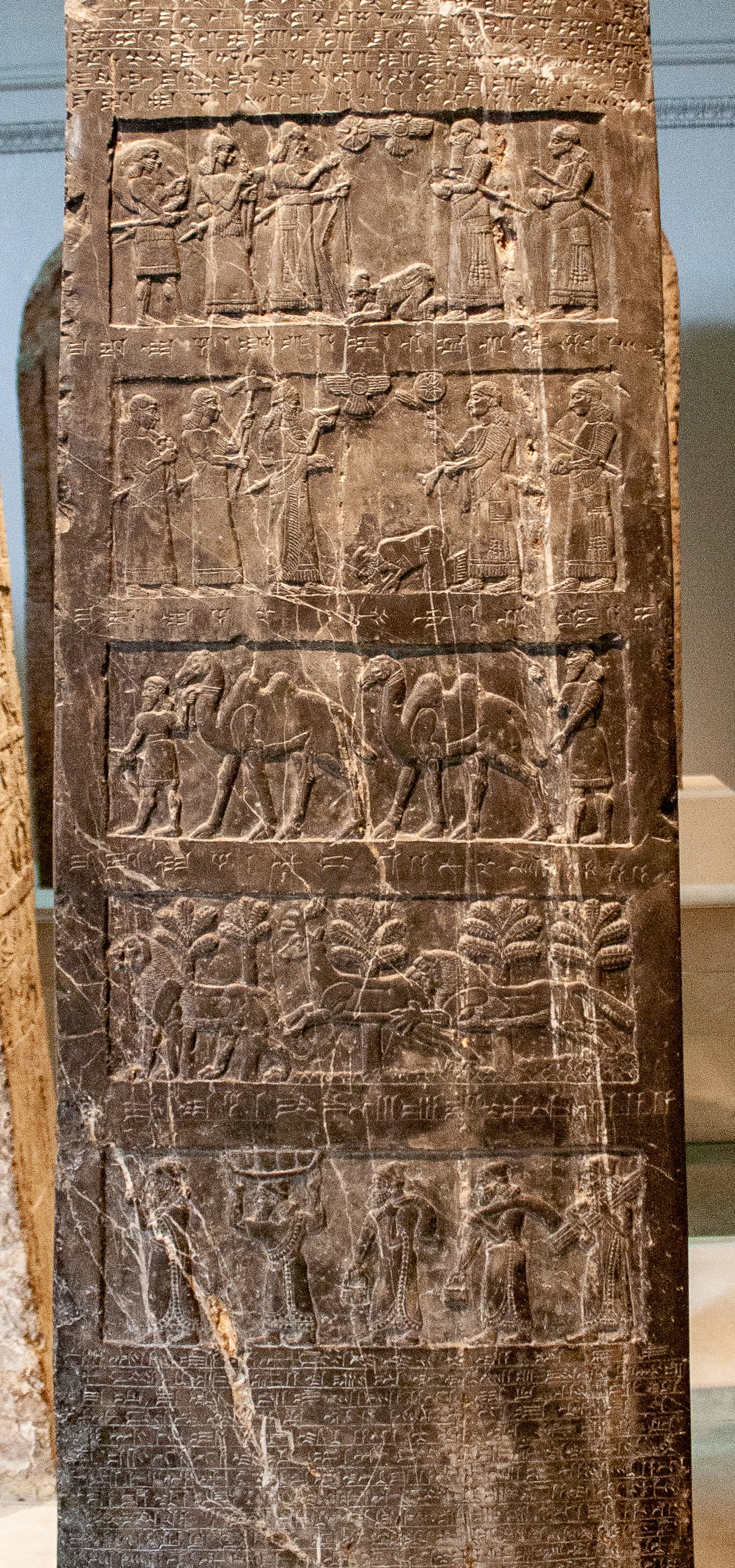
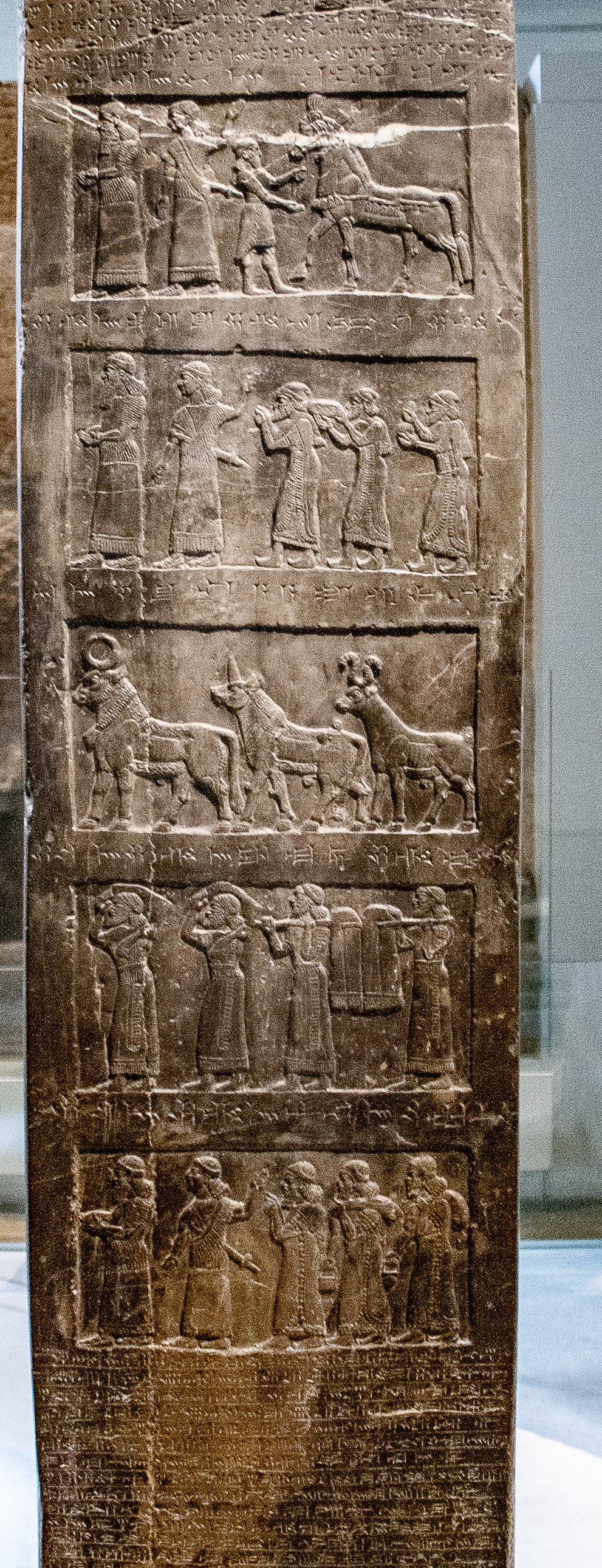
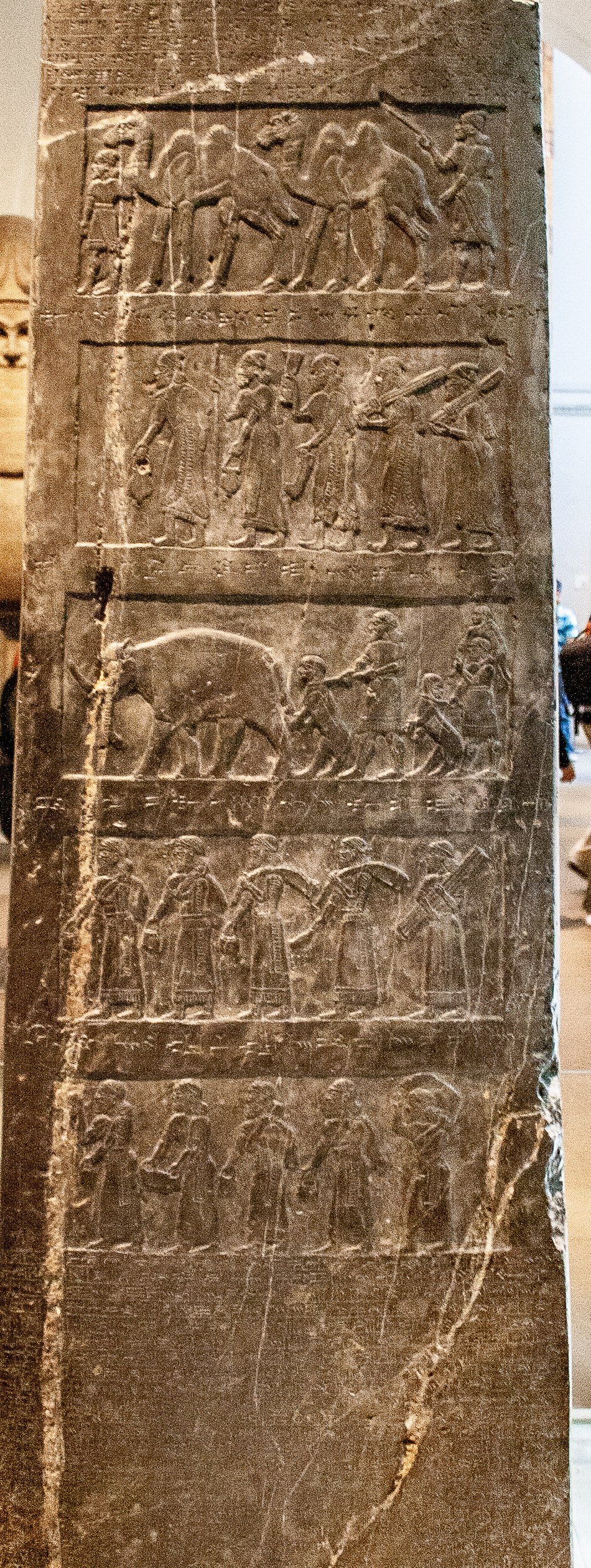
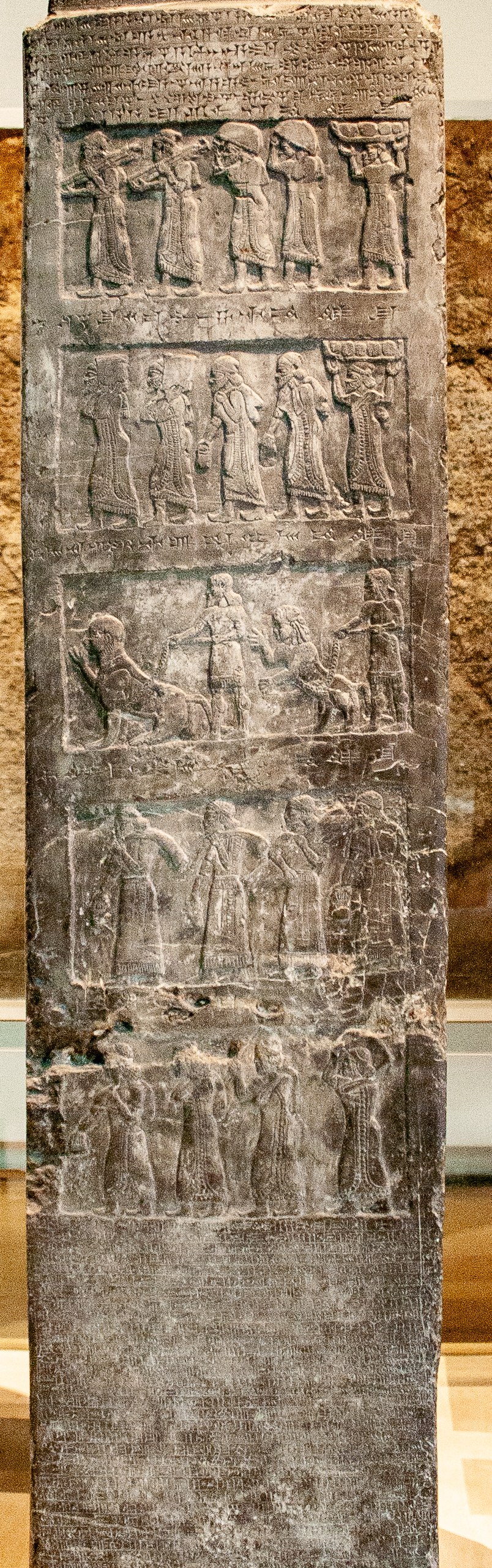
The Black Obelisk of Shalmaneser III, king of Assyria (858-824 BCE), is a four-sided pillar of black limestone about two metres high with a stepped top, set up at Nimrud (ancient Kalhu) about 825 BCE and found there by Austen Henry Layard in 1846. It is in the British Museum (BM 118885). Five registers of reliefs run round its four sides, each showing the tribute of one land; above each register a single line of cuneiform, an epigraph, names the ruler and lists what he brought. A long annals text of 190 lines, recording the king's campaigns year by year, is written above and below the reliefs.
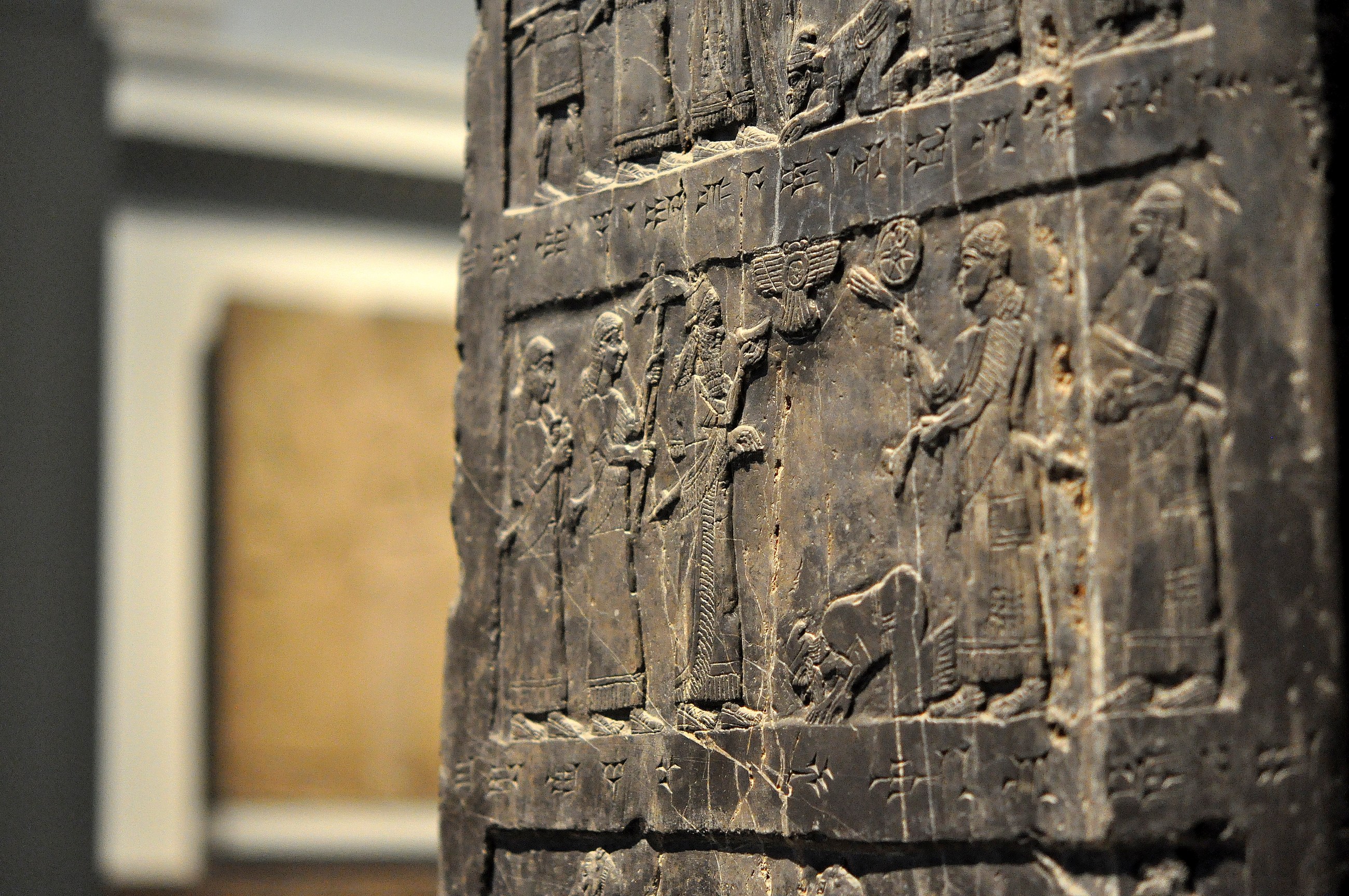
The second epigraph records the tribute of 'Jehu (Iāūa) of Bīt-Ḫumrî', that is Jehu, king of Israel (2 Kings 9-10), described as 'son of Omri' because the Assyrians called Israel 'the house of Omri'; the relief beneath it on side A shows him, or his envoy, prostrate before the Assyrian king. It is often cited as the only known ancient picture of an Israelite king.
This entry gives the five epigraphs in the Akkadian transliteration and English of ORACC (based on A. K. Grayson, RIMA 3, 1996), each with photographs of the four faces. The annals text is not included: no openly available edition divides its 190 lines by face, so its lines cannot yet be matched to the photographs.
How was this verified? (Provenance)
Where on the image
Epigraph 1 (Sua of Gilzanu) is the single line of signs directly above register 1 (counting from the top), which shows a ruler prostrate before the king, and tribute bearers with horses. The line runs round the obelisk above the four panels of the register, so all four face photographs (sides A-D) are given; on each, register 1 is the first framed relief from the top and the epigraph is the band of signs immediately above its frame. Above register 1 the epigraph is the lowest line of the inscribed zone over the reliefs; the lines above it belong to the annals text, which is not given here.
1ma-da-tu šá msu-ú-a KUR.gíl-za-na-a-a KÙ.BABBAR.MEŠ KÙ.GI.MEŠ AN.NA.MEŠ ÚTUL.MEŠ ZABAR GIŠ.ḫu-ṭar-a-te.MEŠ šá ŠU LUGAL ANŠE.KUR.RA.MEŠ ANŠE.A.AB.BA.MEŠ šá šu-na-a-a ṣe-ri-ši-na am-ḫur-šu
1I received the payment of Sūʾa of the land Gilzānu: silver, gold, tin, bronze casseroles, the staffs of the king’s hand, horses, (and) two-humped camels.
Where on the image
Epigraph 2 (Jehu of Israel) is the single line of signs directly above register 2 (counting from the top), which shows the king under a parasol with a ruler prostrate at his feet (side A), and the Israelite tribute bearers. The line runs round the obelisk above the four panels of the register, so all four face photographs (sides A-D) are given; on each, register 2 is the second framed relief from the top and the epigraph is the band of signs immediately above its frame. The first image is a close view of side A, register 2 (Jehu prostrate before Shalmaneser III), with the epigraph line above the panel continuing round the corner onto the next face.
1ma-da-tu šá mia-ú-a DUMU mḫu-um-ri-i KÙ.BABBAR.MEŠ KÙ.GI.MEŠ sap-lu KÙ.GI zu-qu-ut KÙ.GI qa-bu-a-te.MEŠ KÙ.GI da-la-ni.MEŠ KÙ.GI AN.NA.MEŠ GIŠ.ḫu-ṭar-tú šá ŠU MAN GIŠ.pu-aš-ḫa-ti am-ḫur-šu
1I received the payment of Jehu (Iāūa) of (Bīt)-Ḫumrî (Israel; lit. “son of Omri”): silver, gold, a gold bowl, a gold tureen, gold vessels, gold pails, tin, the staffs of the king’s hand, (and) spears.
Where on the image
Epigraph 3 (Musri) is the single line of signs directly above register 3 (counting from the top), which shows two-humped camels and other animals. The line runs round the obelisk above the four panels of the register, so all four face photographs (sides A-D) are given; on each, register 3 is the third framed relief from the top and the epigraph is the band of signs immediately above its frame.
1ma-da-tu šá KUR.mu-uṣ-ri ANŠE.A.AB.BA.MEŠ šá šu-na-a-a ṣe-ri-ši-na al-ap ÍD sa-de-e-ia su-ú-su pi-ra-a-ti.MEŠ ba-gi*-a-ti ú-qup-pu*.MEŠ am-ḫur-šu
1I received the payment of Egypt: two-humped camels, a water buffalo (lit. “a river ox”), a rhinoceros, an antelope, female elephants, female monkeys, (and) apes.
Where on the image
Epigraph 4 (Marduk-apla-usur of Suhu) is the single line of signs directly above register 4 (counting from the top), which shows lions and a stag among trees (side A), and tribute bearers. The line runs round the obelisk above the four panels of the register, so all four face photographs (sides A-D) are given; on each, register 4 is the fourth framed relief from the top and the epigraph is the band of signs immediately above its frame.
1ma-da-tu šá mdAMAR.UTU-A-PAP KUR.su-ḫa-a-a KÙ.BABBAR.MEŠ KÙ.GI.MEŠ da-la-ni KÙ.GI ZÚ.MEŠ AM.SI GIŠ.pu-aš-ḫa-a-ti.MEŠ bu-ú-ṣi* TÚG.lu-bul-ti bir-me u GADA.MEŠ am-ḫur-šu
1I received the payment Marduk-apla-uṣur of the land Sūḫu: silver, gold, gold pails, ivory, spears, byssus, garments with multi-colored trim, and linen (garments).
Where on the image
Epigraph 5 (Qalparunda of Patina) is the single line of signs directly above register 5 (counting from the top), which shows tribute bearers. The line runs round the obelisk above the four panels of the register, so all four face photographs (sides A-D) are given; on each, register 5 is the fifth framed relief from the top and the epigraph is the band of signs immediately above its frame.
1ma-da-tu šá mqar-pa-ru-un-da KUR.pa-ti-na-a-a KÙ.BABBAR.MEŠ KÙ.GI.MEŠ AN.NA.MEŠ ZABAR ar-ḫu ÚTUL.MEŠ ZABAR ZÚ.MEŠ AM.SI.MEŠ GIŠ.ESI.MEŠ am-ḫur-šu
1I received the payment of Qalparunda of the land Pattinu: silver, gold, tin, bronze compound (lit. “fast bronze”), bronze casseroles, ivory, (and) ebony.
Notes
- ORACC renders the epithet of Jehu, literally 'son of Omri', as '(Bīt)-Ḫumrî (Israel; lit. "son of Omri")'.
- The transliteration follows ORACC: Sumerian word-signs in capitals; determinatives are raised (m before a man's name), and KUR (land) and GIŠ (wood) are written before the word with a full stop.
Cite
Sources
- Source: British Museum BM 118885, photographs on Wikimedia Commons (CC BY-SA 4.0) + ORACC RIAo text and translation (CC BY-SA 3.0) (holding institution)
- Critical edition: A. K. Grayson, RIMA 3 (1996), A.0.102.87-91, via ORACC RIAo
← previous · → next · v cycle view · l back to library