Cicero, The Dream of Scipio (De re publica 6.9-29)
Introduction
Cicero wrote the six books of On the Republic in 54-51 BCE. Most of the work was lost in the Middle Ages, but its ending, the Dream of Scipio (Somnium Scipionis), survived complete because the Latin writer Macrobius (early 5th century) wrote a long commentary on it, and copyists placed Cicero's text before the commentary. In the dream, Scipio Aemilianus is taken up by his grandfather Scipio Africanus to a high place among the stars. He is told that those who serve their country have a place prepared in heaven, that the bodies of men are a prison, and that souls come from the eternal fires of the stars. He sees the nine spheres of the universe, hears the music they make, and looks back at an earth so small that Rome's empire seems a point. Africanus tells him that fame among men is brief, and that the true self is the spirit: 'Know, then, that you are a god, if a god is that which lives, feels, remembers, and foresees, and which rules, governs, and moves the body over which it is set, just as the supreme God above us rules this universe' (deum te igitur scito esse, 6.26). The closing argument for the immortality of the self-moving soul (6.27-28) is taken from Plato's Phaedrus.
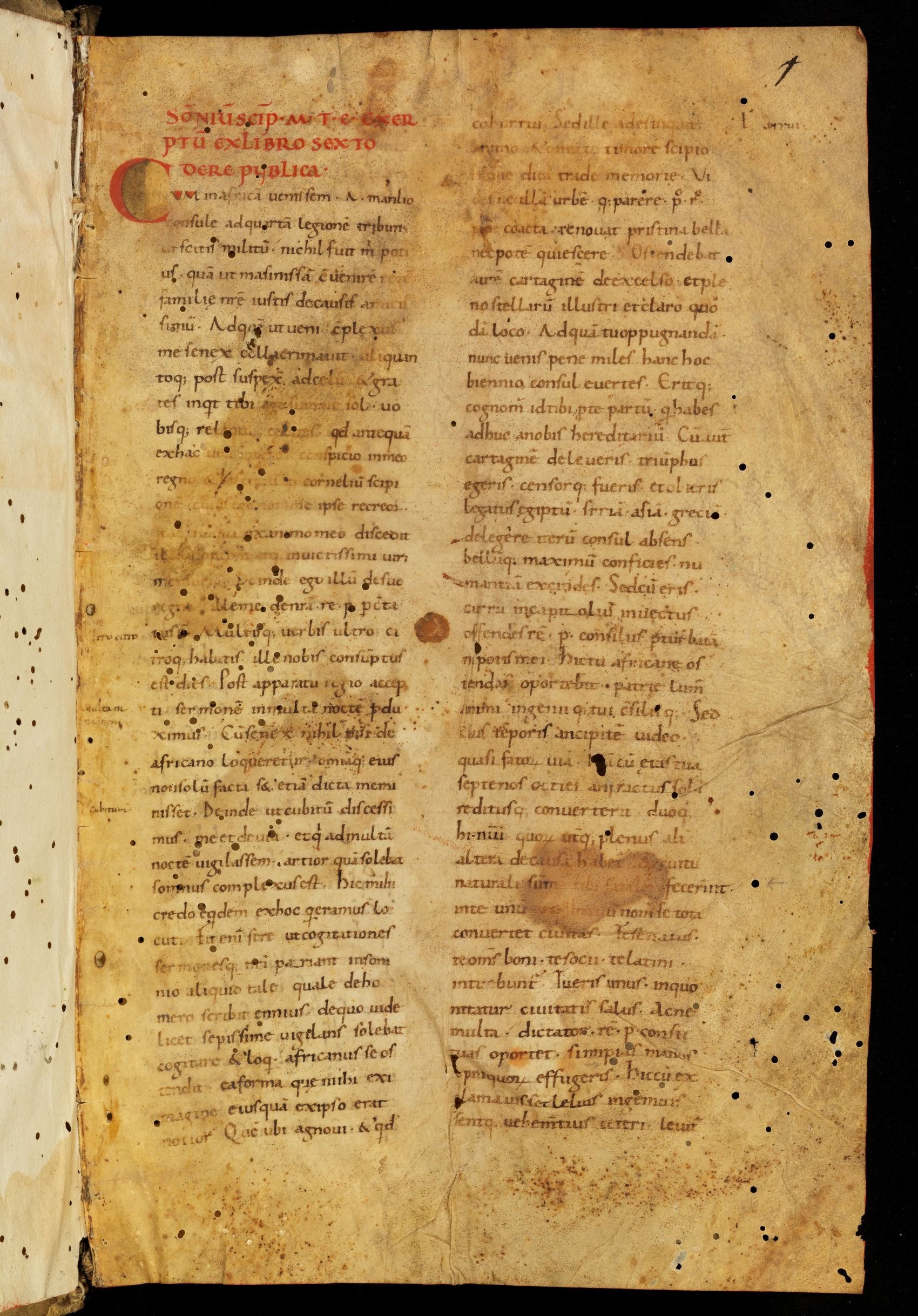
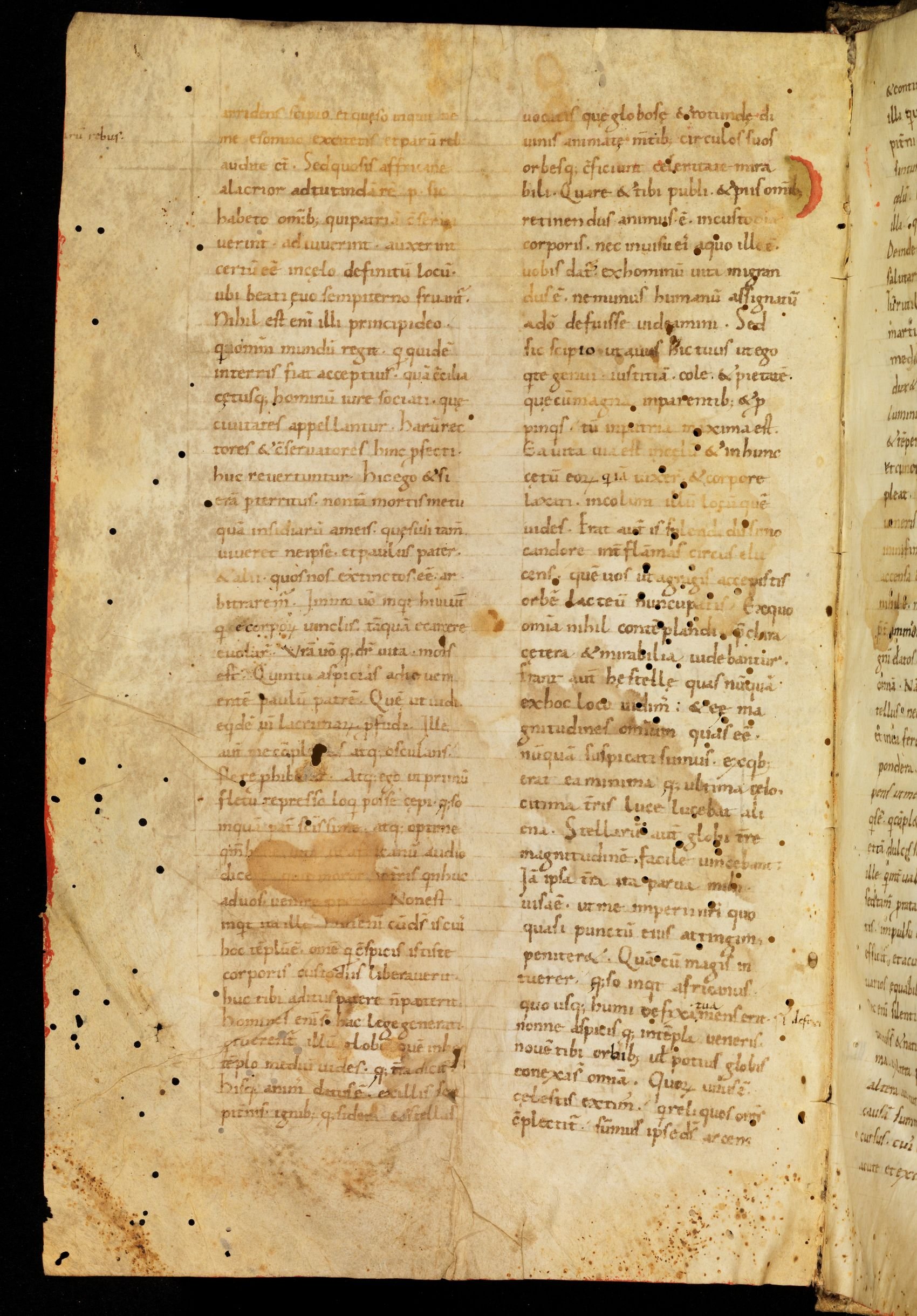
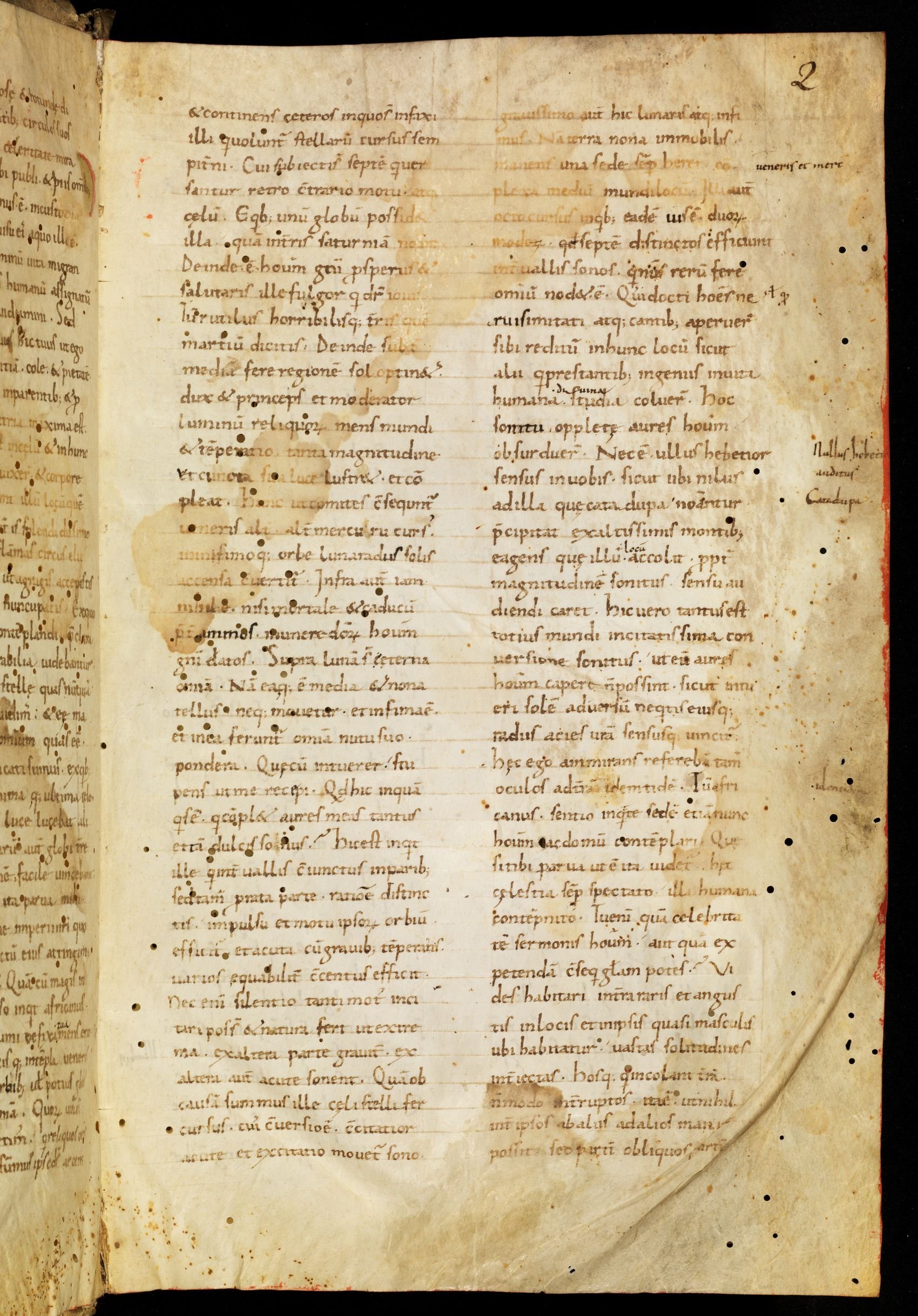
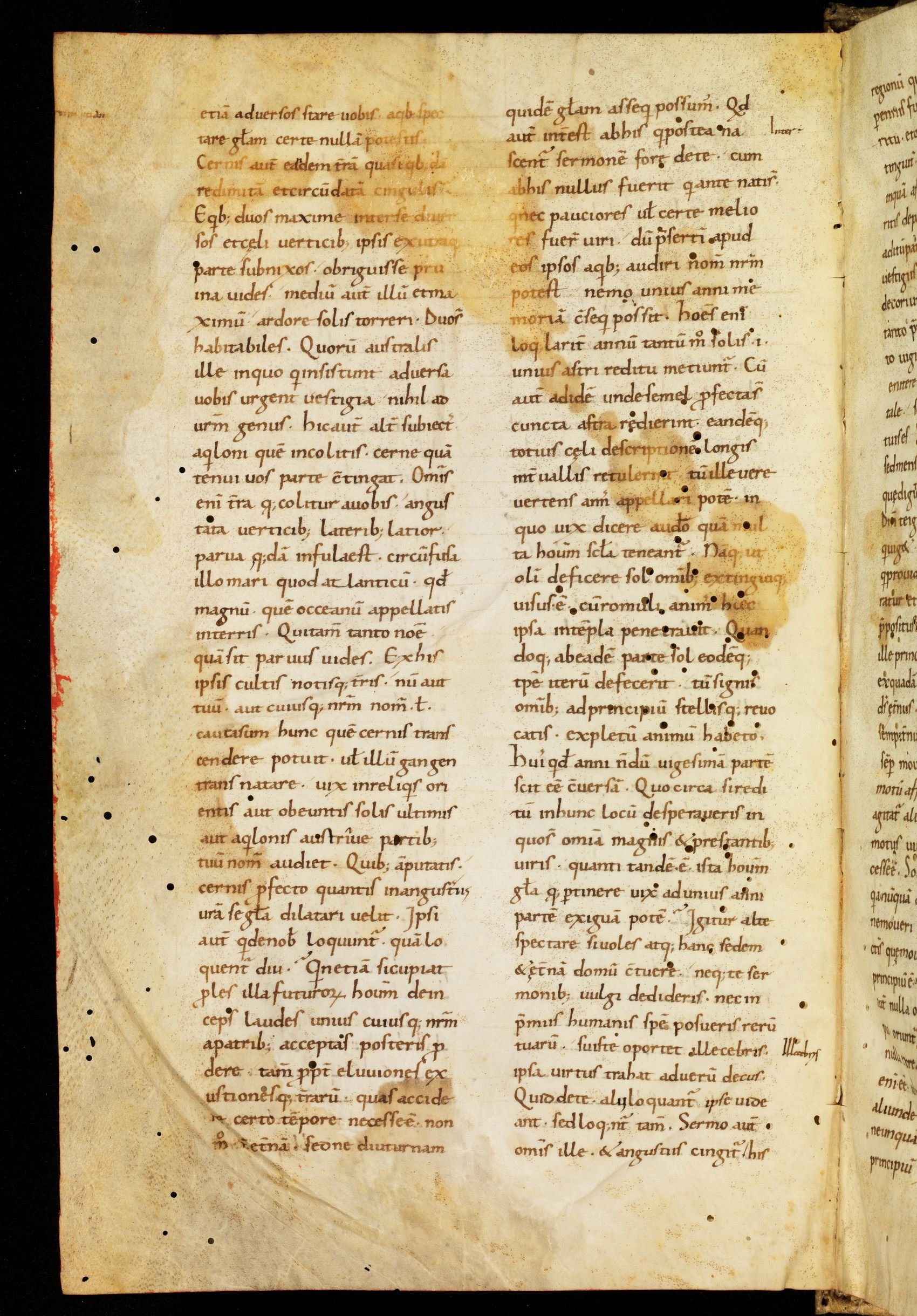
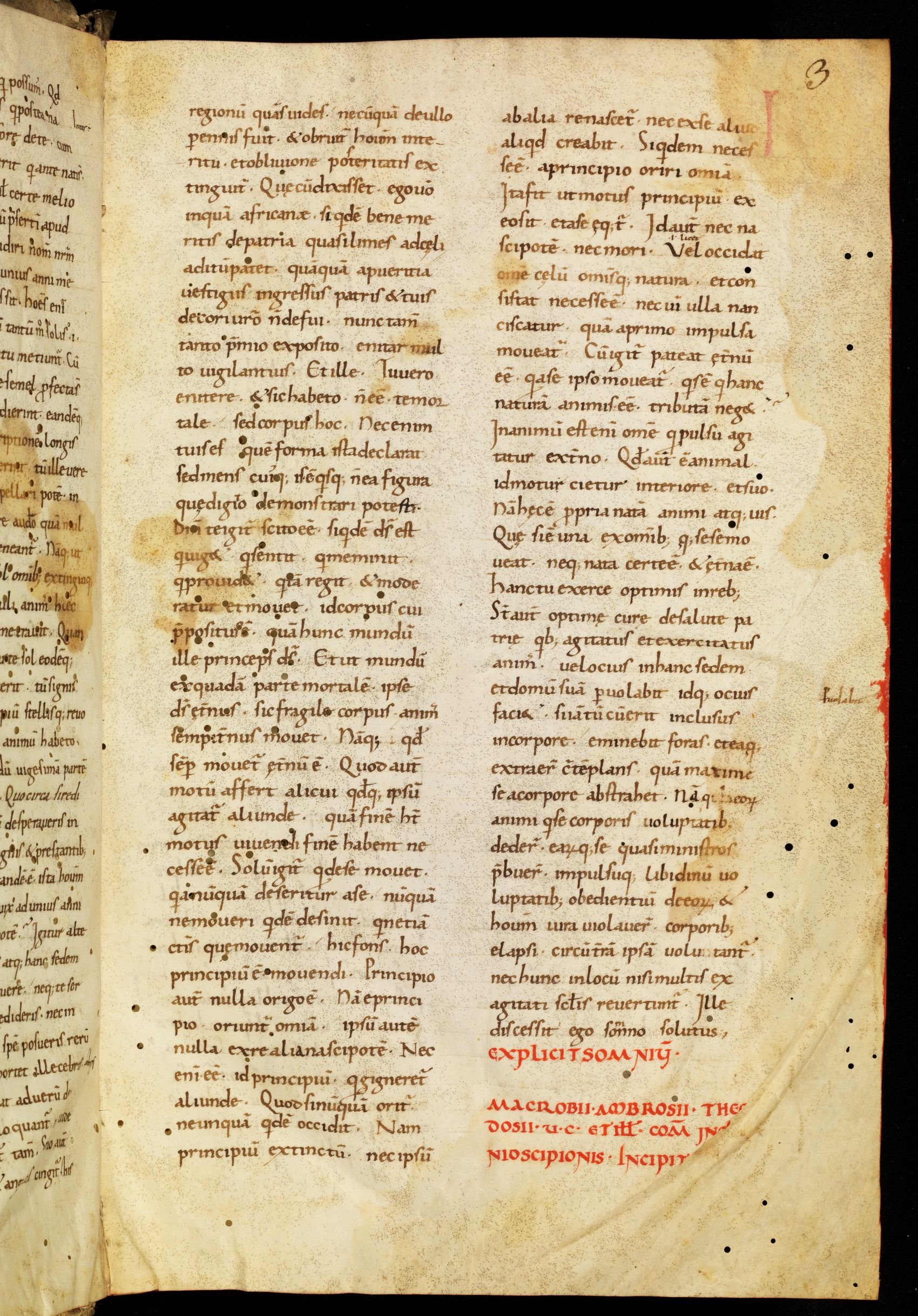
The pages shown are from Bamberg, Staatsbibliothek, Msc.Class.38, written in Italy at the end of the 10th century. The Somnium stands at the head of the book as a text of its own, under the red title 'Somnium Scipionis M. T. C., excerpt from the sixth book on the Republic', and fills five pages in two columns, from fol. 1r to fol. 3r; it ends with a red 'Explicit somnium', and Macrobius' commentary begins in the same column. Each section below is one numbered section of the text (6.9 to 6.29). The page or pages listed for it were identified by reading the first and last lines of every column on the images. The Latin is Mueller's critical edition (1889), not a transcription of this manuscript, so its spelling and a few words differ from what the copyist wrote (for example, the manuscript has 'et quaeso' for Mueller's 'St! quaeso' at 6.12). The English is C. W. Keyes's Loeb translation of 1928. The text is complete.
How was this verified? (Provenance)
Where on the image
On Bamberg Msc.Class.38 fol. 1r col. a. Checked on the images: fol. 1r column a runs from 'Cum in Africam venissem ... Manlio (below the red title)' on its first line (6.9) to 'notior. Quem ubi agnovi, et quidem' on its last line (6.10). The red title above column a reads 'Somnium Scip(ionis) M. T. C. excerptum ex libro sexto de re publica'; the manuscript writes the consul's name 'Manlio' (Mueller 'Manilio'). The Latin shown is Mueller's critical text; the copyist's spelling and some words differ from it. Viewer: https://www.digitale-sammlungen.de/en/view/bsb00140750?page=5
9Cum in Africam venissem M’. Manilio consuli ad quartam legionem tribunus, ut scitis, militum, nihil mihi fuit potius, quam ut Masinissam convenirem regem, familiae nostrae iustis de causis amicissimum. Ad quem ut veni, conplexus me senex conlacrimavit aliquantoque post suspexit ad caelum et: Grates, inquit, tibi ago, summe Sol, vobisque, reliqui Caelites, quod, ante quam ex hac vita migro, conspicio in meo regno et his tectis P. Cornelium Scipionem, cuius ego nomine ipso recreor; itaque numquam ex animo meo discedit illius optimi atque invictissimi viri memoria. Deinde ego illum de suo regno, ille me de nostra re publica percontatus est, multisque verbis ultro citroque habitis ille nobis consumptus est dies.
9Scipio. I was military tribune in the Fourth Legion in Africa under the consul Manius Manilius, as you know. When I arrived in that country my greatest desire was to meet King Masinissa, who for excellent reasons was a very close friend of my family. When I came into his presence the aged man embraced me and wept copiously; after a short interval, turning his eyes up to heaven, he uttered these words: “I thank thee, O supreme Sun, and ye other heavenly beings, that, before I depart this life, I see within my kingdom and under my roof Publius Cornelius Scipio, by the mere sound of whose name I am refreshed; so little has the memory of that noble and invincible hero faded from my memory!” Then I questioned him about his kingdom, while he inquired of me about our commonwealth, and we spent the whole day in an extended discussion of both.
Where on the image
On Bamberg Msc.Class.38 fol. 1r col. a; fol. 1r col. b. Checked on the images: fol. 1r column a runs from 'Cum in Africam venissem ... Manlio (below the red title)' on its first line (6.9) to 'notior. Quem ubi agnovi, et quidem' on its last line (6.10); fol. 1r column b runs from 'cohorrui. Sed ille: Ades, inquit, animo' on its first line (6.10) to '(ingemui)ssentque vehementius ceteri, leniter' on its last line (6.12). The Latin shown is Mueller's critical text; the copyist's spelling and some words differ from it. Viewer: https://www.digitale-sammlungen.de/en/view/bsb00140750?page=5
10Post autem apparatu regio accepti sermonem in multam noctem produximus, cum senex nihil nisi de Africano loqueretur omniaque eius non facta solum, sed etiam dicta meminisset. Deinde, ut cubitum discessimus, me et de via fessum, et qui ad multam noctem vigilassem, artior quam solebat somnus complexus est. Hic mihi (credo equidem ex hoc, quod eramus locuti; fit enim fere, ut cogitationes sermonesque nostri pariant aliquid in somno tale, quale de Homero scribit Ennius, de quo videlicet saepissime vigilans solebat cogitare et loqui) Africanus se ostendit ea forma, quae mihi ex imagine eius quam ex ipso erat notior; quem ubi agnovi, equidem cohorrui, sed ille: Ades, inquit, animo et omitte timorem, Scipio, et, quae dicam, trade memoriae.
10Later, after I had been entertained with royal hospitality, we continued our conversation far into the night, the aged king talking of nothing but Africanus, and recollecting all his sayings as well as his deeds. When we separated to take our rest, I fell immediately into a deeper sleep than usual, as I was weary from my journey and the hour was late. The following dream came to me, prompted, I suppose, by the subject of our conversation; for it often happens that our thoughts and words have some such effect in our sleep as Ennius describes with reference to Homer, about whom, of course, he frequently used to talk and think in his waking hours. I thought that Africanus stood before me, taking that shape which was familiar to me from his bust rather than from his person. Upon recognizing him I shuddered in terror, but he said: “Courage, Scipio, have no fear, but imprint my words upon your memory.
Where on the image
On Bamberg Msc.Class.38 fol. 1r col. b. Checked on the images: fol. 1r column b runs from 'cohorrui. Sed ille: Ades, inquit, animo' on its first line (6.10) to '(ingemui)ssentque vehementius ceteri, leniter' on its last line (6.12). The Latin shown is Mueller's critical text; the copyist's spelling and some words differ from it. Viewer: https://www.digitale-sammlungen.de/en/view/bsb00140750?page=5
11Videsne illam urbem, quae parere populo Romano coacta per me renovat pristina bella nec potest quiescere? (ostendebat autem Karthaginem de excelso et pleno stellarum illustri et claro quodam loco) ad quam tu oppugnandam nunc venis paene miles. Hanc hoc biennio consul evertes, eritque cognomen id tibi per te partum, quod habes adhuc a nobis hereditarium. Cum autem Karthaginem deleveris, triumphum egeris censorque fueris et obieris legatus Aegyptum, Syriam, Asiam, Graeciam, deligere iterum consul absens bellumque maximum conficies, Numantiam excindes. Sed cum eris curru in Capitolium invectus, offendes rem publicam consiliis perturbatam nepotis mei.
11“Do you see yonder city, which, though forced by me into obedience to the Roman people, is renewing its former conflicts and cannot be at rest” (and from a lofty place which was bathed in clear starlight, he pointed out Carthage), “that city to which you now come to lay siege, with a rank little above that of a common soldier? Within two years you as consul shall overthrow it, thus winning by your own efforts the surname which till now you have as an inheritance from me. But after destroying Carthage and celebrating your triumph, you shall hold the censorship; you shall go on missions to Egypt, Syria, Asia and Greece; you shall be chosen consul a second time in your absence; you shall bring a great war to a successful close; and you shall destroy Numantia. But, after driving in state to the Capitol, you shall find the commonwealth disturbed by the designs of my grandson.
Where on the image
Starts on fol. 1r and continues on fol. 1v (page break inside this section): fol. 1r col. b; fol. 1v col. a. Checked on the images: fol. 1r column b runs from 'cohorrui. Sed ille: Ades, inquit, animo' on its first line (6.10) to '(ingemui)ssentque vehementius ceteri, leniter' on its last line (6.12); fol. 1v column a runs from 'arridens Scipio et quaeso, inquit, ne' on its first line (6.12) to '(sem)piternis ignibus, quae sidera et stellas' on its last line (6.15). The manuscript reads 'et quaeso' where Mueller prints 'St! quaeso'. The Latin shown is Mueller's critical text; the copyist's spelling and some words differ from it. Viewer: https://www.digitale-sammlungen.de/en/view/bsb00140750?page=5, https://www.digitale-sammlungen.de/en/view/bsb00140750?page=6
12Hic tu, Africane, ostendas oportebit patriae lumen animi, ingenii consiliique tui. Sed eius temporis ancipitem video quasi fatorum viam. Nam cum aetas tua septenos octiens solis anfractus reditusque converterit, duoque ii numeri, quorum uterque plenus alter altera de causa habetur, circuitu naturali summam tibi fatalem confecerint, in te unum atque in tuum nomen se tota convertet civitas, te senatus, te omnes boni, te socii, te Latini intuebuntur, tu eris unus, in quo nitatur civitatis salus, ac, ne multa, dictator rem publicam constituas oportet, si impias propinquorum manus effugeris. Hic cum exclamasset Laelius ingemuissentque vehementius ceteri, leniter arridens Scipio: St! quaeso, inquit, ne me e somno excitetis, et parumper audite cetera.
12“Then, Africanus, it will be your duty to hold up before the fatherland the light of your character, your ability, and your wisdom. But at that time I see two paths of destiny, as it were, opening before you. For when your age has fulfilled seven times eight returning circuits of the sun, and those two numbers, each of which for a different reason is considered perfect, in Nature's revolving course have reached their destined sum in your life, then the whole State will turn to you and your name alone. The senate, all good citizens, the allies, the Latins, will look to you; you shall be the sole support of the State's security, and, in brief, it will be your duty as dictator to restore order in the commonwealth, if only you escape the wicked hands of your kinsmen.” Laelius cried aloud at this, and the rest groaned deeply, but Scipio said with a gentle smile: Quiet, please; do not wake me from my sleep; listen for a few moments, and hear what followed.
Where on the image
On Bamberg Msc.Class.38 fol. 1v col. a. Checked on the images: fol. 1v column a runs from 'arridens Scipio et quaeso, inquit, ne' on its first line (6.12) to '(sem)piternis ignibus, quae sidera et stellas' on its last line (6.15). The Latin shown is Mueller's critical text; the copyist's spelling and some words differ from it. Viewer: https://www.digitale-sammlungen.de/en/view/bsb00140750?page=6
13Sed quo sis, Africane, alacrior ad tutandam rem publicam, sic habeto: omnibus, qui patriam conservaverint, adiuverint, auxerint, certum esse in caelo definitum locum, ubi beati aevo sempiterno fruantur; nihil est enim illi principi deo, qui omnem mundum regit, quod quidem in terris fiat, acceptius quam concilia coetusque hominum iure sociati, quae civitates appellantur; harum rectores et conservatores hinc profecti huc revertuntur.
13“But, Africanus, be assured of this, so that you may be even more eager to defend the commonwealth: all those who have preserved, aided, or enlarged their fatherland have a special place prepared for them in the heavens, where they may enjoy an eternal life of happiness. For nothing of all that is done on earth is more pleasing to that supreme God who rules the whole universe than the assemblies and gatherings of men associated in justice, which are called States. Their rulers and preservers come from that place, and to that place they return.”
Where on the image
On Bamberg Msc.Class.38 fol. 1v col. a. Checked on the images: fol. 1v column a runs from 'arridens Scipio et quaeso, inquit, ne' on its first line (6.12) to '(sem)piternis ignibus, quae sidera et stellas' on its last line (6.15). The Latin shown is Mueller's critical text; the copyist's spelling and some words differ from it. Viewer: https://www.digitale-sammlungen.de/en/view/bsb00140750?page=6
14Hic ego, etsi eram perterritus non tam mortis metu quam insidiarum a meis, quaesivi tamen, viveretne ipse et Paulus pater et alii, quos nos extinctos arbitraremur. Immo vero, inquit, hi vivunt, qui e corporum vinculis tamquam e carcere evolaverunt, vestra vero, quae dicitur, vita mors est. Quin tu aspicis ad te venientem Paulum patrem? Quem ut vidi, equidem vim lacrimarum profudi, ille autem me complexus atque osculans flere prohibebat.
14Though I was then thoroughly terrified, more by the thought of treachery among my own kinsmen than by the fear of death, nevertheless I asked him whether he and my father Paulus and the others whom we think of as dead, were really still alive. “Surely all those are alive,” he said, “who have escaped from the bondage of the body as from a prison; but that life of yours, which men so call, is really death. Do you not see your father Paulus approaching you?” When I saw him I poured forth a flood of tears, but he embraced and kissed me, and forbade me to weep.
Where on the image
On Bamberg Msc.Class.38 fol. 1v col. a; fol. 1v col. b. Checked on the images: fol. 1v column a runs from 'arridens Scipio et quaeso, inquit, ne' on its first line (6.12) to '(sem)piternis ignibus, quae sidera et stellas' on its last line (6.15); fol. 1v column b runs from 'vocatis, quae globosae et rotundae di(vinis)' on its first line (6.15) to 'complectitur, summus ipse deus, arcens' on its last line (6.17). The Latin shown is Mueller's critical text; the copyist's spelling and some words differ from it. Viewer: https://www.digitale-sammlungen.de/en/view/bsb00140750?page=6
15Atque ego ut primum fletu represso loqui posse coepi, Quaeso, inquam, pater sanctissime atque optime, quoniam haec est vita, ut Africanum audio dicere, quid moror in terris? quin huc ad vos venire propero? Non est ita, inquit ille. Nisi enim deus is, cuius hoc templum est omne, quod conspicis, istis te corporis custodiis liberaverit, huc tibi aditus patere non potest. Homines enim sunt hac lege generati, qui tuerentur illum globum, quem in hoc templo medium vides, quae terra dicitur, iisque animus datus est ex illis sempiternis ignibus, quae sidera et stellas vocatis, quae globosae et rotundae, divinis animatae mentibus, circulos suos orbesque conficiunt celeritate mirabili. Quare et tibi, Publi, et piis omnibus retinendus animus est in custodia corporis nec iniussu eius, a quo ille est vobis datus, ex hominum vita migrandum est, ne munus humanum adsignatum a deo defugisse videamini.
15As soon as I had restrained my grief and was able to speak, I cried out: “O best and most blameless of fathers, since that is life, as I learn from Africanus, why should I remain longer on earth? Why not hasten thither to you?” “Not so,” he replied, “for unless that God, whose temple is everything that you see, has freed you from the prison of the body, you cannot gain entrance there. For man was given life that he might inhabit that sphere called Earth, which you see in the centre of this temple; and he has been given a soul out of those eternal fires which you call stars and planets, which, being round and globular bodies animated by divine intelligences, circle about in their fixed orbits with marvellous speed. Wherefore you, Publius, and all good men, must leave that soul in the custody of the body, and must not abandon human life except at the behest of him by whom it was given you, lest you appear to have shirked the duty imposed upon man by God.
Where on the image
On Bamberg Msc.Class.38 fol. 1v col. b. Checked on the images: fol. 1v column b runs from 'vocatis, quae globosae et rotundae di(vinis)' on its first line (6.15) to 'complectitur, summus ipse deus, arcens' on its last line (6.17). The Latin shown is Mueller's critical text; the copyist's spelling and some words differ from it. Viewer: https://www.digitale-sammlungen.de/en/view/bsb00140750?page=6
16Sed sic, Scipio, ut avus hic tuus, ut ego, qui te genui, iustitiam cole et pietatem, quae cum magna in parentibus et propinquis, tum in patria maxima est; ea vita via est in caelum et in hunc coetum eorum, qui iam vixerunt et corpore laxati illum incolunt locum, quem vides, (erat autem is splendidissimo candore inter flammas circus elucens) quem vos, ut a Graiis accepistis, orbem lacteum nuncupatis; ex quo omnia mihi contemplanti praeclara cetera et mirabilia videbantur. Erant autem eae stellae, quas numquam ex hoc loco vidimus, et eae magnitudines omnium, quas esse numquam suspicati sumus, ex quibus erat ea minima, quae ultima a caelo, citima a terris luce lucebat aliena. Stellarum autem globi terrae magnitudinem facile vincebant. Iam ipsa terra ita mihi parva visa est, ut me imperii nostri, quo quasi punctum eius attingimus, paeniteret.
16But, Scipio, imitate your grandfather here; imitate me, your father; love justice and duty, which are indeed strictly due to parents and kinsmen, but most of all to the fatherland. Such a life is the road to the skies, to that gathering of those who have completed their earthly lives and been relieved of the body, and who live in yonder place which you now see” (it was the circle of light which blazed most brightly among the other fires), “and which you on earth, borrowing a Greek term, call the Milky Circle.” When I gazed in every direction from that point, all else appeared wonderfully beautiful. There were stars which we never see from the earth, and they were all larger than we have ever imagined. The smallest of them was that farthest from heaven and nearest the earth which shone with a borrowed light. The starry spheres were much larger than the earth; indeed the earth itself seemed to me so small that I was scornful of our empire, which covers only a single point, as it were, upon its surface.
Where on the image
Starts on fol. 1v and continues on fol. 2r (page break inside this section): fol. 1v col. b; fol. 2r col. a. Checked on the images: fol. 1v column b runs from 'vocatis, quae globosae et rotundae di(vinis)' on its first line (6.15) to 'complectitur, summus ipse deus, arcens' on its last line (6.17); fol. 2r column a runs from 'et continens ceteros, in quo sunt infixi' on its first line (6.17) to 'acute et excitatio movetur sono' on its last line (6.18). The Latin shown is Mueller's critical text; the copyist's spelling and some words differ from it. Viewer: https://www.digitale-sammlungen.de/en/view/bsb00140750?page=6, https://www.digitale-sammlungen.de/en/view/bsb00140750?page=7
17Quam cum magis intuerer, Quaeso, inquit Africanus, quousque humi defixa tua mens erit? Nonne aspicis, quae in templa veneris? Novem tibi orbibus vel potius globis conexa sunt omnia, quorum unus est caelestis, extumus, qui reliquos omnes complectitur, summus ipse deus arcens et continens ceteros; in quo sunt infixi illi, qui volvuntur, stellarum cursus sempiterni; cui subiecti sunt septem, qui versantur retro contrario motu atque caelum; ex quibus unum globum possidet illa, quam in terris Saturniam nominant. Deinde est hominum generi prosperus et salutaris ille fulgor, qui dicitur Iovis; tum rutilus horribilisque terris, quem Martium dicitis; deinde subter mediam fere regionem sol obtinet, dux et princeps et moderator luminum reliquorum, mens mundi et temperatio, tanta magnitudine, ut cuncta sua luce lustret et compleat. Hunc ut comites consequuntur Veneris alter, alter Mercurii cursus, in infimoque orbe luna radiis solis accensa convertitur. Infra autem iam nihil est nisi mortale et caducum praeter animos munere deorum hominum generi datos, supra lunam sunt aeterna omnia. Nam ea, quae est media et nona, tellus, neque movetur et infima est, et in eam feruntur omnia nutu suo pondera.
17As I gazed still more fixedly at the earth, Africanus said: “How long will your thoughts be fixed upon the lowly earth? Do you not see what lofty regions you have entered? These are the nine circles, or rather spheres, by which the whole is joined. One of them, the outermost, is that of heaven; it contains all the rest, and is itself the supreme God, holding and embracing within itself all the other spheres; in it are fixed the eternal revolving courses of the stars. Beneath it are seven other spheres which revolve in the opposite direction to that of heaven. One of these globes is that light which on earth is called Saturn's. Next comes the star called Jupiter's, which brings fortune and health to mankind. Beneath it is that star, red and terrible to the dwellings of man, which you assign to Mars. Below it and almost midway of the distance is the Sun, the lord, chief, and ruler of the other lights, the mind and guiding principle of the universe, of such magnitude that he reveals and fills all things with his light. He is accompanied by his companions, as it were—Venus and Mercury in their orbits, and in the lowest sphere revolves the Moon, set on fire by the rays of the Sun. But below the Moon there is nothing except what is mortal and doomed to decay, save only the souls given to the human race by the bounty of the gods, while above the Moon all things are eternal. For the ninth and central sphere, which is the earth, is immovable and the lowest of all, and toward it all ponderable bodies are drawn by their own natural tendency downward.”
Where on the image
On Bamberg Msc.Class.38 fol. 2r col. a; fol. 2r col. b. Checked on the images: fol. 2r column a runs from 'et continens ceteros, in quo sunt infixi' on its first line (6.17) to 'acute et excitatio movetur sono' on its last line (6.18); fol. 2r column b runs from 'gravissimo autem hic lunaris atque infi(mus)' on its first line (6.18) to 'possint, sed partim obliquos, partim' on its last line (6.20). The manuscript reads 'acute et excitatio movetur sono' (Mueller 'acuto et excitato movetur sono'). The Latin shown is Mueller's critical text; the copyist's spelling and some words differ from it. Viewer: https://www.digitale-sammlungen.de/en/view/bsb00140750?page=7
18Quae cum intuerer stupens, ut me recepi, Quid? hic, inquam, quis est, qui conplet aures meas tantus et tam dulcis sonus? Hic est, inquit, ille, qui intervallis disiunctus inparibus, sed tamen pro rata parte ratione distinctis inpulsu et motu ipsorum orbium efficitur et acuta cum gravibus temperans varios aequabiliter concentus efficit; nec enim silentio tanti motus incitari possunt, et natura fert, ut extrema ex altera parte graviter, ex altera autem acute sonent. Quam ob causam summus ille caeli stellifer cursus, cuius conversio est concitatior, acuto et excitato movetur sono, gravissimo autem hic lunaris atque infimus; nam terra nona inmobilis manens una sede semper haeret complexa medium mundi locum. Illi autem octo cursus, in quibus eadem vis est duorum, septem efficiunt distinctos intervallis sonos, qui numerus rerum omnium fere nodus est; quod docti homines nervis imitati atque cantibus aperuerunt sibi reditum in hunc locum, sicut alii, qui praestantibus ingeniis in vita humana divina studia coluerunt.
18After recovering from the astonishment with which I viewed these wonders, I said: “What is this loud and agreeable sound that fills my ears?” “That is produced,” he replied, “by the onward rush and motion of the spheres themselves; the intervals between them, though unequal, being exactly arranged in a fixed proportion, by an agreeable blending of high and low tones various harmonies are produced; for such mighty motions cannot be carried on so swiftly in silence; and Nature has provided that one extreme shall produce low tones while the other gives forth high. Therefore this uppermost sphere of heaven, which bears the stars, as it revolves more rapidly, produces a high, shrill tone, whereas the lowest revolving sphere, that of the Moon, gives forth the lowest tone; for the earthly sphere, the ninth, remains ever motionless and stationary in its position in the centre of the universe. But the other eight spheres, two of which move with the same velocity, produce seven different sounds,—a number which is the key of almost everything. Learned men, by imitating this harmony on stringed instruments and in song, have gained for themselves a return to this region, as others have obtained the same reward by devoting their brilliant intellects to divine pursuits during their earthly lives.
Where on the image
On Bamberg Msc.Class.38 fol. 2r col. b. Checked on the images: fol. 2r column b runs from 'gravissimo autem hic lunaris atque infi(mus)' on its first line (6.18) to 'possint, sed partim obliquos, partim' on its last line (6.20). The Latin shown is Mueller's critical text; the copyist's spelling and some words differ from it. Viewer: https://www.digitale-sammlungen.de/en/view/bsb00140750?page=7
19Hoc sonitu oppletae aures hominum obsurduerunt; nec est ullus hebetior sensus in vobis, sicut, ubi Nilus ad illa, quae Catadupa nominantur, praecipitat ex altissimis montibus, ea gens, quae illum locum adcolit, propter magnitudinem sonitus sensu audiendi caret. Hic vero tantus est totius mundi incitatissima conversione sonitus, ut eum aures hominum capere non possint, sicut intueri solem adversum nequitis, eiusque radiis acies vestra sensusque vincitur. Haec ego admirans referebam tamen oculos ad terram identidem.
19Men's ears, ever filled with this sound, have become deaf to it; for you have no duller sense than that of hearing. We find a similar phenomenon where the Nile rushes down from those lofty mountains at the place called Catadupa; the people who live near by have lost their sense of hearing on account of the loudness of the sound. But this mighty music, produced by the revolution of the whole universe at the highest speed, cannot be perceived by human ears, any more than you can look straight at the Sun, your sense of sight being overpowered by its radiance.” While gazing at these wonders, I was repeatedly turning my eyes back to earth.
Where on the image
Starts on fol. 2r and continues on fol. 2v (page break inside this section): fol. 2r col. b; fol. 2v col. a. Checked on the images: fol. 2r column b runs from 'gravissimo autem hic lunaris atque infi(mus)' on its first line (6.18) to 'possint, sed partim obliquos, partim' on its last line (6.20); fol. 2v column a runs from 'etiam adversos stare vobis, a quibus expec(tare)' on its first line (6.20) to '... aeternam, sed ne diuturnam' on its last line (6.23). The Latin shown is Mueller's critical text; the copyist's spelling and some words differ from it. Viewer: https://www.digitale-sammlungen.de/en/view/bsb00140750?page=7, https://www.digitale-sammlungen.de/en/view/bsb00140750?page=8
20Tum Africanus: Sentio, inquit, te sedem etiam nunc hominum ac domum contemplari; quae si tibi parva, ut est, ita videtur, haec caelestia semper spectato, illa humana contemnito. Tu enim quam celebritatem sermonis hominum aut quam expetendam consequi gloriam potes? Vides habitari in terra raris et angustis in locis et in ipsis quasi maculis, ubi habitatur, vastas solitudines interiectas, eosque, qui incolunt terram, non modo interruptos ita esse, ut nihil inter ipsos ab aliis ad alios manare possit, sed partim obliquos, partim transversos, partim etiam adversos stare vobis; a quibus expectare gloriam certe nullam potestis.
20Then Africanus resumed: “I see that you are still directing your gaze upon the habitation and abode of men. If it seems small to you, as it actually is, keep your gaze fixed upon these heavenly things, and scorn the earthly. For what fame can you gain from the speech of men, or what glory that is worth the seeking? You see that the earth is inhabited in only a few portions, and those very small, while vast deserts lie between those inhabited patches, as we may call them; you see that the inhabitants are so widely separated that there can be no communication whatever among the different areas; and that some of the inhabitants live in parts of the earth that are oblique, transverse, and sometimes directly opposite your own; from such you can expect nothing surely that is glory.
Where on the image
On Bamberg Msc.Class.38 fol. 2v col. a. Checked on the images: fol. 2v column a runs from 'etiam adversos stare vobis, a quibus expec(tare)' on its first line (6.20) to '... aeternam, sed ne diuturnam' on its last line (6.23). The Latin shown is Mueller's critical text; the copyist's spelling and some words differ from it. Viewer: https://www.digitale-sammlungen.de/en/view/bsb00140750?page=8
21Cernis autem eandem terram quasi quibusdam redimitam et circumdatam cingulis, e quibus duos maxime inter se diversos et caeli verticibus ipsis ex utraque parte subnixos obriguisse pruina vides, medium autem illum et maximum solis ardore torreri. Duo sunt habitabiles, quorum australis ille, in quo qui insistunt, adversa vobis urgent vestigia, nihil ad vestrum genus; hic autem alter subiectus aquiloni, quem incolitis, cerne quam tenui vos parte contingat. Omnis enim terra, quae colitur a vobis, angustata verticibus, lateribus latior, parva quaedam insula est circumfusa illo mari, quod Atlanticum, quod magnum, quem Oceanum appellatis in terris, qui tamen tanto nomine quam sit parvus, vides.
21“Besides, you will notice that the earth is surrounded and encircled by certain zones, of which the two that are most widely separated, and are supported by the opposite poles of heaven, are held in icy bonds, while the central and broadest zone is scorched by the heat of the sun. Two zones are habitable; of these the southern (the footsteps of whose inhabitants are opposite to yours) has no connection whatever with your zone. Examine this northern zone which you inhabit, and you will see what a small portion of it belongs to you Romans. For that whole territory which you hold, being narrow from North to South, and broader from East to West, is really only a small island surrounded by that sea which you on the earth call the Atlantic, the Great Sea, or the Ocean. Now you see how small it is in spite of its proud name!
Where on the image
On Bamberg Msc.Class.38 fol. 2v col. a. Checked on the images: fol. 2v column a runs from 'etiam adversos stare vobis, a quibus expec(tare)' on its first line (6.20) to '... aeternam, sed ne diuturnam' on its last line (6.23). The Latin shown is Mueller's critical text; the copyist's spelling and some words differ from it. Viewer: https://www.digitale-sammlungen.de/en/view/bsb00140750?page=8
22Ex his ipsis cultis notisque terris num aut tuum aut cuiusquam nostrum nomen vel Caucasum hunc, quem cernis, transcendere potuit vel illum Gangen tranatare? Quis in reliquis orientis aut obeuntis solis ultimis aut aquilonis austrive partibus tuum nomen audiet? quibus amputatis cernis profecto quantis in angustiis vestra se gloria dilatari velit. Ipsi autem, qui de nobis loquuntur, quam loquentur diu?
22Do you suppose that your fame or that of any of us could ever go beyond those settled and explored regions by climbing the Caucasus, which you see there, or by swimming the Ganges? What inhabitants of those distant lands of the rising or setting sun, or the extreme North or South, will ever hear your name? Leave out all these and you cannot fail to see what a narrow territory it is over which your glory is so eager to spread. And how long will even those who do talk of us now continue so to do?
Where on the image
On Bamberg Msc.Class.38 fol. 2v col. a; fol. 2v col. b. Checked on the images: fol. 2v column a runs from 'etiam adversos stare vobis, a quibus expec(tare)' on its first line (6.20) to '... aeternam, sed ne diuturnam' on its last line (6.23); fol. 2v column b runs from 'quidem gloriam assequi possumus. Quid' on its first line (6.23) to 'omnis ille et angustiis cingitur his' on its last line (6.25). The Latin shown is Mueller's critical text; the copyist's spelling and some words differ from it. Viewer: https://www.digitale-sammlungen.de/en/view/bsb00140750?page=8
23Quin etiam si cupiat proles illa futurorum hominum deinceps laudes unius cuiusque nostrum a patribus acceptas posteris prodere, tamen propter eluviones exustionesque terrarum, quas accidere tempore certo necesse est, non modo non aeternam, sed ne diuturnam quidem gloriam adsequi possumus. Quid autem interest ab iis, qui postea nascentur, sermonem fore de te, cum ab iis nullus fuerit, qui ante nati sunt?
23“But even if future generations should wish to hand down to those yet unborn the eulogies of every one of us which they received from their fathers, nevertheless the floods and conflagrations which necessarily happen on the earth at stated intervals would prevent us from gaining a glory which could even be long-enduring, much less eternal. But of what importance is it to you to be talked of by those who are born after you, when you were never mentioned by those who lived before you,
Where on the image
On Bamberg Msc.Class.38 fol. 2v col. b. Checked on the images: fol. 2v column b runs from 'quidem gloriam assequi possumus. Quid' on its first line (6.23) to 'omnis ille et angustiis cingitur his' on its last line (6.25). The Latin shown is Mueller's critical text; the copyist's spelling and some words differ from it. Viewer: https://www.digitale-sammlungen.de/en/view/bsb00140750?page=8
24qui nec pauciores et certe meliores fuerunt viri, praesertim cum apud eos ipsos, a quibus audiri nomen nostrum potest, nemo unius anni memoriam consequi possit. Homines enim populariter annum tantum modo solis, id est unius astri, reditu metiuntur; cum autem ad idem, unde semel profecta sunt, cuncta astra redierint eandemque totius caeli discriptionem longis intervallis rettulerint, tum ille vere vertens annus appellari potest; in quo vix dicere audeo quam multa hominum saecula teneantur. Namque ut olim deficere sol hominibus exstinguique visus est, cum Romuli animus haec ipsa in templa penetravit, quandoque ab eadem parte sol eodemque tempore iterum defecerit, tum signis omnibus ad principium stellisque revocatis expletum annum habeto; cuius quidem anni nondum vicesimam partem scito esse conversam.
24who were no less numerous and were certainly better men; especially as not one of those who may hear our names can retain any recollection for the space of a single year? For people commonly measure the year by the circuit of the sun, that is, of a single star alone; but when all the stars return to the place from which they at first set forth, and, at long intervals, restore the original configuration of the whole heaven, then that can truly be called a revolving year. I hardly dare to say how many generations of men are contained within such a year; for as once the sun appeared to men to be eclipsed and blotted out, at the time when the soul of Romulus entered these regions, so when the sun shall again be eclipsed at the same point and in the same season, you may believe that all the planets and stars have returned to their original positions, and that a year has actually elapsed. But be sure that a twentieth part of such a year has not yet passed.
Where on the image
Starts on fol. 2v and continues on fol. 3r (page break inside this section): fol. 2v col. b; fol. 3r col. a. Checked on the images: fol. 2v column b runs from 'quidem gloriam assequi possumus. Quid' on its first line (6.23) to 'omnis ille et angustiis cingitur his' on its last line (6.25); fol. 3r column a runs from 'regionum quas vides, nec umquam' on its first line (6.25) to 'principium extinctum nec ipsum' on its last line (6.27). The Latin shown is Mueller's critical text; the copyist's spelling and some words differ from it. Viewer: https://www.digitale-sammlungen.de/en/view/bsb00140750?page=8, https://www.digitale-sammlungen.de/en/view/bsb00140750?page=9
25Quocirca si reditum in hunc locum desperaveris, in quo omnia sunt magnis et praestantibus viris, quanti tandem est ista hominum gloria, quae pertinere vix ad unius anni partem exiguam potest? Igitur alte spectare si voles atque hanc sedem et aeternam domum contueri, neque te sermonibus vulgi dedideris nec in praemiis humanis spem posueris rerum tuarum; suis te oportet inlecebris ipsa virtus trahat ad verum decus, quid de te alii loquantur, ipsi videant, sed loquentur tamen. Sermo autem omnis ille et angustiis cingitur iis regionum, quas vides, nec umquam de ullo perennis fuit et obruitur hominum interitu et oblivione posteritatis extinguitur.
25“Consequently, if you despair of ever returning to this place, where eminent and excellent men find their true reward, of how little value, indeed, is your fame among men, which can hardly endure for the small part of a single year? Therefore, if you will only look on high and contemplate this eternal home and resting place, you will no longer attend to the gossip of the vulgar herd or put your trust in human rewards for your exploits. Virtue herself, by her own charms, should lead you on to true glory. Let what others say of you be their own concern; whatever it is, they will say it in any case. But all their talk is limited to those narrow regions which you look upon, nor will any man's reputation endure very long, for what men say dies with them and is blotted out with the forgetfulness of posterity.”
Where on the image
On Bamberg Msc.Class.38 fol. 3r col. a. Checked on the images: fol. 3r column a runs from 'regionum quas vides, nec umquam' on its first line (6.25) to 'principium extinctum nec ipsum' on its last line (6.27). 6.26 begins on fol. 3r column a line 4 ('Quae cum dixisset'); 'Deum te igitur scito esse' ('Know, then, that you are a god') begins line 17 of the same column. The Latin shown is Mueller's critical text; the copyist's spelling and some words differ from it. Viewer: https://www.digitale-sammlungen.de/en/view/bsb00140750?page=9
26Quae cum dixisset, Ego vero, inquam, Africane, siquidem bene meritis de patria quasi limes ad caeli aditum patet, quamquam a pueritia vestigiis ingressus patris et tuis decori vestro non defui, nunc tamen tanto praemio exposito enitar multo vigilantius. Et ille: Tu vero enitere et sic habeto, non esse te mortalem, sed corpus hoc; nec enim tu is es, quem forma ista declarat, sed mens cuiusque is est quisque, non ea figura, quae digito demonstrari potest. Deum te igitur scito esse, siquidem est deus, qui viget, qui sentit, qui meminit, qui providet, qui tam regit et moderatur et movet id corpus, cui praepositus est, quam hunc mundum ille princeps deus; et ut mundum ex quadam parte mortalem ipse deus aeternus, sic fragile corpus animus sempiternus movet.
26When he had spoken thus, I said: “If indeed a path to heaven, as it were, is open to those who have served their country well, henceforth I will redouble my efforts, spurred on by so splendid a reward; though even from my boyhood I have followed in the footsteps of my father and yourself, and have not failed to emulate your glory.” He answered: “Strive on indeed, and be sure that it is not you that is mortal, but only your body. For that man whom your outward form reveals is not yourself; the spirit is the true self, not that physical figure which can be pointed out by the finger. Know, then, that you are a god, if a god is that which lives, feels, remembers, and foresees, and which rules, governs, and moves the body over which it is set, just as the supreme God above us rules this universe. And just as the eternal God moves the universe, which is partly mortal, so an immortal spirit moves the frail body.
Where on the image
On Bamberg Msc.Class.38 fol. 3r col. a; fol. 3r col. b. Checked on the images: fol. 3r column a runs from 'regionum quas vides, nec umquam' on its first line (6.25) to 'principium extinctum nec ipsum' on its last line (6.27); fol. 3r column b runs from 'ab alia renascetur, nec ex se aliud' on its first line (6.27) to 'discessit, ego somno solutus, then the red EXPLICIT SOMNIUM' on its last line (6.29). The Latin shown is Mueller's critical text; the copyist's spelling and some words differ from it. Viewer: https://www.digitale-sammlungen.de/en/view/bsb00140750?page=9
27Nam quod semper movetur, aeternum est; quod autem motum adfert alicui, quodque ipsum agitatur aliunde, quando finem habet motus, vivendi finem habeat necesse est. Solum igitur, quod sese movet, quia numquam deseritur a se, numquam ne moveri quidem desinit; quin etiam ceteris, quae moventur, hic fons, hoc principium est movendi. Principii autem nulla est origo; nam ex principio oriuntur omnia, ipsum autem nulla ex re alia nasci potest; nec enim esset id principium, quod gigneretur aliunde; quodsi numquam oritur, ne occidit quidem umquam. Nam principium exstinctum nec ipsum ab alio renascetur nec ex se aliud creabit, siquidem necesse est a principio oriri omnia. Ita fit, ut motus principium ex eo sit, quod ipsum a se movetur; id autem nec nasci potest nec mori; vel concidat omne caelum omnisque natura et consistat necesse est nec vim ullam nanciscatur, qua a primo inpulsa moveatur.
27“For that which is always in motion is eternal, but that which communicates motion to something else, but is itself moved by another force, necessarily ceases to live when this motion ends. Therefore only that which moves itself never ceases its motion, because it never abandons itself; nay, it is the source and first cause of motion in all other things that are moved. But this first cause has itself no beginning, for everything originates from the first cause, while it can never originate from anything else; for that would not be a first cause which owed its origin to anything else. And since it never had a beginning, it will never have an end. For if a first cause were destroyed, it could never be reborn from anything else, nor could it bring anything else into being; since everything must originate from a first cause. Thus it follows that motion begins with that which is moved of itself; but this can neither be born nor die, or else all the heavens must fall and all nature perish, possessing no force from which they can receive the first impulse to motion.
Where on the image
On Bamberg Msc.Class.38 fol. 3r col. b. Checked on the images: fol. 3r column b runs from 'ab alia renascetur, nec ex se aliud' on its first line (6.27) to 'discessit, ego somno solutus, then the red EXPLICIT SOMNIUM' on its last line (6.29). The Latin shown is Mueller's critical text; the copyist's spelling and some words differ from it. Viewer: https://www.digitale-sammlungen.de/en/view/bsb00140750?page=9
28Cum pateat igitur aeternum id esse, quod a se ipso moveatur, quis est, qui hanc naturam animis esse tributam neget? Inanimum est enim omne, quod pulsu agitatur externo; quod autem est animal, id motu cietur interiore et suo; nam haec est propria natura animi atque vis; quae si est una ex omnibus, quae sese moveat, neque nata certe est et aeterna est.
28“Therefore, now that it is clear that what moves of itself is eternal, who can deny that this is the nature of spirits? For whatever is moved by an external impulse is spiritless; but whatever possesses a spirit is moved by an inner impulse of its own; for that is the peculiar nature and property of a spirit. And as a spirit is the only force that moves itself, it surely has no beginning and is immortal.
Where on the image
On Bamberg Msc.Class.38 fol. 3r col. b. Checked on the images: fol. 3r column b runs from 'ab alia renascetur, nec ex se aliud' on its first line (6.27) to 'discessit, ego somno solutus, then the red EXPLICIT SOMNIUM' on its last line (6.29). Column b of fol. 3r ends the Somnium with the red EXPLICIT SOMNIUM, followed by the red title of Macrobius' commentary. The Latin shown is Mueller's critical text; the copyist's spelling and some words differ from it. Viewer: https://www.digitale-sammlungen.de/en/view/bsb00140750?page=9
29Hanc tu exerce optimis in rebus! sunt autem optimae curae de salute patriae, quibus agitatus et exercitatus animus velocius in hanc sedem et domum suam pervolabit; idque ocius faciet, si iam tum, cum erit inclusus in corpore, eminebit foras et ea, quae extra erunt, contemplans quam maxime se a corpore abstrahet. Namque eorum animi, qui se corporis voluptatibus dediderunt earumque se quasi ministros praebuerunt inpulsuque libidinum voluptatibus oboedientium deorum et hominum iura violaverunt, corporibus elapsi circum terram ipsam volutantur nec hunc in locum nisi multis exagitati saeculis revertuntur. Ille discessit; ego somno solutus sum.
29Use it, therefore, in the best pursuits! And the best tasks are those undertaken in defence of your native land; a spirit occupied and trained in such activities will have a swifter flight to this, its proper home and permanent abode. And this flight will be still more rapid if, while still confined in the body, it looks abroad, and, by contemplating what lies outside itself, detaches itself as much as may be from the body. For the spirits of those who are given over to sensual pleasures and have become their slaves, as it were, and who violate the laws of gods and men at the instigation of those desires which are subservient to pleasure—their spirits, after leaving their bodies, fly about close to the earth, and do not return to this place except after many ages of torture.” He departed, and I awoke from my sleep.
Notes
- Latin: C. F. W. Mueller, M. Tulli Ciceronis librorum de re publica sex quae manserunt (Teubner, 1889), Perseus digital text.
- English: Clinton Walker Keyes, Cicero, De re publica, De legibus (Loeb Classical Library, 1928), pp. 261-283, transcribed from the archive.org scan and checked against its page images. Keyes's Roman chapter numbers and footnote marks are left out; section breaks follow the section numbers beside his Latin text.
Cite
Sources
- Source: Bamberg, Staatsbibliothek, Msc.Class.38 fol. 1r-3r (Bayerische Staatsbibliothek IIIF) + Mueller Latin (Perseus) + C. W. Keyes English (Loeb 1928, archive.org) (holding institution)
- Critical edition: Mueller, De re publica (Teubner 1889), via Perseus
← previous · → next · v cycle view · l back to library