Corpus Hermeticum XIII: the Secret Discourse on the Mountain, on Rebirth
Introduction
The thirteenth treatise of the Corpus Hermeticum is a dialogue between Hermes Trismegistus and his son Tat on 'rebirth' (palingenesia), written in Roman Egypt probably in the 2nd or 3rd century AD. Tat reminds his father that he had said no one can be saved before rebirth, and asks how it happens. Hermes answers that the womb is wisdom in silence and the seed the true Good, and that the one born is 'a god, child of God' (section 2, in Parthey's Greek). He describes his own experience: he has passed out of himself into an immortal body and is 'born in Mind' (3). The twelve 'torments' of matter, from ignorance and grief to rashness and malice, are driven out one by one by ten powers of God, from knowledge of God and joy to life and light (7-10); in Mead's words, 'by this Birth we are made into Gods' (10). Tat, reborn, sees himself everywhere, 'in heaven, in earth, in water, air' (11). Hermes then teaches him the secret hymn, to be sung facing the south wind at sunset and the east at sunrise (16-20), Tat adds his own praise, and Hermes binds him to silence (21-22).
The pages shown are from Florence, Biblioteca Medicea Laurenziana, Plut. 71.33, a paper manuscript of the 14th century (manuscript A of the editions), the same manuscript as the Poimandres in this collection. CH XIII runs from the middle of fol. 141v to the middle of fol. 144r; the title stands in red ink, and the hymn has the red heading 'ὑμνῳδία' on fol. 143v. Each section below is one of the 22 sections of Parthey's edition, linked to the page or pages that carry its words, identified by reading the first and last lines of each page on the image. The Greek is Gustav Parthey's edition of 1854 (chapter 13, pp. 114-128), transcribed for this library from the printed pages and checked line by line against them; Parthey's apparatus is not shown, and his text differs from the manuscript in places. The English is G. R. S. Mead's translation of 1906, made from Reitzenstein's text of 1904, so some phrases do not match Parthey's Greek word for word, and Mead places the numbers 8, 9 and 19 at other sentences (here the English is divided at Parthey's sections).
How was this verified? (Provenance)
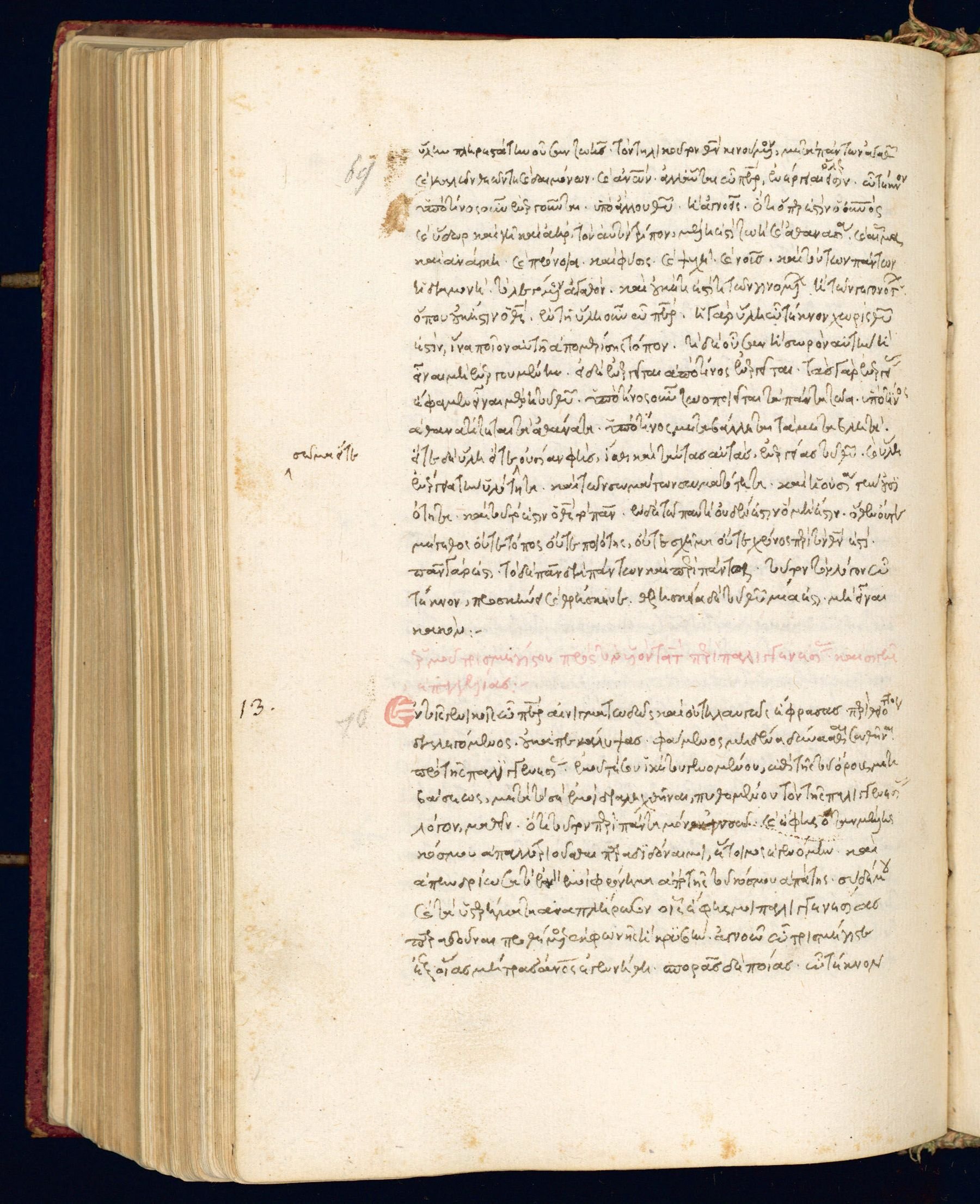
Where on the image
On Laur. Plut. 71.33 fol. 141v. Laur. Plut. 71.33 fol. 141v: in the middle of the page CH XII ends ('... θρησκεία δὲ τοῦ θεοῦ μία ἐστί, μὴ εἶναι κακόν'); below it stands the red title 'Ἑρμοῦ τρισμεγίστου πρὸς τὸν υἱὸν Τὰτ περὶ παλιγγενεσίας καὶ σιγῆς ἐπαγγελίας' (without the words 'ἐν ὄρει λόγος ἀπόκρυφος' of Parthey's title), and CH XIII begins with a red initial: 'Ἐν τοῖς γενικοῖς, ὦ πάτερ, αἰνιγματωδῶς καὶ οὐ τηλαυγῶς ἔφρασας'; a later hand has written '13.' in the margin. The last line reads 'ἐξ οἵας μήτρας ἄνθρωπος ἐγεννήθη· σπορᾶς δὲ ποίας. ὦ τέκνον' (end of section 1 and the first words of section 2; the manuscript has no 'ὕλης καὶ'). Viewer: https://cdm21059.contentdm.oclc.org/digital/collection/plutei/id/1210241 Checked on the images. The Greek shown is Parthey's edition, not a transcription of this manuscript.
Ἑρμοῦ τοῦ τρισμεγίστου πρὸς τὸν υἱὸν Τὰτ ἐν ὄρει λόγος ἀπόκρυφος περὶ παλιγγενεσίας καὶ σιγῆς ἐπαγγελίας.
Τάτ. Ἐν τοῖς γενικοῖς, ὦ πάτερ, αἰνιγματωδῶς καὶ οὐ τηλαυγῶς ἔφρασας περὶ θεότητος διαλεγόμενος, καὶ οὐκ ἀπεκάλυψας, φάμενος μηδένα δύνασθαι σωθῆναι πρὸ τῆς παλιγγενεσίας· ἐμοῦ τέ σου ἱκέτου γενομένου ἐπὶ τῆς τοῦ ὄρους μεταβάσεως μετὰ τὸ σὲ ἐμοὶ διαλεχθῆναι, καὶ ποθουμένου τὸν τῆς παλιγγενεσίας λόγον μαθεῖν, ὅτι τοῦτον παρὰ πάντα μόνον ἀγνοῶ, ἔφης, ὅταν μέλλῃς κόσμου ἀπαλλοτριοῦσθαι, παραδιδόναι μοι. διὸ ἕτοιμος ἐγενόμην καὶ ἀπηλλοτρίωσα τὸ ἐν ἐμοὶ φρόνημα ἀπὸ τῆς τοῦ κόσμου ἀπάτης· σὺ δέ μοι καὶ τὰ ὑστερήματα ἀναπλήρωσον, οἷς ἔφης μοι παλιγγενεσίαν παραδοῦναι, προθέμενος ἐκ φωνῆς ἢ κρυβήν· ἀγνοῶ, ὦ τρισμέγιστε, ἐξ οἵας ὕλης καὶ μήτρας ἄνθρωπος ἐγεννήθη, σπορᾶς δὲ ποίας.
The Secret Sermon on the Mountain, concerning Rebirth and the Promise of Silence, of Thrice-greatest Hermes unto Tat his Son
Tat. [Now] in the General Sermons, father, thou didst speak in riddles most unclear, conversing on Divinity; and when thou saidst no man could e'er be saved before Rebirth, thy meaning thou didst hide.
Further, when I became thy Suppliant, in Wending up the Mount, after thou hadst conversed with me, and when I longed to learn the Sermon (Logos) on Rebirth (for this beyond all other things is just the thing I know not), thou saidst, that thou wouldst give it me — " when thou shalt have become a stranger to the world."
Wherefore I got me ready and made the thought in me a stranger to the world-illusion.
And now do thou fill up the things that fall short in me with what thou saidst would give me the tradition of Rebirth, setting it forth in speech or in the secret way.
I know not, O Thrice-greatest one, from out what matter and what womb Man comes to birth, or of what seed.
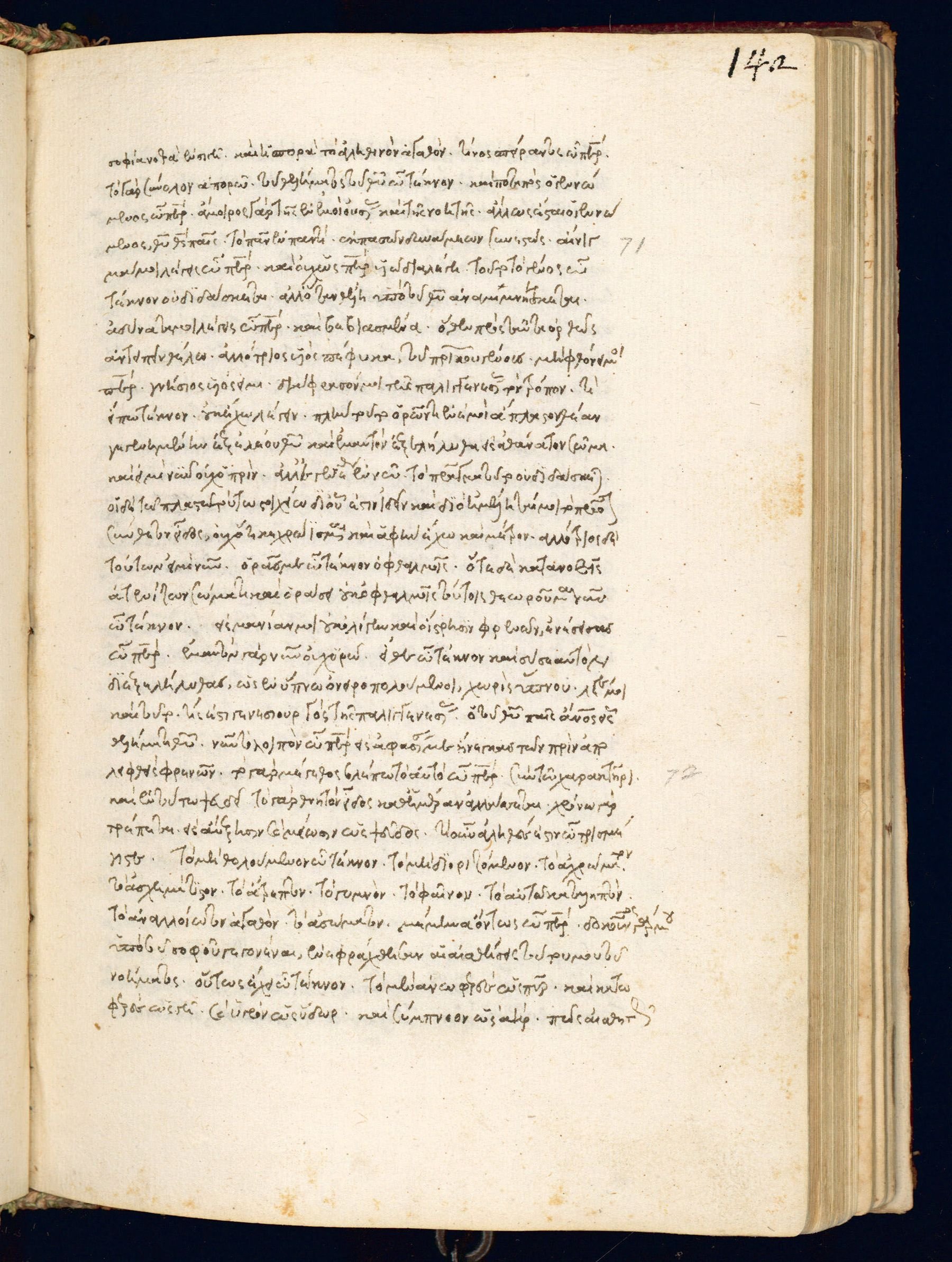
Where on the image
Starts on fol. 141v and continues on fol. 142r (page break inside this section). Laur. Plut. 71.33 fol. 141v: in the middle of the page CH XII ends ('... θρησκεία δὲ τοῦ θεοῦ μία ἐστί, μὴ εἶναι κακόν'); below it stands the red title 'Ἑρμοῦ τρισμεγίστου πρὸς τὸν υἱὸν Τὰτ περὶ παλιγγενεσίας καὶ σιγῆς ἐπαγγελίας' (without the words 'ἐν ὄρει λόγος ἀπόκρυφος' of Parthey's title), and CH XIII begins with a red initial: 'Ἐν τοῖς γενικοῖς, ὦ πάτερ, αἰνιγματωδῶς καὶ οὐ τηλαυγῶς ἔφρασας'; a later hand has written '13.' in the margin. The last line reads 'ἐξ οἵας μήτρας ἄνθρωπος ἐγεννήθη· σπορᾶς δὲ ποίας. ὦ τέκνον' (end of section 1 and the first words of section 2; the manuscript has no 'ὕλης καὶ'). Viewer: https://cdm21059.contentdm.oclc.org/digital/collection/plutei/id/1210241 Laur. Plut. 71.33 fol. 142r begins 'σοφία νοερὰ ἐν σιγῇ· καὶ ἡ σπορὰ τὸ ἀληθινὸν ἀγαθόν. τίνος σπείραντος, ὦ πάτερ;' on its first line and ends 'φερὲς ὡς γῆ· καὶ ὑγρὸν ὡς ὕδωρ· καὶ σύμπνοον ὡς ἀήρ· πῶς αἰσθητῶς' on its last line. Viewer: https://cdm21059.contentdm.oclc.org/digital/collection/plutei/id/1210242 Checked on the images. The Greek shown is Parthey's edition, not a transcription of this manuscript.
Ἑρμῆς. Ὦ τέκνον, σοφία νοερὰ ἐν σιγῇ, καὶ ἡ σπορὰ τὸ ἀληθινὸν ἀγαθόν.
Τάτ. Τίνος σπείραντος, ὦ πάτερ; τὸ γὰρ σύνολον ἀπορῶ.
Ἑρμῆς. Τοῦ θελήματος τοῦ θεοῦ, ὦ τέκνον.
Τάτ. Καὶ ποταπὸς ὁ γεννώμενος, ὦ πάτερ; ἄμοιρος ὢν τῆς ἐν ἐμοὶ οὐσίας τῆς νοητῆς, ἄλλος ἔσται ὁ γεννώμενος θεός, θεοῦ παῖς.
Ἑρμῆς. Τὸ πᾶν ἐν παντὶ ἐκ πασῶν δυνάμεων συνεστός.
Τάτ. Αἴνιγμά μοι λέγεις, ὦ πάτερ, καὶ οὐχ ὡς πατὴρ υἱῷ διαλέγῃ.
Ἑρμῆς. Τοῦτο τὸ γένος, ὦ τέκνον, οὐ διδάσκεται, ἀλλ᾽ ὅταν θέλῃ ὑπὸ τοῦ θεοῦ ἀναμιμνήσκεται.
Hermes. Wisdom that understands in silence [such is the matter and the womb from out which Man is born], and the True Good the seed.
Tat. Who is the sower, father? For I am altogether at a loss.
Her. It is the Will of God, my son.
Tat. And of what kind is he that is begotten, father? For I have no share of that essence in me, which doth transcend the senses. The one that is begot will be another one from God, God's Son?
Her. All in all, out of all powers composed.
Tat. Thou tellest me a riddle, father, and dost not speak as father unto son.
Her. This Race, my son, is never taught; but when He willeth it, its memory is restored by God.
Where on the image
On Laur. Plut. 71.33 fol. 142r. Laur. Plut. 71.33 fol. 142r begins 'σοφία νοερὰ ἐν σιγῇ· καὶ ἡ σπορὰ τὸ ἀληθινὸν ἀγαθόν. τίνος σπείραντος, ὦ πάτερ;' on its first line and ends 'φερὲς ὡς γῆ· καὶ ὑγρὸν ὡς ὕδωρ· καὶ σύμπνοον ὡς ἀήρ· πῶς αἰσθητῶς' on its last line. Viewer: https://cdm21059.contentdm.oclc.org/digital/collection/plutei/id/1210242 Checked on the images. The Greek shown is Parthey's edition, not a transcription of this manuscript.
Τάτ. Ἀδύνατά μοι λέγεις, ὦ πάτερ, καὶ βεβιασμένα· ὅθεν πρὸς ταῦτα ὀρθῶς ἀντειπεῖν θέλω· ἀλλότριος υἱὸς πέφυκα τοῦ πατρικοῦ γένους; μὴ φθόνει μοι, πάτερ· γνήσιος υἱός εἰμι· διάφρασόν μοι τῆς παλιγγενεσίας τὸν τρόπον.
Ἑρμῆς. Τί εἴπω, ὦ τέκνον; οὐκ ἔχω λέγειν πλὴν τοῦτο· ὁρῶ τιν᾽ ἐν ἐμοὶ ἄπλαστον θέαν γεγενημένην· ἐξ ἐλέου θεοῦ καὶ ἐμαυτοῦ ἐξελήλυθα εἰς ἀθάνατον σῶμα· καί εἰμι νῦν οὐχ ὁ πρίν, ἀλλ᾽ ἐγεννήθην ἐν νῷ· τὸ πρᾶγμα τοῦτο οὐ διδάσκεται οὐδὲ τῷ πλαστῷ τούτῳ στοιχείῳ, δι᾽ οὗ ἔστιν ἰδεῖν, καὶ δι᾽ ὃ ἠμέληταί μοι τὸ πρῶτον σύνθετον εἶδος, οὐχ ὅτι κέχρωσμαι καὶ ἀφὴν ἔχω καὶ μέτρον· ἀλλότριος τούτων εἰμὶ νῦν. ὁρᾷς με, ὦ τέκνον, ὀφθαλμοῖς, ὅτε δὴ κατανοεῖς ἀτενίζων σώματι καὶ ὁράσει· οὐκ ὀφθαλμοῖς τούτοις θεωροῦμαι νῦν, ὦ τέκνον.
Tat. Thou sayest things impossible, O father, things that are forced. Hence answers would I have direct unto these things. Am I a son strange to my father's race?
Keep it not, father, back from me. I am a true-born son; explain to me the manner of Rebirth.
Her. What may I say, my son? I can but tell thee this. Whene'er I see within myself the Simple Vision brought to birth out of God's mercy, I have passed through myself into a Body that can never die. And now I am not what I was before; but I am born in Mind.
The way to do this is not taught, and it cannot be seen by the compounded element by means of which thou seest. Yea, I have had my former composed form dismembered for me. I am no longer touched, yet have I touch; I have dimension too; and [yet] am I a stranger to them now.
Thou seest me with eyes, my son; but what I am thou dost not understand [even] with fullest strain of body and of sight.
Where on the image
On Laur. Plut. 71.33 fol. 142r. Laur. Plut. 71.33 fol. 142r begins 'σοφία νοερὰ ἐν σιγῇ· καὶ ἡ σπορὰ τὸ ἀληθινὸν ἀγαθόν. τίνος σπείραντος, ὦ πάτερ;' on its first line and ends 'φερὲς ὡς γῆ· καὶ ὑγρὸν ὡς ὕδωρ· καὶ σύμπνοον ὡς ἀήρ· πῶς αἰσθητῶς' on its last line. Viewer: https://cdm21059.contentdm.oclc.org/digital/collection/plutei/id/1210242 Checked on the images. The Greek shown is Parthey's edition, not a transcription of this manuscript.
Τάτ. Εἰς μανίαν με οὐκ ὀλίγην καὶ οἴστρησιν φρενῶν ἐνέσεισας, ὦ πάτερ· ἐμαυτὸν γὰρ νῦν οὐχ ὁρῶ.
Ἑρμῆς. Εἴθε, ὦ τέκνον, καὶ σὺ σεαυτὸν διεξελήλυθας, ὡς οἱ ἐν ὕπνῳ ὀνειροπολούμενοι χωρὶς ὕπνου.
Τάτ. Λέγε μοι καὶ τοῦτο· τίς ἐστι γενεσιουργὸς τῆς παλιγγενεσίας;
Ἑρμῆς. Ὁ τοῦ θεοῦ παῖς, ἄνθρωπος εἷς, θελήματι θεοῦ.
Tat. Into fierce frenzy and mind-fury hast thou plunged me, father, for now no longer do I see myself.
Her. I would, my son, that thou hadst e'en passed right through thyself, as they who dream in sleep yet sleepless.
Tat. Tell me this too! Who is the author of Rebirth?
Her. The Son of God, the One Man, by God's Will.
Where on the image
On Laur. Plut. 71.33 fol. 142r. Laur. Plut. 71.33 fol. 142r begins 'σοφία νοερὰ ἐν σιγῇ· καὶ ἡ σπορὰ τὸ ἀληθινὸν ἀγαθόν. τίνος σπείραντος, ὦ πάτερ;' on its first line and ends 'φερὲς ὡς γῆ· καὶ ὑγρὸν ὡς ὕδωρ· καὶ σύμπνοον ὡς ἀήρ· πῶς αἰσθητῶς' on its last line. Viewer: https://cdm21059.contentdm.oclc.org/digital/collection/plutei/id/1210242 Checked on the images. The Greek shown is Parthey's edition, not a transcription of this manuscript.
Τάτ. Νῦν τὸ λοιπόν, ὦ πάτερ, εἰς ἀφασίαν με ἤνεγκας, τῶν πρὶν ἀπολειφθέντα φρενῶν· τὸ γὰρ μέγεθος βλέπω τὸ σὸν τὸ αὐτό, ὦ πάτερ, σὺν τῷ χαρακτῆρι.
Ἑρμῆς. Καὶ ἐν τούτῳ ψεύδῃ· τὸ γὰρ θνητῶν εἶδος καθ᾽ ἡμέραν ἀλλάσσεται· χρόνῳ γὰρ τρέπεται εἰς αὔξησιν καὶ μείωσιν ὡς ψεῦδος.
Tat. Now hast thou brought me, father, unto pure stupefaction.
Arrested from the senses which I had before, . . . .; for [now] I see thy Greatness identical with thy distinctive form.
Her. Even in this thou art untrue; the mortal form doth change with every day. 'Tis turned by time to growth and waning, as being an untrue thing.
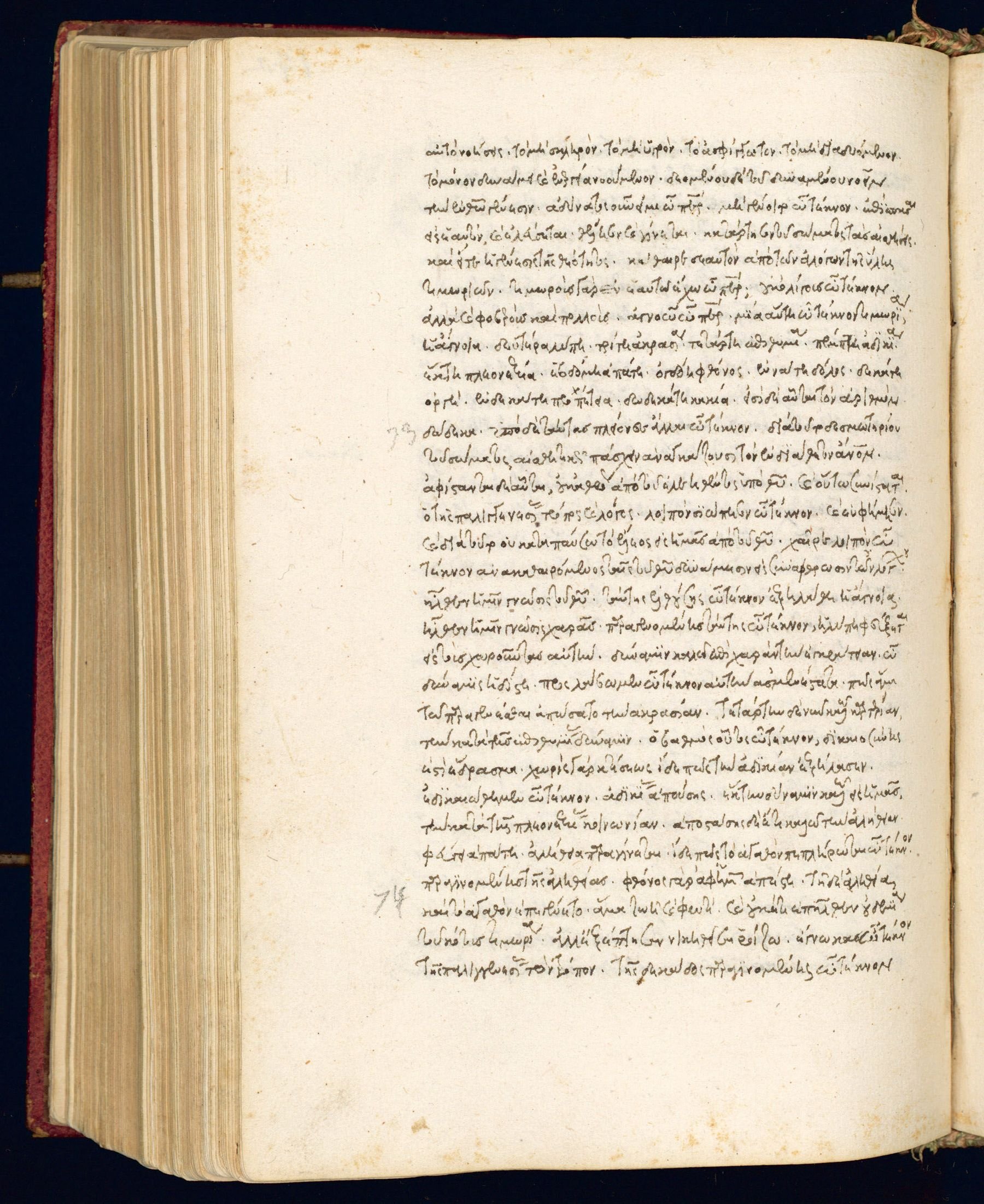
Where on the image
Starts on fol. 142r and continues on fol. 142v (page break inside this section). Laur. Plut. 71.33 fol. 142r begins 'σοφία νοερὰ ἐν σιγῇ· καὶ ἡ σπορὰ τὸ ἀληθινὸν ἀγαθόν. τίνος σπείραντος, ὦ πάτερ;' on its first line and ends 'φερὲς ὡς γῆ· καὶ ὑγρὸν ὡς ὕδωρ· καὶ σύμπνοον ὡς ἀήρ· πῶς αἰσθητῶς' on its last line. Viewer: https://cdm21059.contentdm.oclc.org/digital/collection/plutei/id/1210242 Laur. Plut. 71.33 fol. 142v begins 'αὐτὸ νοήσεις, τὸ μὴ σκληρόν, τὸ μὴ ὑγρόν, τὸ ἀσφίγκτον, τὸ μὴ διαλυόμενον' on its first line and ends 'τῆς παλιγγενεσίας τὸν τρόπον. τῆς δεκάδος παραγινομένης, ὦ τέκνον' on its last line. Viewer: https://cdm21059.contentdm.oclc.org/digital/collection/plutei/id/1210243 Checked on the images. The Greek shown is Parthey's edition, not a transcription of this manuscript.
Τάτ. Τί οὖν ἀληθές ἐστιν, ὦ τρισμέγιστε;
Ἑρμῆς. Τὸ μὴ θολούμενον, ὦ τέκνον, τὸ μὴ διοριζόμενον τὸ ἀχρώματον τὸ ἀσχημάτιστον τὸ ἄτρεπτον τὸ γυμνὸν τὸ φαῖνον τὸ αὐτῷ καταληπτὸν τὸ ἀναλλοίωτον τὸ ἀγαθὸν τὸ ἀσώματον.
Τάτ. Μέμηνα ὄντως, ὦ πάτερ. δοκοῦντος γάρ μου ὑπὸ σοῦ σοφοῦ γεγονέναι, ἐνεφράχθησαν αἱ αἰσθήσεις τούτου μου τοῦ νοήματος.
Ἑρμῆς. Οὕτως ἔχει, ὦ τέκνον. τὸ μὲν ἀνωφερὲς ὡς πῦρ, τὸ δὲ κατωφερὲς ὡς γῆ, καὶ ὑγρὸν ὡς ὕδωρ, καὶ σύμπνοον ὡς ἀήρ· πῶς αἰσθητῶς αὐτὸ νοήσεις, τὸ μὴ σκληρὸν τὸ μὴ ὑγρὸν τὸ ἀσφίγγωτον τὸ μὴ διαλυόμενον τὸ μόνον δυνάμει καὶ ἐνεργείᾳ νοούμενον; δέῃ μόνου δὲ νοῦ δυναμένου νοεῖν τὴν ἐν θεῷ γένεσιν.
Tat. What then is true, Thrice-greatest One? Her. That which is never troubled, son, which cannot be defined; that which no colour hath, nor any figure, which is not turned, which hath no garment, which giveth light; that which is comprehensible unto itself [alone], which doth not suffer change; that which no body can contain.
Tat. In very truth I lose my reason, father. Just when I thought to be made wise by thee, I find the senses of this mind of mine blocked up.
Her. Thus is it, son: That which is upward borne like fire, yet is borne down like earth, that which is moist like water, yet blows like air, how shalt thou this perceive with sense — the that which is not solid nor yet moist, which naught can bind or loose, of which in power and energy alone can man have any notion, — and even then it wants a man who can perceive the Way of Birth in God?
Where on the image
On Laur. Plut. 71.33 fol. 142v. Laur. Plut. 71.33 fol. 142v begins 'αὐτὸ νοήσεις, τὸ μὴ σκληρόν, τὸ μὴ ὑγρόν, τὸ ἀσφίγκτον, τὸ μὴ διαλυόμενον' on its first line and ends 'τῆς παλιγγενεσίας τὸν τρόπον. τῆς δεκάδος παραγινομένης, ὦ τέκνον' on its last line. Viewer: https://cdm21059.contentdm.oclc.org/digital/collection/plutei/id/1210243 Checked on the images. The Greek shown is Parthey's edition, not a transcription of this manuscript.
Τάτ. Ἀδύνατος οὖν εἰμι, ὦ πάτερ.
Ἑρμῆς. Μὴ γένοιτο, ὦ τέκνον· ἐπίσπασαι εἰς σεαυτὸν καὶ ἐλεύσεται, θέλησον καὶ γίνεται, κατάργησον τοῦ σώματος τὰς αἰσθήσεις καὶ ἔσται ἡ γένεσις τῆς θεότητος, κάθαραι σεαυτὸν ἀπὸ τῶν ἀλόγων τῆς ὕλης τιμωρῶν.
Τάτ. Τιμωροὺς ἄρα ἐν ἐμαυτῷ ἔχω, ὦ πάτερ;
Ἑρμῆς. Οὐκ ὀλίγους, ὦ τέκνον, ἀλλὰ καὶ φοβεροὺς καὶ πολλούς.
Τάτ. Ἀγνοῶ, ὦ πάτερ.
Ἑρμῆς. Μία αὕτη, ὦ τέκνον, τιμωρία ἡ ἄγνοια, δευτέρα δὲ λύπη, τρίτη ἀκρασία, τετάρτη ἐπιθυμία, πέμπτη ἀδικία, ἕκτη πλεονεξία, ἑβδόμη ἀπάτη, ὀγδόη φθόνος, ἐννάτη δόλος, δεκάτη ὀργή, ἑνδεκάτη προπέτεια, δωδεκάτη κακία· εἰσὶ δὲ αὗται τὸν ἀριθμὸν δώδεκα, ὑπὸ δὲ ταύταις πλείονες ἄλλαι, ὦ τέκνον· διά τε τοῦ δεσμωτηρίου τοῦ σώματος αἰσθητικῶς πάσχειν ἀναγκάζουσι τὸν ἐνδιάθετον ἄνθρωπον.
Tat. I am incapable of this, O father, then?
Her. Nay, God forbid, my son! Withdraw into thyself, and it will come; will, and it comes to pass; throw out of work the body's senses, and thy Divinity shall come to birth; purge from thyself the brutish torments — things of matter.
Tat. I have tormentors then in me, O father? Her. Ay, no few, my son; nay, fearful ones and manifold.
Tat. I do not know them, father.
Her. Torment the first is this Not-knowing, son; the second one is Grief; the third, Intemperance; the fourth, Concupiscence; the fifth, Unrighteousness; the sixth is Avarice; the seventh, Error; the eighth is Envy; the ninth, Guile; the tenth is Anger; eleventh, Rashness; the twelfth is Malice.
These are in number twelve; but under them are many more, my son; and creeping through the prison of the body they force the man that's placed within to suffer in his senses.
Where on the image
On Laur. Plut. 71.33 fol. 142v. Laur. Plut. 71.33 fol. 142v begins 'αὐτὸ νοήσεις, τὸ μὴ σκληρόν, τὸ μὴ ὑγρόν, τὸ ἀσφίγκτον, τὸ μὴ διαλυόμενον' on its first line and ends 'τῆς παλιγγενεσίας τὸν τρόπον. τῆς δεκάδος παραγινομένης, ὦ τέκνον' on its last line. Viewer: https://cdm21059.contentdm.oclc.org/digital/collection/plutei/id/1210243 Checked on the images. The Greek shown is Parthey's edition, not a transcription of this manuscript.
ἀφίστανται δὲ αὗται οὐκ ἀθρόως ἀπὸ τοῦ ἐλεηθέντος ὑπὸ τοῦ θεοῦ, καὶ οὕτω συνίσταται ὁ τῆς παλιγγενεσίας τρόπος καὶ λόγος. λοιπὸν σιώπησον, ὦ τέκνον, καὶ εὐφήμησον· καὶ διὰ τοῦτο οὐ καταπαύσει τὸ ἔλεος εἰς ἡμᾶς ἀπὸ τοῦ θεοῦ. χαῖρε λοιπόν, ὦ τέκνον, ἀνακαθαιρόμενος ταῖς τοῦ θεοῦ δυνάμεσιν εἰς συνάρθρωσιν τοῦ λόγου. ἦλθεν ἡμῖν γνῶσις τοῦ θεοῦ· ταύτης δὲ ἐλθούσης, ὦ τέκνον, ἐξηλάθη ἡ ἄγνοια. ἦλθεν ἡμῖν γνῶσις χαρᾶς· παραγενομένης ταύτης, ὦ τέκνον, ἡ λύπη φεύξεται εἰς τοὺς χωροῦντας αὐτήν.
But they depart (although not all at once) from him who hath been taken pity on by God; and this it is which constitutes the manner of Rebirth. And . . . . the Reason (Logos).
And now, my son, be still and solemn silence keep! Thus shall the mercy that flows on us from God not cease.
Henceforth rejoice, O son, for by the Powers of God thou art being purified for the articulation of the Reason (Logos). Gnosis of God hath come to us, and when this comes, my son, Not-knowing is cast out.
Gnosis of Joy hath come to us, and on its coming, son, Sorrow will flee away to them who give it room.
Where on the image
On Laur. Plut. 71.33 fol. 142v. Laur. Plut. 71.33 fol. 142v begins 'αὐτὸ νοήσεις, τὸ μὴ σκληρόν, τὸ μὴ ὑγρόν, τὸ ἀσφίγκτον, τὸ μὴ διαλυόμενον' on its first line and ends 'τῆς παλιγγενεσίας τὸν τρόπον. τῆς δεκάδος παραγινομένης, ὦ τέκνον' on its last line. Viewer: https://cdm21059.contentdm.oclc.org/digital/collection/plutei/id/1210243 Checked on the images. The Greek shown is Parthey's edition, not a transcription of this manuscript.
δύναμιν καλῶ ἐπὶ χαρᾷ τὴν ἐγκράτειαν. ὦ δύναμις ἡδίστη· προσλάβωμεν αὐτήν, ὦ τέκνον, ἀσμενέστατα. πῶς ἅμα τῷ παραγενέσθαι ἀπώσατο τὴν ἀκρασίαν· τετάρτην δὲ νῦν καλῶ καρτερίαν τὴν κατὰ τῆς ἐπιθυμίας δύναμιν. ὁ βαθμὸς οὗτος, ὦ τέκνον, δικαιοσύνης ἐστὶν ἕδρασμα. χωρὶς γὰρ κτίσεως ἰδέ, πῶς τὴν ἀδικίαν ἐξήλασεν. ἐδικαιώθημεν, ὦ τέκνον, ἀδικίας ἀπούσης. ἕκτην δύναμιν καλῶ εἰς ἡμᾶς ἐλθοῦσαν τὴν κατὰ τῆς πλεονεξίας, κοινωνίαν. ἀποστάσης δὲ ἔτι καλῶ τὴν ἀλήθειαν· καὶ φεύγει ἡ ἀπάτη, ἀλήθεια δὲ παραγίνεται. ἰδέ, πῶς τὸ ἀγαθὸν πεπλήρωται, ὦ τέκνον, παραγινομένης τῆς ἀληθείας. φθόνος γὰρ ἀφ᾽ ἡμῶν ἀπέστη, τῇ δὲ ἀληθείᾳ καὶ τὸ ἀγαθὸν ἐπεγένετο ἅμα ζωῇ καὶ φωτί, καὶ οὐκ ἔτι ἐπῆλθεν οὐδεμία τοῦ σκότους τιμωρία, ἀλλ᾽ ἐξέπτησαν νικηθεῖσαι ῥοίζῳ.
The Power that follows Joy do I invoke, thy Self-control. O Power most sweet! Let us most gladly bid it welcome, son! How with its coming doth it chase Intemperance away!
Now fourth, on Continence I call, the Power against Desire.
. . . . This step, my son, is Righteousness' firm seat. For without judgment see how she hath chased Unrighteousness away. We are made righteous, son, by the departure of Unrighteousness.
Power sixth I call to us, — that against Avarice, Sharing-with-all.
And now that Avarice is gone, I call on Truth. And Error flees, and Truth is with us.
See how [the measure of] the Good is full, my son, upon Truth's coming. For Envy hath gone from us; and unto Truth is joined the Good as well, with Life and Light.
And now no more doth any torment of the Darkness venture nigh, but vanquished [all] have fled with whirring wings.
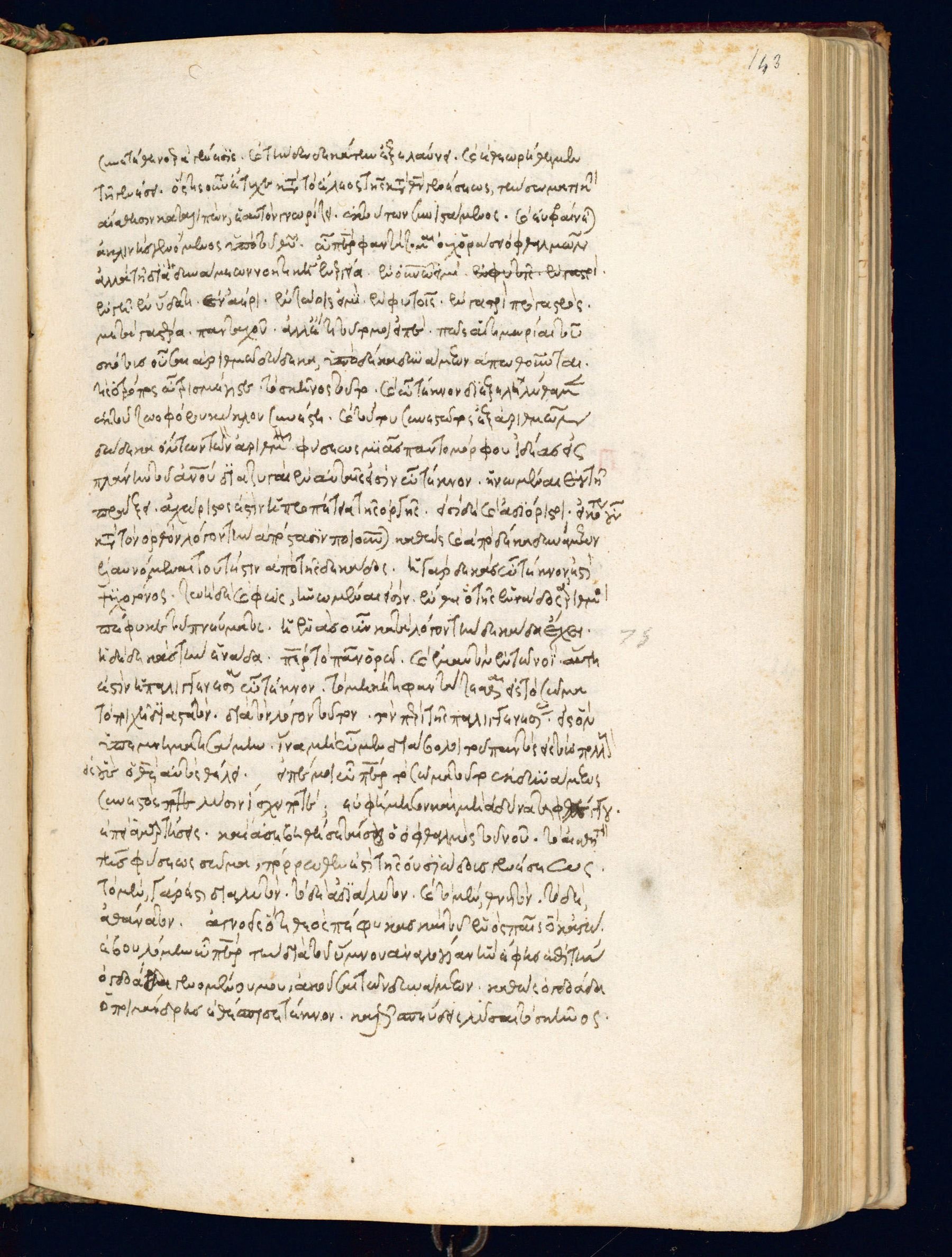
Where on the image
Starts on fol. 142v and continues on fol. 143r (page break inside this section). Laur. Plut. 71.33 fol. 142v begins 'αὐτὸ νοήσεις, τὸ μὴ σκληρόν, τὸ μὴ ὑγρόν, τὸ ἀσφίγκτον, τὸ μὴ διαλυόμενον' on its first line and ends 'τῆς παλιγγενεσίας τὸν τρόπον. τῆς δεκάδος παραγινομένης, ὦ τέκνον' on its last line. Viewer: https://cdm21059.contentdm.oclc.org/digital/collection/plutei/id/1210243 Laur. Plut. 71.33 fol. 143r begins 'συνετέθη νοερὰ γένεσις· καὶ τὴν δωδεκάτην ἐξελαύνει· καὶ ἐθεωρήθημεν' on its first line and ends 'ὁ ποιμάνδρης ἐθέσπισε, τέκνον· καλῶς σπεύδεις λῦσαι τὸ σκῆνος' on its last line. Viewer: https://cdm21059.contentdm.oclc.org/digital/collection/plutei/id/1210244 Checked on the images. The Greek shown is Parthey's edition, not a transcription of this manuscript.
ἔγνωκας, ὦ τέκνον, τῆς παλιγγενεσίας τὸν τρόπον. τῆς δεκάδος παραγινομένης, ὦ τέκνον, συνετέθη νοερὰ γένεσις, καὶ τὴν δωδεκάτην ἐξελαύνει, καὶ ἐθεωρήθημεν τῇ γενέσει. ὅστις οὖν ἔτυχε κατὰ τὸ ἔλεος τῆς κατὰ θεὸν γενέσεως, τὴν σωματικὴν αἴσθησιν καταλιπών, ἑαυτὸν γνωρίζει ἐκ θείων συνιστάμενον, καὶ εὐφραίνεται·
Thou knowest [now], my son, the manner of Rebirth. And when the Ten is come, my son, that driveth out the Twelve, the Birth in understanding is complete, and by this Birth we are made into Gods.
Who then doth by His mercy gain this Birth in God, abandoning the body's senses, knows himself [to be of Light and Life] and that he doth consist of these, and [thus] is filled with Bliss.
Where on the image
On Laur. Plut. 71.33 fol. 143r. Laur. Plut. 71.33 fol. 143r begins 'συνετέθη νοερὰ γένεσις· καὶ τὴν δωδεκάτην ἐξελαύνει· καὶ ἐθεωρήθημεν' on its first line and ends 'ὁ ποιμάνδρης ἐθέσπισε, τέκνον· καλῶς σπεύδεις λῦσαι τὸ σκῆνος' on its last line. Viewer: https://cdm21059.contentdm.oclc.org/digital/collection/plutei/id/1210244 Checked on the images. The Greek shown is Parthey's edition, not a transcription of this manuscript.
Τάτ. Ἀκλινὴς γενόμενος ὑπὸ τοῦ θεοῦ, ὦ πάτερ, φαντάζομαι οὐχ ὁράσει ὀφθαλμῶν, ἀλλὰ τῇ διὰ δυνάμεων νοητικῇ ἐνεργείᾳ· ἐν οὐρανῷ εἰμι, ἐν γῇ, ἐν ὕδατι, ἐν ἀέρι· ἐν ζώοις εἰμί, ἐν φυτοῖς, ἐν γαστρί, πρὸ γαστρός, μετὰ γαστέρα, πανταχοῦ. ἀλλ᾽ ἔτι τοῦτό μοι εἰπέ, πῶς αἱ τιμωρίαι τοῦ σκότους οὖσαι ἀριθμῷ δώδεκα ὑπὸ δέκα δυνάμεων ἀπωθοῦνται; τίς ὁ τρόπος, ὦ τρισμέγιστε;
Tat. By God made steadfast, father, no longer with the sight my eyes afford I look on things, but with the energy the Mind doth give me through the Powers.
In heaven am I, in earth, in water, air; I am in animals, in plants; I'm in the womb, before the womb, after the womb; I'm everywhere!
But further tell me this: How are the torments of the Darkness, when they are twelve in number, driven out by the ten Powers? What is the way of it, Thrice-greatest one?
Where on the image
On Laur. Plut. 71.33 fol. 143r. Laur. Plut. 71.33 fol. 143r begins 'συνετέθη νοερὰ γένεσις· καὶ τὴν δωδεκάτην ἐξελαύνει· καὶ ἐθεωρήθημεν' on its first line and ends 'ὁ ποιμάνδρης ἐθέσπισε, τέκνον· καλῶς σπεύδεις λῦσαι τὸ σκῆνος' on its last line. Viewer: https://cdm21059.contentdm.oclc.org/digital/collection/plutei/id/1210244 Checked on the images. The Greek shown is Parthey's edition, not a transcription of this manuscript.
Ἑρμῆς. Τὸ σκῆνος τοῦτο, ὦ τέκνον, ὃ διεξεληλύθαμεν, ἐκ τοῦ ζωοφόρου κύκλου συνέστη, καὶ τούτου συνεστῶτος ἐκ ζωδίων, δώδεκα ὄντων τὸν ἀριθμόν, φύσεως μὲν μιᾶς, παντομόρφου δὲ ἰδέας. εἰς πλάνην τοῦ ἀνθρώπου διαζυγαὶ ἐν αὐταῖς εἰσιν, ὦ τέκνον, ἡνωμέναι ἐν τῇ πράξει. ἀχώριστός ἐστιν ἡ προπέτεια τῆς ὀργῆς, εἰσὶ δὲ καὶ ἀδιόριστοι. εἰκότως οὖν κατὰ τὸν ὀρθὸν λόγον τὴν ἀπόστασιν ποιοῦνται, καθὼς καὶ ἀπὸ δέκα δυνάμεων ἐλαυνόμεναι, τουτέστιν ἀπὸ τῆς δεκάδος. ἡ γὰρ δεκάς, ὦ τέκνον, ἐστὶ ψυχογόνος. ζωὴ δὲ καὶ φῶς ἡνωμέναι ἐκεῖ εἰσιν, ἔνθα ὁ τῆς ἑνάδος ἀριθμὸς πέφυκε τοῦ πνεύματος. ἡ ἑνὰς οὖν κατὰ λόγον τὴν δεκάδα ἔχει, ἡ δὲ δεκὰς τὴν ἑνάδα.
Her. This dwelling-place through which we have just passed, my son, is constituted from the circle of the types-of-life, this being composed of elements, twelve in number, but of one nature, an omniform idea. For man's delusion there are disunions in them, son, while in their action they are one. Not only can we never part Rashness from Wrath; they cannot even be distinguished.
According to right reason (logos), then, they naturally withdraw once and for all, in as much as they are chased out by no less than ten powers, that is, the Ten.
For, son, the Ten is that which giveth birth to souls. And Life and Light are unified there, where the One hath being from the Spirit. According then to reason (logos) the One contains the Ten, the Ten the One.
Where on the image
On Laur. Plut. 71.33 fol. 143r. Laur. Plut. 71.33 fol. 143r begins 'συνετέθη νοερὰ γένεσις· καὶ τὴν δωδεκάτην ἐξελαύνει· καὶ ἐθεωρήθημεν' on its first line and ends 'ὁ ποιμάνδρης ἐθέσπισε, τέκνον· καλῶς σπεύδεις λῦσαι τὸ σκῆνος' on its last line. Viewer: https://cdm21059.contentdm.oclc.org/digital/collection/plutei/id/1210244 Checked on the images. The Greek shown is Parthey's edition, not a transcription of this manuscript.
Τάτ. Πάτερ, τὸ πᾶν ὁρῶ καὶ ἐμαυτὸν ἐν τῷ νοΐ.
Ἑρμῆς. Αὕτη ἐστὶν ἡ παλιγγενεσία, ὦ τέκνον, τὸ μηκέτι φαντάζεσθαι εἰς τὸ σῶμα τὸ τριχῇ διαστατόν, διὰ τὸν λόγον τοῦτον τὸν περὶ τῆς παλιγγενεσίας, εἰς ὃν ὑπεμνηματισάμην, ἵνα μὴ ὦμεν διάβολοι τοῦ παντὸς εἰς τοὺς πολλούς, εἰς οὓς αὐτὸς οὐ θέλει θεός.
Tat. Father, I see the All, I see myself in Mind.
Her. This is, my son, Rebirth — no more to look on things from body's view-point (a thing three ways in space extended), . . . though this Sermon (Logos) on Rebirth, on which I did not comment; — in order that we may not be calumniators of the All unto the multitude, to whom indeed the God Himself doth will we should not.
Where on the image
On Laur. Plut. 71.33 fol. 143r. Laur. Plut. 71.33 fol. 143r begins 'συνετέθη νοερὰ γένεσις· καὶ τὴν δωδεκάτην ἐξελαύνει· καὶ ἐθεωρήθημεν' on its first line and ends 'ὁ ποιμάνδρης ἐθέσπισε, τέκνον· καλῶς σπεύδεις λῦσαι τὸ σκῆνος' on its last line. Viewer: https://cdm21059.contentdm.oclc.org/digital/collection/plutei/id/1210244 Checked on the images. The Greek shown is Parthey's edition, not a transcription of this manuscript.
Τάτ. Εἰπέ μοι, ὦ πάτερ, τὸ σῶμα τοῦτο τὸ ἐκ δυνάμεων συνεστὸς λύσιν ἔχει ποτέ;
Ἑρμῆς. Εὐφήμησον καὶ μὴ ἀδύνατα φθέγγου, ἐπεὶ ἁμαρτήσεις καὶ ἀσεβηθήσεταί σου ὁ ὀφθαλμὸς τοῦ νοῦ. τὸ αἰσθητὸν τῆς φύσεως σῶμα πόρρωθέν ἐστι τῆς οὐσιώδους γενέσεως. τὸ μὲν γάρ ἐστι διαλυτόν, τὸ δὲ ἀδιάλυτον, καὶ τὸ μὲν θνητόν, τὸ δὲ ἀθάνατον. ἀγνοεῖς, ὅτι θεὸς πέφυκας καὶ τοῦ ἑνὸς παῖς, ὃ κἀγώ;
Tat. Tell me, O father: This Body which is made up of the Powers, is it at any time dissolved?
Her. Hush, [son]! Speak not of things impossible, else wilt thou sin and thy Mind's eye be quenched.
The natural body which our sense perceives is far removed from this essential birth.
The first must be dissolved, the last can never be; the first must die, the last death cannot touch.
Dost thou not know thou hast been born a God, Son of the One, even as I myself?
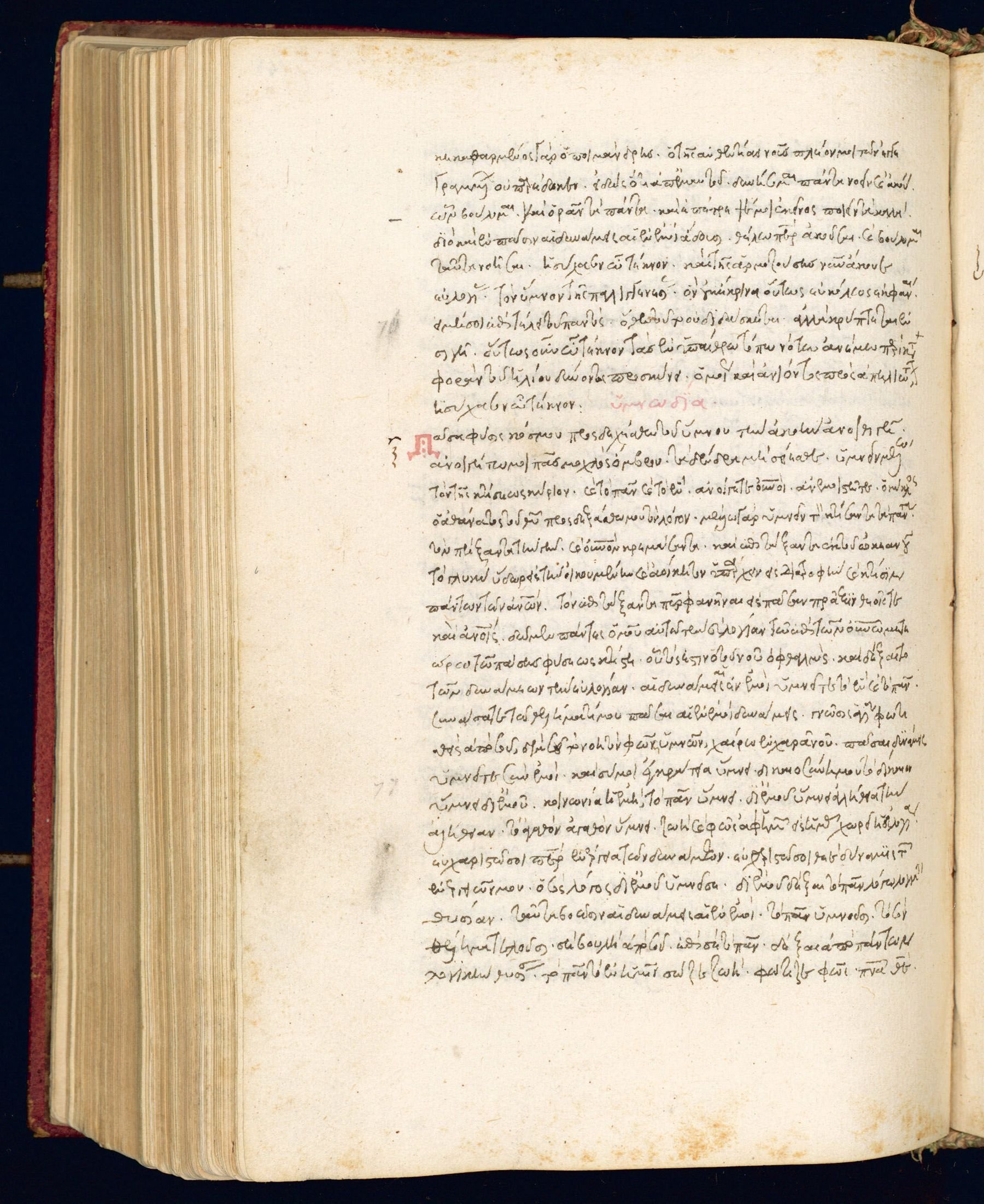
Where on the image
Starts on fol. 143r and continues on fol. 143v (page break inside this section). Laur. Plut. 71.33 fol. 143r begins 'συνετέθη νοερὰ γένεσις· καὶ τὴν δωδεκάτην ἐξελαύνει· καὶ ἐθεωρήθημεν' on its first line and ends 'ὁ ποιμάνδρης ἐθέσπισε, τέκνον· καλῶς σπεύδεις λῦσαι τὸ σκῆνος' on its last line. Viewer: https://cdm21059.contentdm.oclc.org/digital/collection/plutei/id/1210244 Laur. Plut. 71.33 fol. 143v begins 'κεκαθαρμένος γάρ· ὁ ποιμάνδρης ὁ τῆς αὐθεντίας νοῦς, πλέον μοι τῶν ἐγ(γεγραμμένων)' on its first line and ends 'λογικὴν θυσίαν· τὸ πᾶν τὸ ἐν ἡμῖν σῶζε ζωή· φώτιζε φῶς· πνεῦμα θε(έ)' on its last line. In the upper half of the page, after 'ἡσύχασον, ὦ τέκνον', the scribe wrote the heading 'ὑμνῳδία' in red at the end of the line; the hymn (section 17) begins on the next line with a red initial: 'Πᾶσα φύσις κόσμου προσδεχέσθω τοῦ ὕμνου τὴν ἀκοήν'. Viewer: https://cdm21059.contentdm.oclc.org/digital/collection/plutei/id/1210245 Checked on the images. The Greek shown is Parthey's edition, not a transcription of this manuscript.
Τάτ. Ἐβουλόμην, ὦ πάτερ, τὴν διὰ τοῦ ὕμνου εὐλογίαν, ἣν ἔφης ἐπὶ τὴν ὀγδοάδα γενομένου μου ἀκοῦσαι τῶν δυνάμεων.
Ἑρμῆς. Καθὼς ὀγδοάδα ὁ Ποιμάνδρης ἐθέσπισε, τέκνον, καλῶς σπεύδεις λῦσαι τὸ σκῆνος, κεκαθαρμένος γάρ. ὁ Ποιμάνδρης, ὁ τῆς αὐθεντίας νοῦς, πλέον μοι τῶν ἐγγεγραμμένων οὐ παρέδωκεν, εἰδὼς ὅτι ἀπ᾽ ἐμαυτοῦ δυνήσομαι πάντα νοεῖν καὶ ἀκούειν ὧν βούλομαι καὶ ὁρᾶν τὰ πάντα· καὶ ἐπέτρεψέ μοι ἐκεῖνος ποιεῖν τὰ καλά. διὸ καὶ πᾶσαι αἱ δυνάμεις αἱ ἐν ἐμοὶ ᾄδουσι.
Tat. I would, O father, hear the Praise-giving with hymn which thou didst say thou heardest then when thou wert at the Eight [the Ogdoad] of Powers.
Her. Just as the Shepherd did foretell [I should], my son, [when I came to] the Eight.
Well dost thou haste to " strike thy tent," for thou hast been made pure. The Shepherd, Mind of all masterhood, hath not passed on to me more than hath been writ down, for full well did He know that I should of myself be able to learn all, and hear what I should wish, and see all things.
He left to me the making of fair things; wherefore the Powers within me, e'en as they are in all, break into song.
Where on the image
On Laur. Plut. 71.33 fol. 143v. Laur. Plut. 71.33 fol. 143v begins 'κεκαθαρμένος γάρ· ὁ ποιμάνδρης ὁ τῆς αὐθεντίας νοῦς, πλέον μοι τῶν ἐγ(γεγραμμένων)' on its first line and ends 'λογικὴν θυσίαν· τὸ πᾶν τὸ ἐν ἡμῖν σῶζε ζωή· φώτιζε φῶς· πνεῦμα θε(έ)' on its last line. In the upper half of the page, after 'ἡσύχασον, ὦ τέκνον', the scribe wrote the heading 'ὑμνῳδία' in red at the end of the line; the hymn (section 17) begins on the next line with a red initial: 'Πᾶσα φύσις κόσμου προσδεχέσθω τοῦ ὕμνου τὴν ἀκοήν'. Viewer: https://cdm21059.contentdm.oclc.org/digital/collection/plutei/id/1210245 Checked on the images. The Greek shown is Parthey's edition, not a transcription of this manuscript.
Τάτ. Θέλω, πάτερ, ἀκοῦσαι καὶ βούλομαι ταῦτα νοῆσαι.
Ἑρμῆς. Ἡσύχασον, ὦ τέκνον, καὶ τῆς ἁρμοζούσης νῦν ἄκουε εὐλογίας, τὸν ὕμνον τῆς παλιγγενεσίας, ὃν οὐκ ἔκρινα οὕτως ἐκφάναι εὐκόλως, εἰ μή σοι ἐπὶ τέλει τοῦ παντός· ὅθεν τοῦτο οὐ διδάσκεται, ἀλλὰ κρύπτεται ἐν σιγῇ. οὕτως οὖν, ὦ τέκνον, στὰς ἐν ὑπαίθρῳ τόπῳ, πρὸς νότον ἄνεμον ἀποβλέπων περὶ καταφορὰν τοῦ ἡλίου δύνοντος προσκύνει, ὁμοίως καὶ ἀνιόντος πρὸς ἀπηλιώτην. ἡσύχασον οὖν, ὦ τέκνον.
Tat. Father, I wish to hear; I long to know these things.
Her. Be still, my son; hear the Praise-giving now that keeps [the soul] in tune, Hymn of Re-birth — a hymn I would not have thought fit so readily to tell, had'st thou not reached the end of all.
Wherefore this is not taught, but is kept hid in silence.
Thus then, my son, stand in a place uncovered to the sky, facing the southern wind, about the sinking of the setting sun, and make thy worship; so in like manner too when he doth rise, with face to the east wind.
Now, son, be still!
Where on the image
On Laur. Plut. 71.33 fol. 143v. Laur. Plut. 71.33 fol. 143v begins 'κεκαθαρμένος γάρ· ὁ ποιμάνδρης ὁ τῆς αὐθεντίας νοῦς, πλέον μοι τῶν ἐγ(γεγραμμένων)' on its first line and ends 'λογικὴν θυσίαν· τὸ πᾶν τὸ ἐν ἡμῖν σῶζε ζωή· φώτιζε φῶς· πνεῦμα θε(έ)' on its last line. In the upper half of the page, after 'ἡσύχασον, ὦ τέκνον', the scribe wrote the heading 'ὑμνῳδία' in red at the end of the line; the hymn (section 17) begins on the next line with a red initial: 'Πᾶσα φύσις κόσμου προσδεχέσθω τοῦ ὕμνου τὴν ἀκοήν'. Viewer: https://cdm21059.contentdm.oclc.org/digital/collection/plutei/id/1210245 Checked on the images. The Greek shown is Parthey's edition, not a transcription of this manuscript.
Ὑμνῳδία κρυπτή.
Πᾶσα φύσις κόσμου προσδεχέσθω τοῦ ὕμνου τὴν ἀκοήν. ἀνοίγηθι γῆ, ἀνοιγήτω μοι πᾶς μοχλὸς ὄμβρου, τὰ δένδρα μὴ σείεσθε. ὑμνεῖν μέλλω τὸν τῆς κτίσεως κύριον καὶ τὸ πᾶν καὶ τὸ ἕν. ἀνοίγητε οὐρανοί, ἄνεμοί τε στῆτε, ὁ κύκλος ὁ ἀθάνατος τοῦ θεοῦ προσδεξάσθω μου τὸν λόγον. μέλλω γὰρ ὑμνεῖν τὸν κτίσαντα τὰ πάντα, τὸν πήξαντα τὴν γῆν, καὶ οὐρανὸν κρεμάσαντα, καὶ ἐπιτάξαντα ἐκ τοῦ ὠκεανοῦ τὸ γλυκὺ ὕδωρ εἰς τὴν οἰκουμένην καὶ ἀοίκητον ὑπάρχειν εἰς διατροφὴν καὶ χρῆσιν πάντων ἀνθρώπων· τὸν ἐπιτάξαντα πῦρ φανῆναι εἰς πᾶσαν πρᾶξιν θεοῖς τε καὶ ἀνθρώποις. δῶμεν πάντες ὁμοῦ αὐτῷ τὴν εὐλογίαν τῷ ἐπὶ τῶν οὐρανῶν μετεώρῳ, τῷ πάσης φύσεως κτίστῃ. οὗτός ἐστιν ὁ τοῦ νοῦ ὀφθαλμός, καὶ δέξαιτο τῶν δυνάμεών μου τὴν εὐλογίαν.
The Secret Hymnody
Let every nature of the World receive the utterance of my hymn!
Open thou Earth! Let every bolt of the Abyss be drawn for me. Stir not, ye Trees!
I am about to hymn creation's Lord, both All and One.
Ye Heavens open, and ye Winds stay still; [and] let God's deathless Sphere receive my word (logos)!
For I will sing the praise of Him who founded all; who fixed the Earth, and hung up Heaven, and gave command that Ocean should afford sweet water [to the Earth], to both those parts that are inhabited and those that are not, for the support and use of every man; who made the Fire to shine for gods and men for every act.
Let us together all give praise to Him, sublime above the Heavens, of every nature Lord!
'Tis He who is the Eye of Mind; may He accept the praise of these my Powers!
Where on the image
On Laur. Plut. 71.33 fol. 143v. Laur. Plut. 71.33 fol. 143v begins 'κεκαθαρμένος γάρ· ὁ ποιμάνδρης ὁ τῆς αὐθεντίας νοῦς, πλέον μοι τῶν ἐγ(γεγραμμένων)' on its first line and ends 'λογικὴν θυσίαν· τὸ πᾶν τὸ ἐν ἡμῖν σῶζε ζωή· φώτιζε φῶς· πνεῦμα θε(έ)' on its last line. In the upper half of the page, after 'ἡσύχασον, ὦ τέκνον', the scribe wrote the heading 'ὑμνῳδία' in red at the end of the line; the hymn (section 17) begins on the next line with a red initial: 'Πᾶσα φύσις κόσμου προσδεχέσθω τοῦ ὕμνου τὴν ἀκοήν'. Viewer: https://cdm21059.contentdm.oclc.org/digital/collection/plutei/id/1210245 Checked on the images. The Greek shown is Parthey's edition, not a transcription of this manuscript.
αἱ δυνάμεις αἱ ἐν ἐμοὶ ὑμνεῖτε τὸ ἓν καὶ τὸ πᾶν, συνᾴσατε τῷ θελήματί μου πᾶσαι αἱ ἐν ἐμοὶ δυνάμεις. γνῶσις ἁγία, φωτισθεὶς ἀπὸ σοῦ, διὰ σοῦ τὸ νοητὸν φῶς ὑμνῶν, χαίρω ἐν χαρᾷ νοῦ. πᾶσαι δυνάμεις ὑμνεῖτε σὺν ἐμοί, καὶ σύ μοι ἐγκράτεια ὕμνει, δικαιοσύνη μου τὸ δίκαιον ὕμνει δι᾽ ἐμοῦ, κοινωνία ἡ ἐμὴ τὸ πᾶν ὕμνει, δι᾽ ἐμοῦ ὕμνει ἀλήθεια τὴν ἀλήθειαν, τὸ ἀγαθὸν ἀγαθὸν ὕμνει. ζωὴ καὶ φῶς, ἀφ᾽ ἡμῶν εἰς ὑμᾶς χωρεῖ ἡ εὐλογία. εὐχαριστῶ σοι, πάτερ, ἐνέργεια τῶν δυνάμεων, εὐχαριστῶ σοι, θεέ, δύναμις τῶν ἐνεργειῶν μου. ὁ σὸς λόγος δι᾽ ἐμοῦ ὑμνεῖ σε, δι᾽ ἐμοῦ δέξαι τὸ πᾶν λόγῳ, λογικὴν θυσίαν.
Ye Powers that are within me, hymn the One and All; sing with my Will, Powers all that are within me!
O blessed Gnosis, by thee illumined, hymning through thee the Light that mind alone can see, I joy in Joy of Mind. Sing with me praises all ye Powers!
Sing praise, my Self-control; sing thou through me, my Righteousness, the praises of the Righteous; sing thou, my Sharing-all, the praises of the All; through me sing, Truth, Truth's praises!
Sing thou, O Good, the Good! O Life and Light, from us to you our praises flow!
Father, I give Thee thanks, to Thee Thou Energy of all my Powers; I give Thee thanks, O God, Thou Power of all my Energies!
Thy Reason (Logos) sings through me Thy praises. Take back through me the All into [Thy] Reason — [my] reasonable oblation!
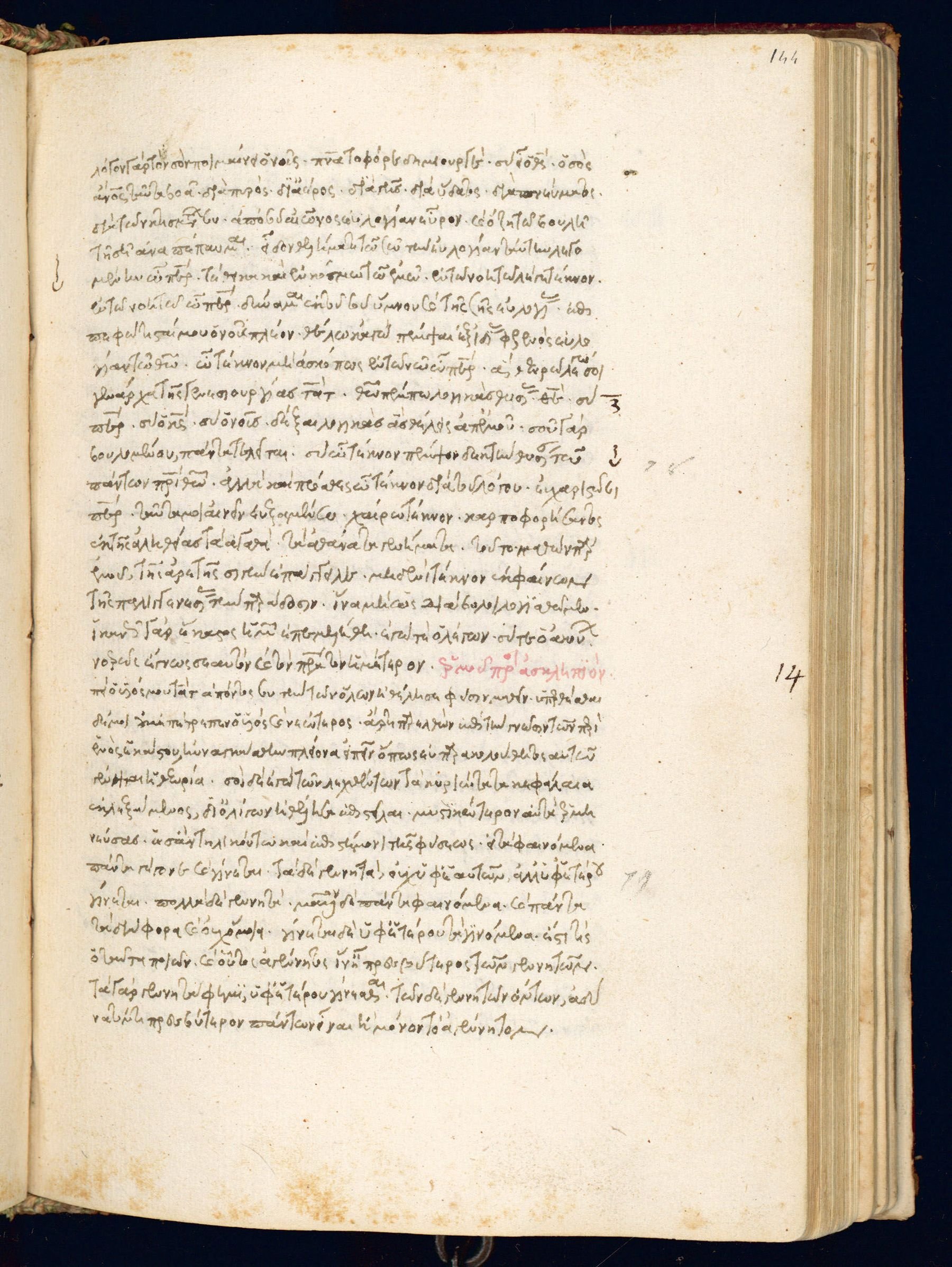
Where on the image
Starts on fol. 143v and continues on fol. 144r (page break inside this section). Laur. Plut. 71.33 fol. 143v begins 'κεκαθαρμένος γάρ· ὁ ποιμάνδρης ὁ τῆς αὐθεντίας νοῦς, πλέον μοι τῶν ἐγ(γεγραμμένων)' on its first line and ends 'λογικὴν θυσίαν· τὸ πᾶν τὸ ἐν ἡμῖν σῶζε ζωή· φώτιζε φῶς· πνεῦμα θε(έ)' on its last line. In the upper half of the page, after 'ἡσύχασον, ὦ τέκνον', the scribe wrote the heading 'ὑμνῳδία' in red at the end of the line; the hymn (section 17) begins on the next line with a red initial: 'Πᾶσα φύσις κόσμου προσδεχέσθω τοῦ ὕμνου τὴν ἀκοήν'. Viewer: https://cdm21059.contentdm.oclc.org/digital/collection/plutei/id/1210245 Laur. Plut. 71.33 fol. 144r begins 'λόγον γὰρ τὸν σὸν ποιμαίνει ὁ νοῦς· πνευματοφόρε δημιουργέ· σὺ ὁ θεός· ὁ σὸς' on its first line. CH XIII ends in the middle of the page: 'νοερῶς ἔγνως σεαυτὸν καὶ τὸν πατέρα τὸν ἡμέτερον', followed on the same line by the red title of CH XIV, 'Ἑρμοῦ πρὸς Ἀσκληπιόν' (a later hand has written '14' in the margin). Viewer: https://cdm21059.contentdm.oclc.org/digital/collection/plutei/id/1210246 Checked on the images. The Greek shown is Parthey's edition, not a transcription of this manuscript.
ταῦτα βοῶσιν αἱ δυνάμεις αἱ ἐν ἐμοί. σὲ τὸ πᾶν ὑμνοῦσι, τὸ σὸν θέλημα τελοῦσιν. ἡ σὴ βουλὴ ἀπὸ σοῦ, ἐπὶ σὲ τὸ πᾶν. δέξαι ἀπὸ πάντων λογικὴν θυσίαν. τὸ πᾶν τὸ ἐν ἡμῖν σῶζε ζωή, φώτιζε φῶς, πνεῦμα θεέ. λόγον γὰρ τὸν σὸν ποιμαίνει ὁ νοῦς, πνευματοφόρε δημιουργέ.
Thus cry the Powers in me. They sing Thy praise, Thou All; they do Thy Will.
From Thee Thy Will; to Thee the All. Receive from all their reasonable oblation. The All that is in us, O Life, preserve; O Light illumine it; O God in-spirit it.
It is Thy Mind that plays the Shepherd to Thy Word, O Thou Creator, Bestower of the Spirit [upon all].
Where on the image
On Laur. Plut. 71.33 fol. 144r. Laur. Plut. 71.33 fol. 144r begins 'λόγον γὰρ τὸν σὸν ποιμαίνει ὁ νοῦς· πνευματοφόρε δημιουργέ· σὺ ὁ θεός· ὁ σὸς' on its first line. CH XIII ends in the middle of the page: 'νοερῶς ἔγνως σεαυτὸν καὶ τὸν πατέρα τὸν ἡμέτερον', followed on the same line by the red title of CH XIV, 'Ἑρμοῦ πρὸς Ἀσκληπιόν' (a later hand has written '14' in the margin). Viewer: https://cdm21059.contentdm.oclc.org/digital/collection/plutei/id/1210246 Checked on the images. The Greek shown is Parthey's edition, not a transcription of this manuscript.
σὺ εἶ ὁ θεός, ὁ σὸς ἄνθρωπος ταῦτα βοᾷ διὰ πυρός, δι᾽ ἀέρος, διὰ γῆς, διὰ ὕδατος, διὰ πνεύματος, διὰ τῶν κτισμάτων σου. ἀπὸ σοῦ αἰῶνος εὐλογίαν εὗρον· καὶ ὃ ζητῶ, βουλῇ τῇ σῇ ἀναπέπαυμαι. εἶδον θελήματι τῷ σῷ τὴν εὐλογίαν ταύτην λεγομένην.
Τάτ. Ὦ πάτερ, τέθεικά σε ἐν κόσμῳ τῷ ἐμῷ.
Ἑρμῆς. Ἐν τῷ νοητῷ λέγε, τέκνον.
Τάτ. Ἐν τῷ νοητῷ, ὦ πάτερ, δύναμαι· ἐκ τοῦ σοῦ ὕμνου καὶ τῆς σῆς εὐλογίας ἐπιπεφώτισταί μου ὁ νοῦς. πλέον θέλω κἀγὼ πέμψαι ἐξ ἰδίας φρενὸς εὐλογίαν τῷ θεῷ.
[For] Thou art God; Thy Man thus cries to Thee through Fire, through Air, through Earth, through Water, [and] through Spirit, through Thy creatures.
'Tis from Thy Æon I have found Praise-giving; and in Thy Will, the object of my search, have I found rest.
Tat. By thy good pleasure have I seen this Praise-giving being sung, O father; I have set it in my Cosmos too.
Her. Say in the Cosmos that thy mind alone can see, my son.
Tat. Yea, father, in the Cosmos that the mind alone can see; for I have been made able by thy Hymn, and by thy Praise-giving my mind hath been illumined. But further I myself as well would from my natural mind send praise-giving to God.
Where on the image
On Laur. Plut. 71.33 fol. 144r. Laur. Plut. 71.33 fol. 144r begins 'λόγον γὰρ τὸν σὸν ποιμαίνει ὁ νοῦς· πνευματοφόρε δημιουργέ· σὺ ὁ θεός· ὁ σὸς' on its first line. CH XIII ends in the middle of the page: 'νοερῶς ἔγνως σεαυτὸν καὶ τὸν πατέρα τὸν ἡμέτερον', followed on the same line by the red title of CH XIV, 'Ἑρμοῦ πρὸς Ἀσκληπιόν' (a later hand has written '14' in the margin). Viewer: https://cdm21059.contentdm.oclc.org/digital/collection/plutei/id/1210246 Checked on the images. The Greek shown is Parthey's edition, not a transcription of this manuscript.
Ἑρμῆς. Ὦ τέκνον, μὴ ἀσκόπως.
Τάτ. Ἐν τῷ νῷ, ὦ πάτερ. ἃ θεωρῶ λέγω σοι, γενάρχα τῆς γενεσιουργίας, Τάτ· θεῷ πέμπω λογικὰς θυσίας. θεὲ, σὺ πάτερ, σὺ ὁ κύριος, σὺ ὁ νοῦς· δέξαι λογικὰς θυσίας ἃς θέλεις ἀπ᾽ ἐμοῦ· σοῦ γὰρ βουλομένου πάντα τελεῖται.
Ἑρμῆς. Σύ, ὦ τέκνον, πέμψον δεκτὴν θυσίαν τῷ πάντων πατρὶ θεῷ. ἀλλὰ καὶ πρόσθες, ὦ τέκνον, διὰ τοῦ λόγου.
Τάτ. Εὐχαριστῶ σοι, πάτερ, ταῦτά μοι αἰνεῖν εὐξαμένῳ.
Her. But not unheedfully, my son.
Tat. Ay. What I behold in mind, that do I say.
To thee, thou Parent of my Bringing into Birth, as unto God I, Tat, send reasonable offerings. O God and Father, thou art the Lord, thou art the Mind. Receive from me oblations reasonable as thou would'st wish; for by thy Will all things have been perfected.
Her. Send thou oblation, son, acceptable to God, the Sire of all; but add, my son, too, " through the Word " (Logos).
Tat. I give thee, father, thanks for showing me to sing such hymns.
Where on the image
On Laur. Plut. 71.33 fol. 144r. Laur. Plut. 71.33 fol. 144r begins 'λόγον γὰρ τὸν σὸν ποιμαίνει ὁ νοῦς· πνευματοφόρε δημιουργέ· σὺ ὁ θεός· ὁ σὸς' on its first line. CH XIII ends in the middle of the page: 'νοερῶς ἔγνως σεαυτὸν καὶ τὸν πατέρα τὸν ἡμέτερον', followed on the same line by the red title of CH XIV, 'Ἑρμοῦ πρὸς Ἀσκληπιόν' (a later hand has written '14' in the margin). Viewer: https://cdm21059.contentdm.oclc.org/digital/collection/plutei/id/1210246 Checked on the images. The Greek shown is Parthey's edition, not a transcription of this manuscript.
Ἑρμῆς. Χαίρω, τέκνον, καρποφορήσαντος ἐκ τῆς ἀληθείας τὰ ἀγαθά, τὰ ἀθάνατα γεννήματα. τοῦτο μαθὼν παρ᾽ ἐμοῦ τῆς ἀρετῆς σιγὴν ἐπάγγειλαι, μηδενί, τέκνον, ἐκφαίνων τῆς παλιγγενεσίας τὴν παράδοσιν, ἵνα μὴ ὡς διάβολοι λογισθῶμεν. ἱκανῶς γὰρ ἕκαστος ἡμῶν ἐπεμελήθη, ἐγώ τε ὁ λέγων σύ τε ὁ ἀκούων. νοερῶς ἔγνως σεαυτὸν καὶ τὸν πατέρα τὸν ἡμέτερον.
Her. Happy am I, my son, that thou hast brought the good fruits forth of Truth, products that cannot die.
And now that thou hast learnt this lesson from me, make promise to keep silence on thy virtue, and to no soul, my son, make known the handing on to thee the manner of Rebirth, that we may not be thought to be calumniators.
And now we both of us have given heed sufficiently, both I the speaker and the hearer thou.
In Mind hast thou become a Knower of thyself and of our [common] Sire.
Notes
- Greek: Gustav Parthey, Hermetis Trismegisti Poemander (Berlin: Nicolai, 1854), cap. 13, pp. 114-128, transcribed from the page images of archive.org poemander00trisgoog and proofread line by line against them (transcription in data/sources/corpus-hermeticum/parthey/parthey1854-ch13.txt). Speaker names (Τάτ., Ἑρμῆς.) are Parthey's. Parthey's apparatus is not shown.
- English: G. R. S. Mead, Thrice-Greatest Hermes, vol. 2 (1906), pp. 219-233, 'The Secret Sermon on the Mountain'. Mead's footnotes are not shown; his square brackets mark words he supplied and '. . . .' marks gaps in the Greek. Mead numbers sections 8, 9 and 19 at other sentences than Parthey; the English is divided here at the words that translate the start of Parthey's sections, and Mead's numerals are left out.
Cite
Sources
- Source: Florence, Biblioteca Medicea Laurenziana, Plut. 71.33 fol. 141v-144r (Biblioteca Medicea Laurenziana, Teca digitale (IIIF)) + Parthey's Greek (1854, transcribed from the page images) + G. R. S. Mead's English (1906) (holding institution)
- Critical edition: Parthey, Hermetis Trismegisti Poemander (1854): CH I via Greek Wikisource, CH XIII transcribed from the 1854 page images
← previous · → next · v cycle view · l back to library