Cuthaean Legend of Naram-Sin (Standard Babylonian version)
Introduction
Naram-Sin describes the enemy hordes created by the gods, his failure to consult the omens, the destruction of his armies, his despair, and the advice he leaves to future rulers: keep calm, guard the land, and do not go out to fight.
The Cuthaean Legend presents itself as an inscription of Naram-Sin, king of Akkad (23rd century BCE), written for his successors. Hordes of strange warriors invade his land; ignoring the omens he attacks them and suffers three defeats, and he learns to trust the gods and to wait. The Standard Babylonian version is the best preserved. This page follows the line numbering of the electronic Babylonian Library edition.
How this page is built. Each section is a run of consecutive lines as written on one photographed clay tablet. For every line the eBL edition (https://www.ebl.lmu.de/corpus/L/1/12/SB/-) lists the manuscripts that carry it, with each tablet's own column and line numbers; the tablet chosen for each run is the photographed copy of the work with the most signs preserved there. Commentaries and texts that only quote a line are never chosen. School and excerpt tablets are used only for lines that no photographed library copy preserves as well, and only where they carry the line as text; their sections say so. The original text is eBL's transliteration of that tablet's signs (not a modern composite text): square brackets mark broken signs, x an illegible sign, # a damaged sign, ? an uncertain reading, and words in {braces} are determinatives; the notes give a key to every sign used on this page, and eBL's layout codes are written out in words (for example '(line break)' or '(blank space)'). Superscript numbers are the line numbers of the eBL edition, used in both the Akkadian and the English. The English is B. R. Foster's translation in the eBL edition (CC BY-NC-SA 4.0), one line of English per line of the text; italics mark uncertain renderings, as in the source. Where the tablet is broken, the English still translates the whole line of eBL's composite text; each section's note names the lines that are broken on its tablet.
Finding a line on the photograph. Each section names the tablet, the face and column, and the tablet's own line numbers (a prime, as in 5', counts from the first preserved line of a broken column). On a tablet with six columns the obverse carries columns i-iii from left to right; the reverse, turned over from bottom to top, carries columns iv-vi from right to left. The photographs often show the obverse above the reverse with the edges around them; a fragment preserves only part of this layout.
This page shows 175 of the 180 lines of the eBL edition (97%), from 5 tablets in the British Museum: 1881,0204.219 (Nineveh), K.5640 (Nineveh), K.5418.A (Nineveh), K.8582 (Nineveh), K.21047 (Nineveh).
Lines not shown. 5 of the 180 lines of the eBL edition are not shown, because no photographed copy of the work used here carries them: 20-21 (no photograph in eBL: SU-1951.67.A (Museum of Anatolian Civilizations, Ankara)); 169-171 (no photograph in eBL: SU-1951.67.A (Museum of Anatolian Civilizations, Ankara)). A line is shown only on a photographed tablet that carries it as text. Commentaries and other texts that quote a line (letters, rituals, god lists) are not used as witnesses, because they carry it with explanations or inside another text; tablets without a photograph in eBL are not used, because the line could not be shown on its tablet.
How was this verified? (Provenance)
Where on the image
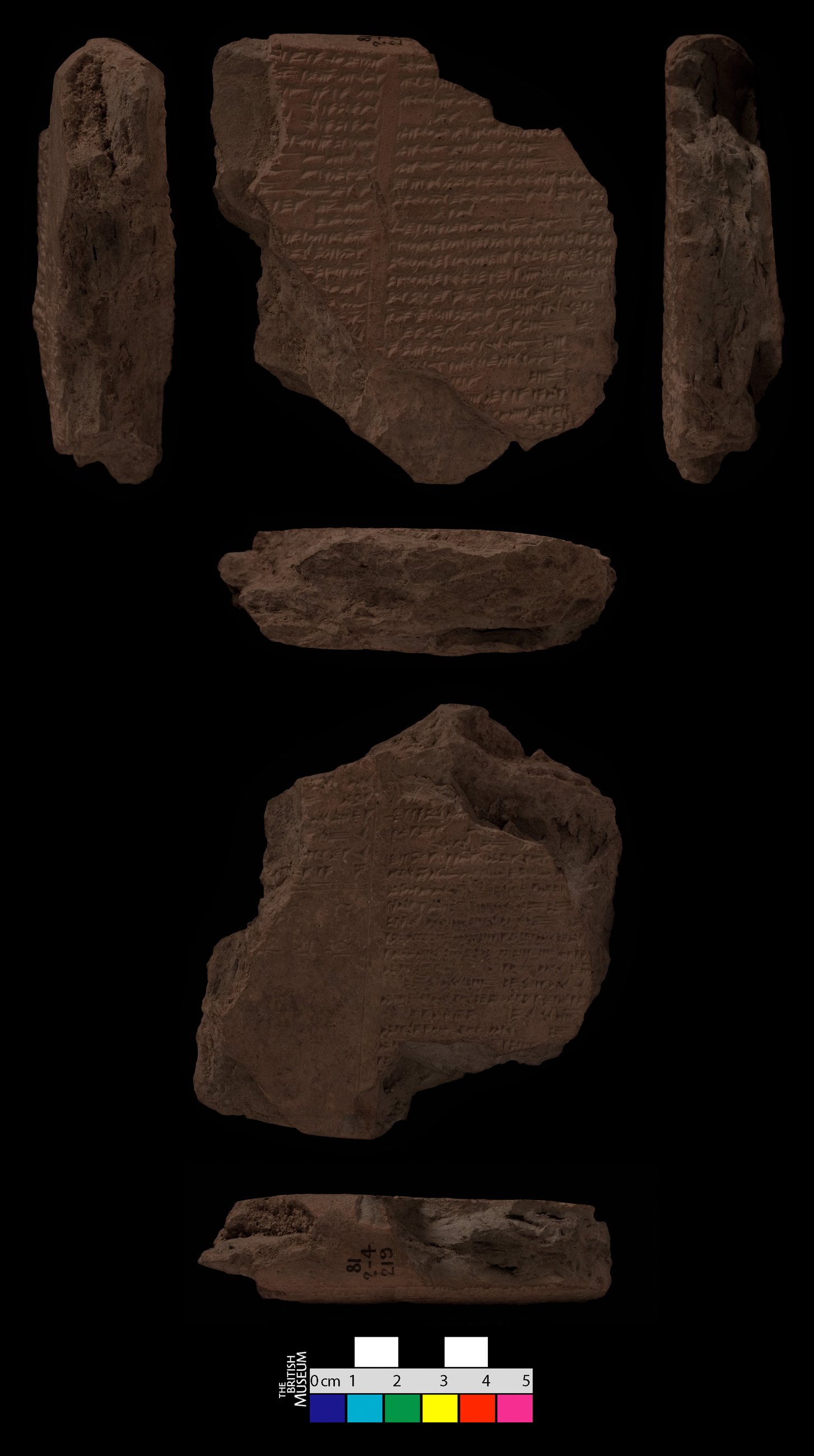
British Museum 1881,0204.219: obverse, column i, the tablet's own lines 1 to 19. eBL's corpus edition (https://www.ebl.lmu.de/corpus/L/1/12/SB/-) attributes SB 1-19 to this manuscript at these column and line numbers. Photograph checked: the obverse has two columns of about 18 and 21 lines. The reverse has a right column of about 17 lines and a worn left column of about 7. This matches eBL's o i 19, o ii 21, r iii 18, r iv 7. Ink 81-2-4,219 is on the obverse and the edge. On this tablet of lines 11, 13, 15-19 only one to three signs survive and lines 1-10, 12, 14 are partly broken (square brackets and x in the Akkadian). The English of these lines translates eBL's composite text, so it includes words that are not preserved on this tablet but are restored from other manuscripts or by the editors. Square brackets in the English mark eBL's restorations in its composite text; words that survive on other tablets carry no brackets even where this tablet is broken. eBL gives no English for line(s) 3.
1[x x x x x x N]A.RU₂.A ši-tas-si
2[x x x x x x x x] DUMU {m}LUGAL-GI.NA
3[x x x x x (x) m]ar*-ṣa-a-ti
4[x x x x a-b]i KUR-a e-mid
5[x x x x x x x a-b]i KUR-a e-mid
6[(x x x x) x x x x mu-m]a-ʾi-ir ma-a-ti
7[(x x x x) x x x x x U₄?-ME]Š ina ZI-hi
8[(x x x x) x x x x x MU?-M]EŠ ina a-la-ki
9[(x x x) x x x x x x x iš?]-ni mi-lik-ša₂
10[(x x x x) x x x x x x x]-šu?#-ma ir-kab
11[x x x x] GAL-MEŠ
12[x x x x x x {d}za-b]a₄-ba₄ {d}a-nu-ni-tu₄
13[x x x x x x q]u-ra-du
14[x x x x x x x x x x] u₂#-ma-ʾi-ir
15[x x x x x x x x i]l?-pu-tu
16[x x x x x K]U₃*-MEŠ
17[x x x x x x x x iq-bu]-u₂#-ni
18[(x) x x x x x x x x x x x x x g]am!?
19[x x x x x x x x x x zi-i-m]a!?
1[Open the foundation box and] read well the [s]tela
2Of all the hardships that Nar[am-Sin], son of Sargon, went through.
3(no English for this line in the eBL edition)
4Sargon, my father, passed away.
5After Sargon, [m]y fat[her], passed away,
6[(…) I became ru]ler of the land.
7[(…) When … day]s had passed,
8[(…) When … year]s had gone by,
9[The land … and] its way of thinking [chan]ged.
10[Against Enmerkar, a host …] its […] and rode.
11[He inquired of the] great god[s],
12[Ishtar, Ilab]a, Zababa, Annunitum,
13[Shullat, Hanish, Shamash] the warrior,
14[He summoned] and charged [diviners],
15[Seven extispicies on seven la]mbs he made,
16[He set up] holy [reed al]tars.
17[The diviners] spoke thus,
18[…]
19[…] pale of face […]
Where on the image
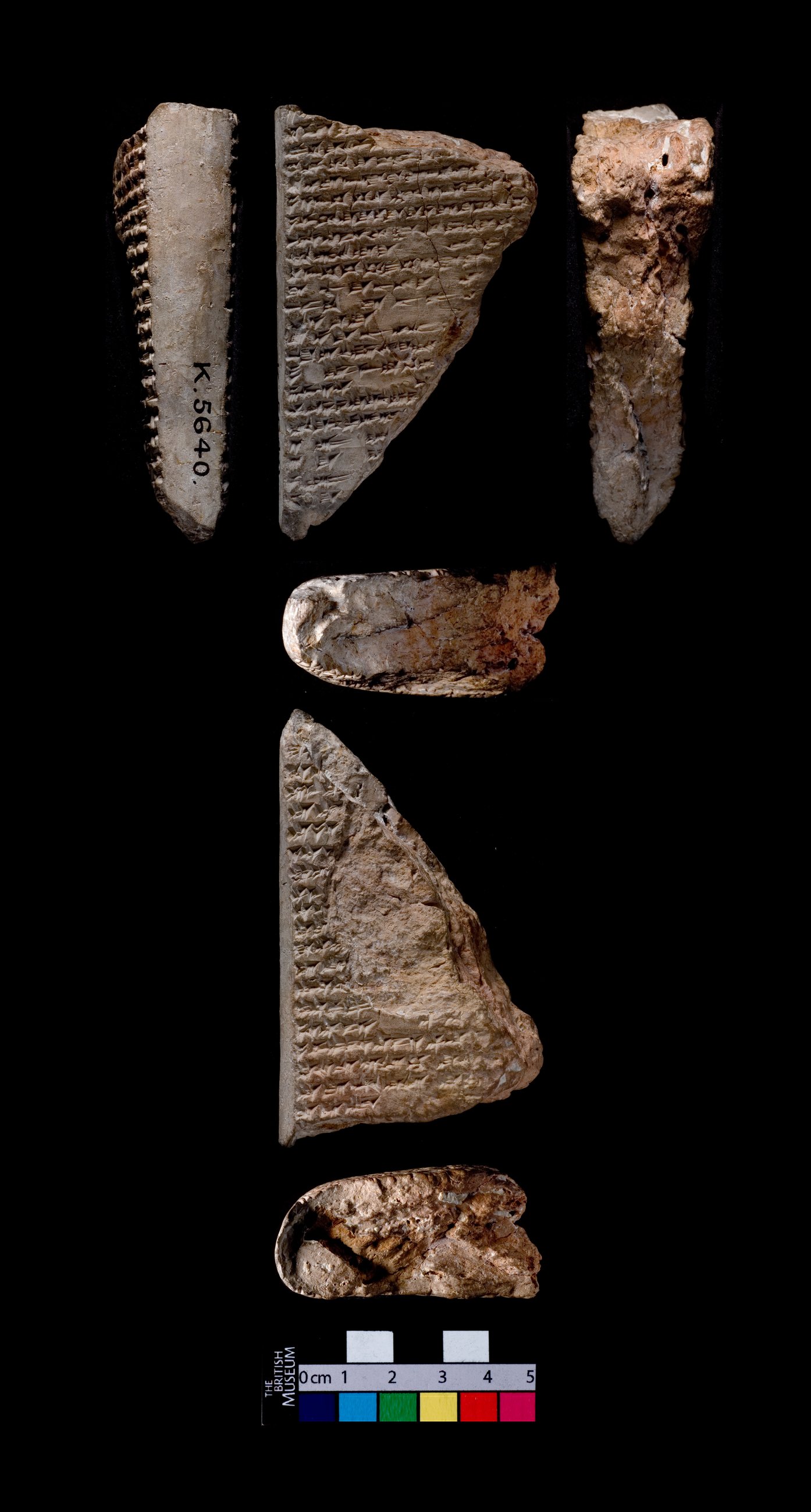
British Museum K.5640: obverse, column i, the tablet's own lines 1' to 6'. eBL's corpus edition (https://www.ebl.lmu.de/corpus/L/1/12/SB/-) attributes SB 22-27 to this manuscript at these column and line numbers. Photograph checked: about 25 lines on the obverse and about 21 on the reverse, with an inscribed left edge, consistent with eBL's o i 24, r iv 21. Ink K.5640 is on the edge. On this tablet of line 22 only one to three signs survive and lines 23-27 are partly broken (square brackets and x in the Akkadian). The English of these lines translates eBL's composite text, so it includes words that are not preserved on this tablet but are restored from other manuscripts or by the editors. Square brackets in the English mark eBL's restorations in its composite text; words that survive on other tablets carry no brackets even where this tablet is broken.
22a#-d[i* (x x x) x x x x x x x]
23en-me-kar₂ A[D₆-taš? x x x x x x x x x x x x (x)]
24de-en-šu EŠ.BAR x [x x x x x x x x (x)]
25[x x x x x] (line break) GIDIM₄ NUNUZ-šu GIDIM₄# NUNUZ# NU[NUZ?-šu x x x x x]
26EN# AN.TA-MEŠ u₃ KI.TA-MEŠ# EN {d}a-nun#-n[a-ki x x x x]
27ša₂ A-MEŠ dal-hu-te NAG u A-MEŠ za-ku-te N[U? x x]
22No sooner had the great [go]ds [spoken thus],
23Enmerkar [became like a] corpse, Shamash [rendered] a harsh judgment on him.
24The judgment on him, the verdict …, his ghost, the gho[sts of …],
25The ghosts of his family, the ghosts of his offspring, the ghosts of his offspring’s offspring, O Shamash the warrior,
26Lord of Above and Below, the lord of the Anunna-gods, lord of the ghosts (of the dead)!
27It was that they drink muddy water and drink no clear water (in the netherworld).
Where on the image
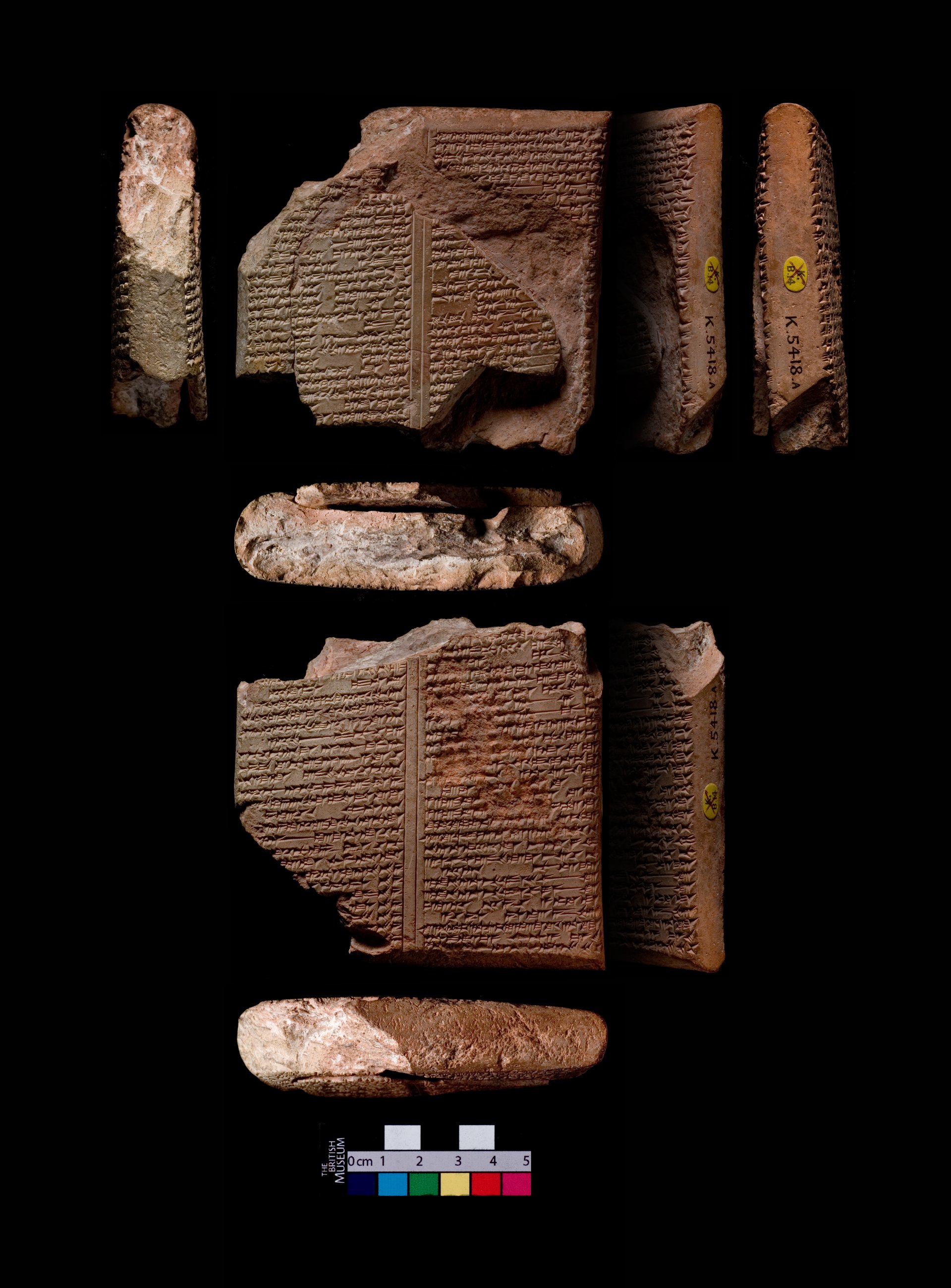
British Museum K.5418.A: obverse, column i, the tablet's own lines 1'-2' to 23'. eBL's corpus edition (https://www.ebl.lmu.de/corpus/L/1/12/SB/-) attributes SB 28-46 to this manuscript at these column and line numbers. Photograph checked: obverse, reverse and edges, with two columns per face of about 20 to 25 lines each, consistent with eBL's 19, 25, 24 and 25 lines. Ink K.5418.A is on the right edge, alongside yellow stickers. On this tablet of lines 42, 45-46 only one to three signs survive and lines 28, 36-41, 43-44 are partly broken (square brackets and x in the Akkadian). The English of these lines translates eBL's composite text, so it includes words that are not preserved on this tablet but are restored from other manuscripts or by the editors. Square brackets in the English mark eBL's restorations in its composite text; words that survive on other tablets carry no brackets even where this tablet is broken. Lines 29-35 are complete on this tablet.
28[x igi]-gal₂#-la#-šu₂# {giš#}T[UKUL-šu₂ ERI]N₂ šu#-a#-tu# ik#-mu#-u₂# (line break) (blank space) ik-šu-du i-na-ru
29ina# NA#.RU₂#.A ul SAR ul TAG₄-am-ma pag-ri u pu-u-ti
30MU ul u₂-še-ṣi-ma ul ak-ta-rab-šu₂
31ERIN₂-MEŠ pag-ri iṣ-ṣur hur-ri a-me-lu-ti (line break) (blank space) a-re-bu pa-nu-šu₂-un
32ib-nu-šu₂-nu-ti-ma DINGIR-MEŠ GAL-MEŠ
33ina qaq-qar ib-nu-u₂ DINGIR-MEŠ a-lu-šu₂
34ti-a-ma-tu u₂-še-niq-šu₂-nu-ti
35ša₃-sur-šu₂-nu {d}be-let-i₃-li₂ u₂-ban-ni
36in[a] q[e₂-r]eb KUR-i ir-ti-bu-ma i-te-eṭ-lu-ma (line break) (blank space) ir-ta-šu₂-u mi-na-ti
37[x LUG]AL-MEŠ-ni at-hu-u₂ šu-pu-u ba-nu-tu
38[x LIM].AM₃ um-ma-na-tu-šu₂-nu
39[x x x x] AD!?#-šu₂-nu LUGAL AMA-šu₂-nu (line break) (blank space) [šar]-ra-tu {munus}me-li-li
40[x x x x x a-l]i[k p]a-ni-šu₂-nu {m}me-ma-an-duh MU-NI
41[x x x x x] {m#}me-du-du MU-NI
42[x x x x x {m}x]-x-pah MU-NI
43[x x x x x {m}tar-ta-d]a-da MU-NI
44[x x x x x {m}bal-da]h!?-dah MU-NI
45[x x x x x {m}a-hu-da-na-di-i]h!? MU-NI
46[x x x x x x x x x x x M]U-NI
28That his sagacity and weaponry captured, defeated, (slew) that host,
29(Enmerkar) did not write upon a stela, nor did he, for my benefit, leave one behind for me,
30He did not put forth his name, so I did not bless him.
31Troops with bodies of “cave birds,” humans with raven faces
32Did the great gods create,
33In the place they created (them), the gods were their cohabitants.
34Tiamat suckled them,
35Belet-ili their mother made (them) fair.
36Inside the mountain(s) they grew up, became adults, got their stature.
37Seven kings they were, allies, they were glorious in form,
386,000 were their troops.
39Anu-banini, their father was king; their mother (was named) queen Melili,
40Their eldest brother, their vanguard, was named Memanduh,
41Their second brother was named Medudu,
42Their third brother was named […]pish,
43Their fourth brother was named Tartadada,
44Their fifth [br]other was named Baldahdah,
45Their sixth brother was named Ahudanadih,
46Their [seve]nth brother was named Hurrukidu.
Where on the image
British Museum 1881,0204.219: obverse, column ii, the tablet's own lines 1 to 23. eBL's corpus edition (https://www.ebl.lmu.de/corpus/L/1/12/SB/-) attributes SB 47-66 to this manuscript at these column and line numbers. Photograph checked: the obverse has two columns of about 18 and 21 lines. The reverse has a right column of about 17 lines and a worn left column of about 7. This matches eBL's o i 19, o ii 21, r iii 18, r iv 7. Ink 81-2-4,219 is on the obverse and the edge. On this tablet of lines 47-48 only one to three signs survive and lines 49-66 are partly broken (square brackets and x in the Akkadian). The English of these lines translates eBL's composite text, so it includes words that are not preserved on this tablet but are restored from other manuscripts or by the editors. Square brackets in the English mark eBL's restorations in its composite text; words that survive on other tablets carry no brackets even where this tablet is broken.
47KUR-MEŠ K[U₃-MEŠ x x x x x]
48re-du-u₂# [x x x x x x x x x x x x x]
49re-eš sa-na-q[i₂-šu₂-nu x x x x x x x x x] (line break) (blank space) is-s[a-qu-ni]
50{uru}pu-ru-uš-ha-an-dar# gi#-mir# [x (x) x x x x x]
51{uru}pu-uh-lu-u₂ [x x x]
52{uru}pu-ra-an-šu-u₂ [x x x]
53lu ṣa a muh na aš₂-hu-hu ah-ha-hu# [x x x (x x x)]
54lup-pu-du lul-bu-u₂ ERIN₂-man-da ka#-[ra-na-a] (line break) (blank space) šu-bat-{d}+e[n-lil₂]
55u qe₂-reb su-bar-ti DU₃-šu₂-nu it-[tas-pa-hu]
56is#-pu-hu-ma ti-a-ma-ti ana gu-ti-um is-s[a-an-qu-ni?]
57is-pu-hu-ma gu-ti-um ana {kur}ELAM.MA{ki} is-s[a-an-qu-ni?]
58is-pu-hu-ma {kur}ELAM.MA{ki} ana sa-pan-ni ik-t[al-du]
59id-du#-ku ša₂ ne₂-be₂-ri ŠUB-u₂ a#-[na x]
60dilmun{ki} ma₂-gan-na me-luh-ha qe₂-re[b x x] (line break) (blank space) ma-la ba-šu-u₂ it#-[tas?-pa?-hu?]
6117 LUGAL-MEŠ EN 90 LIM um-m[a-na-ti-šu₂-nu]
62it#-ti#-šu₂#-nu ana re-ṣu-ti-šu₂-nu it#-t[a?-aš₂-ki-nu-ni]
63[x x re-d]a-a u₂-ma#-[ʾi-ir]
64[x x x x] ṣil#-la-a a-na Š[U-MIN-šu₂ x x]
65[x x x x lu-pu-u]t ina ṣil-le-e [x x x]
66[x x x x x x x k]i-i# na#-ši#-ma# [x x x x]
47They rode against the sacred mountains,
48A soldier apprehended them, they [s]mote their thighs.
49At the beginning of their advance, they ad[vance]d on Burushandar,
50The land of Burushandar, its entire extent, was dispersed,
51Puhlu was dispersed,
52Puranshu [was d]ispers[ed].
53[…] (Na)shhuhu, Ahhahu, … [(…)] …
54Lubbudu, Lulbu, Ummanmanda, Karana, Shubat-E[nlil],
55And Inner Subartu, all of them [were] disp[ersed].
56They dispersed the Sealand, th[ey] advan[ced] on Gutium,
57They dispersed Gutium, they advance[d] on Elam,
58They destroyed Elam, they arrived at the (sea)coast,
59They killed the people at the place of embarkation, threw (them) into the river,
60Dilmun, Magan, Meluhha, whatever (lands) are in the midst of the sea, ([were] dis[persed]).
61Seventeen kings with 90,000 troops
62Sided with them to support them.
63[I s]ummoned a soldier and charged him,
64I set [a dagg]er and a pin in his hand,
65“Stab with the d[agg]er, prick with the pin.
66“[I]f blood comes out, they are human like us.
Where on the image
British Museum K.5418.A: obverse, column ii, the tablet's own lines 1' to 29'. eBL's corpus edition (https://www.ebl.lmu.de/corpus/L/1/12/SB/-) attributes SB 67-91 to this manuscript at these column and line numbers. Photograph checked: obverse, reverse and edges, with two columns per face of about 20 to 25 lines each, consistent with eBL's 19, 25, 24 and 25 lines. Ink K.5418.A is on the right edge, alongside yellow stickers. On this tablet of line 67 only one to three signs survive and lines 68-78, 80-81 are partly broken (square brackets and x in the Akkadian). The English of these lines translates eBL's composite text, so it includes words that are not preserved on this tablet but are restored from other manuscripts or by the editors. Square brackets in the English mark eBL's restorations in its composite text; words that survive on other tablets carry no brackets even where this tablet is broken. Lines 79, 82-91 are complete on this tablet. eBL gives no English for line(s) 68.
67[x x x x E₃]-ni!# [x x x x x]
68[u₂-tuk]-ki# ra#-bi#-ṣu# lem-nu-te# ši#-pir# {d#}+e[n-lil₂ x x]
69re#-du#-u₂ ṭe₃-en-šu₂ u₂-ti[r-ram-ma]
70ina [lu-ṭ]e-e al-p[u-ut]
71ina ṣil#-le#-e# aš₂-hul#-ma da-me it-ta-ṣ[u-ni]
72al#-si# DUMU-MEŠ {lu₂#}HAL-MEŠ u₂-ma-ʾi#-[ir]
737# a#-na?# pa?#-an?# 7# {udu}SILA₄ al-pu-t[u?]
74u₂#-[kin {gi}GUH]ŠU-MEŠ KU₃-MEŠ#
75a-šal#-m[a] DINGIR#-MEŠ GAL-MEŠ
76{d}iš#-tar i[l₃-a-b]a₄ {d}za-ba₄-ba₄ {d}a-nu-ni-tu₄
77{d}šullat₂# {d#}[haniš] {d}UTU# qu-ra-du
78na[m-za-aq x x] GAL!?#-MEŠ# ana a-la-ki-ia (line break) (blank space) [x za-qi₂-qi₂-i]a ul i-di-na-am-ma
79ki#-a#-am# aq#-bi a-na lib₃-bi-ia (line break) (blank space) um-ma lu#-u# a#-na#-ku-ma
80a-a-u₂ UR.M[AH bi]-ra# ib-ri
81a-a-u₂ UR.BAR#.R[A x (x) x] ša₂#-il-tu
82lul-lik ki-i DUMU hab#-ba#-ti# ina# mi₃#-gir# lib₃#-bi-ia
83u₃ lu-ud-di ša₂ DINGIR-ma# ia#-a-ti lu#-uṣ#-bat
84MU.AN.NA mah-ri-tu ina ka#-ša₂-di
852 UŠ LIM ERIN₂ u₂-še-ṣi-ma ina ŠA₃-šu₂-nu (line break) (blank space) 1-en TI NU GUR-ra
862-tu₄ MU.AN.NA ina KUR-di 90 LIM KIMIN
873-tu₄ MU.AN.NA ina KUR-di 60 LIM 7 ME KIMIN
88es-se-hu en-ne₂-šu₂ a-ka-la (line break) (blank space) a-šu₂-uš uš-ta-ni-ih
89ki-a-am aq-bi a-na lib₃-bi-ia um-ma lu-u a-na-ku-ma
90a-na pa-le-e mi#-na-a e-zib
91a-na-ku# LUGAL# la# mu#-šal#-li-mu KUR-šu₂
67“[If] no blood comes out, they are evil fiend, fate, [phan]tom, demons, handiwork of Enlil.”
68(no English for this line in the eBL edition)
69The soldier brought back his report back to me,
70“I stabbed with the [dagg]er,
71“I pricked with the pin, and blood came out.”
72I summoned and charged diviners,
73Seven extispicies upon seven lambs I performed,
74I set up holy reed altars.
75I inquire[d] of the great gods,
76Ishtar, Ilaba, Zababa, Annunitu,
77Shullat, H[anish], Shamash the warrior.
78The latchke[y] of the great g[o]ds did not allow my going nor my vain intent.
79Speaking to myself, thus I said,
80“What lion undertook divination?
81“What wolf consulted a dream interpreter?
82“I will go, as I like, like a brigand,
83“I will cast off what belongs to the gods, I will hold fast (only) to myself!”
84When the first year had come,
85I sent out 120,000 troops against them, not one returned alive.
86When the second year arrived, I sent out 90,000 (troops against them, not one returned alive).
87When the third year arrived, I sent out 60,700 (troops against them, not one returned alive).
88I was confounded, bewildered, checked, anxious, in despair.
89Speaking to myself, thus I said,
90“What have I left for a reign?
91“I am a king who brings no well-being to his land,
Where on the image
British Museum K.5418.A: reverse, column iii, the tablet's own lines 1 to 26. eBL's corpus edition (https://www.ebl.lmu.de/corpus/L/1/12/SB/-) attributes SB 92-114 to this manuscript at these column and line numbers. Photograph checked: obverse, reverse and edges, with two columns per face of about 20 to 25 lines each, consistent with eBL's 19, 25, 24 and 25 lines. Ink K.5418.A is on the right edge, alongside yellow stickers. On this tablet of lines 98, 113-114 only one to three signs survive and lines 96-97, 99-112 are partly broken (square brackets and x in the Akkadian). The English of these lines translates eBL's composite text, so it includes words that are not preserved on this tablet but are restored from other manuscripts or by the editors. Square brackets in the English mark eBL's restorations in its composite text; words that survive on other tablets carry no brackets even where this tablet is broken. Lines 92-95 are complete on this tablet.
92u₃ re-e₂-um la# mu-šal-li-mu um-ma#-ni#-šu₂
93ki lu-uš-tak-kan-ma pag-ri u pu-ti lu-še-ṣi#
94ša₂-lum-mat ne₂-ši <<mu ši>> mu-u-tu NAM.TAR a-ru-ur-tu₂
95na#-mur#-ra-tu hur-ba-šu₂ i₃-bi₂-su-u ne₂-eb-ri-tu
96[x x x d]i-hu di-lip-tu ma-la ba-šu-u (line break) (blank space) [K]I-šu₂#-nu iṭ-ṭar-da
97[x x x x x AN?]-e!?# ša₂#-kin# a-bu-bu
98[x x x x x x x x x a-bu]-bu# ba-ši
99{d#}[e₂-a x x x x x x x x] i#-qab-bi
100i-za[k-kar x x x x at-he]-e#-šu₂
101DINGIR-MEŠ G[AL-MEŠ x x te?-pu?]-ša₂
102taq-ba-nim-ma# a[š₂?-šu₂? (x) x x x x x x hul-lu-q]i₂?
103u₃ šub-šu-u₂# [x x x x x da?-ri]š? (line break) (blank space) ta-ZUR-[x x (x x x)]-a
104ZAG.MUK ša₂ 4-ti M[U.AN.NA x ka-ša₂-d]i
105ina te-me-qi₂ ša₂ {d}e₂-a i[na su-(up)-pe]-e# (line break) (blank space) ša₂ DINGIR-MEŠ [GAL-ME]Š
106SISKUR₂ ZAG.MUK KU₃-ME[Š aq-q]i₂
107te-re-e-te KU₃-MEŠ u[š-te-ši-r]u?
108al-si DUMU-MEŠ {lu₂}HAL-MEŠ u₂-[ma-ʾi-i]r
1097 a-na pa-an 7 {udu}SILA₄ al-p[u-t]u!?
110u₂-kin {gi#}GUHŠU-MEŠ K[U₃-ME]Š
111a-šal-ma [DI]NGIR-MEŠ G[AL-ME]Š
112{d}iš-tar# [x x x {d}za-ba₄-b]a₄ {d#}[a-nu-ni-t]u₄
113{d}šullat₂# [x x x x qu-ra-d]u
114DUMU# [x x x x x x x iq-bu-u₂-n]i
92“And a shepherd who brings no well-being to his people.
93“How shall I place myself that I may bring myself out of this (ordeal)?”
94Fear of lions, death, fate, convulsions,
95Panic, ague, economic collapse, starvation,
96D[iseas]e, migraine, sleeplessness of every sort had come down here with them.
97Above, from heaven, a deluge having been decided,
98Below, from the depths, (…) a deluge being imminent,
99Lord Ea made ready to speak,
100Saying to the gods his br[eth]ren,
101“O great gods, since yo[u di]d this,
102“You commanded me, that the b[ree]d of human[ki]nd be annihilated,
103“[But you g]ods have (long ago) decided that people should be [kept in exi]stence [fo]rever.”
104When New Year of the fourth year arrived,
105With entreaty to Ea and with prayer to the great gods,
106[I m]ade the holy New Year libations,
107I pe[rform]ed correctly the holy commands.
108I summoned and ch[arge]d diviners,
109Seven extispicies upon seven lambs I performed,
110I set up holy reed altars.
111I inquired of the gr[ea]t [g]ods,
112Ishtar, [Ila]ba, Zababa, A[nnunit]u,
113Shullat, [Hanish, Shamash the warri]or.
114The div[iners spoke to m]e [thus],
Where on the image
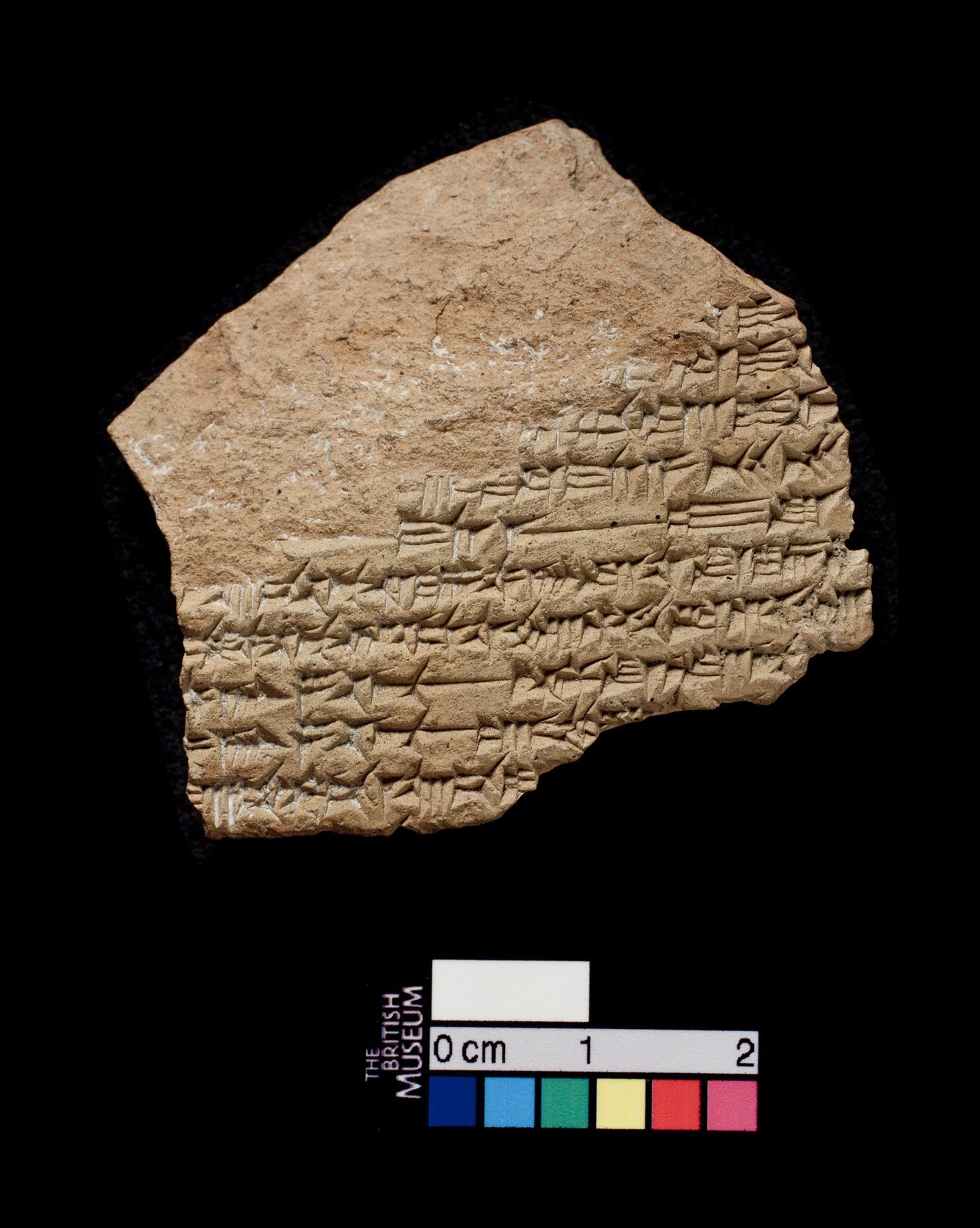
British Museum K.8582: reverse, column iii?, the tablet's own lines 1' to 10'. eBL's corpus edition (https://www.ebl.lmu.de/corpus/L/1/12/SB/-) attributes SB 115-124 to this manuscript at these column and line numbers. Photograph checked: one face with about 10 to 11 lines, consistent with eBL's 11 lines in reverse column iii(?). No ink number is visible. On this tablet of line 115 only one to three signs survive and lines 116-124 are partly broken (square brackets and x in the Akkadian). The English of these lines translates eBL's composite text, so it includes words that are not preserved on this tablet but are restored from other manuscripts or by the editors. Square brackets in the English mark eBL's restorations in its composite text; words that survive on other tablets carry no brackets even where this tablet is broken.
115[x x x x x x x (x)]-na#-aš₂-š[u₂*-nu-ti]
116[(x) x x x x x x] (x) tab!?#/tar!?#/lib!?#-ba-aš₂-šu₂*-n[u*-ti]
117[x x x x x (x) a]n!?/d]u!? šum# ta-aš₂-šu₂*-n[u*-ti]
118[x x x x] u₂#-šar#-da-a qul-mu-[u₂?]
119(blank space) [i]na da-me i-ṭeb-[bu]
120ina# lib₃#-bi-šu₂-nu 12 {lu₂}ERIN₂-MEŠ ip-par-šu-in-n[i-(ma)]
121[E]GIR-šu₂-nu ar-du-ud ah-muṭ ur-ri-ih-[ma]
122[E]RIN₂-MEŠ ša₂-šu₂-nu ak-šu-su-nu-t[i-ma]
123[ER]IN₂-MEŠ ša₂-šu₂-nu u₂-tir#-ra[š]-š[u₂-nu-ti-ma]
124[k]i-a-am aq-bi ana lib₃-bi-i[a x x x x x x]
115“[…] … t[he]m,
116“[…] … th[em],
117“[…] … th[em],
118“The battleax will shed [their blood],
119“[They] will be submerg[ed i]n blood.”
120From among them twelve troops flew off from m[e],
121I [pur]sued them in haste and hurry,
122I overtook those [tr]oops,
123I brought those troops back.
124Speaking to myself, t[hus I s]aid,
Where on the image
British Museum 1881,0204.219: reverse, column iii, the tablet's own lines 3'-4' to 18'. eBL's corpus edition (https://www.ebl.lmu.de/corpus/L/1/12/SB/-) attributes SB 125-140 to this manuscript at these column and line numbers. Photograph checked: the obverse has two columns of about 18 and 21 lines. The reverse has a right column of about 17 lines and a worn left column of about 7. This matches eBL's o i 19, o ii 21, r iii 18, r iv 7. Ink 81-2-4,219 is on the obverse and the edge. On this tablet of lines 139-140 only one to three signs survive and lines 125-134, 136-138 are partly broken (square brackets and x in the Akkadian). The English of these lines translates eBL's composite text, so it includes words that are not preserved on this tablet but are restored from other manuscripts or by the editors. Square brackets in the English mark eBL's restorations in its composite text; words that survive on other tablets carry no brackets even where this tablet is broken. Line 135 is complete on this tablet.
125ba-lu bi#-r[i? x x x x x] (line break) (blank space) ul ub-ba[l x x]
126{udu}SILA₄ a-na UGU-šu₂-nu [x x x]
127nam-za-aq DINGIR-MEŠ GAL-MEŠ g[i-mil-šu₂-nu x x]
128{mul}dil-bat KU₃-tu₄ iš-tu AN-e# [x x x x x x x]
129a-na {m}na-ram-{d}30-mi DUMU {m#}[LUGAL-GI.NA]
130e-zib NUMUN hal-qa₂-ti-i la# [x x x]
131ana ar₂-kat₃ u₄-me {d}+en-lil₂ ana HUL-ti i-na-a[š₂-ša₂ x x x]
132ana ag-gi lib₃-bi {d}+en-lil₂ u₂-qa-a-u?# [x x x]
133URU ERIN₂-MEŠ šu-nu-ti in#-[na?-qa?-ru?]
134(blank space) i-qam-mu-u₂ i-lam-mu-u [x x x]
135URU da-mu-šu₂-nu i-tab-ba-ku
136KI-tu iš-[pi-ki-ša₂] (line break) (blank space) {giš}GIŠIMMAR bi-lat-sa [x x x]
137URU ERIN₂-MEŠ šu₂-nu-ti i-m[ut-tu]
138URU [K]I URU# E₂# KI# E₂# i#-[nak-kir]
139a-b[u? x x x x x]
140GU[RUŠ x x x x x x x x x]
125“Without divination (of liver), flesh, and entr[ails], I must not la[y hand (on them)].”
126I perform[ed] extispicy concerning them,
127The latchkey of the great gods [ordered] mercy for them.
128The shining Morning Star appro[ached me] from heaven thus,
129“To Naram-Sin, son of S[ar]gon:
130“Cease, you shall not destroy the roving breed,
131“In future days Enlil will call them to account for the evil (they have done),
132“They must expect the angry heart of Enlil.
133“The polity of those troops will be des[troy]ed,
134“They will burn (it), dogs will surround (it).
135“That polity’s blood will be shed,
136“Earth will diminish her harvests, date orchards their yield.
137“The polity of those troops will die.
138“City against city, house against house will turn.
139“Father t[o so]n, brother to brother,
140“M[an] to man, companion to friend,
Where on the image
British Museum K.5640: reverse, column iv, the tablet's own lines 2' to 5'. eBL's corpus edition (https://www.ebl.lmu.de/corpus/L/1/12/SB/-) attributes SB 141-144 to this manuscript at these column and line numbers. Photograph checked: about 25 lines on the obverse and about 21 on the reverse, with an inscribed left edge, consistent with eBL's o i 24, r iv 21. Ink K.5640 is on the edge. On this tablet of lines 141, 143-144 only one to three signs survive and line 142 is partly broken (square brackets and x in the Akkadian). The English of these lines translates eBL's composite text, so it includes words that are not preserved on this tablet but are restored from other manuscripts or by the editors. Square brackets in the English mark eBL's restorations in its composite text; words that survive on other tablets carry no brackets even where this tablet is broken.
141it#-t[i x x x x x x x x x x x x]
142UN-MEŠ la k[i?-na-a-ti x x x x x x x x x x x (x)]
143URU nak#-[ru x x x x x]
144URU ša₂-a-[šu₂ x x x x x x x]
141“None will tell the truth to each other.
142“People will be taught untruth, strange things …
143“This host[ile] city – it (they) will be defeated,
144“This city [fa]mine will take over,
Where on the image
British Museum K.5418.A: reverse, column iv, the tablet's own lines 2' to 26'. eBL's corpus edition (https://www.ebl.lmu.de/corpus/L/1/12/SB/-) attributes SB 145-168 to this manuscript at these column and line numbers. Photograph checked: obverse, reverse and edges, with two columns per face of about 20 to 25 lines each, consistent with eBL's 19, 25, 24 and 25 lines. Ink K.5418.A is on the right edge, alongside yellow stickers. On this tablet of lines 145-147, 168 only one to three signs survive and lines 148-153, 155, 162-167 are partly broken (square brackets and x in the Akkadian). The English of these lines translates eBL's composite text, so it includes words that are not preserved on this tablet but are restored from other manuscripts or by the editors. Square brackets in the English mark eBL's restorations in its composite text; words that survive on other tablets carry no brackets even where this tablet is broken. Lines 154, 156-161 are complete on this tablet.
145[x x x x x x x x x ŠE?.BA]R!? i-m[ah-har]
146[x x x x x x x (x x x) x KU]R? ul ib!?-[ši (x)]
147[x x x x x (x) bi-b]il-ti u₂#-[bil-lu-(niš)-šu₂-nu-ti]
148[x x x x da]-a#-ki u[l u₂-b]il-šu₂#-nu#-ti#
149[x x x x {l]u₂}ENS[I₂ x x l]u mam₂-ma ša₂-na-ma
150[x x] i#-nam-b[u-šu₂-ma LU]GAL-ta DU₃-uš
151[tup-šen-n]a e-pu-uš#-ka# NA#.RU₂.A aš₂-ṭur-ka
152[ina GU₂.D]U₈.A{ki} ina e₂-mes-lam
153[ina p]a-pah {d#}U.GUR e-zi-bak-ka
154{na₄#}NA.RU₂.A an-na-a a-mur-ma
155ša₂ pi-i {n[a₄}N]A.RU₂.A an-na-a ši-me#-ma
156la te-se-eh#-hu la te-en-neš-šu₂
157la ta-pal#-lah la ta-tar-ru-ur
158iš-da-a-ka lu-u ki-na
159at-ta ina su-un MUNUS-ka ši-pir lu DU₃-uš
160BAD₃-MEŠ-ka tuk-kil
161hi-ra-ti-ka A-MEŠ mul-li
162pi-sa-an-na-ti-ka ŠE.IM-ka KU₃.BABBAR-ka (line break) (blank space) NIG₂.Š[U]-ka
163NIG₂.GA-ka (line break) [a]-na# URU# [dan]-nu-ti-ka šu-rib
164[x x x x ru-k]u-us-ma tub₂-qa-a-ti e-mid
165[x x x x x] u₂-ṣur pu-ut-ka šul-lim
166[x x x KUR-k]a e tu-ṣi-šu₂
167[x x x x bu-l]a e ta-as-niq-šu₂
168[x x x x x re-d]u?-ti#-ka#
145“Ten quarts of barley will fetch on[e shekel of sil]ver.
146“No strong king … […] … was present in the land.”
147The great gods carried them off as tribute,
148(Whereas) I laid n[o] hand on them to kill.
149Whoever you may be, governor, prince, or anyone else,
150Whom the gods shall name to exercise k[in]gship,
151I have made a foundation box for you, I have written you a stela,
152In C[u]tha in the Emeslam,
153In the cella of Nergal have I left it for you.
154Behold this stela,
155Listen to the wording of this stela.
156You should not be confounded, you should not be bewildered,
157You should not be afraid, you should not tremble,
158Your stance should be firm.
159You should do your task in your wife’s embrace.
160Make your walls trustworthy,
161Fill your moats with water.
162Your coffers, your grain, your silver, your goods and chat[tels]
163Bring into your fortified city.
164Wrap up your [we]apons and lean them in a corner,
165Restrain your warriors, take care of your person.
166Though he raids your land, go not out against him,
167Though he … your livestock, go not nigh him,
168Though he eats the flesh of your soldiery,
Where on the image
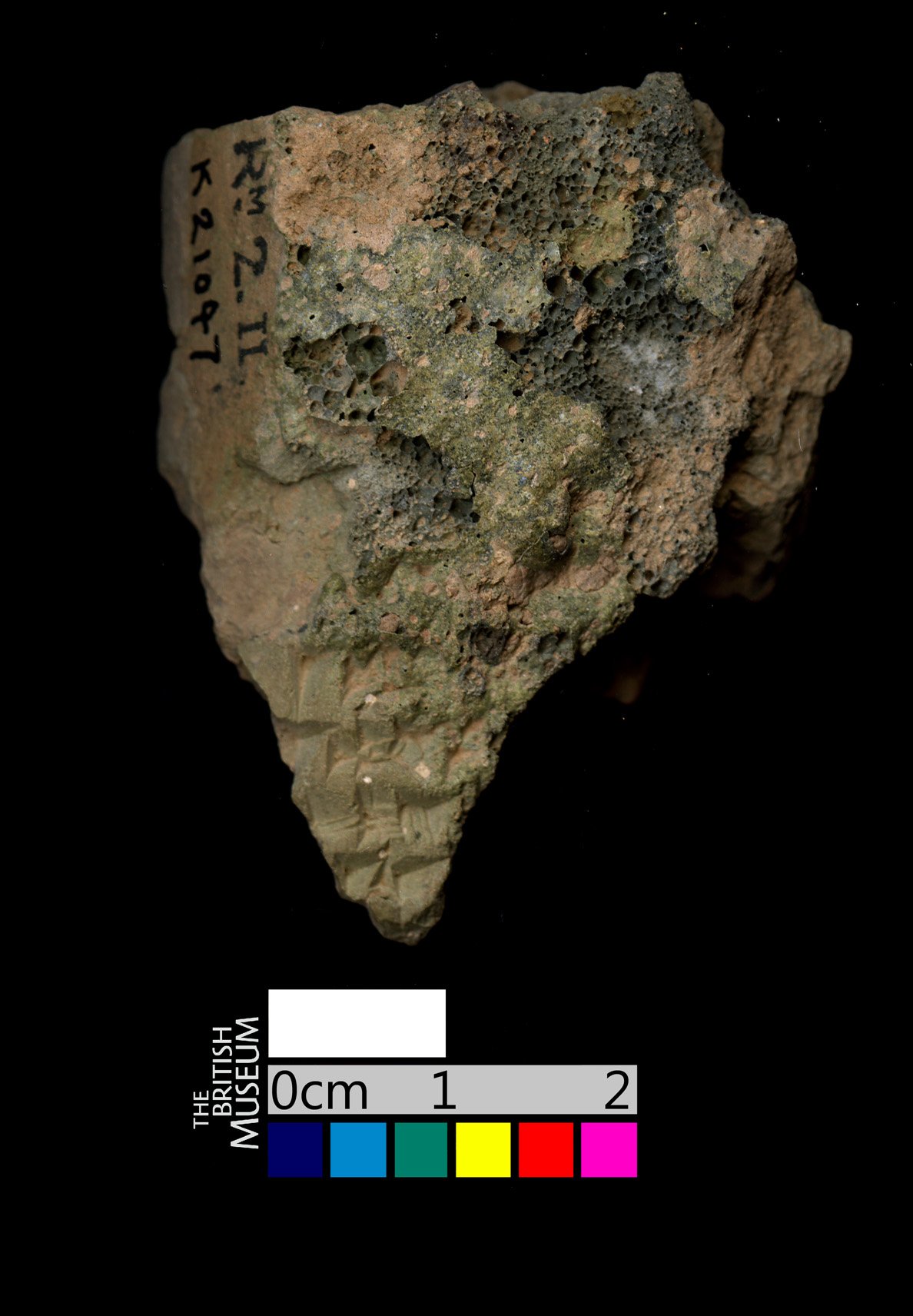
British Museum K.21047: reverse, column iv, the tablet's own lines 1' to 3'. eBL's corpus edition (https://www.ebl.lmu.de/corpus/L/1/12/SB/-) attributes SB 172-174 to this manuscript at these column and line numbers. Photograph checked: one face, mostly covered by a bubbly burnt crust, with about 4 to 5 legible lines in the uncovered lower part, close to eBL's 6 lines in reverse column iv. Ink Rm 2,II(?) and K 21047. On this tablet of lines 172-174 only one to three signs survive. The English of these lines translates eBL's composite text, so it includes words that are not preserved on this tablet but are restored from other manuscripts or by the editors. Square brackets in the English mark eBL's restorations in its composite text; words that survive on other tablets carry no brackets even where this tablet is broken.
172[an]a gul#-[lul-ti-šu₂-nu x x x x]
173ana dum#-[qi₂ x x x x x x x x x]
174[a]na mah-r[i-šu₂-nu x x x x x]
172To their wickedness, repay kindness,
173To kindness (add) gifts and gratifications.
174Avoid them whenever you can.
Where on the image
British Museum 1881,0204.219: reverse, column iv, the tablet's own lines 2' to 7'. eBL's corpus edition (https://www.ebl.lmu.de/corpus/L/1/12/SB/-) attributes SB 175-180 to this manuscript at these column and line numbers. Photograph checked: the obverse has two columns of about 18 and 21 lines. The reverse has a right column of about 17 lines and a worn left column of about 7. This matches eBL's o i 19, o ii 21, r iii 18, r iv 7. Ink 81-2-4,219 is on the obverse and the edge. On this tablet of lines 175-180 only one to three signs survive. The English of these lines translates eBL's composite text, so it includes words that are not preserved on this tablet but are restored from other manuscripts or by the editors. Square brackets in the English mark eBL's restorations in its composite text; words that survive on other tablets carry no brackets even where this tablet is broken. eBL gives no English for line(s) 176, 178, 180.
175[x x x en-q]u-ti
176[x x x NA.RU₂].A#-ka
177[x x (x) x x x x x ta]-mu-ru-ma
178[x x x tu-še]-ṣu-u
179[x x x x x x x a]r-ku-u
180[x x x x k]a-a-ša₂
175Let expert scribes word a stela for you.
176(no English for this line in the eBL edition)
177You who have read my stela and so have brought yourself out of (an ordeal like mine),
178(no English for this line in the eBL edition)
179You who have blessed me, so may a future one bless you.
180(no English for this line in the eBL edition)
Notes
- Akkadian: eBL transliteration of the signs on the photographed tablet (manuscript-level ATF), not a composite text.
- English: B. R. Foster's translation in the eBL edition; it renders eBL's composite text, including restorations from other tablets.
- Line numbers: eBL edition. Each section also gives the tablet's own column and line numbers.
- Signs in the Akkadian: [ ] broken away; x illegible sign; # damaged sign; ? uncertain reading; ! sign corrected by the editor; * collated sign; ( ) signs perhaps broken away; { } determinative; << >> sign written in error by the scribe; / alternative readings; (line break) the line runs on to the next line of the tablet; (blank space) a space left by the scribe.
Cite
Sources
- Source: British Museum tablet photographs + eBL manuscript transliterations (eBL corpus edition L I.12, Cuthaean Legend of Naram-Sin (ed. T. D. N. Mitto), SB -) + English of the eBL edition (B. R. Foster (eBL edition)) (holding institution)
- Critical edition: electronic Babylonian Library, Cuthaean Legend of Naram-Sin (ed. T. D. N. Mitto), manuscript transliterations
← previous · → next · v cycle view · l back to library