Cyrus Cylinder, lines 6-36 (BM 90920)
Introduction
The Cyrus Cylinder is a barrel-shaped clay cylinder inscribed in Babylonian cuneiform for Cyrus II (the Great), king of Persia, after he took Babylon in 539 BCE. It was buried in the foundations of the city wall of Babylon, where it was found in 1879 by Hormuzd Rassam; it is in the British Museum (BM 90920). The text says that Nabonidus, the last king of Babylon, neglected the cult of Marduk, that Marduk chose Cyrus, who entered Babylon without a battle, and that Cyrus returned the gods of many cities to their shrines and gathered their peoples back to their settlements. This policy is often compared with the decree of Cyrus in the Old Testament that allowed the Jews to return to Jerusalem and rebuild the temple (Ezra 1:1-4; 2 Chronicles 36:22-23), although the cylinder names only Mesopotamian cities and gods.
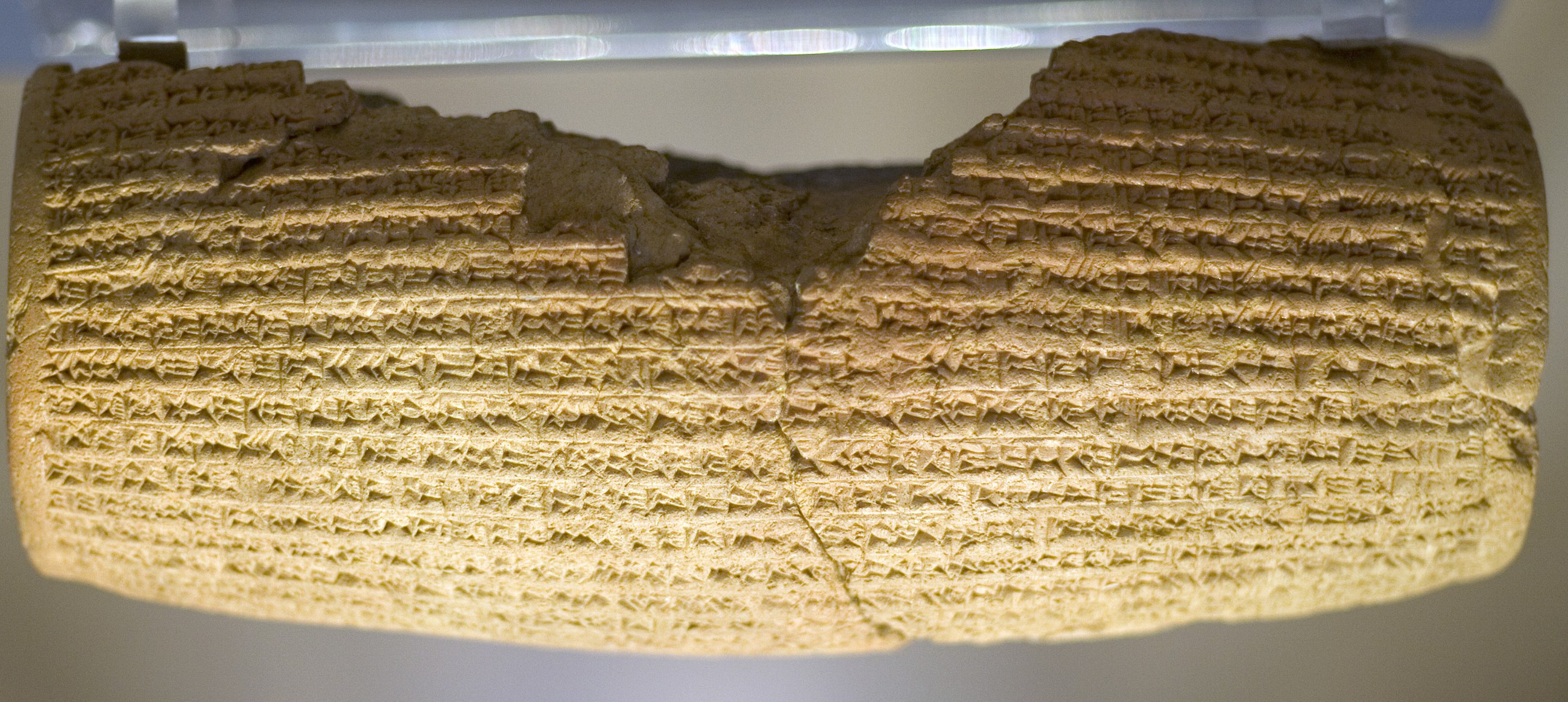
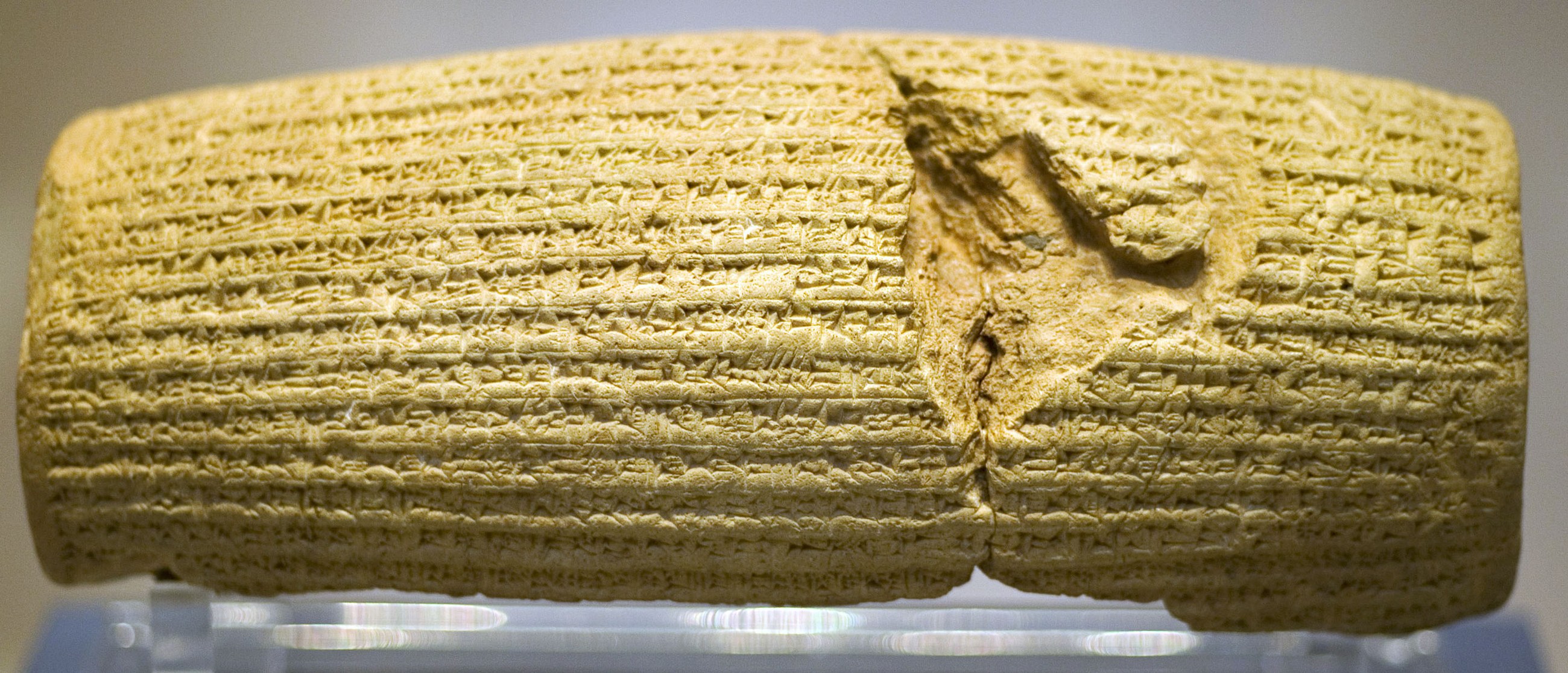
This entry is partial. It gives lines 6-36, which the two available photographs show: the side with lines 5-22 and the side with lines 20-36. Lines 1-5 and 37-46 are not included, because no openly available photograph shows them (the beginning of the text is badly broken, and the last lines are on the side that rests on the stand). The Akkadian and English are ARIo's edition (after I. Finkel), divided into ARIo's paragraphs.
How was this verified? (Provenance)
Where on the image
Lines 6-8: in the band of lines broken in the middle by the break that runs down from the upper edge (Rawlinson's lacuna in lines 5-11); the starts of these lines are preserved at the left of the break. The lines run along the cylinder and follow one another round it; the bands shown in each photograph were identified by matching the breaks with Rawlinson's line-numbered copy (V R 35, 1880) and with the brackets of the ARIo text (see the importer). Brackets mark restorations that are not on the cylinder.
6pa-ra-aṣ la si-ma-ti-šu-nu ta-[ak-li-im la me-si ... la] pa-liḫ ú-mi-ša-am-ma id-de-né-eb-bu-ub ù ⸢a-na ma-ag⸣-ri-tim
7sat-tuk-ku ú-šab-ṭi-li ú-⸢la⸣-[ap-pi-it pél-lu-de-e ... iš]-tak-ka-an qé-reb ma-ḫa-zi pa-la-ḫa dAMAR.UTU LUGAL DINGIR.MEŠ ⸢ig-mur⸣ kar-šu-uš-šu
8le-mu-ut-ti URU-šu [i]-⸢te⸣-né-ep-pu-⸢uš⸣ u₄-mi-ša-am-⸢ma⸣ x x [...] ⸢UN⸣.MEŠ-šú i-na ab-ša-a-ni la ta-ap-šu-úḫ-tim ú-ḫal-li-iq kul-lat-si-in
6Daily, he devised cultic rites that were not befitting them, [impure] food of[ferings, ..., dis]respectful [...] and, as a spiteful act, he brought sattukku-offering to a halt, int[erfered with pelludû-rites (and) est]ablished [...] inside cult-centers. Reverence for the god Marduk, the king of the gods, c[ame to an en]d in his mind. Daily, [he was pe]rforming evil deeds against his city (Babylon); ... [...] his [pe]ople, he brought ruin on all of them with an unrelenting yoke.
Where on the image
Lines 9-14: lines 9-10 where the break narrows towards its lower end (Rawlinson's lacuna in lines 9-11), line 11 at the lower end of the break, lines 12-14 the first complete lines below it. The lines run along the cylinder and follow one another round it; the bands shown in each photograph were identified by matching the breaks with Rawlinson's line-numbered copy (V R 35, 1880) and with the brackets of the ARIo text (see the importer). Brackets mark restorations that are not on the cylinder.
9a-na ta-zi-im-ti-ši-na dEN.LÍL DINGIR.MEŠ ez-zi-iš i-gu-ug-⸢ma⸣ [...] ki-su-úr-šu-un DINGIR.MEŠ a-ši-ib lìb-bi-šu-nu i-zi-bu at-⸢ma⸣-an-šu-un
10i-na ug-ga-ti-ša ú-še-ri-bi a-na qé-reb šu-an-na.KI dAMAR.UTU ⸢ti⸣-[iz-qa-ru dEN.LÍL DINGIR].⸢MEŠ⸣ us-sa-aḫ-ra a-na nap-ḫar da-ád-mi ša in-na-du-ú šu-bat-su-un
11ù UN.MEŠ KUR-šu-me-ri ù URI.KI ša i-mu-ú ša-lam-ta-áš ú-sa-⸢aḫ⸣-ḫi-ir ka-⸢bat⸣-[ta-áš] ir-ta-ši ta-a-a-ra kul-lat ma-ta-a-ta ka-li-ši-na i-ḫi-iṭ ib-re-e-ma
12iš-te-eʾ-e-ma ma-al-ki i-šá-ru bi-bil lìb-bi-ša it-ta-ma-aḫ qa-tu-uš-šu mku-ra-áš LUGAL URU.an-ša-an it-ta-bi ni-bi-it-su a-na ma-li-ku-tim kul-la-ta nap-ḫar iz-zak-ra šu-⸢um-šú⸣
13KUR.qu-ti-i gi-mir um-man-man-da ú-ka-an-ni-ša a-na še-pi-šu UN.MEŠ ṣal-mat SAG.DU ša ú-ša-ak-ši-du qa-ta-a-šú
14i-na ki-it-tim ù mi-šá-ru iš-te-né-eʾ-e-ši-na-a-tim dAMAR.UTU EN GAL ta-ru-ú UN.MEŠ-šú ep-še-e-ti-ša dam-qa-a-ta ù lìb-ba-šu i-ša-ra ḫa-di-iš ip-pa-li-⸢is⸣
9The Enlil of the gods became furiously angry at their complaints an[d ...] their territory. The gods living inside them abandoned their shrines, angry that he had made (them) enter Šuanna (Babylon). The god Marduk, the ex[alted one, the Enlil of the god]s, relented; [his] (hostile) attit[ude] changed towards all of the inhabited settlements whose dwellings were in ruins and the people of the land of Sumer and Akkad who had become like corpses; he became forgiving. 11bHe (Marduk) inspected (and) examined all of the lands, everyone of them, and constantly sought out a righteous king, the desire of his heart. He took Cyrus (II), the king of Anšan, into his hand, called (him) by his name, (and) proclaimed him (lit. “his name”) to be the ruler of the entirety of everything. He made the land of the Gutians (and) all of the Umman-manda (Medes) bow down at his feet. (As for) the black-headed people whom he allowed his hand to conquer, he was assiduous towards their welfare in truth and justice. The god Marduk, the great lord, the one who nurtures his people, look[ed] with pleasure upon his good deeds and righteous heart.
Where on the image
Lines 15-17: the fourth to sixth complete lines below the break, in the middle of the photograph. The lines run along the cylinder and follow one another round it; the bands shown in each photograph were identified by matching the breaks with Rawlinson's line-numbered copy (V R 35, 1880) and with the brackets of the ARIo text (see the importer). Brackets mark restorations that are not on the cylinder.
15a-na URU-šu KÁ.DINGIR.MEŠ.KI a-la-ak-šu iq-bi ú-ša-aṣ-bi-it-su-ma ḫar-ra-nu TIN.TIR.KI ki-ma ib-ri ù tap-pe-e it-tal-la-ka i-da-a-šu
16um-ma-ni-šu rap-ša-a-tim ša ki-ma me-e ÍD la ú-ta-ad-du-ú ni-ba-šu-un GIŠ.TUKUL.MEŠ-šu-nu ṣa-an-du-ma i-ša-ad-di-ḫa i-da-a-šu
17ba-lu qab-li ù ta-ḫa-zi ú-še-ri-ba-áš qé-reb šu-an-na.KI URU-šu KÁ.DINGIR.MEŠ.KI i-ṭi-ir i-na šap-ša-qí mdAG-NÍ.TUKU LUGAL la pa-li-ḫi-šu ú-ma-al-la-a qa-tu-uš-šú
15He (Marduk) commanded that he (Cyrus) should march against his city, Babylon. He made him take the road to Babylon and, like a friend and companion, he marched at his side. His widespread troops, whose number, like the water of a river, cannot be ascertained, marched fully armed at his side. Without a fight or battle, he allowed him to enter Šuanna (Babylon). He saved his city, Babylon, from hardship. He delivered Nabonidus, the king who did not revere him, into his hands.
Where on the image
Lines 18-19: the seventh and eighth lines below the break, in the lower half of the photograph. The lines run along the cylinder and follow one another round it; the bands shown in each photograph were identified by matching the breaks with Rawlinson's line-numbered copy (V R 35, 1880) and with the brackets of the ARIo text (see the importer). Brackets mark restorations that are not on the cylinder.
18UN.MEŠ TIN.TIR.KI ka-li-šu-nu nap-ḫar KUR-šu-me-ri u URI.KI ru-bé-e ù šak-ka-nak-ka ša-pal-šu ik-mi-sa ú-na-áš-ši-qu še-pu-uš-šu iḫ-du-ú a-na LUGAL-ú-ti-šú im-mi-ru pa-nu-uš-šú-un
19be-lu ša i-na tu-kul-ti-ša ú-bal-li-ṭu mi-tu-ta-an i-na pu-uš-qu ù ú-de-e ig-mi-lu kul-la-ta-an ṭa-bi-iš ik-ta-ar-ra-bu-šu iš-tam-ma-ru zi-ki-ir-šu
18The people of Babylon, all of them, the entirety of the land of Sumer and Akkad, (as well as) the nobles and governor(s), bowed down before him (and) kissed his feet. They were happy at him being king (and) their faces shone. (As for) the lord, who through his (Marduk’s) support revived the dying (and) universally spared (them) from trouble and hardship, they graciously blessed him (and) praised his name.
Where on the image
Lines 20-22: at the lower edge of the back view and at the upper edge of the front view, where line 21 is the first line touched by the tip of the large break. The lines run along the cylinder and follow one another round it; the bands shown in each photograph were identified by matching the breaks with Rawlinson's line-numbered copy (V R 35, 1880) and with the brackets of the ARIo text (see the importer). Brackets mark restorations that are not on the cylinder. The last clause of ARIo's paragraph, which renders the first part of line 23, is given in the next section with that line.
20a-na-ku mku-ra-áš LUGAL kiš-šat LUGAL GAL LUGAL dan-nu LUGAL TIN.TIR.KI LUGAL KUR-šu-me-ri ù ak-ka-di-i LUGAL kib-ra-a-ti er-bé-et-tim
21DUMU mka-am-bu-zi-ia LUGAL GAL LUGAL URU.an-ša-an DUMU DUMU mku-ra-áš LUGAL GAL ⸢LUGAL URU⸣.an-ša-an ŠÀ.BAL.BAL mši-iš-pi-iš LUGAL GAL LUGAL URU.an-šá-an
22NUMUN da-ru-ú ša LUGAL-ú-tu ša dEN u dAG ir-a-mu pa-la-a-šu a-na ṭu-ub lìb-bi-šú-nu iḫ-ši-ḫa ⸢LUGAL⸣-ut-su e-nu-ma a-⸢na qé⸣-reb TIN.TIR.KI e-ru-bu sa-li-mi-iš
20I, Cyrus (II), king of the world, great king, strong king, king of Babylon, king of the land of Sumer and Akkad, king of the four quarters (of the world), son of Cambyses (I) — great king, king of Anšan — grandson of Cyrus (I) — great king, kin[g of] Anšan — descendant of Teispes — great king, king of Anšan — the eternal seed of kingship, whose reign the gods Bēl (Marduk) and Nabû love and whose k[ingshi]p they desired to their heart’s content. When I peacefully entered i[n]to Babylon,
Where on the image
Lines 23-25: the upper part of the large break (Rawlinson's lacuna in lines 21-31) interrupts these lines at about 60-75 % of their length. The lines run along the cylinder and follow one another round it; the bands shown in each photograph were identified by matching the breaks with Rawlinson's line-numbered copy (V R 35, 1880) and with the brackets of the ARIo text (see the importer). Brackets mark restorations that are not on the cylinder. ARIo begins its paragraph inside line 23 ('(23b)') and translates the first part of line 23 at the end of the previous paragraph; that clause ('amidst joy and happiness, I took up (my) lordly residence in the palace of the ruler.') is given here, with line 23. The last clause of ARIo's paragraph, which renders the first part of line 26, is given in the next section with that line.
23i-na ul-ṣi ù ri-ša-a-tim i-na É.GAL ma-al-ki ar-ma-a šu-bat be-lu-tú dAMAR.UTU EN GAL lìb-bi ri-it-pa-šu ša ra-⸢im⸣ TIN.TIR.KI ši-⸢ma-a-tiš iš-ku?-na⸣-an-ni-ma u₄-mi-šam a-še-eʾ-a pa-la-⸢aḫ⸣-šú
24um-ma-ni-ia rap-ša-tim i-na qé-reb TIN.TIR.KI i-ša-ad-di-ḫa šu-ul-ma-niš nap-ḫar ⸢KUR⸣-[šu-me-ri] ⸢ù⸣ URI.KI mu-gal-⸢li⸣-tim ul ú-šar-ši
25⸢URU.KI⸣ KÁ.DINGIR.RA.KI ù kul-lat ma-ḫa-zi-šu i-na ša-li-im-tim áš-te-eʾ-e DUMU.MEŠ TIN.TIR.[KI ...] ⸢ša⸣ ki-ma la lìb-[bi] ⸢DINGIR⸣-ma ab-šá-a-ni la si-ma-ti-šú-nu šu-ziz-⸢zu⸣
23amidst joy and happiness, I took up (my) lordly residence in the palace of the ruler. 23bThe god Marduk, the great lord, established for me as (my) des[ti]ny the great magnanimity of one who loves Babylon and daily I strive to revere him. My widespread troops marched peacefully inside Babylon. I did not allow the whole of the lan[d of Sumer] and Akkad to have troublemakers. I sought out the welfare of the city of Babylon and all of its shrines. (As for) the citizens of Babylon, [..., wh]o would have endured a yoke not befitting them if not for the wi[ll of go]d,
Where on the image
Lines 26-29: the widest part of the large break interrupts these lines at about 57-76 % of their length. The lines run along the cylinder and follow one another round it; the bands shown in each photograph were identified by matching the breaks with Rawlinson's line-numbered copy (V R 35, 1880) and with the brackets of the ARIo text (see the importer). Brackets mark restorations that are not on the cylinder. ARIo begins its paragraph inside line 26 ('(26b)') and translates the first part of line 26 at the end of the previous paragraph; that clause ('I allowed (them) to find rest for their exhaustion (and) I relieved (them) off their ...') is given here, with line 26. The last clause of ARIo's paragraph, which renders the first part of line 30, is given in the next section with that line.
26an-ḫu-ut-su-un ú-pa-áš-ši-ḫa ú-ša-ap-ṭi-ir sa-ar-ma-šu-nu a-na ep-še-e-ti-[ia dam-qa-a-ti] dAMAR.UTU EN ⸢GAL⸣-ú iḫ-de-e-ma
27a-na ia-a-ti mku-ra-áš LUGAL pa-li-iḫ-šu ù mka-am-bu-zi-ia DUMU ṣi-it lìb-bi-[ia ù a]-⸢na⸣ nap-⸢ḫar⸣ um-ma-ni-ia
28da-am-qí-iš ik-ru-ub-ma i-na šá-lim-tim ma-ḫar-ša ṭa-bi-iš ni-it-⸢ta⸣-[al-la-ak i-na qí-bi-ti-šú] ṣir-ti nap-ḫar LUGAL a-ši-ib BÁRA.MEŠ
29ša ka-li-iš kib-ra-a-ta iš-tu tam-tim e-li-tim a-di tam-tim šap-li-tim a-ši-ib ⸢na⸣-[gi-i né-su-tim] LUGAL.MEŠ KUR a-mur-ri-i a-ši-ib kuš-ta-ri ka-li-šú-un
26I allowed (them) to find rest for their exhaustion (and) I relieved (them) off their ... 26bThe god Marduk, the gre[a]t lord, was pleased with [my good] deeds and he kindly pronounced a blessing over me – Cyrus (II), the king who reveres him — and Cambyses (II) — the son, [my] offspring — [and] the entir[ety of] my army so that we, [at his] exalted [command], could constantly walk about happily before him in good health. All of the kings who sit on (royal) daises, from every quarter (of the world), from the Upper Sea to the Lower Sea, those who live in [remote] re[gions], (and) the kings of the land of Amurru who live in tents, everyone of them,
Where on the image
Lines 30-32: lines 30-31 are interrupted by the lower end of the large break, line 32 is the first complete line below it. The lines run along the cylinder and follow one another round it; the bands shown in each photograph were identified by matching the breaks with Rawlinson's line-numbered copy (V R 35, 1880) and with the brackets of the ARIo text (see the importer). Brackets mark restorations that are not on the cylinder. ARIo begins its paragraph inside line 30 ('(30b)') and translates the first part of line 30 at the end of the previous paragraph; that clause ('brought their substantial tribute inside Šuanna (Babylon) (and) kissed my feet.') is given here, with line 30.
30bi-lat-su-nu ka-bi-it-tim ú-bi-lu-nim-ma qé-er-ba šu-an-na.KI ú-na-áš-ši-qu še-pu-ú-a iš-tu [šu-an-na].⸢KI⸣ a-di URU.aš-šur.KI ù MÙŠ.EREN.KI
31a-kà-dè.KI KUR.èš-nu-nak URU.za-am-ba-an URU.me-túr-nu BÀD.DINGIR.KI a-di pa-aṭ KUR.qu-ti-i ma-ḫa-⸢za⸣ [e]-⸢ber⸣-ti ÍD.IDIGNA ša iš-tu pa-na-ma na-du-ú šu-bat-su-un
32DINGIR.MEŠ a-ši-ib lìb-bi-šú-nu a-na áš-ri-šu-nu ú-ter-ma ú-šar-ma-a šu-bat da-rí-a-ta kul-lat UN.MEŠ-šú-nu ú-pa-aḫ-ḫi-ra-am-ma ú-te-er da-ád-mi-šú-un
30brought their substantial tribute inside Šuanna (Babylon) (and) kissed my feet. 30bFrom [Šuanna (Babylon)] to Aššur and Susa, Agade, Ešnunna, Zabbān, Mê-Turān, Dēr, as far as the border of the land of the Gutians, (and) cult-centers on the opposite side of the Tigris River whose dwellings had previous been in ruins — I returned the deities who live inside them to their (proper) places and I made (them) reside in (their) eternal dwelling(s). I gathered (together) all of their people and returned (them to) their settlements.
Where on the image
Lines 33-36: the second to fifth lines below the large break, crossed by the crack that runs down from it. The lines run along the cylinder and follow one another round it; the bands shown in each photograph were identified by matching the breaks with Rawlinson's line-numbered copy (V R 35, 1880) and with the brackets of the ARIo text (see the importer). Brackets mark restorations that are not on the cylinder.
33ù DINGIR.MEŠ KUR-šu-me-ri ù URI.KI ša mdAG-NÍ.TUKU a-na ug-ga-tì EN DINGIR.MEŠ ú-še-ri-bi a-na qé-reb šu-an-na.KI i-na qí-bi-ti dAMAR.UTU EN GAL i-na ša-li-im-tim
34i-na maš-ta-ki-šu-nu ú-še-ši-ib šu-ba-at ṭu-ub lìb-bi <<ut>> kul-la-ta DINGIR.MEŠ ša ú-še-ri-bi a-na qé-er-bi ma-ḫa-zi-šu-un
35u₄-mi-ša-am ma-ḫar dEN ù dAG ša a-ra-ku UD.MEŠ-ia li-ta-mu-ú lit-taz-ka-ru a-ma-a-ta du-un-qí-ia ù a-na dAMAR.UTU EN-ia li-iq-bu-ú ša mku-ra-áš <<áš>> LUGAL pa-li-ḫi-ka u mka-am-bu-zi-ia DUMU-šú
36ku x [x x x] ⸢ib?⸣ šu-nu lu-ú za-ni-ni BÁRA-i-ni a-na UD.MEŠ ⸢SÙ⸣.[MEŠ ...] ⸢ù⸣ UN.MEŠ TIN.TIR.KI ⸢ik-tar-ra-bu⸣ LUGAL-ú-tu KUR.KUR ka-li-ši-na šu-ub-ti né-eḫ-tim ú-še-ši-ib
33Moreover, (as for) the deities of the land of Sumer and Akkad who Nabonidus, incurring the wrath of the lord of the gods (Marduk), had brought into Šuanna (Babylon), at the command of the god Marduk, the great lord, I allowed (them) to live in peace in their abodes, (in) the dwelling(s) of (their) heart’s content. May all of the deities whom I made enter into their cult-centers speak daily about my life being long (and) may they mention favorable words about me in the presence of the gods Bēl (Marduk) and Nabû. Furthermore, may they say this to the god Marduk, my lord: “[(As for) the ...] of Cyrus (II), the king who reveres you, and Cambyses (II), his son, [...] may they be the ones who provision our shrines until distant days.” Also, the people of Babylon blessed (my) kingship. I allowed the lands, all of them, to live undisturbed.
Notes
- ARIo's English is divided into paragraphs that do not always begin at a line start; a number such as 23b marks a paragraph that begins inside line 23. ARIo translates the first part of such a line (23a) at the end of the previous paragraph; that clause is moved to the section that carries the line, so each section's English covers the same lines as its Akkadian. Lines 9-14 form one section because ARIo's English for lines 10 and 11 is interwoven.
- The transliteration follows ARIo: Sumerian word-signs in capitals, determinatives raised (m before a man's name, d before a god's name), half brackets for damaged signs, square brackets for restorations.
Cite
Sources
- Source: British Museum BM 90920, photographs by Prioryman on Wikimedia Commons (CC BY-SA 3.0) + ORACC ARIo text and translation (CC BY-SA 3.0) (holding institution)
- Critical edition: ORACC ARIo Cyrus II 1 (after I. Finkel)
← previous · → next · v cycle view · l back to library