Daodejing, chapter 33 (Mawangdui silk manuscripts)
Introduction
Chapter 33 of the Daodejing (Laozi), shown on the two oldest nearly complete copies of the work: the silk manuscripts Laozi A and Laozi B, found in 1973 in Tomb 3 at Mawangdui, Changsha (Hunan), a tomb sealed in 168 BCE. Laozi A is written in a script between seal and clerical forms and does not avoid the personal name of the Han founder Liu Bang (邦); it is commonly dated before 195 BCE. Laozi B is in clerical script, avoids 邦, and is commonly dated 194-180 BCE. Both put the De part (chapters 38-81) before the Dao part (chapters 1-37), and a few chapters stand in a different order from the received text.
Each section gives the silk transcription column by column, with the Jicheng column number before each column (for Laozi B, 上 and 下 are the upper and lower halves of a column, photographed on facing plates), and links to the plate that carries those columns. □ marks a lost character; ∠, ‧ and ﹦ are marks written on the silk (﹦ repeats the character before it). Below the transcription is the received text of the Wang Bi recension, which is the text James Legge translated in 1891; the silk wording differs from it, most visibly in 恆 for received 常 (the received text avoids the name of Emperor Wen, Liu Heng), in the frequent final particle 也, and in loan characters such as 胃 for 謂.
How was this verified? (Provenance)
Where on the image
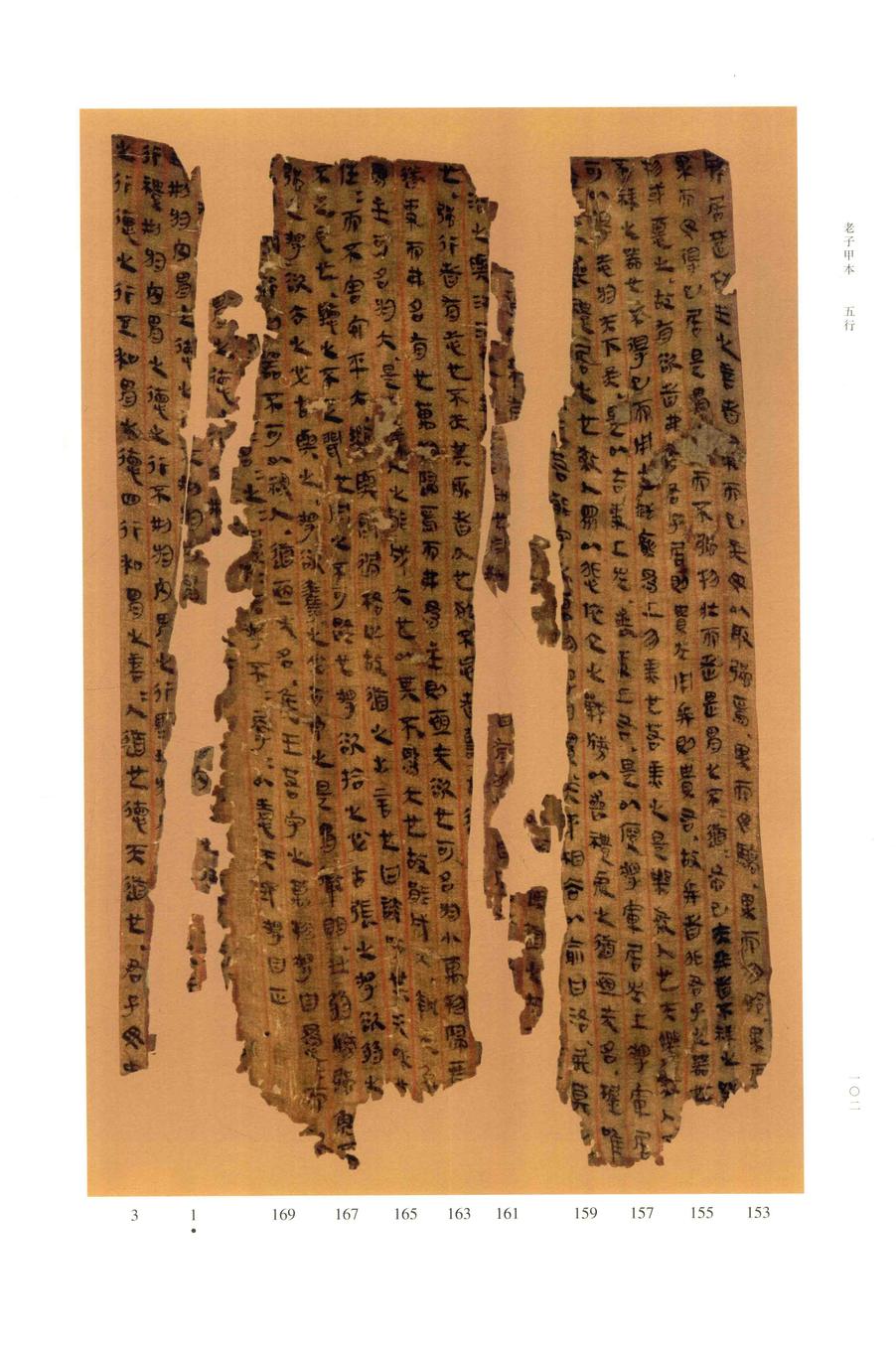
Laozi A (甲本), columns 161 to 162, on plate p. 102 of Changsha Mawangdui Han mu jianbo jicheng, vol. 1 (column numbers are printed under each plate; the columns run from right to left). Checked on the image: column 162 reads 也∠強行者有志也不失其所者久也死不忘者壽也. The opening characters of this chapter are lost or not readable on this plate image, so these are the first characters that were confirmed. □ marks a character lost on the silk (11 in this section). Transcription and column numbers: Wikisource 老子 (帛書甲本), which follows the Jicheng column numbering. The English is Legge's translation of the received text, shown below the silk transcription; the silk wording differs from it in many places, so compare the two Chinese texts for the variants.
161知人者知也自知□□□□□者有力也自勝者□□□□□□
162也∠強行者有志也不失其所者久也死不忘者壽也
Compare: Received text (Wang Bi recension), the text Legge translated
知人者智,自知者明。勝人者有力,自勝者強。知足者富。強行者有志。不失其所者久。死而不亡者壽。
1He who knows other men is discerning; he who knows himself is intelligent. He who overcomes others is strong; he who overcomes himself is mighty. He who is satisfied with his lot is rich; he who goes on acting with energy has a (firm) will.
2He who does not fail in the requirements of his position, continues long; he who dies and yet does not perish, has longevity.
Where on the image
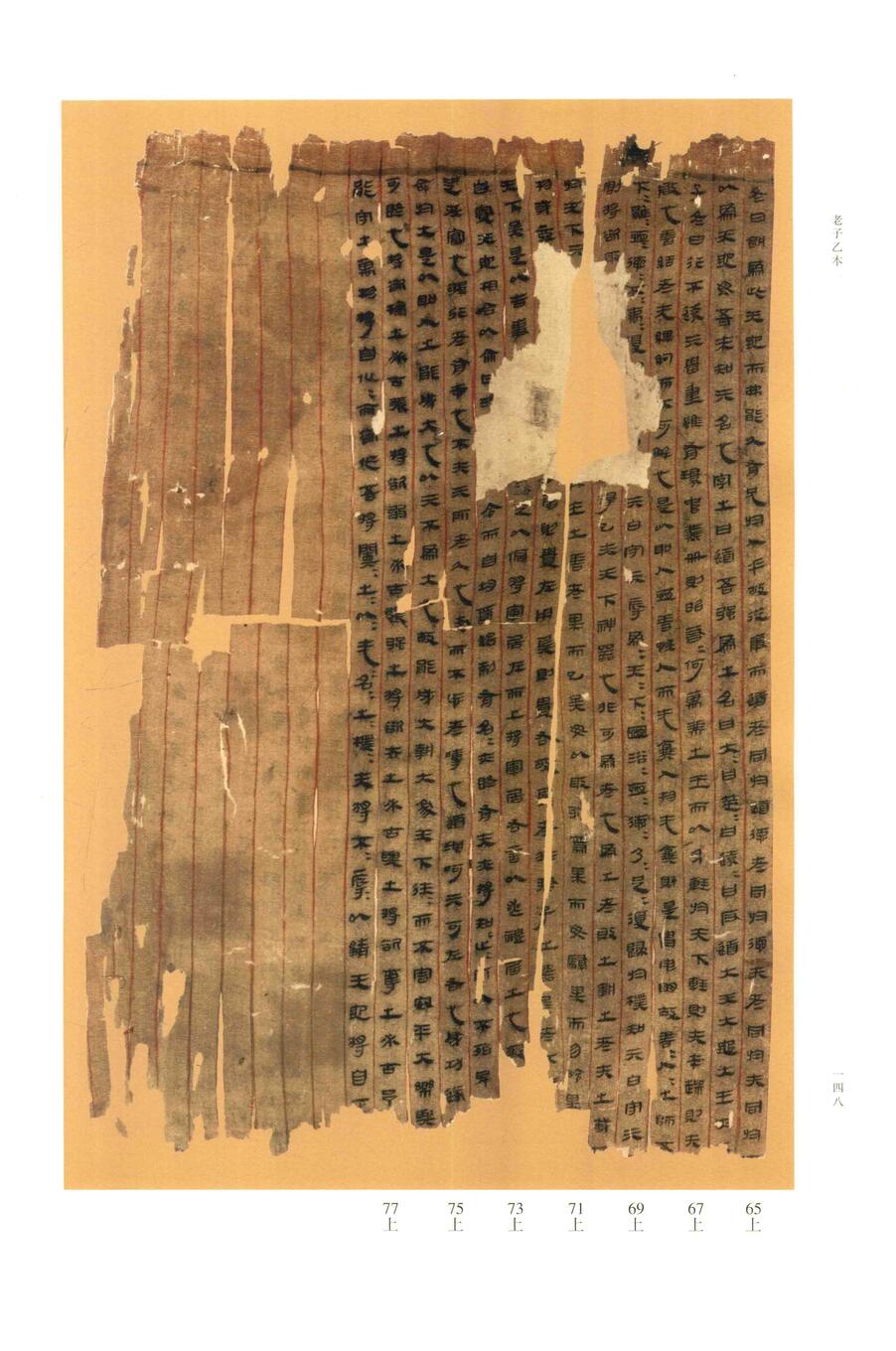
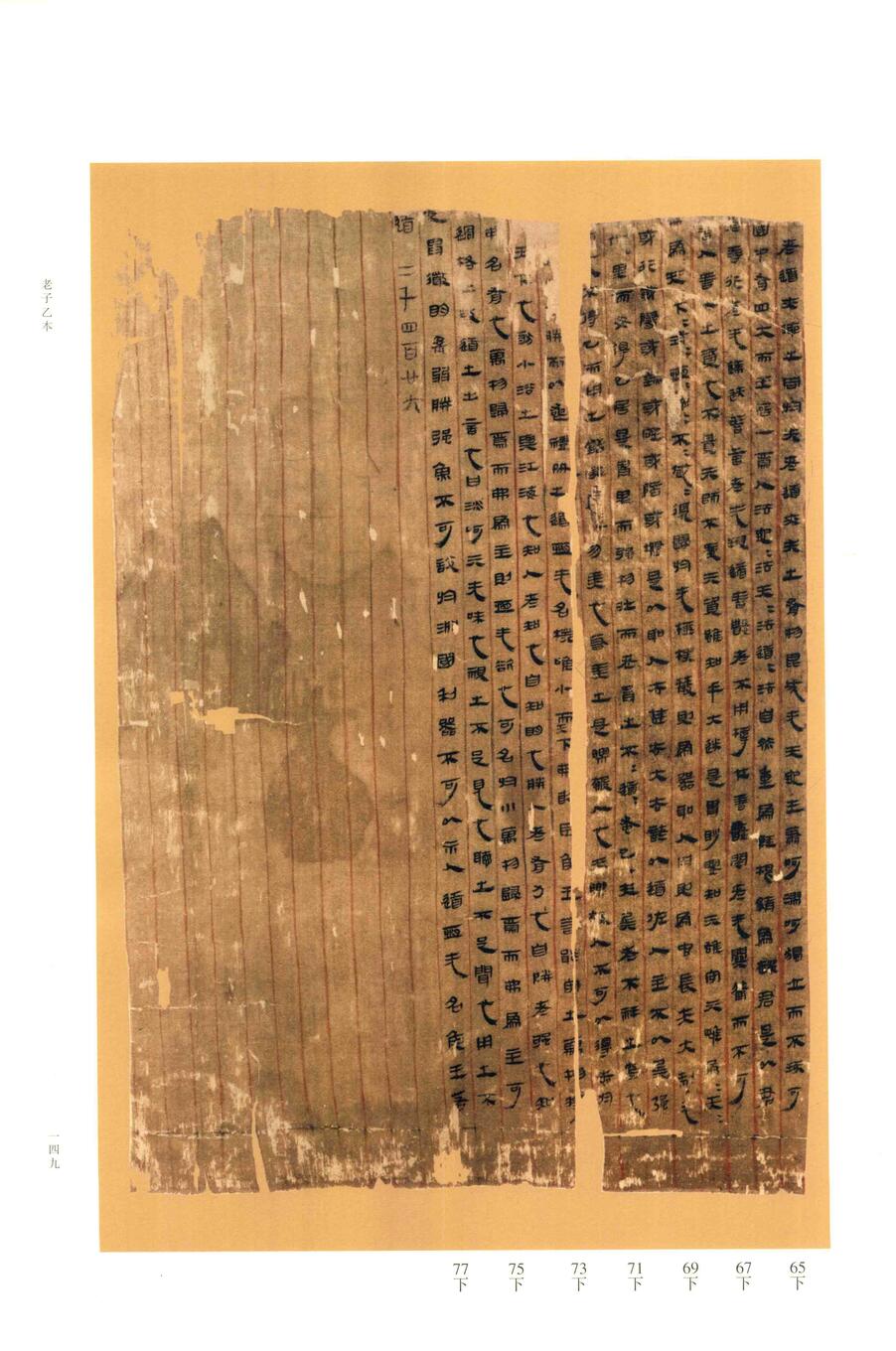
Laozi B (乙本), columns 74下 to 75上, on plates p. 148 and p. 149 of Changsha Mawangdui Han mu jianbo jicheng, vol. 1 (column numbers are printed under each plate; the columns run from right to left; each column of Laozi B is photographed as an upper half (上) and a lower half (下) on facing plates). Checked on the image: column 74下 reads 猷小浴之與江海也 知人者知也自知 (the opening of this chapter, with the end of the preceding text where shown). Transcription and column numbers: Wikisource 老子 (帛書乙本), which follows the Jicheng column numbering. The English is Legge's translation of the received text, shown below the silk transcription; the silk wording differs from it in many places, so compare the two Chinese texts for the variants.
74下知人者知也自知明也朕人者有力也自朕者強也知
75上足者富也強行者有志也不失亓所者久也死而不忘者壽也
Compare: Received text (Wang Bi recension), the text Legge translated
知人者智,自知者明。勝人者有力,自勝者強。知足者富。強行者有志。不失其所者久。死而不亡者壽。
1He who knows other men is discerning; he who knows himself is intelligent. He who overcomes others is strong; he who overcomes himself is mighty. He who is satisfied with his lot is rich; he who goes on acting with energy has a (firm) will.
2He who does not fail in the requirements of his position, continues long; he who dies and yet does not perish, has longevity.
Notes
- English: James Legge, The Tao Teh King (Sacred Books of the East 39, 1891); Legge's paragraph numbers are kept as superscripts.
- Legge translated the received text, not the silk manuscripts. Where the silk wording differs, his English follows the received text shown under the transcription.
- Silk transcription: Wikisource Page transcriptions of the Jicheng plates (revisions of 18 October 2026, marked not yet proofread on Wikisource), checked against the plates for each chapter opening.
Cite
Sources
- Source: Mawangdui Laozi A and B silk manuscripts (plates of Changsha Mawangdui Han mu jianbo jicheng vol. 1, via Wikimedia Commons) + Wikisource column transcription + Wang Bi received text (Wikisource) + Legge 1891 English (Project Gutenberg) (holding institution)
- Critical edition: Changsha Mawangdui Han mu jianbo jicheng (2014) column numbers; Wikisource transcription; Wang Bi received text
← previous · → next · v cycle view · l back to library