Daodejing, chapter 58 (Mawangdui silk manuscripts)
Introduction
Chapter 58 of the Daodejing (Laozi), shown on the two oldest nearly complete copies of the work: the silk manuscripts Laozi A and Laozi B, found in 1973 in Tomb 3 at Mawangdui, Changsha (Hunan), a tomb sealed in 168 BCE. Laozi A is written in a script between seal and clerical forms and does not avoid the personal name of the Han founder Liu Bang (邦); it is commonly dated before 195 BCE. Laozi B is in clerical script, avoids 邦, and is commonly dated 194-180 BCE. Both put the De part (chapters 38-81) before the Dao part (chapters 1-37), and a few chapters stand in a different order from the received text.
Each section gives the silk transcription column by column, with the Jicheng column number before each column (for Laozi B, 上 and 下 are the upper and lower halves of a column, photographed on facing plates), and links to the plate that carries those columns. □ marks a lost character; ∠, ‧ and ﹦ are marks written on the silk (﹦ repeats the character before it). Below the transcription is the received text of the Wang Bi recension, which is the text James Legge translated in 1891; the silk wording differs from it, most visibly in 恆 for received 常 (the received text avoids the name of Emperor Wen, Liu Heng), in the frequent final particle 也, and in loan characters such as 胃 for 謂.
How was this verified? (Provenance)
Where on the image
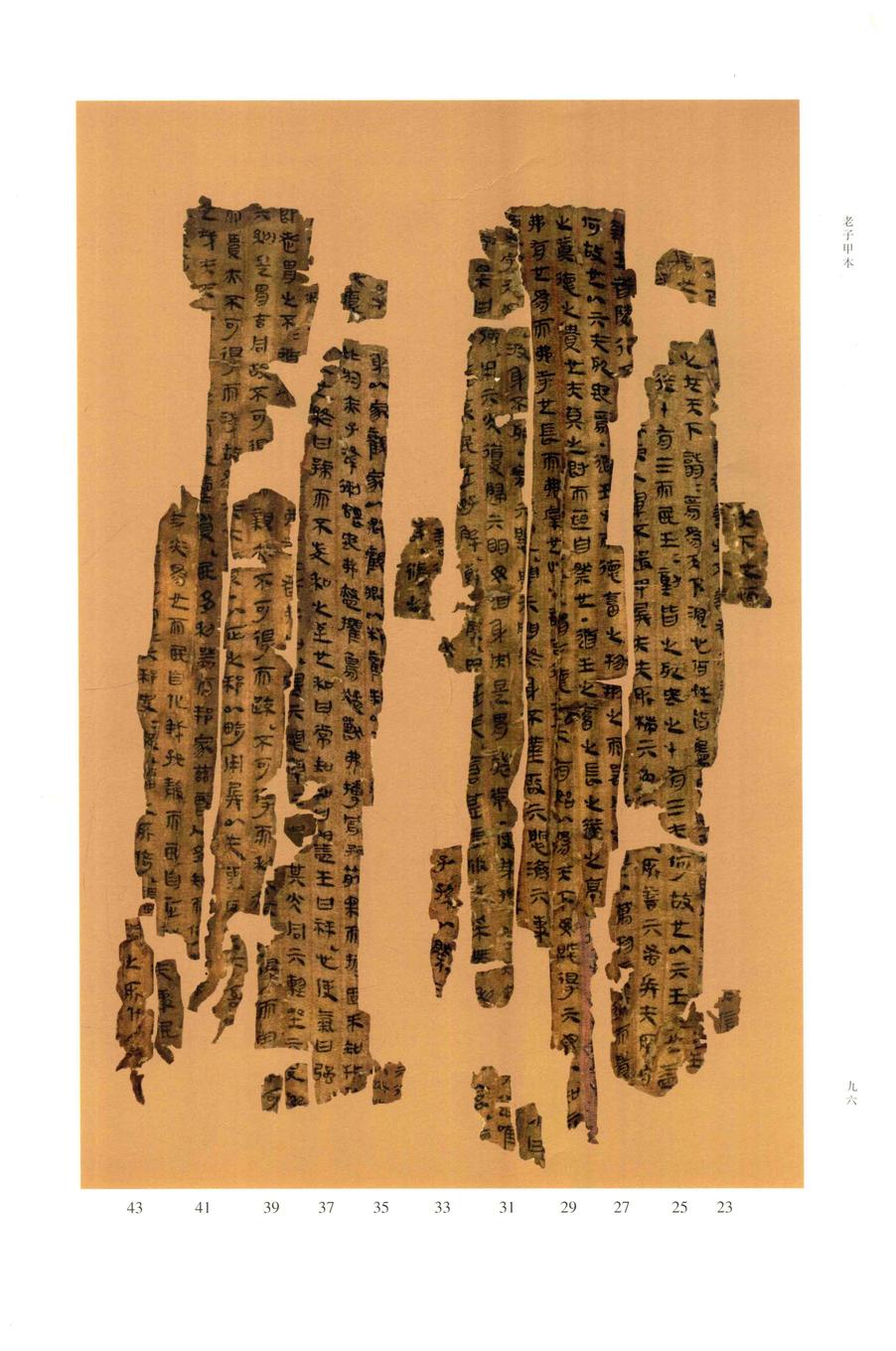
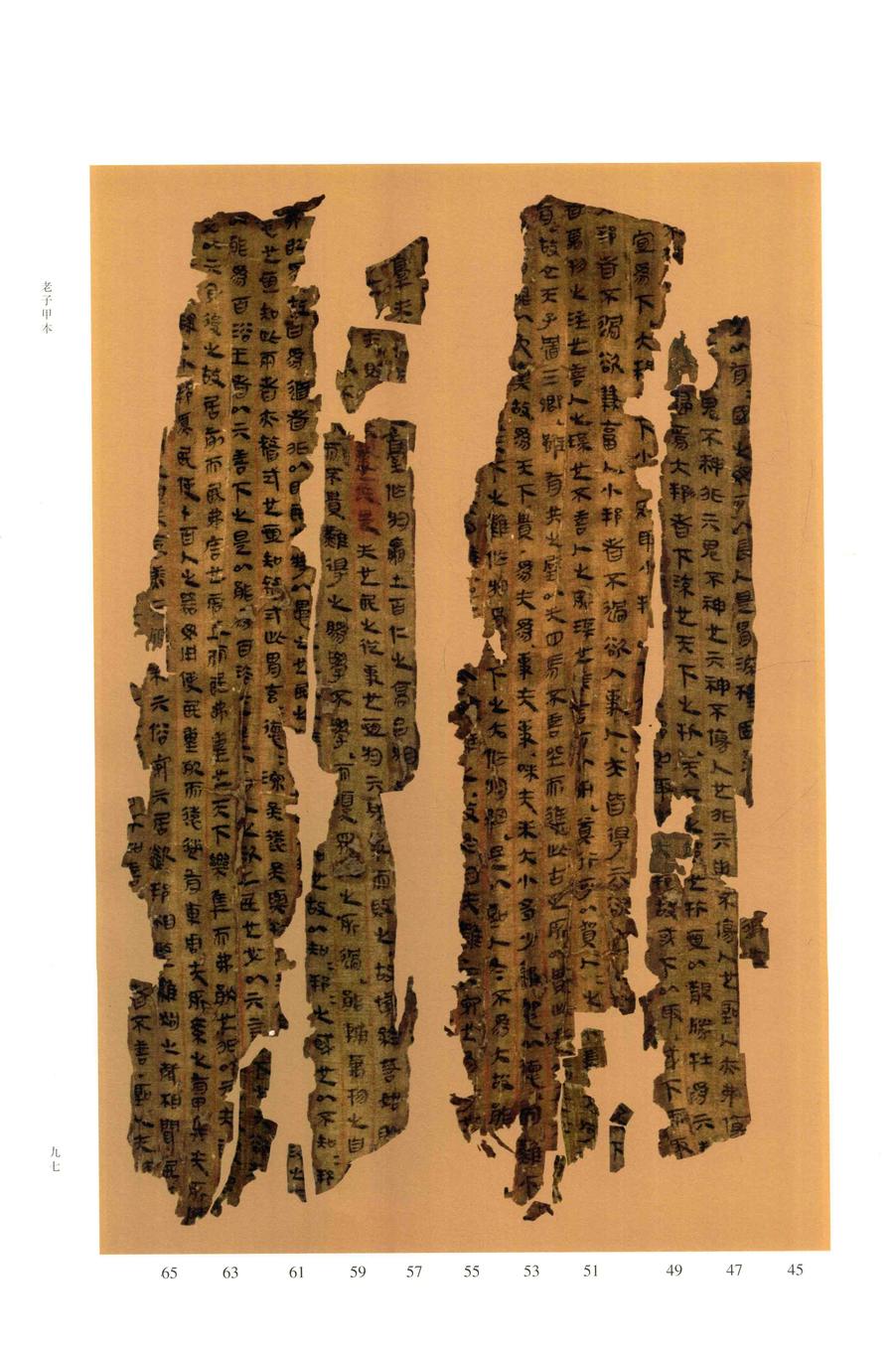
Laozi A (甲本), columns 43 to 45, on plates p. 96 and p. 97 of Changsha Mawangdui Han mu jianbo jicheng, vol. 1 (column numbers are printed under each plate; the columns run from right to left). Checked on the image: column 43 reads 福之所倚∠福禍之所伏. The opening characters of this chapter are lost or not readable on this plate image, so these are the first characters that were confirmed. □ marks a character lost on the silk (51 in this section). Transcription and column numbers: Wikisource 老子 (帛書甲本), which follows the Jicheng column numbering. The English is Legge's translation of the received text, shown below the silk transcription; the silk wording differs from it in many places, so compare the two Chinese texts for the variants.
43□□□□□□□□亓正察﹦亓邦缺﹦禍∠福之所倚∠福禍之所伏□□□□
44□□□□□□□□□□□□□□□□□□□□□□□□□□□□□□□□□□
45□□□□□
Compare: Received text (Wang Bi recension), the text Legge translated
其政悶悶,其民淳淳;其政察察,其民缺缺。禍兮福之所倚,福兮禍之所伏。孰知其極?其無正。正復為奇,善復為妖。人之迷,其日固久。是以聖人方而不割,廉而不劌,直而不肆,光而不燿。
1The government that seems the most unwise,
Oft goodness to the people best supplies;
That which is meddling, touching everything,
Will work but ill, and disappointment bring.
Misery!--happiness is to be found by its side! Happiness!--misery lurks beneath it! Who knows what either will come to in the end?
2Shall we then dispense with correction? The (method of) correction shall by a turn become distortion, and the good in it shall by a turn become evil. The delusion of the people (on this point) has indeed subsisted for a long time.
3Therefore the sage is (like) a square which cuts no one (with its angles); (like) a corner which injures no one (with its sharpness). He is straightforward, but allows himself no license; he is bright, but does not dazzle.
Where on the image
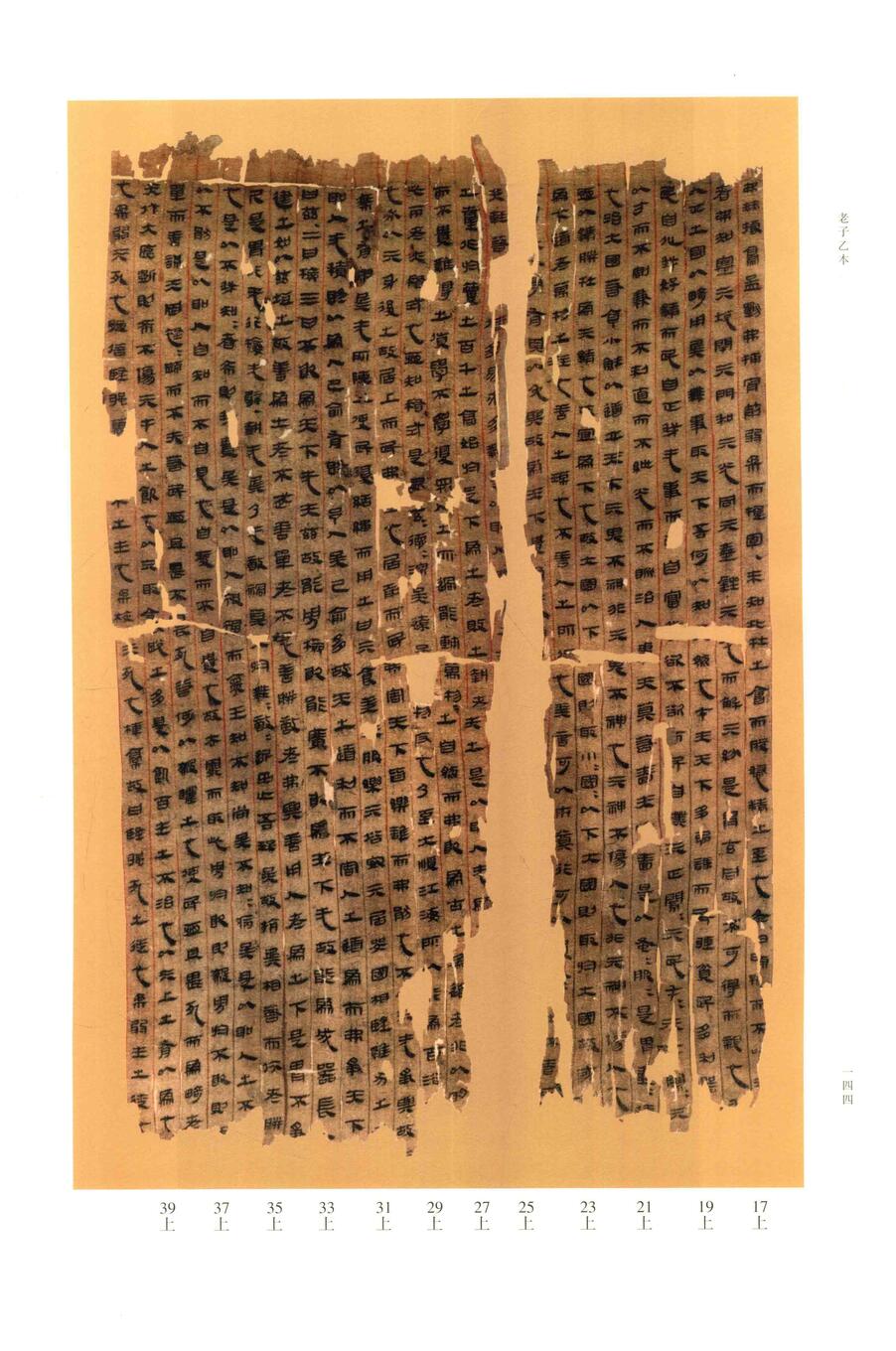
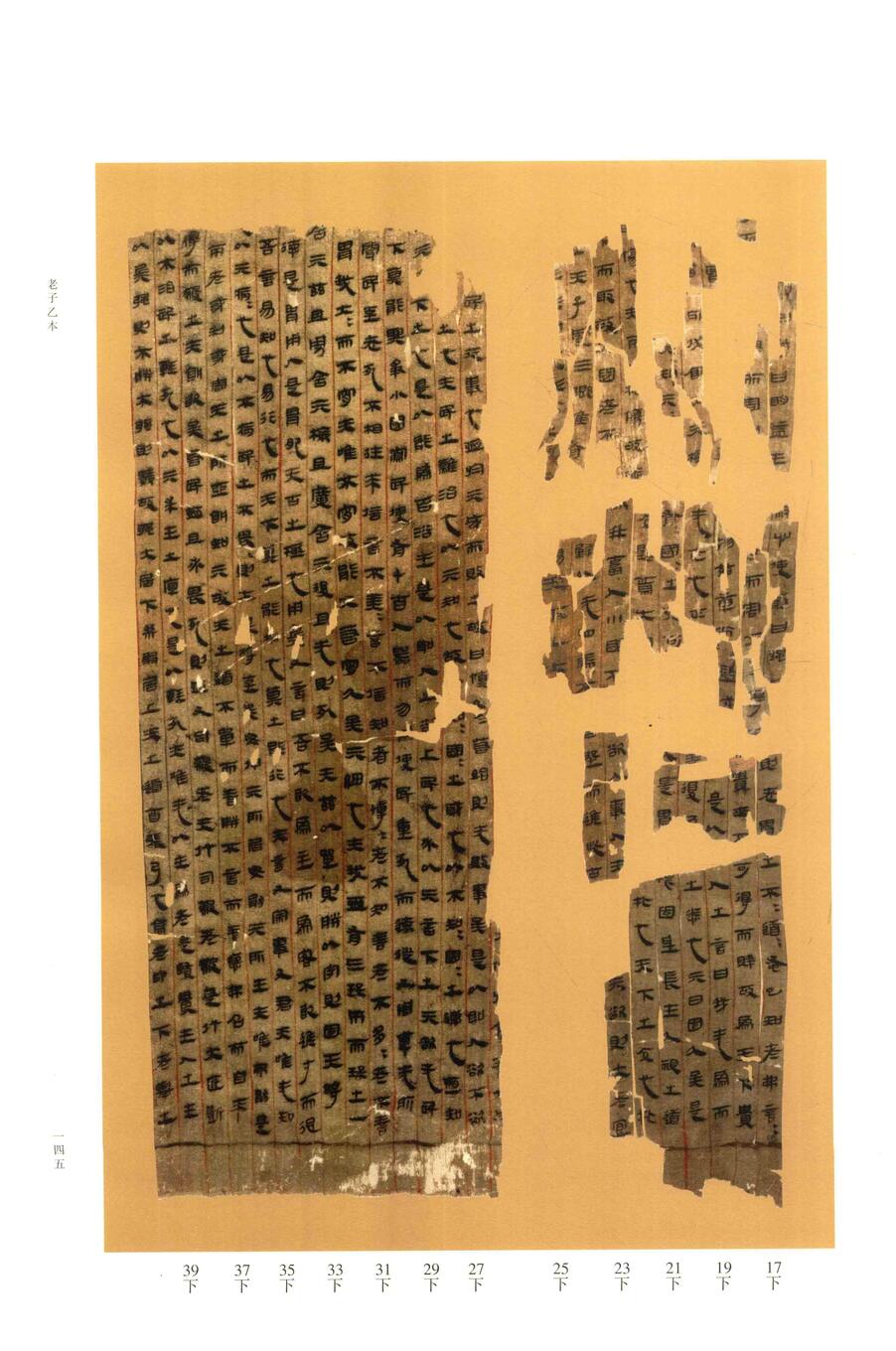
Laozi B (乙本), columns 20上 to 21上, on plates p. 144 and p. 145 of Changsha Mawangdui Han mu jianbo jicheng, vol. 1 (column numbers are printed under each plate; the columns run from right to left; each column of Laozi B is photographed as an upper half (上) and a lower half (下) on facing plates). Checked on the image: column 20上 reads 而民自樸 亓正閔﹦亓民屯﹦亓 (the opening of this chapter, with the end of the preceding text where shown). □ marks a character lost on the silk (10 in this section). Transcription and column numbers: Wikisource 老子 (帛書乙本), which follows the Jicheng column numbering. The English is Legge's translation of the received text, shown below the silk transcription; the silk wording differs from it in many places, so compare the two Chinese texts for the variants.
20上亓正閔﹦亓民屯﹦亓正察﹦亓
20下□□□福□之所伏孰知亓極□無正也正□□□善復為□□之悉也亓日固久矣是
21上以方而不割兼而不刺直而不紲光而不眺
Compare: Received text (Wang Bi recension), the text Legge translated
其政悶悶,其民淳淳;其政察察,其民缺缺。禍兮福之所倚,福兮禍之所伏。孰知其極?其無正。正復為奇,善復為妖。人之迷,其日固久。是以聖人方而不割,廉而不劌,直而不肆,光而不燿。
1The government that seems the most unwise,
Oft goodness to the people best supplies;
That which is meddling, touching everything,
Will work but ill, and disappointment bring.
Misery!--happiness is to be found by its side! Happiness!--misery lurks beneath it! Who knows what either will come to in the end?
2Shall we then dispense with correction? The (method of) correction shall by a turn become distortion, and the good in it shall by a turn become evil. The delusion of the people (on this point) has indeed subsisted for a long time.
3Therefore the sage is (like) a square which cuts no one (with its angles); (like) a corner which injures no one (with its sharpness). He is straightforward, but allows himself no license; he is bright, but does not dazzle.
Notes
- English: James Legge, The Tao Teh King (Sacred Books of the East 39, 1891); Legge's paragraph numbers are kept as superscripts.
- Legge translated the received text, not the silk manuscripts. Where the silk wording differs, his English follows the received text shown under the transcription.
- Silk transcription: Wikisource Page transcriptions of the Jicheng plates (revisions of 18 October 2026, marked not yet proofread on Wikisource), checked against the plates for each chapter opening.
Cite
Sources
- Source: Mawangdui Laozi A and B silk manuscripts (plates of Changsha Mawangdui Han mu jianbo jicheng vol. 1, via Wikimedia Commons) + Wikisource column transcription + Wang Bi received text (Wikisource) + Legge 1891 English (Project Gutenberg) (holding institution)
- Critical edition: Changsha Mawangdui Han mu jianbo jicheng (2014) column numbers; Wikisource transcription; Wang Bi received text
← previous · → next · v cycle view · l back to library