Descent of Ishtar to the Netherworld (Standard Babylonian version)
Introduction
Ishtar decides to go down to the Netherworld, the 'Land of No Return' ruled by her sister Ereshkigal. At each of the seven gates the gatekeeper removes one of her garments or ornaments, until she stands naked before Ereshkigal, who has her struck with diseases. While Ishtar is below, all mating on earth stops. Ea creates a being who obtains the water of life; Ishtar is sprinkled with it and returns, but a substitute must be given, and the text ends with instructions concerning Dumuzi and a ritual for the dead.
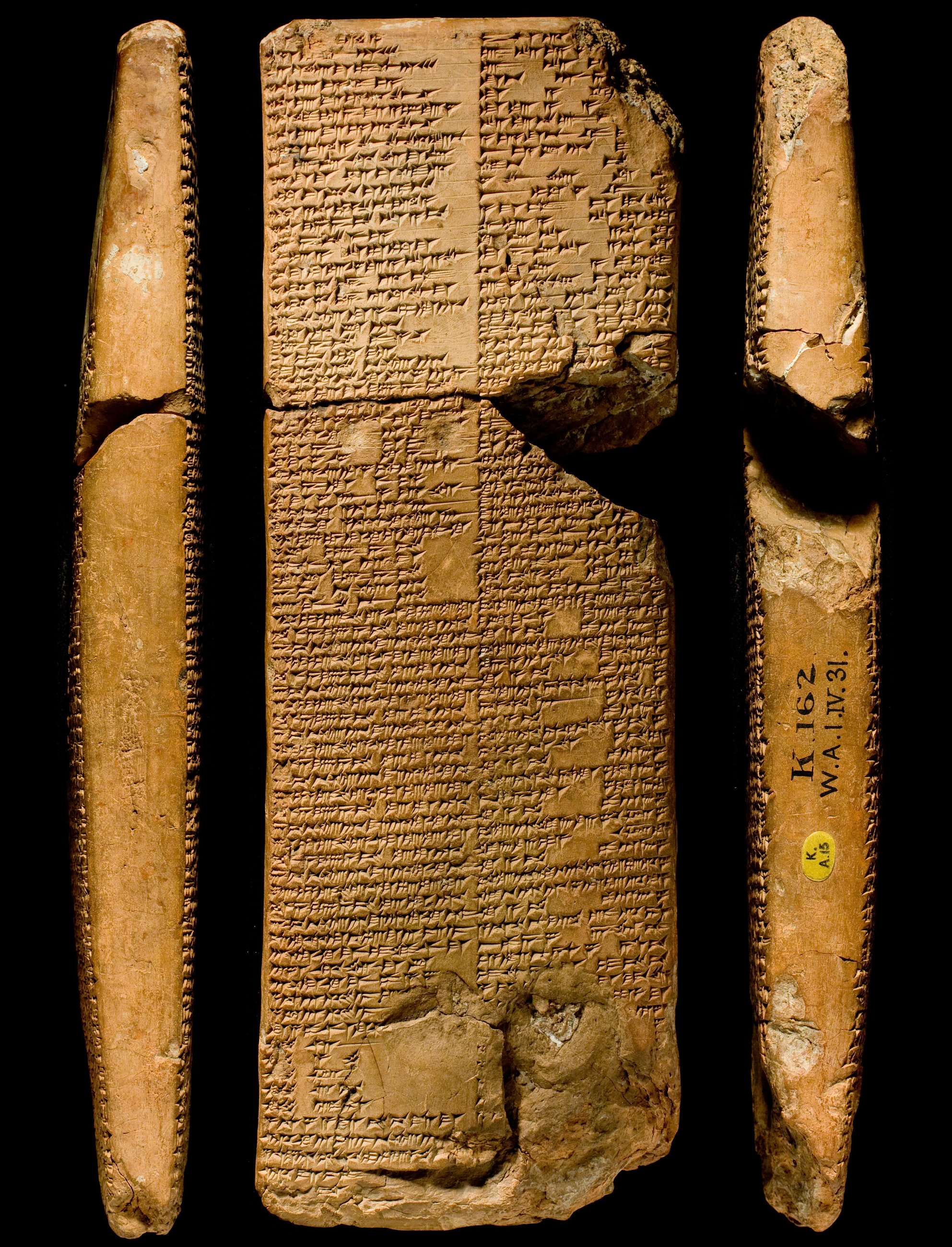
The poem is an Akkadian adaptation of the Sumerian 'Inana's Descent'. The main copies are a Neo-Assyrian tablet from Nineveh (K.162) and tablets from Ashur. This page follows the line numbering of the electronic Babylonian Library edition.
How this page is built. Each section is a run of consecutive lines as written on one photographed clay tablet. For every line the eBL edition (https://www.ebl.lmu.de/corpus/L/1/8/SB/-) lists the manuscripts that carry it, with each tablet's own column and line numbers; the tablet chosen for each run is the photographed copy of the work with the most signs preserved there. Commentaries and texts that only quote a line are never chosen. School and excerpt tablets are used only for lines that no photographed library copy preserves as well, and only where they carry the line as text; their sections say so. The original text is eBL's transliteration of that tablet's signs (not a modern composite text): square brackets mark broken signs, x an illegible sign, # a damaged sign, ? an uncertain reading, and words in {braces} are determinatives; the notes give a key to every sign used on this page, and eBL's layout codes are written out in words (for example '(line break)' or '(blank space)'). Superscript numbers are the line numbers of the eBL edition, used in both the Akkadian and the English. The English is B. R. Foster's translation in the eBL edition (CC BY-NC-SA 4.0), one line of English per line of the text; italics mark uncertain renderings, as in the source. Where the tablet is broken, the English still translates the whole line of eBL's composite text; each section's note names the lines that are broken on its tablet.
Finding a line on the photograph. Each section names the tablet, the face and column, and the tablet's own line numbers (a prime, as in 5', counts from the first preserved line of a broken column). On a tablet with six columns the obverse carries columns i-iii from left to right; the reverse, turned over from bottom to top, carries columns iv-vi from right to left. The photographs often show the obverse above the reverse with the edges around them; a fragment preserves only part of this layout.
This page shows 138 of the 148 lines of the eBL edition (93%), from 1 tablet in the British Museum: K.162 (Nineveh).
Lines not shown. 10 of the 148 lines of the eBL edition are not shown, because no photographed copy of the work used here carries them: 11a (no photograph in eBL: VAT.9729 (Vorderasiatisches Museum, Berlin)); 12a (no photograph in eBL: VAT.9729 (Vorderasiatisches Museum, Berlin)); 18a (no photograph in eBL: VAT.9729 (Vorderasiatisches Museum, Berlin)); 23a (no photograph in eBL: VAT.9729 (Vorderasiatisches Museum, Berlin)); 97a (no photograph in eBL: VAT.9729 (Vorderasiatisches Museum, Berlin)); 103a (no photograph in eBL: VAT.9729 (Vorderasiatisches Museum, Berlin)); 118a-118c (no photograph in eBL: VAT.9729 (Vorderasiatisches Museum, Berlin)); 137a (no photograph in eBL: VAT.9729 (Vorderasiatisches Museum, Berlin)). A line is shown only on a photographed tablet that carries it as text. Commentaries and other texts that quote a line (letters, rituals, god lists) are not used as witnesses, because they carry it with explanations or inside another text; tablets without a photograph in eBL are not used, because the line could not be shown on its tablet.
How was this verified? (Provenance)
Where on the image
British Museum K.162: obverse, the tablet's own lines 1 to 27. eBL's corpus edition (https://www.ebl.lmu.de/corpus/L/1/8/SB/-) attributes SB 1-27 to this manuscript at these column and line numbers. Photograph checked: obverse, reverse and edges of a tall single-column tablet, ink number K.162 and 'W.A.I. IV 31' on the right edge; the obverse is fully inscribed and the reverse ends with a ruling, one more line and an uninscribed area, consistent with eBL's obverse (80 lines) and reverse (58 lines). Each face is shown as a crop of the British Museum photograph. On this tablet lines 1-10, 24-27 are partly broken (square brackets and x in the Akkadian). The English of these lines translates eBL's composite text, so it includes words that are not preserved on this tablet but are restored from other manuscripts or by the editors. Square brackets in the English mark eBL's restorations in its composite text; words that survive on other tablets carry no brackets even where this tablet is broken. Lines 11, 12, 13-18, 19-23 are complete on this tablet. eBL line(s) 11a, 12a, 18a, 23a fall within this run but are not on this tablet (they are listed among the lines not shown).
1a#-na# KUR#.NU#.GI₄.A | qaq-qa-ri l[a? ta-a-ri?]
2{d}INNIN DUMU.MUNUS {d}30 | u₂-zu-un-ša₂ [iš-kun]
3iš-kun-ma DUMU.MUNUS {d}30 | u₂-zu-u[n-ša₂]
4a-na E₂ e-ṭe-e | šu-bat {d}e[r-kal-la]
5a-na E₂ ša e-ri-bu-šu₂ | la a-ṣ[u-u₂]
6a-na har-ra-ni ša a-lak-ta-ša₂ | la ta-a-a-[rat]
7a-na E₂ ša e-ri-bu-šu₂ | zu-um-mu-u₂ nu#-[u₂-ra]
8a-šar SAHAR-HI.A bu-bu-us-su-nu | a-kal-šu-nu ṭi-i[ṭ-ṭu]
9nu-u₂-ru ul im-ma-ru | ina e-ṭu-ti aš₂-[bu]
10lab-šu-ma GIM iṣ-ṣu-ri | ṣu-bat gap-[pi]
11UGU {giš}IG u {giš}SAG.KUL | ša₂-bu-uh ep-ru#
12{d}+INNIN a-na KA₂ KUR.NU.GI₄.A | ina ka-ša₂-di-ša₂#
13a-na {lu₂}I₃.DU₈ ba-a-bi | a-ma-tu₄ iz-zak-kar
14{lu₂}I₃.DU₈-me-e | pi-ta-a ba-ab-ka
15pi-ta-a ba-ab-ka-ma | lu-ru-ba a-na-ku
16šum-ma la ta-pat-ta-a ba-a-bu | la er-ru-ba a-na-ku
17a-mah-ha-aṣ dal-tu₄ | sik-ku-ru a-šab-bir
18a-mah-ha-aṣ si-ip-pu-ma | u₂-ša₂-bala-kat₃ {giš}IG-MEŠ
19u₂-še-el-la-a mi-tu-ti | GU₇-MEŠ bal-ṭu-ti
20UGU bal-ṭu-ti | i-ma-ʾi-du mi-tu-ti
21{lu₂}I₃.DU pa-a-šu₂ | i-pu-uš#-ma# i-qab-bi
22iz-zak-ka-ra a-na | GAL-ti# {d}iš#-tar#
23i-zi-zi be-el-ti | la ta-na-da#-aš₂#-ši
24lu-ul-lik MU-ki lu-ša₂-an-ni | a-na šar-ra-ti# {d}e[reš-k]i-gal
25e#-ru-um-ma {lu₂}I₃.DU₈ | iz-zak-ka#-ra# [x x x x x]
26an#-ni#-tu#-me#-e# a#-ha#-ta#-ki# {d#}iš#-tar# | i?#-z[a?-az? x x x (x)]
27mu#-kil-tu ša₂ kip#-pe-e GAL#-MEŠ# | da#-l[i-ha-at x x x x x x x x x]
1To the netherworld, land of n[o return],
2Ishtar, daughter of Sin, [set] her mind.
3Indeed, the daughter of Sin did set [her] mind
4To the gloomy house, the seat of the ne[therworld],
5To the house that none leaves who enters,
6To the road whose journey has no return,
7To the house whose entrants are bereft of light,
8Where dust is their sustenance and clay their food.
9They see no light but dwell in darkness,
10They are clothed like birds in wings for garments,
11And dust has gathered on the door and bolt.
12When Ishtar reached the gate of the netherworld,
13She said (these) words to the gatekeeper:
14“Gatekeeper! Open your gate for me!
15“Open your gate for me that I may enter!
16“If you will not open the gate that I may enter,
17“I will break down the door, I will smash the bolt,
18“I will break down the frame, I will topple the doors.
19“I will raise up the dead to devour the living,
20“The dead shall outnumber the living."
21The gatekeeper made ready to speak,
22Saying to the great one, Ishtar,
23“Stay, my lady, do not cast it down.
24“Let me go announce your name to the queen E[resh]kigal.”
25The gatekeeper went in and said to Ereshkigal,
26“Here is your sister at [(your) gate],
27“She who holds the great play-rope, who roils up the deep before Ea the [king]”.
Where on the image
British Museum K.162: obverse, the tablet's own lines 28 to 54. eBL's corpus edition (https://www.ebl.lmu.de/corpus/L/1/8/SB/-) attributes SB 28-54 to this manuscript at these column and line numbers. Photograph checked: obverse, reverse and edges of a tall single-column tablet, ink number K.162 and 'W.A.I. IV 31' on the right edge; the obverse is fully inscribed and the reverse ends with a ruling, one more line and an uninscribed area, consistent with eBL's obverse (80 lines) and reverse (58 lines). Each face is shown as a crop of the British Museum photograph. On this tablet lines 28-39 are partly broken (square brackets and x in the Akkadian). The English of these lines translates eBL's composite text, so it includes words that are not preserved on this tablet but are restored from other manuscripts or by the editors. Square brackets in the English mark eBL's restorations in its composite text; words that survive on other tablets carry no brackets even where this tablet is broken. Lines 40-54 are complete on this tablet.
28{d}ereš-ki-[ga]l an-ni-[t]a | i-n[a x x x (x)]
29ki-ma ni-kis# {giš}bi#-[n]i | e-r[u-qu? x x x]
30ki-ma ša₂-pat ku-ni-ni | iṣ-li#-[ma x x x x x]
31mi-na-a lib₃-ba-ša₂ ub-la-an-ni | mi-na-a kab-t[a-ša₂-ma x x x x x x]
32an-ni-tu-me-e | a-na-ku it-ti# [x x x x x x]
33ki-ma NINDA-MEŠ a-kal IM | ki-ma KAŠ-MEŠ a-šat-t[a-a x x x x x]
34lu-ub-ki a-na GURUŠ-MEŠ | ša e-zi-bu {munus}hi-[re-ti-šu₂-nu]
35lu-ub-ki a-na {munus}KI.SIKIL-MEŠ | ša TA UR₂ ha-i-ri-ši-na# [x x x x]
36a-na {lu₂}TUR la-ke-e lu-ub-ki | ša ina la U₄-MEŠ-šu ṭar-[du]
37a-lik {lu₂}I₃.DU₈ | pi-ta-aš₂-ši ba-ab-k[a]
38up-pi-is-si-ma | ki-ma GARZA-MEŠ la-bi-ru-t[i]
39il-lik {lu₂}I₃.DU₈ | ip-ta-aš₂-ši ba-ab-[šu₂]
40er-bi be-el-ti | GU₂.DU₈.A{ki} li-riš-ki#
41E₂.GAL KUR.NU.GI | li-ih-du ina pa-ni-ki
42DIŠ-en KA₂ u₂-še-rib-ši-ma um-ta-ṣi | it-ta-bal AGA GAL-a ša SAG.DU-ša₂
43am-mi₃-ni {lu₂}I₃.DU₈ ta-at-bal | AGA GAL-a ša SAG.DU-ia
44er-bi be-el-ti ša {d}NIN KI-ti₃ | ki-a-am GARZA-MEŠ-ša₂
45MIN-a KA₂ u₂-še-rib-ši-ma um-ta-ṣi | it-ta-bal in-ṣa-ba-te ša GEŠTU+MIN-MEŠ-ša₂
46am-mi₃-ni {lu₂}I₃.DU₈ ta-at-bal | in-ṣa-ba-te ša GEŠTU+MIN-ia
47er-bi be-el-ti ša {d}NIN KI-ti₃ | ki-a-am GARZA-MEŠ-ša₂
48EŠ₅-šu₂ KA₂ u₂-še-rib-ši-ma um-ta-ṣi | it-ta-bal {na₄}NUNUZ-MEŠ ša₂ GU₂-ša₂
49am-mi₃-ni {lu₂}I₃.DU₈ ta-at-bal | {na₄}NUNUZ-MEŠ ša₂ GU₂-ia
50er-bi be-el-ti ša {d}NIN KI-ti₃ | ki-a-am GARZA-MEŠ-ša₂
51LIMMU-u₂ KA₂ u₂-še-rib-ši-ma um-ta-ṣi | it-ta-bal du-di-na-te ša₂ GABA-ša₂
52am-mi₃-ni {lu₂}I₃.DU₈ ta-at-bal | du-di-na-te ša₂ GABA-ia
53er-bi be-el-ti ša {d}NIN KI-ti₃ | ki-a-am GARZA-MEŠ-ša₂
54IA₂-šu₂ KA₂ u₂-še-rib-ši-ma um-ta-ṣi | it-ta-bal šib-bu NA₄ TU ša₂ MURUB₄-MEŠ-ša₂
28When Ereshkigal heard this,
29Her face went pale as a freshly cut tamarisk,
30Her lips went dark as the rim of a vat.
31“What made her resolve on me? What has aroused her bad feelings in her against me?
32“Here now, shall I drink water with the (netherworld) Anunna-gods,
33“Shall I eat clay for bread, shall I drink dirty water for beer?
34“Shall I weep for the young men who have left [their] helpmeets?
35“Shall I weep for the young women who are wrenched from lovers’ loins?
36“Shall I weep for the helpless infant who was taken before its time?
37“Go, gatekeeper, open [your] gate to her,
38“Treat her according to the age-old rules.”
39Off went the gatekeeper and opened [the] gate to her:
40“Enter, my lady, so that Cutha rejoice over you,
41“That the palace of the netherworld be glad at your presence.”
42He brought her in the first gate, he loosed and removed the great tiara of her head.
43“Why, gatekeeper, did you remove the great tiara of my head?”
44“Enter, my lady. Thus the rules of the mistress of the netherworld.”
45He brought her in the second gate, he loosed and removed the earrings of her ears.
46“Why, gatekeeper, did you remove the earrings of my ears?”
47“Enter, my lady. Thus the rules of the mistress of the netherworld.”
48He brought her in the third gate, he loosed and removed the beads of her neck.
49“Why, gatekeeper, did you remove the beads of my neck?”
50“Enter, my lady. Thus the rules of the mistress of the netherworld.”
51He brought her in the fourth gate, he loosed and removed the garment pins of her breast.
52“Why, gatekeeper, did you remove the garment pins of my breast?”
53“Enter, my lady. Thus the rules of the mistress of the netherworld.”
54He brought her in fifth gate, he loosed and removed the girdle of birth stones of her waist.
Where on the image
British Museum K.162: obverse, the tablet's own lines 55 to 80. eBL's corpus edition (https://www.ebl.lmu.de/corpus/L/1/8/SB/-) attributes SB 55-80 to this manuscript at these column and line numbers. Photograph checked: obverse, reverse and edges of a tall single-column tablet, ink number K.162 and 'W.A.I. IV 31' on the right edge; the obverse is fully inscribed and the reverse ends with a ruling, one more line and an uninscribed area, consistent with eBL's obverse (80 lines) and reverse (58 lines). Each face is shown as a crop of the British Museum photograph. On this tablet of lines 74, 79-80 only one to three signs survive and lines 67-73, 75-78 are partly broken (square brackets and x in the Akkadian). The English of these lines translates eBL's composite text, so it includes words that are not preserved on this tablet but are restored from other manuscripts or by the editors. Square brackets in the English mark eBL's restorations in its composite text; words that survive on other tablets carry no brackets even where this tablet is broken. Lines 55-66 are complete on this tablet.
55am-mi₃-ni {lu₂}I₃.DU₈ ta-at-bal | šib-bu NA₄ TU ša₂ MURUB₄-MEŠ-ia
56er-bi be-el-ti ša {d}NIN KI-ti₃ | ki-a-am GARZA-MEŠ-ša₂
57AŠ₃-šu₂ KA₂ u₂-še-rib-ši-ma um-ta-ṣi | it-ta-bal HAR-MEŠ ŠU+MIN-ša₂ u GIR₃+MIN-ša₂
58am-mi₃-ni {lu₂}I₃.DU₈ ta-at-bal | HAR-MEŠ ŠU+MIN-ia u GIR₃+MIN-ia
59er-bi be-el-ti ša {d}NIN KI-ti₃ | ki-a-am GARZA-MEŠ-ša₂
60IMIN-u₂ KA₂ u₂-še-rib-ši-ma um-ta-ṣi | it-ta-bal ṣu-bat bal-ti ša₂ zu-um-ri-ša₂
61am-mi₃-ni {lu₂}I₃.DU₈ ta-at-bal | ṣu-bat bal-ti ša₂ zu-um-ri-ia
62er-bi be-el-ti ša {d}NIN KI-ti₃ | ki-a-am GARZA-MEŠ-ša₂
63iš-tu ul-la-nu-um-ma {d}iš-tar | a-na KUR.NU.GI₄ u₂-ri-du
64{d}ereš-ki-gal i-mur-ši-ma | ina pa-ni-ša₂ ir-ʾu-ub
65{d}+INNIN ul im-ma-lik | e-le-nu-uš-ša₂ uš-bi
66{d}ereš-ki-gal pa-a-ša₂# | i-pu-uš#-ma# i-qab-bi
67a-na {d}nam-tar SUKKAL-ša₂# | a-ma-t[a] iz-zak-kar
68a-lik {d}nam-tar | x x [x (x x)] mah-ri]-ia-ma
69šu-ṣa-aš₂-ši 1 šu-ši G[IG-MEŠ | x x x x] {d}+INNIN
70GIG IGI+MIN | [x x IGI+MIN]-ša₂
71GIG# a-hi | a#-[na a-hi]-ša₂
72GIG# GIR₃+MIN | a#-[na GIR₃+MIN]-ša₂#
73GIG lib₃-bi# | a#-[na lib₃-bi]-ša₂
74GIG SAG.DU | x [x x x x (x)]
75a-na ša₂-a-ša gab-bi-ša-ma | a-n[a ...]
76ar-ki {d}iš-tar be-el-ti# a?#-[na? ...]
77a-na bur-ti GU₄ ul# i-šah-hi-i[ṭ | x x x x x x]
78ar-da-tu₄ ina# SILA# | [x x x x x x]
79[it]-til# eṭ-l[u x x x x (x)]
80[it]-til a[r-da-tu₄ x x x x (x)]
55“Why, gatekeeper, did you remove the girdle of birth stones of my waist?”
56“Enter, my lady. Thus the rules of the mistress of the netherworld."
57He brought her in the sixth gate, he loosed and removed her bracelets and anklets.
58“Why, gatekeeper, did you remove my bracelets and anklets?”
59“Enter, my lady. Thus the rules of the mistress of the netherworld.”
60He brought her in the seventh gate, he loosed and removed the loincloth of her body.
61“Why, gatekeeper, did you remove the loincloth of my body?”
62“Enter, my lady. Thus the rules of the mistress of the netherworld.”
63As soon as Ishtar had entered the netherworld,
64Ereshkigal saw her and trembled with fury at her.
65Ishtar, without thinking, sat (in the place of honor) above her.
66Ereshkigal made ready to speak, and said
67To Namtar, her vizier, these words,
68“Go Namtar, [take her from] my presence!
69“Let loose against her sixty di[seases, let them overwhelm] Ishtar,
70“Eye disease [against] her [eyes],
71“Side disease a[gainst] her [sides],
72“Foot disease a[gainst] her [feet],
73“Heart disease a[gainst] her [heart],
74“Head disease [against her head] ,
75“I [let them loose] against all of her!”
76After the lady Ishtar [went down] to the netherworld,
77The bull would not mount the cow, [the ass would not impregnate the jenny],
78The [young man would not impregnate] the girl in the thoroughfare,
79The young man slept in [his bedroom],
80The g[irl s]lept [by herself].
Where on the image
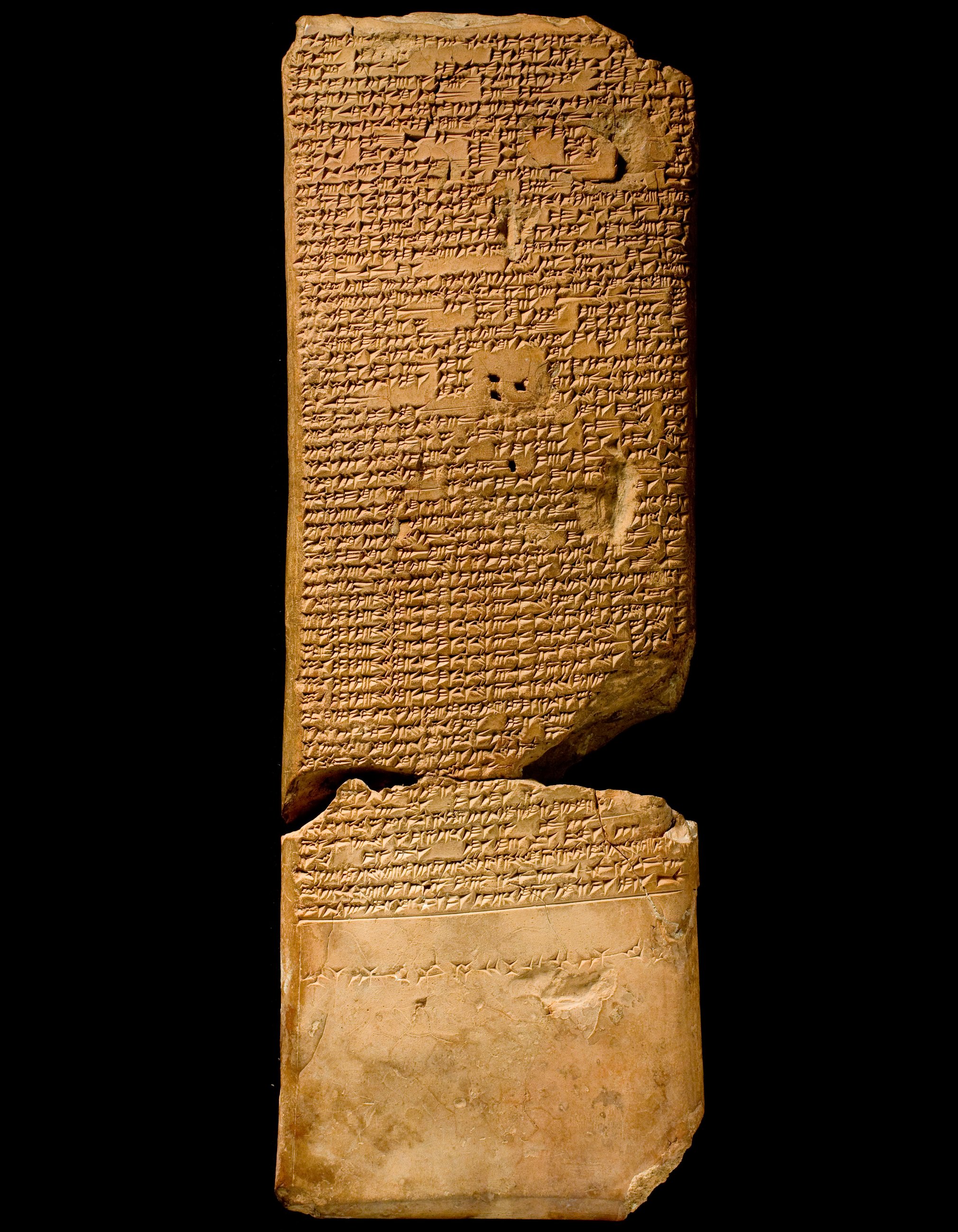
British Museum K.162: reverse, the tablet's own lines 1 to 29. eBL's corpus edition (https://www.ebl.lmu.de/corpus/L/1/8/SB/-) attributes SB 81-109 to this manuscript at these column and line numbers. Photograph checked: obverse, reverse and edges of a tall single-column tablet, ink number K.162 and 'W.A.I. IV 31' on the right edge; the obverse is fully inscribed and the reverse ends with a ruling, one more line and an uninscribed area, consistent with eBL's obverse (80 lines) and reverse (58 lines). Each face is shown as a crop of the British Museum photograph. On this tablet lines 81-84, 88-91, 95 are partly broken (square brackets and x in the Akkadian). The English of these lines translates eBL's composite text, so it includes words that are not preserved on this tablet but are restored from other manuscripts or by the editors. Square brackets in the English mark eBL's restorations in its composite text; words that survive on other tablets carry no brackets even where this tablet is broken. Lines 85-87, 92-94, 96-97, 98-103, 104-109 are complete on this tablet. eBL line(s) 97a, 103a fall within this run but are not on this tablet (they are listed among the lines not shown).
81{d#}pap-sukkal SUKKAL DINGIR#-MEŠ# GAL-MEŠ gu-ud-du-ud ap-pa-šu₂ pa-nu#-š[u₂ x x (x)]
82[k]ar-ru la#-biš# ma-le-e na-a?#-[ši]
83il-lik an-hiš i-na pa-an {d}30 AD-šu₂ i-bak#-[ki]
84i-na pa-an {d}e₂-a LUGAL il-la-ka di-ma-a#-[šu]
85{d#}iš-tar a-na KI-ti₃ u₂-rid ul i-la-a
86ul-tu ul-la-nu-um#-ma {d}iš#-tar a-na KUR.NU.GI₄ u₂-ri#-du#
87a-na bur-ti GU₄ ul i-šah#-hi#-iṭ# ANŠE# EME₃# ul# u₂#-ša₂-ra
88ar-da-tu₄ ina SILA ul u₂-ša₂-ra [eṭ]-lu
89it#-til eṭ-lu i-na kum₂-[m]i-šu₂
90it#-til ar-da-tu₄# i-na a-hi-[ti]-ša₂
91{d}e₂-a ina em-qi lib₃#-bi#-šu₂ ib-ta-ni z[i]k-ru
92ib-ni-ma {m}E₃-šu-na-mir {lu₂}as-sin-nu
93al-ka {m}E₃-šu-na-mir i-na KA₂ KUR.NU.GI₄.A šu-kun pa-ni-ka
947 KA₂ KUR.NU.GI₄.A lip-pe-tu#-u# i-na pa-ni-ka
95{d}ereš-ki-gal li-mur-ka-ma i-n[a p]a-ni-ka li-ih-du
96ul-tu lib₃-ba-ša₂ i-nu-uh-hu kab#-ta#-as-sa ip-pe-red-du-u
97tum₃-me-ši-ma MU DINGIR-MEŠ GAL-MEŠ
98šu-qi SAG-MEŠ-ka a-na {kuš}hal-zi-qi uz-na šu-kun
99e be-el-ti {kuš}hal-zi-qu lid-nu-ni A-MEŠ ina lib₃-bi lu-ul-ta-ti
100{d}ereš-ki-gal an-ni-ta ina še-mi-ša₂
101tam-ha-aṣ UR₂-ša₂ taš-šu-ka u₂-ba-an-ša₂
102te-ter-ša-an-ni e-riš-tu₄ la e-re-ši
103al-ka {m}E₃-šu₂-na-mir lu-zir-ka iz-ra GAL-a
104NINDA-MEŠ {giš}APIN-MEŠ URU lu a-kal-ka
105{dug}ha-ba-na-at URU lu# ma-al-ti-it-ka
106GISSU BAD₃ lu#-u₂# man-za-zu-ka
107as-kup-pa-tu lu mu-ša-bu-u₂-ka
108šak-ru u₃ ṣa-mu-u₂ lim-ha-ṣu le-et-ka
109{d}ereš-ki-gal pa-a-ša₂ i-pu-uš-ma i-qab-bi
81Papsukkal, vizier of the great gods, was downcast and his features [were gloomy].
82He was dressed in mourning and [left] his hair unkempt.
83Off went he in despair before Sin his father, weeping,
84Before Ea the king [his] tears flowed down.
85“Ishtar has gone down to the netherworld, she has not come up.
86“As soon as Ishtar went down to the netherworld,
87“The bull will not mount the cow, the ass will not impregnate the jenny,
88“The young man will not impregnate the girl in the thoroughfare,
89“The young man has slept in his [bedroom],
90“The girl has slept by herself.”
91Ea, in his wise heart, conceived (what was) called for,
92He created Asushunamir, an impersonator.
93“Go, Asushunamir, make your way to the netherworld,
94“Let the seven gates of the netherworld be opened before you.
95“Let Ereshkigal see you and feel well-disposed toward you.
96“When she calms and her feelings are well-disposed,
97“Have her swear the oath of the great gods.
98“Look up and set your mind on the waterskin,
99‘Oh, my lady, let them give me the waterskin, that I may drink water from it.’”
100When Ereshkigal heard this,
101She smote her thigh, she bit her finger.
102“You (Asushunamir) asked of me the unaskable!
103“Come, Asushunamir, I will curse you a great curse,
104“May bread of the public plowing be your food,
105“May the public sewer pipe be your drinking place.
106“The shadow of a wall be your station,
107“The threshold be your dwelling.
108“May drunk and sober slap your cheek!”
109Ereshkigal made ready to speak,
Where on the image
British Museum K.162: reverse, the tablet's own lines 30 to 58. eBL's corpus edition (https://www.ebl.lmu.de/corpus/L/1/8/SB/-) attributes SB 110-138 to this manuscript at these column and line numbers. Photograph checked: obverse, reverse and edges of a tall single-column tablet, ink number K.162 and 'W.A.I. IV 31' on the right edge; the obverse is fully inscribed and the reverse ends with a ruling, one more line and an uninscribed area, consistent with eBL's obverse (80 lines) and reverse (58 lines). Each face is shown as a crop of the British Museum photograph. On this tablet lines 112, 114-115, 124-136 are partly broken (square brackets and x in the Akkadian). The English of these lines translates eBL's composite text, so it includes words that are not preserved on this tablet but are restored from other manuscripts or by the editors. Square brackets in the English mark eBL's restorations in its composite text; words that survive on other tablets carry no brackets even where this tablet is broken. Lines 110-111, 113, 116-118, 119-123, 137, 138 are complete on this tablet. eBL line(s) 118a, 118b, 118c, 137a fall within this run but are not on this tablet (they are listed among the lines not shown).
110a-na {d}nam-tar SUKKAL-ša₂ a-ma-ta iz-zak-kar
111a-lik {d}nam-tar ma-ha-aṣ E₂.GAL.GI.NA
112{na₄}KUN₄-MEŠ za-ʾi-i-na ša {n[a₄}P]A-MEŠ
113{d}a-nun-na-ki# šu-ṣa-a i-na {giš}GU.ZA KU₃#.GI# šu-šib
114{d}+INNIN A-MEŠ TI.LA# su-luh-ši-ma li-qa-aš₂-š[i ina mah]-ri-ia
115il-lik {d}nam#-tar im (written over erased ma?)-ha-aṣ E₂.[GAL].GI.NA
116{na₄}KUN₄-MEŠ u₂-za-ʾi-i-na ša# {na₄#}PA-MEŠ
117{d}a-nun-na-ki u₂-še-ṣa-a ina {giš}GU.ZA KU₃.GI u₂-še-šib
118{d}iš-tar A-MEŠ TI.LA is-luh-ši-ma il-qa-aš₂-ši
119DIŠ-en KA₂ u₂-še-ṣi-ši-ma ut-te-er-ši ṣu-bat bal-ti ša₂ zu-um-ri-ša₂
120MIN-a KA₂ u₂-še-ṣi-ši-ma ut-te-er-ši še-mer ŠU+MIN-ša₂ u GIR₃+MIN-ša₂
121EŠ₅-ša₂ KA₂ u₂-še-ṣi-ši-ma ut-te-er-ši šib-bu NA₄ TU ša₂ MURUB₄-MEŠ-ša₂
122LIMMU-u₂ KA₂ u₂-še-ṣi-ši-ma ut-te-er-ši du-di-na-te ša₂ GABA-ša₂
123IA₂-šu₂ KA₂ u₂-še-ṣi-ši-ma ut-te-er-ši {na₄}NUNUZ-MEŠ ša₂ GU₂-ša₂
124AŠ₃-šu₂ KA₂ u₂-še-ṣi-ši-ma ut-te-er-ši in-ṣa-ba-te ša₂ GEŠTU#+MIN#-[ša₂]
125IMIN-u KA₂ u₂-še-ṣi-ši-ma ut-te-er-ši a-gu-u ra-ba-a# ša₂# [x x x]
126šum-ma nap-ṭi-ri-ša₂ la ta-ad-di-nak-kam₂-ma a-na ša₂-ša₂-ma# [x x x]
127a-na {d}dumu-zi ha-mir ṣe-eh-[ru-ti-ša₂]
128A-MEŠ el-lu-ti ra-am-mi₃-ik I₃ DU[G₃.GA x x x]
129TUG₂ HUŠ#.A lu#-ub₂-biš-su GI.GID₂ {na₄#}ZA#.[GIN₃ x x (x x)]
130x [(x) šam]-ha?#-[te l]i-na-ʾa-a# [x x x x]
131[x] x {d}be#-li#-li šu#-kut#-ta#-[ša₂ x x x x x]
132[{n]a₄}IGI+MIN-MEŠ-te ma-la-a b[ir-ka-a-ša₂]
133ik#-kil a-hi-ša₂ taš-me tam-ha-aṣ {d}be-li-li šu-kut-ta#-ša₂# x [x x (x)]
134{na₄}IGI-MEŠ-te ša₂ un-dal-la-a pa-an [x x]
135a-hi e-du la ta-hab-bil-an-[ni?]
136ina u₄-me {d}dumu-zi el-la-an-ni GI.GID₂ {na₄}ZA.GIN₃ HAR {na₄}GUG it-ti-šu₂ el-la-an#-n[i]
137it-ti-šu₂ el-la-an-ni {lu₂}ER₂-MEŠ u {munus}ER₂-MEŠ
138BA.UŠ₂-MEŠ li-lu-nim-ma qut-ri-in li-iṣ-ṣi-nu
110Saying these words to Namtar her vizier,
111“Go, Namtar, knock at the Egalgina,
112“Decorate the thresholds with cowrie shells.
113“Bring out and seat the (netherworld) Anunna-gods on thrones of gold,
114“Sprinkle Ištar and with water of life and take her from my presence."
115Namtar went and knocked at the Egalgina,
116He decorated the thresholds with cowrie shells,
117He brought out and seated the (netherworld) Anunna-gods on thrones of gold,
118He sprinkled Ishtar with the water of life and took her away.
119He brought her out the first gate and returned to her the loincloth of her body,
120He brought her out the second gate and returned to her bracelets and anklets,
121He brought her out the third gate and returned to her the girdle of birth stones of her waist,
122He brought her out the fourth gate and returned to her the garment pins of her breast,
123He brought her out the fifth gate and returned to her the beads of her neck,
124He brought her out the sixth gate and returned to her the earrings of her ears,
125He brought her out the seventh gate and returned to her the great tiara of [her h]ead.
126“If she does not pay you her ransom, bring [her] back here.
127“Tammuz, her childhood lover,
128“Bathe in a bath of pure water and a[noint with] fine oil,
129“Dress him in a red garment, let him strike up a lapis flute [… a carnelian ring],
130“Let prostitutes turn [his] mood.”
131[The lady] Belili was put[ting right] her jewelry,
132[…] eyestones with which she filled her l[ap].
133When she heard the wailing for her brother, Belili smote her jewelry of her body,
134The eyestones that filled the Wild Cow’s face.
135“Don’t rob me of my only brother!
136“On the day Tammuz (says) “Hurrah!” the lapis flute and carnelian ring (say) “Hurrah!”
137“With him (say) “Hurrah!” the wailing men and wailing women,
138“Let the dead come up and smell the incense.”
Notes
- Akkadian: eBL transliteration of the signs on the photographed tablet (manuscript-level ATF), not a composite text.
- English: B. R. Foster's translation in the eBL edition; it renders eBL's composite text, including restorations from other tablets.
- Line numbers: eBL edition. Each section also gives the tablet's own column and line numbers.
- Signs in the Akkadian: [ ] broken away; x illegible sign; # damaged sign; ? uncertain reading; ! sign corrected by the editor; ... broken signs of unknown number; ( ) signs perhaps broken away; { } determinative; | division between the parts of a line written in separate columns on the tablet.
Cite
Sources
- Source: British Museum tablet photographs + eBL manuscript transliterations (eBL corpus edition L I.8, Descent of Ishtar (ed. A. Setälä, rev. Z. J. Földi, A. Hätinen, E. Jiménez, G. Rozzi), SB -) + English of the eBL edition (B. R. Foster (eBL edition)) (holding institution)
- Critical edition: electronic Babylonian Library, Descent of Ishtar (ed. A. Setälä, rev. Z. J. Földi, A. Hätinen, E. Jiménez, G. Rozzi), manuscript transliterations
← previous · → next · v cycle view · l back to library