Gezer calendar, Istanbul 2089 T
Introduction
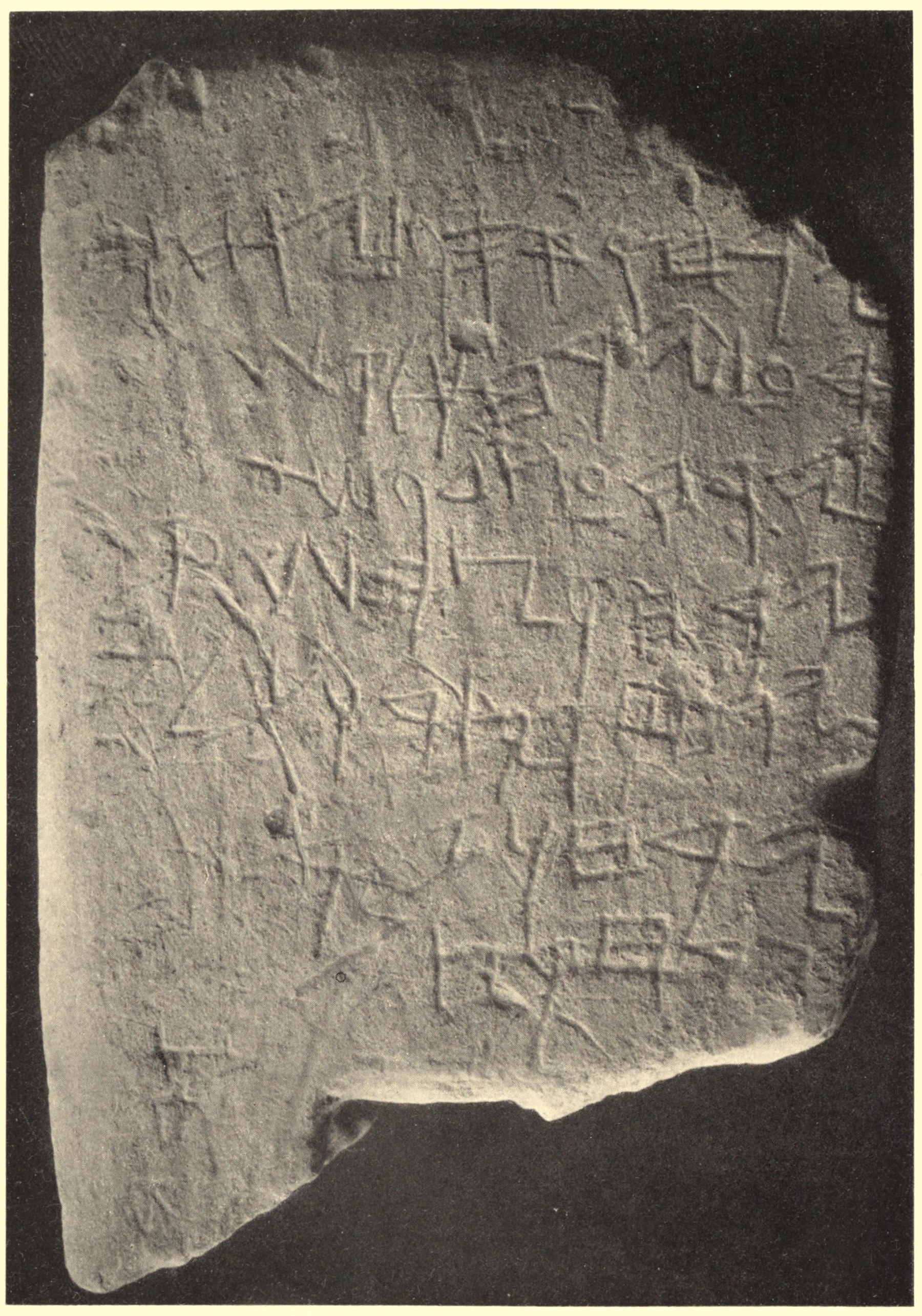
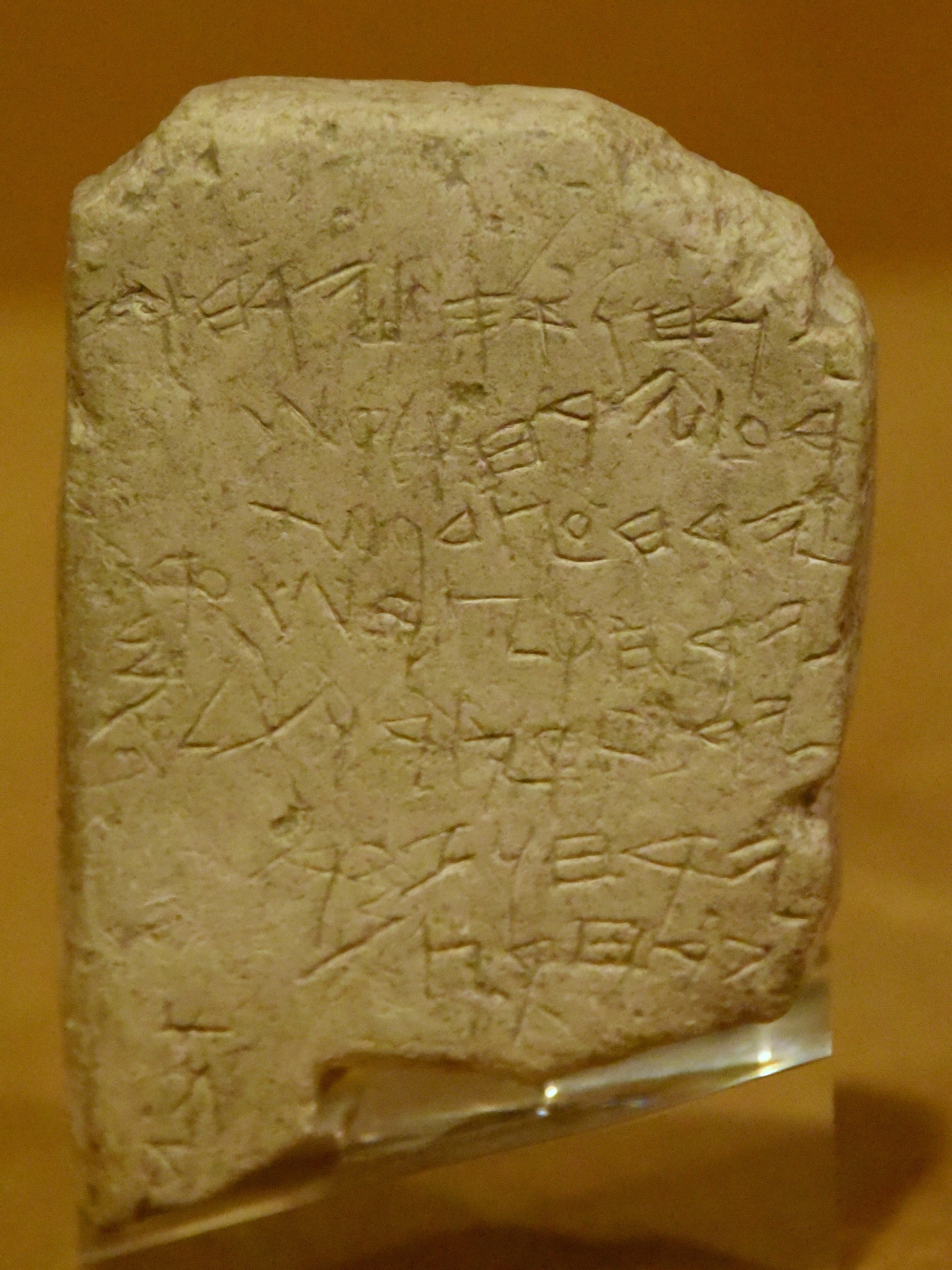
The Gezer calendar is a small tablet of soft limestone, about 11 cm high, found in 1908 by R. A. S. Macalister in his excavations at Gezer for the Palestine Exploration Fund. Its seven short lines list the months of the farming year by their work: ingathering, sowing, late sowing, cutting flax, barley harvest, the general harvest, pruning the vines and summer fruit. It is usually dated to about the 10th century BCE, and it is one of the oldest known inscriptions in a language close to the Hebrew of the Old Testament; the tablet may have been a writing exercise. It is now in the Istanbul Archaeology Museums (inv. 2089 T).
The text is Mark Lidzbarski's reading as printed by S. R. Driver in 1913, in Hebrew square letters, with a letter-for-letter Latin transliteration of the same text and Driver's English. Driver's printed errata are applied (lines 3 and 5 begin ירח, not ירחו). A line over a letter marks an uncertain reading. The letters written apart at the lower left corner, which Lidzbarski read as the beginning of a name, are not part of the seven lines given here.
How was this verified? (Provenance)
Where on the image
All seven lines are on the one inscribed face, which both photographs show whole (checked on the images: seven lines of large incised letters under the broken top edge, read right to left; line 1 begins at the right with yrḥw, the circle of ʿayin stands near the right end of line 2 in rʿ, and the last two lines are short; a few letters are written apart at the lower left corner). The first image is the photographic plate in Driver's book (1913), the second a recent photograph in Istanbul. Line numbers are Driver's.
1 ירחו אסף ירחו ז̅1 yrḥw ʾsp yrḥw z̅2 רע ירחו לקש2 rʿ yrḥw lqš3 ירח עצד פשת3 yrḥ ʿṣd pšt4 ירח קצר שערם4 yrḥ qṣr šʿrm5 ירח קצרו כל5 yrḥ qṣrw kl6 ירחו זמר6 yrḥw zmr7 ירח קץ7 yrḥ qṣ
1The month of ingathering [Tishri]. The month of 2sowing. The month of late sowing. 3The month of cutting (or hoeing up ?) flax. 4The month of barley-harvest. 5The month of the general harvest. 6The month of (vine-)pruning. 7The month of summer-fruits.
Notes
- Driver's line over a letter means 'the reading is not quite certain' (Notes, p. viii, note 2).
- Driver on line 4: 'The ם is placed below the line for want of space.'
- The Latin transliteration is a mechanical letter-for-letter rendering of the square-script text (ʾ b g d h w z ḥ ṭ y k l m n s ʿ p ṣ q r š t); it adds no reading of its own.
Cite
Sources
- Source: Gezer tablet, Istanbul 2089 T: Driver 1913 Plate I (public domain) and a Commons photograph (CC BY-SA 4.0) + Driver's 1913 text and translation (public domain) (holding institution)
- Critical edition: M. Lidzbarski's reading, in S. R. Driver, Notes on the Hebrew Text ... of Samuel, 2nd ed. (1913), p. vii
← previous · → next · v cycle view · l back to library