Epic of Gilgamesh, Tablet I (Gilgamesh and the creation of Enkidu): tablet K.7017
Introduction
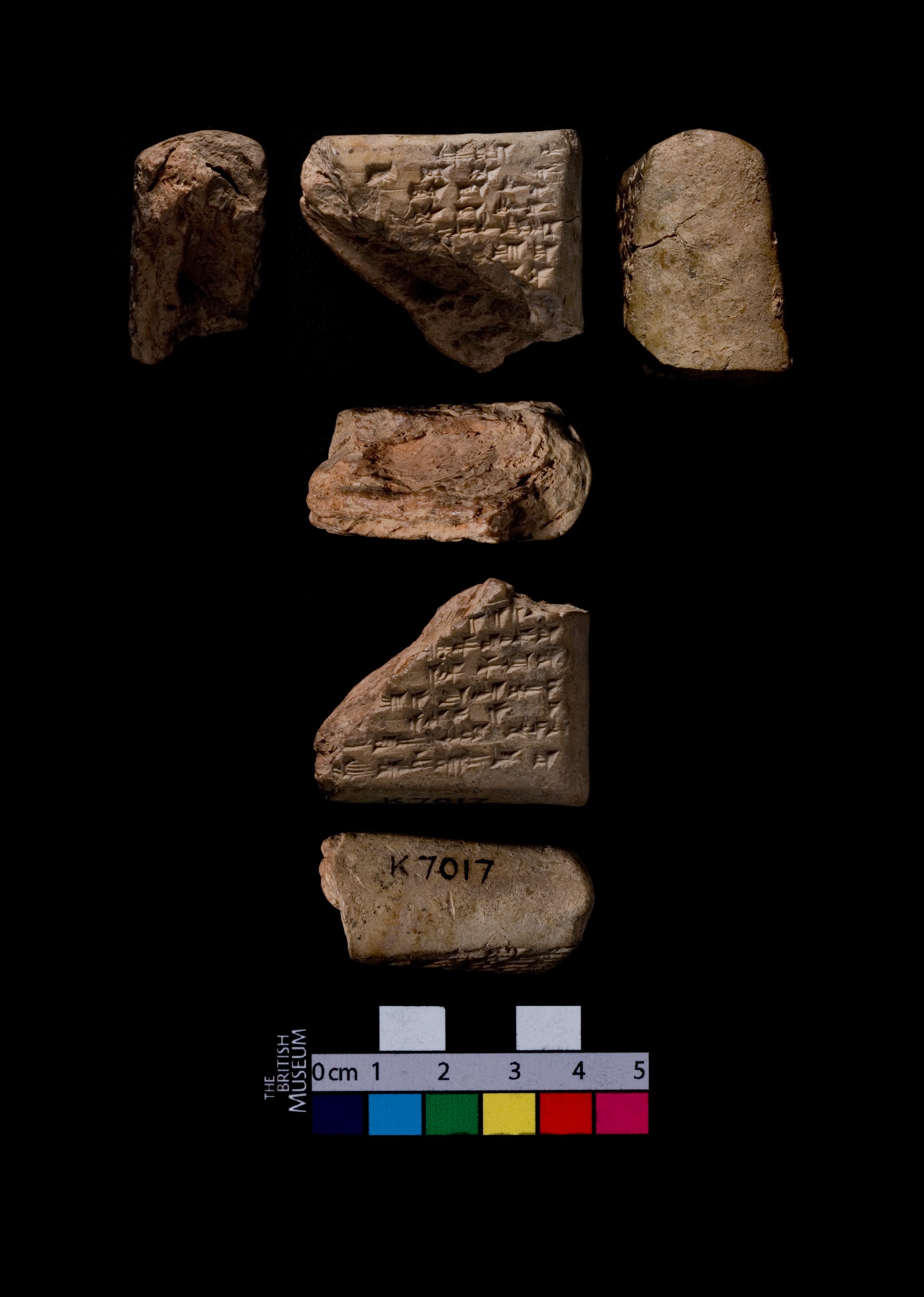
Tablet I of the Epic of Gilgamesh (Standard Babylonian version, attributed to Sin-leqi-unninni) as it survives on one physical object: British Museum tablet K.7017 (K.7017, columns iii-iv), excavated at Nineveh from the library of Ashurbanipal (7th c. BCE). It is manuscript F₂ in A. R. George's 2003 edition. The photograph is the British Museum's, showing the inscribed face(s) and edges; column(s) iii, iv are preserved (17 lines).
Three criteria are met for every section:
- Manuscript scan: the British Museum photograph of K.7017 itself (served by the Electronic Babylonian Library, LMU Munich). Each section names the column and face (obverse = columns i-iii, reverse = columns iv-vi) and the tablet's own line numbers, so the reader can find the lines on the photograph.
- Original text: the eBL manuscript-level ATF transliteration of the signs on this tablet (not the composite text). Brackets [ ] mark broken signs, x an illegible sign, # a damaged sign. Superscript numbers are the modern line numbers of George 2003 / eBL.
- Public-domain English: R. Campbell Thompson, The Epic of Gilgamish (London, 1928), verbatim, with his marginal line numbers as T n.
On line numbers. Thompson's 1928 numbering is not George's. For Tablet I the eBL edition records Thompson's 1930 column/line number for each modern line, and that concordance is used here. Where the tablet's text begins or ends inside a Thompson block, the whole block is given and the section says so. Thompson's readings reflect the state of knowledge in 1928: modern editions (George 2003; the eBL edition, updated continuously) supersede him and are not public domain, so they are not reproduced here beyond the transliteration of this tablet's signs.
How was this verified? (Provenance)
158[x x x x x x x x e-pe-š]i [EDIN]
159[x x x x x x x x x x x x x x x] ṣa-a-a-di#
160[x x x x x x x x x x x x {munus}š]am-hat u₂-ru-ma
161[x x x x x i-sa-an?-ni-q]u a-na maš-qe₂-e
162[x x x x x x x x x x lip-t]a-a ku-zu-ub-ša₂
163[x x x x i-ṭe-h]e a-na ša₂-a-ša₂
T iii 35So that I fear to approach [him] . The pits which I [myself] hollow’d
(With mine own hands) hath he fill’d in (again, and) the traps of my [setting]
Torn up, (and) out of my clutches hath holpen escape (all) the cattle,
Beasts [of the desert]: to work at my fieldcraft he will not allow me."
T iii 40Gilgamish unto him, unto the hunter made answer (in this wise):
"Go, (good) my hunter, take with thee a courtesan-girl, a hetaera,
When he the cattle shall [gather] again to the place of (their) drinking,
So shall she put off her mantle, (the charm of her) beauty [revealing],
Thompson's numbered block(s) extend before the lines preserved on this tablet; the whole block is given so that no English line is cut mid-block.
164[x x x x x x x x ir-b]u-u₂ UGU EDIN-šu
165[x x x x x x x x x x x ha-rim]-tu₄ šam-hat u₂-ru-ma $ end of column
T iii 45(Then) shall he spy her, and (sooth) will embrace her, (and thenceforth) his cattle
Which in his very own deserts were rear’d will (straightway) deny him. "
(The Seduction of Enkidu).
Forth went the hunter, took with him a courtesan-girl, a hetaera,
(So) did they start on their travels, went forth on their journey (together),
(Aye), at the term of three days arrived at the pleasaunce appointed.
Sate they down in their ambush (?), the hunter and the hetaera,
Thompson's numbered block(s) extend after the lines preserved on this tablet; the whole block is given so that no English line is cut mid-block.
166[x x x x x x x x x] har-ra-nu
167[x x x x x x x x x x x] ik#-tal-du-ni
168[x x x x x x x x x x uš-bi-šu-n]u it-taš-bu-ni
169[x x x x x x x x x x x x x x] it-taš-bu-ni
170[x x x x x x x x x x x]
T iii 45(Then) shall he spy her, and (sooth) will embrace her, (and thenceforth) his cattle
Which in his very own deserts were rear’d will (straightway) deny him. "
(The Seduction of Enkidu).
Forth went the hunter, took with him a courtesan-girl, a hetaera,
(So) did they start on their travels, went forth on their journey (together),
(Aye), at the term of three days arrived at the pleasaunce appointed.
Sate they down in their ambush (?), the hunter and the hetaera,
T iii 50One day, two days they sat by the place where (the beasts) drank (their) water.
(Then) at last came the cattle to take their fill in their drinking.
Thompson's numbered block(s) extend before the lines preserved on this tablet; the whole block is given so that no English line is cut mid-block.
171[x x x x x x x x x] i#-ṭi-bu lib-ba-šu₂
172[x x x x x x x x x x x š]a₂-du#-um-ma
173[x x x x x x x x x x]
174[x x x x x x x x i-te]p-pir
T iv 1Thither the animals came that their hearts might delight in the water,
(Aye), there was Enkidu also, he whom the mountains had gender’d,
E’en with gazelles did he pasture on herbage, along with the cattle
Cite
Source & Cross-References
- Source text: British Museum K.7017 photograph via eBL + eBL manuscript ATF (L.1.4 SB I) + R. Campbell Thompson 1928 — view original
- Critical edition: Electronic Babylonian Library manuscript transliteration (CC BY-NC-SA 4.0)
← previous · → next · v cycle view · l back to library