Epic of Gilgamesh, Tablet VI (Ishtar and the Bull of Heaven): tablet K.4579.A
Introduction
Tablet VI of the Epic of Gilgamesh (Standard Babylonian version, attributed to Sin-leqi-unninni) as it survives on one physical object: British Museum tablet K.4579.A (K.4579A + K.8018 (joined)), excavated at Nineveh from the library of Ashurbanipal (7th c. BCE). It is manuscript Q₁ in A. R. George's 2003 edition. The photograph is the British Museum's, showing the inscribed face(s) and edges; column(s) i, ii, v, vi are preserved (63 lines).
Three criteria are met for every section:
- Manuscript scan: the British Museum photograph of K.4579.A itself (served by the Electronic Babylonian Library, LMU Munich). Each section names the column and face (obverse = columns i-iii, reverse = columns iv-vi) and the tablet's own line numbers, so the reader can find the lines on the photograph.
- Original text: the eBL manuscript-level ATF transliteration of the signs on this tablet (not the composite text). Brackets [ ] mark broken signs, x an illegible sign, # a damaged sign. Superscript numbers are the modern line numbers of George 2003 / eBL.
- Public-domain English: R. Campbell Thompson, The Epic of Gilgamish (London, 1928), verbatim, with his marginal line numbers as T n.
On line numbers. Thompson's 1928 numbering is not George's. For this tablet the correspondence was established one anchor per Thompson marginal number by reading his verse against the Akkadian; sections are cut only at those anchors, so each section's English is the block of Thompson's lines that renders exactly these Akkadian lines. Where the tablet's text begins or ends inside a Thompson block, the whole block is given and the section says so. Thompson's readings reflect the state of knowledge in 1928: modern editions (George 2003; the eBL edition, updated continuously) supersede him and are not public domain, so they are not reproduced here beyond the transliteration of this tablet's signs.
How was this verified? (Provenance)
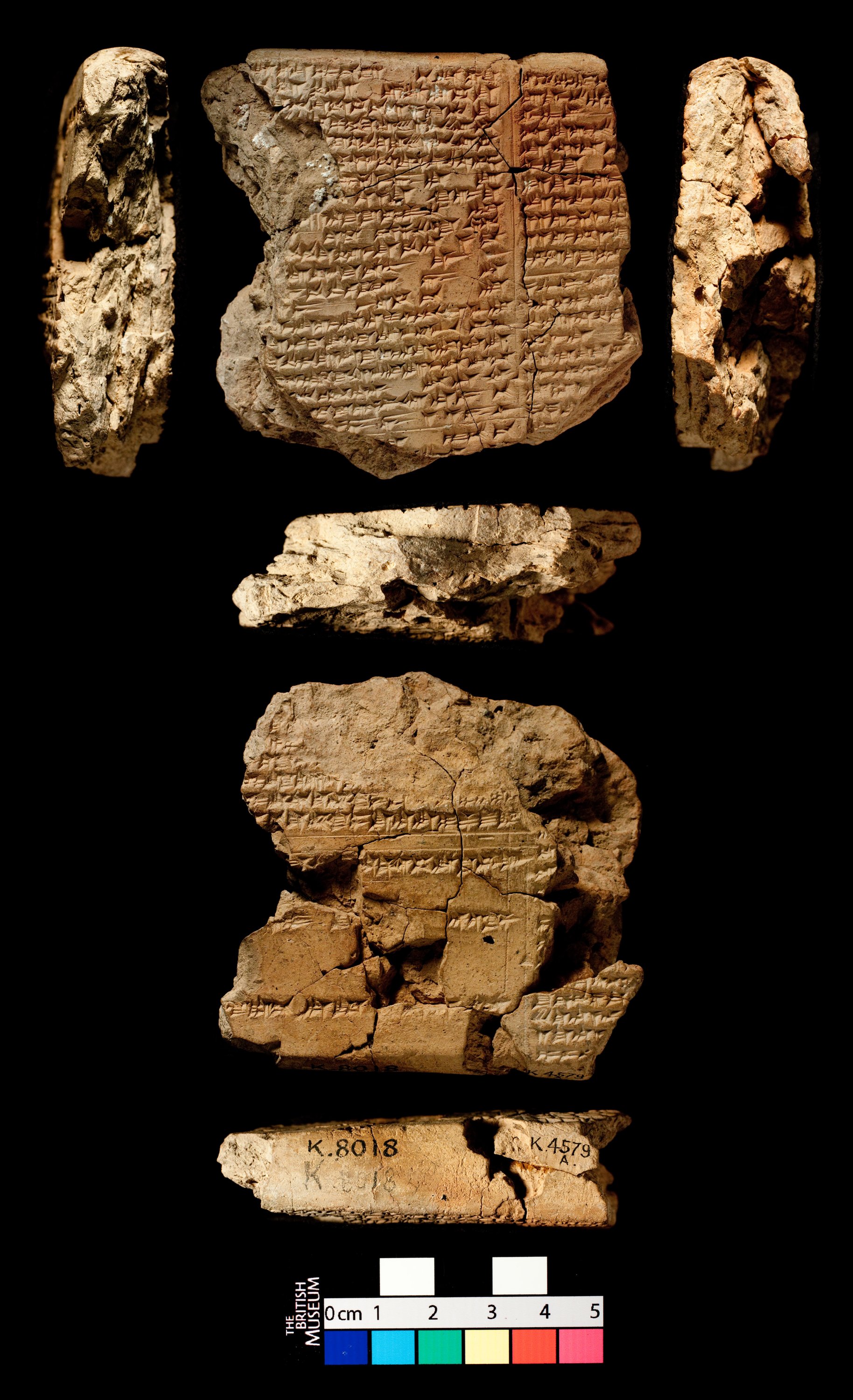
1[x x ma]-le-e-šu ub-bi-ib til-le-e-šu
2[u₂-na-si]s qim-mat-su e-li ṣe-ri-šu
3[x x mar-š]u-ti-šu it-tal-bi-iš za-ku-ti-šu
4[x x x x it]-tah#-li#-pa-am-ma ra-kis a-gu-uh-hu
5[x x x x x x x i-t]e-ep-pir-am-ma ra-kis a-gu-uh-hu
6[x x x x x x {d}GIŠ-gi]m₂-maš IGI-MEŠ it-ta-ši ru-bu-tu₂ {d}15
7[x x x x x x x lu]-u₂ ha-me-er at-ta
8[x x x x x x] qa-a-šu qi₂-šam-ma
9[x x x x mu-ti-m]a a-na-ku lu-u₂ aš₂-šat-ka
(Gilgamish is removing the stains of combat).
T 1(Now) is he washing his stains, (and) is cleansing his garments in tatters,
Braiding (?) (the locks of) his hair (to descend loose) over his shoulders,
Laying aside his garments besmirchen, (and) donning his clean ones,
Putting on armlets (?), and girding his body about with a baldric,
T 5Gilgamish bindeth his fillet, and girdeth himself with a baldric.
(Ishtar sees him and seeks to wed him).
(Now) Lady Ishtar espieth the beauty of Gilgamish: (saith she),
"Gilgamish, come, be a bridegroom, to me of the fruit (of thy body)
Grant me largesse: (for) my husband shalt be and I'll be thy consort.
10[lu-ša₂-aṣ-mid-k]a {giš}GIGIR {na₄}ZA.GIN₃ u₃ KU₃.SIG₁₇
11[x x x x x KU₃.S]IG₁₇-am-ma el-me-šu qar-na-a-ša
12[x x ṣa-an-d]a-ta UD-MEŠ ku-da-nu GAL-MEŠ
13[x x x x x x s]a-am-mat {giš}EREN er-ba
14[x x] E₂#-ni ina e-re-bi-ka
15[x x x x-r]at-tu-u₂ li-na-aš₂-ši-qu GIR₃+MIN-MEŠ-ka
16[lu kam-s]u ina šap-li-ka LUGAL-MEŠ EN-MEŠ u NUN-MEŠ
17[x x liq?-t]u? KUR-i u ma-a-tu lu-u₂ na-šu-nik₂-ka bil-tu
18[x x x t]ak₂-ši-i US₅.UDU.HA₂-MEŠ-ka tu-a-me li-li-da
19[x x x x bi]l-ti {anše}KUNGA li-ba-ʾa
T 10O, but I'll furnish a chariot for thee, (all) azure and golden,
Golden its wheel, and its yoke precious stones , each day to be harness'd
Unto great mules: (O), enter our house with the fragrance of cedar.
T 15(So) when thou enterest into our house shall threshold and dais
Kiss thy feet, (and) beneath thee do homage kings, princes, and rulers,
Bringing thee yield of the mountains and plains as a tribute: thy she-goats
Bring forth in plenty, thy ewes shall bear twins, thy asses attaining
20[x x x x x x]{giš#}GIGIR lu-u₂ ša₂-ru-uh la-sa-mu
21[x x x x ni-r]u ša₂-ni-ni a-a ir-ši
22[x x x x x x x D]U₃-ma i-qab-bi
23[x x x x x x r]u-bu-tu₂ {d}1[5]
T 20(Each) to the size of a mule, (and) thy steeds in thy chariot winning
Fame for their gallop: [thy mules ] in the yoke shall ne’er have a rival."
[Gilgamish] open’d his mouth in reply, Lady Ishtar [to answer]:
"Aye, but what must I give] thee, (if (?)) I should take thee in marriage?
Thompson's numbered block(s) extend after the lines preserved on this tablet; the whole block is given so that no English line is cut mid-block.
34{giš}IG ar₂-ka-bi-[in-ni ša₂ x x x x x x x x x x]
35E₂.GAL mu-nap-p[i-ṣa-at x x x]
36pi-i-ru [x x x x x x x x x x]
37it-tu-u₂ mu-ṭ[ap-pi-lat? (x x) x x x]
38{kuš}na-a-da m[u-ra-sa-at x x x]
39pi-i-lu m[u-x x x x x x]
T 30. . . . I shall be bound, . . . let us amass (?), . . . clothe with a garment.
[What, then, will be my advantage, supposing) I take thee in marriage?
[Thou’rt but a ruin which giveth no shelter (?) to man] from the weather,
Thou’rt but a back door [not] giving resistance to blast or to windstorm,
T 35Thou’rt but a palace which dasheth the heroes [within it to pieces],
Thou’rt but a pitfall (which letteth) its covering [give way (all treach’rous)],
Thou art but pitch which [defileth] the man who doth carry it with him,
Thou’rt but a bottle which [leaketh] on him who doth carry it with him,
Thou art but limestone which [letteth] stone ramparts [fall crumbling in ruin].
Thompson's numbered block(s) extend before the lines preserved on this tablet; the whole block is given so that no English line is cut mid-block.
40ia-šu-bu-u₂ [x x x x x x x x x]
41{kuš}E.SIR₂ mu-na-[ši-kat₃ x x x x]
42a-a-u₂ ha-me-r[a-ki x x x x x]
43a-a-u₂ al-lal-ki [x x x x x x x]
44al-kim-ma lu-up-pi-[iš x x x x x x x]
45ša₂ bu-di-im-m[a x x x x x x]
46a-na {d}dumu-zi h[a-mi-ri x x x x x]
47šat-ta a-na šat-t[a x x x x x x x x]
48al-lal-la b[it-ru-ma x x x x]
49tam-ha-ṣi-šu-ma kap-p[i-šu x x x x]
T 40Thou’rt but chalcedony [failing to guard (?)] in an enemy's country,
Thou’rt but a sandal which causeth its owner [to trip (by the wayside)].
Who was ever [thy] husband [thou faithfully lovedst] for all time?
Who hath been ever thy lord who hath gain’d [over thee the advantage?
Come, and I will unfold thee [the endless tale] of thy husbands.
T 45(Sooth), thou shalt vouch (?) for the truth (?) of (this) list—Thy maidenhood's consort,
Tammuz, each year dost make him the cause of Wailing , (then cometh
Next) the bird Roller gay-feather’d thou lovedst, and (yet) thou didst smite him
50a-šib ina {giš}TIR-i[m-ma x x x x x]
51ta-ra-me-m[a x x x x x x x x]
527 u 7 t[u-uh-tar-ri-šu x x x x x]
53ta#-r[a-mi-ma x x x x x x x x]
58[x x x x x x x x x x u₂-tul₅-l]a?
T 50Breaking his wing: in the grove doth he stand, crying kappi 'my wing!'
Lovedst thou also a Lion, in (all) the full strength of (his) vigour,
(Yet) thou didst dig for him seven and seven (deep) pits (to entrap him).
Lovedst thou also a Stallion, magnificent he in the battle,
Thou wert the cause of a bridle, a spur, and a whip to him: (also)
T 55Thou wert the cause of his fifty miles galloping; thou wert the cause, too,
(Eke), of exhaustion and sweating (?); (thereafter), ’twas thou who didst (also)
Unto his mother Silili give cause for (her deep) lamentation.
Lovedst thou also a Shepherd, a neatherd, for thee without ceasing
Thompson's numbered block(s) extend after the lines preserved on this tablet; the whole block is given so that no English line is cut mid-block.
153{d#}[GIŠ-gim₂-maš x x x x x x x x x x x]
154iš-[me-ma x x x x x x x x x x]
155iš-[lu-uh x x x x x x x x x x x]
T 160"Woe unto Gilgamish—he who by killing the Bull of the Heavens,
Made me lament." When Enkidu heard this, the shrieking of Ishtar,
Wrenching the member from out of the Bull, he toss’d (it) before her;
156i[š-x x x x x x x x x x x] | [x x x x x x x x x x x x]
157er-[ri-šu x x x x x x x x]
158u[p-tah-hi-ir x x x x x x x x]
159{10} i[na x] e#-m[it-ti x x x x x x x x]
160[is-si-m]a {d}GIŠ-gim₂-[maš x x x x x x x x x x]
161ku-bur qar-ni-šu i#-[na-ad-du x x x x x]
16230 ma-na.AM₃ [x x x x x x x]
1632 ma-na.A[M₃ x x x x x x]
T 165"If I could only have reach’d thee, i’faith, I’d ha’ served thee the same way,
I’d ha’ let dangle his guts on thy flanks (as a girdle about thee)."
Ishtar assembled the girl-devotees, the hetaerae and harlots,
Over the member (torn out) from the Bull she led the lamenting.
(The Triumph of Gilgamish).
T 170Gilgamish call’d to the masters of craft, the artists, (yea), all of them,
That at the size of its horns (all) the guilds of the crafts speak their praises
Each had of azure in weight thirty minas to be as their setting,
Two fingers their . ... ... . . . . . . . . . . .
1646 GU[R x x x x x x x x]
T 175Both of them held six measures of oil; to his god Lugal-banda
He for (his) unguent devoting, brought in, and (thus) let them hang (there),
(There) in the shrine of his forbears.
(And now) in the River Euphrates
Washing their hands, they start (on their progress) and come (to the city);
(Now) are they striding the highway of Erech, the heroes of Erech
Thompson's numbered block(s) extend after the lines preserved on this tablet; the whole block is given so that no English line is cut mid-block.
176[x] x [x x x x x x x x x x]
177[x]-ma x [x x x x x x x x x x]
178[(x)] x-a i?#-[x x x x x x x x]
179{d#}GIŠ#-gim₂#-maš# i#-[na x x x x x x x x x]
180u₂-tu-lu-ma GURUŠ-MEŠ ša₂# i#-[na x x x x x x x]
181u₂#-tu-ul-ma {d}+en-ki-du₃ šu#-na#-tu# i#-na#-aṭ-ṭ[al]
182[i]t-be₂#-ma {d}+en-ki-du₃ šu-na-tu i-pa-aš₂-šar
T 185[Enkidu—he is most] famous of giants.
(Three mutilated lines follow.)
T 190So in his palace did Gilgamish hold high revel: (thereafter),
(While all) the heroes asleep, on their nightly couches were lying
Enkidu, too, was asleep, and a vision beheld, and (so) coming
Enkidu (now) his dream to reveal: (thus) spake he unto his comrade.
Thompson's numbered block(s) extend before and after the lines preserved on this tablet; the whole block is given so that no English line is cut mid-block.
Cite
Source & Cross-References
- Source text: British Museum K.4579.A photograph via eBL + eBL manuscript ATF (L.1.4 SB VI) + R. Campbell Thompson 1928 — view original
- Critical edition: Electronic Babylonian Library manuscript transliteration (CC BY-NC-SA 4.0)
← previous · → next · v cycle view · l back to library