Epic of Gilgamesh, Tablet XI (the Flood): tablet K.3375
Introduction
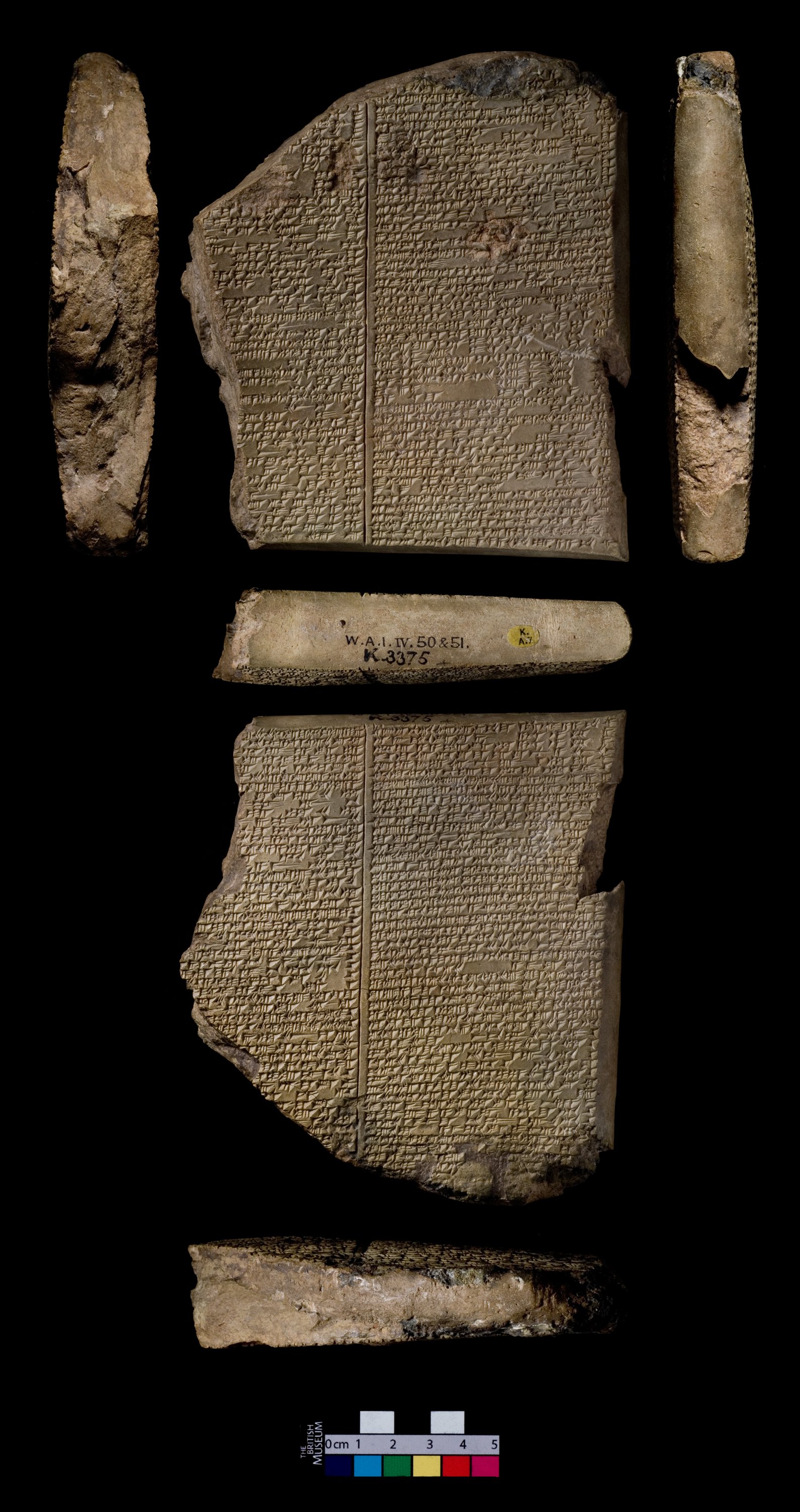
Tablet XI of the Epic of Gilgamesh (Standard Babylonian version, attributed to Sin-leqi-unninni) as it survives on one physical object: British Museum tablet K.3375 (The 'Flood Tablet' (BM K.3375), unjoined; columns ii-v), excavated at Nineveh from the library of Ashurbanipal (7th c. BCE). It is manuscript J₁ in A. R. George's 2003 edition. The photograph is the British Museum's, showing the inscribed face(s) and edges; column(s) ii, iii, iv, v are preserved (224 lines).
Three criteria are met for every section:
- Manuscript scan: the British Museum photograph of K.3375 itself (served by the Electronic Babylonian Library, LMU Munich). Each section names the column and face (obverse = columns i-iii, reverse = columns iv-vi) and the tablet's own line numbers, so the reader can find the lines on the photograph.
- Original text: the eBL manuscript-level ATF transliteration of the signs on this tablet (not the composite text). Brackets [ ] mark broken signs, x an illegible sign, # a damaged sign. Superscript numbers are the modern line numbers of George 2003 / eBL.
- Public-domain English: R. Campbell Thompson, The Epic of Gilgamish (London, 1928), verbatim, with his marginal line numbers as T n.
On line numbers. Thompson's 1928 numbering is not George's. For this tablet the correspondence was established one anchor per Thompson marginal number by reading his verse against the Akkadian; sections are cut only at those anchors, so each section's English is the block of Thompson's lines that renders exactly these Akkadian lines. Where the tablet's text begins or ends inside a Thompson block, the whole block is given and the section says so. Thompson's readings reflect the state of knowledge in 1928: modern editions (George 2003; the eBL edition, updated continuously) supersede him and are not public domain, so they are not reproduced here beyond the transliteration of this tablet's signs.
How was this verified? (Provenance)
56[x x x x x x x x x u]b-la#
57[x x x x x x x x x bu]-na-ša₂
58[x x x x x x x x x x x E₂.G]AR₈-MEŠ-ša₂
59[x x x x x x x x x m]uh-hi-ša₂
T 55Pitch did the children provide, (while) the strong brought [all] that was needful.
(Then) on the fifth day (after) I laid out the shape (of my vessel),
Ten gar each was the height of her sides, in accord with her planning(?),
Ten gar to match was the size of her deck (?), and the shape of the forepart (?)
Thompson's numbered block(s) extend before the lines preserved on this tablet; the whole block is given so that no English line is cut mid-block.
60[x x x x x x x] e#-ṣir-ši
61[x x x x x x x x x ( : )]
62[ap-ta-ra-as-s]u a-na 7-[š]u₂
63[x x x x x x x x] a-na [9-š]u₂
64[x x x x x x x x x] lu# am-haṣ#
65[x x x x x x hi-ših-t]i ad-[d]i
66[x x x x x at-ta-ba]k a-n[a] GIR₄
67[x x x x x x] a-na lib₃-bi
68[x x x x x] {giš#}s[u-us-su-ul] ša₂# i#-zab-bi-lu I₃.GIŠ
69[x x x x] I₃.GIŠ ša₂# i#-ku-lu ni-iq-qu
T 60Did I lay down, (and) the same did I fashion; (aye), six times cross-pinn’d her,
Sevenfold did I divide her . . . ., divided her inwards
Ninefold: hammer’d the caulking within her, (and) found me a quant-pole,
T 65(All) that was needful I added; the hull with six shar of bitumen
Smear’d I, (and) three shar of pitch [did I smear] on the inside; some people,
Bearing a vessel of grease, three shar of it brought (me); (and) one shar
(Out of this) grease did I leave, which the tackling (?) consumed; (and) the boatman
70[x x x] u₂#-pa-az-zi-ru {lu₂}MA₂.LAH₄
71[x x x mi-n]i? uṭ-ṭab₃-bi-ih GU₄-MEŠ
72[x x x UDU.NITA₂]-MEŠ u₄-mi-šam-ma
73[x x x ku-ru]-un-nu I₃.GIŠ u₃ GEŠTIN
74[x x x x] ki-ma A-MEŠ ID₂-ma
75[x x x ip-pu-š]u₂ ki-ma u₄-mi a-ki-tim-ma
76[x x x x x x x x] piš-ša₂-ti qa-ti ad-di
77[x x x x r]a-be₂-e {giš}MA₂ gam-rat
78[x x x x x x x] x šup-šu-qu-ma
79[x x x x x ni]t-tab-ba-lu e-liš u šap-liš
80[x x x x il-l]i-ku ši-ni-pat-su
81[x x x x x e-ṣe-en]-ši
82mim-ma i-šu-u₂ e-ṣe-en-ši KU₃.BABBAR
83[x x x x x e]-ṣe-en-ši KU₃.SIG₁₇
84[x x x x x x e-ṣe-e]n-ši NUMUN ZI-MEŠ ka-la-ma
85[x x x x x x {giš}M]A₂ ka-la kim-ti-ia u sa-lat-ia
T 70Two shar of grease stow’d away; (yea), beeves for the . . . I slaughter’d,
Each day lambs did I slay: mead, beer, oil, wine, too, the workmen
[Drank] as though they were water , and made a great feast like the New Year,
(Five mutilated lines "I added salve for the hand(s)," "the vessel was finish’d . . . Shamash the great." "was difficult," " . . ? I caused to bring above and below," "two-thirds of it"):
T 80[All I possess’d I] laded aboard her; the silver I laded
All I possess'd; gold, all I possess’d I laded aboard her,
All I possess’d of the seed of all living [I laded aboard] her.
Into the ship I embark’d all my kindred and family (with me),
86[x x x x x x x DUMU-ME]Š um-ma-a-ni ka-li-šu₂-nu u₂-še-li
87[x x x x x] iš-ku-nam-ma
88[x x x x x x x li-la-a-t]i u₂-ša₂-az-na-an-nu ša₂-mu-ut ki-ba-a-ti
89[x x x x x x] {giš#}MA₂-ma pi-he KA₂-ka
90[x x x x x] ik-tal-da
91[x x x x x x x li-la-a-t]i u₂-ša₂-az-na-na ša₂-mu-ut ki-ba-a-ti
92[x x x x x x] bu-na-šu
93[x x x x x x x x p]u-luh-ta i-ši
94[x x x x x x {giš}M]A₂-ma ap-te-hi ba-a-bi
T 85Cattle (and) beasts of the field (and) all handicraftsmen embarking.
(Then) decreed Shamash the hour: " . . . . (?)
Shall in the night let a plentiful rainfall(?) pour down . . . .
(Then) do thou enter the vessel, and (straightway) shut down thy hatchway."
T 90Came (then) that hour (appointed), . . . . . . (?)
Did in the night let a plentiful rainfall(?) pour down . . . . (?)
View’d I the aspect of day: to look on the day bore a horror,
(Wherefore) I enter’d the vessel, and (straightway) shut down my hatchway,
(So, too) to shut down the vessel to Puzur-Amurri (?), the boatman,
95[x x x x x x x x x p]u-zu-ur-{d}KUR.GAL {lu₂}MA₂.LAH₄
96[at-ta-di-i]n a-di bu-še-e-šu₂
97[x x x x x x] ina na-ma-ri
98[x x x x x x x A]N-e ur-pa-tu₄ ṣa-lim-tu₄
99[x x x x x x] ir-tam-ma-am-ma
100[x x x x x i]l-la-ku ina mah-ri
101[x x x GU.ZA.LA₂-ME]Š KUR-u₂ u ma-a-tu₄
102[x x x {d}er₃-ra-g]al i-na-as-sah
103[x x x x x mi-i]h-ri u₂-šar-di
104[x x x x x iš-šu]-u₂# & di-pa-ra-a-ti
T 95Did I deliver the poop (of the ship), besides its equipment.
(Then), when something of dawn had appear’d, from out the horizon
Rose a cloud darkling; (lo), Adad (the storm-god) was rumbling within it,
T 100Nabu and Sharru were leading the vanguard, and coming as heralds
Over the hills and the levels: (then) Irragal wrench’d out the bollards;
Havoc Ninurta let loose as he came, th’ Anunnaki their torches
105[x x x x x x x u₂-ha-a]m-ma-ṭu ma-a-tu₄
106[x x x x x x x x i-b]a-ʾ-u₂ AN-e
107[x x x x x da-ʾ-um-ma-t]i? ut-ter-ru $ end of column
T 105Brandish’d, and shrivell’d the land with their flames; desolation from Adad
Stretch’d to (high) Heaven, (and) all that was bright was turn’d into darkness.
(Four lines mutilated "the land like . . .," "for one day the st[orm] . . ., " "fiercely blew . . . . " "like a battle . . . ").
Nor could a brother distinguish his brother; from heaven were mortals
Not to be spied. O, were stricken with terror the gods at the Deluge,
Fleeing, they rose to the Heaven of Anu, and crouch’d in the outskirts,
Thompson's numbered block(s) extend after the lines preserved on this tablet; the whole block is given so that no English line is cut mid-block.
109[x x x x x x x] a-bu-bu x [x x]
110[x x x] i#-zi#-[qam-ma x x-š]i KUR-a a#-[bu-bu?]
111[ki-m]a qab-li UGU# UN-MEŠ u₂-ba-ʾ-u₂ [ka-šu₂-šu₂]
112ul# im-mar a-hu a-ha-šu₂
113ul# u₂#-ta#-ad#-da#-a# UN#-MEŠ# ina A[N-e]
114DINGIR.DINGIR ip-tal-hu a-bu-ba#-am-[ma]
115it-te-eh-su i-te-lu-u₂ ana AN-e ša₂ {d}a-nim
116DINGIR-MEŠ ki-ma UR.GI₇ kun-nu-nu ina ka-ma-a-ti rab-ṣu
117i-šas-si {d}iš-tar ma-li-ti
118u₂-nam-bi DINGIR.MAH & ṭa-bat rig-ma
119u₄-mu ul-lu-u₂ a-na ṭi-iṭ-ṭi lu-u₂ i-tur-ma
T 105Brandish’d, and shrivell’d the land with their flames; desolation from Adad
Stretch’d to (high) Heaven, (and) all that was bright was turn’d into darkness.
(Four lines mutilated "the land like . . .," "for one day the st[orm] . . ., " "fiercely blew . . . . " "like a battle . . . ").
Nor could a brother distinguish his brother; from heaven were mortals
Not to be spied. O, were stricken with terror the gods at the Deluge,
Fleeing, they rose to the Heaven of Anu, and crouch’d in the outskirts,
T 115Cow 'ring like curs were the gods (while) like to a woman in travail
Ishtar did cry, she shrieking aloud, (e’en) the sweet-spoken Lady
(She of the gods): 'May that day turn to dust, because I spake evil
Thompson's numbered block(s) extend before the lines preserved on this tablet; the whole block is given so that no English line is cut mid-block.
120ša₂# a#-na#-ku ina ma-har DINGIR.DINGIR aq-bu-u₂ {munus}HUL
121ki#-i aq#-bi ina ma-har & DINGIR.DINGIR {munus}HUL
122ana hul-l[u]-uq UN-MEŠ-ia qab-la aq-bi-ma
123a-na-ku-[u]m-ma ul-la-da ni-šu-u₂-a-a-ma
124ki-i DUMU-MEŠ KU₆.HA₂ u₂-ma-al-la-a tam-ta-am-ma
125DINGIR.DINGIR šu-ut {d}a-nun-na-ki ba-ku-u₂ it-ti-ša₂
126DINGIR-MEŠ aš-ru aš₂-bi i-na bi-ki-ti
127kat₃-ma šap-ta-šu₂-nu le#-qa#-a bu-uh-re-e-ti
1286 ur-ra u₃# mu-ša₂-a-ti
129il-lak ša₂-a-ru a-bu-bu# me#-hu-u₂ i-sap-pan KUR
130se-bu-u₂ u₄-mu i-na ka-ša₂-a-di# [( : )]
131te#-riq# šu-u₂ a-bu-bu qab-la
T 120(There) in th’ Assemblage of Gods! O, how could I utter (such) evil
(There) in the Assemblage of Gods, (so) to blot out my people, ordaining
Havoc! Sooth, then, am I to give birth, unto (these) mine own people
Only to glut (with their bodies) the Sea as though they were fish-spawn?'
T 125Gods—Anunnaki—wept with her, the gods were sitting (all) humbled,
(Aye), in (their) weeping, (and) closed were their lips amid(?)]the Assemblage.
Six days, a se’nnight the hurricane, deluge, (and) tempest continued
Sweeping the land: when the seventh day came, were quelléd the warfare,
132-133aša₂ im-tah-ṣu ki-ma ha-a-a-al-ti | i-nu-uh A.AB.BA
133buš-ha-ri-ir-ma im-hul!(U₃)-lu a-bu-bu ik-la
134ap-pa-al-sa ta-ma-ta ša₂-kin qu-lu
135u₃ kul-lat te-ne₂-še-e-ti i-tu-ra a-na ṭi-iṭ-ṭi
136ki-ma u₂-ri mit-hu-rat u₂-šal-lu
137ap-te nap-pa-ša₂-am-ma UD.DA im-ta-qut UGU BAD₃ ap-pi-ia
138uk-tam-mi-is-ma at-ta-šab a-bak-ki
139UGU BAD₃ ap-pi-ia il-la-ka di-ma-a-a
140ap-pa-li-is kib-ra-a-ti pa-tu A.AB.BA
T 130Tempest (and) deluge which like to an army embattail’d were fighting.
Lull’d was the sea, (all) spent was the gale, assuaged was the deluge,
(So) did I look on the day; (lo), sound was (all) still’d; and all human
Back to (its) clay was return’d, and fen was level with roof-tree.
T 135(Then) I open’d a hatchway, and down on my cheek stream’d the sunlight,
Bowing myself, I sat weeping, my tears o’er my cheek(s) overflowing,
Into the distance I gazed, to the furthest bounds of the Ocean,
141a-na 12.TA.AM₃ i-te-la-a na-gu-u₂#
142a-na KUR ni-muš i-te-mid {giš}M[A₂]
143KUR-u₂ {kur}ni-muš {giš}MA₂ iṣ-bat-ma a-na na-a-ši ul i[d-din]
1441-en u₄-mu 2-a u₄-mu KUR-u₂ ni-muš K[IMIN]
145šal-ša₂ u₄-mu re-ba-a u₄-mu KUR-u₂ ni-muš KI[MIN]
1465-šu₂ 6-ša₂ KUR-u₂ ni-muš KI[MIN]
1477-a u₄-ma i-na ka-ša₂-d[i]
148u₂-še-ṣi-ma TU{mušen} u₂-maš-šar
149il-lik TU{mušen} i-tu-ram-m[a]
150man-za-zu ul i-pa-aš₂-šum-ma is-sah-r[a]
T 140Land was uprear’d at twelve (points), and the Ark on the Mountain of Nisir
Grounded; the Mountain of Nisir held fast, nor gave lease to her shifting.
One day, (nay,) two, did Nisir hold fast, nor give lease to her shifting.
Three days, (nay), four, did Nisir hold fast, nor give lease to her shifting,
Five days, (nay,) six, did Nisir hold fast, nor give lease to her shifting.
T 145(Then), when the seventh day dawn’d, I put forth a dove, and released (her),
(But) to and fro went the dove, and return’d (for) a resting-place was not.
151u₂-še-ṣi-ma SIM{mušen} u₂-maš-šar!(ŠIR₃)
152il-lik SIM{mušen} i-tu-ram-m[a]
153man-za-zu ul i-pa-aš₂-šum-ma is-sah-ra
154u₂-še-ṣi-ma a-re-bi u₂-maš-šar!(ŠIR₃)
155il-lik a-re-bi-ma qa-ru-ra ša₂ A-MEŠ i-mur-ma
156ik-kal i-ša₂-ah-hi i-tar-ri ul is-sah-ra
157u₂-še-ṣi-ma a-na 4 IM-MEŠ at-ta-qi₂ ni-qa-a
158aš₂-kun sur-qin-nu ina UGU ziq-qur-rat KUR-i
1597 u 7 {dug}A.DA.GUR₅ uk-tin
T 150(Then) I a swallow put forth and released; to and fro went the swallow,
She (too) return’d, (for) a resting-place was not; I put forth a raven,
Her, (too,) releasing; the raven went, too, and th’ abating of waters
Saw; and she ate as she waded (and) splash’d, (unto me) not returning.
T 155Unto the four winds (of heaven) I freed (all the beasts), and an off’ring
Sacrificed, and a libation I pour’d on the peak of the mountain,
Twice seven flagons devoting, (and) sweet cane, (and) cedar, and myrtle,
160i-na šap-li-šu₂-nu at-ta-bak GI {giš}EREN u {šim}GI[R₂]
161DINGIR-MEŠ i-ṣi-nu i-ri-ša₂
162DINGIR-MEŠ i-ṣi-nu i-ri-ša₂ DUG₃.G[A]
163DINGIR-MEŠ ki-ma zu-um-be₂-e UGU EN SISKUR₂ ip-tah-ru
164ul-tu ul-la-nu-um-ma DINGIR.MAH ina ka-ša₂-di-šu₂
165iš-ši NIM-MEŠ GAL-MEŠ ša₂ {d}a-num i-pu-šu₂ ki-i ṣu-hi-šu₂
166DINGIR-MEŠ an-nu-ti lu-u₂ {na₄}ZA.GIN₃ GU₂-ia <<a-a am-ši>>
T 160Heap’d up beneath them; the gods smelt the savour, the gods the sweet savour
Smelt; (aye,) the gods did assemble like flies o’er him making the off’ring.
Then, on arriving, the Queen (of the gods) the magnificent jewels
Lifted on high, which Anu had made in accord with her wishes;
'O ye Gods! I will (rather) forget (this) my necklet of sapphires,
167U₄-MEŠ an-nu-ti ah-su-sa-am-ma ana da-riš a-a am-ši
168DINGIR-MEŠ lil-li-ku-ni a-na sur-qin-ni
169{d}en-lil₂ a-a il-li-ka a-na sur-qin-ni
170aš₂-šu₂ la im-tal-ku-ma iš-ku-nu a-bu-bu
171u₃ UN-MEŠ-ia im-nu-u₂ ana ka-ra-ši
T 165Than not maintain these days in remembrance, nor ever forget them.
(So), though (the rest of) the gods may present themselves at the off’ring,
Enlil (alone of the gods) may (himself) not come to the off’ring,
Because he, unreasoning, brought on a deluge, and therefore my people
Unto destruction consign’d.'
172ul-tu ul-la-nu-um-ma {d}+en-lil₂ ina ka-ša₂-di-šu₂
173i-mur {giš}MA₂-ma i-te-ziz {d}+en-lil₂
174lib-ba-ti im-ta-li ša₂ DINGIR.DINGIR {d}i₂-gi₃-gi₃
175a-a-um-ma u₂-ṣi na-piš-ti
176a-a ib-luṭ LU₂ ina ka-ra-š[i]
177{d}nin-urta pa-a-šu₂ DU₃-ma DUG₄.GA
178MU-ar₂ ana qu-ra-di {d}+en-l[il₂]
179man-nu-um-ma ša₂ la {d}e₂-a a-ma-tu i-ban-n[i]
180u₃ {d}e₂-a i-de-e-ma ka-la šip-r[i]
181{d}e₂-a pa-a-šu₂ DU₃-ma DUG₄.GA
182MU-ar₂ ana qu-ra-du {d}+en-[lil₂]
183at-ta ABGAL DINGIR-MEŠ qu-ra-[du]
T 170Then Enlil, on his arrival,
Spied out the vessel, and (straightway) did Enlil burst into anger,
Swollen with wrath ’gainst the gods, the Igigi : 'Hath any of mortals
’Scaped? Sooth, never a man could have lived through (the welter of) ruin.'
(Then) did Ninurta make answer and speak unto warrior Enlil,
T 175Saying: 'O, who can there be to devise such a plan, except Ea?
Surely, ’tis Ea is privy to ev’ry design.' Whereat Ea
Answer’d and spake unto Enlil, the warrior, saying: 'O chieftain
Thou of the gods, thou warrior! How, forsooth, how (all) uncounsell’d
184ki-i-ki-i la tam-ta-lik-ma a-bu-bu taš-k[un]
185be-el hi-ṭi e-mid hi-ṭa-a-šu₂
186be-el gil₂-la-ti e-mid gil₂-lat-[su]
187ru-um-me a-a ib-ba-ti-iq šu-du-ud a-a i[r-mu]
188am-ma-ku taš-ku-nu a-bu-ba
189UR.MAH lit-ba-am-ma UN-MEŠ li-ṣa-a[h-hir]
190am-ma-ku taš-ku-nu a-bu-ba
191UR.BAR.RA lit-ba-am-ma UN-MEŠ li-ṣa-[hi-ir]
192am-ma-ku taš-ku-nu a-bu-ba
193hu-šah-hu liš-ša₂-kin-ma KUR liš-[giš]
194am-ma-ku taš-ku-nu a-bu-ba
195{d}er₃-ra lit-ba-am-ma UN-MEŠ li[š]-giš#
196a-na-ku ul ap-ta-a pi-riš-ti DINGIR-MEŠ GAL-MEŠ
197at-ra-ha-sis šu-na-ta u₂-šab-ri-šum-ma pi-riš-ti DINGIR-MEŠ iš-me
198e-nin-na-ma mi-lik-šu₂ mil-ku
T 180Couldst thou a deluge bring on? (Aye,) visit his sin on the sinner
Visit his guilt on the guilty, (but) O, have mercy, that (thereby)
He shall not be cut off; be clement, that he may not [perish].
O, instead of thy making a flood, let a lion come, man to diminish;
O, instead of thy making a flood, let a jackal come, man to diminish;
O, instead of thy making a flood, let a famine occur, that the country
T 185May be [devour’d(?)]; instead of thy making a flood, let the Plague-god
Come and the people [o’erwhelm];
Sooth, indeed ’twas not I of the Great Gods the secret revealéd,
(But) to th’ Abounding in Wisdom vouchsafed I a dream, and (in this wise)
He of the gods heard the secret. Deliberate, now, on his counsel'.
199i-lam-ma {d}IDIM ana lib₃-bi {giš}MA₂
200iṣ-bat qa-ti-ia-ma ul-te-la-an-ni ia-a-ši
201uš-te-li uš-tak-mi-is sin-niš-ti ina i-di-ia
202il-pu-ut pu-ut-ni-ma iz-za-az ina bi-ri-in-ni i-kar-ra-ban-na-ši
203i-na pa-na {m}UD-ZI a-me-lu-tum₃-ma
204e-nin-na-ma {m}UD-ZI u MUNUS-šu₂ lu-u e-mu-u₂ ki-ma DINGIR-MEŠ na-ši-ma
205lu-u₂ a-šib-ma {m}UD-ZI ina ru-u₂-qi₂ ina pi-i ID₂-MEŠ
206il-qu-in-ni-ma ina ru-qi₂ ina KA ID₂-MEŠ uš-te-ši-bu-in-ni
207e-nin-na-ma ana ka-a-ša₂ man-nu DINGIR-MEŠ u₂-pah-ha-rak-kum₂-ma
208ba-la-ṭa ša₂ tu-ba-ʾ-u₂ tu-ut-ta-a at-ta
209ga-na e ta-at-til 6 ur-ri u₃ 7 mu-ša₂-a-ti
T 190(Then) to the Ark came up Enlil; my hand did he grasp, and uplifted
Me, even me, and my wife, too, he raised, and, bent-kneed beside me,
Made her to kneel; our foreheads he touch’d as he stood there between us,
Blessing us; 'Uta-Napishtim hath hitherto only been mortal,
Now, indeed, Uta-Napishtim and (also) his wife shall be equal
T 195Like to us gods; in the distance afar at the mouth of the rivers
Uta-Napishtim shall dwell'. (So) they took me and (there) in the distance
Caused me to dwell at the mouth of the rivers.
But thee, as for thee, pray,
Who will assemble the gods for thy (need), that the life which thou seekest
Thou mayst discover? Come, fall not asleep for six days, aye, a se’nnight!"
(But Gilgamish is too mortal to resist even sleep).
210ki-ma aš₂-bu-ma ina bi-rit pu-ri-di-šu₂
211šit-tu ki-ma im-ba-ri i-nap-pu-uš UGU-šu₂
212{m}UD-ZI ana ša₂-ši-ma MU-ar₂ ana mar-hi-ti-šu₂
213am-ri {lu₂}GURUŠ ša₂ i-ri-šu₂ ba-la-ṭu
214šit-tu ki-ma im-ba-ri i-nap-pu-uš UGU-šu₂
215mar-hi-is-su ana ša₂-šu-ma MU-ar₂ a-na {m}UD-ZI ru-qi₂
216lu-pu-us-su-ma li-ig-gel₂-ta-a LU₂
217har-ra-ni il-li-ka li-tur ina šul-me
218KA₂.GAL u₂-ṣa-a li-tur a-na ma-ti-šu₂
219{m}UD-ZI ana ša₂-ši-ma MU-ar₂ ana mar-hi-ti-šu₂
T 200(Then), while he sat on his haunches a sleep like a breeze breathed upon him.
Spake to her, Uta-Napishtim, yea, unto his wife: "O, behold him,
E’en the strong fellow who asketh for life, (how) hath breathéd upon him
T 205Sleep like a breeze!" (Then) his wife unto Uta-Napishtim the Distant
Answer 'd: "O, touch him, and let the man wake, that the road he hath traversed
He may betake himself homeward in peace, that he by the portal
Whence he fared forth may return to his land." Spake Uta-Napishtim,
220rag-ga-at a-me-lut-tu i-rag-gi-ig-ki
221ga-na e-pi-i ku-ru-um-ma#-ti#-šu₂# ši-tak-ka-ni ina re-ši-šu₂
222u₃ u₄-mi ša₂ it-t[i-l]u ina i-ga-ri eṣ-r[i]
223ši-i e-pi ku-ru#-um-ma#-ti#-šu₂ iš#-tak-ka-an ina r[e-ši-šu₂]
224u₃# u₄-mi š[a₂ i]t-ti-l[u ina i-g]a-ri ud#-[da-aš₂-šu₂]
225[iš-t]a-at# [ša₂-b]u-lat ku#-ru#-[um-mat-su]
226[x x x x x] 3#-tu₄ raṭ#-bat [ : ]
227[x x x x x x x x]
228[x x x x it-ta-d]i [( : )]
229[x x x x x]
T 210(Yea), to his wife: "(How) the troubles of mortals do trouble thee also!
Bake then his flour (and) put at his head, but the time he is sleeping
On the house-wall do thou mark it. " (So straightway) she (did so), his flour
Baked she (and) set at his head, but the time he was sleeping she noted
T 215On the house-wall. (So), first was collected his flour, (then) secondly sifted,
Thirdly, ’twas moisten’d, and fourthly she kneaded his dough, and so fifthly
Leaven she added, and sixthly ’twas baked; (then) seventh—he touch’d him,
All on a sudden, and (so from his slumber) awoke the (great) fellow!
Gilgamish unto him spake, (yea) to Uta-Napishtim the Distant:
Thompson's numbered block(s) extend after the lines preserved on this tablet; the whole block is given so that no English line is cut mid-block.
230[x x x x x x x x i]l-pu-us-su-ma ig-gel₂-ta-a LU₂
231[x x x x x x x ša₂-šu-m]a MU-ar₂ a-na {m}UD-ZI ru-qi₂
T 215On the house-wall. (So), first was collected his flour, (then) secondly sifted,
Thirdly, ’twas moisten’d, and fourthly she kneaded his dough, and so fifthly
Leaven she added, and sixthly ’twas baked; (then) seventh—he touch’d him,
All on a sudden, and (so from his slumber) awoke the (great) fellow!
Gilgamish unto him spake, (yea) to Uta-Napishtim the Distant:
Thompson's numbered block(s) extend before the lines preserved on this tablet; the whole block is given so that no English line is cut mid-block.
232[x x x x x i]r-hu-u₂ e-li-ia
233[x x x x x x x x-m]a ta-ad-de-kan-ni at-ta
234[x x x x x x x x x MU-r]a a-na {m}{d}GIŠ-gim₂-maš
235[al-kam-ma? {d}GIŠ-gim₂-m]aš mu-na-a ku-ru-um-me-ti-ka
237[iš-ta-at ša₂-bu-lat] ku-ru-um-mat-ka
238[x x x x x ša₂-l]ul-tu₄ raṭ-bat
239[x x ip-t]e-ṣi ka-man-ka
240[x x x x it-ta-d]i 6-tu₄ ba-aš-lat
241[x x x pe-et-t]im-ma al-pu-ut-ka a-na-ku
242[x x x x x x x x] MU-ar₂ a-na {m}UD-ZI ru-qi₂
T 220"(Tell me), I pr’ythee (?), was 't thou, who when sleep was shower’d upon me
All on a sudden didst touch me, and (straightway) rouse me (from slumber)?"
Uta-Napishtim to Gilgamish [spake, (yea), unto him spake he]:
"Gilgamish, told was the tale of thy meal . . . and (then) did I wake thee:
T 225['One'—was collected] thy flour: [(then) 'two']—it was sifted; (and) 'thirdly'—
Moisten’d: (and) 'fourthly'—she kneaded thy dough [(and) 'fifthly'] the leaven
Added: (and) 'sixthly'—’twas baked: [(and) 'seventh'] —’twas I on a sudden
Touch’d thee and thou didst awake." To Uta-Napishtim, the Distant,
243[x x x x x x {m}u]t-ZI a-a-ka-ni lul-lik
244[x x x x uṣ-ṣab-bi-t]a ek-ke-mu
245[x x ma-a-a-li-i]a a-šib mu-u₂-tu₄
246[x x x x x x lu-u]š-kun šu-u₂ mu-tum₃-ma
247[x x x x x x x x i-zak-ka-r]a a-na {m}ur-šanabi₂ ma-la-hi
248[x x x x x x lid]-di-ka ne₂-be₂-ru li-zer-ka
249[x x x x x DU.DU-M]EŠ-ku ah-ša₂ zu-um-me
250[x x x x x pa-n]a-as-su
251ik-ta-su-u₂ ma-lu-u₂ pa-gar-šu₂
252[x x x uq-t]a-at-tu-u₂ du-muq UZU-MEŠ-šu₂
T 230Gilgamish answer'd: "O, [how] shall I act, (or) where shall I hie me,
Uta-Napishtim? A Robber (from me) hath ravish’d my [courage,]
Death [in] my bed-chamber broodeth, and Death is wherever I [listen] ."
[Spake] to [him, (yea),] to the boatman Ur-Shanabi Uta-Napishtim:
T 235"’Tis thou, Ur-Shanabi . . . the crossing, will hate thee,
(Sooth), to all those who come to its marge, doth its marge set a limit:
(This) man for whom thou wert guide—are stains to cover his body,
Or shall a skin hide the grace of his limbs? Ur-Shanabi, take him,
253[x x x {m}u]r-šanabi₂ ana nam-se-e bil-šu₂-ma
254[x x x x A-M]EŠ GIM el-li lim-si
255[x x x x x] li-bil tam-tu₄
256ṭa-a-bu lu ṣa-pu zu-mur-šu₂
257[lu-u₂ ud-d]u-uš par₂-si-gu ša₂ qaq-qa-di-šu₂
258[x x x lu]-u₂# la-biš ṣu-bat bal-ti-šu₂
259[x x x x x x an]a KUR#-šu₂ < : >
260a-di i-kaš-ša₂-du ana ur-hi-šu₂
261[x x x x x a]-a# id-di e-de-šu₂ li-diš
262[x x x x {m}]ur-šanabi₂ ana nam-se-e u₂-bil-šu-ma
263[x x x A-M]EŠ GIM el-li im-si
T 240Lead him to where he may bathe, that he wash off his stains in the water
(White) as the snow: let him cast off his pelt(s) that the sea may remove (them);
Fair let his body appear: of his head be the fillet renewéd,
Let him, as clothes for his nakedness, garb himself in a mantle,
T 245Such that, or ever he come to his city, and finish his journey,
No (sign of) age shall the mantle betray, but preserve (all) its freshness."
Wherefore Ur-Shanabi took him, and where he might bathe did he lead him,
Washing his stains in the [water] like snow, his pelt(s), [too], discarding,
264[x x x x x x] u₂#-bil tam-tu₄
265ṭa-a-bu iṣ-ṣa-pi zu-mur-šu₂
266[x x x x x x x x S]AG.DU-šu₂
267te-di-qa la-biš ṣu-bat bal-ti-šu₂
271[x x x x x {m}u]r-šanabi₂ ir-ka-bu {giš}MA₂
272[x x x x id]-du-u₂ šu-nu ir-tak-bu
273[x x x x x x x x M]U-ar₂# a-na {m}UD-ZI ru-qi₂
274[x x x x x x] i#-na-ha i-šu-ṭa
T 250So that the sea might bear them away; (and) his body appearéd
Fair; [of] his head he [the fillet] renewed, and himself in a mantle
Garb’d, as the clothes for his nakedness, [such that or ever his city
Reach he], or ever he finish his journey, [the mantle betray not
T 255Age, but] preserve [(all) its freshness].
(So) into their vessel embarkéd
Gilgamish, (aye), and Ur-Shanabi, launching (their) craft [on the billow],
They themselves riding aboard (her).
(The magic gift of restored youth).
To Uta-Napishtim, the Distant ,
Spake (then) his wife: "Came Gilgamish (hither) aweary with rowing,
275[x x x ta-at-tan-na-aš₂-šum-m]a i-ta-ar₂ ana KUR-šu₂
276[x x x x x pa-r]i-sa {d}GIŠ-gim₂-maš
277[x x x x x x x] a#-na kib-ri
278[x x x x x x x x x x a-n]a {d}GIŠ-gim₂-maš
279[x x x x x x x ta-na-h]a ta-šu-ṭa#
280[x x x x x x x x ta-ta-a]r₂ ana KUR-ka
281[x x x x x x x x x x ni-ṣ]ir-ti
282[x x x x x x ka-a-ša₂ lu-u]q-bi-ka
283[x x x x x x x x x x x x x x x š]a₂-k[i]n
284[x x x x x x x x x x ŠU+MIN-k]a?
T 260What wilt thou give wherewith he return to his land?" and the meanwhile
Gilgamish, lifting his pole, was pushing the boat at the seashore.
(Then answer'd) Uta-Napishtim to him, (yea), [to] Gilgamish [spake he]:
"Gilgamish, (hither) didst come (all) aweary with rowing; (O, tell me),
T 265What shall I give thee (as gift) wherewith to return to thy country?
Gilgamish, I will reveal thee a hidden matter . . . I'll tell thee:
There is a plant like a thorn with its root (?) [deep down in the ocean],
Like unto those of the briar (in sooth) its prickles will scratch [thee],
Cite
Source & Cross-References
- Source text: British Museum K.3375 photograph via eBL + eBL manuscript ATF (L.1.4 SB XI) + R. Campbell Thompson 1928 — view original
- Critical edition: Electronic Babylonian Library manuscript transliteration (CC BY-NC-SA 4.0)
← previous · → next · v cycle view · l back to library