Epic of Gilgamesh, Tablet XI (the Flood): tablet K.8517
Introduction
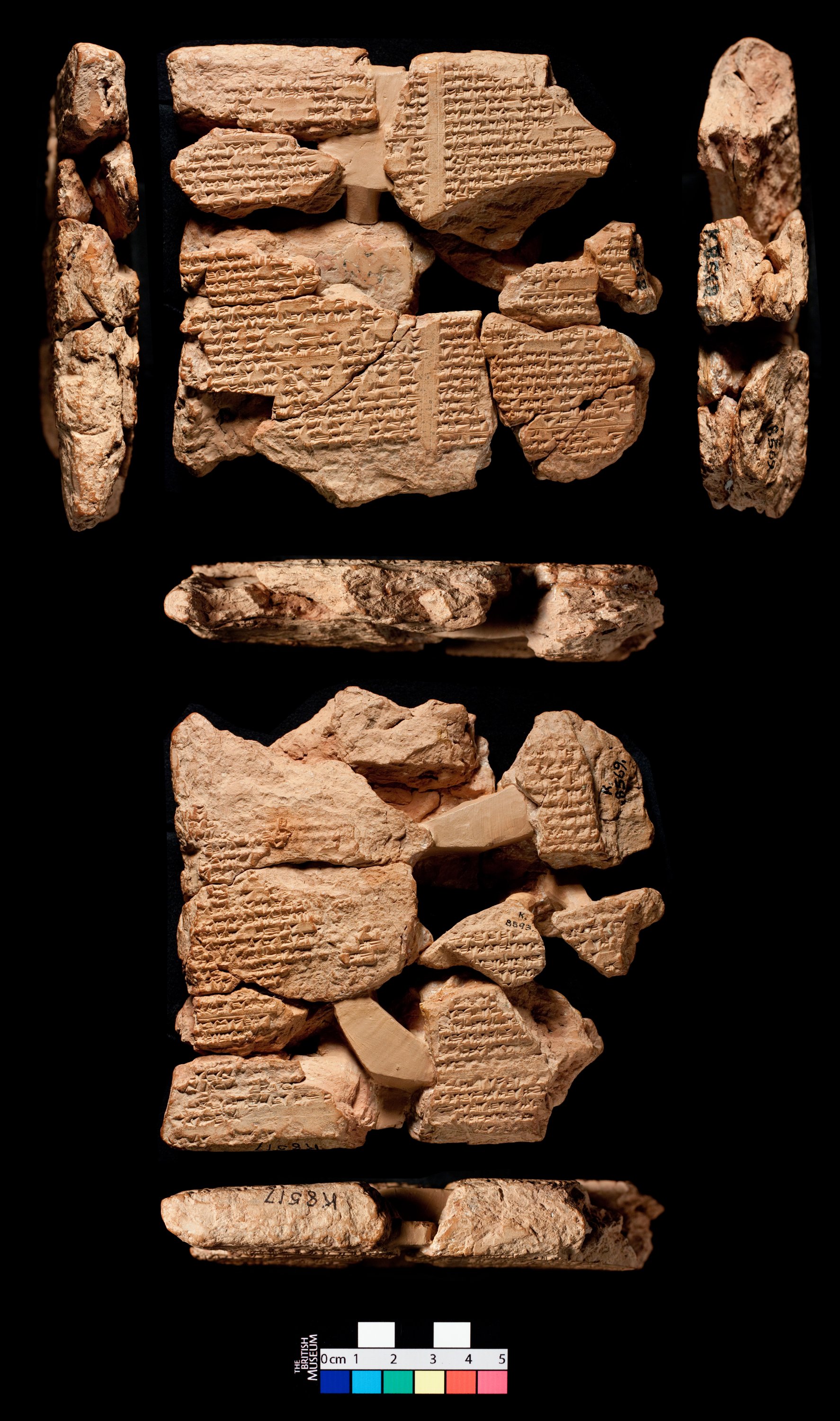
Tablet XI of the Epic of Gilgamesh (Standard Babylonian version, attributed to Sin-leqi-unninni) as it survives on one physical object: British Museum tablet K.8517 (K.8517 + K.8518 + K.8569 + K.8593 + K.8595 (joined)), excavated at Nineveh from the library of Ashurbanipal (7th c. BCE). It is manuscript W₁ in A. R. George's 2003 edition. The photograph is the British Museum's, showing the inscribed face(s) and edges; column(s) i, ii, v, vi are preserved (154 lines).
Three criteria are met for every section:
- Manuscript scan: the British Museum photograph of K.8517 itself (served by the Electronic Babylonian Library, LMU Munich). Each section names the column and face (obverse = columns i-iii, reverse = columns iv-vi) and the tablet's own line numbers, so the reader can find the lines on the photograph.
- Original text: the eBL manuscript-level ATF transliteration of the signs on this tablet (not the composite text). Brackets [ ] mark broken signs, x an illegible sign, # a damaged sign. Superscript numbers are the modern line numbers of George 2003 / eBL.
- Public-domain English: R. Campbell Thompson, The Epic of Gilgamish (London, 1928), verbatim, with his marginal line numbers as T n.
On line numbers. Thompson's 1928 numbering is not George's. For this tablet the correspondence was established one anchor per Thompson marginal number by reading his verse against the Akkadian; sections are cut only at those anchors, so each section's English is the block of Thompson's lines that renders exactly these Akkadian lines. Where the tablet's text begins or ends inside a Thompson block, the whole block is given and the section says so. Thompson's readings reflect the state of knowledge in 1928: modern editions (George 2003; the eBL edition, updated continuously) supersede him and are not public domain, so they are not reproduced here beyond the transliteration of this tablet's signs.
How was this verified? (Provenance)
1[x x x x x x x x x x x x x x ru]-qi₂#
2[x x x x x x x {m}UD-ZI-t]i₃
3[x x x x] ul# ša₂#-na#-a ki#-i# ia-a-ti-m[a at]-ta
4[x x x] ul# ša₂-na-ta ki-i ia-ši-ma [at]-ta
5[gum₂-m]u[r]-ku# lib₃-bi a-na e-peš t[u-q]u-un-tu₂ °x\<tu₂>°
6[x x x x n]a-da#-at-ta e-li ṣe-[ri]-ka
7[x x k]i-ki#-i# ta#-az#-ziz#-ma# ina# UKKIN# DINGIR#-MEŠ# ba#-la#-[ṭa te]š₂-ʾ-u₁₆(UM)
8[{m}U]D-ZI-ti₃ ana ša₂-šu-ma MU-r[a a-na {d}GI]Š-gim₂-maš
9lu-up-te-ka {d}GIŠ-gim₂-maš [x x ni-ṣ]ir-ti
(The Cause of the Flood).
T 1Gilgamish unto him spake, to Uta-Napishtim the Distant:
"Uta-Napishtim, upon thee I gaze, (yet) in no wise thy presence
Strange is, (for) thou art like me, and in no wise different art thou;
T 5Thou art like me; (yea) a stomach for fighting doth make thee consummate,
[Aye, and to rest (?)] on thy back thou dost lie. [O tell me (?)], how couldst thou
Stand in th’ Assemblage of Gods to petition for life (everlasting)?"
Uta-Napishtim (addressing him thus) unto Gilgamish answer'd:
"Gilgamish, I unto thee will discover the (whole) hidden story,
10u₃ pi-riš-ti ša₂ DINGIR-MEŠ ka-a-ša₂ l[u-uq-bi]-ka
11{uru}šu-ri-ip-pak URU ša₂ ti-du-šu at-ta
12x [x x x x x pu-ra]t-ti šak-nu
13[UR]U šu-u₂ la-bir-ma [x x qer-bu]-šu
14[a-n]a ša₂#-kan# a#-bu#-bu# ub#-la# lib₃#-[ba-šu₂-nu x x GAL]-MEŠ
15[x x x x x x x x x : ]
16[x x x x x x x {d}en-l]il₂
17[x x x x x x x x ( : )]
18[x x x x x {d}en-nu-g]i
19[{d}]nin#-ši#-ku₃# {d#}e₂#-[a x x x x x x x]
20a#-mat-su-nu u₂-ša₂-an-na-a# ana# ki#-i[k-ki-ši ( : )]
21[x x x x x x x x x x x]
22[k]i-i[k-k]i-šu ši-me-ma i-ga-r[u x x x x]
23[{lu₂}šu-r]i-ip-pa-ku-u₂ DUMU {m}uba[ra-{d}tu-tu]
24[x x] E₃# bi-ni {giš}MA₂
T 10Aye, and the rede of the Gods will I tell thee.
The City Shurippak —
(O ’tis) a city thou knowest!—is set [on the marge] of Euphrates,
Old is this city, with gods in its midst. (Now), the great gods a deluge
Purposed to bring: . . . . . . there was Anu, their sire; their adviser
Warrior Enlil; Ninurta , their herald; their leader(?) Ennugi;
Nin-igi-azag—’tis Ea—, (albeit) conspirator with them,
T 20Unto a reed-hut their counsel betray’d he: "O Reed-hut, O Reed-hut!
Wall, wall! Hearken, O Reed-hut, consider, O Wall! O thou Mortal,
Thou of Shurippak, thou scion of Ubara-Tutu, a dwelling
25muš-šir₃ NIG₂#.[TUKU-ma x x x x x]
26[ma]-ak#-ku#-ra# ze#-er-ma na#-piš#-t[u₂?]
27[š]u-li-ma NUMUN nap-ša₂-a-ti ka-la-ma a-na lib₃-bi# {giš#}[MA₂]
28{giš#}MA₂ ša₂ ta-ban-nu-ši at-[ta]
29[l]u-u₂# min₃-du-da mi-na-tu-ša₂#
30[l]u-u₂# mit-hur ru-pu-us-sa u₃ mu-rak-ša₂
31[k]i-ma# ABZU ša₂-a-ši ṣu-ul-lil-ši
32[a]-na#-ku# i-de-ma MU-ra# a-na {d}e₂#-a be-li₂-ia
33[x x] be-li₂ ša₂ taq-ba-a at-ta ki-a-am
T 25Pull down, (and) fashion a vessel (therewith); abandon possessions,
Life do thou seek, (and) thy hoard disregard, and save life; every creature
Make to embark in the vessel. The vessel, which thou art to fashion,
T 30Apt be its measure; its beam and its length be in due correspondence,
(Then) [on] the deep do thou launch it." And I—sooth, I apprehending,
(This wise) to Ea, my lord, did I speak: '[See], Lord, what thou sayest
34[x x] a-na-ku# ep-pu-uš
35[x x x x x x u]m-ma-nu u₃ ši-bu-tu₄
36[x x x x x x x x x x i]-qab#-bi
37i-zak-ka-ra ana IR₃-šu₂ ia-a-tu₂
38[x x x x x x] ta-qab-ba-aš₂-šu-nu-tu
39[x x x x x x x x {d}en-l]il₂ i-ze-er-an-ni-ma
40[x x x x x x x x : ]
41[x qaq-qa]r {d#}+en#-lil₂# ul# a#-šak#-kan# še#-pi#-i#-a#
T 35Thus, do I honour, I'll do—(but) to city, to people, and elders
Am I, forsooth, to explain?' (Then) Ea made answer in speaking,
Saying to me—me, his henchman!—'Thou mortal, shalt speak to them this wise:
"’Tis me alone (?) whom Enlil so hateth that I in your city
T 40No (more) may dwell, nor turn my face unto the land which is Enlil's.
[I will go] down to the Deep, (there) dwelling with Ea, my [liege] lord,
(Wherefore) [on] you will he shower down plenty, yea, fowl [in great number(?)],
Thompson's numbered block(s) extend after the lines preserved on this tablet; the whole block is given so that no English line is cut mid-block.
57ina ha-an-ši u₄#-me# [x x x x x x]
581.IKU GUR₂-sa 10 NINDAN.TA.A[M₃ x x x x x x x]
5910 NINDAN.TA.AM₃ im-ta-hir [x x x x x]
T 55Pitch did the children provide, (while) the strong brought [all] that was needful.
(Then) on the fifth day (after) I laid out the shape (of my vessel),
Ten gar each was the height of her sides, in accord with her planning(?),
Ten gar to match was the size of her deck (?), and the shape of the forepart (?)
Thompson's numbered block(s) extend before the lines preserved on this tablet; the whole block is given so that no English line is cut mid-block.
60ad-di la-an-ši ša₂-a-ši [x x x]
61ur-tag-gi-ib-ši a-na 6-šu
62a[p-ta-ra-as-si x x x x]
63qer-bi-is-su₂ ap-ta-ra-as [x x x x]
64{giš}GAG-MEŠ A-MEŠ ina MURUB₄-ša₂ lu-u₂ [x x]
65a-mur pa-ri-su u₃ hi-ših-tu₄ [x x]
663 šar₂ ku-up-ri at-ta-bak ana ki-i-ri
673 šar₂@v ESIR a[t?-ta-di x x x x]
683 šar₂@v ERIN₂-MEŠ na-aš₂ {giš}su-us-su-ul ša₂ i-zab-b[i-lu]
69e-zu-ub šar₂@v I₃.GIŠ ša₂# i#-ku#-lu# n[i-iq-qu]
T 60Did I lay down, (and) the same did I fashion; (aye), six times cross-pinn’d her,
Sevenfold did I divide her . . . ., divided her inwards
Ninefold: hammer’d the caulking within her, (and) found me a quant-pole,
T 65(All) that was needful I added; the hull with six shar of bitumen
Smear’d I, (and) three shar of pitch [did I smear] on the inside; some people,
Bearing a vessel of grease, three shar of it brought (me); (and) one shar
(Out of this) grease did I leave, which the tackling (?) consumed; (and) the boatman
702 šar₂@v I₃.GIŠ# [x x x x x x x]
71a-n[a x x x x x x x x x]
73[x x x x x x x x] u₃?# [x]
74[x x x x x x x x x x x x x : ]
75[x x x ip-pu-š]u? ki-i u₄#-[mi x x x x]
76[x x x x x x x x x x x x x x x ( : )]
77[la-a]m {d}UTU ra-[be₂-e x x x x]
78[x x x x] x x [(x x) šup-šu]-qu#-ma#
79gi#-ir#.MA₂.DU₃-MEŠ# nit#-tab-ba-lu [x x x x x]
80[x x x x il-l]i-ku [š]i-ni-[pat-su]
81[mim-ma i-šu-u₂] e#-ṣe#-en-ši
82mim-ma i-šu-[u₂ e-ṣ]e-en#-[ši x x]
83mim#-ma# i#-š[u-u₂] e#-ṣe#-en#-ši KU₃.SIG₁₇
84mim-ma i-š[u-u₂ KIMIN NUMU]N Z[I-MEŠ x x x]
85uš-te-li a-[na] ŠA₃! {giš}MA₂ k[a-la kim-t]i-ia# u₃# [x x x]
T 70Two shar of grease stow’d away; (yea), beeves for the . . . I slaughter’d,
Each day lambs did I slay: mead, beer, oil, wine, too, the workmen
[Drank] as though they were water , and made a great feast like the New Year,
(Five mutilated lines "I added salve for the hand(s)," "the vessel was finish’d . . . Shamash the great." "was difficult," " . . ? I caused to bring above and below," "two-thirds of it"):
T 80[All I possess’d I] laded aboard her; the silver I laded
All I possess'd; gold, all I possess’d I laded aboard her,
All I possess’d of the seed of all living [I laded aboard] her.
Into the ship I embark’d all my kindred and family (with me),
86bu-ul EDI[N] u₂#-ma-am EDIN DUMU#-MEŠ# um#-ma-nu# ka#-li#-šu#-n[u x x x]
87a-dan-na# {d}UTU iš-ku-[nam-ma]
88ina še-er ku-u[k-k]i ina li-la-a-ti u₂!-ša₂-az-na-nu ša₂-mu-t[u x x x x]
89e-ru-ub ana [li]b₃-bi {giš}MA₂-ma pi-he {giš}MA₂
90a-dan-nu šu-u₂ [x x x]
91ina še-er ku-u[k-k]i ina li-la-a-ti i-za-an-na-nu ša₂-mu-tu k[i-ba-a-ti]
92ša₂ u₄-mi at-t[a-ṭa]l bu-na-šu
93u₄-mu a-na i-tap-lu-si pu-lu[h-ta x x]
94e-ru-u[b] a#-na {giš}MA₂-ma ap-ti#-hi# ba-[a-bi]
T 85Cattle (and) beasts of the field (and) all handicraftsmen embarking.
(Then) decreed Shamash the hour: " . . . . (?)
Shall in the night let a plentiful rainfall(?) pour down . . . .
(Then) do thou enter the vessel, and (straightway) shut down thy hatchway."
T 90Came (then) that hour (appointed), . . . . . . (?)
Did in the night let a plentiful rainfall(?) pour down . . . . (?)
View’d I the aspect of day: to look on the day bore a horror,
(Wherefore) I enter’d the vessel, and (straightway) shut down my hatchway,
(So, too) to shut down the vessel to Puzur-Amurri (?), the boatman,
95a-na pe-he-e# [ša₂] {giš#}MA₂ a-na pu-zu-<ur>-{d#}KUR#.GAL {lu₂}[MA₂.LAH₄]
96E₂.GAL at-[ta]-din# a-di bu-še-e#-[šu₂]
97mim-mu-u₂ še-e-ri ina n[a-ma-ri]
98i#-lam#-ma# u[l-tu i-ši]d AN-e ur-pa-tu₄! ṣa-[lim-tu₄]
99[x x x x x x ir-tag]-gu#-um# [( : )]
100{d#}šullat₂# u {d}haniš₂ il-la#-[ku x x x]
101[x x x gu-za-lu]-u₂# KUR-u₂# [x x x x]
T 95Did I deliver the poop (of the ship), besides its equipment.
(Then), when something of dawn had appear’d, from out the horizon
Rose a cloud darkling; (lo), Adad (the storm-god) was rumbling within it,
T 100Nabu and Sharru were leading the vanguard, and coming as heralds
Over the hills and the levels: (then) Irragal wrench’d out the bollards;
Havoc Ninurta let loose as he came, th’ Anunnaki their torches
Thompson's numbered block(s) extend after the lines preserved on this tablet; the whole block is given so that no English line is cut mid-block.
236[x x x x x x x x x] lu#-u₂?# [x x x x x x]
237[x x x x x x ku-ru-um-m]at-ka [ : ]
2382-t[u₄ x x x x x x x]
239[x x x x x ka-man-k]a
2405-tu₄# ši-pa i[t-ta-di x x x x x]
241[x x x x x x x te-e]t-te-gel₂-ta-[a x x]
242[x x x x x x x x x x] a#-na {m}UD-Z[I x x]
T 220"(Tell me), I pr’ythee (?), was 't thou, who when sleep was shower’d upon me
All on a sudden didst touch me, and (straightway) rouse me (from slumber)?"
Uta-Napishtim to Gilgamish [spake, (yea), unto him spake he]:
"Gilgamish, told was the tale of thy meal . . . and (then) did I wake thee:
T 225['One'—was collected] thy flour: [(then) 'two']—it was sifted; (and) 'thirdly'—
Moisten’d: (and) 'fourthly'—she kneaded thy dough [(and) 'fifthly'] the leaven
Added: (and) 'sixthly'—’twas baked: [(and) 'seventh'] —’twas I on a sudden
Touch’d thee and thou didst awake." To Uta-Napishtim, the Distant,
Thompson's numbered block(s) extend before the lines preserved on this tablet; the whole block is given so that no English line is cut mid-block.
243[x x x x x x {m}u]t-ZI-ti₃ a-a-[x x x x x]
244[x x x x x x x x ek-k]e-mu
245ina E₂ ma-a-a-[li-a x x x x]
246[x x x x x x lu-u]š-kun šu-u₂# [x x x]
247[x x x x x x x x i-zak-ka-r]a a-na {m}ur!-{d}šanabi₂ m[a-la-hi]
248[x x x x x x x x x x ne-b]e₂-[ru x x x]
254[x x x x x x GI]M e[l-li x x]
255[lid-d]i maš-ki-šu-ma li#-bil# [x x] :#?
256[ṭ]a?-[bu]-um#? ṣu₂#-p[u x x x]
257[lu]-u₂# ud-du-šu₂ par-si-gi š[a₂ SAG.D]U-šu₂
258te-di-qa lu [x x x x x x x]
259[x x x x x i]l-la#-ku ana URU-šu₂
260a-di i#-[kaš-š]a₂-du a-na u[r-hi-šu₂]
261[x x x ši-p]a a-a id-di#-[ma? e-de-š]u l[i-diš]
262[il-qe₂-š]u-m[a {m}u]r-šanabi₂# a#-[na x x x] u₂-[bil-šu-ma]
263[m]a-le-šu₂ ina A#-[MEŠ x x x x x]
T 230Gilgamish answer'd: "O, [how] shall I act, (or) where shall I hie me,
Uta-Napishtim? A Robber (from me) hath ravish’d my [courage,]
Death [in] my bed-chamber broodeth, and Death is wherever I [listen] ."
[Spake] to [him, (yea),] to the boatman Ur-Shanabi Uta-Napishtim:
T 235"’Tis thou, Ur-Shanabi . . . the crossing, will hate thee,
(Sooth), to all those who come to its marge, doth its marge set a limit:
(This) man for whom thou wert guide—are stains to cover his body,
Or shall a skin hide the grace of his limbs? Ur-Shanabi, take him,
T 240Lead him to where he may bathe, that he wash off his stains in the water
(White) as the snow: let him cast off his pelt(s) that the sea may remove (them);
Fair let his body appear: of his head be the fillet renewéd,
Let him, as clothes for his nakedness, garb himself in a mantle,
T 245Such that, or ever he come to his city, and finish his journey,
No (sign of) age shall the mantle betray, but preserve (all) its freshness."
Wherefore Ur-Shanabi took him, and where he might bathe did he lead him,
Washing his stains in the [water] like snow, his pelt(s), [too], discarding,
264id-di KUŠ-MEŠ-š[u-ma x x x x]
265ṭa-a-bu iṣ-ṣa-pu zu-mu[r-šu₂ ( : )]
266[x x x x x x x x x x x]
267te-di-qa la-biš ṣu-bat ba[l-ti-šu₂ ( : )]
268[x x x x x x x x]
269a#-di i-kaš-ša₂-du# ana ur#-hi#-šu₂# ( : )
270[x x x x x x x x x x x x x x x]
271{d}GIŠ-gim₂-maš u {m}u[r-šanabi₂ x x x x x : ]
272[x x x x x x x x x x x x]
273mar-hi-is-su ana ša₂-šu-ma# MU#-[ar₂ x x x x x x]
274{d}GIŠ-gim₂-maš DU-ka i-n[a-ha x x x]
T 250So that the sea might bear them away; (and) his body appearéd
Fair; [of] his head he [the fillet] renewed, and himself in a mantle
Garb’d, as the clothes for his nakedness, [such that or ever his city
Reach he], or ever he finish his journey, [the mantle betray not
T 255Age, but] preserve [(all) its freshness].
(So) into their vessel embarkéd
Gilgamish, (aye), and Ur-Shanabi, launching (their) craft [on the billow],
They themselves riding aboard (her).
(The magic gift of restored youth).
To Uta-Napishtim, the Distant ,
Spake (then) his wife: "Came Gilgamish (hither) aweary with rowing,
275mi-na ta-at-tan-na-a[š₂-šum-ma x x x x x x]
276u₃# šu-u₂ iš-ši pa-ri-[sa x x x x ( : )]
277[x x x x x x x x x x x]
278[{m}UD-Z]I-ti₃ ana# ša₂#-šu#-m[a x x x x x x x x]
T 260What wilt thou give wherewith he return to his land?" and the meanwhile
Gilgamish, lifting his pole, was pushing the boat at the seashore.
(Then answer'd) Uta-Napishtim to him, (yea), [to] Gilgamish [spake he]:
"Gilgamish, (hither) didst come (all) aweary with rowing; (O, tell me),
Thompson's numbered block(s) extend after the lines preserved on this tablet; the whole block is given so that no English line is cut mid-block.
298[lu]-ša₂-[kil x x x x x x x x ( : )]
299[x x x x x x x x x]
300ana-ku# lu#-k[ul-ma lu-tur] ana ṣe-eh-ri-i[a-a-ma]
301ana# 20# DANNA ik-su#-pu ku-sa-pa# :#
302ana 30 DANNA iš-[ku-nu nu-bat-ta]
303[i-m]ur-ma bu-u₂-ru {d}GIŠ#-gim₂#-maš# ša₂# ka#-[ṣu-u₂ x x x]
304[u₂-r]id ana lib₃-bi-[ma x x x x x]
305[MU]Š i-te-ṣe-en n[i-piš x x : ]
306[x x x x x x x x x x]
307[ina t]a-ri-šu# i[t-ta-di x x x]
T 280(Erech), the high-wall’d, and give it to eat [unto . . . .].
'Greybeard-who-turneth-to-man-in-his-prime' is its name and I'll eat it
I myself, that again I may come to my youthful condition."
(The Quest ends in Tragedy).
Broke they their fast at the fortieth hour: at the sixtieth rested.
T 285Gilgamish spied out a pool of cool water, (and) therein descending
Bathed in the water. (But here was) a serpent who snuff’d the plant's fragrance,
Darted he up [from the water (?)], and snatch’d the plant, uttering malison
Thompson's numbered block(s) extend before the lines preserved on this tablet; the whole block is given so that no English line is cut mid-block.
308[ina] u₄#-me-šu#-ma# {d}GI[Š-gi]m₂-[maš x x x x x x]
309[UG]U BAD₃ ap-pi-šu₂ DU-ka di-ma-a#-šu₂# :#
310i?#-[x x x x x x x]
311[ana ma]n-ni#-ia₂ {m}ur-{d}šanabi₂ i-na-ha i-da-a-a :#
312an[a x x x x x x x x x x x]
313[u]l aš₂-kun dum-qa a-[na x x x]
314[ana] UR.MAH ša₂ qaq-qa-ri du-un-[qu?] e#-te-[pu-uš]
315e#-nin-na ana 20 DANNA e-du-u₂# [i-na-a]š-šam-[ma]
316[r]a-a-ṭu ki#-i# ap-tu-u₂# at#-ta#-bak# u₂-n[u-tu₂]
317[ut-t]a a-a-ta# ša₂# ana it-t[i-ia x x x an]a-ku l[u ah-hi-is]
T 290As he drew back. Then Gilgamish sate him, (and) burst into weeping.
Over his cheeks flow’d his tears: to the boatman Ur -Shanabi [spake he(?)]
"(Pr’ythee), [for] whom have toiléd mine arms, O Ur-Shanabi, (tell me),
T 295(Pr’ythee), for whom hath my heart's blood been spent? (yea), not for mine own self,
Have I the guerdon achieved; (no), ’tis for an earth-lion (only)
Have I the guerdon secured—(and) now at the fortieth hour
(Such an) one reiveth (it)—O, when I open’d the sluice and . . .ed the attachment,
(Aye), I noted the sign (?) which to me was vouchsafed as a warning,
318[x x] MA₂# e#-te#-zib# ina kib#-ri# [ : ]
319a[na x x x ik-su]-p[u x x x]
320[ana 30] DANNA iš-ku-nu nu-bat-t[a ( : )]
321[x x x x x x x x x x x x x]
322[{d}GI]Š-gim₂-maš ana ša₂-šu-ma M[U-ra a-na]
323[e-l]i-ma {m}ur-{d}šanabi₂ ina U[GU x x x x x x x]
324[te-me-en]-na# hi#-[i]-iṭ#-[ma ( : )]
325[x x x x x x x x]
326[u₃] uš#-ši#-šu# la# i[d-du-u₂ x x x]
327[šar₂@v U]RU{ki} šar₂@v {g[iš}KI]RI₆-M[EŠ š]ar₂@v [x x x x x x x x x x]
328[3] šar₂@v u pi-t[i-i]r UNUG{ki} [x x x]
T 300Would I had turn’d and abandon’d the boat at the marge (of the ocean)!"
Broke they their fast at the fortieth hour: at the sixtieth rested,
(So in the end) to the middle of Erech, the high-wall’d, arrivéd.
(The Pride of the Architect).
Gilgamish spake to him, (yea), to the boatman Ur-Shanabi (this wise):
"Do thou, Ur-Shanabi, go up and walk on the ramparts of Erech,
Look on its base, and take heed of its bricks, if its bricks be not kiln-burnt,
T 305(Aye), and its ground-work be not bitumen, e’en seven courses,
One shar the city, (and) one shar the gardens, and one shar the (2)
. . . . the Temple of Ishtar, amass’d I three shar and . . . (?) of Erech .
Cite
Source & Cross-References
- Source text: British Museum K.8517 photograph via eBL + eBL manuscript ATF (L.1.4 SB XI) + R. Campbell Thompson 1928 — view original
- Critical edition: Electronic Babylonian Library manuscript transliteration (CC BY-NC-SA 4.0)
← previous · → next · v cycle view · l back to library