The Keš Temple Hymn (Old Babylonian version)
Introduction
The Keš Temple Hymn praises the temple of the mother goddess Nintur (Ninḫursaĝa) at the city of Keš and its hero Ašgi. Enlil speaks the praise and the goddess Nisaba writes it down; the hymn is divided into eight 'houses', each closed by a line naming the house ('The first house', and so on). With the Instructions of Shuruppak it is one of the two oldest known works of literature: copies were found at Abu Salabikh dating to about 2600-2500 BCE. The version shown here is the Old Babylonian one (about 1900-1700 BCE), a standard text in the scribal schools. The whole of it is carried by one object shown here, a four-sided clay prism in the Walters Art Museum, Baltimore (WAM 48.1802), photographed face by face.
Each section below is one paragraph of the ETCSL translation, shown with the photographed tablet or tablets that carry those lines and their own transliterations. The block heading names the tablet, the face and the column; the superscript numbers are ETCSL's line numbers.
Coverage. Of the 165 lines of the ETCSL composite, 133 are shown on at least one photographed tablet. The remaining lines are named in the notes of the sections concerned; the English there renders manuscripts without a usable photograph. The Early Dynastic copies from Abu Salabikh are not included.
Not shown. ETCSL paragraphs D 58A-58Q, D 58R, H 103A-103K, H 103L are left out: no photographed tablet carries at least half of their lines.
Tablets shown:
- WAM 48.1802 (CDLI P272905; provenance uncertain)
How was this verified? (Provenance)
Where on the image
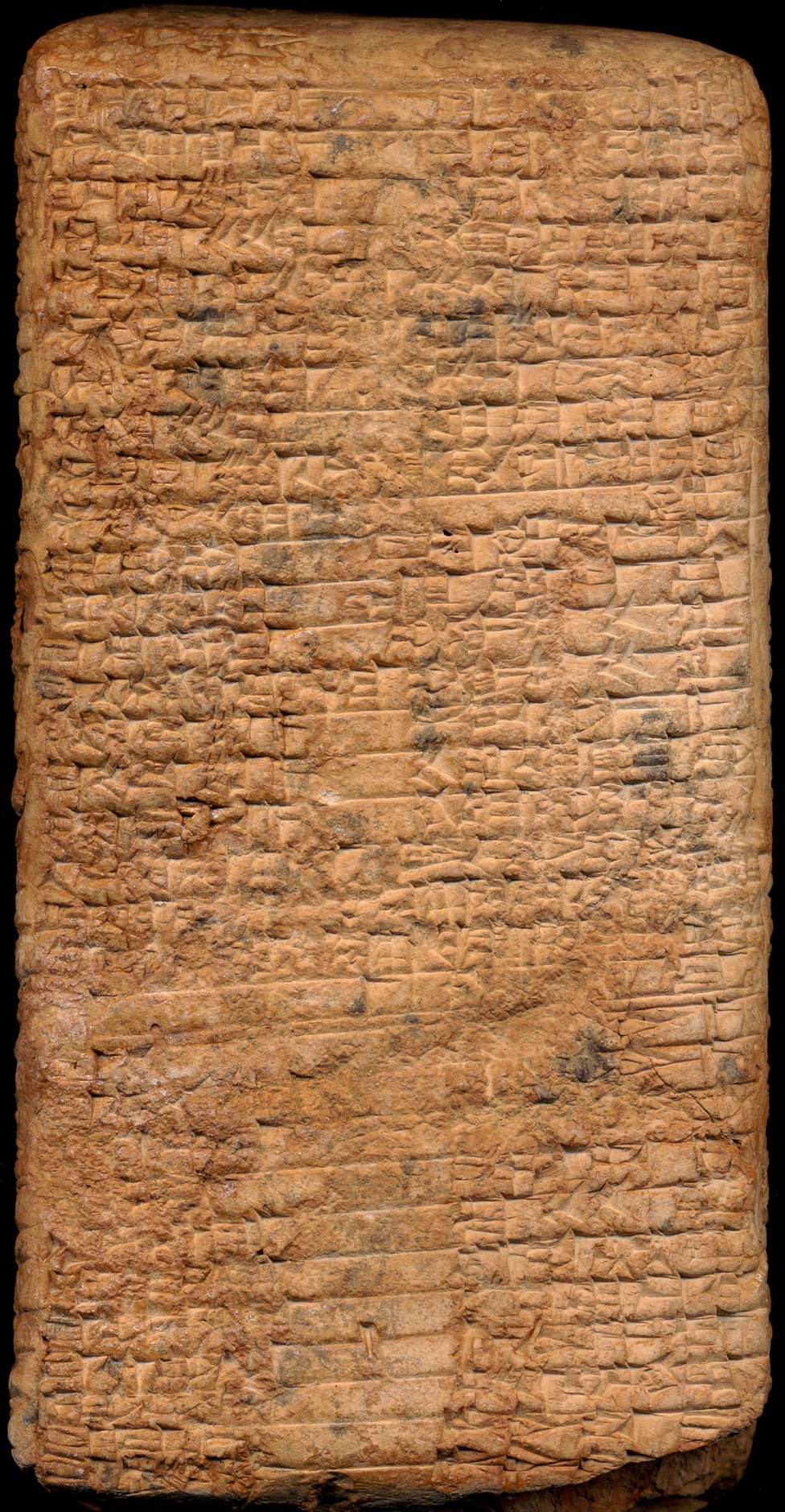
WAM 48.1802 (CDLI P272905), surface a line 1 to surface a line 9 = ETCSL lines A 1-A 9. Line correspondence from the CDLI transliterations' own links to the composite (Q000751, ETCSL numbering), each link checked against the ETCSL composite text. WAM 48.1802 is a four-sided prism; the CDLI photograph shows faces a-d from left to right (top and bottom above and below), cropped here to one file per face. The face order was checked on the image: faces b, c and d show the blank spaces that CDLI records after the house rubrics (b after lines 12 and 26, c after 8 and 21, d after 6 and 29) at those heights, and face a has none. The English is ETCSL's translation of the composite text.
[WAM 48.1802, surface a]
A1ege-nun-e ege-nun-e e₂-ta nam-ta-ab-e₃
A2{d}en-lil₂ ege-nun-e e₂-ta nam-ta-ab-e₃
A3ege-nun-e nam-lugal-la e₂-ta nam-ta-ab-e₃
A4{d}en-lil₂ kur-kur-ra igi mi-ni in-il₂-il₂-i
A5{d}en-lil₂-ra kur ni₂-ba mu-na-il₂-il₂-i
A6ab-ub-da-limmu {d}en-lil₂-ra {geš}kiri₆-ginx mu-na-sa₇
A7keš₃{ki} sag-il₂ mu-na-ni-in-gal₂
A8keš₃{ki} kur-kur-ra sag-ga₂ il₂-bi
A9{d}en-lil₂-le keš₃{ki} za₃-mi₂ am₃-ma-ab-be₂
A 1-9 The princely lord, the princely lord came forth from the house. Enlil, the princely lord, came forth from the house. The princely lord came forth royally from the house. Enlil lifted his glance over all the lands, and the lands raised themselves to Enlil. The four corners of heaven became green for Enlil like a garden. Keš was positioned there for him with head uplifted, and as Keš lifted its head among all the lands, Enlil spoke in praise of Keš.
Where on the image
WAM 48.1802 (CDLI P272905), surface a line 10 to surface a line 20 = ETCSL lines A 10-A 20. Line correspondence from the CDLI transliterations' own links to the composite (Q000751, ETCSL numbering), each link checked against the ETCSL composite text. WAM 48.1802 is a four-sided prism; the CDLI photograph shows faces a-d from left to right (top and bottom above and below), cropped here to one file per face. The face order was checked on the image: faces b, c and d show the blank spaces that CDLI records after the house rubrics (b after lines 12 and 26, c after 8 and 21, d after 6 and 29) at those heights, and face a has none. The English is ETCSL's translation of the composite text.
[WAM 48.1802, surface a]
A10{d}nisaba nu-ka-aš-bi-im
A11inim-bi-ta sa-ginx im-da-an-sur
A12dub-ba sar-sar šu-še₃ al-ga₂-ga₂
A13e₂ muš₃-kalam-ma gu₄-huš-aratta
A14e₂-keš₃{ki} muš₃-kalam-ma gu₄-huš-aratta
A15hur-sag-da-mu₂-a an-da gu₂-la₂-a
A16e₂-kur-da-mu₂-a kur-ra sag-il₂-bi
A17abzu ginx ri-a hur-sag-bi sig₇-sig₇-ga
A18keš₃{ki}-ginx rib-ba lu₂ ši-in-ga-tum₂-mu
A19ur-sag-bi {aš}ašgi{gi₁₈} rib-ba ama ši-in-ga-u₃-tu
A20nin-bi {d}nin-tu-ginx rib-ba-ra a-ba-a igi mu-ni-in-du
A 10-20 Nisaba was its decision-maker (?); with its words she wove it intricately like a net. Written on tablets it was held in her hands: House, platform of the Land, important fierce bull! House Keš, platform of the Land, important fierce bull! Growing as high as the hills, embracing the heavens, growing as high as E-kur, lifting its head among the mountains! Rooted in the abzu (2 mss. have instead: Colourful as the abzu), verdant like the mountains! Will anyone else bring forth something as great as Keš? Will any other mother ever give birth to someone as great as its hero Ašgi? Who has ever seen anyone as great as its lady Nintur?
Where on the image
WAM 48.1802 (CDLI P272905), surface a line 21 = ETCSL lines A 21. Line correspondence from the CDLI transliterations' own links to the composite (Q000751, ETCSL numbering), each link checked against the ETCSL composite text. WAM 48.1802 is a four-sided prism; the CDLI photograph shows faces a-d from left to right (top and bottom above and below), cropped here to one file per face. The face order was checked on the image: faces b, c and d show the blank spaces that CDLI records after the house rubrics (b after lines 12 and 26, c after 8 and 21, d after 6 and 29) at those heights, and face a has none. The English is ETCSL's translation of the composite text.
[WAM 48.1802, surface a]
A21e₂ 1(diš)-kam-ma
A 21 The first house.
Where on the image
WAM 48.1802 (CDLI P272905), surface a line 22 to surface a line 30 = ETCSL lines B 22-B 30. Line correspondence from the CDLI transliterations' own links to the composite (Q000751, ETCSL numbering), each link checked against the ETCSL composite text. WAM 48.1802 is a four-sided prism; the CDLI photograph shows faces a-d from left to right (top and bottom above and below), cropped here to one file per face. The face order was checked on the image: faces b, c and d show the blank spaces that CDLI records after the house rubrics (b after lines 12 and 26, c after 8 and 21, d after 6 and 29) at those heights, and face a has none. The English is ETCSL's translation of the composite text.
[WAM 48.1802, surface a]
B22e₂-du₁₀ ki-du₁₀-ga du₃-a
B23e₂-keš₃{ki} ki-du₁₀-ga du₃-a
B24ma₂-gur₈-nun-ginx an-na diri-ga
B25ma₂-gur₈-ku₃-ginx ka₂-SI ri-a
B26ma₂-an-na-ginx muš₃-kur-kur-ra
B27u₅-ban₃-da-ginx pešx-ta sur-sur-ra
B28e₂ gu₄-ginx ur₅-ša₄ ninda₂-ginx gu₃-nun-di
B29e₂-ša₃-bi-ta lipiš-kalam-ma
B30a-ga-bi-ta zi-ki-en-gi-ra
B 22-30 Good house, built in a good location, house Keš, (some mss. add here: good house,) built in a good location, floating in the heavens like a princely barge, like a holy barge furnished with a …… gate, like the boat of heaven, the platform of all the lands! …… from the riverbank like a …… boat cabin! House roaring like an ox, bellowing loudly like a breed-bull! House in whose interior is the power of the Land, and behind which is the life of Sumer!
Where on the image
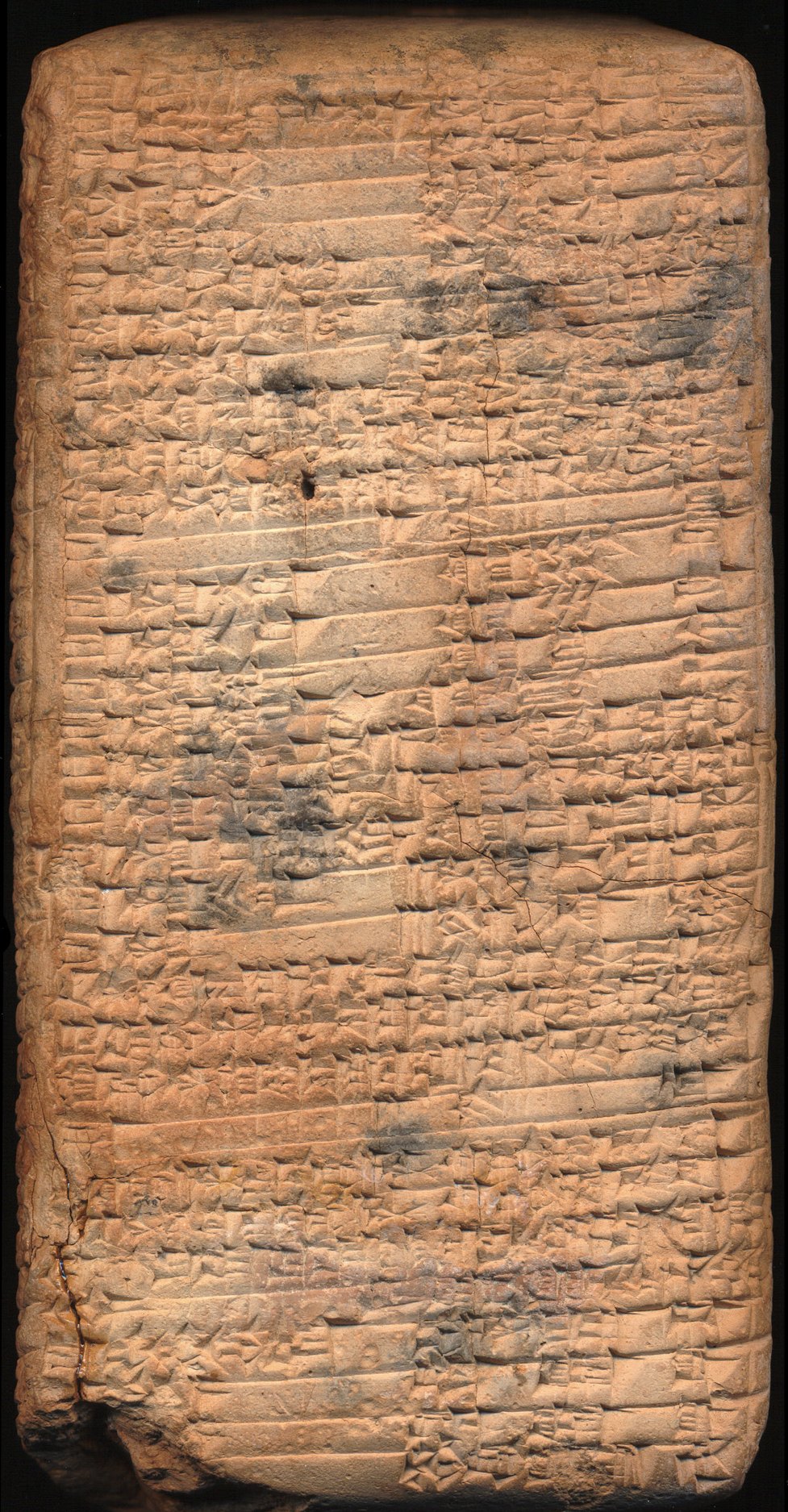
WAM 48.1802 (CDLI P272905), surface a line 31 to surface b line 11 = ETCSL lines B 31-B 43. Line correspondence from the CDLI transliterations' own links to the composite (Q000751, ETCSL numbering), each link checked against the ETCSL composite text. WAM 48.1802 is a four-sided prism; the CDLI photograph shows faces a-d from left to right (top and bottom above and below), cropped here to one file per face. The face order was checked on the image: faces b, c and d show the blank spaces that CDLI records after the house rubrics (b after lines 12 and 26, c after 8 and 21, d after 6 and 29) at those heights, and face a has none. The English is ETCSL's translation of the composite text.
[WAM 48.1802, surface a]
B31e₂ eb-gal an-ne₂ us₂-sa
B32e₂-zi-da-gal an-ne₂ us₂-sa
[WAM 48.1802, surface b]
B33e₂ men-gal an-ne₂ us₂-sa
B34e₂-{d}tir-an-na an-ne₂ us₂-sa
B35e₂ muš₂-bi an-ša₃-ga la₂-a
B36te-me-bi abzu-a si-ga
B37gizzu-bi kur-kur-ra du₆-la
B38e₂-an-ne₂ ki-gar-ra {d}en-lil₂-le za₃-mi₂ du₁₁-ga
B39ama {d}nin-tu-ra eš-bar-kin du₁₁-ga
B40e₂-keš₃{ki} gurun-na sig₇-ga
B41keš₃{ki}-ginx rib-ba lu₂ ši-in-ga-tum₂-mu
B42ur-sag-bi {d}{aš}ašgi{gi₁₈} rib-ba ama ši-in-ga-u₃-tu
B43nin-bi {d}nin-tu-ginx rib-ba-ra a-ba-a igi mu-ni-in-du
B 31-43 House, great enclosure, reaching to the heavens, great, true house, reaching to the heavens! House, great crown reaching to the heavens, house, rainbow reaching to the heavens! House whose diadem extends into the midst of the heavens, whose foundations are fixed in the abzu, whose shade covers all lands! House founded by An, praised by Enlil, given an oracle by Mother Nintur! House Keš, green in its fruit! Will anyone else bring forth something as great as Keš? Will any other mother ever give birth to someone as great as its hero Ašgi? Who has ever seen anyone as great as its lady Nintur?
Where on the image
WAM 48.1802 (CDLI P272905), surface b line 12 = ETCSL lines B 44. Line correspondence from the CDLI transliterations' own links to the composite (Q000751, ETCSL numbering), each link checked against the ETCSL composite text. WAM 48.1802 is a four-sided prism; the CDLI photograph shows faces a-d from left to right (top and bottom above and below), cropped here to one file per face. The face order was checked on the image: faces b, c and d show the blank spaces that CDLI records after the house rubrics (b after lines 12 and 26, c after 8 and 21, d after 6 and 29) at those heights, and face a has none. The English is ETCSL's translation of the composite text.
[WAM 48.1802, surface b]
B44e₂ 2(diš)-kam-ma
B 44 The second house.
Where on the image
WAM 48.1802 (CDLI P272905), surface b line 13 to surface b line 25 = ETCSL lines C 45-C 57. Line correspondence from the CDLI transliterations' own links to the composite (Q000751, ETCSL numbering), each link checked against the ETCSL composite text. WAM 48.1802 is a four-sided prism; the CDLI photograph shows faces a-d from left to right (top and bottom above and below), cropped here to one file per face. The face order was checked on the image: faces b, c and d show the blank spaces that CDLI records after the house rubrics (b after lines 12 and 26, c after 8 and 21, d after 6 and 29) at those heights, and face a has none. The English is ETCSL's translation of the composite text.
[WAM 48.1802, surface b]
C45e₂ an-še₃ 1(šar'u) GAN₂ ki-še₃ 5(šar₂) GAN₂
C46e₂ an-še₃ 1(bur'u) GAN₂ ki-še₃ 5(bur₃) GAN₂
C47e₂ an-še₃ alim ki-še₃ lu-lim
C48e₂ an-še₃ šeg₉-bar ki-še₃ dara₃-maš
C49e₂ an-še₃ šeg₉-bar-dar-a ki-še₃ dara₃-maš-sa₇-ga
C50e₂ an-še₃ muš-gu₇{mušen}-ginx sig₇-ga ki-še₃ u₅-{mušen}-ginx-a-e šu₂-a
C51e₂ an-še₃ utu-ginx e₃-a ki-še₃ itix-ginx bara₃-ga
C52e₂ an-še₃ utug₂-šul ki-še₃ {geš}tun₃-am₃
C53e₂ an-še₃ kur-ra-am₃ ki-še₃ idim-ma-am₃
C54e₂ an-še₃ 3(diš)-kam-bi na-nam
C55keš₃{ki}-ginx rib-ba lu₂ ši-in-ga-an-tum₂-mu
C56ur-sag-bi {d}{aš}ašgi{gi₁₈} rib-ba ama ši-in-ga-u₃-tu
C57nin-bi {d}nin-tu-ginx rib-ba-ra a-ba-a igi mu-ni-in-du
C 45-57 House, 10 šar at its upper end, five šar at its lower end; house, 10 bur at its upper end, five bur at its lower end! House, at its upper end a bison, at its lower end a stag; house, at its upper end a wild sheep, at its lower end a deer; house, at its upper end a dappled wild sheep, at its lower end a beautiful deer! House, at its upper end green as a snake-eater bird, at its lower end floating on the water like a pelican! House, at its upper end rising like the sun, at its lower end spreading like the moonlight; house, at its upper end a warrior mace, at its lower end a battle-axe; house, at its upper end a mountain, at its lower end a spring! House, at its upper end threefold indeed! Will anyone else bring forth something as great as Keš? Will any other mother ever give birth to someone as great as its hero Ašgi? Who has ever seen anyone as great as its lady Nintur?
Where on the image
WAM 48.1802 (CDLI P272905), surface b line 26 = ETCSL lines C 58. Line correspondence from the CDLI transliterations' own links to the composite (Q000751, ETCSL numbering), each link checked against the ETCSL composite text. WAM 48.1802 is a four-sided prism; the CDLI photograph shows faces a-d from left to right (top and bottom above and below), cropped here to one file per face. The face order was checked on the image: faces b, c and d show the blank spaces that CDLI records after the house rubrics (b after lines 12 and 26, c after 8 and 21, d after 6 and 29) at those heights, and face a has none. The English is ETCSL's translation of the composite text.
[WAM 48.1802, surface b]
C58e₂ 3(diš)-kam-ma
C 58 The third house.
Where on the image
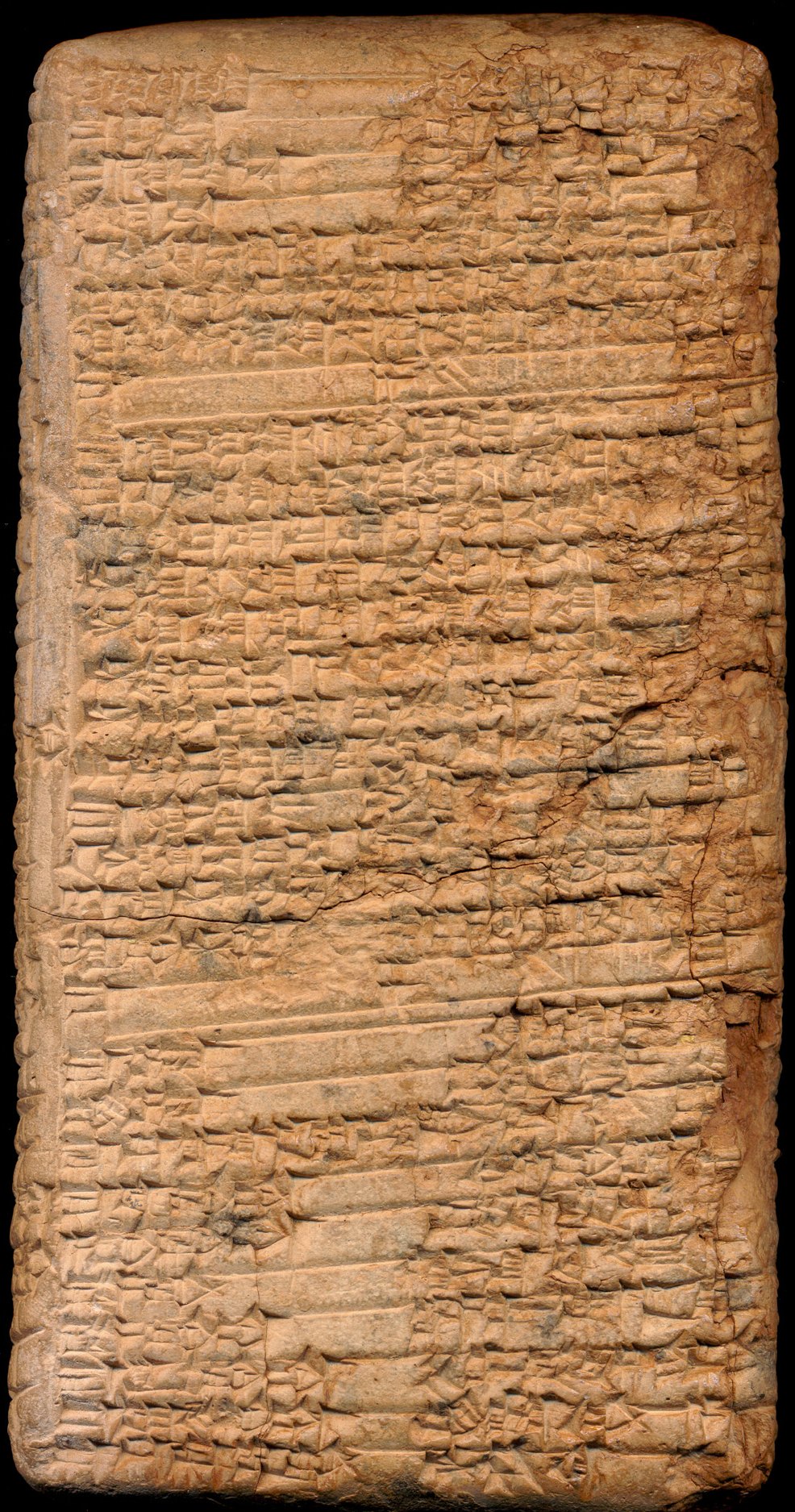
WAM 48.1802 (CDLI P272905), surface b line 27 to surface c line 7 = ETCSL lines E 59-E 73. Line correspondence from the CDLI transliterations' own links to the composite (Q000751, ETCSL numbering), each link checked against the ETCSL composite text. WAM 48.1802 is a four-sided prism; the CDLI photograph shows faces a-d from left to right (top and bottom above and below), cropped here to one file per face. The face order was checked on the image: faces b, c and d show the blank spaces that CDLI records after the house rubrics (b after lines 12 and 26, c after 8 and 21, d after 6 and 29) at those heights, and face a has none. The English is ETCSL's translation of the composite text.
[WAM 48.1802, surface b]
E59iri{ki} ga-am₃ iri{ki} ga-am₃ ša₃-bi a-ba mu-zu
E60e₂-keš₃{ki} iri{ki} ga-am₃ ša₃-bi a-ba mu-zu
E61ša₃-bi ur-sag-ur-sag-e-ne si mu-un-si-sa₂-e-ne
E62eš-bar-kin du₁₁-ga šu-gal mu-un-du₇-du₇
E63e₂ gu₄-du₇-du₇-dam gu₄ am₃-ma-gur-re
E64e₂ gu₄-šar₂-a al-ku₂-e
E65e₂ udu-šar₂-a-am₂ al-ku₂-e
E66eren? x-ma-am₂ gu₂-bi luh-luh-ha
[WAM 48.1802, surface c]
E67bara₂-bara₂-e-ne gu₂-ne am₃-ma-gal₂-le-ne
E68{geš}taškarin-da men an-da gur₃-u₄
E69{geš}asalx-ginx an-da tal₂-tal₂ sal-la
E70hur-sag-da an-da sig₇-sig₇-ga
E71keš₃{ki}-ginx rib-ba lu₂ ši-in-ga-an-tum₂-mu
E72ur-sag-bi {d}{aš}ašgi{gi₁₈} rib-ba ama ši-in-ga-u₃-tu
E73nin-bi {d}nin-tu-ginx rib-ba-ra a-ba-a igi mu-ni-in-du
E 59-73 It is indeed a city, it is indeed a city! Who knows its interior? The house Keš is indeed a city! Who knows its interior? The heroes make their way straight into its interior and perform its oracle rites perfectly. Frisking cattle are gathered at the house in herds. The house consumes many cattle; the house consumes many sheep. (1 line unclear) Those who sit on daises bow their necks before it. It wears a crown to vie with the boxwood tree, it spreads out to vie with the poplar ……; it is (1 ms. adds here: growing) as green as the hills! Will anyone else bring forth something as great as Keš? Will any other mother ever give birth to someone as great as its hero Ašgi? Who has ever seen anyone as great as its lady Nintur?
Where on the image
WAM 48.1802 (CDLI P272905), surface c line 8 = ETCSL lines E 74. Line correspondence from the CDLI transliterations' own links to the composite (Q000751, ETCSL numbering), each link checked against the ETCSL composite text. WAM 48.1802 is a four-sided prism; the CDLI photograph shows faces a-d from left to right (top and bottom above and below), cropped here to one file per face. The face order was checked on the image: faces b, c and d show the blank spaces that CDLI records after the house rubrics (b after lines 12 and 26, c after 8 and 21, d after 6 and 29) at those heights, and face a has none. The English is ETCSL's translation of the composite text.
[WAM 48.1802, surface c]
E74e₂ 4(diš)-kam-ma
E 74 The fourth house.
Where on the image
WAM 48.1802 (CDLI P272905), surface c line 9 to surface c line 20 = ETCSL lines F 75-F 86. Line correspondence from the CDLI transliterations' own links to the composite (Q000751, ETCSL numbering), each link checked against the ETCSL composite text. WAM 48.1802 is a four-sided prism; the CDLI photograph shows faces a-d from left to right (top and bottom above and below), cropped here to one file per face. The face order was checked on the image: faces b, c and d show the blank spaces that CDLI records after the house rubrics (b after lines 12 and 26, c after 8 and 21, d after 6 and 29) at those heights, and face a has none. The English is ETCSL's translation of the composite text.
[WAM 48.1802, surface c]
F75e₂ pirig u₃-tu ša₃-bi ur-sag su₃-ud
F76e₂-keš₃{ki} pirig u₃-tu ša₃-bi ur-sag su₃-ud
F77ša₃-bi ur-sag-ur-dag-e-ne ši-mu-un-nin₂ si-sa₂
F78{d}nin-hur-sag-ga₂ ušum-gal-am₃ ša₃ im-mi-in-tuš
F79{d}nin-tu-ra ama-gal-la tu-tu mu-un-ga₂-ga₂
F80{d}šul-pa-e₃-a ensi₂-ke₄ nam-en mu-un-x#-x#
F81{d}{aš}ašgi ur-sag mezem mu-un-ku₂-e#
F82{d}uru₃-maš nimgir-gal-eden-na mu-un-da-an-x#
F83e₂ lulim gu₄-e₃ am₃-ma-gur-re
F84keš₃{ki}-ginx rib-ba lu₂ ši-in-ga-tum₂-mu
F85ur-sag {d}{aš}ašgi{gi₁₈} rib-ba ama ši-in-ga-u₃-tu
F86nin-bi {d}nin-tu-ginx rib-ba-ra a-ba-a igi mu-un-du
F 75-86 House given birth by a lion, whose interior the hero has embellished (?)! House Keš, given birth by a lion, whose interior the hero has embellished (?)! The heroes make their way straight into its interior. Ninḫursaĝa sits within like a great dragon. Nintur the great mother assists at births there. Šul-pa-e the ruler acts as lord. Ašgi the hero consumes the contents of the vessels (?). Urumaš, the great herald of the plains, dwells there too. Stags are gathered at the house in herds. Will anyone else bring forth something as great as Keš? Will any other mother ever give birth to someone as great as its hero Ašgi? Who has ever seen anyone as great as its lady Nintur?
Where on the image
WAM 48.1802 (CDLI P272905), surface c line 21 = ETCSL lines F 87. Line correspondence from the CDLI transliterations' own links to the composite (Q000751, ETCSL numbering), each link checked against the ETCSL composite text. WAM 48.1802 is a four-sided prism; the CDLI photograph shows faces a-d from left to right (top and bottom above and below), cropped here to one file per face. The face order was checked on the image: faces b, c and d show the blank spaces that CDLI records after the house rubrics (b after lines 12 and 26, c after 8 and 21, d after 6 and 29) at those heights, and face a has none. The English is ETCSL's translation of the composite text.
[WAM 48.1802, surface c]
F87e₂ 5(diš)-kam-ma
F 87 The fifth house.
Where on the image
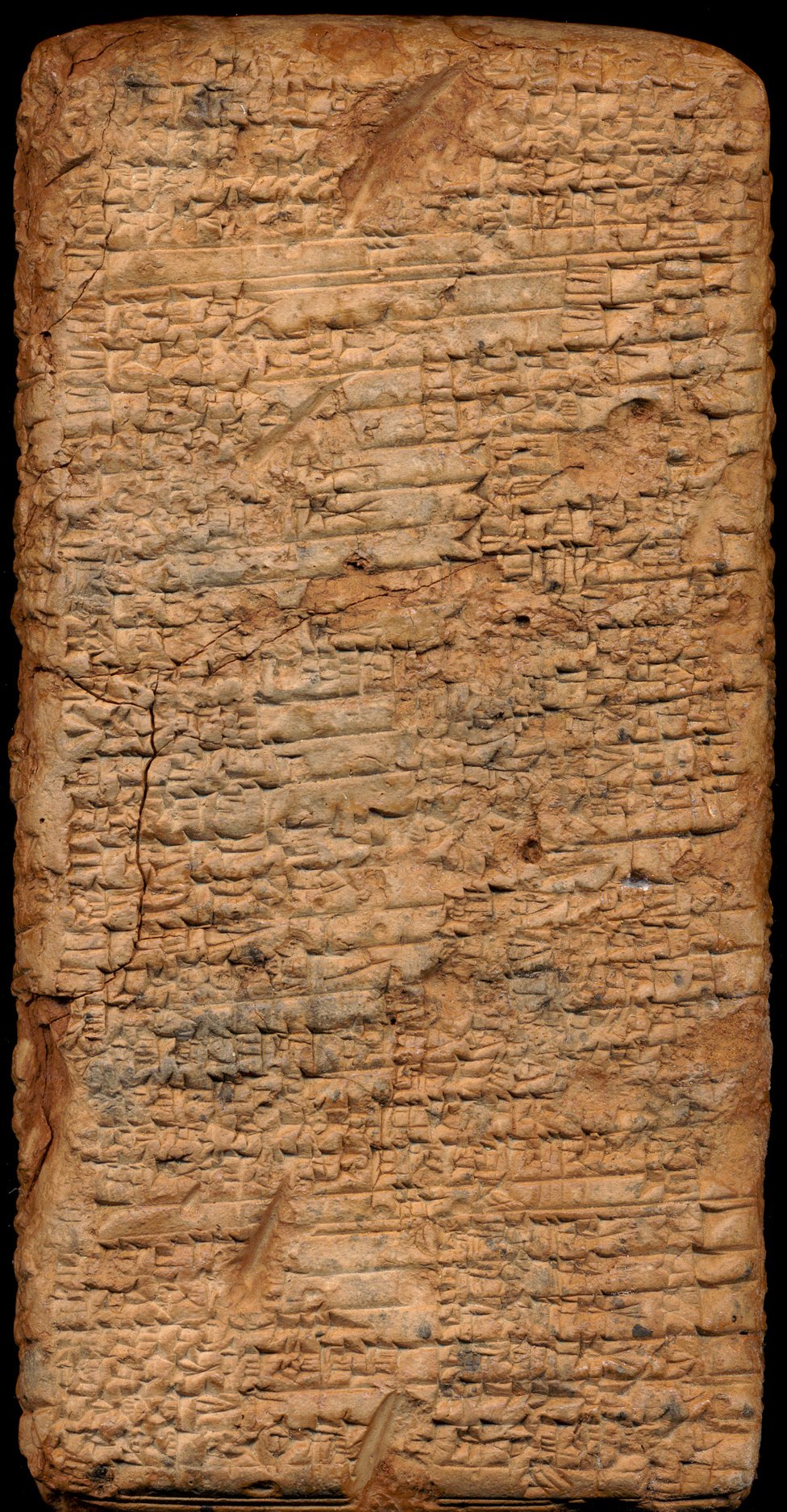
WAM 48.1802 (CDLI P272905), surface c line 22 to surface d line 5 = ETCSL lines G 88-G 96, G 97-G 102. Line correspondence from the CDLI transliterations' own links to the composite (Q000751, ETCSL numbering), each link checked against the ETCSL composite text. WAM 48.1802 is a four-sided prism; the CDLI photograph shows faces a-d from left to right (top and bottom above and below), cropped here to one file per face. The face order was checked on the image: faces b, c and d show the blank spaces that CDLI records after the house rubrics (b after lines 12 and 26, c after 8 and 21, d after 6 and 29) at those heights, and face a has none. ETCSL line(s) G 96A are not shown from the tablet(s) here (not preserved on them, or the correspondence could not be confirmed): for those lines the English renders other manuscripts. In line(s) G 89 the tablet's text differs from the composite line that the English translates (other words or spellings). The English is ETCSL's translation of the composite text.
[WAM 48.1802, surface c]
G88e₂ utu-ginx ki-gal-la gub-ba
G89am-babbar-ginx eden su₈-ga#!
G90e₂ nun-e-ki-gar-ra igi-da ar₂-ra [...]
G91e₂ ša₃-bi-ta lipiš-bi kalam-ma
G92a-ga-bi-ta zi ki-en-gi-ra
G93ka₂-bi-ta pirig šu-ba na₂-a
G94ka₂-bi-ta un-gal inim-gar-ra
G95e₂ ig-bi-ta kur-gal gaba nu-gi-gi
G96{geš}sag-kul!-ta am-gal-la du₇-a
G97ga₂-nun ga₂-ra-bi an-ub ki-ub
[WAM 48.1802, surface d]
G98gi#-gun₄#{ki}-na-bi la-ha-ma ki-us₂-sa
G99bad₃-nun-na-bi eš₃-uri₂{ki} ka-keš₃-da
G100keš₃{ki}-ginx rib-ba lu₂ ši-in-ga-an-tum₂-mu
G101ur-sag-bi {d}{aš}ašgi{gi₁₈} rib-ba ama ši-in-ga-u₃-tu
G102nin-bi {d}nin-tu-ra-ginx rib-ba-ra a-ba-a igi mu-ni-in-du
G 88-102 House positioned over its foundations like a storm, like white bulls standing about on the plain; house founded by the prince, in praise on the tigi instrument! House in whose interior is the power of the Land, and behind which is the life of Sumer (some mss. have instead: it is filled with life); at whose gate is a lion reclining on its paws, at whose gate is the ruler who decides cases (?)! House at whose door is the Great Mountain without adversary; at whose bolt (some mss. have here instead: at whose bar) is a great frisking wild bull (some mss. add here the line: , at whose bolt is a beast …… a man) (1 ms. adds here instead the line: , at whose …… is an awe-inspiring lion) ! Whose well-founded storehouse is a corner of heaven, a corner of earth (1 ms. has here instead: Whose storehouse established as a household is a lance (?)); whose terrace is supported by laḫama deities; whose princely (1 ms. adds: great) wall …… the shrine of Urim! Will anyone else bring forth something as great as Keš? Will any other mother ever give birth to someone as great as its hero Ašgi? Who has ever seen anyone as great as its lady Nintur?
Where on the image
WAM 48.1802 (CDLI P272905), surface d line 6 = ETCSL lines G 103. Line correspondence from the CDLI transliterations' own links to the composite (Q000751, ETCSL numbering), each link checked against the ETCSL composite text. WAM 48.1802 is a four-sided prism; the CDLI photograph shows faces a-d from left to right (top and bottom above and below), cropped here to one file per face. The face order was checked on the image: faces b, c and d show the blank spaces that CDLI records after the house rubrics (b after lines 12 and 26, c after 8 and 21, d after 6 and 29) at those heights, and face a has none. The English is ETCSL's translation of the composite text.
[WAM 48.1802, surface d]
G103e₂ 6(diš)-kam-ma
G 103 The sixth house.
Where on the image
WAM 48.1802 (CDLI P272905), surface d line 7 to surface d line 18 = ETCSL lines I 104-I 115. Line correspondence from the CDLI transliterations' own links to the composite (Q000751, ETCSL numbering), each link checked against the ETCSL composite text. WAM 48.1802 is a four-sided prism; the CDLI photograph shows faces a-d from left to right (top and bottom above and below), cropped here to one file per face. The face order was checked on the image: faces b, c and d show the blank spaces that CDLI records after the house rubrics (b after lines 12 and 26, c after 8 and 21, d after 6 and 29) at those heights, and face a has none. The English is ETCSL's translation of the composite text.
[WAM 48.1802, surface d]
I104e₂-ku₂ KU-bi e₂-nin
I105e₂-keš{ki} KU-bi e₂-nun
I106e₂ en-bi {d}a-nun-na-meš
I107nu-eš₃-bi giri₂-la₂ e₂-an-na-me-eš
I108e₂-2 lugal-bur-ra am₃-mi-gib
I109en-du₁₀ ša₃ eše₂-la₂ am₃-mi-in-la₂
I110a-tu-e šibir šu bi₂-in-du₈
I111tu-e a-ur₄-a am₃-mi-tum₂
I112lal₃-e ki-ku₃-ga am₃-mi-in-tuš
I113enkum-e-ne arax ki am₃-ma-gal₂-le-eš
I114pa₄-šeš-e-ne kuš mu-un-sig₃-ge-ne
I115e₂-šub iri-šub-a mu-ni-ib-be₂-e-ne
I 104-115 The holy house whose …… is the shrine, the holy house Keš, whose …… is the shrine; the house whose lords are the Anuna gods, whose nueš priests are the sacrificers of E-ana! In the house the king places stone bowls in position; the good en priest …… holds the lead-rope dangling. The a-tu priest holds the staff; the …… brings the gathered (?) waters. The …… takes his seat in the holy place; the enkum priests bow down ……. The pašeš priests beat the drumskins; they recite powerfully, powerfully.
Where on the image
WAM 48.1802 (CDLI P272905), surface d line 19 to surface d line 28 = ETCSL lines I 116-I 117, I 119-I 126. Line correspondence from the CDLI transliterations' own links to the composite (Q000751, ETCSL numbering), each link checked against the ETCSL composite text (placed at another ETCSL line than CDLI's link, where the signs match that line: WAM 48.1802 surface d 21, CDLI I 118 -> ETCSL I 119; WAM 48.1802 surface d 22, CDLI I 119 -> ETCSL I 120; WAM 48.1802 surface d 23, CDLI I 120 -> ETCSL I 121; WAM 48.1802 surface d 24, CDLI I 121 -> ETCSL I 122; WAM 48.1802 surface d 25, CDLI I 122 -> ETCSL I 123; WAM 48.1802 surface d 26, CDLI I 123 -> ETCSL I 124; WAM 48.1802 surface d 27, CDLI I 124 -> ETCSL I 125; WAM 48.1802 surface d 28, CDLI I 125 -> ETCSL I 126). WAM 48.1802 is a four-sided prism; the CDLI photograph shows faces a-d from left to right (top and bottom above and below), cropped here to one file per face. The face order was checked on the image: faces b, c and d show the blank spaces that CDLI records after the house rubrics (b after lines 12 and 26, c after 8 and 21, d after 6 and 29) at those heights, and face a has none. ETCSL line(s) I 118 are not shown from the tablet(s) here (not preserved on them, or the correspondence could not be confirmed): for those lines the English renders other manuscripts. The English is ETCSL's translation of the composite text.
[WAM 48.1802, surface d]
I116si-am-ma-ke₄ gum₂-ga mi-ni-ib-za
I117{geš}al-gar-surx-ra suh₃-sah mi-ni-ib-za
I119tigi nun-du₁₀-ge mu-na-du₁₂-a
I120e₂ al-du₃ girix-zal-bi al-du₁₀
I121e₂-keš₃{ki} al-du₃ giriz-zal-bi al-du₁₀
I122nin-bi DIN-bi-a mu-un-tuš
I123{d}nin-hur-sag-ga₂ nin-bi DIN-bi-a mu-un-tuš
I124keš₃{ki}-ginx rib-ba lu₂ ši-in-ga-an-tum₂-mu
I125ur-sag-bi {d}{aš}ašgi{gi₁₈} rib-ba ama ši-in-ga-u₃-tu
I126nin-bi {d}nin-tu-ra-ginx rib-ba-ra a-ba-a igi mu-ni-in-du
I 116-126 The bull's horn is made to growl; the drumsticks are made to thud. The singer cries out (1 ms. has instead: declaims) to the ala drum; the grand sweet tigi is played for him (some mss. have instead: the sweet tigi is well tuned). The house is built; its nobility is good! The house Keš is built; its nobility is good! Its lady has taken a seat in its ……. Ninḫursaĝa, its lady, has taken her seat in its ……. Will anyone else bring forth something as great as Keš? Will any other mother ever give birth to someone as great as its hero Ašgi? Who has ever seen anyone as great as its lady Nintur?
Where on the image
WAM 48.1802 (CDLI P272905), surface d line 29 = ETCSL lines I 127. Line correspondence from the CDLI transliterations' own links to the composite (Q000751, ETCSL numbering), each link checked against the ETCSL composite text (placed at another ETCSL line than CDLI's link, where the signs match that line: WAM 48.1802 surface d 29, CDLI I 126 -> ETCSL I 127). WAM 48.1802 is a four-sided prism; the CDLI photograph shows faces a-d from left to right (top and bottom above and below), cropped here to one file per face. The face order was checked on the image: faces b, c and d show the blank spaces that CDLI records after the house rubrics (b after lines 12 and 26, c after 8 and 21, d after 6 and 29) at those heights, and face a has none. The English is ETCSL's translation of the composite text.
[WAM 48.1802, surface d]
I127e₂ 7(diš)-kam-ma
I 127 The seventh house.
Where on the image
WAM 48.1802 (CDLI P272905), surface d line 30 to surface d line 35 = ETCSL lines J 128-J 133. Line correspondence from the CDLI transliterations' own links to the composite (Q000751, ETCSL numbering), each link checked against the ETCSL composite text (placed at another ETCSL line than CDLI's link, where the signs match that line: WAM 48.1802 surface d 30, CDLI I 127 -> ETCSL J 128; WAM 48.1802 surface d 31, CDLI J 128 -> ETCSL J 129; WAM 48.1802 surface d 32, CDLI J 129 -> ETCSL J 130; WAM 48.1802 surface d 33, CDLI J 130 -> ETCSL J 131; WAM 48.1802 surface d 34, CDLI J 131 -> ETCSL J 132; WAM 48.1802 surface d 35, CDLI J 132 -> ETCSL J 133). WAM 48.1802 is a four-sided prism; the CDLI photograph shows faces a-d from left to right (top and bottom above and below), cropped here to one file per face. The face order was checked on the image: faces b, c and d show the blank spaces that CDLI records after the house rubrics (b after lines 12 and 26, c after 8 and 21, d after 6 and 29) at those heights, and face a has none. The English is ETCSL's translation of the composite text.
[WAM 48.1802, surface d]
J128iri-še₃ iri-še₃ lu₂ te-am₃ te
J129e₂-keš₃{ki} iri-še₃ lu₂ te-am₃ te
J130ur-sag-bi {d}{aš}ašgi lu₂ te-am₃ te
J131nin-bi {d}nin-tu-ra-še₃ lu₂ te-am₃-te
J132keš₃{ki}-du₃-a {d}{aš}ašgi za₃-mi₂
J133keš₃{ki} za₃-SAL-la-am {d}nin-tu-ra za₃-mi₂
J 128-133 Draw near, man, to the city, to the city -- but do not draw near! Draw near, man, to the house Keš, to the city -- but do not draw near! Draw near, man, to its hero Ašgi -- but do not draw near! Draw near, man, to its lady Nintur -- but do not draw near! Praise be to well-built Keš, O Ašgi! Praise be to cherished Keš and Nintur!
Where on the image
WAM 48.1802 (CDLI P272905), surface d line 36 = ETCSL lines J 134. Line correspondence from the CDLI transliterations' own links to the composite (Q000751, ETCSL numbering), each link checked against the ETCSL composite text (placed at another ETCSL line than CDLI's link, where the signs match that line: WAM 48.1802 surface d 36, CDLI J 133 -> ETCSL J 134). WAM 48.1802 is a four-sided prism; the CDLI photograph shows faces a-d from left to right (top and bottom above and below), cropped here to one file per face. The face order was checked on the image: faces b, c and d show the blank spaces that CDLI records after the house rubrics (b after lines 12 and 26, c after 8 and 21, d after 6 and 29) at those heights, and face a has none. The English is ETCSL's translation of the composite text.
[WAM 48.1802, surface d]
J134e₂ 8(diš)-kam-ma
J 134 The eighth house.
Notes
- Transliteration: CDLI ATF rendered in Unicode (sz = š, s, = ṣ, t, = ṭ, sign indices as subscripts). [ ] broken signs, # damaged sign, ? uncertain reading, ! corrected sign, x unreadable sign.
- Where several tablets carry a paragraph, the first tablet's lines are given in full and later tablets add only lines the first does not carry (or a line whose first copy keeps no readable sign).
Cite
Sources
- Source: CDLI photographs and transliterations of Old Babylonian tablets + ETCSL 4.80.2 English translation (CC BY-NC-SA 3.0) (holding institution)
- Critical edition: CDLI transliterations of the tablets; ETCSL 4.80.2 composite
← previous · → next · v cycle view · l back to library