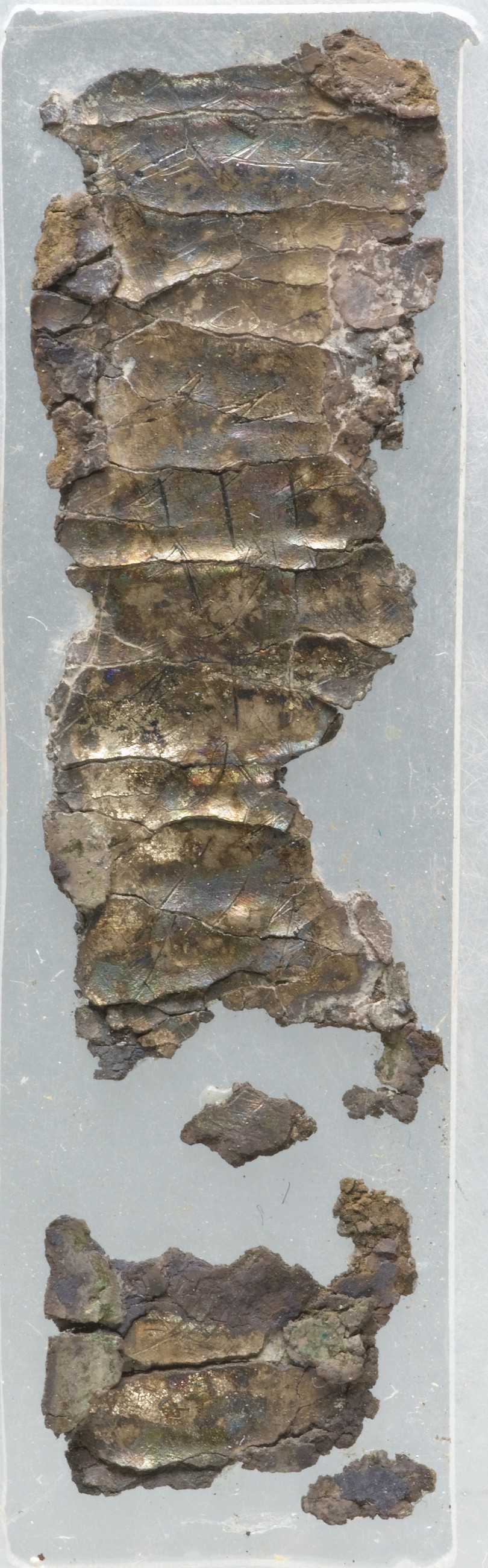
Ketef Hinnom silver amulet KH2 (the priestly blessing), Israel Museum
Introduction
The Ketef Hinnom amulets are two tiny rolled strips of silver found in 1979 by Gabriel Barkay in a burial cave at Ketef Hinnom, on the slope above the Hinnom valley in Jerusalem. They date from the late 7th or early 6th century BCE, before the Babylonian destruction of Jerusalem, and were worn as amulets. Unrolled and read, both carry words of the priestly blessing of Numbers 6:24-26, 'The LORD bless thee, and keep thee: The LORD make his face shine upon thee', which makes them the oldest surviving text that is also found in the Old Testament. They are in the Israel Museum, Jerusalem.
This entry gives the smaller amulet, KH2 (about 11 by 39 mm): its twelve preserved lines in Hebrew letters, a transliteration and an English rendering, all from Wikipedia. Lines 5-12 contain the blessing. The top of the strip is lost. The larger amulet, KH1, is not included here because no openly licensed original-language text of it was available.
How was this verified? (Provenance)
Where on the image
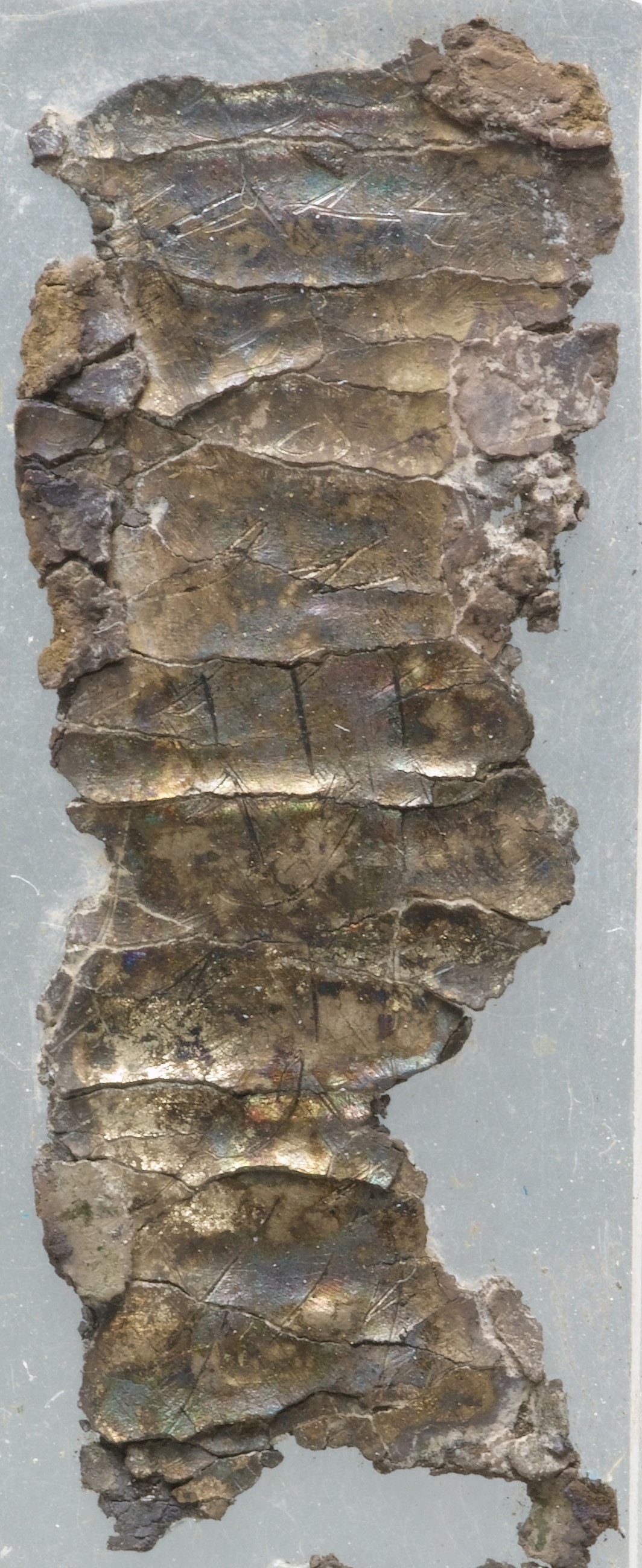
The twelve preserved lines are on the one inscribed side of the unrolled silver strip, which the first photograph shows whole (checked on the image: the strip mounted on a plate, broken at the top, with fine scratched letters running across its width; the letters are very small and faint, the strip being about 11 mm wide, and the detached pieces at the bottom come from the lower end). Lines are numbered from the top of the preserved text as in Wikipedia. Square brackets are restorations, not visible on the silver. Where the text is on the photographs: the strip is photographed upright, so each line runs across its width (right to left) and the lines follow one another from the broken top downwards, over the large upper piece (the upper two thirds of the first photograph) and on to the detached pieces below it; which line ends on which piece cannot be told from the photograph. The second photograph is the large upper piece alone at the full resolution of the source photograph. The letters are very small, fine scratches on crumpled, cracked silver, and at this resolution they show only as groups of short straight strokes spread over the piece (near its top, in the middle and in its lower part); single letters and line divisions cannot be read on the photograph, so the line numbers follow the published reading, not a count made on the image. No sharper open photograph of the strip was found (Wikimedia Commons and archive.org, searched 2026-11-12).
1 ה/ו ברך ה1 h/w brk h2 [א] ליהו[ה]2 [ʔ] lyhw[h]3 העזר ו3 hʕzr w4 הגער ב4 hgʕr b5 [ר]ע יברך5 [r]ʕ ybrk6 יהוה י6 yhwh y7 שמרך7 šmrk8 יאר יה8 yʔr yh9 [ו]ה פניו9 [w]h pnyw10 [אל]יך וי10 [ʔl]yk wy11 שם לך ש11 šm lk š12 [ל]ם12 [l]m
1-h/hu. May be blessed h/sh-
2-[e] by YHW[H,]
3the warrior/helper and
4the rebuker of
5[E]vil: May bless you,
6YHWH,
7keep you.
8Make shine, YH-
9-[W]H, His face
10[upon] you and g-
11-rant you p-
12-[ea]ce.
Notes
- The English renders word-divisions across line ends as the amulet has them ('h/sh-', 'YH-/-[W]H', 'g-/-rant', 'p-/-[ea]ce'); a slash gives two possible readings.
- Lines 5-12 correspond to Numbers 6:24-25 and the last words of 6:26: 'The LORD bless thee, and keep thee: The LORD make his face shine upon thee ... and give thee peace' (KJV).
- In lines 5 and 12 the square brackets of the Hebrew-letter text are placed as in Wikipedia's transliteration of the same lines; the Wikipedia markup has them displaced.
- Text, transliteration and English from English Wikipedia, 'Ketef Hinnom scrolls', revision 1378179986 (https://en.wikipedia.org/wiki/Ketef_Hinnom_scrolls), under CC BY-SA 4.0.
Cite
Sources
- Source: Ketef Hinnom amulet KH2, Israel Museum: photograph via Wikimedia Commons + text, transliteration and English from English Wikipedia (CC BY-SA 4.0) (holding institution)
- Critical edition: Wikipedia, 'Ketef Hinnom scrolls' (text and transliteration of KH2)
← previous · → next · v cycle view · l back to library