The Lament for Ur
Introduction
The Lament for Ur (ETCSL 'The lament for Urim') mourns the destruction of the city of Ur, which fell to the Elamites in about 2004 BCE, ending the Third Dynasty of Ur. The gods abandon their cities one by one; the goddess Ningal tells how she pleaded with An and Enlil to spare Ur and how the storm destroyed it; the poem ends with prayers to Nanna for the city's restoration. It was composed in the following decades and copied in the Old Babylonian schools (about 1900-1700 BCE).
No single photographed tablet preserves the whole text. Each section below is one paragraph of the ETCSL translation, shown with the photographed tablet or tablets that carry those lines and their own transliterations. The block heading names the tablet, the face and the column; the superscript numbers are ETCSL's line numbers.
Coverage. Of the 442 lines of the ETCSL composite, 244 are shown on at least one photographed tablet. The remaining lines are named in the notes of the sections concerned; the English there renders manuscripts without a usable photograph.
Not shown. ETCSL paragraphs A 26-34, B 36-37, C 39-46, C 47-55, C 56-63, C 64-71, C 72, D 73-74, D 75, E 76-84, E 85-94, E 95-100A, E 101-111, E 112-122, E 123-132, E 133, F 134, M 286-291, M 292-298, M 299-309, M 310-320, M 321-327, M 328, N 329, N 330, O 331-341, O 342-347, R 401, T 419 are left out: no photographed tablet carries at least half of their lines.
Tablets shown:
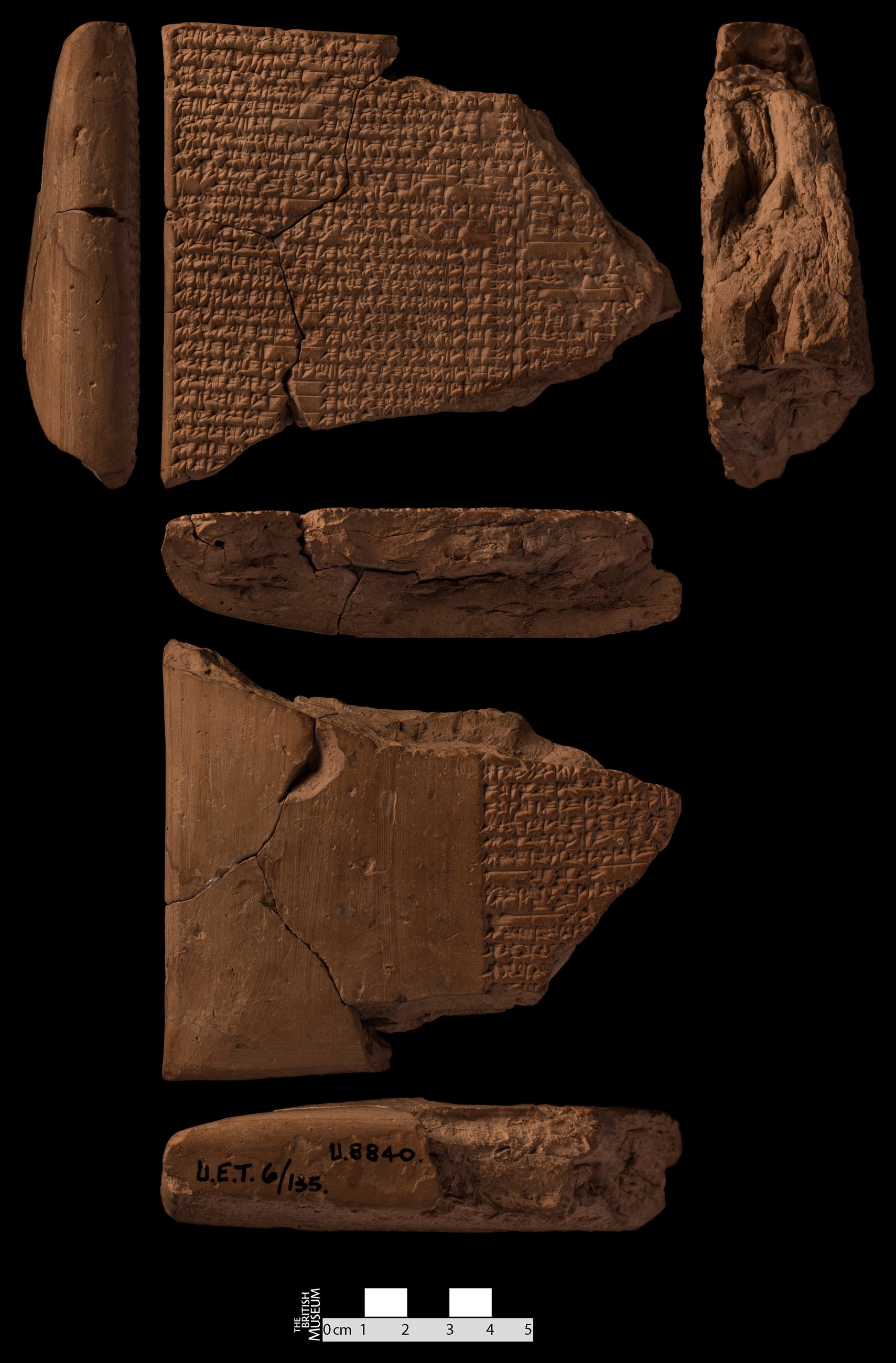
- UET 6 135 (CDLI P346220; Ur)
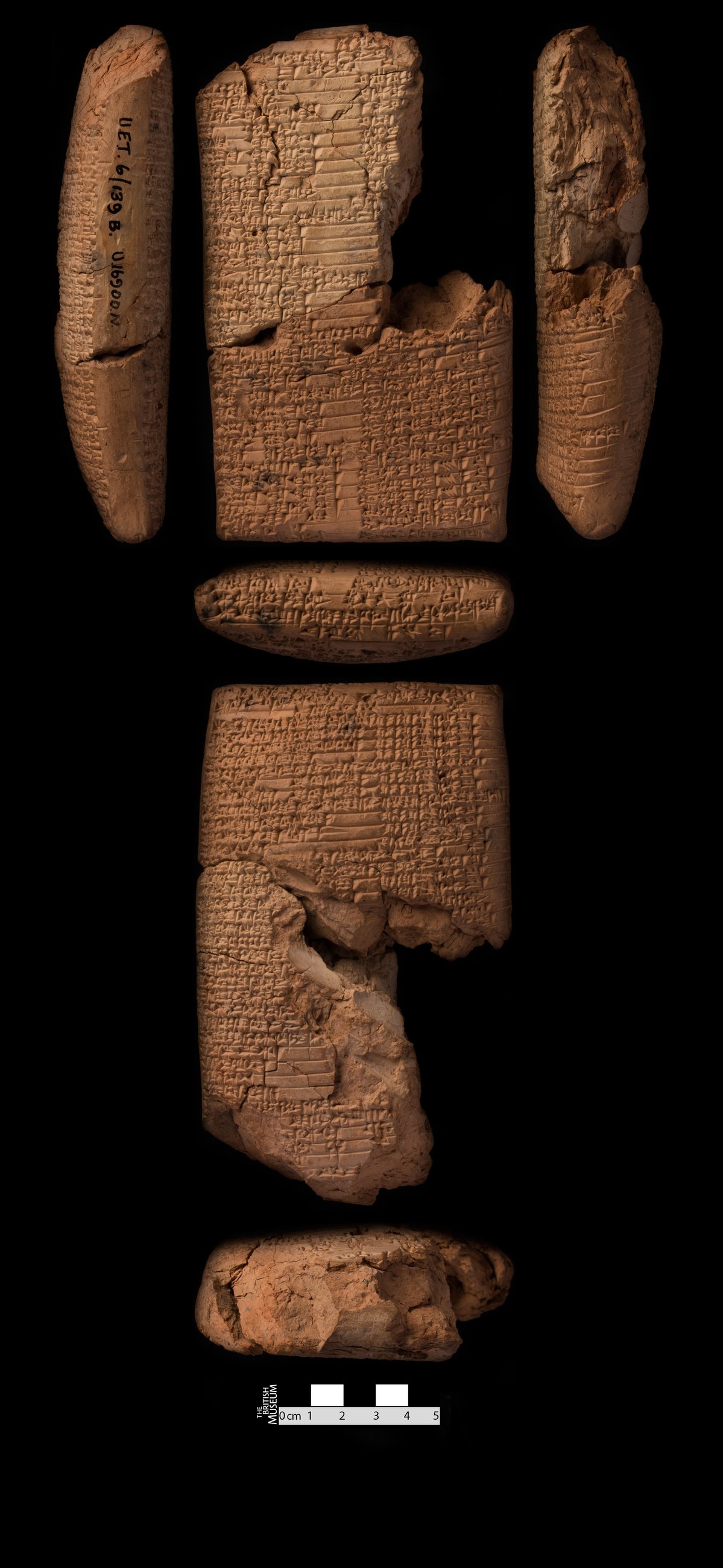
- UET 6 139b = U 16900n (CDLI P464308; Ur)
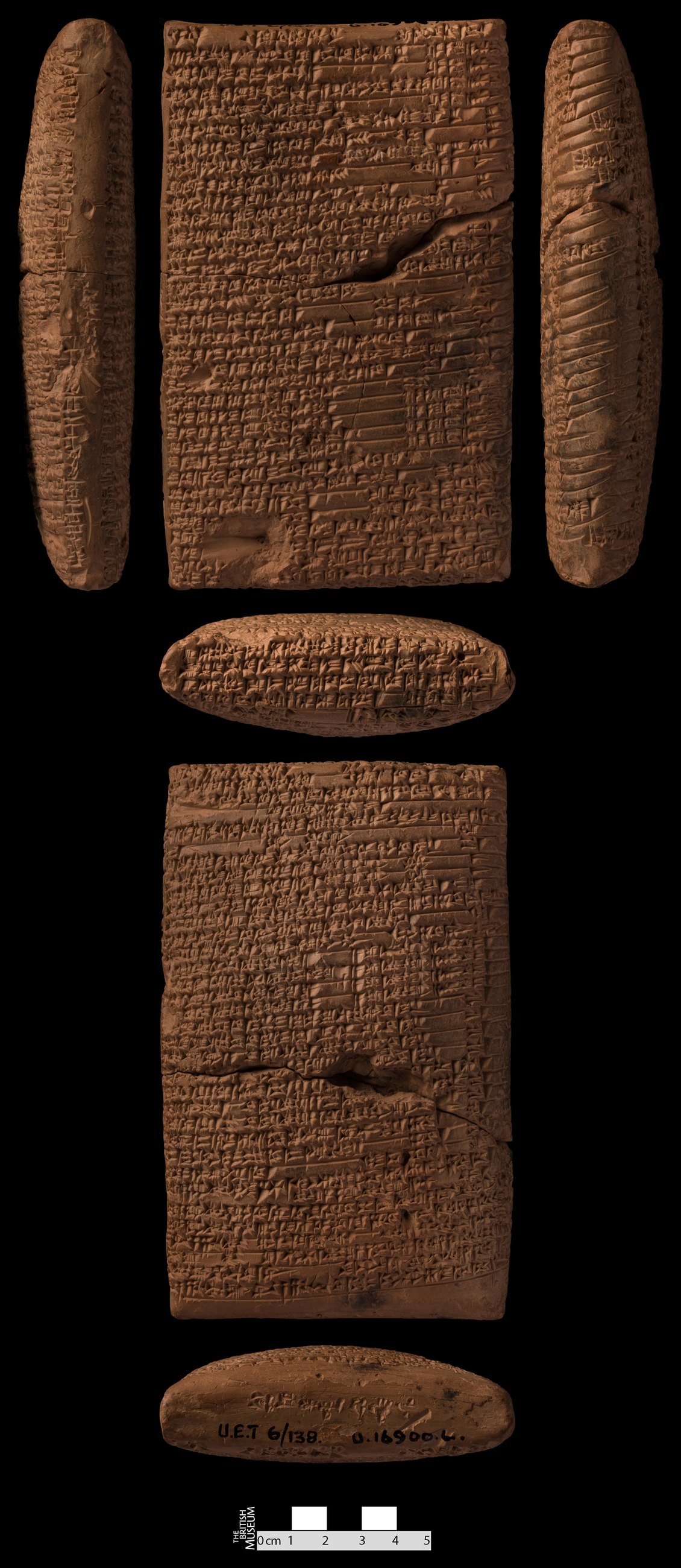
- UET 6 138 = U 16900l (CDLI P346223; Ur)
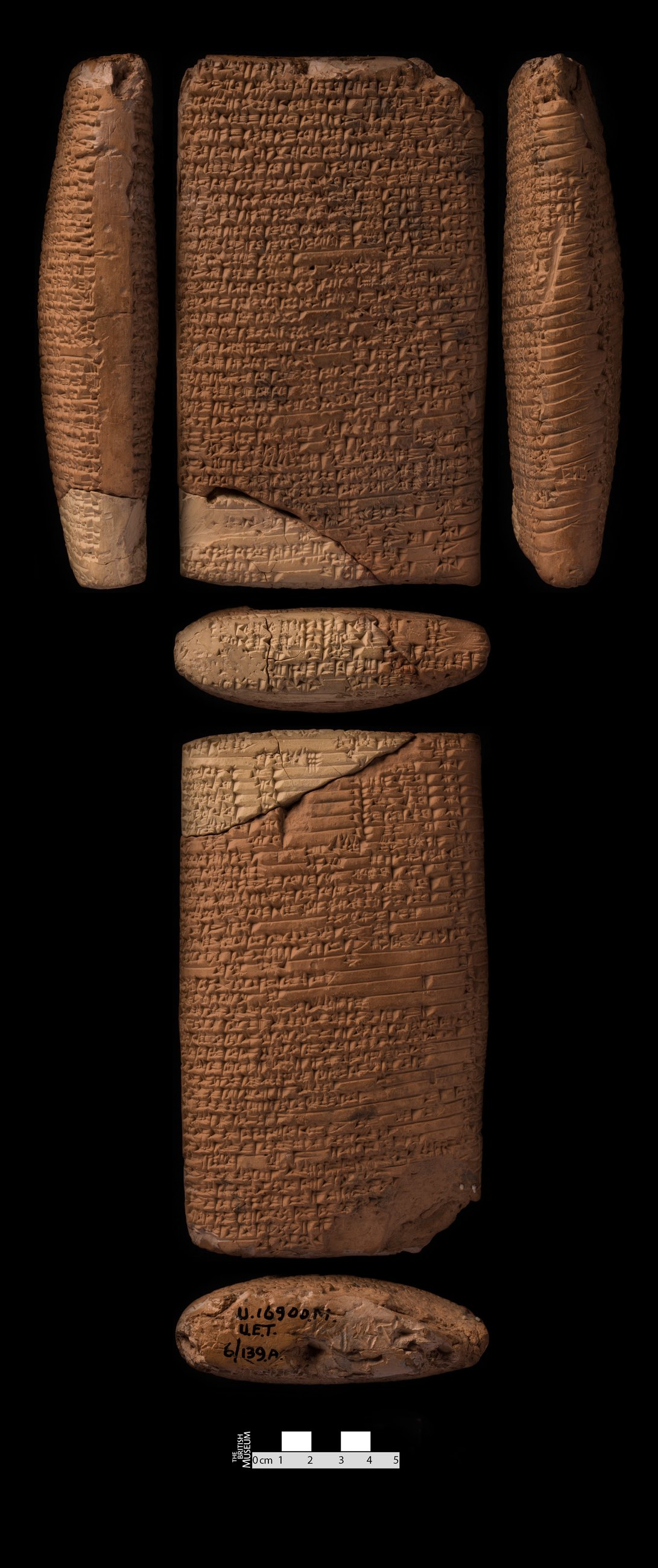
- UET 6 139a = U 16900m (CDLI P346224; Ur)
How was this verified? (Provenance)
Where on the image
UET 6 135 (CDLI P346220), obverse, column i line 1 to obverse, column i line 7 = ETCSL lines A 1-A 5, A 7-A 8. Line correspondence from the CDLI transliterations' own links to the composite (Q000379, ETCSL numbering), each link checked against the ETCSL composite text (placed at another ETCSL line than CDLI's link, where the signs match that line: UET 6 135 obverse, column i 6, CDLI A 6 -> ETCSL A 7; UET 6 135 obverse, column i 7, CDLI A 7 -> ETCSL A 8). The photograph is CDLI's image of the whole tablet, checked by eye for each tablet used; the transliteration names the face and column of every block. ETCSL line(s) A 6 are not shown from the tablet(s) here (not preserved on them, or the correspondence could not be confirmed): for those lines the English renders other manuscripts. The English is ETCSL's translation of the composite text.
[UET 6 135, obverse, column i]
A1tur₃-a-na muš₃ mi-ni-in-ga amaš#-a-na [...]
A2am-e tur₃-a-na muš₃ mi-ni-in-ga amaš-a-na#!? [...]
A3u₃-mu-un kur-kur-ra-ke₄ muš₃ mi-ni-in#-ga# [...]
A4{d}mu-ul-lil₂-le eš₃-e# nibru{ki} muš₃ mi-ni-in-ga# amaš#-a#-na# lil₂#-le#
A5dam-a-ni {d}nin-lil₂-le muš₃ mi-ni-in-ga amaš-a-na# lil₂-le
A7nin keš₃{ki}-a-ke₄ muš₃ mi-ni-in-ga amaš-a-na# lil₂-le
A8ga-ša-an-mah-e e₂-bi# keš₃{ki}-a muš₃ mi-ni-in-ga amaš-a-na# lil₂-le
A 1-8 He has abandoned his cow-pen and has let the breezes haunt his sheepfold. The wild bull has abandoned his cow-pen and has let the breezes haunt his sheepfold. The lord of all the lands has abandoned it and has let the breezes haunt his sheepfold. Enlil has abandoned the shrine Nibru and has let the breezes haunt his sheepfold. His wife Ninlil has abandoned it and has let the breezes haunt her sheepfold. Ninlil has abandoned that house, the Ki-ur, and has let the breezes haunt her sheepfold. The queen of Keš has abandoned it and has let the breezes haunt her sheepfold. Ninmaḫ has abandoned that house Keš and has let the breezes haunt her sheepfold.
Where on the image
UET 6 135 (CDLI P346220), obverse, column i line 8 to obverse, column i line 17 = ETCSL lines A 9-A 18. Line correspondence from the CDLI transliterations' own links to the composite (Q000379, ETCSL numbering), each link checked against the ETCSL composite text (placed at another ETCSL line than CDLI's link, where the signs match that line: UET 6 135 obverse, column i 8, CDLI A 8 -> ETCSL A 9; UET 6 135 obverse, column i 9, CDLI A 9 -> ETCSL A 10; UET 6 135 obverse, column i 10, CDLI A 10 -> ETCSL A 11; UET 6 135 obverse, column i 11, CDLI A 11 -> ETCSL A 12; UET 6 135 obverse, column i 12, CDLI A 12 -> ETCSL A 13; UET 6 135 obverse, column i 13, CDLI A 13 -> ETCSL A 14; UET 6 135 obverse, column i 14, CDLI A 14 -> ETCSL A 15; UET 6 135 obverse, column i 15, CDLI A 15 -> ETCSL A 16; UET 6 135 obverse, column i 16, CDLI A 16 -> ETCSL A 17; UET 6 135 obverse, column i 17, CDLI A 17 -> ETCSL A 18). The photograph is CDLI's image of the whole tablet, checked by eye for each tablet used; the transliteration names the face and column of every block. The English is ETCSL's translation of the composite text.
[UET 6 135, obverse, column i]
A9mu-lu i₃-si-in{ki}-na-ke₄ muš₃ mi-ni-in-ga amaš-a-na# lil₂-le
A10{d}ga-ša-an-i₃-si-in{ki}-na#-ke₄# eš₃ e₂-gal-mah-a muš₃ mi-ni-in-ga amaš#-a-na# lil₂-le
A11nin ki unu{ki}-ga-ke₄ muš₃ mi-ni-in-ga amaš-a-na# lil₂-le
A12{d}ga-ša-an-an-na-ke₄#? e₂-bi ki unu{ki}-ga-ke₄ muš₃ mi-ni-in-ga amaš-a-na# lil₂-le
A13{d}nanna eš₃ uri₂{ki}-ma muš₃ mi-ni-in-ga amaš#-a-na# lil₂-le
A14{d}suen-e e₂-kiš-nu-gal₂ muš₃ mi-ni-in-ga amaš#-a-na# lil₂-le
A15dam#-a-ni {d}ga-ša-an-gal-e muš₃ mi-ni-in-ga amaš-a-na# lil₂-le
A16{d}ga-ša-an-gal-e agrun!-ku₃-ga muš₃ mi-ni-in-ga amaš-a-na# lil₂-le
A17dam iri-ze₂-ba{ki}-ke₄# muš₃ mi-ni-in-ga amaš-a-na# lil₂-le
A18dam-an-ki e₂ iri-ze₂-ba#?-ke₄ muš₃ mi-ni-in-ga amaš-a-na# lil₂-le
A 9-18 She of Isin has abandoned it and has let the breezes haunt her sheepfold. Ninisina has abandoned the shrine Egal-maḫ and has let the breezes haunt her sheepfold. The queen of Unug has abandoned it and has let the breezes haunt her sheepfold. Inana has abandoned that house Unug and has let the breezes haunt her sheepfold. Nanna has abandoned Urim and has let the breezes haunt his sheepfold. Suen has abandoned E-kiš-nu-ĝal and has let the breezes haunt his sheepfold. His wife Ningal has abandoned it and has let the breezes haunt her sheepfold. Ningal has abandoned her Agrun-kug and has let the breezes haunt her sheepfold. The wild bull of Eridug has abandoned it and has let the breezes haunt his sheepfold. Enki has abandoned that house Eridug and has let the breezes haunt his sheepfold.
Where on the image
UET 6 135 (CDLI P346220), obverse, column i line 18 to obverse, column i line 24 = ETCSL lines A 19-A 25. Line correspondence from the CDLI transliterations' own links to the composite (Q000379, ETCSL numbering), each link checked against the ETCSL composite text (placed at another ETCSL line than CDLI's link, where the signs match that line: UET 6 135 obverse, column i 18, CDLI A 18 -> ETCSL A 19; UET 6 135 obverse, column i 19, CDLI A 19 -> ETCSL A 20; UET 6 135 obverse, column i 20, CDLI A 20 -> ETCSL A 21; UET 6 135 obverse, column i 21, CDLI A 21 -> ETCSL A 22; UET 6 135 obverse, column i 22, CDLI A 22 -> ETCSL A 23; UET 6 135 obverse, column i 23, CDLI A 23 -> ETCSL A 24; UET 6 135 obverse, column i 24, CDLI A 24 -> ETCSL A 25). The photograph is CDLI's image of the whole tablet, checked by eye for each tablet used; the transliteration names the face and column of every block. ETCSL line(s) A 18A are not shown from the tablet(s) here (not preserved on them, or the correspondence could not be confirmed): for those lines the English renders other manuscripts. ETCSL labels this paragraph 18A-26, but its English ends with line 25; line 26 opens ETCSL's next paragraph (A 26-34), which is not shown because the photographed tablets carry fewer than half of its lines. UET 6 135 continues below the lines shown with lines 26 and 27 (obverse i 25-26). The English is ETCSL's translation of the composite text.
[UET 6 135, obverse, column i]
A19{d}šara₂ e₂-mah#-a muš₃ mi-ni-in-ga amaš-a-na# lil₂-le
A20{d}u₄-sahar#-ra e₂-bi umma{ki}-a muš₃ mi-ni-in-ga amaš-a-na# lil₂-le
A21{d}ba-ba₆ iri-ku₃-ga muš₃ mi-ni-in-ga amaš-a-na# lil₂-le#
A22de₄-du₁₁ amax(|E₂xSAL|)-na muš₃ mi-ni-in-ga amaš-a#-na# [lil₂-le]
A23ama-ni {d}ab-ba-u₂# muš₃ mi-ni-in#-ga# amaš#-[a-na lil₂-le]
A24{d}ab-ba-u₂ ma₂-gu₂-[...]
A25{d}lamma e₂-e#-[...]
A 18A-25 (1 ms. adds 1 line: …… (partially preserved name of a goddess) has abandoned that house Larag and has let the breezes haunt her sheepfold.) Šara has abandoned E-maḫ and has let the breezes haunt his sheepfold. Ud-saḫara has abandoned that house Umma and has let the breezes haunt her sheepfold. Bau has abandoned Iri-kug and has let the breezes haunt her sheepfold. She has abandoned her flooded chamber and has let the breezes haunt her sheepfold. Her son Ab-Bau has abandoned it and has let the breezes haunt his sheepfold. Ab-Bau has abandoned Ma-gu-ena and has let the breezes haunt his sheepfold. The protective goddess of the holy house has abandoned it and has let the breezes haunt her sheepfold.
Where on the image
UET 6 135 (CDLI P346220), obverse, column ii line 8' = ETCSL lines A 35. Line correspondence from the CDLI transliterations' own links to the composite (Q000379, ETCSL numbering), each link checked against the ETCSL composite text; for other tablets where CDLI gives no link, by the line's signs (UET 6 135 obverse, column ii 8' = ETCSL A 35). The photograph is CDLI's image of the whole tablet, checked by eye for each tablet used; the transliteration names the face and column of every block. The English is ETCSL's translation of the composite text.
[UET 6 135, obverse, column ii]
A35ki-[ru-gu₂ ...]
A 35 1st kirugu.
Where on the image
UET 6 135 (CDLI P346220), reverse, column i line 10' = ETCSL lines B 38. Line correspondence from the CDLI transliterations' own links to the composite (Q000379, ETCSL numbering), each link checked against the ETCSL composite text; for other tablets where CDLI gives no link, by the line's signs (UET 6 135 reverse, column i 10' = ETCSL B 38). The photograph is CDLI's image of the whole tablet, checked by eye for each tablet used; the transliteration names the face and column of every block. The English is ETCSL's translation of the composite text.
[UET 6 135, reverse, column i]
B38geš-gi₄-gal₂#-[...]
B 38 Its ĝišgiĝal.
Where on the image
UET 6 139b = U 16900n (CDLI P464308), obverse line 1 to obverse line 3 = ETCSL lines F 135. Line correspondence by aligning the tablet's CDLI transliteration line by line with the ETCSL composite text by sign sequence, in composite order (up to three lines between two aligned lines are placed one to one in the ETCSL lines left free between them, and a line next to an aligned run in the ETCSL line next to it, when their signs agree). The photograph is CDLI's image of the whole tablet, checked by eye for each tablet used; the transliteration names the face and column of every block. Line(s) marked + (UET 6 139b = U 16900n obverse 1; UET 6 139b = U 16900n obverse 2) are on the tablet among the lines shown but match no line of the ETCSL composite (an added or repeated line, a variant, or too little preserved to place); the English does not translate them. UET 6 139b obverse 1 ('[...]-x er2-ra ba-[...]', with er2 'tears') may be the end of ETCSL F 134 ('urim2{ki} er2-re ba-an-di-ni-ib-ĝar', 'Urim has been given over to tears'), but too little is preserved to place it. The English is ETCSL's translation of the composite text.
[UET 6 139b = U 16900n, obverse]
+[...]-x er₂-ra# ba#-[...]
+[...] ba#-an#-da-gul-la me-ni ba-[...]
F135geš-gi₄-gal₂-bi-[im]
F 135 Its ĝišgiĝal.
Where on the image
UET 6 139b = U 16900n (CDLI P464308), obverse line 4 to obverse line 12 = ETCSL lines G 136-G 143. Line correspondence by aligning the tablet's CDLI transliteration line by line with the ETCSL composite text by sign sequence, in composite order (up to three lines between two aligned lines are placed one to one in the ETCSL lines left free between them, and a line next to an aligned run in the ETCSL line next to it, when their signs agree). The photograph is CDLI's image of the whole tablet, checked by eye for each tablet used; the transliteration names the face and column of every block. Line(s) marked + (UET 6 139b = U 16900n obverse 6) are on the tablet among the lines shown but match no line of the ETCSL composite (an added or repeated line, a variant, or too little preserved to place); the English does not translate them. The English is ETCSL's translation of the composite text.
[UET 6 139b = U 16900n, obverse]
G136u₄#-ba u₄ ne#-en ba-si-si-ga#-[...]
G137nin-da uru₁₇#{ki}-ni ba-an-da#-[...]
+iri{ki}-ni ba-an-da-gul# me-ni ba-[...]
G138u₄-ba u₄ ne-en ba-dim₂-dim₂#-[...]
G139uru₁₇-gu₁₀ gul-gul-da im-ma#-[...]
G140uri₂{ki} gul-gul-da im-ma#-[...]
G141ug₃-bi ug₅-ge-de₃ im-ma#-[...]
G142u₄-ba me-e uru₁₇-ga₂ ga₂-la# [...]
G143ka-na-ag₂-ga₂ IM šub-be₂ ba-ra#-[...]
G 136-143 "On that day, when such a storm had pounded, when in the presence of the queen her city had been destroyed, on that day, when such a storm had been created, when they had pronounced the utter destruction of my city, when they had pronounced the utter destruction of Urim, when they had directed that its people be killed, on that day I did not abandon my city, I did not forsake my land."
Where on the image
UET 6 139b = U 16900n (CDLI P464308), obverse line 13 to obverse line 22 = ETCSL lines G 144-G 150. Line correspondence by aligning the tablet's CDLI transliteration line by line with the ETCSL composite text by sign sequence, in composite order (up to three lines between two aligned lines are placed one to one in the ETCSL lines left free between them, and a line next to an aligned run in the ETCSL line next to it, when their signs agree). The photograph is CDLI's image of the whole tablet, checked by eye for each tablet used; the transliteration names the face and column of every block. Line(s) marked + (UET 6 139b = U 16900n obverse 20; UET 6 139b = U 16900n obverse 21; UET 6 139b = U 16900n obverse 22) are on the tablet among the lines shown but match no line of the ETCSL composite (an added or repeated line, a variant, or too little preserved to place); the English does not translate them. The English is ETCSL's translation of the composite text.
[UET 6 139b = U 16900n, obverse]
G144an-ra i-bi₂-ga₂ me-e# [...]
G145{d}mu-ul-lil₂-la₂ ni₂-gu₁₀ ša₃-ne-ša₄ he₂#-[...]
G146uru₁₇-gu₁₀ nam-ma-gul [...]
G147uri₂{ki} nam-ma-gul [...]
G148ug₃-bi nam-uš₂-a [...]
G149an-ne₂ e-ne-eg₃-bi [...]
G150{d}mu-ul-lil₂-la₂ i₃-sa₆-ga he₂-a-bi [...]
+uru₁₇-gu₁₀ gul-gul-de₃ [...]
+uri₂{ki} gul-gul-de₃ [...]
+ug₃-bi ug₅#-ge#-de₃ [...]
G 144-150 "Truly I shed my tears before An. Truly I myself made supplication to Enlil. "Let not my city be destroyed," I implored them. "Let not Urim be destroyed," I implored them. "Let not its people perish," I implored them. But An did not change that word. Enlil did not soothe my heart with an "It is good -- so be it"."
Where on the image
UET 6 139b = U 16900n (CDLI P464308), obverse line 23 to obverse line 32 = ETCSL lines G 151-G 160. Line correspondence by aligning the tablet's CDLI transliteration line by line with the ETCSL composite text by sign sequence, in composite order (up to three lines between two aligned lines are placed one to one in the ETCSL lines left free between them, and a line next to an aligned run in the ETCSL line next to it, when their signs agree). The photograph is CDLI's image of the whole tablet, checked by eye for each tablet used; the transliteration names the face and column of every block. The English is ETCSL's translation of the composite text.
[UET 6 139b = U 16900n, obverse]
G1512(diš@t)-kam#-ma#-[...]-uh₂#-ru-um ki-sag-ki a#-x-x-[...]-le#?-[...]
G152{d#}a-nun-na#-ke₄#-e#-ne e-ne-eg₃# [...] keš₂-da#?-bi# ba#-an-da-dur₂-ru-ne#-eš
G153ur₂# he₂-em-ma-BU-BU siki he₂-em-ma#-sur₅-sur₅
G154an-ra i-bi₂-ga₂ me-e he₂-em-ma-na-de₂
G155{d}mu-ul#-lil₂-la₂ ni₂-gu₁₀ ša₃-ne-ša₄ he₂-em-ma-ni-in-ne₂
G156iri{ki}-gu₁₀# nam-ma-gul he₂-em-mi-in-ne-du₁₁
G157uri₂{ki#} nam-ma-gul he₂-em-mi-in-ne-du₁₁
G158ug₃-bi nam-uš₂-a he₂-em-mi-in-ne-du₁₁
G159an-e e-ne-eg₃-bi ba-ra-ba-ra-gi₄
G160{d}mu-ul-lil₂-la₂ i₃-sa₆ he₂-a-bi ša₃-gu₁₀ ba-ra-ab-sed₄-de₃
G 151-160 "A second time, when the council had settled itself in the pre-eminent place, and the Anuna had seated themselves to ratify decisions, I prostrated (?) myself and stretched out my arms. Truly I shed my tears before An. Truly I myself made supplication to Enlil. "Let not my city be destroyed," I implored them. "Let not Urim be destroyed," I implored them. "Let not its people perish," I implored them. But An did not change that word. Enlil did not soothe my heart with an "It is good -- so be it"."
Where on the image
UET 6 139b = U 16900n (CDLI P464308), obverse line 33 to obverse line 40 = ETCSL lines G 161-G 168. Line correspondence by aligning the tablet's CDLI transliteration line by line with the ETCSL composite text by sign sequence, in composite order (up to three lines between two aligned lines are placed one to one in the ETCSL lines left free between them, and a line next to an aligned run in the ETCSL line next to it, when their signs agree). The photograph is CDLI's image of the whole tablet, checked by eye for each tablet used; the transliteration names the face and column of every block. The English is ETCSL's translation of the composite text.
[UET 6 139b = U 16900n, obverse]
G161uru₁₇#{ki}-gu₁₀ gul-gul-de₃ he₂-em-ma-ag₂-eš-a-ba
G162uri₂{ki} gul-gul-de₃ he₂-em-ma-ag₂-eš-a-ba
G163ug₃-bi ug₅-ge-de₃ he₂-em-ma-ag₂-eš-a-ba
G164me-e nig₂-KA-gu₁₀ mu-e-de₃-šum₂-ma-gin₇
G165me-e uru₁₇-gu₁₀#-ta#? he₂-en-ga-ba-e-da-ab-la₂-e
G166uri₂{ki} ga₂-da he₂-en-ga-ba-e-da-ab-la₂-e
G167an-ne₂ e-ne-eg₃-bi hur nu-kur₂-ru-da
G168mu-ul-lil₂-la₂-e ka-ta e₃-a-ni šu nu-bala-e-de₃
G 161-168 "They gave instructions that my city should be utterly destroyed. They gave instructions that Urim should be utterly destroyed. They decreed its destiny that its people should be killed. In return for the speech (?) which I had given them, they both bound me together with my city and also bound my Urim together with me. An is not one to change his command, and Enlil does not alter what he has uttered."
Where on the image
UET 6 139b = U 16900n (CDLI P464308), obverse line 41 to reverse line 1 = ETCSL lines G 169. Line correspondence by aligning the tablet's CDLI transliteration line by line with the ETCSL composite text by sign sequence, in composite order (up to three lines between two aligned lines are placed one to one in the ETCSL lines left free between them, and a line next to an aligned run in the ETCSL line next to it, when their signs agree). The photograph is CDLI's image of the whole tablet, checked by eye for each tablet used; the transliteration names the face and column of every block. Line(s) marked + (UET 6 139b = U 16900n reverse 1) are on the tablet among the lines shown but match no line of the ETCSL composite (an added or repeated line, a variant, or too little preserved to place); the English does not translate them. UET 6 139b obverse 1 ('[...]-x er2-ra ba-[...]', with er2 'tears') may be the end of ETCSL F 134 ('urim2{ki} er2-re ba-an-di-ni-ib-ĝar', 'Urim has been given over to tears'), but too little is preserved to place it. The English is ETCSL's translation of the composite text.
[UET 6 139b = U 16900n, obverse]
G169ki-ru-gu₂ 4(diš)-kam-ma
[UET 6 139b = U 16900n, reverse]
+nin-da uru₁₇{ki}-ni ba-an-da-gul-la₂
G 169 4th kirugu.
Where on the image
UET 6 139b = U 16900n (CDLI P464308), reverse line 2 = ETCSL lines H 170. Line correspondence by aligning the tablet's CDLI transliteration line by line with the ETCSL composite text by sign sequence, in composite order (up to three lines between two aligned lines are placed one to one in the ETCSL lines left free between them, and a line next to an aligned run in the ETCSL line next to it, when their signs agree). The photograph is CDLI's image of the whole tablet, checked by eye for each tablet used; the transliteration names the face and column of every block. The English is ETCSL's translation of the composite text.
[UET 6 139b = U 16900n, reverse]
H170uru₁₇{ki}-ni ba-an-da-gul-la me-ni ba-an-da-kur₂-ra
H 170 Her city has been destroyed in her presence, her powers have been alienated from her.
Where on the image
UET 6 139b = U 16900n (CDLI P464308), reverse line 3 = ETCSL lines H 171. Line correspondence by aligning the tablet's CDLI transliteration line by line with the ETCSL composite text by sign sequence, in composite order (up to three lines between two aligned lines are placed one to one in the ETCSL lines left free between them, and a line next to an aligned run in the ETCSL line next to it, when their signs agree). The photograph is CDLI's image of the whole tablet, checked by eye for each tablet used; the transliteration names the face and column of every block. The English is ETCSL's translation of the composite text.
[UET 6 139b = U 16900n, reverse]
H171geš-gi₄-gal₂-bi-im
H 171 Its ĝišgiĝal.
Where on the image
UET 6 139b = U 16900n (CDLI P464308), reverse line 4 to reverse line 10 = ETCSL lines I 172-I 178. Line correspondence by aligning the tablet's CDLI transliteration line by line with the ETCSL composite text by sign sequence, in composite order (up to three lines between two aligned lines are placed one to one in the ETCSL lines left free between them, and a line next to an aligned run in the ETCSL line next to it, when their signs agree). The photograph is CDLI's image of the whole tablet, checked by eye for each tablet used; the transliteration names the face and column of every block. The English is ETCSL's translation of the composite text.
[UET 6 139b = U 16900n, reverse]
I172{d}en-lil₂-le u₄-de₃ gu₃ ba-an-de₂ ug₃-e še am₃-ša₄
I173u₄ he₂-gal₂-la kalam-e ba-da-an-kar ug₃-e še am₃-ša₄
I174u₄ du₁₀ ki-en-gi-ra ba-da-an-kar ug₃-bi še am₃-ša₄
I175u₄ hul gal₂ a₂ ba-da-ag₂ ug₃-bi še am₃-ša₄
I176kin₂-gal u₄-da u₄-da gub-ba-ni šu-ni im-ma-an-šum-mu-uš
I177u₄ kalam til-til gu₃ ba-an-de₂ ug₃-e še am₃-ša₄
I178u₄ gal-e an-na-ke₄ gu₃ ba-an-de₂ ug₃-e še am₃-ša₄
I 172-178 Enlil called the storm -- the people groan. He brought the storm of abundance away from the Land -- the people groan. He brought the good storm away from Sumer -- the people groan. He issued directions to the evil storm -- the people groan. He entrusted it to Kin-gal-uda, the keeper of the storm. He called upon the storm that annihilates the Land -- the people groan. He called upon the evil gales -- the people groan.
Where on the image
UET 6 139b = U 16900n (CDLI P464308), reverse line 11 to reverse line 19 = ETCSL lines I 179-I 187. Line correspondence by aligning the tablet's CDLI transliteration line by line with the ETCSL composite text by sign sequence, in composite order (up to three lines between two aligned lines are placed one to one in the ETCSL lines left free between them, and a line next to an aligned run in the ETCSL line next to it, when their signs agree). The photograph is CDLI's image of the whole tablet, checked by eye for each tablet used; the transliteration names the face and column of every block. The English is ETCSL's translation of the composite text.
[UET 6 139b = U 16900n, reverse]
I179{d}en-lil₂-le {d}gibil₆ a₂#?-tah-a-ni-a mu-un-na-ni-in-ku₄-re
I180u₄ gal an-na-ke₄ gu₃ ba-an-de₂ ug₃-e še am₃-ša₄
I181u₄ gal an-ta gu₃ im-me ug₃-e še am₃-ša₄
I182u₄ gal kalam til-til-e ki-a murum mi#-ni-ib₂-ša₄
I183tu₁₅# hul# a mah# [...]-gin₇ a₂!?-bi nu-ga₂-ga₂
I184uru₁₇{ki}-a [...]-gaz#? x-ke₃-e teš₂-bi i₃-gu₇-e
I185an-na ur₂-ba tukur₂#? [...]-x-DU? ug₃-e še am₃-ša₄
I186u₄-de₃ igi-bi izi mu#-[...]-re# ug₃#-e še am₃-ša₄
I187u₄ mir-mir-re izi-[...]-mu#-un-BI
I 179-187 Enlil brought Gibil as his aid. He called the great storm of heaven -- the people groan. The great storm howls above -- the people groan. The storm that annihilates the Land roars below -- the people groan. The evil wind, like a rushing torrent, cannot be restrained. The weapons in the city smash heads and consume indiscriminately. The storm whirled gloom around the base of the horizon -- the people groan. In front of the storm, heat blazes -- the people groan. A fiery glow burns with the raging storm.
Where on the image
UET 6 139b = U 16900n (CDLI P464308), reverse line 20 to reverse line 23 = ETCSL lines I 188-I 191. Line correspondence by aligning the tablet's CDLI transliteration line by line with the ETCSL composite text by sign sequence, in composite order (up to three lines between two aligned lines are placed one to one in the ETCSL lines left free between them, and a line next to an aligned run in the ETCSL line next to it, when their signs agree). The photograph is CDLI's image of the whole tablet, checked by eye for each tablet used; the transliteration names the face and column of every block. The English is ETCSL's translation of the composite text.
[UET 6 139b = U 16900n, reverse]
I188an-bar₇ im šeg₃ il₂-[...]-bar₇#-re
I189an-bar₇-GAN₂ u₄ babbar₂ e₃#-[...]-an-ku₄
I190kalam-ma u₄ zalag# la-ba-ra#-[...]
I191ge₆ giri₁₇-zal a sed₄-de₃ x [...]
I 188-191 After the haze had lifted at noon, he made fires blaze. He locked up the day and the rising of the bright sun together with the good storm. In the Land he did not let the bright sun rise; it shone like the evening star. In the delightful night, the time when coolness sets in, he redoubled the south wind.
Where on the image
UET 6 139b = U 16900n (CDLI P464308), reverse line 24 to reverse line 28 = ETCSL lines I 192-I 196. Line correspondence by aligning the tablet's CDLI transliteration line by line with the ETCSL composite text by sign sequence, in composite order (up to three lines between two aligned lines are placed one to one in the ETCSL lines left free between them, and a line next to an aligned run in the ETCSL line next to it, when their signs agree). The photograph is CDLI's image of the whole tablet, checked by eye for each tablet used; the transliteration names the face and column of every block. In line(s) I 193 the tablet's text differs from the composite line that the English translates (other words or spellings). The English is ETCSL's translation of the composite text.
[UET 6 139b = U 16900n, reverse]
I192šika bar-bar-ra sahar im-da-x-[...]
I193sag-gig₂-ga tu₁₅ im-ma#?-[...]
I194ki-en-gi geš-bur₂-gin₇ i₃-[...]
I195ug₃-e sag e₂-gar₈ du₃ i₃-ak#?-[...]
I196u₄ gig-ga er₂-re na-ag₂-bi# [...]
I 192-196 The scorching potsherds made the dust glow (?) -- the people groan. He swept the winds over the black-headed people -- the people groan. Sumer was overturned by a snare -- the people groan. It attacked (?) the Land and devoured it completely. Tears cannot influence the bitter storm -- the people groan.
Where on the image
UET 6 139b = U 16900n (CDLI P464308), reverse line 29 to reverse line 35 = ETCSL lines I 197-I 200, I 202-I 203. Line correspondence by aligning the tablet's CDLI transliteration line by line with the ETCSL composite text by sign sequence, in composite order (up to three lines between two aligned lines are placed one to one in the ETCSL lines left free between them, and a line next to an aligned run in the ETCSL line next to it, when their signs agree). The photograph is CDLI's image of the whole tablet, checked by eye for each tablet used; the transliteration names the face and column of every block. ETCSL line(s) I 201 are not shown from the tablet(s) here (not preserved on them, or the correspondence could not be confirmed): for those lines the English renders other manuscripts. Line(s) marked + (UET 6 139b = U 16900n reverse 32) are on the tablet among the lines shown but match no line of the ETCSL composite (an added or repeated line, a variant, or too little preserved to place); the English does not translate them. The English is ETCSL's translation of the composite text.
[UET 6 139b = U 16900n, reverse]
I197u₄ šu ur₄-ur₄-re [...]
I198u₄ a-ma-ru-gin₇ [...]
I199u₄ kalam til-til [...]
+u₄ izi-gin₇ bar₇-a [...]
I200u₄# [...] u₂#-gu# de₂-de₃ hul gal₂#-e#? bi₂#-[...]
I202[...] du₁₁-ga {d}en-lil₂-la₂ x [...]
I203[...]-gin₇# im-dul gada-gin₇# [...]
I 197-203 The reaping storm dragged across the Land. Like a flood storm it completely destroyed the city. The storm that annihilates the Land silenced the city. The storm that will make anything vanish came doing evil. The storm blazing like fire performed its task upon the people. The storm ordered by Enlil in hate, the storm which wears away the Land, covered Urim like a garment, was spread out over it like linen.
Where on the image
UET 6 139b = U 16900n (CDLI P464308), reverse line 36 = ETCSL lines I 204. Line correspondence by aligning the tablet's CDLI transliteration line by line with the ETCSL composite text by sign sequence, in composite order (up to three lines between two aligned lines are placed one to one in the ETCSL lines left free between them, and a line next to an aligned run in the ETCSL line next to it, when their signs agree). The photograph is CDLI's image of the whole tablet, checked by eye for each tablet used; the transliteration names the face and column of every block. The English is ETCSL's translation of the composite text.
[UET 6 139b = U 16900n, reverse]
I204[ki]-ru#-gu₂ 5(diš)-kam#-[ma]
I 204 5th kirugu.
Where on the image
UET 6 139b = U 16900n (CDLI P464308), reverse line 37 = ETCSL lines J 205. Line correspondence by aligning the tablet's CDLI transliteration line by line with the ETCSL composite text by sign sequence, in composite order (up to three lines between two aligned lines are placed one to one in the ETCSL lines left free between them, and a line next to an aligned run in the ETCSL line next to it, when their signs agree). The photograph is CDLI's image of the whole tablet, checked by eye for each tablet used; the transliteration names the face and column of every block. The English is ETCSL's translation of the composite text.
[UET 6 139b = U 16900n, reverse]
J205[...]-ru# [ug₃]-e# še am₃-[ša₄]
J 205 The storm, like a lion, has attacked unceasingly -- the people groan.
Where on the image
UET 6 139b = U 16900n (CDLI P464308), reverse line 38 to reverse line 39 = ETCSL lines J 206. Line correspondence by aligning the tablet's CDLI transliteration line by line with the ETCSL composite text by sign sequence, in composite order (up to three lines between two aligned lines are placed one to one in the ETCSL lines left free between them, and a line next to an aligned run in the ETCSL line next to it, when their signs agree). The photograph is CDLI's image of the whole tablet, checked by eye for each tablet used; the transliteration names the face and column of every block. Line(s) marked + (UET 6 139b = U 16900n reverse 39) are on the tablet among the lines shown but match no line of the ETCSL composite (an added or repeated line, a variant, or too little preserved to place); the English does not translate them. The English is ETCSL's translation of the composite text.
[UET 6 139b = U 16900n, reverse]
J206[geš-gi₄]-gal₂-bi-im
+[...] x du₆-du₆-da
J 206 Its ĝišgiĝal.
Where on the image
UET 6 138 = U 16900l (CDLI P346223), obverse line 1 to obverse line 11 = ETCSL lines K 207-K 209, K 211-K 217. Line correspondence by aligning the tablet's CDLI transliteration line by line with the ETCSL composite text by sign sequence, in composite order (up to three lines between two aligned lines are placed one to one in the ETCSL lines left free between them, and a line next to an aligned run in the ETCSL line next to it, when their signs agree). The photograph is CDLI's image of the whole tablet, checked by eye for each tablet used; the transliteration names the face and column of every block. ETCSL line(s) K 209A-K 210 are not shown from the tablet(s) here (not preserved on them, or the correspondence could not be confirmed): for those lines the English renders other manuscripts. Line(s) marked + (UET 6 138 = U 16900l obverse 4) are on the tablet among the lines shown but match no line of the ETCSL composite (an added or repeated line, a variant, or too little preserved to place); the English does not translate them. The English is ETCSL's translation of the composite text.
[UET 6 138 = U 16900l, obverse]
K207u₄-ba u₄ uru₁₇ ba-da-an-gar iri-bi du₆-du₆-da
K208a-a {d}nanna uru₁₇#-bi du₆-du₆-da ba-da-an-gar ug₃ še am₃-ša₄
K209u₄# ka-na-ag₂ ba-da-an-kar ug₃ še am₃-ša₄
+ka-na-ag₂-e šika ku₅-da nu-me-a sug!-ge₄ bi₂-in-gu₇ ug₃ še am₃-ša₄
K211badx(EZEN)-bi gu₂-giri₁₆ im-mi-in-gar ug₃ še am₃-ša₄
K212abul mah-ba giri₃ gal₂-la-ba adda im-mi-in-gar-gar-re
K213sila dagal ezem-gin₇ du₃-a-ba sag numun-e-eš ba-ab-gar
K214e-sir₂-e-sir₂-ra giri₃ gal₂-la-ba adda im-mi-in-gar-gar-re
K215ešemen ezem gal₂ ug₃ zarx(SUG)?-re-eš mu-un-sal
K216u₃-mun kalam-ma alal an-na-ke₄ sur-sur ba-gar-gar
K217adda-ba i₃-udu u₄-de₃# gal₂-la-ba ni₂-bi mu-un-zal-le-eš
K 207-217 Then the storm was removed from the city, that city reduced to ruin mounds. It was removed from Father Nanna's city reduced to ruin mounds -- the people groan. Then, the storm was taken from the Land -- the people groan. (2 mss. add 1 line: The good storm was taken from Sumer -- the people groan.) Its people littered its outskirts just as if they might have been broken potsherds. Breaches had been made in its walls -- the people groan. On its lofty city-gates where walks had been taken, corpses were piled. On its boulevards where festivals had been held, heads lay scattered (?). In all its streets where walks had been taken, corpses were piled. In its places where the dances of the Land had taken place, people were stacked in heaps. They made the blood of the Land flow down the wadis like copper or tin. Its corpses, like fat left in the sun, melted away of themselves.
Where on the image
UET 6 138 = U 16900l (CDLI P346223), obverse line 12 to obverse line 22 = ETCSL lines K 218-K 219, K 222-K 229. Line correspondence by aligning the tablet's CDLI transliteration line by line with the ETCSL composite text by sign sequence, in composite order (up to three lines between two aligned lines are placed one to one in the ETCSL lines left free between them, and a line next to an aligned run in the ETCSL line next to it, when their signs agree). The photograph is CDLI's image of the whole tablet, checked by eye for each tablet used; the transliteration names the face and column of every block. ETCSL line(s) K 220-K 221 are not shown from the tablet(s) here (not preserved on them, or the correspondence could not be confirmed): for those lines the English renders other manuscripts. Line(s) marked + (UET 6 138 = U 16900l obverse 15) are on the tablet among the lines shown but match no line of the ETCSL composite (an added or repeated line, a variant, or too little preserved to place); the English does not translate them. The English is ETCSL's translation of the composite text.
[UET 6 138 = U 16900l, obverse]
K218lu₂ {uruda}ha-zi-in-e i-im-til-la-gin₇ sag TUG₂ la-ba-an-ak#-[...]
K219maš-nita geš-bur₂ dab₅-ba-gin₇ ka# sahar-ra bi₂-in-us₂#
K222lu₂ {geš}mitum-e i-im-til-la-gin₇# {tug₂#}nig₂-la₂# [...]-bi₂#-in-la₂
+e-gi₄-in-zu! ki ha-ri-iš-tum ama#-ba#? [...] mud₂#-ba mu-un-še₂₁-še₂₁
K223lu₂ geštin nag nu-me-eš gu₂ za₃-ga bi₂-ib₂-lax(ME)-eš
K224{geš}tukul-e gub-ba {geš}tukul-e bi₂-in-gaz₂#
K225lu₂-kar-ra-bi u₄ im-ma-an-de₆ ug₃-e še am₃-ša₄
K226uri₂{ki}-ma si-ga kal-ga-bi ša₃-gar-re ba-til
K227um-ma ab#-ba e₂-ta nu-e₃ izi mu-ni-in-si-ge₅-eš
K228di₄-di₄#-la₂# ur₂ ama-bi ne-a ku₆-še₆ a ba-ab-de₆
K229emeda{+da#} lirum kal-ga# lirum-ba ba-an-du₈-du₈
K 218-229 The heads of its men slain by the axe were not covered with a cloth. Like a gazelle caught in a trap, their mouths bit the dust. Men struck down by the spear were not bound with bandages. As if in the place where their mothers had laboured, they lay in their own blood. Its men who were finished off by the battle-mace were not bandaged with new (?) cloth. Although they were not drunk with strong drink, their necks drooped on their shoulders. He who stood up to the weapon was crushed by the weapon -- the people groan. He who ran away from it was overwhelmed (?) by the storm -- the people groan. The weak and the strong of Urim perished from hunger. Mothers and fathers who did not leave their houses were consumed by fire. The little ones lying in their mothers' arms were carried off like fish by the waters. Among the nursemaids with their strong embrace, the embrace was pried open.
Where on the image
UET 6 138 = U 16900l (CDLI P346223), obverse line 23 to obverse line 33 = ETCSL lines K 230-K 238, K 240. Line correspondence by aligning the tablet's CDLI transliteration line by line with the ETCSL composite text by sign sequence, in composite order (up to three lines between two aligned lines are placed one to one in the ETCSL lines left free between them, and a line next to an aligned run in the ETCSL line next to it, when their signs agree). The photograph is CDLI's image of the whole tablet, checked by eye for each tablet used; the transliteration names the face and column of every block. ETCSL line(s) K 239 are not shown from the tablet(s) here (not preserved on them, or the correspondence could not be confirmed): for those lines the English renders other manuscripts. Line(s) marked + (UET 6 138 = U 16900l obverse 32) are on the tablet among the lines shown but match no line of the ETCSL composite (an added or repeated line, a variant, or too little preserved to place); the English does not translate them. UET 6 138 = U 16900l obverse 32 stands where ETCSL line K 239 would be, but its signs do not match that line closely enough to place it there. In line(s) K 238 the tablet's text differs from the composite line that the English translates (other words or spellings). The English is ETCSL's translation of the composite text.
[UET 6 138 = U 16900l, obverse]
K230dim₂-ma kalam-ma u₂-gu ba-an-de₂ ug₃-e še am₃-ša₄
K231erim₃-ma kalam-ma u₂-gu ba-an-de₂ ug₃-e še am₃-ša₄
K232ama dumu-ni-ir irix(ERIM₃)?-ni ba-ra#-e₃ ug₃-e še am₃-ša₄
K233ad-da dumu-ni?-ta!? ba!-da-an-gur? ug₃-e še am₃-ša₄
K234iri{ki}-a dam ba-šub dumu ba-šub nig₂-gur₁₁! ba-birx(HAR)-birx(HAR)-re
K235sag-gig₂-ga ki-sag-gal₂-la-na im-me-de₃-re₇{+re}-eš
K236nin-bi mušen ni₂ te-a-gin₇ uru₁₇{ki}-ni ba-ra-e₃
K237{d}nin-gal mušen# ni₂# te#-a#-gin₇ uru₁₇{ki}-ni ba-ra-e₃
K238nig₂-gur₁₁ x-[... ma]-al#-ma-al-la sug!-ge₄ hu-mu-da-ab-gux(KA)
+erimx(URU₂)-ma [...] x-ab-du₁₂-du₁₂ ni₂ im-ma-lah₅
K240a₂-nigin₂-na {d#?}gibil₆# lu₂ sikil-ke₄ kin₂-ga₂ al-du₃-du₃
K 230-240 The Land's judgment disappeared -- the people groan. The Land's counsel was swallowed by a swamp -- the people groan. The mother absconded before her child's eyes -- the people groan. The father turned away from his child -- the people groan. In the city the wife was abandoned, the child was abandoned, possessions were scattered about. The black-headed people were carried off from their strongholds. Its queen like a bird in fright departed from her city. Ningal like a bird in fright departed from her city. All the treasures accumulated in the Land were defiled. In all the storehouses abounding in the Land fires were kindled. In its ponds Gibil, the purifier, relentlessly did his work.
Where on the image
UET 6 138 = U 16900l (CDLI P346223), obverse line 34 to reverse line 4 = ETCSL lines K 241-K 249. Line correspondence by aligning the tablet's CDLI transliteration line by line with the ETCSL composite text by sign sequence, in composite order (up to three lines between two aligned lines are placed one to one in the ETCSL lines left free between them, and a line next to an aligned run in the ETCSL line next to it, when their signs agree). The photograph is CDLI's image of the whole tablet, checked by eye for each tablet used; the transliteration names the face and column of every block. The English is ETCSL's translation of the composite text.
[UET 6 138 = U 16900l, obverse]
K241hur-sag sukud#?-[...] šu#? nu-te-ge₂₆-e en e₂-kiš-nu-gal₂-la-ke₄
K242e₂ zi-de₃ {uruda}ha-zi-in gal-gal-e teš₂-bi i₃-gu₇-e
K243šimašgi{ki} elam{ki} lu₂ ha-lam-ma ušu₃ kin₂ ba-da-ak-ak
K244e₂ zi-de₃ uru₁₇ {geš}al-e ba-ab-ra-a-gin₇ ug₃-e še am₃-ša₄
K245uru₁₇# du₆-du₆-da mu-un-ga₂-ga₂-e-ne ug₃-e še am₃-ša₄
[UET 6 138 = U 16900l, reverse]
K246nin-bi a uru₁₇-gu₁₀ im-me a e₂-gu₁₀ im-me
K247{d}nin-gal a uru₂-gu₁₀ im-me a e₂-gu₁₀# im#-me!?
K248{lu₂}nu-nuz-e u₄ uru₁₇ ba-da-gul u₄ e₂ ba-da-gul
K249{d#}[...] eš₃# uri₂{ki}-ma ba-da-gul-la ug₃ ba-da-bir-birx(HAR)-re
K 241-249 The good house of the lofty untouchable mountain, E-kiš-nu-ĝal, was entirely devoured by large axes. The people of Šimaški and Elam, the destroyers, counted its worth as only thirty shekels. They broke up the good house with pickaxes. They reduced the city to ruin mounds. Its queen cried, "Alas, my city", cried, "Alas, my house". Ningal cried, "Alas, my city," cried, "Alas, my house. As for me, the woman, both my city has been destroyed and my house has been destroyed. O Nanna, the shrine Urim has been destroyed and its people have been killed."
Where on the image
UET 6 138 = U 16900l (CDLI P346223), reverse line 5 = ETCSL lines K 250. Line correspondence by aligning the tablet's CDLI transliteration line by line with the ETCSL composite text by sign sequence, in composite order (up to three lines between two aligned lines are placed one to one in the ETCSL lines left free between them, and a line next to an aligned run in the ETCSL line next to it, when their signs agree). The photograph is CDLI's image of the whole tablet, checked by eye for each tablet used; the transliteration names the face and column of every block. The English is ETCSL's translation of the composite text.
[UET 6 138 = U 16900l, reverse]
K250ki-ru-gu₂ 6(diš)-kam-ma
K 250 6th kirugu.
Where on the image
UET 6 138 = U 16900l (CDLI P346223), reverse line 6 = ETCSL lines L 251. Line correspondence by aligning the tablet's CDLI transliteration line by line with the ETCSL composite text by sign sequence, in composite order (up to three lines between two aligned lines are placed one to one in the ETCSL lines left free between them, and a line next to an aligned run in the ETCSL line next to it, when their signs agree). The photograph is CDLI's image of the whole tablet, checked by eye for each tablet used; the transliteration names the face and column of every block. ETCSL line(s) L 252 are not shown from the tablet(s) here (not preserved on them, or the correspondence could not be confirmed): for those lines the English renders other manuscripts. The English is ETCSL's translation of the composite text.
[UET 6 138 = U 16900l, reverse]
L251tur₃-a-na amaš-a-na nu-nuz-e gu₃ gig-ga mu-ni-ib₂-be₂ iri u₄-de₃ am₃-gul-e
L 251-252 In her cow-pen, in her sheepfold the woman utters bitter words: "The city has been destroyed by the storm."
Where on the image
UET 6 138 = U 16900l (CDLI P346223), reverse line 7 = ETCSL lines L 253. Line correspondence by aligning the tablet's CDLI transliteration line by line with the ETCSL composite text by sign sequence, in composite order (up to three lines between two aligned lines are placed one to one in the ETCSL lines left free between them, and a line next to an aligned run in the ETCSL line next to it, when their signs agree). The photograph is CDLI's image of the whole tablet, checked by eye for each tablet used; the transliteration names the face and column of every block. The English is ETCSL's translation of the composite text.
[UET 6 138 = U 16900l, reverse]
L253geš-gi₄-gal₂-bi-im
L 253 Its ĝišgiĝal.
Where on the image
UET 6 138 = U 16900l (CDLI P346223), reverse line 8 to reverse line 18 = ETCSL lines M 254-M 264. Line correspondence by aligning the tablet's CDLI transliteration line by line with the ETCSL composite text by sign sequence, in composite order (up to three lines between two aligned lines are placed one to one in the ETCSL lines left free between them, and a line next to an aligned run in the ETCSL line next to it, when their signs agree). The photograph is CDLI's image of the whole tablet, checked by eye for each tablet used; the transliteration names the face and column of every block. The English is ETCSL's translation of the composite text.
[UET 6 138 = U 16900l, reverse]
M254ama {d}nin-gal uru₁₇{ki}-ni lu₂-erim₂-gin₇ bar-ta ba-ra-gub
M255{lu₂}nu-nuz-e na-ag₂ uru₁₇ hul-a-na gig-ga-bi im-me
M256{d}nin-gal-e na-ag₂ e₂ hul-a-na gig-ga-bi im-me
M257an-ne₂ uru₁₇ na-ag₂ ha-ba-de₃-ku₅ uru₁₇{ki}-gu₁₀ hu-mu-da-gul
M258{d}en-lil₂-le e₂-gu₁₀ aš₂!(TUG₂) he₂-bi₂-ib-bala-e {geš}al ha-ba-IŠ-ra
M259sig-ta du-ga₂ izi ba-ni-šub uru₁₇{ki}-gu₁₀ hu-mu-da-gul
M260{d}en-lil₂-le igi-nim-ma-ni u₃-bu-bu-ul ha-ba-ni-tag!?
M261[...] bar-ra uru₁₇ bar hu-mu-da-gul a uru₁₇-gu₁₀ ga-am₃-du₁₁
M262uru₂#? ša₃-ba uru₂ ša₃-ab hu-mu-da-gul a uru₂-gu₁₀ ga-am₃-du₁₁
M263e₂# uru₂#? bar-ra-gu₁₀ ba-gulx(GIR₄)-gul-e a uru₂-gu₁₀ ga-am₃-du₁₁
M264[...] uru₁₇? ša₃-ba-gu₁₀ ba-gul-gulx(GIR₄)-e a uru₂-gu₁₀ ga-am₃-du₁₁
M 254-264 Mother Ningal, like an enemy, stands outside her city. The woman laments bitterly over her devastated house. Over her devastated shrine Urim, the princess bitterly declares: "An has indeed cursed my city, my city has been destroyed before me. Enlil has indeed transformed my house, it has been smitten by pickaxes. On my ones coming from the south he hurled fire. Alas, my city has indeed been destroyed before me. On my ones coming from the highlands Enlil hurled flames. Outside the city, the outer city was destroyed before me -- I shall cry "Alas, my city". Inside the city, the inner city was destroyed before me -- I shall cry "Alas, my city". My houses of the outer city were destroyed -- I shall cry "Alas, my houses". My houses of the inner city were destroyed -- I shall cry "Alas, my houses"."
Where on the image
UET 6 138 = U 16900l (CDLI P346223), reverse line 19 to reverse line 28 = ETCSL lines M 265-M 274. Line correspondence by aligning the tablet's CDLI transliteration line by line with the ETCSL composite text by sign sequence, in composite order (up to three lines between two aligned lines are placed one to one in the ETCSL lines left free between them, and a line next to an aligned run in the ETCSL line next to it, when their signs agree). The photograph is CDLI's image of the whole tablet, checked by eye for each tablet used; the transliteration names the face and column of every block. The English is ETCSL's translation of the composite text.
[UET 6 138 = U 16900l, reverse]
M265x-gu₁₀ u₈ zi-gin₇ ba-ra-ma-lug sipa zi-bi ba-ra-gub
M266uri₂{ki} ud₅ zi-gin₇ ba-ra-ma-lug gab₂-bar-bi ba-ra-gub
M267gu₄-gu₁₀ tur₃-bi-a ba-ra-an-gub mu-nu₁₀#-bi ba-ra-gub
M268e-ze₂-gu₁₀ amaš#-bi#-a# ba#-ra#-an#-dur₂-ru-un# [...]-bi ba-ra-gub
M269i₇ uru₂{ki}-ke₄ sahar ha-ba-ab-gur₄-gur₄ e₂# [...] x ha#?-ba-ab-tum₃
M270ša₃-ba a zal-le ba-ra-mu-un-de₆ mu#-[...] ba#-ra-gub
M271GAN₂ uru₂-ga₂-ke₄ še ba-ra-mu-un-gal₂ mu-gar₃-bi ba-ra-gub
M272GAN₂-gu₁₀ GAN₂ {geš}al ri-a-gin₇ mul-GAN₂-mul{sar} ha-ba-mu₂
M273pu₂ {geš}kiri₆ lal₃ geštin du₈-a-ba {geš}AD₂ kur-ra ha-ba-mu₂
M274edin giri₁₇-zal-bi SI-A-ba gir₄-gin₇ ba-ur₅-ur₅
M 265-274 "My city no longer multiplies for me like good ewes, its good shepherd is gone. Urim no longer multiplies for me like good ewes, its shepherd boy is gone. My bull no longer crouches in its cow-pen, its herdsman is gone. My sheep no longer crouch in their fold, their herdsman is gone. In the river of my city dust has gathered, and the holes of foxes have been dug there. In its midst no flowing water is carried, its tax-collector is gone. In the fields of my city there is no grain, their farmer is gone. My fields, like fields from which the hoe has been kept away (?), have grown tangled (?) weeds. My orchards and gardens that produced abundant syrup and wine have grown mountain thornbushes. My plain that used to be covered in its luxurious verdure has become cracked (?) like a kiln."
Where on the image
UET 6 138 = U 16900l (CDLI P346223), reverse line 29 to left edge line 1 = ETCSL lines M 275-M 281. Line correspondence by aligning the tablet's CDLI transliteration line by line with the ETCSL composite text by sign sequence, in composite order (up to three lines between two aligned lines are placed one to one in the ETCSL lines left free between them, and a line next to an aligned run in the ETCSL line next to it, when their signs agree). The photograph is CDLI's image of the whole tablet, checked by eye for each tablet used; the transliteration names the face and column of every block. ETCSL line(s) M 282-M 285 are not shown from the tablet(s) here (not preserved on them, or the correspondence could not be confirmed): for those lines the English renders other manuscripts. Line(s) marked + (UET 6 138 = U 16900l reverse 36; UET 6 138 = U 16900l left edge 1) are on the tablet among the lines shown but match no line of the ETCSL composite (an added or repeated line, a variant, or too little preserved to place); the English does not translate them. The English is ETCSL's translation of the composite text.
[UET 6 138 = U 16900l, reverse]
M275mu-un-gur₁₁-gu₁₀ buru₄{mušen} dugud zi-ga-gin₇ dal-dal-bi ha-ba-ab-[...] mu-un-gur₁₁-gu₁₀ ga-am₃-du₁₁
M276mu-un-gur₁₁-gu₁₀ sig-ta di-ga₂ sig-še₃ ha-ba-ab-de₆ mu-un-gur₁₁-gu₁₀ ga-am₃-du₁₁
M277mu-un-gur₁₁-gu₁₀ igi-nim-ta di-ga₂ igi-nim-še₃ ha-ba-ab#-de₆ mu-un-gur₁₁-gu₁₀ ga-am₃-du₁₁
M278ku₃ {na₄}za-gin₃-gu₁₀-ta ba-e-bir-bir-re mu-un#-gur₁₁-gu₁₀ ga-am₃-du₁₁
M279gil-sa-gu₁₀ sug-ge₄ hu-mu-un-da-gu₇ mu-un-gur₁₁-gu₁₀ ga-am₃-du₁₁
M280ku₃-gu₁₀ lu₂ ku₃ nu-zu-ne šu-bi ba-ni-in-si mu-un-gu₇
M281{na₄}za-gin₃-gu₁₀ lu₂ {na₄}za-gin₃ nu-zu-ne gu₂-bi ha-ma-da-ab-si
+{iti}gur₁₀-{d}inanna u₄ 1(u) 4(diš)-kam
[UET 6 138 = U 16900l, left edge]
+mu-x-x-x
M 275-285 "My possessions, like a flock of rooks rising up, have risen in flight -- I shall cry "O my possessions". He who came from the south has carried my possessions off to the south -- I shall cry "O my possessions". He who came from the highlands has carried my possessions off to the highlands -- I shall cry "O my possessions". My silver, gems and lapis lazuli have been scattered about -- I shall cry "O my possessions". The swamp has swallowed my treasures -- I shall cry "O my possessions". Men ignorant of silver have filled their hands with my silver. Men ignorant of gems have fastened my gems around their necks. My small birds and fowl have flown away -- I shall say "Alas, my city". My slave-girls and children have been carried off by boat -- I shall say "Alas, my city". Woe is me, my slave-girls bear strange emblems in a strange city. My young men mourn in a desert they do not know."
Where on the image
UET 6 139a = U 16900m (CDLI P346224), obverse line 1 to obverse line 8 = ETCSL lines O 351-O 358. Line correspondence by aligning the tablet's CDLI transliteration line by line with the ETCSL composite text by sign sequence, in composite order (up to three lines between two aligned lines are placed one to one in the ETCSL lines left free between them, and a line next to an aligned run in the ETCSL line next to it, when their signs agree). The photograph is CDLI's image of the whole tablet, checked by eye for each tablet used; the transliteration names the face and column of every block. ETCSL line(s) O 348-O 350 are not shown from the tablet(s) here (not preserved on them, or the correspondence could not be confirmed): for those lines the English renders other manuscripts. The English is ETCSL's translation of the composite text.
[UET 6 139a = U 16900m, obverse]
O351[a]-a# {d}nanna išib-zu eš₂#-da# [...] šu# [...]
O352lu₂#-mah-zu gi-gun₄-na ku₃-zu ša₃ gada nu-mu-um#?-[...]
O353en zi ša₃ hi-li pa₃-da-zu e₂-kiš-nu-gal₂-la
O354eš₃-ta ge₆-par₄-še₃ hul₂-la-a-ni nu-mu-ni-in-ku₄
O355a-u₃-a kisal ezem-ma-zu ezem nu-mu-ni-ib₂-du₁₀-ge
O356šem₅ {kuš}a₂-la₂-e nig₂ ša₃ hul₂-le-a tigi nu-mu-ra-du₁₂
O357sag-gig₂-ga ezem#-zu-še₃ a# la-ba-tu₅-tu₅-a
O358gu-gin₇ sag BU-ra zi ha-ba-ni-ku₅ uludin₂-bi ba-kur₂
O 348-358 Its gudug priest no longer walks in his wig, how is your heart ……! Its en priestess no longer lives in the ĝipar, now how do you exist? In the uzga shrine the priest who cherishes purification rites makes no purification rites for you. Father Nanna, your išib priest does not make perfect holy supplications to you. Your lumaḫ priest does not dress in linen in your holy giguna shrine. Your righteous en priestess chosen in your ardent heart, she of the E-kiš-nu-ĝal, does not proceed joyously from the shrine to the ĝipar. The aua priests do not celebrate the festivals in your house of festivals. They do not play for you the šem and ala instruments which gladden the heart, nor the tigi. The black-headed people do not bathe during your festivals. Like …… mourning has been decreed for them; their appearance has indeed changed.
Where on the image
UET 6 139a = U 16900m (CDLI P346224), obverse line 9 to obverse line 16 = ETCSL lines O 359-O 362, O 365-O 368. Line correspondence by aligning the tablet's CDLI transliteration line by line with the ETCSL composite text by sign sequence, in composite order (up to three lines between two aligned lines are placed one to one in the ETCSL lines left free between them, and a line next to an aligned run in the ETCSL line next to it, when their signs agree). The photograph is CDLI's image of the whole tablet, checked by eye for each tablet used; the transliteration names the face and column of every block. ETCSL line(s) O 363-O 364 are not shown from the tablet(s) here (not preserved on them, or the correspondence could not be confirmed): for those lines the English renders other manuscripts. The English is ETCSL's translation of the composite text.
[UET 6 139a = U 16900m, obverse]
O359en₃-du-zu er₂-re ba-da-an-ku₄ en₃-tukum-bi-še₃ SAR-e
O360tigi-zu a-nir-ra ba-da-an-ku₄ en₃-tukum-bi-še₃ SAR-e
O361gu₄-zu tur₃-a-na ba-ra-ba-da-an-gub en₃-tukum-bi-še₃ SAR-e
O362udu-zu amaš-bi-a ba-ra-ba-dur₂-ru-un en₃-tukum-bi-še₃ SAR-e
O365šu-kux(PEŠ) ku₆ gur₃-ru-zu hul-gal₂-e ba-dab₅
O366mušen-du₃ mušen gur₃-ru-zu ul₄-ul₄-e im-gen#
O367i₇ ma-rux(TE)-re ba-ab-du₇-za# ša₃-ba {u₂}numun₂ ba-an-mu₂#
O368har-ra-an {geš}gigir#-ra# ba-ab-du₇-za ša₃-ba {geš}AD₂ kur-ra ba-an-mu₂
O 359-368 Your song has been turned into weeping before you -- how long will this last? Your tigi music has been turned into lamentation before you -- how long will this last? Your bull is not brought into its pen, its fat is not prepared for you. Your sheep does not live in its fold, its milk is not made abundant for you. Your fat carrier does not come to you from the cow-pen -- how long will this last? Your milk carrier does not come to you from the sheepfold -- how long will this last? An evildoer has seized your fisherman who was carrying fish -- how long will this last? Lightning carried off your fowler who was carrying birds -- how long will this last? The teme plants grow in the middle of your watercourses which were once suitable for barges, and mountain thornbushes grow on your roads which had been constructed for waggons.
Where on the image
UET 6 139a = U 16900m (CDLI P346224), obverse line 17 to obverse line 23 = ETCSL lines O 369-O 370, O 372-O 375, O 377. Line correspondence by aligning the tablet's CDLI transliteration line by line with the ETCSL composite text by sign sequence, in composite order (up to three lines between two aligned lines are placed one to one in the ETCSL lines left free between them, and a line next to an aligned run in the ETCSL line next to it, when their signs agree). The photograph is CDLI's image of the whole tablet, checked by eye for each tablet used; the transliteration names the face and column of every block. ETCSL line(s) O 371, O 376 are not shown from the tablet(s) here (not preserved on them, or the correspondence could not be confirmed): for those lines the English renders other manuscripts. The English is ETCSL's translation of the composite text.
[UET 6 139a = U 16900m, obverse]
O369uru₂-zu e₂-zu ama-bi-gin₇ er₂# gig i₃-še₈-še₈
O370uri₂{ki}-ma dumu sila-a ha!-lam-gin₇# ki mu-ši-kikken₂
O372šeg₁₂-zu# e₂ zi-za lu₂-lu₇-gin₇ he₂-me-am₃-bi im-me-e
O373nin-gu₁₀ e₂-ta e₃-me-en uru₁₇-ta e₃-me-en
O374en₃-še₃-am₃ iri-zu lu₂-erim₂-gin₇ bar-ta ba-gub-be₂
O375ama {d}nin-gal e₂-zu ki erim₂-gin₇ gaba-na ba-e-da-sa₂
O377kalam-ma-a-ni-še₃ kuš₂-u₃ he₂-me-en-na za₃ e-ne ba-tag-ge
O 369-377 My queen, your city weeps before you as its mother. Urim, like a child lost in a street, seeks a place before you. Your house, like a man who has lost everything, stretches out (?) its hands to you. Your brick-built righteous house, like a human being, cries "Where are you?". My queen, you have indeed left the house, you have left the city. How long will you stand aside from your city like an enemy? Mother Ningal, you confronted your city like an enemy. Although you are a queen who loves her city, you abandoned your sheepfold. Although you are one who cares for her Land, you set it on fire.
Where on the image
UET 6 139a = U 16900m (CDLI P346224), obverse line 24 to obverse line 29 = ETCSL lines O 378, O 380-O 383, O 385. Line correspondence by aligning the tablet's CDLI transliteration line by line with the ETCSL composite text by sign sequence, in composite order (up to three lines between two aligned lines are placed one to one in the ETCSL lines left free between them, and a line next to an aligned run in the ETCSL line next to it, when their signs agree). The photograph is CDLI's image of the whole tablet, checked by eye for each tablet used; the transliteration names the face and column of every block. ETCSL line(s) O 379, O 384, O 386 are not shown from the tablet(s) here (not preserved on them, or the correspondence could not be confirmed): for those lines the English renders other manuscripts. The English is ETCSL's translation of the composite text.
[UET 6 139a = U 16900m, obverse]
O378gu₄-gin₇ tur₃-zu-še₃ udu-gin₇ amaš-zu-še₃
O380dumu banda₃{+da}-gin₇ ama₅-zu#-še₃ nin-gu₁₀ e₂-zu-še₃
O381an lugal dingir-re-e-ne muš₂-am₃-zu he₂-em-me
O382{d}en-lil₂ lugal kur-kur-ra-ke₄ nam-zu-še₃!? he₂-bi₂-ib-tar-re
O383iri{ki}-zu!(BA) ki-bi-a ha-ra-ab-gi₄-gi₄ nam-ereš-bi ak
O385uri₂#{ki#} ki#-bi-a ha-ra-ab-gi₄-gi₄ nam-ereš-bi ak
O 378-386 Mother Ningal, return like a bull to your cattle-pen, like a sheep to your fold, like a bull to your cattle-pen of former days, like a sheep to your fold. My queen, like a young child to your room, return to your house. May An, king of the gods, declare "Enough!" to you. May Enlil, king of all the lands, decree your fate. May he restore your city for you -- exercise its queenship! May he restore Nibru for you -- exercise its queenship! May he restore Urim for you -- exercise its queenship! May he restore Isin for you -- exercise its queenship!
Where on the image
UET 6 139a = U 16900m (CDLI P346224), obverse line 30 = ETCSL lines O 387. Line correspondence by aligning the tablet's CDLI transliteration line by line with the ETCSL composite text by sign sequence, in composite order (up to three lines between two aligned lines are placed one to one in the ETCSL lines left free between them, and a line next to an aligned run in the ETCSL line next to it, when their signs agree). The photograph is CDLI's image of the whole tablet, checked by eye for each tablet used; the transliteration names the face and column of every block. The English is ETCSL's translation of the composite text.
[UET 6 139a = U 16900m, obverse]
O387ki#-ru#-gu₂ ussu-kam-ma
O 387 8th kirugu.
Where on the image
UET 6 139a = U 16900m (CDLI P346224), obverse line 31 = ETCSL lines P 388. Line correspondence by aligning the tablet's CDLI transliteration line by line with the ETCSL composite text by sign sequence, in composite order (up to three lines between two aligned lines are placed one to one in the ETCSL lines left free between them, and a line next to an aligned run in the ETCSL line next to it, when their signs agree). The photograph is CDLI's image of the whole tablet, checked by eye for each tablet used; the transliteration names the face and column of every block. The English is ETCSL's translation of the composite text.
[UET 6 139a = U 16900m, obverse]
P388[...] mu#-da-kur₂-ra me-zu#? ki-bi ha-ra-ab-gi₄-gi₄
P 388 "My powers have been alienated from me."
Where on the image
UET 6 139a = U 16900m (CDLI P346224), obverse line 32 = ETCSL lines P 389. Line correspondence by aligning the tablet's CDLI transliteration line by line with the ETCSL composite text by sign sequence, in composite order (up to three lines between two aligned lines are placed one to one in the ETCSL lines left free between them, and a line next to an aligned run in the ETCSL line next to it, when their signs agree). The photograph is CDLI's image of the whole tablet, checked by eye for each tablet used; the transliteration names the face and column of every block. The English is ETCSL's translation of the composite text.
[UET 6 139a = U 16900m, obverse]
P389geš#-gi₄-gal₂-bi-im
P 389 Its ĝišgiĝal.
Where on the image
UET 6 139a = U 16900m (CDLI P346224), obverse line 33 to reverse line 1 = ETCSL lines Q 390-Q 398. Line correspondence by aligning the tablet's CDLI transliteration line by line with the ETCSL composite text by sign sequence, in composite order (up to three lines between two aligned lines are placed one to one in the ETCSL lines left free between them, and a line next to an aligned run in the ETCSL line next to it, when their signs agree). The photograph is CDLI's image of the whole tablet, checked by eye for each tablet used; the transliteration names the face and column of every block. The English is ETCSL's translation of the composite text.
[UET 6 139a = U 16900m, obverse]
Q390e# u₄-de₃ u₄-de₃ kalam teš₂-a i-ni-ib-ri
Q391u₄ gal an-na-ke₄ u₄ gu₃ dub₂-dub₂-be₂
Q392u₄ gig#-ga# kalam-ma ba-e-zal-la ri
Q393u₄# uru₂#? gul-gul-e u₄ e₂ gul-gul-e
Q394u₄# tur₃ gul-gul-e u₄ amaš tab-tab-be₂
Q395garza# ku₃#-ga šu bi₂-la₂-a-bi
Q396garza#? aratta#-a-ka šu pe-el-la₂ im-mi-in-du₁₁-ga
Q397u₄#!? kalam-ma nig₂-du₁₀-ge im-mi-in-ku₅# ri#
[UET 6 139a = U 16900m, reverse]
Q398u₄ sag-gig₂-ga a₂ bi₂-ib₂-la₂#-a ri
Q 390-398 Alas, storm after storm swept the Land together: the great storm of heaven, the ever-roaring storm, the malicious storm which swept over the Land, the storm which destroyed cities, the storm which destroyed houses, the storm which destroyed cow-pens, the storm which burned sheepfolds, which laid hands on the holy rites, which defiled the weighty counsel, the storm which cut off all that is good from the Land, the storm which pinioned the arms of the black-headed people.
Where on the image
UET 6 139a = U 16900m (CDLI P346224), reverse line 2 = ETCSL lines Q 399. Line correspondence by aligning the tablet's CDLI transliteration line by line with the ETCSL composite text by sign sequence, in composite order (up to three lines between two aligned lines are placed one to one in the ETCSL lines left free between them, and a line next to an aligned run in the ETCSL line next to it, when their signs agree). The photograph is CDLI's image of the whole tablet, checked by eye for each tablet used; the transliteration names the face and column of every block. The English is ETCSL's translation of the composite text.
[UET 6 139a = U 16900m, reverse]
Q399ki-ru-gu₂ 9(diš)-kam-ma
Q 399 9th kirugu.
Where on the image
UET 6 139a = U 16900m (CDLI P346224), reverse line 3 = ETCSL lines R 400. Line correspondence by aligning the tablet's CDLI transliteration line by line with the ETCSL composite text by sign sequence, in composite order (up to three lines between two aligned lines are placed one to one in the ETCSL lines left free between them, and a line next to an aligned run in the ETCSL line next to it, when their signs agree). The photograph is CDLI's image of the whole tablet, checked by eye for each tablet used; the transliteration names the face and column of every block. The English is ETCSL's translation of the composite text.
[UET 6 139a = U 16900m, reverse]
R400u₄ ri u₄ igi teš₂ nu#-gal₂#-la# ri
R 400 The storm which does not respect …….
Where on the image
UET 6 139a = U 16900m (CDLI P346224), reverse line 4 to reverse line 11 = ETCSL lines S 402-S 409. Line correspondence by aligning the tablet's CDLI transliteration line by line with the ETCSL composite text by sign sequence, in composite order (up to three lines between two aligned lines are placed one to one in the ETCSL lines left free between them, and a line next to an aligned run in the ETCSL line next to it, when their signs agree). The photograph is CDLI's image of the whole tablet, checked by eye for each tablet used; the transliteration names the face and column of every block. ETCSL line(s) S 410 are not shown from the tablet(s) here (not preserved on them, or the correspondence could not be confirmed): for those lines the English renders other manuscripts. The English is ETCSL's translation of the composite text.
[UET 6 139a = U 16900m, reverse]
S402u₄ ama nu-zu ri u₄ a-a nu-zu ri
S403u₄ dam nu-zu ri u₄ dumu nu-zu ri
S404u₄ nin₉ nu-zu ri# u₄ šeš nu-zu ri
S405u₄ usar nu-zu ri ma-la nu-zu ri
S406u₄ dam šub-ba u₄ dumu šub-ba
S407u₄ ri u₄ kalam-ma u₂-gu bi₂-in-de₂-a-ke₄
S408u₄ hul gig du₁₁-ga {d}en-lil₂-la₂-ta im-mi-in-zal-la ri
S409a-a {d}nanna u₄-bi uru₁₇-zu-še₃ hur nam-ba-ga₂-ga₂
S 402-410 The storm which knows no mother, the storm which knows no father, the storm which knows no wife, the storm which knows no child, the storm which knows no sister, the storm which knows no brother, the storm which knows no neighbour, the storm which knows no female companion, the storm which caused the wife to be abandoned, which caused the child to be abandoned, the storm which caused the light in the Land to disappear, the storm which swept through, ordered in hate by Enlil -- Father Nanna, may that storm swoop down no more on your city. May your black-headed people see it no more.
Where on the image
UET 6 139a = U 16900m (CDLI P346224), reverse line 12 to reverse line 16 = ETCSL lines S 411-S 414, S 416. Line correspondence by aligning the tablet's CDLI transliteration line by line with the ETCSL composite text by sign sequence, in composite order (up to three lines between two aligned lines are placed one to one in the ETCSL lines left free between them, and a line next to an aligned run in the ETCSL line next to it, when their signs agree). The photograph is CDLI's image of the whole tablet, checked by eye for each tablet used; the transliteration names the face and column of every block. ETCSL line(s) S 415 are not shown from the tablet(s) here (not preserved on them, or the correspondence could not be confirmed): for those lines the English renders other manuscripts. The English is ETCSL's translation of the composite text.
[UET 6 139a = U 16900m, reverse]
S411u₄-bi im an-ta šeg₃-ga₂-gin₇ ki-bi-še₃ nam-ba-gur
S412nig₂-zi-gal₂ an-ki sag-gig₂ ni₂ im-mu-e-da-ab-ri
S413u₄ šu du₃-a-ba he₂-em-ma-gul-e
S414abul ge₆-u₃-na-gin₇ ig he₂-bi₂-ib₂-keš₂-da
S416nig₂-ka₉-bi e₂ {d}en-lil₂-la₂-ke₄ {geš}gag-ta he₂-em-ta-si-ig
S 411-416 May that storm, like rain pouring down from heaven, never recur. May that storm, which struck down all the black-headed living beings of heaven and earth, be entirely destroyed. May the door be closed on it, like the great city-gate at night-time. May that storm not be given a place in the reckoning, may its record be hung from a nail outside the house of Enlil.
Where on the image
UET 6 139a = U 16900m (CDLI P346224), reverse line 17 = ETCSL lines S 417. Line correspondence by aligning the tablet's CDLI transliteration line by line with the ETCSL composite text by sign sequence, in composite order (up to three lines between two aligned lines are placed one to one in the ETCSL lines left free between them, and a line next to an aligned run in the ETCSL line next to it, when their signs agree). The photograph is CDLI's image of the whole tablet, checked by eye for each tablet used; the transliteration names the face and column of every block. The English is ETCSL's translation of the composite text.
[UET 6 139a = U 16900m, reverse]
S417ki-ru-gu₂ 1(u)-kam-ma
S 417 10th kirugu.
Where on the image
UET 6 139a = U 16900m (CDLI P346224), reverse line 18 = ETCSL lines T 418. Line correspondence by aligning the tablet's CDLI transliteration line by line with the ETCSL composite text by sign sequence, in composite order (up to three lines between two aligned lines are placed one to one in the ETCSL lines left free between them, and a line next to an aligned run in the ETCSL line next to it, when their signs agree). The photograph is CDLI's image of the whole tablet, checked by eye for each tablet used; the transliteration names the face and column of every block. The English is ETCSL's translation of the composite text.
[UET 6 139a = U 16900m, reverse]
T418ul-la u₄ kur₂-ra u₄-da egir-bi-še₃
T 418 Until distant days, other days, future days.
Where on the image
UET 6 139a = U 16900m (CDLI P346224), reverse line 19 to reverse line 25 = ETCSL lines U 420-U 426. Line correspondence by aligning the tablet's CDLI transliteration line by line with the ETCSL composite text by sign sequence, in composite order (up to three lines between two aligned lines are placed one to one in the ETCSL lines left free between them, and a line next to an aligned run in the ETCSL line next to it, when their signs agree). The photograph is CDLI's image of the whole tablet, checked by eye for each tablet used; the transliteration names the face and column of every block. The English is ETCSL's translation of the composite text.
[UET 6 139a = U 16900m, reverse]
U420u₄ ul kalam ki gar-ra-a-ba
U421{d}nanna lu₂ sun₅-na giri₃-zu mu-un-dab₅-ba
U422er₂-ra e₂ si-ga mu-ra-an-du₁₁ igi-zu-še₃ du₁₂-a-bi
U423sag-gig₂ ba-ra-an-šub-šub-bu-uš-a giri₁₇ šu ha-ra-ab-tag-ge-ne
U424iri du₆-du₆-dam ba-an-gar-ra-ba i-si-iš-bi hu-mu-ra-an-ga₂-ga₂
U425{d}nanna uru₁₇ ki-bi-a gi₄-a-za pa e₃ ha-ra-ab-ke₃-e
U426mul-an ku₃-gin₇ nam-mu-ha-lam-e-de₃ igi-zu-še₃ ba-dab₅-be₂
U 420-426 From distant days when the Land was founded, O Nanna, the humble people who lay hold of your feet have brought to you their tears for the silent house, playing music before you. May the black-headed people, cast away from you, make obeisance to you. In your city reduced to ruin mounds may a lament be made to you. O Nanna, may your restored city be resplendent before you. Like a bright heavenly star may it not be destroyed, may it pass before you.
Where on the image
UET 6 139a = U 16900m (CDLI P346224), reverse line 26 to reverse line 36 = ETCSL lines U 427-U 432, U 433-U 437. Line correspondence by aligning the tablet's CDLI transliteration line by line with the ETCSL composite text by sign sequence, in composite order (up to three lines between two aligned lines are placed one to one in the ETCSL lines left free between them, and a line next to an aligned run in the ETCSL line next to it, when their signs agree). The photograph is CDLI's image of the whole tablet, checked by eye for each tablet used; the transliteration names the face and column of every block. ETCSL line(s) U 432A are not shown from the tablet(s) here (not preserved on them, or the correspondence could not be confirmed): for those lines the English renders other manuscripts. The English is ETCSL's translation of the composite text.
[UET 6 139a = U 16900m, reverse]
U427dingir lu₂-lux(URU)-ke₄ kadra mu-ra-an-de₆
U428lu₂ siskur₂-ra-ke₄ a-ra-zu mu-ra-ab-be₂
U429{d}nanna arhuš sug₄ kalam-ma-me-en
U430en {d}dil-im₂-babbar₂ ša₃-zu mi-ni-ib₂-du₁₁-ga-ta
U431{d}nanna lu₂-lux(URU)-ba nam-tag-bi u₃-mu-e-duh
U432lu₂ a-ra-zu im-me-a ša₃ ha-ba-na#-hun-e
U433lu₂ siskur₂-ra-ke₄ mu-un-gub-ba! igi zi u₃-mu-un-ši-in-bar
U434{d}nanna igi zi bar-ra-zu ša₃-šu-nigin₂#? sug₄#-ga
U435lu₂-lux(URU)-bi u₄ hul duh-a-ke₄ he₂-em-da#-x-[...]
U436ša₃ kalam-ma-ke₄ gal₂-la-gin₇ he₂-em-da#-ši#-[...]
U437{d#}nanna# iri ki-bi gi₄-a-za me#-teš₂# [...]
U 427-437 The personal deity of a man brings you a greeting gift; a supplicant utters prayers to you. Nanna, you who have mercy on the Land, Lord Ašimbabbar -- as concerns him who speaks your heart's desire, Nanna, after you have absolved that man's sin, may your heart relent towards him who utters prayers to you. (3 mss. add 1 line: The personal deity of this man brings you a present.) He looks favourably on the man who stands there with his offering. Nanna, you whose penetrating gaze searches hearts, may its people who suffered that evil storm be pure before you. May the hearts of your people who dwell in the Land be pure before you. Nanna, in your restored city may you be fittingly praised.
Where on the image
UET 6 139a = U 16900m (CDLI P346224), reverse line 37 = ETCSL lines U 438. Line correspondence by aligning the tablet's CDLI transliteration line by line with the ETCSL composite text by sign sequence, in composite order (up to three lines between two aligned lines are placed one to one in the ETCSL lines left free between them, and a line next to an aligned run in the ETCSL line next to it, when their signs agree). The photograph is CDLI's image of the whole tablet, checked by eye for each tablet used; the transliteration names the face and column of every block. The English is ETCSL's translation of the composite text.
[UET 6 139a = U 16900m, reverse]
U438ki-ru-gu₂ 1(u) [1(diš)-kam-ma]
U 438 11th kirugu.
Notes
- Transliteration: CDLI ATF rendered in Unicode (sz = š, s, = ṣ, t, = ṭ, sign indices as subscripts). [ ] broken signs, # damaged sign, ? uncertain reading, ! corrected sign, x unreadable sign. After a sign, @t marks it as written turned (tenû).
- Where several tablets carry a paragraph, the first tablet's lines are given in full and later tablets add only lines the first does not carry (or a line whose first copy keeps no readable sign).
- A line marked + is on the tablet but matches no line of the ETCSL composite (an added or repeated line, a variant, or too little preserved to place); it is shown where it stands and is not translated.
Cite
Sources
- Source: CDLI photographs and transliterations of Old Babylonian tablets + ETCSL 2.2.2 English translation (CC BY-NC-SA 3.0) (holding institution)
- Critical edition: CDLI transliterations of the tablets; ETCSL 2.2.2 composite
← previous · → next · v cycle view · l back to library