3 Kingdoms (1 Kings), Chapter 20 (Codex Alexandrinus)
Introduction
3 Kingdoms (1 Kings) 20 in the Greek Old Testament (the Septuagint) as written in Codex Alexandrinus, a Greek Bible copied in the fifth century, probably in Egypt, and now in the British Library (Royal MS 1 D. V, the first of its four volumes). It is one of the three great early codices of the whole Greek Bible, with Codex Vaticanus and Codex Sinaiticus.
Order: Codex Alexandrinus gives Swete's chapters 20 (Naboth's vineyard) and 21 (the wars with the king of Syria) in the order of the Hebrew text, 21 before 20; Swete follows Codex Vaticanus. Each section links to the page that actually carries its verses.
Verses not in Swete's text: Swete's Greek (Codex Vaticanus) has no verse numbered 11, 12 in this chapter. In the books of Kingdoms and Chronicles Codex Alexandrinus often follows the Hebrew text more closely and may have text at such points; any such lines on the pages shown have no Greek column here. Brenton, translating a Vaticanus-type text, mostly lacks them too.
English without Greek: Brenton's verse(s) 20:11-12 translate text that Swete's Greek (Codex Vaticanus) lacks at this point, so they are left out of the English column.
This entry meets the strict three-criteria standard of the Theosis Library:
- Manuscript scan: the pages of Codex Alexandrinus carrying this chapter (fol. 219v, fol. 220r, fol. 220v), from the full-size photographic (autotype) facsimile published by the British Museum in 1879-1883, as digitised on the Internet Archive. The verse range of every page comes from the reduced photographic facsimile of 1930, which prints it beneath each plate, and the opening words of every page were read on the plate to confirm the page and the verse it begins with. Each section links to the page or pages that hold its verses. Folio numbers are those written at the head of each leaf and visible on the plates.
- Original text: Swete's edition, which here prints the text of Codex Vaticanus (Vat. gr. 1209), the base of his edition, and gives the readings of Alexandrinus only in his apparatus. The Greek column is therefore Vaticanus' text; where Alexandrinus differs, the plate shows what Alexandrinus reads.
- English translation: Sir Lancelot C. L. Brenton, The Septuagint Version of the Old Testament (1844; 1851 edition), a translation of the Greek, public domain, from the eBible.org text.
How was this verified? (Provenance)
Where on the image
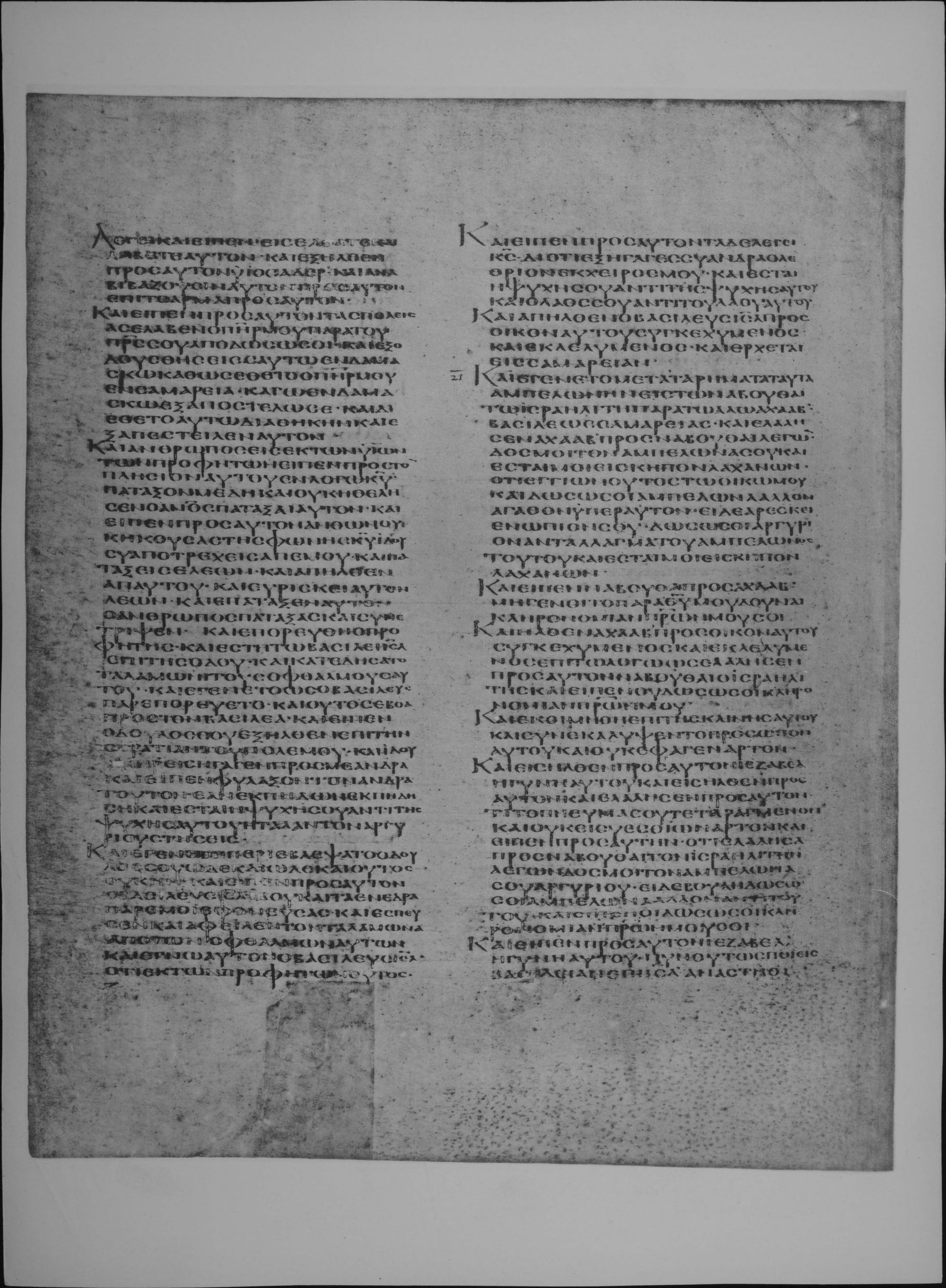
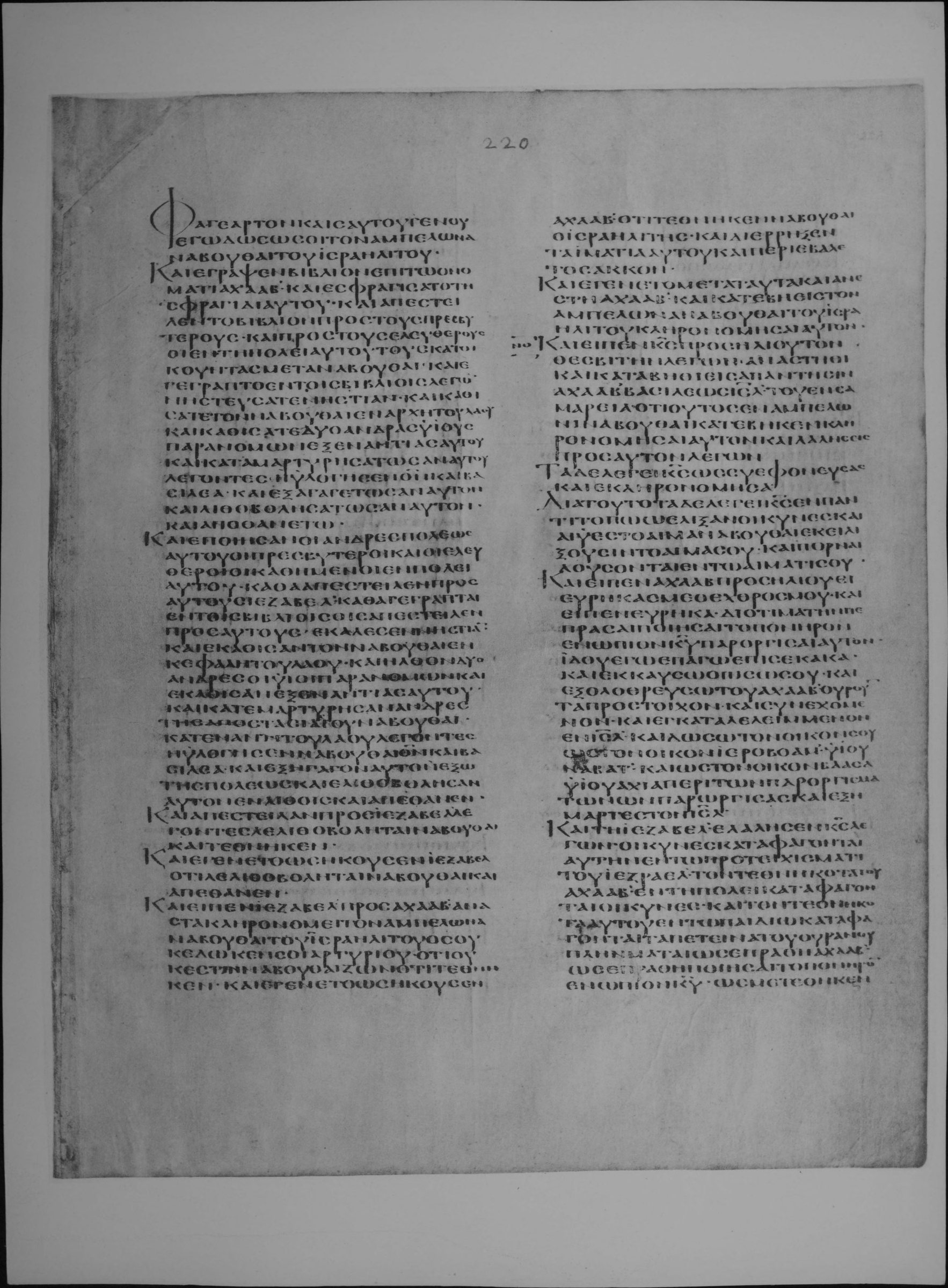
3 Kingdoms (1 Kings) 20:1-7 is on fol. 219v (full-size facsimile of 1879-83, Internet Archive codex-alexandrinus leaf 457). The 1930 reduced facsimile prints beneath this page: 1 Kings xxi. 33-43, xx. 1-7. Checked on the plate: the page begins inside 3 Kingdoms (1 Kings) 21:33 (first words read: ΚΑΙ ΕΞΗΛΘΕΝ ΠΡΟΣ ΑΥΤΟΝ ΥΙΟΣ ΑΔΕΡ ΚΑΙ ΑΝΑΒΙΒΑΖΟΥΣΙΝ ΑΥΤΟΝ ΠΡΟΣ ΑΥΤΟΝ ΕΠΙ ΤΟ ΑΡΜΑ). 3 Kingdoms (1 Kings) 20:7-8 is on fol. 220r (full-size facsimile of 1879-83, Internet Archive codex-alexandrinus leaf 458). The 1930 reduced facsimile prints beneath this page: 1 Kings xx. 7-25. Checked on the plate: the page begins inside 3 Kingdoms (1 Kings) 20:7 (first words read: ΦΑΓΕ ΑΡΤΟΝ ΚΑΙ ΣΕΑΥΤΟΥ ΓΕΝΟΥ ΕΓΩ ΔΩΣΩ ΣΟΙ ΤΟΝ ΑΜΠΕΛΩΝΑ ΝΑΒΟΥΘΑΙ ΤΟΥ ΙΣΡΑΗΛΙΤΟΥ).
1Καὶ ἀμπελὼν εἷς ἦν τῷ Ναβουθαὶ τῷ Ἰσραηλείτῃ παρὰ τῷ ἅλῳ Ἀχαὰβ βασιλέως Σαμαρείας. 2καὶ ἐλάλησεν Ἀχαὰβ πρὸς Ναβουθαὶ λέγων Δός μοι τὸν ἀμπελῶνά σου καὶ ἔσται μοι εἰς κῆπον λαχάνων, ὅτι ἐγγίων οὗτος τῷ οἴκῳ μου, καὶ δώσω σοι ἀμπελῶνα ἄλλον ἀγαθὸν ὑπὲρ αὐτόν· εἰ δὲ ἀρέσκει ἐνώπιόν σου, δώσω σοι ἀργύριον ἄλλαγμα ἀμπελῶνός σου τούτου, καὶ ἔσται μοι εἰς κῆπον λαχάνων. 3καὶ εἶπεν Ναβουθαὶ πρὸς Ἀχαάβ Μὴ γένοιτό μοι παρὰ θεοῦ μου δοῦναι κληρονομίαν πατέρων μου σοί. 4καὶ ἐγένετο τὸ πνεῦμα Ἀχαὰβ τεταραγμένον, καὶ ἐκοιμήθη ἐπὶ τῆς κλίνης αὐτοῦ καὶ συνεκάλυψεν τὸ πρόσωπον αὐτοῦ, καὶ οὐκ ἔφαγεν ἄρτον. 5καὶ εἰσῆλθεν Ἰεζάβελ ἡ γυνὴ αὐτοῦ πρὸς αὐτὸν καὶ ἐλάλησεν πρὸς αὐτόν Τί τὸ πνεῦμά σου τεταραγμένον, καὶ οὐκ εἶ σὺ ἐσθίων ἄρτον; 6καὶ εἶπεν πρὸς αὐτήν Ὅτι ἐλάλησα πρὸς Ναβουθαὶ τὸν Ἰσραηλείτην λέγων Δός μοι τὸν ἀμπελῶνά σου ἀργυρίου· εἰ δὲ βούλει, δώσω σοι ἀμπελῶνα ἄλλον ἀντ᾽ αὐτοῦ· καὶ εἶπεν Οὐ δώσω σοι κληρονομίαν πατέρων μου. 7καὶ εἶπεν πρὸς αὐτὸν Ἰεζάβελ ἡ γυνὴ αὐτοῦ Σὺ νῦν οὕτως ποιεῖς βασιλέα ἐπὶ Ἰσραήλ; ἀνάστηθι, φάγε ἄρτον καὶ σαυτοῦ γενοῦ· ἐγὼ δώσω σοι τὸν ἀμπελῶνα Ναβουθαὶ τοῦ Ἰσραηλείτου. 8καὶ ἔγραψεν βιβλίον ἐπὶ τῷ ὀνόματι Ἀχαὰβ καὶ ἐσφραγίσατο τῇ σφραγῖδι αὐτοῦ, καὶ ἀπέστειλεν τὸ βιβλίον πρὸς τοὺς πρεσβυτέρους καὶ τοὺς ἐλευθέρους τοὺς κατοικοῦντας μετὰ Ναβουθαί.
1And Nabuthai the Jezraelite had a vineyard, near the threshingfloor of Achaab king of Samaria. 2And Achaab spoke to Nabuthai, saying, Give me thy vineyard, and I will have it for a garden of herbs, for it is near my house: and I will give thee another vineyard better than it; or if it please thee, I will give thee money, the price of this thy vineyard, and I will have it for a garden of herbs. 3And Nabuthai said to Achaab, My God forbid me that I should give thee the inheritance of my fathers. 4And the spirit of Achaab was troubled, and he lay down upon his bed, and covered his face, and ate no bread. 5And Jezabel his wife went in to him, and spoke to him, saying, Why is thy spirit troubled, and why dost thou eat no bread? 6And he said to her, Because I spoke to Nabuthai the Jezraelite, saying, Give me thy vineyard for money; or if thou wilt, I will give thee another vineyard for it: and he said, I will not give thee the inheritance of my fathers. 7And Jezabel his wife said to him, Dost thou now thus act the king over Israel? arise, and eat bread, and be thine own master, and I will give thee the vineyard of Nabuthai the Jezraelite. 8And she wrote a letter in the name of Achaab, and sealed it with his seal, and sent the letter to the elders, and to the freemen who dwelt with Nabuthai.
Where on the image
3 Kingdoms (1 Kings) 20:9-18 is on fol. 220r (full-size facsimile of 1879-83, Internet Archive codex-alexandrinus leaf 458). The 1930 reduced facsimile prints beneath this page: 1 Kings xx. 7-25. Checked on the plate: the page begins inside 3 Kingdoms (1 Kings) 20:7 (first words read: ΦΑΓΕ ΑΡΤΟΝ ΚΑΙ ΣΕΑΥΤΟΥ ΓΕΝΟΥ ΕΓΩ ΔΩΣΩ ΣΟΙ ΤΟΝ ΑΜΠΕΛΩΝΑ ΝΑΒΟΥΘΑΙ ΤΟΥ ΙΣΡΑΗΛΙΤΟΥ).
9καὶ ἐγέγραπτο ἐν τοῖς βιβλίοις λέγων Νηστεύσατε νηστείαν, καὶ καθίσατε τὸν Ναβουθαὶ ἐν ἀρχῇ τοῦ λαοῦ· 10καὶ ἐνκαθίσατε δύο ἄνδρας, υἱοὺς παρανόμων. 13καὶ ἐκάθισαν ἐξ ἐναντίας αὐτοῦ, καὶ κατεμαρτύρησαν αὐτοῦ λέγοντες Ηὐλόγηκας θεὸν καὶ βασιλέα· καὶ ἐξήγαγον αὐτὸν ἔξω τῆς πόλεως καὶ ἐλιθοβόλησαν αὐτὸν λίθοις, καὶ ἀπέθανεν. 14καὶ ἀπέστειλαν πρὸς Ἰεζάβελ λέγοντες Λελιθοβόληται Ναβουθαὶ καὶ τέθνηκεν. 15καὶ ἐγένετο ὡς ἤκουσεν Ἰεζάβελ, καὶ εἶπεν πρὸς Ἀχαάβ Ἀνάστα, κληρονόμει τὸν ἀμπελῶνα Ναβουθαὶ τοῦ Ἰσραηλείτου ὃς οὐκ ἔδωκέν σοι ἀργυρίου, ὅτι οὐκ ἔστιν Ναβουθαὶ ζῶν, ὅτι τέθνηκεν. 16καὶ ἐγένετο ὡς ἤκουσεν Ἀχαὰβ ὅτι τέθνηκεν Ναβουθαὶ ὁ Ἰσραηλείτης, καὶ διέρρηξεν τὰ ἱμάτια ἑαυτοῦ καὶ περιεβάλετο σάκκον· καὶ ἐγένετο μετὰ ταῦτα καὶ ἀνέστη καὶ κατέβη Ἀχαὰβ εἰς τὸν ἀμπελῶνα Ναβουθαὶ τοῦ Ἰσραηλείτου κληρονομῆσαι αὐτόν. 17Καὶ εἶπεν Κύριος πρὸς Ἠλειοὺ τὸν Θεσβείτην λέγων 18Ἀνάστηθι καὶ κατάβηθι εἰς ἀπαντὴν Ἀχαὰβ βασιλέως Ἰσραὴλ τοῦ ἐν Σαμαρείᾳ, ὅτι οὗτος ἐν ἀμπελῶνι Ναβουθαί, ὅτι καταβέβηκεν ἐκεῖ κληρονομῆσαι αὐτόν.
9And it was written in the letters, saying, Keep a fast, and set Naboth in a chief place among the people. 10And set two men, sons of transgressors, before him, and let them testify against him, saying, He blessed God and the king: and let them lead him forth, and stone him, and let him die. 13And two men, sons of transgressors, came in, and sat opposite him, and bore witness against him, saying, Thou hast blessed God and the king. And they led him forth out of the city, and stoned him with stones, and he died. 14And they sent to Jezabel, saying, Nabuthai is stoned, and is dead. 15And it came to pass, when Jezabel heard it, that she said to Achaab, Arise, take possession of the vineyard of Nabuthai the Jezraelite, who would not sell it to thee: for Nabuthai is not alive, for he is dead. 16And it came to pass, when Achaab heard that Nabuthai the Jezraelite was dead, that he rent his garments, and put on sackcloth. And it came to pass afterward, that Achaab arose and went down to the vineyard of Nabuthai the Jezraelite, to take possession of it. 17And the Lord spoke to Eliu the Thesbite, saying, 18Arise, and go down to meet Achaab king of Israel, who is in Samaria, for he is in the vineyard of Nabuthai, for he has gone down thither to take possession of it.
Where on the image
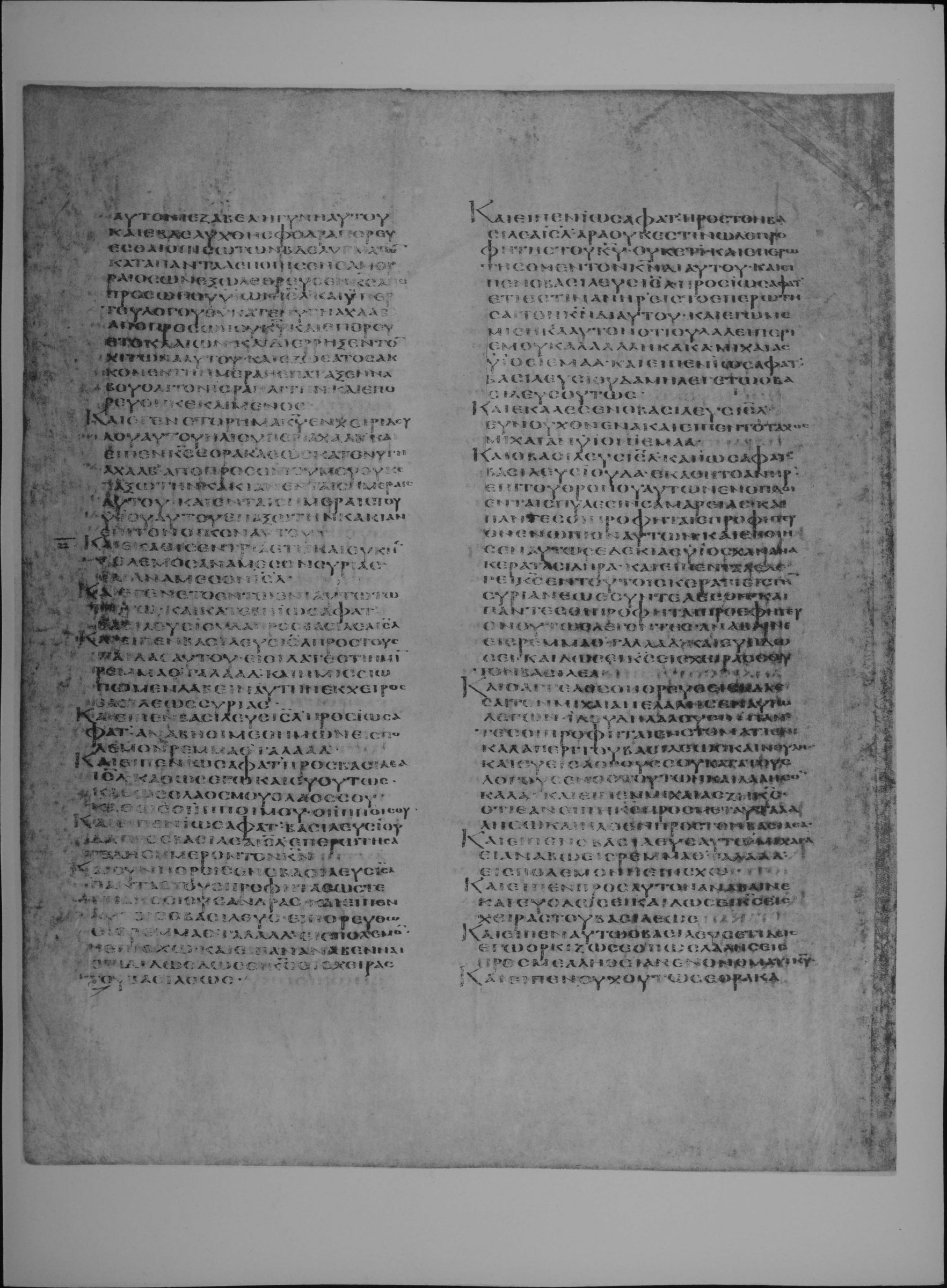
3 Kingdoms (1 Kings) 20:19-25 is on fol. 220r (full-size facsimile of 1879-83, Internet Archive codex-alexandrinus leaf 458). The 1930 reduced facsimile prints beneath this page: 1 Kings xx. 7-25. Checked on the plate: the page begins inside 3 Kingdoms (1 Kings) 20:7 (first words read: ΦΑΓΕ ΑΡΤΟΝ ΚΑΙ ΣΕΑΥΤΟΥ ΓΕΝΟΥ ΕΓΩ ΔΩΣΩ ΣΟΙ ΤΟΝ ΑΜΠΕΛΩΝΑ ΝΑΒΟΥΘΑΙ ΤΟΥ ΙΣΡΑΗΛΙΤΟΥ). 3 Kingdoms (1 Kings) 20:25-26 is on fol. 220v (full-size facsimile of 1879-83, Internet Archive codex-alexandrinus leaf 459). The 1930 reduced facsimile prints beneath this page: 1 Kings xx. 25-29, xxii. 1-17. Checked on the plate: the page begins inside 3 Kingdoms (1 Kings) 20:25 (first words read: ΑΥΤΟΝ ΙΕΖΑΒΕΛ Η ΓΥΝΗ ΑΥΤΟΥ ΚΑΙ ΕΒΔΕΛΥΧΘΗ ΣΦΟΔΡΑ ΠΟΡΕΥΕΣΘΑΙ ΟΠΙΣΩ ΤΩΝ ΒΔΕΛΥΓΜΑΤΩΝ).
19καὶ λαλήσεις πρὸς αὐτὸν λέγων Τάδε λέγει Κύριος Ὡς σὺ ἐφόνευσας καὶ ἐκληρονόμησας, διὰ τοῦτο τάδε λέγει Κύριος Ἐν παντὶ τόπῳ ᾧ ἔλιξαν αἱ ὕες καὶ οἱ κύνες τὸ αἷμα Ναβουθαί, ἐκεῖ λίξουσιν οἱ κύνες τὸ αἷμά σου, καὶ αἱ πόρναι λούσονται ἐν τῷ αἵματί σου. 20καὶ εἶπεν Ἀχαὰβ πρὸς Ἠλειού Εἰ εὕρηκάς με, ὁ ἐχθρός μου; καὶ εἶπεν Εὕρηκα, διότι μάτην πέπρασαι ποιῆσαι τὸ πονηρὸν ἐνώπιον Κυρίου, παροργίσαι αὐτόν. 21ἰδοὺ ἐγὼ ἐπάγω ἐπὶ σὲ κακά, καὶ ἐκκαύσω ὀπίσω σου καὶ ἐξολεθρεύσω τοῦ Ἀχαὰβ οὐροῦντα πρὸς τοῖχον καὶ συνεχόμενον καὶ ἐνκαταλελειμμένον ἐν Ἰσραήλ· 22καὶ δώσω τὸν οἶκόν σου ὡς τὸν οἶκον Ἰεροβοὰμ υἱοῦ Ναβὰθ καὶ ὡς τὸν οἶκον Βαασὰ υἱοῦ Ἀχειά, περὶ τῶν παροργισμάτων ὧν παρώργισας καὶ ἐξήμαρτες τὸν Ἰσραὴλ. 23καὶ τῇ Ἰεζάβελ ἐλάλησεν Κύριος λέγων Οἱ κύνες καταφάγονται αὐτὴν ἐν τῷ προτειχίσματι τοῦ Ἰσραήλ. 24τὸν τεθνηκότα τοῦ Ἀχαὰβ ἐν τῇ πόλει φάγονται οἱ κύνες, καὶ τὸν τεθνηκότα αὐτοῦ ἐν τῷ πεδίῳ φάγονται τὰ πετεινὰ τοῦ οὐρανοῦ. 25πλὴν ματαίως Ἀχαάβ, ὡς ἐπράθη ποιῆσαι τὸ πονηρὸν ἐνώπιον Κυρίου, ὡς μετέθηκεν αὐτὸν Ἰεζάβελ ἡ γυνὴ αὐτοῦ· 26καὶ ἐβδελύχθη σφόδρα πορεύεσθαι ὀπίσω τῶν βδελυγμάτων κατὰ πάντα ἃ ἐποίησεν ὁ Ἀμορραῖος, ὃν ἐξωλέθρευσεν Κύριος ἀπὸ προσώπου υἱῶν Ἰσραήλ.
19And thou shalt speak to him, saying, Thus saith the Lord, Forasmuch as thou hast slain and taken possession, therefore thus saith the Lord, In every place where the swine and the dogs have licked the blood of Nabuthai, there shall the dogs lick thy blood; and the harlots shall wash themselves in thy blood. 20And Achaab said to Eliu, Hast thou found me, mine enemy? and he said, I have found thee: because thou hast wickedly sold thyself to work evil in the sight of the Lord, to provoke him to anger; 21behold, I bring evil upon thee: and I will kindle a fire after thee, and I will utterly destroy every male of Achaab, and him that is shut up and him that is left in Israel. 22And I will make thy house as the house of Jeroboam the son of Nabat, and as the house of Baasa son of Achia, because of the provocations wherewith thou hast provoked me, and caused Israel to sin. 23And the Lord spoke of Jezabel, saying, The dogs shall devour her within the fortification of Jezrael. 24Him that is dead of Achaab in the city shall the dogs eat, and him that is dead of him in the field shall the birds of the sky eat. 25But Achaab did wickedly, in that he sold himself to do that which was evil in the sight of the Lord, as his wife Jezabel led him astray. 26And he did very abominably in following after the abominations, according to all that the Amorite did, whom the Lord utterly destroyed from before the children of Israel.
Where on the image
3 Kingdoms (1 Kings) 20:27-29 is on fol. 220v (full-size facsimile of 1879-83, Internet Archive codex-alexandrinus leaf 459). The 1930 reduced facsimile prints beneath this page: 1 Kings xx. 25-29, xxii. 1-17. Checked on the plate: the page begins inside 3 Kingdoms (1 Kings) 20:25 (first words read: ΑΥΤΟΝ ΙΕΖΑΒΕΛ Η ΓΥΝΗ ΑΥΤΟΥ ΚΑΙ ΕΒΔΕΛΥΧΘΗ ΣΦΟΔΡΑ ΠΟΡΕΥΕΣΘΑΙ ΟΠΙΣΩ ΤΩΝ ΒΔΕΛΥΓΜΑΤΩΝ).
27καὶ ὑπὲρ τοῦ λόγου ὡς κατενύγη Ἀχαὰβ ἀπὸ προσώπου τοῦ κυρίου, καὶ ἐπορεύετο κλαίων καὶ διέρρηξεν τὸν χιτῶνα αὐτοῦ καὶ ἐζώσατο σάκκον ἐπὶ τὸ σῶμα αὐτοῦ καὶ ἐνήστευσεν· καὶ περιεβάλετο σάκκον ἐν τῇ ἡμέρᾳ ᾗ ἐπάταξεν Ναβουθαὶ τὸν Ἰσραηλείτην, καὶ ἐπορεύθη. 28καὶ ἐγένετο ῥῆμα Κυρίου ἐν χειρὶ δούλου αὐτοῦ Ἠλειοὺ περὶ Ἀχαάβ, καὶ εἶπεν Κύριος 29Ἑώρακας ὡς κατενύγη Ἀχαὰβ ἀπὸ προσώπου μου; οὐκ ἐπάξω τὴν κακίαν ἐν ταῖς ἡμέραις αὐτοῦ· καὶ ἐν ταῖς ἡμέραις υἱοῦ αὐτοῦ ἐπάξω τὴν κακίαν.
27And because of the word, Achaab was pierced with sorrow before the Lord, and he both went weeping, and rent his garment, and girt sackcloth upon his body, and fasted; he put on sackcloth also in the day that he smote Nabuthai the Jezraelite, and went his way. 28And the word of the Lord came by the hand of his servant Eliu concerning Achaab, and the Lord said, 29Hast thou seen how Achaab has been pricked to the heart before me? I will not bring on the evil in his days, but in his son's days will I bring on the evil.
Cite
Sources
- Source: Codex Alexandrinus (British Library Royal MS 1 D. V) via the British Museum photographic facsimiles of 1879-83 and 1930 (Internet Archive) + Swete's Septuagint + Brenton's English (holding institution)
- Critical edition: H. B. Swete, The Old Testament in Greek according to the Septuagint (1909)
← previous · → next · v cycle view · l back to library