4 Kingdoms (2 Kings), Chapter 16 (Codex Alexandrinus)
Introduction
4 Kingdoms (2 Kings) 16 in the Greek Old Testament (the Septuagint) as written in Codex Alexandrinus, a Greek Bible copied in the fifth century, probably in Egypt, and now in the British Library (Royal MS 1 D. V, the first of its four volumes). It is one of the three great early codices of the whole Greek Bible, with Codex Vaticanus and Codex Sinaiticus.
This entry meets the strict three-criteria standard of the Theosis Library:
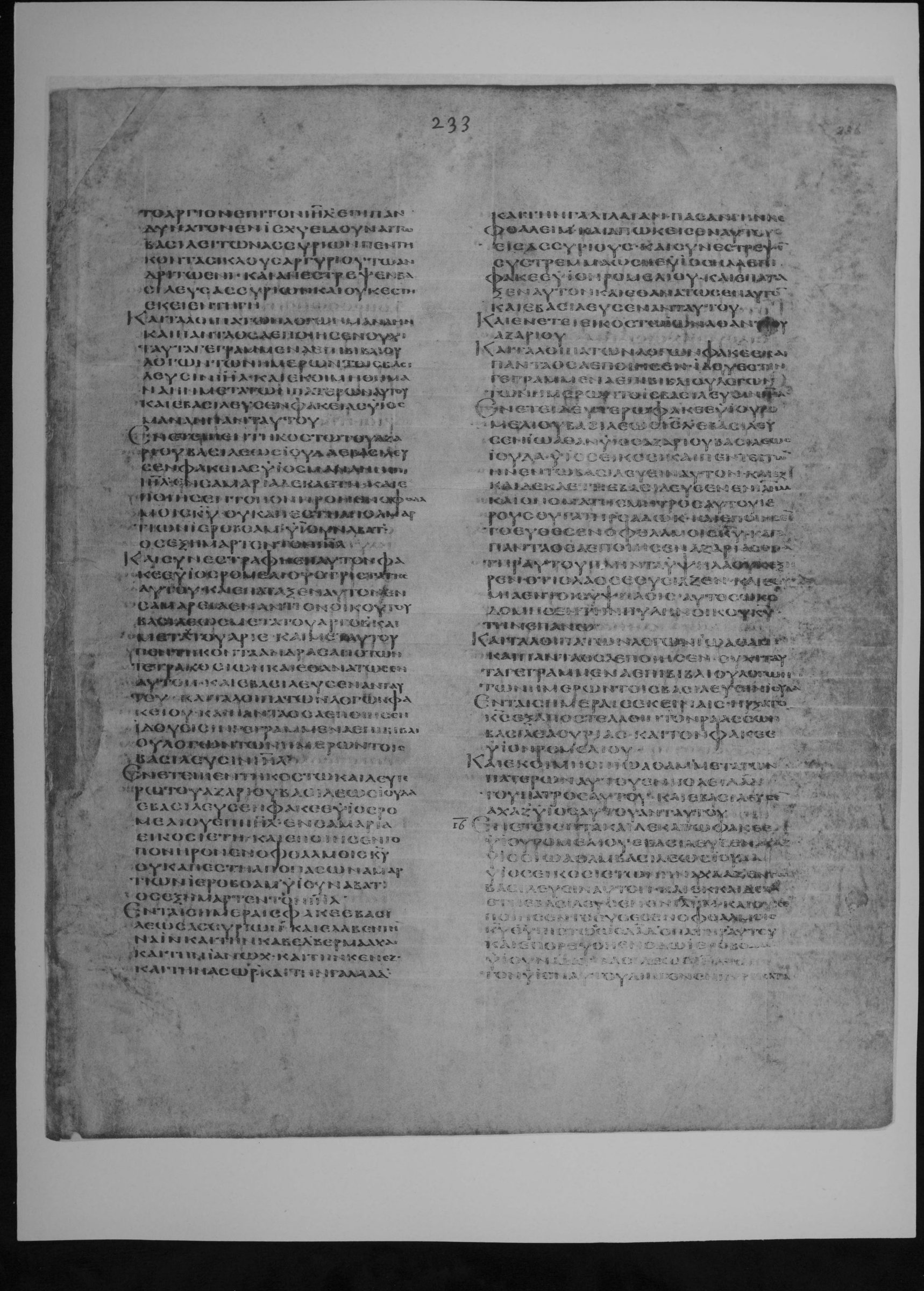
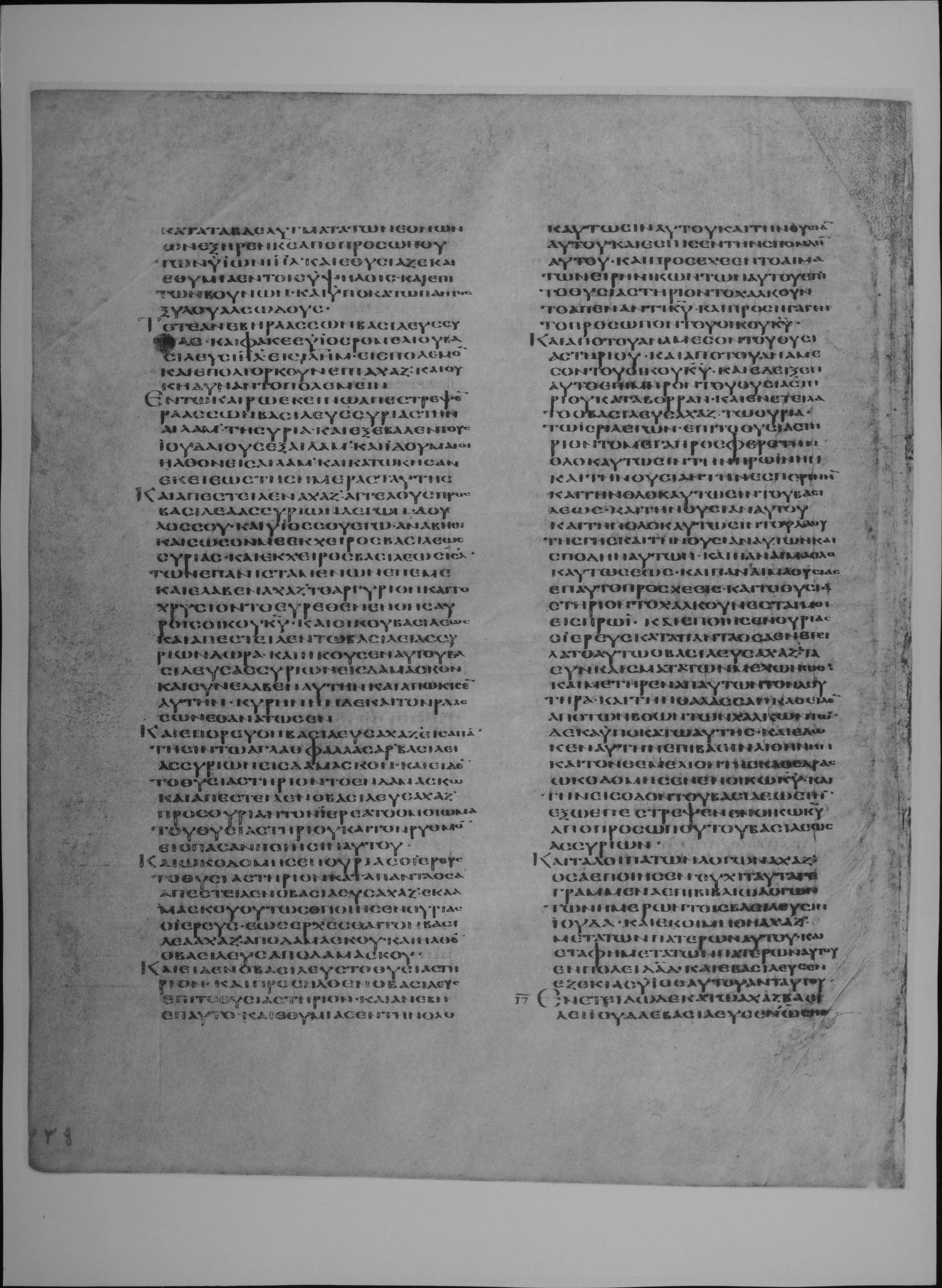
- Manuscript scan: the pages of Codex Alexandrinus carrying this chapter (fol. 233r, fol. 233v), from the full-size photographic (autotype) facsimile published by the British Museum in 1879-1883, as digitised on the Internet Archive. The verse range of every page comes from the reduced photographic facsimile of 1930, which prints it beneath each plate, and the opening words of every page were read on the plate to confirm the page and the verse it begins with. Each section links to the page or pages that hold its verses. Folio numbers are those written at the head of each leaf and visible on the plates.
- Original text: Swete's edition, which here prints the text of Codex Vaticanus (Vat. gr. 1209), the base of his edition, and gives the readings of Alexandrinus only in his apparatus. The Greek column is therefore Vaticanus' text; where Alexandrinus differs, the plate shows what Alexandrinus reads.
- English translation: Sir Lancelot C. L. Brenton, The Septuagint Version of the Old Testament (1844; 1851 edition), a translation of the Greek, public domain, from the eBible.org text.
How was this verified? (Provenance)
Where on the image
4 Kingdoms (2 Kings) 16:1-3 is on fol. 233r (full-size facsimile of 1879-83, Internet Archive codex-alexandrinus leaf 484). The 1930 reduced facsimile prints beneath this page: 2 Kings xv. 20-xvi. 3. Checked on the plate: the page begins inside 4 Kingdoms (2 Kings) 15:20 (first words read: ΤΟ ΑΡΓΥΡΙΟΝ ΕΠΙ ΤΟΝ ΙΣΡΑΗΛ ΕΠΙ ΠΑΝ ΔΥΝΑΤΟΝ ΙΣΧΥΙ ΔΟΥΝΑΙ ΤΩ ΒΑΣΙΛΕΙ ΑΣΣΥΡΙΩΝ). 4 Kingdoms (2 Kings) 16:3-8 is on fol. 233v (full-size facsimile of 1879-83, Internet Archive codex-alexandrinus leaf 485). The 1930 reduced facsimile prints beneath this page: 2 Kings xvi. 3-xvii. 1. Checked on the plate: the page begins inside 4 Kingdoms (2 Kings) 16:3 (first words read: ΚΑΤΑ ΤΑ ΒΔΕΛΥΓΜΑΤΑ ΤΩΝ ΕΘΝΩΝ ΩΝ ΕΞΗΡΕΝ ΚΣ ΑΠΟ ΠΡΟΣΩΠΟΥ ΤΩΝ ΥΙΩΝ ΙΣΡΑΗΛ).
1Ἐν ἔτει ἑπτακαιδεκάτῳ Φάκεε υἱοῦ Ῥομελίου ἐβασίλευσεν Ἀχὰζ υἱὸς Ἰωαθὰμ βασιλέως Ἰούδα. 2υἱὸς εἴκοσι ἐτῶν ἦν Ἀχὰς ἐν τῷ βασιλεύειν αὐτόν, καὶ ἑκκαίδεκα ἔτη ἐβασίλευσεν ἐν Ἰερουσαλήμ· καὶ οὐκ ἐποίησεν τὸ εὐθὲς ἐν ὀφθαλμοῖς Κυρίου θεοῦ πιστῶς ὡς Δαυεὶδ ὁ πατὴρ αὐτοῦ. 3καὶ ἐπορεύθη ἐν ὁδῷ βασιλέως Ἰσραήλ, καί γε τὸν υἱὸν αὐτοῦ διῆγεν πυρὶ καὶ τὰ βδελύγματα τῶν ἐθνῶν ὧν ἐξῆρεν Κύριος ἀπὸ προσώπου τῶν υἱῶν Ἰσραήλ. 4καὶ ἐθυσίαζεν καὶ ἐθυμία ἐν τοῖς ὑψηλοῖς καὶ ἐπὶ τῶν βουνῶν καὶ ὑποκάτω παντὸς ξύλου ἀλσώδους. 5Τότε ἀνέβη Ῥαασσὼν βασιλεὺς Συρίας καὶ Φάκεε υἱὸς Ῥομελίου βασιλεὺς Ἰσραὴλ εἰς Ἰερουσαλὴμ εἰς πόλεμον καὶ ἐπολιόρκουν ἐπὶ Ἀχάζ, καὶ οὐκ ἐδύναντο πολεμεῖν. 6ἐν τῷ καιρῷ ἐκείνῳ ἐπέστρεψεν Ῥαασσὼν βασιλεὺς Συρίας τὴν Αἰλὰθ τῇ Συρίᾳ, καὶ ἐξέβαλεν τοὺς Ἰουδαίους ἐξ Αἰλάθ, καὶ Ἰδουμαῖοι ἦλθον εἰς Αἰλὰθ καὶ κατῴκησαν ἐκεῖ ἕως τῆς ἡμέρας ταύτης. 7καὶ ἀπέστειλεν Ἀχὰζ ἀγγέλους πρὸς Θαλγαθφελλασὰρ βασιλέα Ἀσσυρίων λέγων Δοῦλός σου καὶ υἱός σου ἐγώ. ἀνάβηθι, σῶσόν με ἐκ χειρὸς βασιλέως Συρίας καὶ ἐκ χειρὸς βασιλέως Ἰσραὴλ τῶν ἐπανισταμένων ἐπ᾽ ἐμέ. 8καὶ ἔλαβεν Ἀχὰζ ἀργύριον καὶ χρυσίον τὸ εὑρεθὲν ἐν θησαυροῖς οἴκου Κυρίου καὶ οἴκου τοῦ βασιλέως καὶ ἀπέστειλεν τῷ βασιλεῖ δῶρα.
1In the seventeenth year of Phakee son of Romelias began Achaz the son of Joatham king of Juda to reign. 2Twenty years old was Achaz when he began to reign, and he reigned sixteen years in Jerusalem; and he did not that which was right in the eyes of the Lord his God faithfully, as David his father had done. 3And he walked in the way of the kings of Israel, yea, he made his son to pass through the fire, according to the abominations of the heathen whom the Lord cast out from before the children of Israel. 4And he sacrificed and burnt incense on the high places, and upon the hills, and under every shady tree. 5Then went up Raasson king of Syria and Phakee son of Romelias king of Israel against Jerusalem to war, and besieged Achaz, but could not prevail against him. 6At that time Raasson king of Syria recovered Ælath to Syria, and drove out the Jews from Ælath, and the Idumeans came to Ælath, and dwelt there until this day. 7And Achaz sent messengers to Thalgath-phellasar king of the Assyrians, saying, I am thy servant and thy son: come up, deliver me out of the hand of the king of Syria, and out of the hand of the king of Israel, who are rising up against me. 8And Achaz took the silver and the gold that was found in the treasures of the house of the Lord, and of the king's house, and sent gifts to the king.
Where on the image
4 Kingdoms (2 Kings) 16:9-16 is on fol. 233v (full-size facsimile of 1879-83, Internet Archive codex-alexandrinus leaf 485). The 1930 reduced facsimile prints beneath this page: 2 Kings xvi. 3-xvii. 1. Checked on the plate: the page begins inside 4 Kingdoms (2 Kings) 16:3 (first words read: ΚΑΤΑ ΤΑ ΒΔΕΛΥΓΜΑΤΑ ΤΩΝ ΕΘΝΩΝ ΩΝ ΕΞΗΡΕΝ ΚΣ ΑΠΟ ΠΡΟΣΩΠΟΥ ΤΩΝ ΥΙΩΝ ΙΣΡΑΗΛ).
9καὶ ἤκουσεν αὐτοῦ βασιλεὺς Ἀσσυρίων· καὶ ἀνέβη βασιλεὺς Ἀσσυρίων εἰς Δαμασκόν, καὶ συνέλαβεν αὐτὴν καὶ ἀπῴκισεν αὐτήν, καὶ τὸν Ῥαασσὼν ἐθανάτωσεν. 10Καὶ ἐπορεύθη βασιλεὺς Ἀχὰζ εἰς ἀπαντὴν αὐτοῦ τῷ Θαλγαλφελλασὰρ βασιλεῖ Ἀσσυρίων εἰς Δαμασκόν· καὶ εἶδεν τὸ θυσιαστήριον ἐν Δαμασκῷ· καὶ ἀπέστειλεν ὁ βασιλεὺς Ἀχὰζ πρὸς Οὐρείαν τὸν ἱερέα τὸ ὁμοίωμα τοῦ θυσιαστηρίου καὶ τὸν ῥυθμὸν αὐτοῦ εἰς πᾶσαν ποίησιν αὐτοῦ. 11καὶ ᾠκοδόμησεν Οὐρείας ὁ ἱερεὺς τὸ θυσιαστήριον κατὰ πάντα ὅσα ἀπέστειλεν ὁ βασιλεὺς Ἀχὰζ ἐκ Δαμασκοῦ. 12καὶ εἶδεν ὁ βασιλεὺς τὸ θυσιαστήριον, καὶ ἀνέβη ἐπ᾽ αὐτό, 13καὶ ἐθυμίασεν τὴν ὁλοκαύτωσιν αὐτοῦ καὶ τὴν θυσίαν αὐτοῦ καὶ τὴν σπονδὴν αὐτοῦ, καὶ προσέχεεν τὸ αἷμα τῶν εἰρηνικῶν τῶν αὐτοῦ ἐπὶ τὸ θυσιαστήριον 14τὸ χαλκοῦν τὸ ἀπέναντι Κυρίου καὶ προσήγαγεν τὸ πρόσωπον τοῦ οἴκου Κυρίου, ἀπὸ τοῦ ἀνὰ μέσον τοῦ θυσιαστηρίου καὶ ἀπὸ τοῦ ἀνὰ μέσον τοῦ οἴκου Κυρίου, καὶ ἔδειξεν αὐτὸ ἐπὶ μηρὸν τοῦ θυσιαστηρίου κατὰ βορρᾶν. 15καὶ ἐνετείλατο ὁ βασιλεὺς Ἀχὰζ τῷ Οὐρείᾳ τῷ ἱερεῖ λέγων Ἐπὶ τὸ θυσιαστήριον τὸ μέγα πρόσφερε τὴν ὁλοκαύτωσιν τὴν πρωινὴν καὶ τὴν θυσίαν τὴν ἑσπερινήν, καὶ τὴν ὁλοκαύτωσιν τοῦ βασιλέως καὶ τὴν θυσίαν αὐτοῦ, καὶ τὴν ὁλοκαύτωσιν παντὸς τοῦ λαοῦ καὶ τὴν θυσίαν αὐτῶν καὶ τὴν σπονδὴν αὐτῶν, καὶ πᾶν αἷμα ὁλοκαυτώσεως καὶ πᾶν αἷμα θυσίας ἐπ᾽ αὐτὸ προσχεεῖς· ἐπὶ τὸ θυσιαστήριον τὸ χαλκοῦν ἔσται μοι εἰς τὸ πρωί. 16καὶ ἐποίησεν Οὐρείας ὁ ἱερεὺς κατὰ πάντα ὅσα ἐνετείλατο αὐτῷ ὁ βασιλεὺς Ἀχάς.
9And the king of the Assyrians hearkened to him: and the king of the Assyrians went up to Damascus and took it, and removed the inhabitants, and slew king Raasson. 10And king Achaz went to Damascus to meet Thalgath-phellasar king of the Assyrians at Damascus; and he saw an altar at Damascus. And king Achaz sent to Urias the priest the pattern of the altar, and its proportions, and all its workmanship. 11And Urias the priest built the altar, according to all the directions which king Achaz sent from Damascus. 12And the king saw the altar, and went up to it, 13and offered his whole-burnt-offering, and his meat-offering, and his drink-offering, and poured out the blood of his peace-offerings on the brazen altar that was before the Lord. 14And he brought forward the one before the house of the Lord from between the altar and the house of the Lord, and he set it openly by the side of the altar northwards. 15And king Achaz charged Urias the priest, saying, Offer upon the great altar the whole-burnt-offering in the morning and the meat-offering in the evening, and the whole-burnt-offering of the king, and his meat-offering, and the whole-burnt-offering of all the people, and their meat-offering, and their drink-offering; and thou shalt pour all the blood of the whole-burnt-offering, and all the blood of any other sacrifice upon it: and the brazen altar shall be for me in the morning. 16And Urias the priest did according to all that king Achaz commanded him.
Where on the image
4 Kingdoms (2 Kings) 16:17-20 is on fol. 233v (full-size facsimile of 1879-83, Internet Archive codex-alexandrinus leaf 485). The 1930 reduced facsimile prints beneath this page: 2 Kings xvi. 3-xvii. 1. Checked on the plate: the page begins inside 4 Kingdoms (2 Kings) 16:3 (first words read: ΚΑΤΑ ΤΑ ΒΔΕΛΥΓΜΑΤΑ ΤΩΝ ΕΘΝΩΝ ΩΝ ΕΞΗΡΕΝ ΚΣ ΑΠΟ ΠΡΟΣΩΠΟΥ ΤΩΝ ΥΙΩΝ ΙΣΡΑΗΛ).
17καὶ συνέκοψεν ὁ βασιλεὺς τὰ συνκλείσματα τῶν μεχωνὼθ καὶ μετῆρεν ἀπ᾽ αὐτῶν τὸν λουτῆρα, καὶ τὴν θάλασσαν καθεῖλεν ἀπὸ τῶν βοῶν τῶν χαλκῶν τῶν ὑποκάτω αὐτῆς καὶ ἔδωκεν αὐτὴν ἐπὶ βάσιν λιθίνην. 18καὶ τὸν θεμέλιον τῆς καθέδρας ᾠκοδόμησεν ἐν οἴκῳ Κυρίου, καὶ τὴν εἴσοδον τοῦ βασιλέως τὴν ἔξω ἐπέστρεψεν οἴκῳ Κυρίου ἀπὸ προσώπου βασιλέως Ἀσσυρίων. 19Καὶ τὰ λοιπὰ τῶν λόγων Ἀχὰζ ὅσα ἐποίησεν, οὐχὶ ταῦτα γεγραμμένα ἐπὶ βιβλίῳ λόγων τῶν ἡμερῶν τοῖς βασιλεῦσιν Ἰούδα. 20καὶ ἐκοιμήθη Ἀχὰζ μετὰ τῶν πατέρων αὐτοῦ, καὶ ἐτάφη ἐν πόλει Δαυείδ· καὶ ἐβασίλευσεν Ἑζεκίας υἱὸς αὐτοῦ ἀντ᾽ αὐτοῦ.
17And king Achaz cut off the borders of the bases, and removed the laver from off them, and took down the sea from the brazen oxen that were under it, and set it upon a base of stone. 18And he made a base for the throne in the house of the Lord, and he turned the king's entrance without in the house of the Lord because of the king of the Assyrians. 19And the rest of the acts of Achaz, even all that he did, are not these written in the book of the chronicles of the kings of Juda? 20And Achaz slept with his fathers, and was buried in the city of David: and Ezekias his son reigned in his stead.
Cite
Sources
- Source: Codex Alexandrinus (British Library Royal MS 1 D. V) via the British Museum photographic facsimiles of 1879-83 and 1930 (Internet Archive) + Swete's Septuagint + Brenton's English (holding institution)
- Critical edition: H. B. Swete, The Old Testament in Greek according to the Septuagint (1909)
← previous · → next · v cycle view · l back to library