4 Maccabees, Chapter 11 (Codex Alexandrinus)
Introduction
4 Maccabees 11 in the Greek Old Testament (the Septuagint) as written in Codex Alexandrinus, a Greek Bible copied in the fifth century, probably in Egypt, and now in the British Library (Royal MS 1 D. VI, the second of its four volumes). It is one of the three great early codices of the whole Greek Bible, with Codex Vaticanus and Codex Sinaiticus.
Numbering: Swete's Greek and Brenton's English number or divide some verses of this chapter differently (Swete 11:6-8 = Brenton 11:6). Each column keeps its own verse numbers, and sections are cut only where the two texts agree, so each section holds the same passage in both languages.
This entry meets the strict three-criteria standard of the Theosis Library:
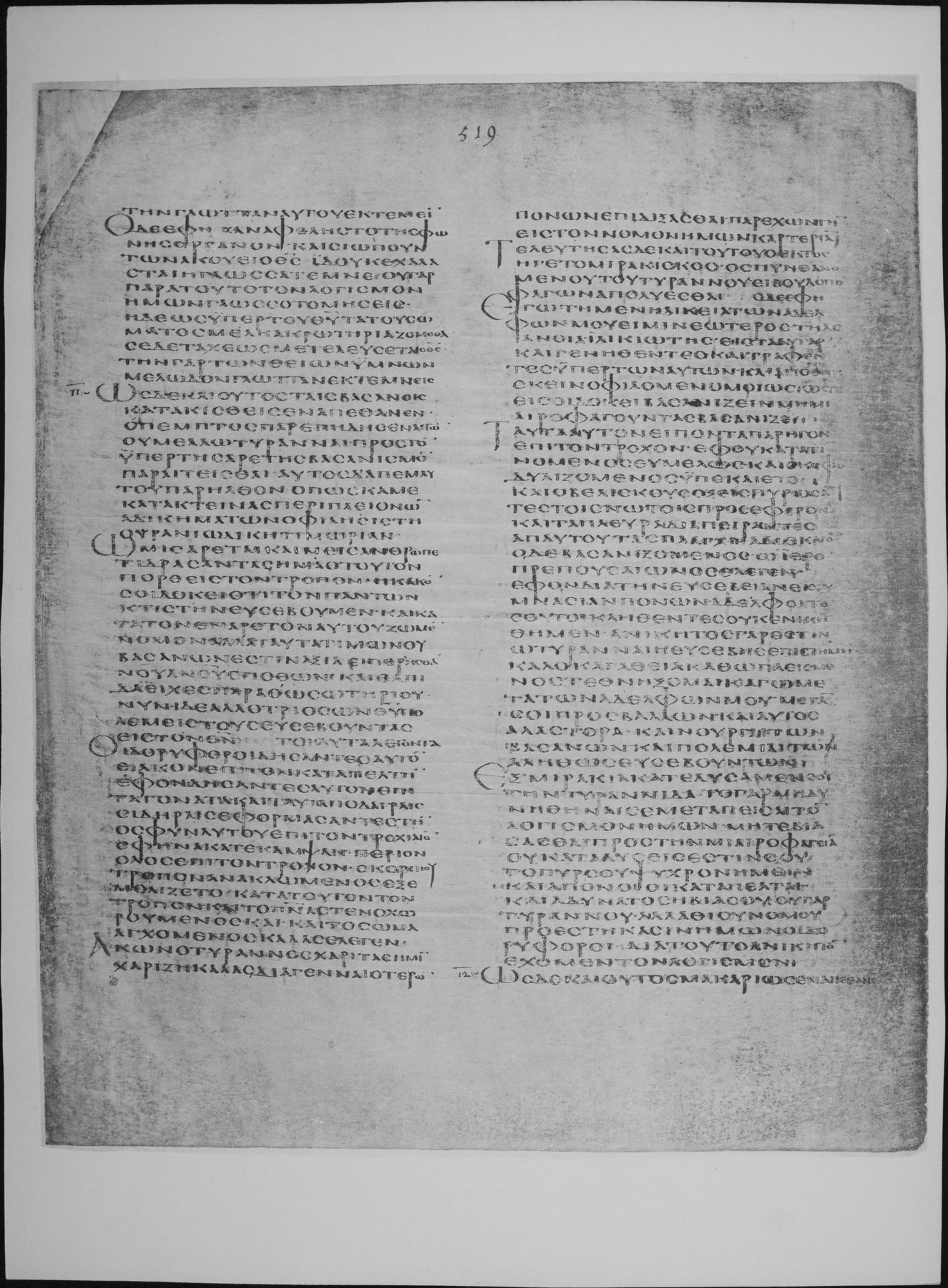
- Manuscript scan: the page of Codex Alexandrinus carrying this chapter (fol. 519r), from the full-size photographic (autotype) facsimile published by the British Museum in 1879-1883, as digitised on the Internet Archive. The verse range of every page comes from the reduced photographic facsimile of 1957, which prints it beneath each plate, and the opening words of every page were read on the plate to confirm the page and the verse it begins with. Each section links to the page or pages that hold its verses. Folio numbers are those written at the head of each leaf and visible on the plates.
- Original text: Swete's edition, which in the books of Maccabees prints the text of Codex Alexandrinus itself (Codex Vaticanus does not contain these books), with the readings of other manuscripts in his apparatus. Swete adds accents, breathings and punctuation and expands the abbreviated sacred names, so the plate shows the same text in unaccented capitals.
- English translation: Sir Lancelot C. L. Brenton, The Septuagint Version of the Old Testament (1844; 1851 edition), a translation of the Greek, public domain, from the eBible.org text.
How was this verified? (Provenance)
Where on the image
4 Maccabees 11:1-8 is on fol. 519r (full-size facsimile of 1879-83, Internet Archive codex-alexandrinus leaf 1044). The 1957 reduced facsimile prints beneath this page: 4 Maccabees x. 17-xii. 1. Checked on the plate: the page begins inside 4 Maccabees 10:17 (first words read: ΤΗΝ ΓΛΩΤΤΑΝ ΑΥΤΟΥ ΕΚΤΕΜΕΙΝ Ο ΔΕ ΕΦΗ ΚΑΝ ΑΦΕΛΗΣ ΤΟ ΤΗΣ ΦΩΝΗΣ ΟΡΓΑΝΟΝ).
1Ὡς δὲ καὶ οὗτος ταῖς βασάνοις καταικισθεὶς ἐναπέθανεν, ὁ πέμπτος παρεπήδησεν, λέγων 2Οὐ μέλλω, τύραννε, πρὸς τὸν ὑπὲρ τῆς ἀρετῆς βασανισμὸν παραιτεῖσθαι. 3αὐτὸς δ᾽ ἀπ᾽ ἐμαυτοῦ παρῆλθον, ὅπως κἀμὲ κατακτείνας, περὶ πλειόνων ἀδικημάτων ὀφιλήσῃς τῇ οὐρανίῳ δίκῃ τιμωρίαν. 4ὦ μισάρετε καὶ μισάνθρωπε, τί δράσαντας ἡμᾶς τοῦτον πορθεῖς τὸν τρόπον; 5ἢ κακόν σοι δοκεῖ, ὅτι τὸν πάντων κτὶστην εὐσεβοῦμεν, καὶ κατὰ τὸν ἐνάρετον αὐτοῦ ζῶμεν νόμον; 6ἀλλὰ ταῦτα τιμῶν, οὐ βασάνων ἐστὶν ἄξια, 7εἴπερ ᾐσθάνου ἀνθρώπους ποθῶν, καὶ ἐλπίδα εἶχες παρὰ θεῷ σωτηρίου· 8νῦν ἰδὲ ἀλλότριος ὢν θεοῦ, πολεμεῖς τοὺς εὐσεβοῦντας εἰς τὸν θεόν.
1And when he had died, disfigured in his torments, the fifth leaped forward, and said, 2I intend not, O tyrant, to get excused from the torment which is in behalf of virtue. 3But I have come of my own accord, that by the death of me, you may owe heavenly vengeance a punishment for more crimes. 4O thou hater of virtue and of men, what have we done that thou thus revellest in our blood? 5Does it seem evil to thee that we worship the Founder of all things, and live according to his surpassing law? 6But this is worthy of honours, not of torments; hadst thou been capable of the higher feelings of men, and possessed the hope of salvation from God. Behold, now, being alien from God, thou makest war against those who are religious toward God.
Where on the image
4 Maccabees 11:9-16 is on fol. 519r (full-size facsimile of 1879-83, Internet Archive codex-alexandrinus leaf 1044). The 1957 reduced facsimile prints beneath this page: 4 Maccabees x. 17-xii. 1. Checked on the plate: the page begins inside 4 Maccabees 10:17 (first words read: ΤΗΝ ΓΛΩΤΤΑΝ ΑΥΤΟΥ ΕΚΤΕΜΕΙΝ Ο ΔΕ ΕΦΗ ΚΑΝ ΑΦΕΛΗΣ ΤΟ ΤΗΣ ΦΩΝΗΣ ΟΡΓΑΝΟΝ).
9τοιαῦτα λέγοντα οἱ δορυφόροι δήσαντες αὐτὸν εἷλκον ἐπὶ τὸν καταπέλτην· 10ἐφ᾽ ὃν δήσαντες αὐτὸν ἐπὶ τὰ γόνατα, καὶ ταῦτα ποδάγραις σιδηραῖς ἐφαρμόσαντες τὴν ὀσφὺν αὐτοῦ ἐπὶ τὸν τροχιαῖον σφῆνα κατέκαμψαν· περὶ ὃν ὅλος ἐπὶ τὸν τροχὸν σκορπίου τρόπον ἀνακλώμενος ἐξεμελίζετο. 11κατὰ τοῦτον τὸν τρόπον καὶ τὸ πνεῦμα στενοχωρούμενος καὶ τὸ σῶμα ἀγχόμενος 12Καλάς, ἔλεγεν, ἄκων, ὁ τύραννος, χάριτας ἡμῖν χαρίζῃ, καλάς, διὰ γενναιοτέρων πόνων ἐπιδείξασθαι παρέχων τὴν εἰς τὸν νόμον ἡμῶν καρτερίαν. 13Τελευτήσαντος δὲ καὶ τούτου, ὁ ἕκτος ἤγετο μειρακίσκος· ὃς πυνθανομένου τοῦ τύραννου εἰ βούλοιτο φαγὼν ἀπολύεσθαι, ὁ δὲ ἔφη 14Ἐγὼ τῇ μὲν ἡλικίᾳ τῶν ἀδελφῶν μου εἰμὶ νεώτερος, τῇ δέ διανοίᾳ ἡλικιώτης. 15εἰς τὰ αὐτὰ γὰρ καὶ γενηθέντες καὶ τραφέντες, ὑπὲρ τῶν αὐτῶν καὶ ἀποθνήσκειν ὀφίλομεν ὁμοίως. 16ὥστε εἴ σοι δοκεῖ βασανίζειν μὴ μιεροφαγοῦντας, βασάνιζε.
9As he said this, the spearbearers bound him, and drew him to the catapelt: 10to which binding him at his knees, and fastening them with iron fetters, they bent down his loins upon the wedge of the wheel; and his body was then dismembered, scorpion-fashion. 11With his breath thus confined, and his body strangled, he said, 12A great favour thou bestowest upon us, O tyrant, by enabling us to manifest our adherence to the law by means of nobler sufferings. 13He also being dead, the sixth, quite a youth, was brought out; and on the tyrant asking him whether he would eat and be delivered, he said, 14I am indeed younger than my brothers, but in understanding I am as old; 15for having been born and reared unto the same end, we are bound to die also in behalf of the same cause. 16So that if thou think proper to torment us for not eating the unclean;—torment!
Where on the image
4 Maccabees 11:17-24 is on fol. 519r (full-size facsimile of 1879-83, Internet Archive codex-alexandrinus leaf 1044). The 1957 reduced facsimile prints beneath this page: 4 Maccabees x. 17-xii. 1. Checked on the plate: the page begins inside 4 Maccabees 10:17 (first words read: ΤΗΝ ΓΛΩΤΤΑΝ ΑΥΤΟΥ ΕΚΤΕΜΕΙΝ Ο ΔΕ ΕΦΗ ΚΑΝ ΑΦΕΛΗΣ ΤΟ ΤΗΣ ΦΩΝΗΣ ΟΡΓΑΝΟΝ).
17ταῦτα αὐτὸν εἰπόντα παρῆγον ἐπὶ τὸν τροχόν. 18ἐφ᾽ οὗ κατατεινόμενος εὐμελῶς καὶ ἐκσφονδυλιζόμενος ὑπεκαίετο. 19καὶ ὀβελίσκους ὀξεῖς πυρώσαντες, τοῖς νώτοις προσέφερον· καὶ τὰ πλευρὰ διαπείραντες, ἀπ᾽ αὐτοῦ τὰ σπλάγχνα διέκαιον. 20ὁ δὲ βασανιζόμενος Ὦ ἱεροπρεποῦς αἰῶνος, ἔλεγεν, ἐφ᾽ ὃν διὰ τὴν εὐσέβειαν εἰς γυμνασίαν πόνων ἀδελφοὶ τοσοῦτοι κληθέντες οὐκ ἐνικήθημεν. 21ἀνίκητος γάρ ἐστιν, ὦ τύραννε, ἡ εὐσεβὴς ἐπιστήμη. 22καλοκἀγαθίᾳ καθωπλισμένος τεθνήξομαι κἀγὼ μετὰ τῶν ἀδελφῶν μου, 23μέγαν σοι προσβάλλων καὶ αὐτὸς ἀλάστορα, καινουργὲ τῶν βασάνων, καὶ πολέμιε τῶν ἀληθῶς εὐσεβούντων. 24ἓξ μειράκια κατελύσαμέν σου τὴν τυραννίδα.
17As he said this, they brought him to the wheel. 18Extended upon which, with limbs racked and dislocated, he was gradually roasted from beneath. 19And having heated sharp spits, they approached them to his back; and having transfixed his sides, they burned away his entrails. 20And he, while tormented, said, O period good and holy, in which, for the sake of religion, we brothers have been called to the contest of pain, and have not been conquered. 21For religious understanding, O tyrant, is unconquered. 22Armed with upright virtue, I also shall depart with my brethren. 23I, too, bearing with me a great avenger, O deviser of tortures, and enemy of the truly pious. 24We six youths have destroyed thy tyranny.
Where on the image
4 Maccabees 11:25-27 is on fol. 519r (full-size facsimile of 1879-83, Internet Archive codex-alexandrinus leaf 1044). The 1957 reduced facsimile prints beneath this page: 4 Maccabees x. 17-xii. 1. Checked on the plate: the page begins inside 4 Maccabees 10:17 (first words read: ΤΗΝ ΓΛΩΤΤΑΝ ΑΥΤΟΥ ΕΚΤΕΜΕΙΝ Ο ΔΕ ΕΦΗ ΚΑΝ ΑΦΕΛΗΣ ΤΟ ΤΗΣ ΦΩΝΗΣ ΟΡΓΑΝΟΝ).
25τὸ γὰρ μὴ δυνηθῆναί σε μεταπεῖσαι τὸν λογισμὸν ἡμῶν, μήτε βιάσασθαι πρὸς τὴν μιεροφαγίαν, οὐ κατάλυσίς ἐστίν σου; 26τὸ πῦρ σου ψυχρὸν ἡμῖν, καὶ ἄπονοι οἱ καταπέλται, καὶ ἀδύνατος ἡ βία σου. 27οὐ γὰρ τυράννου ἀλλὰ θείου νόμου προεστήκασιν ἡμῶν οἱ δορυφόροι· διὰ τοῦτο ἀνίκητον ἔχομεν τὸν λογισμόν.
25For is not your inability to overrule our reasoning, and to compel us to eat the unclean, thy destruction? 26Your fire is cold to us, your catapelts are painless, and your violence harmless. 27For the guards not of a tyrant but of a divine law are our defenders: through this we keep our reasoning unconquered.
Cite
Sources
- Source: Codex Alexandrinus (British Library Royal MS 1 D. VI) via the British Museum photographic facsimiles of 1879-83 and 1957 (Internet Archive) + Swete's Septuagint + Brenton's English (holding institution)
- Critical edition: H. B. Swete, The Old Testament in Greek according to the Septuagint (1909)
← previous · → next · v cycle view · l back to library