Daniel (Theodotion), Chapter 8 (Codex Alexandrinus)
Introduction
Daniel (Theodotion) 8 in the Greek Old Testament (the Septuagint) as written in Codex Alexandrinus, a Greek Bible copied in the fifth century, probably in Egypt, and now in the British Library (Royal MS 1 D. VI, the second of its four volumes). It is one of the three great early codices of the whole Greek Bible, with Codex Vaticanus and Codex Sinaiticus.
This entry meets the strict three-criteria standard of the Theosis Library:
- Manuscript scan: the pages of Codex Alexandrinus carrying this chapter (fol. 412v, fol. 413r), from the full-size photographic (autotype) facsimile published by the British Museum in 1879-1883, as digitised on the Internet Archive. The verse range of every page comes from the reduced photographic facsimile of 1936, which prints it beneath each plate, and the opening words of every page were read on the plate to confirm the page and the verse it begins with. Each section links to the page or pages that hold its verses. Folio numbers are those written at the head of each leaf and visible on the plates.
- Original text: Swete's edition of the Greek version of Daniel ascribed to Theodotion, which Codex Alexandrinus carries, as almost all Greek manuscripts do, in place of the older Septuagint version (Swete prints that older version, known from the Chigi manuscript, on facing pages; it is not used here). Swete's text of Theodotion is that of Codex Vaticanus (Vat. gr. 1209), with Alexandrinus' readings in his apparatus, so the Greek column is Vaticanus' text; where Alexandrinus differs, the plate shows what Alexandrinus reads. Brenton's English also translates Theodotion's version.
- English translation: Sir Lancelot C. L. Brenton, The Septuagint Version of the Old Testament (1844; 1851 edition), a translation of the Greek, public domain, from the eBible.org text.
How was this verified? (Provenance)
Where on the image
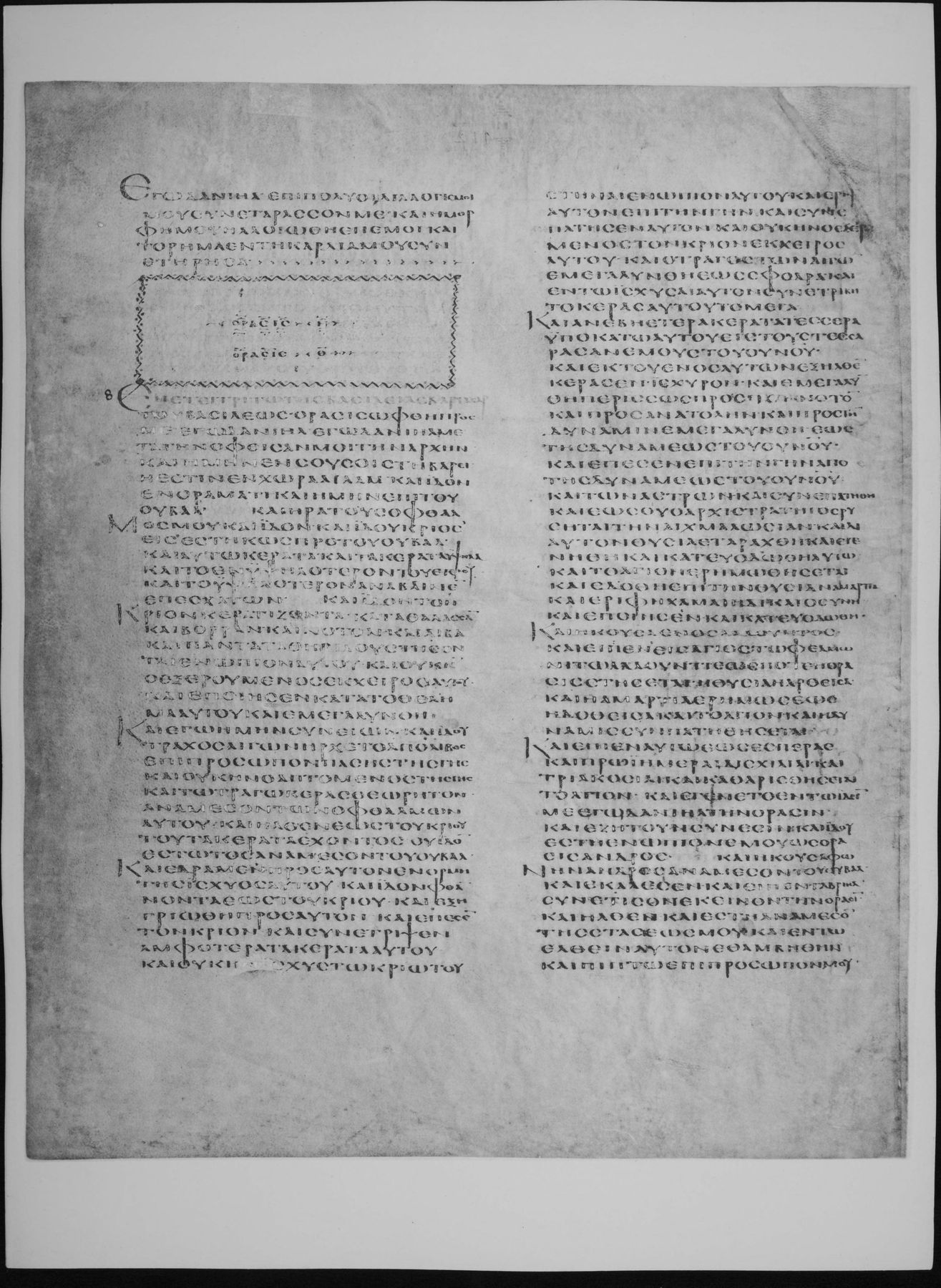
Daniel (Theodotion) 8:1-8 is on fol. 412v (full-size facsimile of 1879-83, Internet Archive codex-alexandrinus leaf 849). The 1936 reduced facsimile prints beneath this page: Dan. vii. 28-viii. 17. Checked on the plate: the page begins at the start of Daniel (Theodotion) 7:28 (first words read: ΕΓΩ ΔΑΝΙΗΛ ΕΠΙ ΠΟΛΥ ΟΙ ΔΙΑΛΟΓΙΣΜΟΙ ΜΟΥ ΣΥΝΕΤΑΡΑΣΣΟΝ ΜΕ).
1Ἐν ἔτει τρίτῳ τῆς βασιλείας Βαλτασὰρ τοῦ βασιλέως ὅρασις ὤφθη πρὸς μέ, ἐγὼ Δανιήλ, μετὰ τὴν ὀφθεῖσάν μοι τὴν ἀρχήν. 2καὶ ἤμην ἐν Σούσοις τῇ βάρει ἥ ἐστιν ἐν χώρᾳ Αἰλάμ, καὶ ἤμην ἐπὶ τοῦ Οὐβάλ. 3καὶ ἦρα τοὺς ὀφθαλμούς μου καὶ ἴδον, καὶ ἰδοὺ κριὸς εἷς ἑστηκὼς πρὸ τοῦ Οὐβάλ, καὶ αὐτῷ κέρατα ὑψηλά· καὶ τὸ ἓν ὑψηλότερον τοῦ ἑτέρου, καὶ τὸ ὑψηλὸν ἀνέβαινεν ἐπ᾽ ἐσχάτῳ. 4ἴδον τὸν κριὸν κερατίζοντα κατὰ θάλασσαν καὶ βορρᾶ καὶ νότον· καὶ πάντα τὰ θηρία οὐ στήσονται ἐνώπιον αὐτοῦ, καὶ οὐκ ἦν ὁ ἐξαιρούμενος ἐκ χειρὸς αὐτοῦ, καὶ ἐποίησεν κατὰ τὸ θέλημα αὐτοῦ καὶ ἐμεγαλύνθη. 5καὶ ἐγὼ ἤμην συνίων, καὶ ἰδοὺ τράγος αἰγῶν ἤρχετο ἀπὸ λιβὸς ἐπὶ πρόσωπον πάσης τῆς γῆς, καὶ οὐκ ἦν ἁπτόμενος τῆς γῆς, καὶ τῷ τράγῳ κέρας μέσον τῶν ὀφθαλμῶν αὐτοῦ. 6καὶ ἦλθεν ἕως τοῦ κριοῦ τοῦ τὰ κέρατα ἔχοντος, οὗ ἴδον ἑστὼς ἐνώπιον τοῦ Οὐβάλ, καὶ ἔδραμεν πρὸς αὐτὸν ἐν ὁρμῇ τῆς ἰσχύος αὐτοῦ. 7καὶ ἴδον αὐτὸν φθάνοντα ἕως τοῦ κριοῦ, καὶ ἐξηγριάνθη πρὸς αὐτόν· καὶ ἔπαισεν τὸν κριὸν καὶ συνέτριψεν ἀμφότερα τὰ κέρατα αὐτοῦ, καὶ οὐκ ἦν ἰσχὺς τῷ κριῷ τοῦ στῆναι ἐνώπιον αὐτοῦ· καὶ ἔριψεν αὐτὸν ἐπὶ τὴν γῆν καὶ συνεπάτησεν αὐτόν, καὶ οὐκ ἦν ὁ ἐξαιρούμενος τὸν κριὸν ἐκ χειρὸς αὐτοῦ. 8καὶ ὁ τράγος τῶν αἰγῶν ἐμεγαλύνθη ἕως σφόδρα· καὶ ἐν τῷ ἰσχῦσαι αὐτὸν συνετρίβη τὸ κέρας αὐτοῦ τὸ μέγα, καὶ ἀνέβη κέρατα τέσσερα ὑποκάτω αὐτοῦ εἰς τοὺς τέσσαρες ἀνέμους τοῦ οὐρανοῦ.
1In the third year of the reign of king Baltasar a vision appeared to me, even to me Daniel, after that which appeared to me at the first. 2And I was in Susa the palace, which is in the land of Ælam, and I was on the bank of Ubal. 3And I lifted up mine eyes, and saw, and, behold, a ram standing in front of the Ubal; and he had high horns; and one was higher than the other, and the high one came up last. 4And I saw the ram butting westward, and northward, and southward; and no beast could stand before him, and there was none that could deliver out of his hand; and he did according to his will, and became great. 5And I was considering, and, behold, a he-goat came from the south-west on the face of the whole earth, and touched not the earth: and the goat had a horn between his eyes. 6And he came to the ram that had the horns, which I had seen standing in front of the Ubal, and he ran at him with the violence of his strength. 7And I saw him coming up close to the ram, and he was furiously enraged against him, and he smote the ram, and broke both his horns: and there was no strength in the ram to stand before him, but he cast him on the ground, and trampled on him; and there was none that could deliver the ram out of his hand. 8And the he-goat grew exceedingly great: and when he was strong, his great horn was broken; and four other horns rose up in its place toward the four winds of heaven.
Where on the image
Daniel (Theodotion) 8:9-16 is on fol. 412v (full-size facsimile of 1879-83, Internet Archive codex-alexandrinus leaf 849). The 1936 reduced facsimile prints beneath this page: Dan. vii. 28-viii. 17. Checked on the plate: the page begins at the start of Daniel (Theodotion) 7:28 (first words read: ΕΓΩ ΔΑΝΙΗΛ ΕΠΙ ΠΟΛΥ ΟΙ ΔΙΑΛΟΓΙΣΜΟΙ ΜΟΥ ΣΥΝΕΤΑΡΑΣΣΟΝ ΜΕ).
9καὶ ἐκ τοῦ ἑνὸς αὐτῶν ἐξῆλθεν κέρας ἓν ἰσχυρόν, καὶ ἐμεγαλύνθη περισσῶς πρὸς τὸν νότον καὶ πρὸς τὴν δύναμιν· 10ἐμεγαλύνθη ἕως τῆς δυνάμεως τοῦ οὐρανοῦ· καὶ ἔπεσεν ἐπὶ τὴν γῆν ἀπὸ τῆς δυνάμεως τοῦ οὐρανοῦ καὶ ἀπὸ τῶν ἄστρων, καὶ συνεπάτησαν αὐτά, 11καὶ ἕως ὁ ἀρχιστράτηγος ῥύσηται τὴν αἰχμαλωσίαν, καὶ δι᾽ αὐτὸν θυσία ἐράχθη, καὶ κατευοδώθη αὐτῷ· καὶ τὸ ἅγιον ἐρημωθήσεται. 12καὶ ἐδόθη ἐπὶ τὴν θυσίαν ἁμαρτία, καὶ ἐρίφη χαμαὶ ἡ δικαιοσύνη· καὶ ἐποίησεν καὶ εὐοδώθη. 13καὶ ἤκουσα ἑνὸς ἁγίου λαλοῦντος· καὶ εἶπεν εἷς ἅγιος τῷ φελμουνεὶ τῷ λαλοῦντι Ἕως πότε ἡ ὅρασις στήσεται, ἡ θυσία ἡ ἀρθεῖσα καὶ ἡ ἁμαρτία ἐρημώσεως ἡ δοθεῖσα, καὶ τὸ ἅγιον καὶ ἡ δύναμις συνπατηθήσεται; 14καὶ εἶπεν αὐτῷ Ἕως ἑσπέρας καὶ πρωί, ἡμέραι δισχίλιαι καὶ τριακόσιαι· καὶ καθαρισθήσεται τὸ ἃγιον. 15Καὶ ἐγένετο ἐν τῷ ἰδεῖν με, ἐγὼ Δανιήλ, τὴν ὅρασιν, καὶ ἐζήτουν σύνεσιν· καὶ ἰδοὺ ἔστη ἐνώπιον ἐμοῦ ὡς ὅρασις ἀνδρός. 16καὶ ἤκουσα φωνὴν ἀνδρὸς ἀνὰ μέσον τοῦ Οὐβάλ, καὶ ἐκάλεσεν καὶ εἶπεν Γαβριήλ, συνέτισον ἐκεῖνον τὴν ὅρασιν.
9And out of one of them came forth one strong horn, and it grew very great toward the south, and toward the host: 10and it magnified itself to the host of heaven; and there fell to the earth some of the host of heaven and of the stars, and they trampled on them. 11And this shall be until the chief captain shall have delivered the captivity: and by reason of him the sacrifice was disturbed, and he prospered; and the holy place shall be made desolate. 12And a sin-offering was given for the sacrifice, and righteousness was cast down to the ground; and it practised, and prospered. 13And I heard one saint speaking, and a saint said to a certain one speaking, How long shall the vision continue, even the removal of the sacrifice, and the bringing in of the sin of desolation; and how long shall the sanctuary and host be trampled? 14And he said to him, Evening and morning there shall be two thousand and four hundred days; and then the sanctuary shall be cleansed. 15And it came to pass, as I, even I Daniel, saw the vision, and sought to understand it, that, behold, there stood before me as the appearance of a man. 16And I heard the voice of a man between the banks of the Ubal; and he called, and said, Gabriel, cause that man to understand the vision.
Where on the image
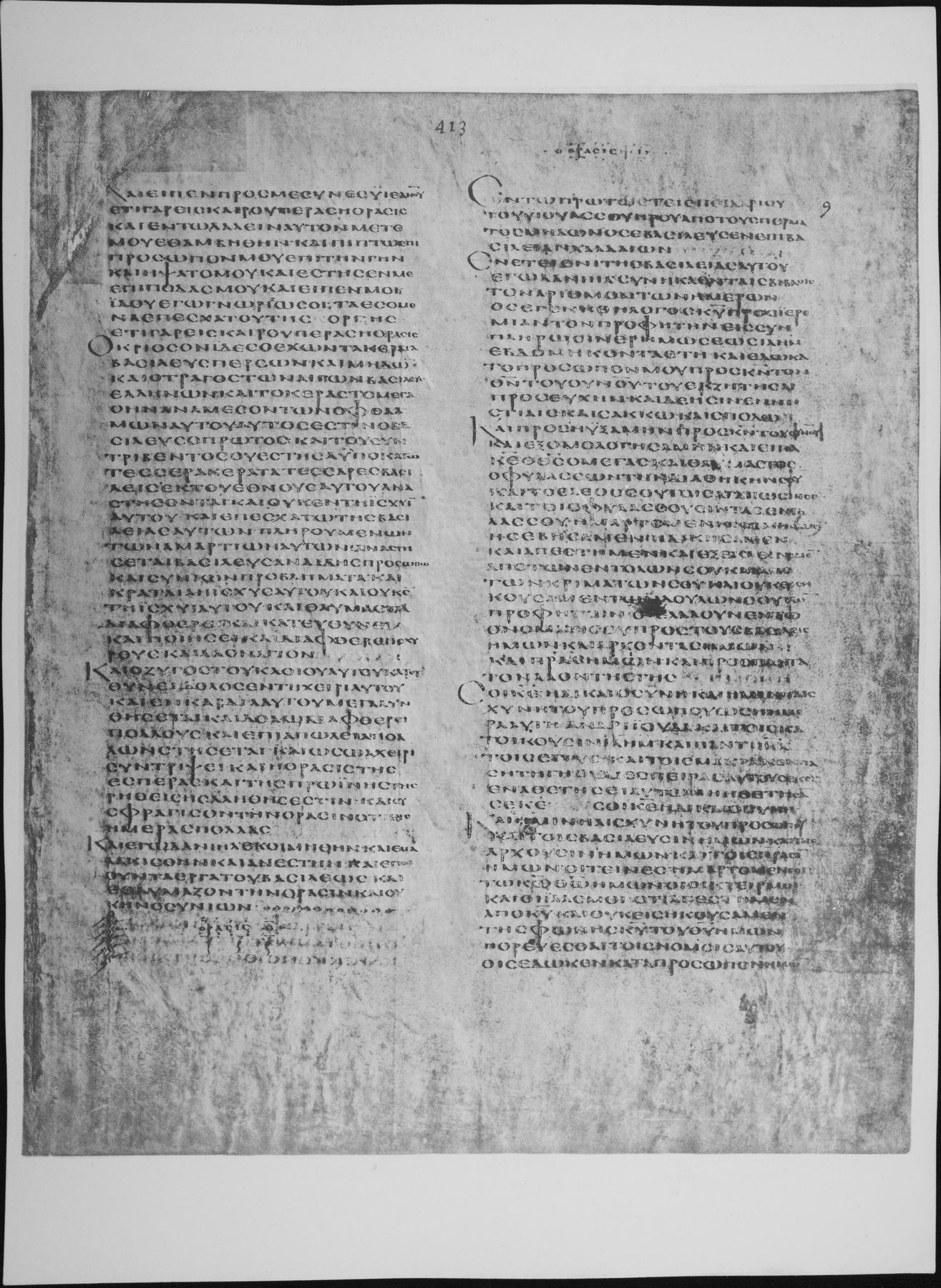
Daniel (Theodotion) 8:17 is on fol. 412v (full-size facsimile of 1879-83, Internet Archive codex-alexandrinus leaf 849). The 1936 reduced facsimile prints beneath this page: Dan. vii. 28-viii. 17. Checked on the plate: the page begins at the start of Daniel (Theodotion) 7:28 (first words read: ΕΓΩ ΔΑΝΙΗΛ ΕΠΙ ΠΟΛΥ ΟΙ ΔΙΑΛΟΓΙΣΜΟΙ ΜΟΥ ΣΥΝΕΤΑΡΑΣΣΟΝ ΜΕ). Daniel (Theodotion) 8:17-24 is on fol. 413r (full-size facsimile of 1879-83, Internet Archive codex-alexandrinus leaf 850). The 1936 reduced facsimile prints beneath this page: Dan. viii. 17-ix. 10. Checked on the plate: the page begins inside Daniel (Theodotion) 8:17 (first words read: ΚΑΙ ΕΙΠΕΝ ΠΡΟΣ ΜΕ ΣΥΝΕΣ ΥΙΕ ΑΝΟΥ ΕΤΙ ΓΑΡ ΕΙΣ ΚΑΙΡΟΥ ΠΕΡΑΣ Η ΟΡΑΣΙΣ).
17καὶ ἦλθεν καὶ ἔστη ἐχόμενος τῆς στάσεώς μου· καὶ ἐν τῷ ἐλθεῖν αὐτὸν ἐθαμβήθην, καὶ πίπτω ἐπὶ πρόσωπόν μου· καὶ εἶπεν πρὸς μέ Υἱὲ ἀνθρώπου, ἔτι γὰρ εἰς καιροῦ πέρας ἡ ὅρασις. 18καὶ ἐν τῷ λαλεῖν αὐτὸν μετ᾽ ἐμοῦ πίπτω ἐπὶ πρόσωπόν μου ἐπὶ τὴν γῆν, καὶ ἥψατό μου καὶ ἔστησέν με ἐπὶ πόδας, 19καὶ εἶπεν Ἰδοὺ ἐγὼ γνωρίζω σοι τὰ ἐσόμενα ἐπ᾽ ἐσχάτῳ τῆς ὀργῆς· ἔτι γὰρ εἰς καιροῦ πέρας ἡ ὅρασις. 20ὁ κριὸς ὃν εἶδες, ὁ ἔχων τὰ κέρατα, βασιλεὺς Περσῶν καὶ Μήδων. 21καὶ ὁ τράγος τῶν αἰγῶν βασιλεὺς Ἑλλήνων· καὶ τὸ κέρας τὸ μέγα ὃ ἦν ἀνὰ μέσον τῶν ὀφθαλμῶν αὐτοῦ, αὐτός ἐστιν ὁ βασιλεὺς ὁ πρῶτος. 22καὶ τοῦ συντριβέντος οὗ ἔστησαν τέσσερα ὑποκάτω κέρατα, τέσσαρες βασιλεῖς ἐκ τοῦ ἔθνους αὐτοῦ ἀναστήσονται, καὶ οὐκ ἐν τῇ ἰσχύι αὐτῶν. 23καὶ ἐπ᾽ ἐσχάτων τῆς βασιλείας αὐτῶν, πληρουμένων τῶν ἁμαρτιῶν αὐτῶν, ἀναστήσεται βασιλεὺς ἀναιδὴς προσώπῳ καὶ συνίων προβλήματα. 24καὶ κραταιὰ ἡ ἰσχὺς αὐτοῦ, καὶ θαυμαστὰ διαφθερεῖ, καὶ κατευθυνεῖ καὶ ποιήσει, καὶ διαφθερεῖ ἰσχυροὺς καὶ λαὸν ἅγιον.
17And he came and stood near where I stood: and when he came, I was struck with awe, and fell upon my face: but he said to me, Understand, son of man: for yet the vision is for an appointed time. 18And while he spoke with me, I fell upon my face to the earth: and he touched me, and set me on my feet. 19And he said, Behold, I make thee know the things that shall come to pass at the end of the wrath: for the vision is yet for an appointed time. 20The ram which thou sawest that had the horns is the king of the Medes and Persians. 21The he-goat is the king of the Greeks: and the great horn which was between his eyes, he is the first king. 22And as for the one that was broken, in whose place there stood up four horns, four kings shall arise out of his nation, but not in their own strength. 23And at the latter time of their kingdom, when their sins are coming to the full, there shall arise a king bold in countenance, and understanding riddles. 24And his power shall be great, and he shall destroy wonderfully, and prosper, and practise, and shall destroy mighty men, and the holy people.
Where on the image
Daniel (Theodotion) 8:25-27 is on fol. 413r (full-size facsimile of 1879-83, Internet Archive codex-alexandrinus leaf 850). The 1936 reduced facsimile prints beneath this page: Dan. viii. 17-ix. 10. Checked on the plate: the page begins inside Daniel (Theodotion) 8:17 (first words read: ΚΑΙ ΕΙΠΕΝ ΠΡΟΣ ΜΕ ΣΥΝΕΣ ΥΙΕ ΑΝΟΥ ΕΤΙ ΓΑΡ ΕΙΣ ΚΑΙΡΟΥ ΠΕΡΑΣ Η ΟΡΑΣΙΣ).
25καὶ ὁ ζυγὸς τοῦ κλοιοῦ αὐτοῦ κατευθυνεῖ· δόλος ἐν τῇ χειρὶ αὐτοῦ, καὶ ἐν καρδίᾳ αὐτοῦ μεγαλυνθήσεται, καὶ δόλῳ διαφθερεῖ πολλούς, καὶ ἐπὶ ἀπωλείας πολλῶν στήσεται, καὶ ὡς ὠὰ χειρὶ συντρίψει. 26καὶ ἡ ὅρασις τῆς ἑσπέρας καὶ τῆς πρωίας τῆς ῥηθείσης ἀληθῶς ἐστιν· καὶ σὺ σφράγισον τὴν ὅρασιν, ὅτι εἰς ἡμέρας πολλάς. 27καὶ ἐγὼ Δανιὴλ ἐκοιμήθην καὶ ἐμαλακίσθην· καὶ ἀνέστην καὶ ἐποίουν τὰ ἔργα τοῦ βασιλέως, καὶ ἐθαύμαζον τὴν ὅρασιν, καὶ οὐκ ἦν ὁ συνίων.
25And the yoke of his chain shall prosper: there is craft in his hand; and he shall magnify himself in his heart, and by craft shall destroy many, and he shall stand up for the destruction of many, and shall crush them as eggs in his hand. 26And the vision of the evening and morning that was mentioned is true: and do thou seal the vision; for it is for many days. 27And I Daniel fell asleep, and was sick: then I arose, and did the king's business; and I wondered at the vision, and there was none that understood it.
Cite
Sources
- Source: Codex Alexandrinus (British Library Royal MS 1 D. VI) via the British Museum photographic facsimiles of 1879-83 and 1936 (Internet Archive) + Swete's Septuagint + Brenton's English (holding institution)
- Critical edition: H. B. Swete, The Old Testament in Greek according to the Septuagint (1909)
← previous · → next · v cycle view · l back to library