Exodus, Chapter 13 (Codex Alexandrinus)
Introduction
Exodus 13 in the Greek Old Testament (the Septuagint) as written in Codex Alexandrinus, a Greek Bible copied in the fifth century, probably in Egypt, and now in the British Library (Royal MS 1 D. V, the first of its four volumes). It is one of the three great early codices of the whole Greek Bible, with Codex Vaticanus and Codex Sinaiticus, and for Genesis 1:1-46:28, which Codex Vaticanus has lost, it is the oldest surviving complete Greek text (older papyri such as the Berlin Genesis papyrus and Chester Beatty 961 survive only in part).
This entry meets the strict three-criteria standard of the Theosis Library:
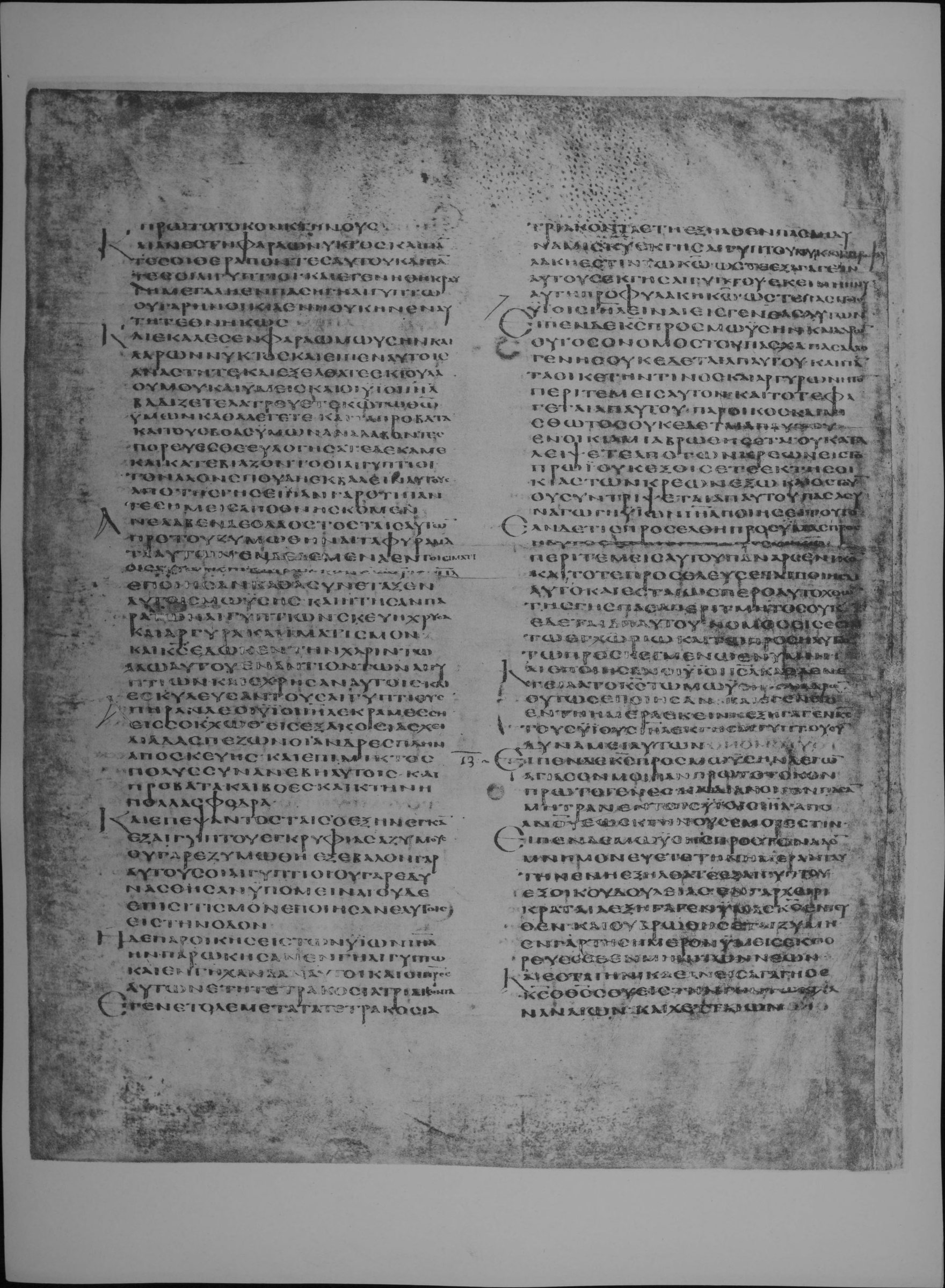
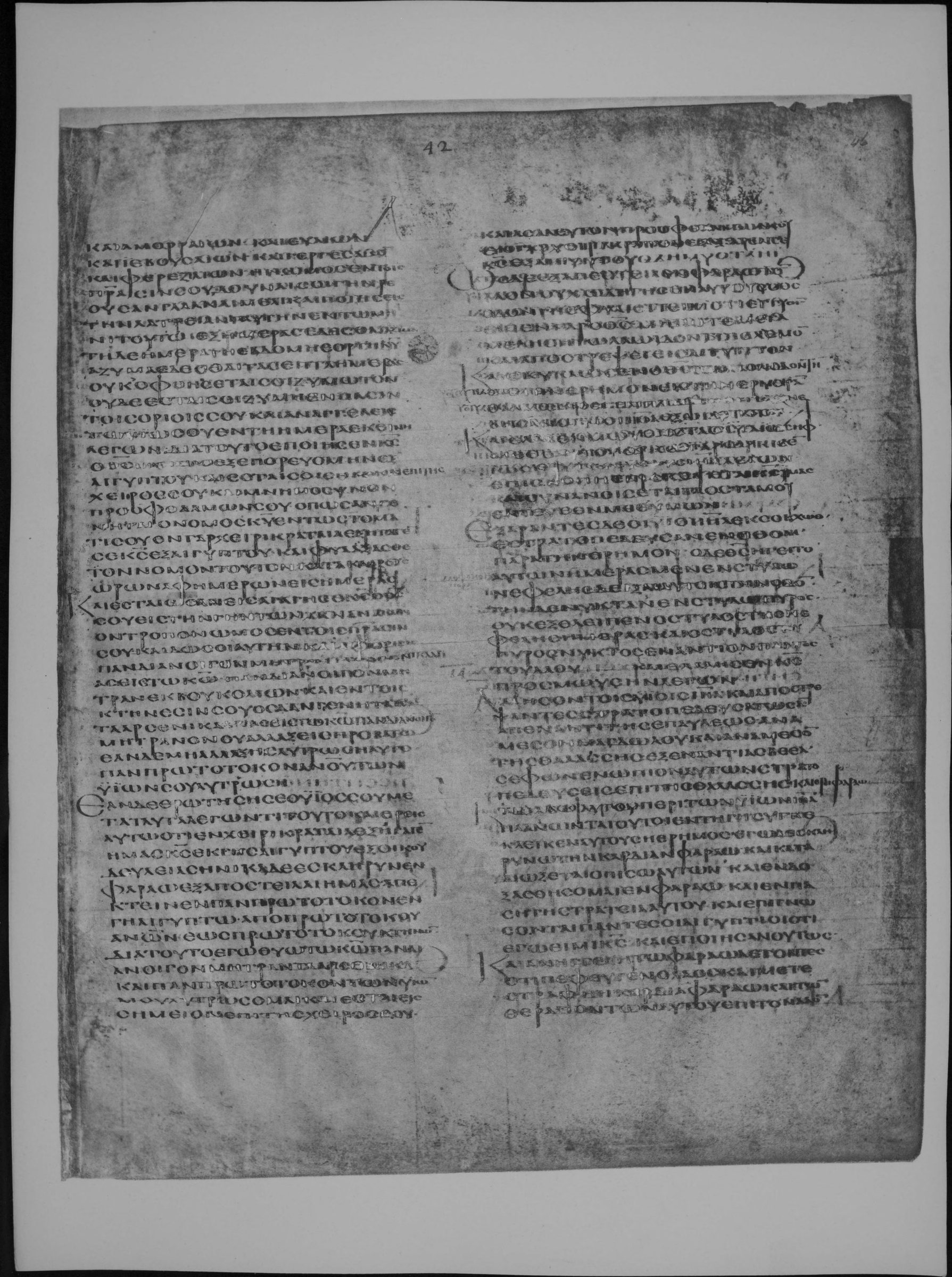
- Manuscript scan: the pages of Codex Alexandrinus carrying this chapter (fol. 41v, fol. 42r), from the full-size photographic (autotype) facsimile published by the British Museum in 1879-1883, as digitised on the Internet Archive. The verse range of every page comes from the reduced photographic facsimile of 1915, which prints it beneath each plate, and the opening words of every page were read on the plate to confirm the page and the verse it begins with. Each section links to the page or pages that hold its verses. Folio numbers are those written at the head of each leaf and visible on the plates.
- Original text: Swete's edition, which here prints the text of Codex Vaticanus (Vat. gr. 1209), the base of his edition, and gives the readings of Alexandrinus only in his apparatus. The Greek column is therefore Vaticanus' text; where Alexandrinus differs, the plate shows what Alexandrinus reads.
- English translation: Sir Lancelot C. L. Brenton, The Septuagint Version of the Old Testament (1844; 1851 edition), a translation of the Greek, public domain, from the eBible.org text.
How was this verified? (Provenance)
Where on the image
Exodus 13:1-5 is on fol. 41v (full-size facsimile of 1879-83, Internet Archive codex-alexandrinus leaf 103). The 1915 reduced facsimile prints beneath this page: Exod. xii. 29-xiii. 5. Checked on the plate: the page begins inside Exodus 12:29 (first words read: ΚΑΙ ΠΡΩΤΟΤΟΚΟΥ ΚΤΗΝΟΥΣ ΚΑΙ ΑΝΕΣΤΗ ΦΑΡΑΩ ΝΥΚΤΟΣ ΚΑΙ ΠΑΝΤΕΣ ΟΙ ΘΕΡΑΠΟΝΤΕΣ). Exodus 13:5-8 is on fol. 42r (full-size facsimile of 1879-83, Internet Archive codex-alexandrinus leaf 104). The 1915 reduced facsimile prints beneath this page: Exod. xiii. 5-xiv. 5. Checked on the plate: the page begins inside Exodus 13:5 (first words read: ΚΑΙ ΑΜΟΡΡΑΙΩΝ ΚΑΙ ΕΥΑΙΩΝ ΚΑΙ ΙΕΒΟΥΣΑΙΩΝ ΚΑΙ ΓΕΡΓΕΣΑΙΩΝ ΚΑΙ ΦΕΡΕΖΑΙΩΝ).
1Εἶπεν δὲ Κύριος πρὸς Μωυσῆν λέγων 2Ἁγίασόν μοι πᾶν πρωτότοκον πρωτογενὲς διανοῖγον πᾶσαν μήτραν ἐν τοῖς υἱοῖς Ἰσραὴλ ἀπὸ ἀνθρώπου ἕως κτήνους· ἐμοί ἐστιν. 3Εἶπεν δὲ Μωυσῆς πρὸς τὸν λαόν Μνημονεύετε τὴν ἡμέραν ταύτην ἐν ᾗ ἐξήλθατε ἐκ γῆς Αἰγύπτου, ἐξ οἴκου δουλίας· ἐν γὰρ χειρὶ κραταιᾷ ἐξήγαγεν ὑμᾶς Κύριος ἐντεῦθεν· καὶ οὐ βρωθήσεται ζύμη. 4ἐν γὰρ τῇ σήμερον ὑμεῖς ἐκπορεύεσθε ἐν μηνὶ τῶν νέων. 5καὶ ἔσται ἡνίκα ἐὰν εἰσαγάγῃ σε Κύριος ὁ θεός σου εἰς τὴν γῆν τῶν Χαναναίων καὶ Χετταίων καὶ Εὑαίων καὶ Γεργεσαίων καὶ Ἀμορραίων καὶ Φερεζαίων καὶ Ἰεβουσαίων, ἣν ὤμοσεν τοῖς πατράσιν σου δοῦναί σοι, γῆν ῥέουσαν γάλα καὶ μέλι, καὶ ποιήσεις τὴν λατρίαν ταύτην ἐν τῷ μηνὶ τούτῳ. 6ἓξ ἡμέρας ἔδεσθε ἄζυμα, τῇ δὲ ἡμέρᾳ τῇ ἑβδόμῃ ἑορτὴ Κυρίου· 7ἄζυμα ἔδεσθε ἑπτὰ ἡμέρας, οὐκ ὀφθήσεταί σοι ζυμωτὸν οὐδὲ ἔσται σοι ζύμη ἐν πᾶσιν τοῖς ὁρίοις σου. 8καὶ ἀναγγελεῖς τῷ υἱῷ σου ἐν τῇ ἡμέρᾳ ἐκείνῃ λέγων Διὰ τοῦτο ἐποίησεν Κύριος ὁ θεός μοι, ὡς ἐξεπορευόμην ἐξ Αἰγύπτου.
1And the Lord spoke to Moses, saying, 2Sanctify to me every first-born, first produced, opening every womb among the children of Israel both of man and beast: it is mine. 3And Moses said to the people, Remember this day, in which ye came forth out of the land of Egypt, out of the house of bondage, for with a strong hand the Lord brought you forth thence; and leaven shall not be eaten. 4For on this day ye go forth in the month of new corn. 5And it shall come to pass when the Lord thy God shall have brought thee into the land of the Chananites, and the Chettites, and Amorites, and Evites, and Jebusites, and Gergesites, and Pherezites, which he sware to thy fathers to give thee, a land flowing with milk and honey, that thou shalt perform this service in this month. 6Six days ye shall eat unleavened bread, and on the seventh day is a feast to the Lord. 7Seven days shall ye eat unleavened bread; nothing leavened shall be seen with thee, neither shalt thou have leaven in all thy borders. 8And thou shalt tell thy son in that day, saying, Therefore the Lord dealt thus with me, as I was going out of Egypt.
Where on the image
Exodus 13:9-16 is on fol. 42r (full-size facsimile of 1879-83, Internet Archive codex-alexandrinus leaf 104). The 1915 reduced facsimile prints beneath this page: Exod. xiii. 5-xiv. 5. Checked on the plate: the page begins inside Exodus 13:5 (first words read: ΚΑΙ ΑΜΟΡΡΑΙΩΝ ΚΑΙ ΕΥΑΙΩΝ ΚΑΙ ΙΕΒΟΥΣΑΙΩΝ ΚΑΙ ΓΕΡΓΕΣΑΙΩΝ ΚΑΙ ΦΕΡΕΖΑΙΩΝ).
9καὶ ἔσται σοι σημεῖον ἐπὶ τῆς χειρός σου καὶ μνημόσυνον πρὸ ὀφθαλμῶν σου, ὅπως ἂν γένηται ὁ νόμος Κυρίου ἐν τῷ στόματί σου· ἐν γὰρ χειρὶ κραταιᾷ ἐξήγαγέν σε Κύριος ὁ θεὸς ἐξ Αἰγύπτου. 10καὶ φυλάξεσθε τὸν νόμον τοῦτον ἀφ᾽ ἡμερῶν εἰς ἡμέρας. 11Καὶ ἔσται ὡς ἂν εἰσαγάγῃ σε Κύριος ὁ θεός σου εἰς τὴν γῆν τῶν Χαναναίων, ὃν τρόπον ὤμοσεν τοῖς πατράσιν σου, καὶ δώσει σοι αὐτήν, 12καὶ ἀφελεῖς πᾶν διανοῖγον μήτραν, τὰ ἀρσενικά, τῷ κυρίῳ· πᾶν διανοῖγον μήτραν ἐκ τῶν βουκολίων ἢ ἐν τοῖς κτήνεσίν σου ὅσα ἐὰν γένηταί σοι, τὰ ἀρσενικὰ ἁγιάσεις τῷ κυρίῳ. 13πᾶν διανοῖγον μήτραν ὄνου ἀλλάξεις προβάτῳ· ἐὰν δὲ μὴ ἀλλάξῃς, λυτρώσῃ αὐτό· πᾶν πρωτότοκον ἀνθρώπου τῶν υἱῶν σου λυτρώσῃ. 14ἐὰν δὲ ἐρωτήσῃ σε ὁ υἱός σου μετὰ ταῦτα λέγων Τί τοῦτο; καὶ ἐρεῖς αὐτῷ ὅτι Ἐν χειρὶ κραταιᾷ ἐξήγαγεν Κύριος ἡμᾶς ἐκ γῆς Αἰγύπτου, ἐξ οἴκου δουλίας· 15ἡνίκα δὲ ἐσκλήρυνεν Φαραὼ ἐξαποστεῖλαι ἡμᾶς, ἀπέκτεινεν πᾶν πρωτότοκον ἐν γῇ Αἰγύπτῳ ἀπὸ πρωτοτόκων ἀνθρώπων ἕως πρωτοτόκων κτηνῶν· διὰ τοῦτο ἐγὼ θύω πᾶν πρωτότοκον τῷ κυρίῳ, πᾶν διανοῖγον μήτραν, τὰ ἀρσενικὰ, καὶ πᾶν πρωτότοκον τῶν υἱῶν μου λυτρώσομαι. 16καὶ ἔσται εἰς σημεῖον ἐπὶ τῆς χειρός σου, καὶ ἀσάλευτον πρὸ ὀφθαλμῶν σου· ἐν γὰρ χειρὶ κραταιᾷ ἐξήγαγέν σε Κύριος ἐξ Αἰγύπτου.
9And it shall be to thee a sign upon thy hand and a memorial before thine eyes, that the law of the Lord may be in thy mouth, for with a strong hand the Lord God brought thee out of Egypt. 10And preserve ye this law according to the times of the seasons, from year to year. 11And it shall come to pass when the Lord thy God shall bring thee into the land of the Chananites, as he sware to thy fathers, and shall give it thee, 12that thou shalt set apart every offspring opening the womb, the males to the Lord, every one that opens the womb out of the herds or among thy cattle, as many as thou shalt have: thou shalt sanctify the males to the Lord. 13Every offspring opening the womb of the ass thou shalt change for a sheep; and if thou wilt not change it, thou shalt redeem it: every first-born of man of thy sons shalt thou redeem. 14And if thy son should ask thee hereafter, saying, What is this? then thou shalt say to him, With a strong hand the Lord brought us out of Egypt, out of the house of bondage. 15And when Pharao hardened his heart so as not to send us away, he slew every first-born in the land of Egypt, both the first-born of man and the first-born of beast; therefore do I sacrifice every offspring that opens the womb, the males to the Lord, and every first-born of my sons I will redeem. 16And it shall be for a sign upon thy hand, and immovable before thine eyes, for with a strong hand the Lord brought thee out of Egypt.
Where on the image
Exodus 13:17-22 is on fol. 42r (full-size facsimile of 1879-83, Internet Archive codex-alexandrinus leaf 104). The 1915 reduced facsimile prints beneath this page: Exod. xiii. 5-xiv. 5. Checked on the plate: the page begins inside Exodus 13:5 (first words read: ΚΑΙ ΑΜΟΡΡΑΙΩΝ ΚΑΙ ΕΥΑΙΩΝ ΚΑΙ ΙΕΒΟΥΣΑΙΩΝ ΚΑΙ ΓΕΡΓΕΣΑΙΩΝ ΚΑΙ ΦΕΡΕΖΑΙΩΝ).
17Ὡς δὲ ἐξαπέστειλεν Φαραὼ τὸν λαόν, οὐχ ὡδήγησεν αὐτοὺς ὁ θεὸς ὁδὸν γῆς Φυλιστιείμ, ὅτι ἐγγὺς ἦν· εἶπεν γὰρ ὁ θεός Μή ποτε μεταμελήσῃ τῷ λαῷ ἰδόντι πόλεμον, καὶ ἀποστρέψῃ εἰς Αἴγυπτον. 18καὶ ἐκύκλωσεν ὁ θεὸς τὸν λαὸν ὁδὸν τὴν εἰς τὴν ἔρημον, εἰς τὴν ἐρυθρὰν θάλασσαν· πέμπτῃ δὲ γενεᾷ ἀνέβησαν οἱ υἱοὶ Ἰσραὴλ ἐκ γῆς Αἰγύπτου. 19Καὶ ἔλαβεν Μωυσῆς τὰ ὀστᾶ Ἰωσὴφ μεθ᾽ ἑαυτοῦ· ὅρκῳ γὰρ ὥρκισεν τοὺς υἱοὺς Ἰσραὴλ λέγων Ἐπισκοπῇ ἐπισκέψεται ὑμᾶς Κύριος, καὶ συνανοίσετέ μου τὰ ὀστᾶ ἐντεῦθεν μεθ᾽ ὑμῶν. 20Ἐξάραντες δὲ οἱ υἱοὶ Ἰσραὴλ ἐκ Σοκχὼθ ἐστρατοπέδευσαν ἐν Ὀθὸμ παρὰ τὴν ἔρημον. 21ὁ δὲ θεὸς ἡγεῖτο αὐτῶν, ἡμέρας μὲν ἐν στύλῳ νεφέλης δεῖξαι αὐτοῖς τὴν ὁδόν, τὴν δὲ νύκτα ἐν στύλῳ πυρός· 22οὐκ ἐξέλιπεν δὲ ὁ στύλος τῆς νεφέλης ἡμέρας καὶ ὁ στύλος τοῦ πυρὸς νυκτὸς ἐναντίον τοῦ λαοῦ παντός.
17And when Pharao sent forth the people, God led them not by the way of the land of the Phylistines, because it was near; for God said, Lest at any time the people repent when they see war, and return to Egypt. 18And God led the people round by the way to the wilderness, to the Red Sea: and in the fifth generation the children of Israel went up out of the land of Egypt. 19And Moses took the bones of Joseph with him, for he had solemnly adjured the children of Israel, saying, God will surely visit you, and ye shall carry up my bones hence with you. 20And the children of Israel departed from Socchoth, and encamped in Othom by the wilderness. 21And God led them, in the day by a pillar of cloud, to show them the way, and in the night by a pillar of fire. 22And the pillar of cloud failed not by day, nor the pillar of fire by night, before all the people.
Cite
Sources
- Source: Codex Alexandrinus (British Library Royal MS 1 D. V) via the British Museum photographic facsimiles of 1879-83 and 1915 (Internet Archive) + Swete's Septuagint + Brenton's English (holding institution)
- Critical edition: H. B. Swete, The Old Testament in Greek according to the Septuagint (1909)
← previous · → next · v cycle view · l back to library