Exodus, Chapter 32 (Codex Alexandrinus)
Introduction
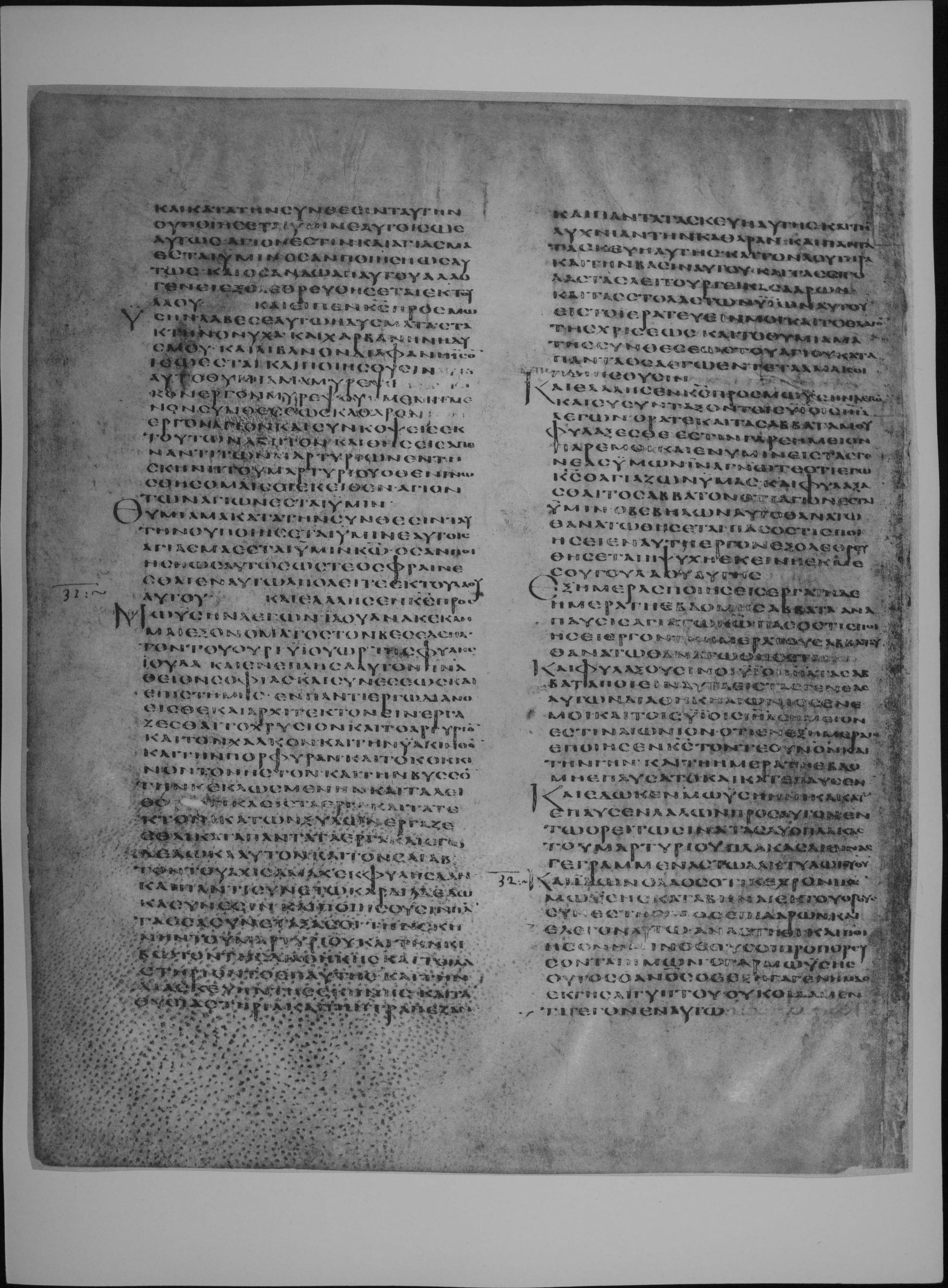
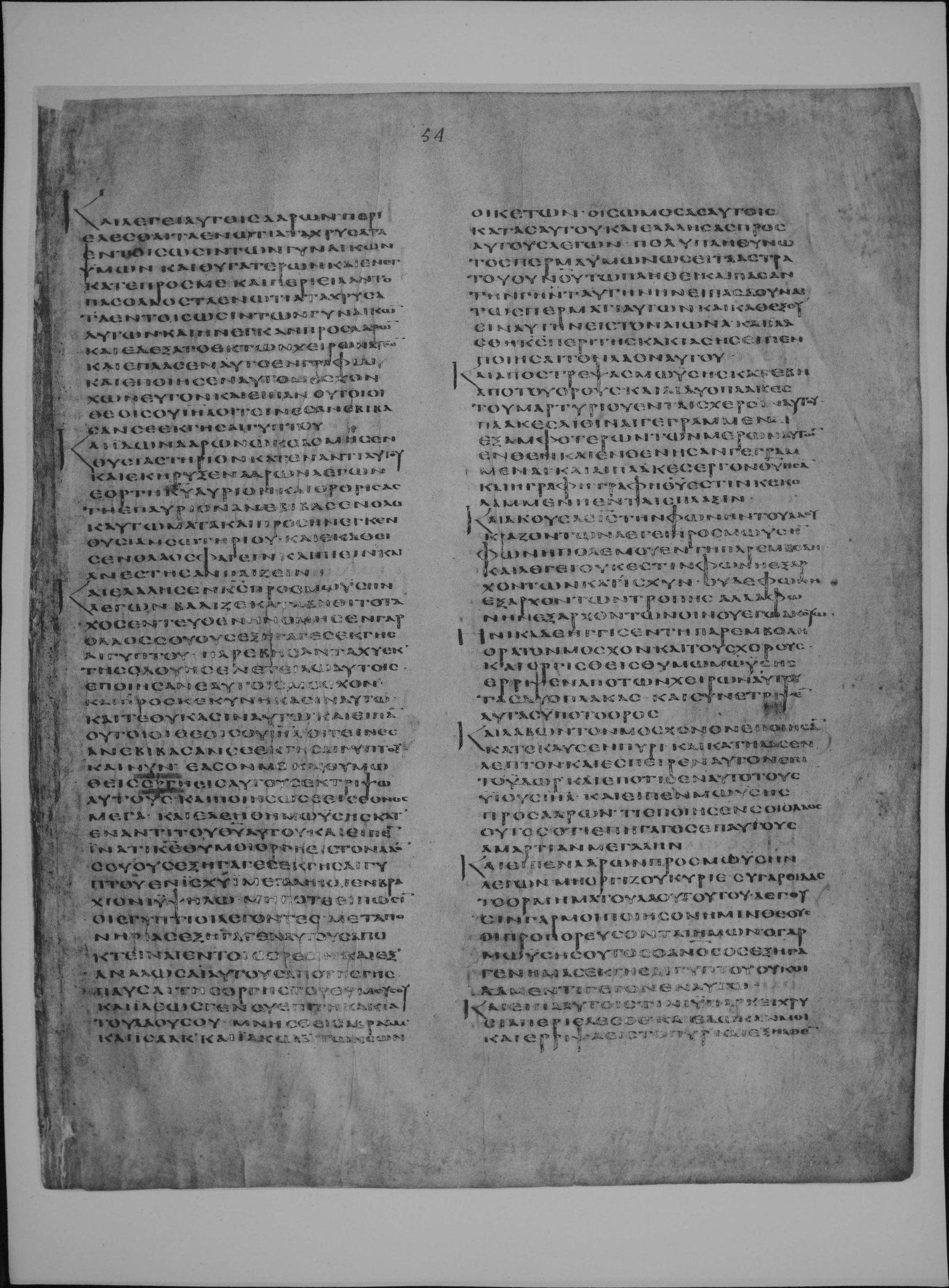
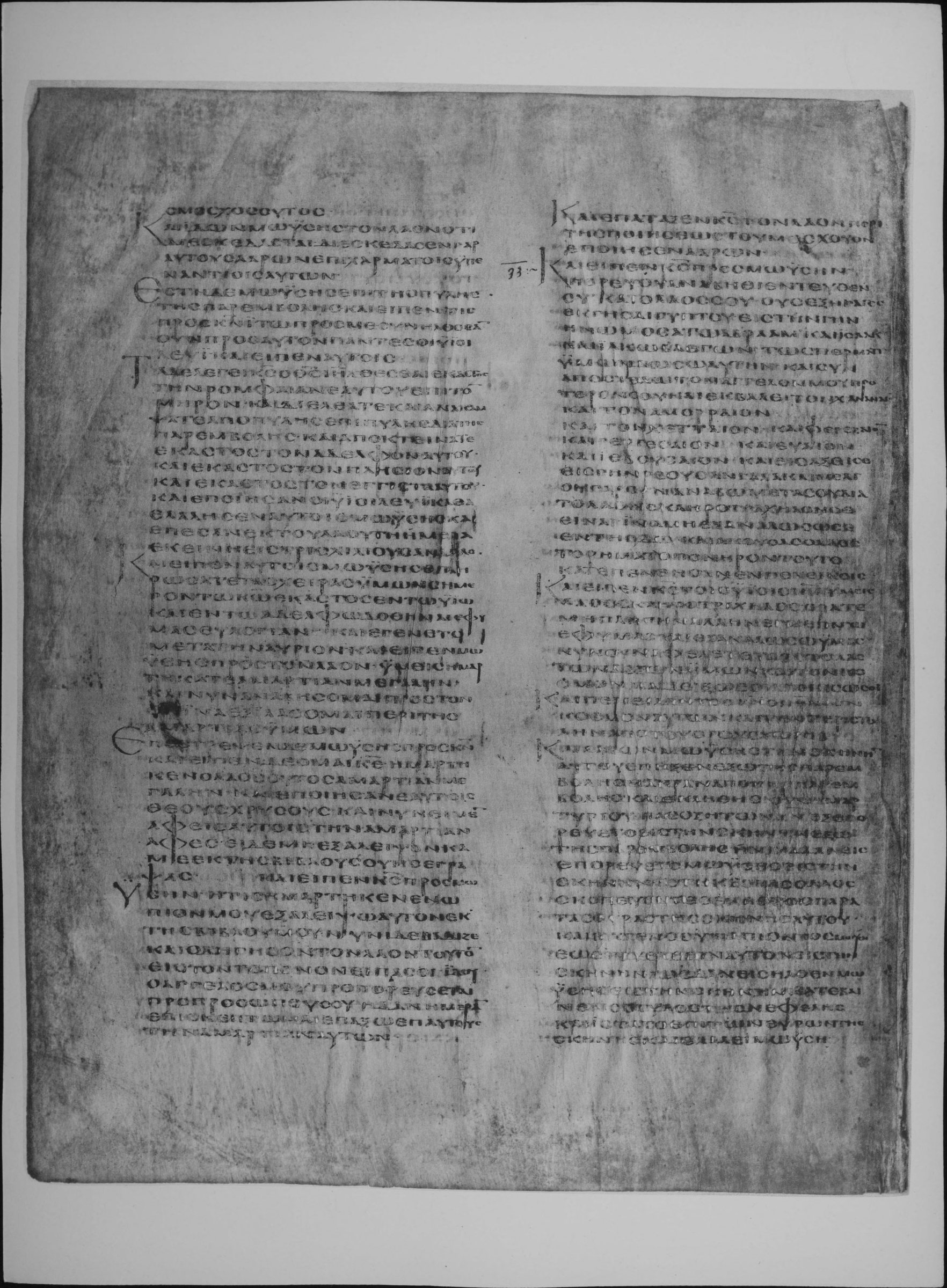
Exodus 32 in the Greek Old Testament (the Septuagint) as written in Codex Alexandrinus, a Greek Bible copied in the fifth century, probably in Egypt, and now in the British Library (Royal MS 1 D. V, the first of its four volumes). It is one of the three great early codices of the whole Greek Bible, with Codex Vaticanus and Codex Sinaiticus, and for Genesis 1:1-46:28, which Codex Vaticanus has lost, it is the oldest surviving complete Greek text (older papyri such as the Berlin Genesis papyrus and Chester Beatty 961 survive only in part).
Numbering: Swete's Greek and Brenton's English number or divide some verses of this chapter differently (Swete 32:8-9 = Brenton 32:8). Each column keeps its own verse numbers, and sections are cut only where the two texts agree, so each section holds the same passage in both languages.
This entry meets the strict three-criteria standard of the Theosis Library:
- Manuscript scan: the pages of Codex Alexandrinus carrying this chapter (fol. 53v, fol. 54r, fol. 54v), from the full-size photographic (autotype) facsimile published by the British Museum in 1879-1883, as digitised on the Internet Archive. The verse range of every page comes from the reduced photographic facsimile of 1915, which prints it beneath each plate, and the opening words of every page were read on the plate to confirm the page and the verse it begins with. Each section links to the page or pages that hold its verses. Folio numbers are those written at the head of each leaf and visible on the plates.
- Original text: Swete's edition, which here prints the text of Codex Vaticanus (Vat. gr. 1209), the base of his edition, and gives the readings of Alexandrinus only in his apparatus. The Greek column is therefore Vaticanus' text; where Alexandrinus differs, the plate shows what Alexandrinus reads.
- English translation: Sir Lancelot C. L. Brenton, The Septuagint Version of the Old Testament (1844; 1851 edition), a translation of the Greek, public domain, from the eBible.org text.
How was this verified? (Provenance)
Where on the image
Exodus 32:1 is on fol. 53v (full-size facsimile of 1879-83, Internet Archive codex-alexandrinus leaf 127). The 1915 reduced facsimile prints beneath this page: Exod. xxx. 32-xxxii. 1. Checked on the plate: the page begins inside Exodus 30:32 (first words read: ΚΑΙ ΚΑΤΑ ΤΗΝ ΣΥΝΘΕΣΙΝ ΤΑΥΤΗΝ ΟΥ ΠΟΙΗΘΗΣΕΤΑΙ ΥΜΙΝ ΕΑΥΤΟΙΣ). Exodus 32:2-9 is on fol. 54r (full-size facsimile of 1879-83, Internet Archive codex-alexandrinus leaf 128). The 1915 reduced facsimile prints beneath this page: Exod. xxxii. 2-24. Checked on the plate: the page begins at the start of Exodus 32:2 (first words read: ΚΑΙ ΛΕΓΕΙ ΑΥΤΟΙΣ ΑΑΡΩΝ ΠΕΡΙΕΛΕΣΘΑΙ ΤΑ ΕΝΩΤΙΑ ΤΑ ΧΡΥΣΑ).
1Καὶ ἰδὼν ὁ λαὸς ὅτι κεχρόνικεν Μωυσῆς καταβῆναι ἐκ τοῦ ὄρους, συνέστη ὁ λαὸς ἐπὶ Ἀαρὼν καὶ λέγουσιν αὐτῷ Ἀνάστηθι καὶ ποίησον ἡμῖν θεοὺς οἳ προπορεύσονται ἡμῶν· ὁ γὰρ Μωσῆς οὗτος ὁ ἄνθρωπος ὃς ἐξήγαγεν ἡμᾶς ἐξ Αἰγύπτου, οὐκ οἴδαμεν τί γέγονεν αὐτῷ. 2καὶ λέγει αὐτοῖς Ἀαρών Περιέλεσθε τὰ ἐνώτια τὰ χρυσᾶ τὰ ἐν τοῖς ὠσὶν τῶν γυναικῶν ὑμῶν καὶ θυγατέρων, καὶ ἐνέγκατε πρὸς μέ. 3καὶ περιείλαντο πᾶς ὁ λαὸς τὰ ἐνώτια τὰ χρυσᾶ τὰ ἐν τοῖς ὠσὶν αὐτῶν, καὶ ἤνεγκαν πρὸς Ἀαρών. 4καὶ ἐδέξατο ἐκ τῶν χειρῶν αὐτῶν καὶ ἔπλασεν αὐτὰ ἐν τῇ γραφίδι, καὶ ἐποίησεν αὐτὰ μόσχον χωνευτὸν καὶ εἶπεν Οὗτοι οἱ θεοί σου, Ἰσραήλ, οἵτινες ἀνεβίβασάν σε ἐκ γῆς Αἰγύπτου. 5καὶ ἰδὼν Ἀαρὼν ᾠκοδόμησεν θυσιαστήριον κατέναντι αὐτοῦ· καὶ ἐκήρυξεν Ἀαρὼν λέγων Ἑορτὴ τοῦ κυρίου αὔριον. 6καὶ ὀρθρίσας τῇ ἐπαύριον ἀνεβίβασεν ὁλοκαυτώματα, καὶ προσήνεγκεν θυσίαν σωτηρίου· καὶ ἐκάθισεν ὁ λαὸς φαγεῖν καὶ πιεῖν, καὶ ἀνέστησαν παίζειν. 7Καὶ ἐλάλησεν Κύριος πρὸς Μωυσῆν λέγων Βάδιζε τὸ τάχος ἐντεῦθεν, κατάβηθι· ἠνόμησεν γὰρ ὁ λαός σου ὃν ἐξήγαγες ἐκ γῆς Αἰγύπτου. 8παρέβησαν ταχὺ ἐκ τῆς ὁδοῦ ἧς ἐνετείλω αὐτοῖς· ἐποίησαν ἑαυτοῖς μόσχον, καὶ προσκεκυνήκασιν αὐτῷ καὶ εἶπαν 9Οὗτοι οἱ θεοί σου, Ἰσραήλ, οἵτινες ἀνεβίβασάν σε ἐκ γῆς Αἰγύπτου.
1And when the people saw that Moses delayed to come down from the mountain, the people combined against Aaron, and said to him, Arise and make us gods who shall go before us; for this Moses, the man who brought us forth out of the land of Egypt—we do not know what is become of him. 2And Aaron says to them, Take off the golden ear-rings which are in the ears of your wives and daughters, and bring them to me. 3And all the people took off the golden ear-rings that were in their ears, and brought them to Aaron. 4And he received them at their hands, and formed them with a graving tool; and he made them a molten calf, and said, These are thy gods, O Israel, which have brought thee up out of the land of Egypt. 5And Aaron having seen it built an altar before it, and Aaron made proclamation saying, To-morrow is a feast of the Lord. 6And having risen early on the morrow, he offered whole burnt-offerings, and offered a peace-offering; and the people sat down to eat and drink, and rose up to play. 7And the Lord spoke to Moses, saying, Go quickly, descend hence, for thy people whom thou broughtest out of the land of Egypt have transgressed; 8they have quickly gone out of the way which thou commandedst; they have made for themselves a calf, and worshipped it, and sacrificed to it, and said, These are thy gods, O Israel, who brought thee up out of the land of Egypt.
Where on the image
Exodus 32:10-17 is on fol. 54r (full-size facsimile of 1879-83, Internet Archive codex-alexandrinus leaf 128). The 1915 reduced facsimile prints beneath this page: Exod. xxxii. 2-24. Checked on the plate: the page begins at the start of Exodus 32:2 (first words read: ΚΑΙ ΛΕΓΕΙ ΑΥΤΟΙΣ ΑΑΡΩΝ ΠΕΡΙΕΛΕΣΘΑΙ ΤΑ ΕΝΩΤΙΑ ΤΑ ΧΡΥΣΑ).
10καὶ νῦν ἔασόν με καὶ θυμωθεὶς ὀργῇ εἰς αὐτοὺς ἐκτρίψω αὐτούς, καὶ ποιήσω σε εἰς ἔθνος μέγα. 11καὶ ἐδεήθη Μωυσῆς ἔναντι Κυρίου τοῦ θεοῦ καὶ εἶπεν Ἵνα τί, Κύριε, θυμοῖ ὀργῇ εἰς τὸν λαόν σου, οὓς ἐξήγαγες ἐκ γῆς Αἰγύπτου ἐν ἰσχύι μεγάλῃ καὶ ἐν τῷ βραχίονί σου τῷ ὑψηλῷ; 12μή ποτε εἴπωσιν οἱ Αἰγύπτιοι λέγοντες Μετὰ πονηρίας ἐξήγαγεν αὐτοὺς ἀποκτεῖναι ἐν τοῖς ὄρεσιν καὶ ἐξαναλῶσαι αὐτοὺς ἀπὸ τῆς γῆς. παῦσαι τῆς ὀργῆς τοῦ θυμοῦ σου, καὶ ἵλεως γενοῦ ἐπὶ τῇ κακίᾳ τοῦ λαοῦ σου, 13μνησθεὶς Ἀβραὰμ καὶ Ἰσαὰκ καὶ Ἰακὼβ τῶν σῶν οἰκετῶν, οἷς ὤμοσας κατὰ σεαυτοῦ καὶ ἐλάλησας πρὸς αὐτοὺς λέγων Πολυπληθυνῶ τὸ σπέρμα ὑμῶν ὡσεὶ τὰ ἄστρα τοῦ οὐρανοῦ τῷ πλήθει, καὶ πᾶσαν τὴν γῆν ταύτην ἣν εἶπας δοῦναι αὐτοῖς, καὶ καθέξουσιν αὐτὴν εἰς τὸν αἰῶνα. 14καὶ ἱλάσθη Κύριος περιποιῆσαι τὸν λαὸν αὐτοῦ. 15Καὶ ἀποστρέψας Μωυσῆς κατέβη ἀπὸ τοῦ ὄρους· καὶ αἱ δύο πλάκες τοῦ μαρτυρίου ἐν ταῖς χερσὶν αὐτοῦ, πλάκες λίθιναι, καταγεγραμμέναι ἐξ ἀμφοτέρων τῶν μερῶν αὐτῶν, ἔνθεν καὶ ἔνθεν ἦσαν γεγραμμέναι· 16καὶ αἱ πλάκες ἔργον θεοῦ ἦσαν, καὶ ἡ γραφὴ γραφὴ θεοῦ κεκολαμμένη ἐν ταῖς πλαξίν. 17καὶ ἀκούσας Ἰησοῦς τῆς φωνῆς τοῦ λαοῦ κραζόντων λέγει πρὸς Μωυσῆν Φωνὴ πολέμου ἐν τῇ παρεμβολῇ.
10And now let me alone, and I will be very angry with them and consume them, and I will make thee a great nation. 11And Moses prayed before the Lord God, and said, Wherefore, O Lord, art thou very angry with thy people, whom thou broughtest out of the land of Egypt with great strength, and with thy high arm? 12Take heed lest at any time the Egyptians speak, saying, With evil intent he brought them out to slay them in the mountains, and to consume them from off the earth; cease from thy wrathful anger, and be merciful to the sin of thy people, 13remembering Abraam and Isaac and Jacob thy servants, to whom thou hast sworn by thyself, and hast spoken to them, saying, I will greatly multiply your seed as the stars of heaven for multitude, and all this land which thou spokest of to give to them, so that they shall possess it for ever. 14And the Lord was prevailed upon to preserve his people. 15And Moses turned and went down from the mountain, and the two tables of testimony were in his hands, tables of stone written on both their sides: they were written within and without. 16And the tables were the work of God, and the writing the writing of God written on the tables. 17And Joshua having heard the voice of the people crying, says to Moses, There is a noise of war in the camp.
Where on the image
Exodus 32:18-24 is on fol. 54r (full-size facsimile of 1879-83, Internet Archive codex-alexandrinus leaf 128). The 1915 reduced facsimile prints beneath this page: Exod. xxxii. 2-24. Checked on the plate: the page begins at the start of Exodus 32:2 (first words read: ΚΑΙ ΛΕΓΕΙ ΑΥΤΟΙΣ ΑΑΡΩΝ ΠΕΡΙΕΛΕΣΘΑΙ ΤΑ ΕΝΩΤΙΑ ΤΑ ΧΡΥΣΑ). Exodus 32:24-25 is on fol. 54v (full-size facsimile of 1879-83, Internet Archive codex-alexandrinus leaf 129). The 1915 reduced facsimile prints beneath this page: Exod. xxxii. 24-xxxiii. 9. Checked on the plate: the page begins inside Exodus 32:24 (first words read: ΜΟΣΧΟΣ ΟΥΤΟΣ ΚΑΙ ΙΔΩΝ ΜΩΥΣΗΣ ΤΟΝ ΛΑΟΝ ΟΤΙ ΔΙΕΣΚΕΔΑΣΤΑΙ).
18καὶ λέγει Οὐκ ἔστιν φωνὴ ἐξαρχόντων κατ᾽ ἰσχὺν οὐδὲ φωνὴ ἐξαρχόντων τροπῆς· ἀλλὰ φωνὴν ἐξαρχόντων οἴνου ἐγὼ ἀκούω. 19καὶ ἡνίκα ἤγγιζεν τῇ παρεμβολῇ, ὁρᾷ τὸν μόσχον καὶ τοὺς χορούς· καὶ ὀργισθεὶς θυμῷ Μωυσῆς ἔρριψεν ἀπὸ τῶν χειρῶν αὐτοῦ τὰς δύο πλάκας, καὶ συνέτριψεν αὐτὰς ὑπὸ τὸ ὄρος· 20καὶ λαβὼν τὸν μόσχον ὃν ἐποίησαν κατέκαυσεν αὐτὸν ἐν πυρί, καὶ κατήλεσεν αὐτὸν λεπτόν, καὶ ἔσπειρεν αὐτὸν ὑπὸ τὸ ὕδωρ, καὶ ἐπότισεν αὐτὸ τοὺς υἱοὺς Ἰσραήλ. 21καὶ εἶπεν Μωυσῆς τῷ Ἀαρών Τί ἐποίησέν σοι ὁ λαὸς οὗτος ὅτι ἐπήγαγες ἐπ᾽ αὐτοὺς ἁμαρτίαν μεγάλην; 22καὶ εἶπεν Ἀαρὼν πρὸς Μωυσῆν Μὴ ὀργίζου, κύριε· σὺ γὰρ οἶδας τὸ ὅρμημα τοῦ λαοῦ τούτου. 23λέγουσιν γάρ μοι Ποίησον ἡμῖν θεοὺς οἳ προπορεύσονται ἡμῶν· ὁ γὰρ Μωυσῆς οὗτος ὁ ἄνθρωπος ὃς ἐξήγαγεν ἡμᾶς ἐξ Αἰγύπτου, οὐκ οἴδαμεν τί γέγονεν αὐτῷ. 24καὶ εἶπα αὐτοῖς Εἴ τινι ὑπάρχει χρυσία, περιέλεσθε. καὶ ἔδωκάν μοι· καὶ ἔρριψα εἰς τὸ πῦρ, καὶ ἐξῆλθεν ὁ μόσχος οὗτος. 25καὶ ἰδὼν Μωυσῆς τὸν λαὸν ὅτι διεσκέδασται, διεσκέδασεν γὰρ αὐτοὺς Ἀαρών, ἐπίχαρμα τοῖς ὑπεναντίοις αὐτῶν·
18And Moses says, It is not the voice of them that begin the battle, nor the voice of them that begin the cry of defeat, but the voice of them that begin the banquet of wine do I hear. 19And when he drew nigh to the camp, he sees the calf and the dances; and Moses being very angry cast the two tables out of his hands, and broke them to pieces under the mountain. 20And having taken the calf which they made, he consumed it with fire, and ground it very small, and scattered it on the water, and made the children of Israel to drink it. 21And Moses said to Aaron, What has this people done to thee, that thou hast brought upon them a great sin? 22And Aaron said to Moses, Be not angry, my lord, for thou knowest the impetuosity of this people. 23For they say to me, Make us gods, which shall go before us; for as for this man Moses, who brought us out of Egypt, we do not know what is become of him. 24And I said to them, If any one has golden ornaments, take them off; and they gave them me, and I cast them into the fire, and there came out this calf. 25And when Moses saw that the people was scattered,—for Aaron had scattered them so as to be a rejoicing to their enemies,—
Where on the image
Exodus 32:26-35 is on fol. 54v (full-size facsimile of 1879-83, Internet Archive codex-alexandrinus leaf 129). The 1915 reduced facsimile prints beneath this page: Exod. xxxii. 24-xxxiii. 9. Checked on the plate: the page begins inside Exodus 32:24 (first words read: ΜΟΣΧΟΣ ΟΥΤΟΣ ΚΑΙ ΙΔΩΝ ΜΩΥΣΗΣ ΤΟΝ ΛΑΟΝ ΟΤΙ ΔΙΕΣΚΕΔΑΣΤΑΙ).
26ἔστη δὲ Μωυσῆς ἐπὶ τῆς πύλης τῆς παρεμβολῆς καὶ εἶπεν Τίς πρὸς Κύριον; ἴτω πρὸς μέ. συνῆλθον οὖν πάντες οἱ υἱοὶ Λευεί. 27καὶ λέγει αὐτοῖς Τάδε λέγει Κύριος ὁ θεὸς Ἰσραήλ Θέσθε ἕκαστος τὴν ἑαυτοῦ ῥομφαίαν ἐπὶ τόν μηρόν, καὶ διέλθατε καὶ ἀνακάμψατε ἀπὸ πύλης ἐπὶ πύλην διὰ τῆς παρεμβολῆς, καὶ ἀποκτείνατε ἕκαστος τὸν ἀδελφὸν αὐτοῦ καὶ ἕκαστος τὸν ἔγγιστα αὐτοῦ. 28καὶ ἐποίησαν οἱ υἱοὶ Λευεὶ καθὰ ἐλάλησεν αὐτοῖς Μωυσῆς· καὶ ἔπεσαν ἐκ τοῦ λαοῦ ἐν ἐκείνῃ τῇ ἡμέρᾳ εἰς τρισχιλίους ἄνδρας. 29καὶ εἶπεν αὐτοῖς Μωυσῆς Ἐπληρώσατε τὰς χεῖρας ὑμῶν σήμερον Κυρίῳ, ἕκαστος ἐν τῷ υἱῷ ἢ τῷ ἀδελφῷ, δοθῆναι ἐφ᾽ ὑμᾶς εὐλογίαν. 30Καὶ ἐγένετο μετὰ τὴν αὔριον εἶπεν Μωσῆς πρὸς τὸν λαόν Ὑμεῖς ἡμαρτήκατε ἁμαρτίαν μεγάλην. καὶ νῦν ἀναβήσομαι πρὸς τὸν θεὸν ἵνα ἐξιλάσωμαι περὶ τῆς ἁμαρτίας ὑμῶν. 31ὑπέστρεψεν δὲ Μωυσῆς πρὸς Κύριον καὶ εἶπεν Δέομαι, κύριε· ἡμάρτηκεν ὁ λαὸς οὗτος ἁμαρτίαν μεγάλην, καὶ ἐποίησαν ἑαυτοῖς θεοὺς χρυσοῦς· 32καὶ νῦν εἰ μὲν ἀφεῖς αὐτοῖς τὴν ἁμαρτίαν αὐτῶν, ἄφες· εἰ δὲ μή, ἐξάλειψόν με ἐκ τῆς βίβλου σου ἧς ἔγραψας· 33καὶ εἶπεν Κύριος πρὸς Μωυσῆν Εἴ τις ἡμάρτηκεν, ἐξαλείψω αὐτοὺς ἐκ τῆς βίβλου μου. 34σὺ δὲ βάδιζε κατάβηθι, καὶ ὁδήγησον τὸν λαὸν τοῦτον εἰς τὸν τόπον ὃν εἶπά σοι· ἰδοὺ ὁ ἄγγελός μου προπορεύεται πρὸ προσώπου σου· ᾗ δ᾽ ἂν ἡμέρᾳ ἐπισκέπτωμαι, ἐπάξω ἐπ᾽ αὐτοὺς τὴν ἁμαρτίαν αὐτῶν. 35καὶ ἐπάταξεν Κύριος τόν λαὸν περὶ τῆς ποιήσεως τοῦ μόσχου οὗ ἐποίησεν Ἀαρών.
26then stood Moses at the gate of the camp, and said, Who is on the Lord's side? let him come to me. Then all the sons of Levi came to him. 27And he says to them, Thus saith the Lord God of Israel, Put every one his sword on his thigh, and go through and return from gate to gate through the camp, and slay every one his brother, and every one his neighbour, and every one him that is nearest to him. 28And the sons of Levi did as Moses spoke to them, and there fell of the people in that day to the number of three thousand men. 29And Moses said to them, Ye have filled your hands this day to the Lord each one on his son or on his brother, so that blessing should be given to you. 30And it came to pass after the morrow had begun, that Moses said to the people, Ye have sinned a great sin; and now I will go up to God, that I may make atonement for your sin. 31And Moses returned to the Lord and said, I pray, O Lord, this people has sinned a great sin, and they have made for themselves golden gods. 32And now if thou wilt forgive their sin, forgive it; and if not, blot me out of thy book, which thou hast written. 33And the Lord said to Moses, If any one has sinned against me, I will blot them out of my book. 34And now go, descend, and lead this people into the place of which I spoke to thee: behold, my angel shall go before thy face; and in the day when I shall visit I will bring upon them their sin. 35And the Lord smote the people for the making of the calf, which Aaron made.
Cite
Sources
- Source: Codex Alexandrinus (British Library Royal MS 1 D. V) via the British Museum photographic facsimiles of 1879-83 and 1915 (Internet Archive) + Swete's Septuagint + Brenton's English (holding institution)
- Critical edition: H. B. Swete, The Old Testament in Greek according to the Septuagint (1909)
← previous · → next · v cycle view · l back to library