Exodus, Chapter 6 (Codex Alexandrinus)
Introduction
Exodus 6 in the Greek Old Testament (the Septuagint) as written in Codex Alexandrinus, a Greek Bible copied in the fifth century, probably in Egypt, and now in the British Library (Royal MS 1 D. V, the first of its four volumes). It is one of the three great early codices of the whole Greek Bible, with Codex Vaticanus and Codex Sinaiticus, and for Genesis 1:1-46:28, which Codex Vaticanus has lost, it is the oldest surviving complete Greek text (older papyri such as the Berlin Genesis papyrus and Chester Beatty 961 survive only in part).
This entry meets the strict three-criteria standard of the Theosis Library:
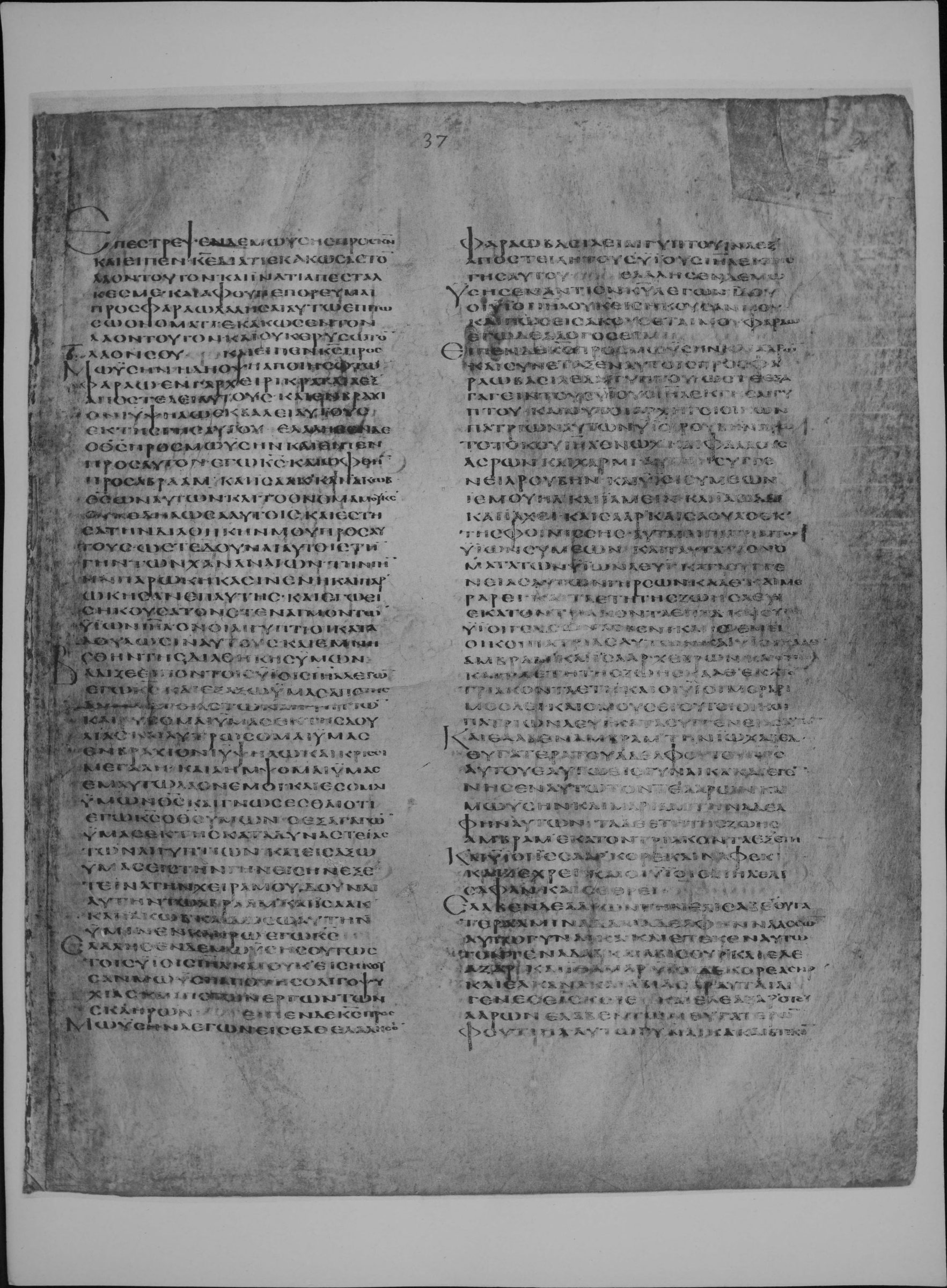
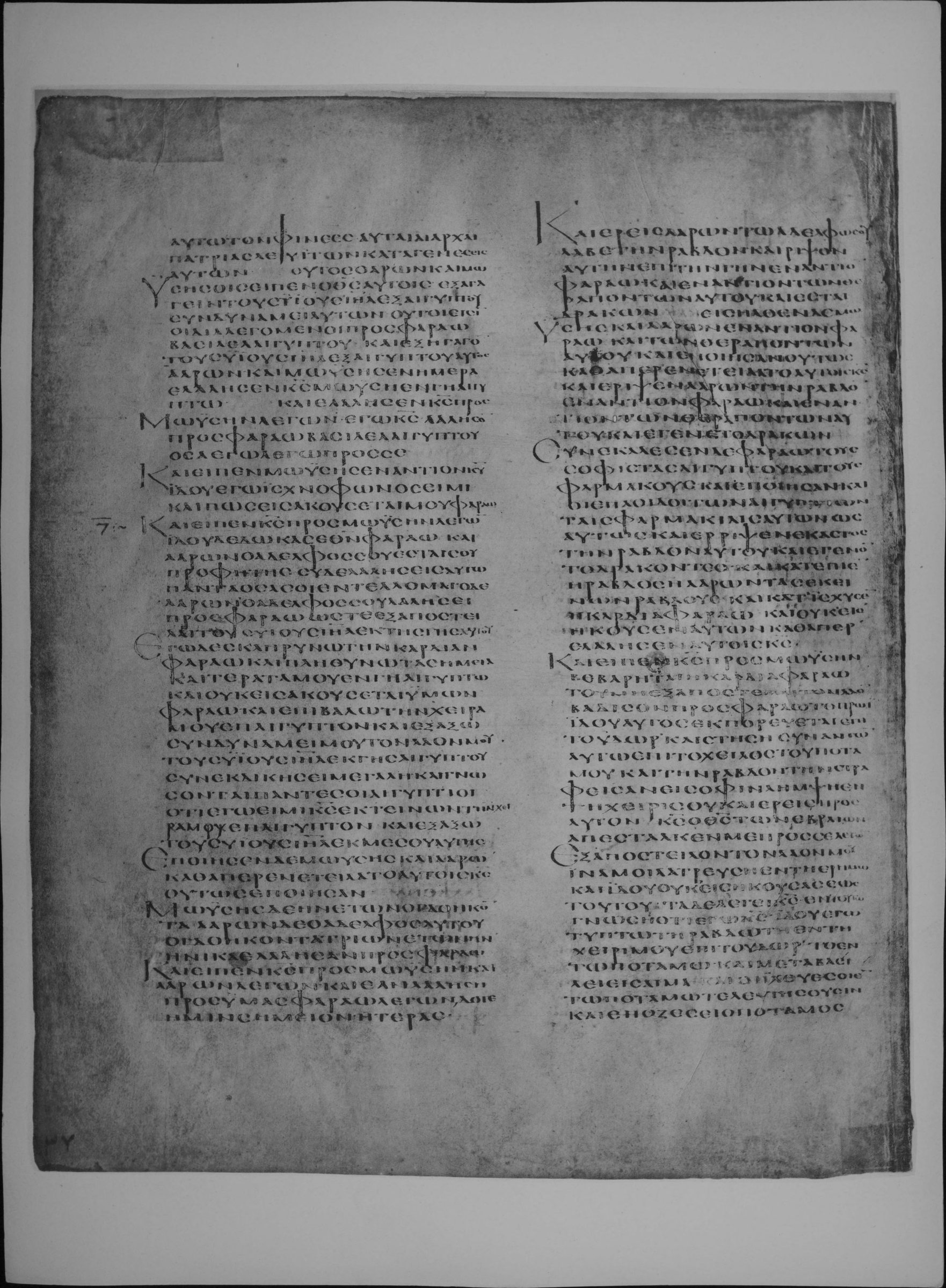
- Manuscript scan: the pages of Codex Alexandrinus carrying this chapter (fol. 37r, fol. 37v), from the full-size photographic (autotype) facsimile published by the British Museum in 1879-1883, as digitised on the Internet Archive. The verse range of every page comes from the reduced photographic facsimile of 1915, which prints it beneath each plate, and the opening words of every page were read on the plate to confirm the page and the verse it begins with. Each section links to the page or pages that hold its verses. Folio numbers are those written at the head of each leaf and visible on the plates.
- Original text: Swete's edition, which here prints the text of Codex Vaticanus (Vat. gr. 1209), the base of his edition, and gives the readings of Alexandrinus only in his apparatus. The Greek column is therefore Vaticanus' text; where Alexandrinus differs, the plate shows what Alexandrinus reads.
- English translation: Sir Lancelot C. L. Brenton, The Septuagint Version of the Old Testament (1844; 1851 edition), a translation of the Greek, public domain, from the eBible.org text.
How was this verified? (Provenance)
Where on the image
Exodus 6:1-8 is on fol. 37r (full-size facsimile of 1879-83, Internet Archive codex-alexandrinus leaf 94). The 1915 reduced facsimile prints beneath this page: Exod. v. 22-vi. 25. Checked on the plate: the page begins at the start of Exodus 5:22 (first words read: ΕΠΕΣΤΡΕΨΕΝ ΔΕ ΜΩΥΣΗΣ ΠΡΟΣ ΚΝ ΚΑΙ ΕΙΠΕΝ ΚΕ ΔΙΑ ΤΙ ΕΚΑΚΩΣΑΣ ΤΟΝ ΛΑΟΝ ΤΟΥΤΟΝ).
1καὶ εἶπεν Κύριος πρὸς Μωυσῆν Ἤδη ὄψει ἃ ποιήσω τῷ Φαραώ· ἐν γὰρ χειρὶ κραταιᾷ ἐξαποστελεῖ αὐτούς, καὶ ἐν βραχίονι ὑψηλῷ ἐκβαλεῖ αὐτοὺς ἐκ τῆς γῆς αὐτοῦ. 2Ἐλάλησεν δὲ ὁ θεὸς πρὸς Μωυσῆν καὶ εἶπεν πρὸς αὐτόν Ἐγὼ Κύριος· 3καὶ ὤφθην πρὸς Ἀβραὰμ καὶ Ἰσαὰκ καὶ Ἰακώβ, θεὸς ὢν αὐτῶν, καὶ τὸ ὄνομά μου Κύριος οὐκ ἐδήλωσα αὐτοῖς· 4καὶ ἔστησα τὴν διαθήκην μου πρὸς αὐτοὺς ὥστε δοῦναι αὐτοῖς τὴν γῆν τῶν Χαναναίων, τὴν γῆν ἣν παρῳκήκασιν, ἐν ᾗ καὶ παρῴκησαν ἐπ᾽ αὐτῆς. 5καὶ ἐγὼ εἰσήκουσα τὸν στεναγμὸν τῶν υἱῶν Ἰσραήλ, ὃν οἱ Αἰγύπτιοι καταδουλοῦνται αὐτούς, καὶ ἐμνήσθην τῆς διαθήκης ὑμῶν. 6βάδιζε εἰπὸν τοῖς υἱοῖς Ἰσραὴλ λέγων Ἐγὼ Κύριος, καὶ ἐξάξω ὑμᾶς ἀπὸ τῆς δυναστείας τῶν Αἰγυπτίων, καὶ ῥύσομαι ὑμᾶς ἐκ τῆς δουλίας, καὶ λυτρώσομαι ὑμᾶς ἐν βραχίονι ὑψηλῷ καὶ κρίσει μεγάλῃ· 7καὶ λήμψομαι ἐμαυτῷ ὑμᾶς λαὸν ἐμοί, καὶ ἔσομαι ὑμῶν θεός, καὶ γνώσεσθε ὅτι ἐγὼ Κύριος ὁ θεὸς ὑμῶν ὁ ἐξαγαγὼν ὑμᾶς ἐκ τῆς καταδυναστείας τῶν Αἰγυπτίων· 8καὶ ἐξάξω ὑμᾶς εἰς τὴν γῆν εἰς ἣν ἐξέτεινα τὴν χεῖρά μου δοῦναι αὐτὴν τῷ Ἀβραὰμ καὶ Ἰσαὰκ καὶ Ἰακώβ, καὶ δώσω ὑμῖν αὐτὴν ἐν κλήρῳ· ἐγὼ Κύριος.
1And the Lord said to Moses, Now thou shalt see what I will do to Pharao; for he shall send them forth with a mighty hand, and with a high arm shall he cast them out of his land. 2And God spoke to Moses and said to him, I am the Lord. 3And I appeared to Abraam and Isaac and Jacob, being their God, but I did not manifest to them my name Lord. 4And I established my covenant with them, to give them the land of the Chananites, the land wherein they sojourned, in which also they dwelt as strangers. 5And I hearkened to the groaning of the children of Israel (the affliction with which the Egyptians enslave them) and I remembered the covenant with you. 6Go, speak to the children of Israel, saying, I am the Lord; and I will lead you forth from the tyranny of the Egyptians, and I will deliver you from bondage, and I will ransom you with a high arm, and great judgment. 7And I will take you to me a people for myself, and will be your God; and ye shall know that I am the Lord your God, who brought you out from the tyranny of the Egyptians. 8And I will bring you into the land concerning which I stretched out my hand to give it to Abraam and Isaac and Jacob, and I will give it you for an inheritance: I am the Lord.
Where on the image
Exodus 6:9-16 is on fol. 37r (full-size facsimile of 1879-83, Internet Archive codex-alexandrinus leaf 94). The 1915 reduced facsimile prints beneath this page: Exod. v. 22-vi. 25. Checked on the plate: the page begins at the start of Exodus 5:22 (first words read: ΕΠΕΣΤΡΕΨΕΝ ΔΕ ΜΩΥΣΗΣ ΠΡΟΣ ΚΝ ΚΑΙ ΕΙΠΕΝ ΚΕ ΔΙΑ ΤΙ ΕΚΑΚΩΣΑΣ ΤΟΝ ΛΑΟΝ ΤΟΥΤΟΝ).
9ἐλάλησεν δὲ Μωυσῆς οὕτως τοῖς υἱοῖς Ἰσραήλ· καὶ οὐκ εἰσήκουσαν Μωυσῇ ἀπὸ τῆς ὀλιγοψυχίας καὶ ἀπὸ τῶν ἔργων τῶν σκληρῶν. 10Εἶπεν δὲ Κύριος πρὸς Μωυσῆν λέγων 11Εἴσελθε λάλησον Φαραὼ βασιλεῖ Αἰγύπτου ἵνα ἐξαποστείλῃ τοὺς υἱοὺς Ἰσραὴλ ἐκ τῆς γῆς αὐτοῦ. 12ἐλάλησεν δὲ Μωυσῆς ἔναντι Κυρίου λέγων Ἰδοὺ οἱ υἱοὶ Ἰσραὴλ οὐκ εἰσήκουσάν μου, καὶ πῶς εἰσακούσεταί μου Φαραώ; ἐγὼ δὲ ἄλογός εἰμι. 13εἶπεν δὲ Κύριος πρὸς Μωυσῆν καὶ Ἀαρών, καὶ συνέταξεν αὐτοῖς πρὸς Φαραὼ βασιλέα Αἰγύπτου ὥστε ἐξαποστεῖλαι τοὺς υἱοὺς Ἰσραὴλ ἐκ γῆς Αἰγύπτου. 14Καὶ οὗτοι ἀρχηγοὶ οἴκων πατριῶν αὐτῶν. υἱοὶ Ῥουβὴν πρωτοτόκου Ἰσραήλ· Ἑνὼχ καὶ Φαλλούς, Ἁσρὼν καὶ Χαρμεί· αὕτη ἡ συγγενία Ῥουβήν. 15καὶ υἱοὶ Συμεών· Ἰεμιὴλ καὶ Ἰαμεὶν καὶ Ἰώαδ καὶ Ἰαχεὶν καὶ Σάαρ καὶ Σαοὺλ ὁ ἐκ τῆς Φοινίσσης· αὗται αἱ πατριαὶ τῶν υἱῶν Συμεών. 16καὶ ταῦτα τὰ ὀνόματα τῶν υἱῶν Λευεὶ κατὰ συγγενίας αὐτῶν· Γεδσὼν καὶ Καὰθ καὶ Μεραρεί· καὶ τὰ ἔτη τῆς ζωῆς Λευεὶ ἑκατὸν τριάκοντα ἑπτά.
9And Moses spoke thus to the sons of Israel, and they hearkened not to Moses for faint-heartedness, and for their hard tasks. 10And the Lord spoke to Moses, saying, 11Go in, speak to Pharao king of Egypt, that he send forth the children of Israel out of his land. 12And Moses spoke before the Lord, saying, Behold, the children of Israel hearkened not to me, and how shall Pharao hearken to me? and I am not eloquent. 13And the Lord spoke to Moses and Aaron, and gave them a charge to Pharao king of Egypt, that he should send forth the children of Israel out of the land of Egypt. 14And these are the heads of the houses of their families: the sons of Ruben the first-born of Israel; Enoch and Phallus, Asron, and Charmi, this is the kindred of Ruben. 15And the sons of Symeon, Jemuel and Jamin, and Aod, and Jachin and Saar, and Saul the son of a Phœnician woman, these are the families of the sons of Symeon. 16And these are the names of the sons of Levi according to their kindreds, Gedson, Caath, and Merari; and the years of the life of Levi were a hundred and thirty-seven.
Where on the image
Exodus 6:17-24 is on fol. 37r (full-size facsimile of 1879-83, Internet Archive codex-alexandrinus leaf 94). The 1915 reduced facsimile prints beneath this page: Exod. v. 22-vi. 25. Checked on the plate: the page begins at the start of Exodus 5:22 (first words read: ΕΠΕΣΤΡΕΨΕΝ ΔΕ ΜΩΥΣΗΣ ΠΡΟΣ ΚΝ ΚΑΙ ΕΙΠΕΝ ΚΕ ΔΙΑ ΤΙ ΕΚΑΚΩΣΑΣ ΤΟΝ ΛΑΟΝ ΤΟΥΤΟΝ).
17καὶ οὗτοι υἱοὶ Γεδσών· Λοβενὶ καὶ Σεμεεί, οἶκοι πατριᾶς αὐτῶν. 18καὶ υἱοὶ Καάθ· Ἀμβρὰμ καὶ Ἰσσαχάρ, Χεβρὼν καὶ Ὀζειήλ· καὶ τὰ ἔτη τῆς ζωῆς Καὰθ ἑκατὸν τριάκοντα ἔτη. 19καὶ υἱοὶ Μεραρεί· Μοολεὶ καὶ Ὀμουσεί. οὗτοι οἶκοι πατριῶν Λευεὶ κατὰ συγγενίαν αὐτῶν. 20καὶ ἔλαβεν Ἀμβρὰν τὴν Ἰωχάβεδ θυγατέρα τοῦ ἀδελφοῦ τοῦ πατρὸς αὐτοῦ ἑαυτῷ εἰς γυναῖκα, καὶ ἐγέννησεν αὐτῷ τόν τε Ἀαρὼν καὶ Μωυσῆν καὶ Μαριὰμ τὴν ἀδελφὴν αὐτῶν· τὰ δὲ ἔτη τῆς ζωῆς Ἀμβρὰν ἑκατὸν τριάκοντα δύο ἔτη. 21καὶ υἱοὶ Ἰσσαάρ· Κόρε καὶ Νάφεκ καὶ Ζεχρεί. 22καὶ υἱοὶ Ὀζειήλ· Ἐλισαφὰν καὶ Σεγρεί. 23ἔλαβεν δὲ Ἀαρὼν τὴν Ἐλεισάβεθ θυγατέρα Ἀμειναδὰβ ἀδελφὴν Ναασσὼν αὐτῷ γυναῖκα, καὶ ἔτεκεν αὐτῷ τόν τε Ναδὰβ καὶ τὸν Ἀβιοὺδ καὶ τὸν Ἐλεαζὰρ καὶ Ἰθαμάρ. 24υἱοὶ δὲ Κόρε· Ἀσεὶρ καὶ Ἐλκανὰ καὶ Ἀβιασάρ· αὗται αἱ γενέσεις Κόρε.
17And these are the sons of Gedson, Lobeni and Semei, the houses of their family. And the sons of Caath, 18Ambram and Issaar, Chebron, and Oziel; and the years of the life of Caath were a hundred and thirty-three years. 19And the sons of Merari, Moöli, and Omusi, these are the houses of the families of Levi, according to their kindreds. 20And Ambram took to wife Jochabed the daughter of his father's brother, and she bore to him both Aaron and Moses, and Mariam their sister: and the years of the life of Ambram were a hundred and thirty-two years. 21And the sons of Issaar, Core, and Naphec, and Zechri. 22And the sons of Oziel, Misael, and Elisaphan, and Segri. 23And Aaron took to himself to wife Elisabeth daughter of Aminadab sister of Naasson, and she bore to him both Nadab and Abiud, and Eleazar and Ithamar. 24And the sons of Core, Asir, and Elkana, and Abiasar, these are the generations of Core.
Where on the image
Exodus 6:25 is on fol. 37r (full-size facsimile of 1879-83, Internet Archive codex-alexandrinus leaf 94). The 1915 reduced facsimile prints beneath this page: Exod. v. 22-vi. 25. Checked on the plate: the page begins at the start of Exodus 5:22 (first words read: ΕΠΕΣΤΡΕΨΕΝ ΔΕ ΜΩΥΣΗΣ ΠΡΟΣ ΚΝ ΚΑΙ ΕΙΠΕΝ ΚΕ ΔΙΑ ΤΙ ΕΚΑΚΩΣΑΣ ΤΟΝ ΛΑΟΝ ΤΟΥΤΟΝ). Exodus 6:25-30 is on fol. 37v (full-size facsimile of 1879-83, Internet Archive codex-alexandrinus leaf 95). The 1915 reduced facsimile prints beneath this page: Exod. vi. 25-vii. 18. Checked on the plate: the page begins inside Exodus 6:25 (first words read: ΑΥΤΩ ΤΟΝ ΦΙΝΕΕΣ ΑΥΤΑΙ ΑΙ ΑΡΧΑΙ ΠΑΤΡΙΑΣ ΛΕΥΙΤΩΝ ΚΑΤΑ ΓΕΝΕΣΕΙΣ ΑΥΤΩΝ).
25καὶ Ἐλεαζὰρ ὁ τοῦ Ἀαρὼν ἔλαβεν τῶν θυγατέρων Φουτιὴλ αὐτῷ γυναῖκα, καὶ ἔτεκεν αὐτῷ τὸν Φινεές· αὗται αἱ ἀρχαὶ πατριᾶς Λευειτῶν κατὰ γενέσεις αὐτῶν. 26οὗτος Ἀαρὼν καὶ Μωυσῆς, οἷς εἶπεν αὐτοῖς ὁ θεὸς ἐξαγαγεῖν τοὺς υἱοὺς Ἰσραὴλ ἐκ γῆς Αἰγύπτου σὺν δυνάμει αὐτῶν. 27οὗτοί εἰσιν οἱ διαλεγόμενοι πρὸς Φαραὼ βασιλέα Αἰγύπτου· καὶ ἐξήγαγον τοὺς υἱοὺς Ἰσραὴλ ἐκ γῆς Αἰγύπτου, αὐτὸς Ἀαρὼν καὶ Μωυσῆς. 28ᾟ ἡμέρᾳ ἐλάλησεν Κύριος Μωυσῇ ἐν γῇ Αἰγύπτῳ 29καὶ ἐλάλησεν Κύριος πρὸς Μωυσῆν λέγων Ἐγὼ Κύριος· λάλησον πρὸς Φαραὼ βασιλέα Αἰγύπτου, καὶ ἐγὼ λέγω πρὸς σέ. 30καὶ εἶπεν Μωυσῆς ἐναντίον Κυρίου Ἰδοὺ ἐγὼ ἰσχνόφωνός εἰμι, καὶ πῶς εἰσακούσεταί μου Φαραώ;
25And Eleazar the son of Aaron took to himself for a wife one of the daughters of Phutiel, and she bore to him Phinees. These are the heads of the family of the Levites, according to their generations. 26This is Aaron and Moses, whom God told to bring out the children of Israel out of the land of Egypt with their forces. 27These are they that spoke with Pharao king of Egypt, and Aaron himself and Moses brought out the children of Israel from the land of Egypt, 28in the day in which the Lord spoke to Moses in the land of Egypt; 29then the Lord spoke to Moses, saying, I am the Lord: speak to Pharao king of Egypt whatsoever I say to thee. 30And Moses said before the Lord, Behold, I am not able in speech, and how shall Pharao hearken to me?
Cite
Sources
- Source: Codex Alexandrinus (British Library Royal MS 1 D. V) via the British Museum photographic facsimiles of 1879-83 and 1915 (Internet Archive) + Swete's Septuagint + Brenton's English (holding institution)
- Critical edition: H. B. Swete, The Old Testament in Greek according to the Septuagint (1909)
← previous · → next · v cycle view · l back to library