Exodus, Chapter 8 (Codex Alexandrinus)
Introduction
Exodus 8 in the Greek Old Testament (the Septuagint) as written in Codex Alexandrinus, a Greek Bible copied in the fifth century, probably in Egypt, and now in the British Library (Royal MS 1 D. V, the first of its four volumes). It is one of the three great early codices of the whole Greek Bible, with Codex Vaticanus and Codex Sinaiticus, and for Genesis 1:1-46:28, which Codex Vaticanus has lost, it is the oldest surviving complete Greek text (older papyri such as the Berlin Genesis papyrus and Chester Beatty 961 survive only in part).
Numbering: Swete's Greek and Brenton's English number or divide some verses of this chapter differently (Swete 8:1-4 = Brenton 7:26-29; Swete 8:5-32 = Brenton 8:1-28). Each column keeps its own verse numbers, and sections are cut only where the two texts agree, so each section holds the same passage in both languages.
This entry meets the strict three-criteria standard of the Theosis Library:
- Manuscript scan: the pages of Codex Alexandrinus carrying this chapter (fol. 38r, fol. 38v, fol. 39r), from the full-size photographic (autotype) facsimile published by the British Museum in 1879-1883, as digitised on the Internet Archive. The verse range of every page comes from the reduced photographic facsimile of 1915, which prints it beneath each plate, and the opening words of every page were read on the plate to confirm the page and the verse it begins with. Each section links to the page or pages that hold its verses. Folio numbers are those written at the head of each leaf and visible on the plates.
- Original text: Swete's edition, which here prints the text of Codex Vaticanus (Vat. gr. 1209), the base of his edition, and gives the readings of Alexandrinus only in his apparatus. The Greek column is therefore Vaticanus' text; where Alexandrinus differs, the plate shows what Alexandrinus reads.
- English translation: Sir Lancelot C. L. Brenton, The Septuagint Version of the Old Testament (1844; 1851 edition), a translation of the Greek, public domain, from the eBible.org text.
How was this verified? (Provenance)
Where on the image
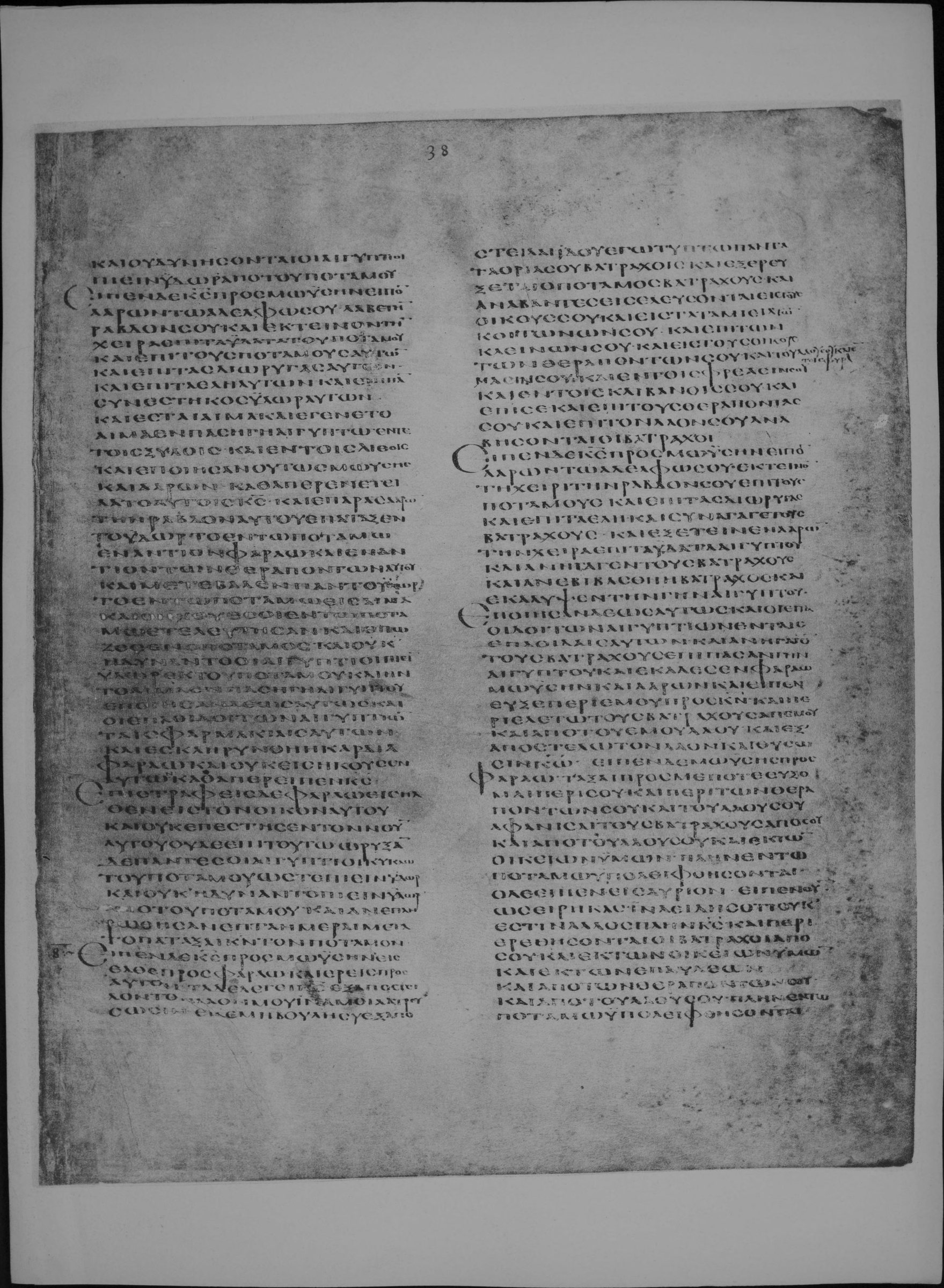
Exodus 8:1-8 is on fol. 38r (full-size facsimile of 1879-83, Internet Archive codex-alexandrinus leaf 96). The 1915 reduced facsimile prints beneath this page: Exod. vii. 18-viii. 11. Checked on the plate: the page begins inside Exodus 7:18 (first words read: ΚΑΙ ΟΥ ΔΥΝΗΣΟΝΤΑΙ ΟΙ ΑΙΓΥΠΤΙΟΙ ΠΙΕΙΝ ΥΔΩΡ ΑΠΟ ΤΟΥ ΠΟΤΑΜΟΥ ΕΙΠΕΝ ΔΕ ΚΣ ΠΡΟΣ ΜΩΥΣΗΝ).
1Εἶπεν δὲ Κύριος πρὸς Μωυσῆν Εἴσελθε πρὸς Φαραὼ καὶ ἐρεῖς πρὸς αὐτόν Τάδε λέγει Κύριος Ἐξαπόστειλον τὸν λαόν μου ἵνα μοι λατρεύσωσιν· 2εἰ δὲ μὴ βούλει σὺ ἐξαποστεῖλαι, ἰδοὺ ἐγὼ τύπτω πάντα τὰ ὅριά σου τοῖς βατράχοις. 3καὶ ἐξερεύξεται ὁ ποταμὸς βατράχους· καὶ ἀναβάντες εἰσελεύσονται εἰς τοὺς οἴκους σου καὶ εἰς τὰ ταμεῖα τῶν κοιτώνων σου καὶ ἐπὶ τῶν κλινῶν σου, καὶ ἐπὶ τοὺς οἴκους τῶν θεραπόντων σου καὶ τοῦ λαοῦ σου, καὶ ἐν τοῖς φυράμασίν σου καὶ ἐν τοῖς κλιβάνοις σου· 4καὶ ἐπὶ σὲ καὶ ἐπὶ τοὺς θεράποντάς σου καὶ ἐπὶ τὸν λαόν σου ἀναβήσονται οἱ βάτραχοι. 5εἶπεν δὲ Κύριος πρὸς Μωυσῆν Εἰπὸν Ἀαρὼν τῷ ἀδελφῷ σου Ἔκτεινον τῇ χειρὶ τὴν ῥάβδον σου ἐπὶ τοὺς ποταμοὺς καὶ ἐπὶ τὰς διώρυγας καὶ ἐπὶ τὰ ἕλη, καὶ ἀνάγαγε τοὺς βατράχους. 6καὶ ἐξέτεινεν Ἀαρὼν τὴν χεῖρα ἐπὶ τὰ ὕδατα Αἰγύπτου, καὶ ἀνήγαγεν τοὺς βατράχους· καὶ ἀνεβιβάσθη ὁ βάτραχος, καὶ ἐκάλυψεν τὴν γῆν Αἰγύπτου. 7ἐποίησαν δὲ ὡσαύτως καὶ οἱ ἐπαοιδοὶ τῶν Αἰγυπτίων ταῖς φαρμακίαις αὐτῶν, καὶ ἀνήγαγον τοὺς βατράχους ἐπὶ γῆν Αἰγύπτου. 8καὶ ἐκάλεσεν Φαραὼ Μωυσῆν καὶ Ἀαρὼν καὶ εἶπεν Εὔξασθε περὶ ἐμοῦ πρὸς Κύριον, καὶ περιελέτω τοὺς βατράχους ἀπ᾽ ἐμοῦ καὶ ἀπὸ τοῦ ἐμοῦ λαοῦ, καὶ ἐξαποστελῶ αὐτοὺς καὶ θύσωσιν τῷ κυρίῳ.
7:26And the Lord said to Moses, Go in to Pharao, and thou shalt say to him, These things says the Lord: send forth my people, that they may serve me. 7:27And if thou wilt not send them forth, behold, I afflict all thy borders with frogs: 7:28and the river shall teem with frogs, and they shall go up and enter into thy houses, and into thy bed-chambers, and upon thy beds, and upon the houses of thy servants, and of thy people, and on thy dough, and on thine ovens. 7:29And upon thee, and upon thy servants, and upon thy people, shall the frogs come up. 1And the Lord said to Moses, Say to Aaron thy brother, Stretch forth with the hand thy rod over the rivers, and over the canals, and over the pools, and bring up the frogs. 2And Aaron stretched forth his hand over the waters of Egypt, and brought up the frogs: and the frog was brought up, and covered the land of Egypt. 3And the charmers of the Egyptians also did likewise with their sorceries, and brought up the frogs on the land of Egypt. 4And Pharao called Moses and Aaron, and said, Pray for me to the Lord, and let him take away the frogs from me and from my people; and I will send them away, and they shall sacrifice to the Lord.
Where on the image
Exodus 8:9-11 is on fol. 38r (full-size facsimile of 1879-83, Internet Archive codex-alexandrinus leaf 96). The 1915 reduced facsimile prints beneath this page: Exod. vii. 18-viii. 11. Checked on the plate: the page begins inside Exodus 7:18 (first words read: ΚΑΙ ΟΥ ΔΥΝΗΣΟΝΤΑΙ ΟΙ ΑΙΓΥΠΤΙΟΙ ΠΙΕΙΝ ΥΔΩΡ ΑΠΟ ΤΟΥ ΠΟΤΑΜΟΥ ΕΙΠΕΝ ΔΕ ΚΣ ΠΡΟΣ ΜΩΥΣΗΝ). Exodus 8:12-16 is on fol. 38v (full-size facsimile of 1879-83, Internet Archive codex-alexandrinus leaf 97). The 1915 reduced facsimile prints beneath this page: Exod. viii. 12-31. Checked on the plate: the page begins at the start of Exodus 8:12 (first words read: ΕΞΗΛΘΕΝ ΔΕ ΜΩΥΣΗΣ ΚΑΙ ΑΑΡΩΝ ΑΠΟ ΦΑΡΑΩ ΚΑΙ ΕΒΟΗΣΕΝ ΜΩΥΣΗΣ ΠΡΟΣ ΚΝ).
9εἶπεν δὲ Μωυσῆς πρὸς Φαραώ Τάξαι πρὸς μὲ πότε εὔξωμαι περὶ σοῦ καὶ περὶ τῶν θεραπόντων σου καὶ περὶ τοῦ λαοῦ σου, ἀφανίσαι τοὺς βατράχους ἀπὸ σοῦ καὶ ἀπὸ τοῦ λαοῦ σου καὶ ἐκ τῶν οἰκιῶν ὑμῶν· πλὴν ἐν τῷ ποταμῷ ὑπολειφθήσονται. 10ὁ δὲ εἶπεν Εἰς αὔριον. εἶπεν οὖν Ὡς εἴρηκας· ἵνα ἴδῃς ὅτι οὐκ ἔστιν ἄλλος πλὴν Κυρίου· 11καὶ περιαιρεθήσονται οἱ βάτραχοι ἀπὸ σοῦ καὶ ἐκ τῶν οἰκιῶν ὑμῶν καὶ ἐκ τῶν ἐπαύλεων καὶ ἀπὸ τῶν θεραπόντων σου καὶ ἀπὸ τοῦ λαοῦ σου· πλὴν ἐν τῷ ποταμῷ ὑπολειφθήσονται. 12ἐξῆλθεν δὲ Μωυσῆς καὶ Ἀαρὼν ἀπὸ Φαραώ· καὶ ἐβόησεν Μωυσῆς πρὸς Κύριον περὶ τοῦ ὁρισμοῦ τῶν βατράχων, ὡς ἐτάξατο Φαραώ. 13ἐποίησεν δὲ Κύριος καθάπερ εἶπεν Μωυσῆς, καὶ ἐτελεύτησαν οἱ βάτραχοι ἐκ τῶν οἰκιῶν καὶ ἐκ τῶν ἐπαύλεων καὶ ἐκ τῶν ἀγρῶν· 14καὶ συνήγαγον αὐτοὺς θιμωνιὰς θιμωνιάς, καὶ ὤζεσεν ἡ γῆ. 15ἰδὼν δὲ Φαραὼ ὅτι γέγονεν ἀνάψυξις, ἐβαρύνθη ἡ καρδία αὐτοῦ καὶ οὐκ εἰσήκουσεν αὐτῶν, καθάπερ ἐλάλησεν Κύριος. 16Εἶπεν δὲ Κύριος πρὸς Μωυσῆν Εἰπὸν Ἀαρών Ἔκτεινον τῇ χειρὶ τὴν ῥάβδον σου καὶ πάταξον τὸ χῶμα τῆς γῆς, καὶ ἔσονται σκνῖφες ἔν τε τοῖς ἀνθρώποις καὶ ἐν τοῖς τετράποσιν καὶ ἐν πάσῃ γῇ Αἰγύπτου.
5And Moses said to Pharao, Appoint me a time when I shall pray for thee, and for thy servants, and for thy people, to cause the frogs to disappear from thee, and from thy people, and from your houses, only in the river shall they be left behind. 6And he said, On the morrow: he said therefore, As thou hast said; that thou mayest know, that there is no other God but the Lord. 7And the frogs shall be removed away from thee, and from your houses and from the villages, and from thy servants, and from thy people, only in the river they shall be left. 8And Moses and Aaron went forth from Pharao, and Moses cried to the Lord concerning the restriction of the frogs, as Pharao appointed him. 9And the Lord did as Moses said, and the frogs died out of the houses, and out of the villages, and out of the fields. 10And they gathered them together in heaps, and the land stank. 11And when Pharao saw that there was relief, his heart was hardened, and he did not hearken to them, as the Lord spoke. 12And the Lord said to Moses, Say to Aaron, Stretch forth thy rod with thy hand and smite the dust of the earth; and there shall be lice both upon man, and upon quadrupeds, and in all the land of Egypt.
Where on the image
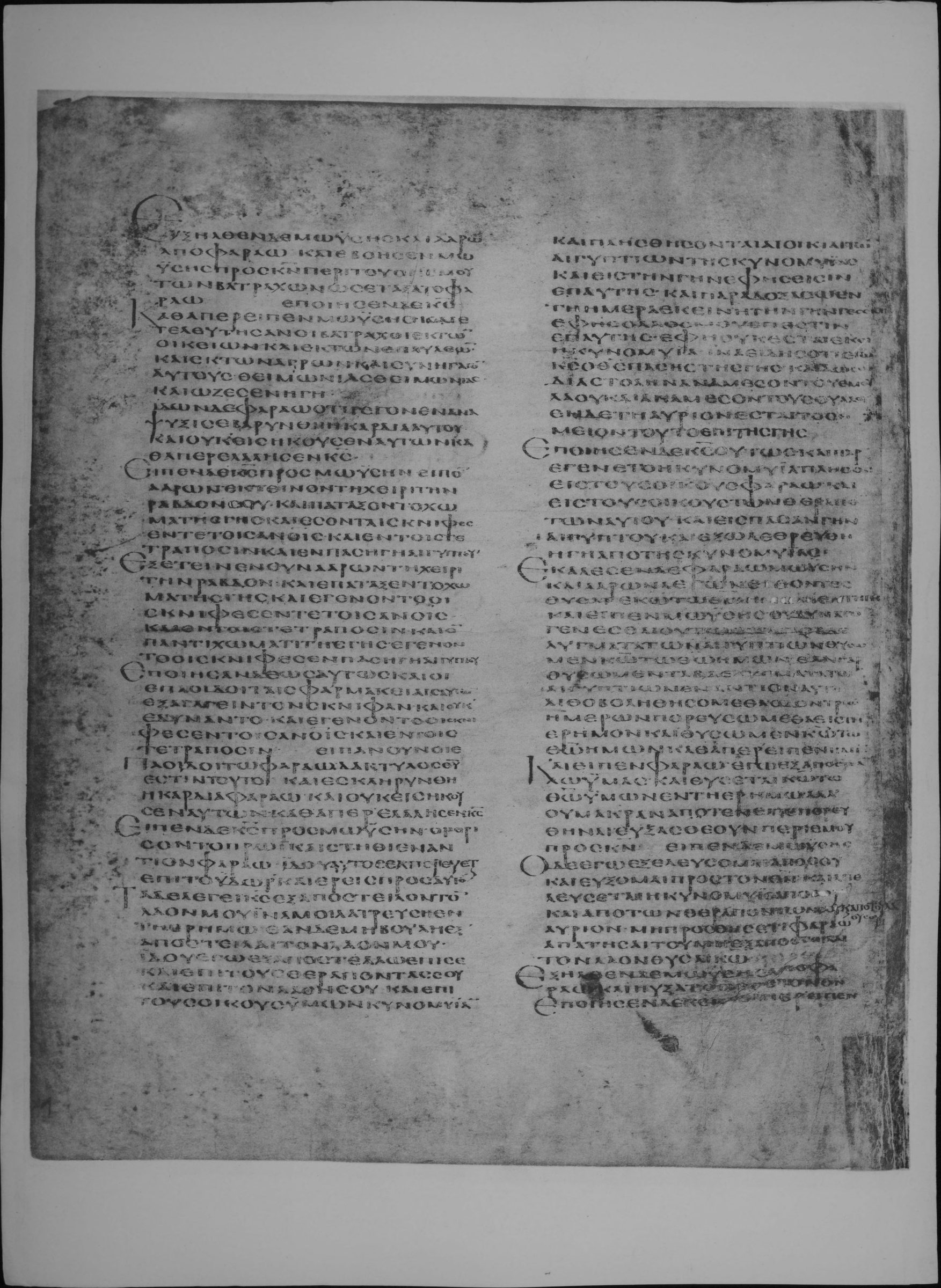
Exodus 8:17-24 is on fol. 38v (full-size facsimile of 1879-83, Internet Archive codex-alexandrinus leaf 97). The 1915 reduced facsimile prints beneath this page: Exod. viii. 12-31. Checked on the plate: the page begins at the start of Exodus 8:12 (first words read: ΕΞΗΛΘΕΝ ΔΕ ΜΩΥΣΗΣ ΚΑΙ ΑΑΡΩΝ ΑΠΟ ΦΑΡΑΩ ΚΑΙ ΕΒΟΗΣΕΝ ΜΩΥΣΗΣ ΠΡΟΣ ΚΝ).
17ἐξέτεινεν οὖν Ἀαρὼν τῇ χειρὶ τὴν ῥάβδον καὶ ἐπάταξεν τὸ χῶμα τῆς γῆς, καὶ ἐγένοντο οἱ σκνῖφες ἐν τοῖς ἀνθρώποις καὶ ἐν τοῖς τετράποσιν· καὶ ἐν παντὶ χώματι τῆς γῆς ἐγένοντο οἱ σκνῖφες. 18ἐποίησαν δὲ ὡσαύτως καὶ οἱ ἐπαοιδοὶ ταῖς φαρμακίαις αὐτῶν ἐξαγαγεῖν τὸν σκνῖφα, καὶ οὐκ ἠδύναντο· καὶ ἐγένοντο οἱ σκνῖφες ἐν τοῖς ἀνθρώποις καὶ ἐν τοῖς τετράποσιν. 19εἶπαν οὖν οἱ ἐπαοιδοὶ τῷ Φαραώ Δάκτυλος θεοῦ ἐστὶν τοῦτο· καὶ ἐσκληρύνθη ἡ καρδία Φαραώ, καὶ οὐκ εἰσήκουσεν αὐτῶν, καθάπερ ἐλάλησεν Κύριος. 20Εἶπεν δὲ Κύριος πρὸς Μωυσῆν Ὄρθρισον τὸ πρωὶ καὶ στῆθι ἐναντίον Φαραώ· καὶ ἰδοὺ αὐτὸς ἐξελεύσεται ἐπὶ τὸ ὕδωρ, καὶ ἐρεῖς πρὸς αὐτόν Τάδε λέγει Κύριος Ἐξαπόστειλον τὸν λαόν μου ἵνα μοι λατρεύσωσιν ἐν τῇ ἐρήμῳ· 21ἐὰν δὲ μὴ βούλῃ ἐξαποστεῖλαι τὸν λαόν μου, ἰδοὺ ἐγὼ ἐπαποστέλλω ἐπὶ σὲ καὶ ἐπὶ τοὺς θεράποντάς σου καὶ ἐπὶ τὸν λαόν σου καὶ ἐπὶ τοὺς οἴκους ὑμῶν κυνόμυιαν, καὶ πλησθήσονται αἱ οἰκίαι τῶν Αἰγυπτίων τῆς κυνομυίης, καὶ εἰς τὴν γῆν ἐφ᾽ ἧς εἰσὶν ἐπ᾽ αὐτῆς. 22καὶ παραδοξάσω ἐν τῇ ἡμέρᾳ ἐκείνῃ τὴν γῆν Γέσεμ, ἐφ᾽ ἧς ὁ λαός μου ἔπεστιν ἐπ᾽ αὐτῆς, ἐφ᾽ ἧς οὐκ ἔσται ἐκεῖ ἡ κυνόμυια· ἵνα εἰδῇς ὅτι ἐγώ εἰμι Κύριος ὁ κύριος πάσης τῆς γῆς. 23καὶ δώσω διαστολὴν ἀνὰ μέσον τοῦ ἐμοῦ λαοῦ καὶ ἀνὰ μέσον τοῦ σοῦ λαοῦ· ἐν δὲ τῇ αὔριον ἔσται τοῦτο ἐπὶ τῆς γῆς. 24ἐποίησεν δὲ Κύριος οὕτως, καὶ παρεγένετο ἡ κυνόμυια πλῆθος εἰς τοὺς οἴκους Φαραὼ καὶ εἰς τοὺς οἴκους τῶν θεραπόντων αὐτοῦ καὶ εἰς πᾶσαν τὴν γῆν Αἰγύπτου· καὶ ἐξωλεθρεύθη ἡ γῆ ἀπὸ τῆς κυνομυίης.
13So Aaron stretched out his rod with his hand, and smote the dust of the earth; and the lice were on men and on quadrupeds, and in all the dust of the earth there were lice. 14And the charmers also did so with their sorceries, to bring forth the louse, and they could not. And the lice were both on the men and on the quadrupeds. 15So the charmers said to Pharao, This is the finger of God. But the heart of Pharao was hardened, and he hearkened not to them, as the Lord said. 16And the Lord said to Moses, Rise up early in the morning, and stand before Pharao: and, behold, he will go forth to the water, and thou shalt say to him, These things says the Lord: Send away my people, that they may serve me in the wilderness. 17And if thou wilt not let my people go, behold, I send upon thee, and upon thy servants, and upon thy people, and upon your houses, the dog-fly; and the houses of the Egyptians shall be filled with the dog-fly, even throughout the land upon which they are. 18And I will distinguish marvellously in that day the land of Gesem, on which my people dwell, in which the dog-fly shall not be: that thou mayest know that I am the Lord the God of all the earth. 19And I will put a difference between my people and thy people, and on the morrow shall this be on the land. And the Lord did thus. 20And the dog-fly came in abundance into the houses of Pharao, and into the houses of his servants, and into all the land of Egypt; and the land was destroyed by the dog-fly.
Where on the image
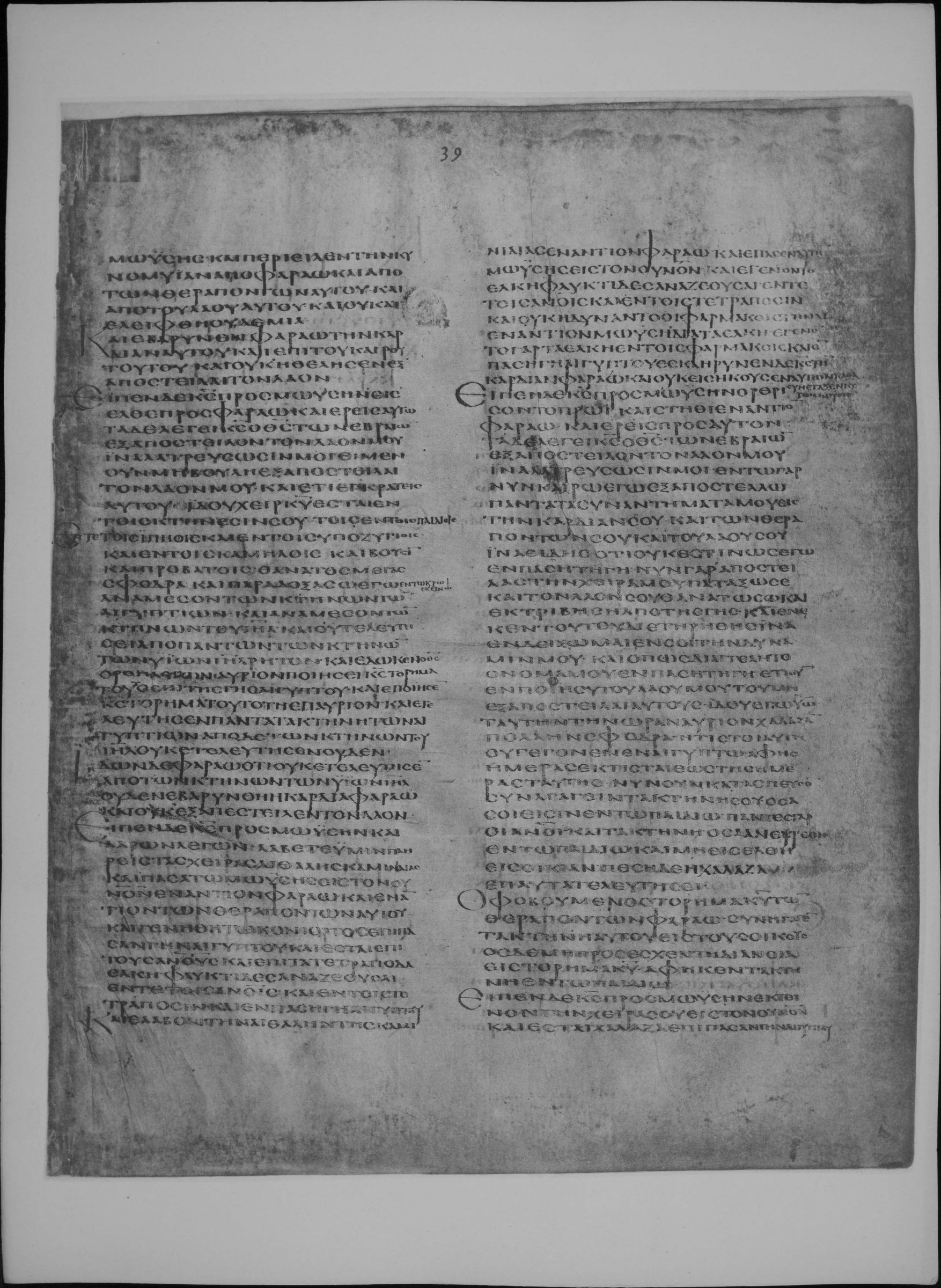
Exodus 8:25-31 is on fol. 38v (full-size facsimile of 1879-83, Internet Archive codex-alexandrinus leaf 97). The 1915 reduced facsimile prints beneath this page: Exod. viii. 12-31. Checked on the plate: the page begins at the start of Exodus 8:12 (first words read: ΕΞΗΛΘΕΝ ΔΕ ΜΩΥΣΗΣ ΚΑΙ ΑΑΡΩΝ ΑΠΟ ΦΑΡΑΩ ΚΑΙ ΕΒΟΗΣΕΝ ΜΩΥΣΗΣ ΠΡΟΣ ΚΝ). Exodus 8:31-32 is on fol. 39r (full-size facsimile of 1879-83, Internet Archive codex-alexandrinus leaf 98). The 1915 reduced facsimile prints beneath this page: Exod. viii. 31-ix. 22. Checked on the plate: the page begins inside Exodus 8:31 (first words read: ΜΩΥΣΗΣ ΚΑΙ ΠΕΡΙΕΙΛΕΝ ΤΗΝ ΚΥΝΟΜΥΙΑΝ ΑΠΟ ΦΑΡΑΩ ΚΑΙ ΑΠΟ ΤΩΝ ΘΕΡΑΠΟΝΤΩΝ ΑΥΤΟΥ).
25ἐκάλεσεν δὲ Φαραὼ Μωυσῆν καὶ Ἀαρὼν λέγων Ἐλθόντες θύσατε τῷ θεῷ ὑμῶν ἐν τῇ γῇ· 26καὶ εἶπεν Μωυσῆς Οὐ δυνατὸν γενέσθαι οὕτως τὸ ῥῆμα τοῦτο, τὰ γὰρ βδελύγματα τῶν Αἰγυπτίων θύσομεν Κυρίῳ τῷ θεῷ ἡμῶν· ἐὰν γὰρ θύσωμεν τὰ βδελύγματα τῶν Αἰγυπτίων ἐναντίον αὐτῶν, λιθοβοληθησόμεθα. 27ὁδὸν τριῶν ἡμερῶν πορευσόμεθα εἰς τὴν ἔρημον, καὶ θύσομεν τῷ θεῷ ἡμῶν καθάπερ εἶπεν Κύριος ἡμῖν. 28καὶ εἶπεν Φαραώ Ἐγὼ ἀποστέλλω ὑμᾶς, καὶ θύσατε τῷ θεῷ ὑμῶν ἐν τῇ ἐρήμῳ, ἀλλ᾽ οὐ μακρὰν ἀποτενεῖτε πορευθῆναι· εὔξασθε οὖν περὶ ἐμοῦ πρὸς Κύριον. 29εἶπεν δὲ Μωυσῆς Ὅδε ἐγὼ ἐξελεύσομαι ἀπὸ σοῦ καὶ εὔξομαι πρὸς τὸν θεόν, καὶ ἀπελεύσεται ἀπὸ σοῦ ἡ κυνόμυια καὶ ἀπὸ τῶν θεραπόντων σου καὶ τοῦ λαοῦ σου αὔριον· μὴ προσθῇς ἔτι, Φαραώ, ἐξαπατῆσαι τοῦ μὴ ἐξαποστεῖλαι τὸν λαὸν θῦσαι Κυρίῳ. 30ἐξῆλθεν δὲ Μωυσῆς ἀπὸ Φαραὼ καὶ ηὔξατο πρὸς τὸν θεόν. 31ἐποίησεν δὲ Κύριος καθάπερ εἶπεν Μωυσῆς, καὶ περιεῖλεν τὴν κυνόμυιαν ἀπὸ Φαραὼ καὶ τῶν θεραπόντων αὐτοῦ καὶ τοῦ λαοῦ αὐτοῦ, καὶ οὐ κατελείφθη οὐδεμία. 32καὶ ἐβάρυνεν Φαραὼ τὴν καρδίαν αὐτοῦ καὶ ἐπὶ τοῦ καιροῦ τούτου, καὶ οὐκ ἠθέλησεν ἐξαποστεῖλαι τὸν λαόν.
21And Pharao called Moses and Aaron, saying, Go and sacrifice to the Lord your God in the land. 22And Moses said, It cannot be so, for we shall sacrifice to the Lord our God the abominations of the Egyptians; for if we sacrifice the abominations of the Egyptians before them, we shall be stoned. 23We will go a journey of three days into the wilderness, and we will sacrifice to the Lord our God, as the Lord said to us. 24And Pharao said, I will let you go, and do ye sacrifice to your God in the wilderness, but do not go very far away: pray then for me to the Lord. 25And Moses said, I then will go forth from thee and pray to God, and the dog-fly shall depart both from thy servants, and from thy people to-morrow. Do not thou, Pharao, deceive again, so as not to send the people away to do sacrifice to the Lord. 26And Moses went out from Pharao, and prayed to God. 27And the Lord did as Moses said, and removed the dog-fly from Pharao, and from his servants, and from his people, and there was not one left. 28And Pharao hardened his heart, even on this occasion, and he would not send the people away.
Cite
Sources
- Source: Codex Alexandrinus (British Library Royal MS 1 D. V) via the British Museum photographic facsimiles of 1879-83 and 1915 (Internet Archive) + Swete's Septuagint + Brenton's English (holding institution)
- Critical edition: H. B. Swete, The Old Testament in Greek according to the Septuagint (1909)
← previous · → next · v cycle view · l back to library