Ezekiel, Chapter 19 (Codex Alexandrinus)
Introduction
Ezekiel 19 in the Greek Old Testament (the Septuagint) as written in Codex Alexandrinus, a Greek Bible copied in the fifth century, probably in Egypt, and now in the British Library (Royal MS 1 D. VI, the second of its four volumes). It is one of the three great early codices of the whole Greek Bible, with Codex Vaticanus and Codex Sinaiticus.
This entry meets the strict three-criteria standard of the Theosis Library:
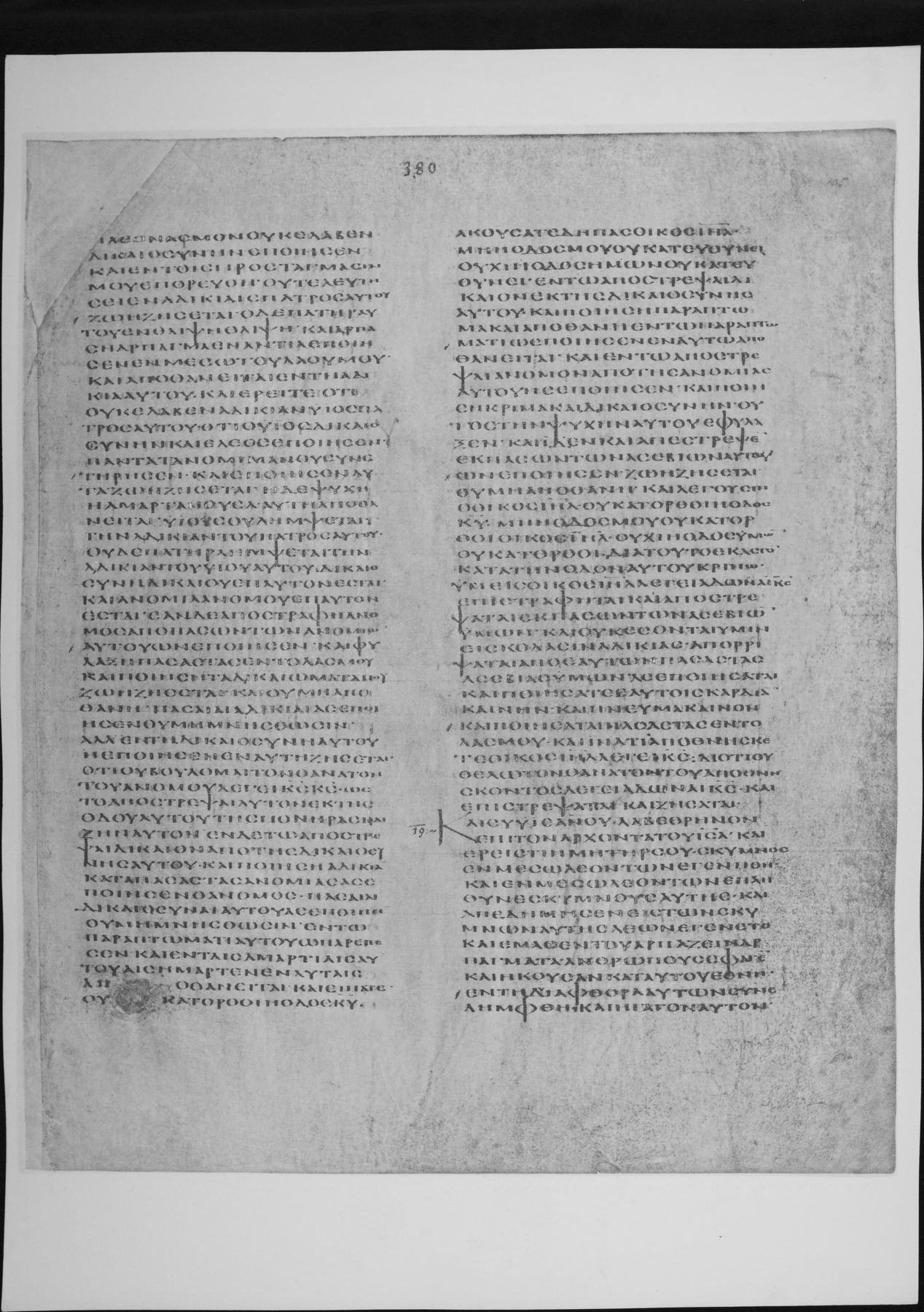
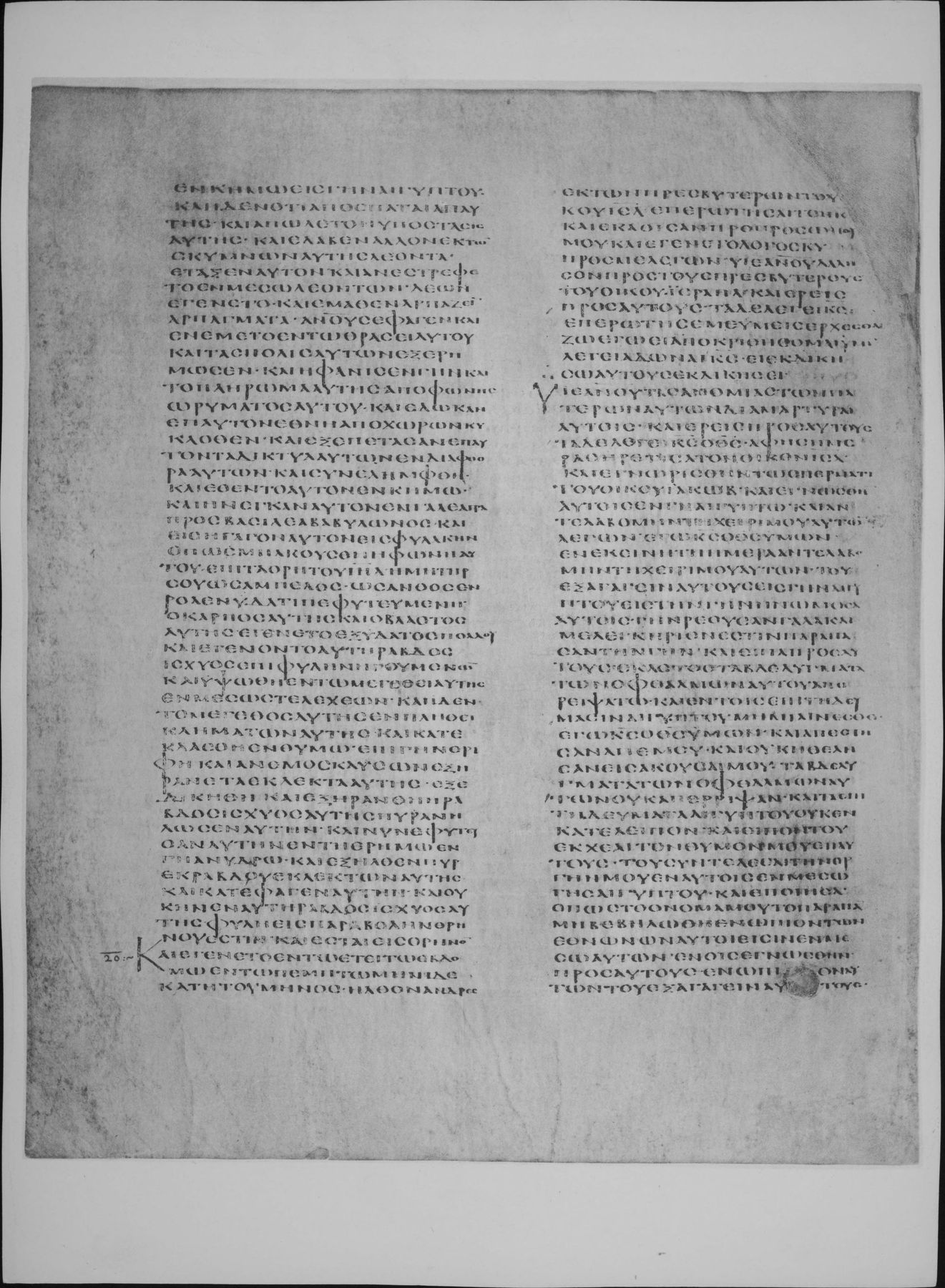
- Manuscript scan: the pages of Codex Alexandrinus carrying this chapter (fol. 380r, fol. 380v), from the full-size photographic (autotype) facsimile published by the British Museum in 1879-1883, as digitised on the Internet Archive. The verse range of every page comes from the reduced photographic facsimile of 1936, which prints it beneath each plate, and the opening words of every page were read on the plate to confirm the page and the verse it begins with. Each section links to the page or pages that hold its verses. Folio numbers are those written at the head of each leaf and visible on the plates.
- Original text: Swete's edition, which here prints the text of Codex Vaticanus (Vat. gr. 1209), the base of his edition, and gives the readings of Alexandrinus only in his apparatus. The Greek column is therefore Vaticanus' text; where Alexandrinus differs, the plate shows what Alexandrinus reads.
- English translation: Sir Lancelot C. L. Brenton, The Septuagint Version of the Old Testament (1844; 1851 edition), a translation of the Greek, public domain, from the eBible.org text.
How was this verified? (Provenance)
Where on the image
Ezekiel 19:1-4 is on fol. 380r (full-size facsimile of 1879-83, Internet Archive codex-alexandrinus leaf 784). The 1936 reduced facsimile prints beneath this page: Ezek. xviii. 17-xix. 4. Checked on the plate: the page begins inside Ezekiel 18:17 (first words read: ΤΟΚΟΝ ΟΥΔΕ ΠΛΕΟΝΑΣΜΟΝ ΟΥΚ ΕΛΑΒΕΝ ΔΙΚΑΙΟΣΥΝΗΝ ΕΠΟΙΗΣΕΝ ΚΑΙ ΕΝ ΤΟΙΣ ΠΡΟΣΤΑΓΜΑΣΙΝ ΜΟΥ ΕΠΟΡΕΥΘΗ). Ezekiel 19:4-8 is on fol. 380v (full-size facsimile of 1879-83, Internet Archive codex-alexandrinus leaf 785). The 1936 reduced facsimile prints beneath this page: Ezek. xix. 4-xx. 9. Checked on the plate: the page begins inside Ezekiel 19:4 (first words read: ΕΝ ΚΗΜΩ ΕΙΣ ΓΗΝ ΑΙΓΥΠΤΟΥ ΚΑΙ ΕΙΔΕΝ ΟΤΙ ΑΠΩΣΤΑΙ ΑΠ ΑΥΤΗΣ ΚΑΙ ΑΠΩΛΕΤΟ Η ΥΠΟΣΤΑΣΙΣ ΑΥΤΗΣ ΚΑΙ ΕΛΑΒΕΝ ΑΛΛΟΝ).
1Καὶ σὺ λάβε θρῆνον ἐπὶ τὸν ἄρχοντα τοῦ Ἰσραήλ, 2καὶ ἐρεῖς Τί ἡ μήτηρ σου; σκύμνος· ἐν μέσῳ λεόντων ἐγενήθη, ἐν μέσῳ λεόντων ἐπλήθυνεν σκύμνους αὐτῆς. 3καὶ ἀπεπήδησεν εἷς τῶν σκύμνων αὐτῆς, λέων ἐγένετο, καὶ ἔμαθεν τοῦ ἁρπάζειν ἁρπάγματα, ἀνθρώπους ἔφαγεν. 4καὶ ἤκουσαν κατ᾽ αὐτοῦ ἔθνη, ἐν τῇ διαφθορᾷ αὐτῶν συνελήμφθη, καὶ ἤγαγον αὐτὸν ἐν κημῷ εἰς γῆν Αἰγύπτου. 5καὶ ἴδεν ὅτι ἀπῶσται ἀπ᾽ αὐτῆς, ἀπώλετο ἡ ὑπόστασις αὐτῆς· καὶ ἔλαβεν ἄλλον ἐκ τῶν σκύμνων αὐτῆς, λέοντα ἔταξεν αὐτόν. 6καὶ ἀνεστρέφετο ἐν μέσῳ λεόντων, λέων ἐγένετο, καὶ ἔμαθεν ἁρπάζειν ἁρπάγματα, ἀνθρώπους ἔφαγεν· 7καὶ ἐνέμετο τῷ θράσει αὐτοῦ καὶ τὰς πόλεις αὐτῶν ἐξηρήμωσεν, καὶ ἠφάνισεν γῆν καὶ τὸ πλήρωμα αὐτῆς ἀπὸ φωνῆς ὠρύματος αὐτοῦ. 8καὶ ἔδωκαν ἐπ᾽ αὐτὸν ἔθνη ἐκ χωρῶν κυκλόθεν, καὶ ἐξεπέτασαν ἐπ᾽ αὐτὸν δίκτυα αὐτῶν, ἐν διαφθορᾷ αὐτῶν συνελήμφθη·
1Moreover do thou take up a lamentation for the prince of Israel, 2and say, Why is thy mother become a whelp in the midst of lions? in the midst of lions she has multiplied her whelps. 3And one of her whelps sprang forth; he became a lion, and learned to take prey, he devoured men. 4And the nations heard a report of him; he was caught in their pit, and they brought him into the land of Egypt in chains. 5And she saw that he was driven away from her, and her hope of him perished, and she took another of her whelps; she made him a lion. 6And he went up and down in the midst of lions, he became a lion, and learned to take prey, he devoured men. 7And he prowled in his boldness and laid waste their cities, and made the land desolate, and the fulness of it, by the voice of his roaring. 8Then the nations set upon him from the countries round about, and they spread their nets upon him: he was taken in their pit.
Where on the image
Ezekiel 19:9-14 is on fol. 380v (full-size facsimile of 1879-83, Internet Archive codex-alexandrinus leaf 785). The 1936 reduced facsimile prints beneath this page: Ezek. xix. 4-xx. 9. Checked on the plate: the page begins inside Ezekiel 19:4 (first words read: ΕΝ ΚΗΜΩ ΕΙΣ ΓΗΝ ΑΙΓΥΠΤΟΥ ΚΑΙ ΕΙΔΕΝ ΟΤΙ ΑΠΩΣΤΑΙ ΑΠ ΑΥΤΗΣ ΚΑΙ ΑΠΩΛΕΤΟ Η ΥΠΟΣΤΑΣΙΣ ΑΥΤΗΣ ΚΑΙ ΕΛΑΒΕΝ ΑΛΛΟΝ).
9καὶ ἔθεντο αὐτὸν ἐν κημῷ καὶ ἐν γαλεάγρᾳ, ἦλθεν πρὸς βασιλέα Βαβυλῶνος, καὶ εἰσήγαγεν αὐτὸν εἰς φυλακήν, ὅπως μὴ ἀκουσθῇ ἡ φωνὴ αὐτοῦ ἐπὶ τὰ ὄρη τοῦ Ἰσραήλ. 10Ἡ μήτηρ σου ὡς ἄμπελος καὶ ὡς ἄνθος ἐν ῥόᾳ ἐν ὕδατι πεφυτευμένη, ὁ καρπὸς αὐτῆς καὶ ὁ βλαστὸς αὐτῆς ἐγένετο ἐξ ὕδατος πολλοῦ. 11καὶ ἐγένετο αὕτη ῥάβδος ἐπὶ φυλὴν ἡγουμένων, καὶ ὑψώθη τῷ μεγέθει αὐτῆς ἐν μέσῳ στελεχῶν, καὶ ἴδεν τὸ μέγεθος αὐτῆς ἐν πλήθει κλημάτων αὐτῆς. 12καὶ κατεκλάσθη ἐν θυμῷ, ἐπὶ γῆν ἐρρίφη, καὶ ἄνεμος ὁ καύσων ἐξήρανεν τὰ ἐκλεκτὰ αὐτῆς· ἐξεδικήθησαν, καὶ ἐξηράνθη ἡ ῥάβδος ἰσχύος αὐτῆς, πῦρ ἀνήλωσεν αὐτήν. 13καὶ νῦν πεφύτευκαν αὐτὴν ἐν τῇ ἐρήμῳ, ἐν γῇ ἀνύδρῳ. 14καὶ ἐξῆλθεν πῦρ ἐκ ῥάβδου ἐκλεκτῶν αὐτῆς καὶ κατέφαγεν αὐτήν, καὶ οὐκ ἦν ἐν αὐτῇ ῥάβδος ἰσχύος· φυλὴ εἰς παραβολὴν θρήνου ἐστίν, καὶ ἔσται εἰς θρῆνον.
9And they put him in chains and in a cage, and he came to the king of Babylon; and he cast him into prison, that his voice should not be heard on the mountains of Israel. 10Thy mother was as a vine and as a blossom on a pomegranate tree, planted by water: her fruit and her shoots abounded by reason of much water. 11And she became a rod for a tribe of princes, and was elevated in her bulk in the midst of other trees, and she saw her bulk in the multitude of her branches. 12But she was broken down in wrath, she was cast upon the ground, and the east wind dried up her choice branches: vengeance came upon them, and the rod of her strength was withered; fire consumed it. 13And now they have planted her in the wilderness, in a dry land. 14And fire is gone out of a rod of her choice boughs, and has devoured her; and there was no rod of strength in her. Her race is become a parable of lamentation, and it shall be for a lamentation.
Cite
Sources
- Source: Codex Alexandrinus (British Library Royal MS 1 D. VI) via the British Museum photographic facsimiles of 1879-83 and 1936 (Internet Archive) + Swete's Septuagint + Brenton's English (holding institution)
- Critical edition: H. B. Swete, The Old Testament in Greek according to the Septuagint (1909)
← previous · → next · v cycle view · l back to library