Genesis, Chapter 6 (Codex Alexandrinus)
Introduction
Genesis 6 in the Greek Old Testament (the Septuagint) as written in Codex Alexandrinus, a Greek Bible copied in the fifth century, probably in Egypt, and now in the British Library (Royal MS 1 D. V, the first of its four volumes). It is one of the three great early codices of the whole Greek Bible, with Codex Vaticanus and Codex Sinaiticus, and for Genesis 1:1-46:28, which Codex Vaticanus has lost, it is the oldest surviving complete Greek text (older papyri such as the Berlin Genesis papyrus and Chester Beatty 961 survive only in part).
Verse division: the digital Swete text prints 5:32 at the head of 6:1; it is shown in the entry for chapter 5 as 5:32, as Brenton numbers it.
This entry meets the strict three-criteria standard of the Theosis Library:
- Manuscript scan: the pages of Codex Alexandrinus carrying this chapter (fol. 3v, fol. 4r), from the full-size photographic (autotype) facsimile published by the British Museum in 1879-1883, as digitised on the Internet Archive. The verse range of every page comes from the reduced photographic facsimile of 1915, which prints it beneath each plate, and the opening words of every page were read on the plate to confirm the page and the verse it begins with. Each section links to the page or pages that hold its verses. Folio numbers are those written at the head of each leaf and visible on the plates.
- Original text: Swete's edition, which in Genesis 1:1-46:28 prints the text of Codex Alexandrinus itself (Codex Vaticanus has lost these chapters), with the spelling of A for the most part. Swete adds accents, breathings and punctuation and expands the abbreviated sacred names, so the plate shows the same text in unaccented capitals.
- English translation: Sir Lancelot C. L. Brenton, The Septuagint Version of the Old Testament (1844; 1851 edition), a translation of the Greek, public domain, from the eBible.org text.
How was this verified? (Provenance)
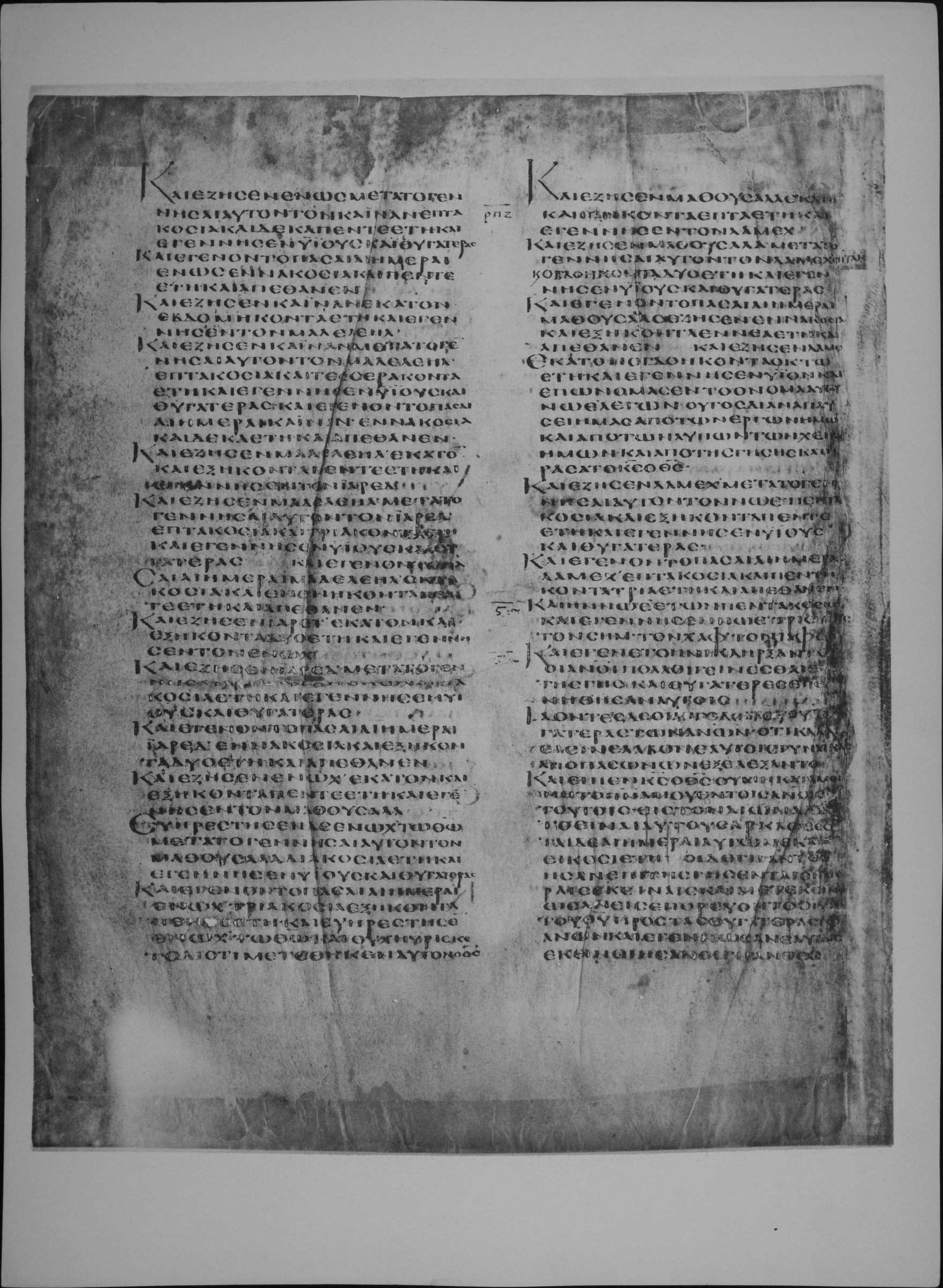
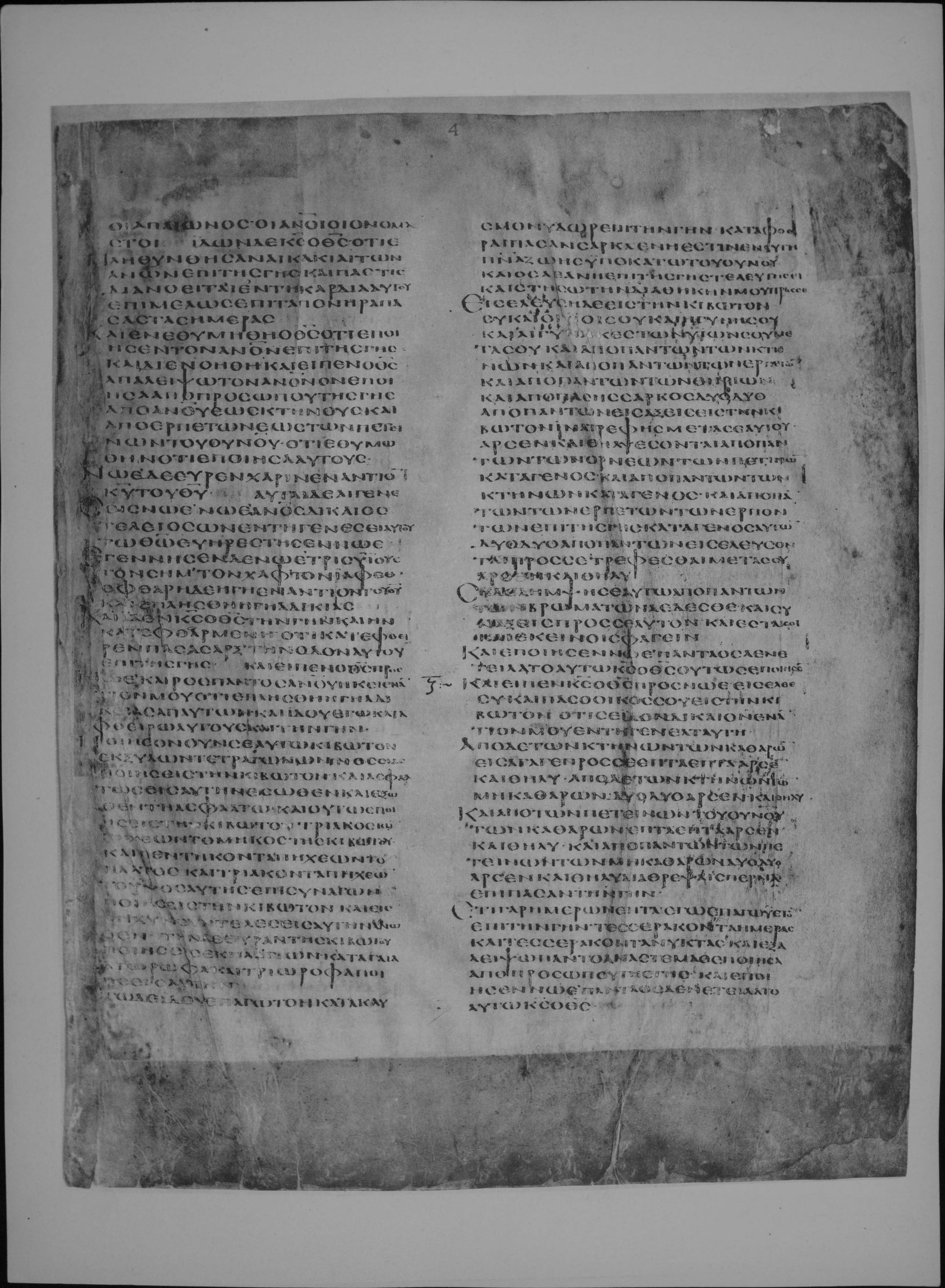
Where on the image
Genesis 6:1-4 is on fol. 3v (full-size facsimile of 1879-83, Internet Archive codex-alexandrinus leaf 27). The 1915 reduced facsimile prints beneath this page: Gen. v. 10-vi. 4. Checked on the plate: the page begins at the start of Genesis 5:10 (first words read: ΚΑΙ ΕΖΗΣΕΝ ΕΝΩΣ ΜΕΤΑ ΤΟ ΓΕΝΝΗΣΑΙ ΑΥΤΟΝ ΤΟΝ ΚΑΙΝΑΝ). Genesis 6:4-8 is on fol. 4r (full-size facsimile of 1879-83, Internet Archive codex-alexandrinus leaf 28). The 1915 reduced facsimile prints beneath this page: Gen. vi. 4-vii. 5. Checked on the plate: the page begins inside Genesis 6:4 (first words read: ΟΙ ΑΠ ΑΙΩΝΟΣ ΟΙ ΑΝΘΡΩΠΟΙ ΟΙ ΟΝΟΜΑΣΤΟΙ ΙΔΩΝ ΔΕ ΚΣ Ο ΘΣ).
1Καὶ ἐγένετο ἡνίκα ἤρξαντο οἱ ἄνθρωποι πολλοὶ γίνεσθαι ἐπὶ τῆς γῆς, καὶ θυγατέρες ἐγενήθησαν αὐτοῖς· 2ἰδόντες δὲ οἱ ἄγγελοι τοῦ θεοῦ τὰς θυγατέρας τῶν ἀνθρώπων ὅτι καλαί εἰσιν, ἔλαβον ἑαυτοῖς γυναῖκας ἀπὸ πασῶν ὧν ἐξελέξαντο. 3καὶ εἶπεν Κύριος ὁ θεός Οὐ μὴ καταμείνῃ τὸ πνεῦμά μου ἐν τοῖς ἀνθρώποις τούτοις εἰς τὸν αἰῶνα, διὰ τὸ εἶναι αὐτοὺς σάρκας· ἔσονται δὲ αἱ ἡμέραι αὐτῶν ἑκατὸν εἴκοσι ἔτη. 4οἱ δὲ γίγαντες ἦσαν ἐπὶ τῆς γῆς ἐν ταῖς ἡμέραις ἐκείναις, καὶ μετ᾽ ἐκεῖνο ὡς ἂν εἰσεπορεύοντο οἱ υἱοὶ τοῦ θεοῦ πρὸς τὰς θυγατέρας τῶν ἀνθρώπων, καὶ ἐγεννῶσαν ἑαυτοῖς· ἐκεῖνοι ἦσαν οἱ γίγαντες οἱ ἀπ᾽ αἰῶνος, οἱ ἄνθρωποι οἱ ὀνομαστοί. 5ἰδὼν δὲ Κύριος ὁ θεὸς ὅτι ἐπληθύνθησαν αἱ κακίαι τῶν ἀνθρώπων ἐπὶ τῆς γῆς, καὶ πᾶς τις διανοεῖται ἐν τῇ καρδίᾳ αὐτοῦ ἐπιμελῶς ἐπὶ τὰ πονηρὰ πάσας τὰς ἡμέρας· 6καὶ ἐνεθυμήθη ὁ θεὸς ὅτι ἐποίησεν τὸν ἄνθρωπον ἐπὶ τῆς γῆς, καὶ διενοήθη. 7καὶ εἶπεν ὁ θεός Ἀπαλείψω τὸν ἄνθρωπον ὃν ἐποίησα ἀπὸ προσώπου τῆς γῆς, ἀπὸ ἀνθρώπου ἕως κτήνους καὶ ἀπὸ ἑρπετῶν ἕως τῶν πετεινῶν τοῦ οὐρανοῦ· ὅτι ἐθυμώθην ὅτι ἐποίησα αὐτούς. 8Νῶε δὲ εὗρεν χάριν ἐναντίον Κυρίου τοῦ θεοῦ.
1And it came to pass when men began to be numerous upon the earth, and daughters were born to them, 2that the sons of God having seen the daughters of men that they were beautiful, took to themselves wives of all whom they chose. 3And the Lord God said, My Spirit shall certainly not remain among these men for ever, because they are flesh, but their days shall be an hundred and twenty years. 4Now the giants were upon the earth in those days; and after that when the sons of God were wont to go in to the daughters of men, they bore children to them, those were the giants of old, the men of renown. 5And the Lord God having seen that the wicked actions of men were multiplied upon the earth, and that every one in his heart was intently brooding over evil continually, 6then God laid it to heart that he had made man upon the earth, and he pondered it deeply. 7And God said, I will blot out man whom I have made from the face of the earth, even man with cattle, and reptiles with flying creatures of the sky, for I am grieved that I have made them. 8But Noe found grace before the Lord God.
Where on the image
Genesis 6:9-16 is on fol. 4r (full-size facsimile of 1879-83, Internet Archive codex-alexandrinus leaf 28). The 1915 reduced facsimile prints beneath this page: Gen. vi. 4-vii. 5. Checked on the plate: the page begins inside Genesis 6:4 (first words read: ΟΙ ΑΠ ΑΙΩΝΟΣ ΟΙ ΑΝΘΡΩΠΟΙ ΟΙ ΟΝΟΜΑΣΤΟΙ ΙΔΩΝ ΔΕ ΚΣ Ο ΘΣ).
9Αὗται δὲ αἱ γενέσεις Νῶε. Νῶε ἄνθρωπος δίκαιος, τέλειος ὢν ἐν τῇ γενέσει αὐτοῦ· τῷ θεῷ εὐηρέστησεν Νῶε. 10ἐγέννησεν δὲ Νῶε τρεῖς υἱούς, τὸν Σήμ, τὸν Χάμ, τὸν Ἰάφεθ. 11ἐφθάρη δὲ ἡ γῆ ἐναντίον τοῦ θεοῦ, καὶ ἐπλήσθη ἡ γῆ ἀδικίας. 12καὶ ἴδεν Κύριος ὁ θεὸς τὴν γῆν, καὶ ἦν κατεφθαρμένη, ὅτι κατέφθειρεν πᾶσα σὰρξ τὴν ὁδὸν αὐτοῦ ἐπὶ τῆς γῆς. 13Καὶ εἶπεν ὁ θεὸς πρὸς Νῶε Καιρὸς παντὸς ἀνθρώπου ἥκει ἐναντίον μου, ὅτι ἐπλήσθη ἡ γῆ ἀδικίας ἀπ᾽ αὐτῶν· καὶ ἰδοὺ ἐγὼ καταφθείρω αὐτοὺς καὶ τὴν γῆν. 14ποίησον οὖν σεαυτῷ κιβωτὸν ἐκ ξύλων τετραγώνων· νοσσιὰς ποιήσεις τὴν κιβωτόν, καὶ ἀσφαλτώσεις αὐτὴν ἔσωθεν καὶ ἔξωθεν τῇ ἀσφάλτῳ. 15καὶ οὕτως ποιήσεις τὴν κιβωτόν· τριακοσίων πήχεων τὸ μῆκος τῆς κιβωτοῦ, καὶ πεντήκοντα πήχεων τὸ πλάτος, καὶ τριάκοντα πήχεων τὸ ὕψος αὐτῆς. 16ἐπισυνάγων ποιήσεις τὴν κιβωτόν, καὶ εἰς πῆχυν συντελέσεις αὐτὴν ἄνωθεν· τὴν δὲ θύραν τῆς κιβωτοῦ ποιήσεις ἐκ πλαγίων· κατάγαια διώροφα καὶ τριώροφα ποιήσεις αὐτήν.
9And these are the generations of Noe. Noe was a just man; being perfect in his generation, Noe was well-pleasing to God. 10And Noe begot three sons, Sem, Cham, Japheth. 11But the earth was corrupted before God, and the earth was filled with iniquity. 12And the Lord God saw the earth, and it was corrupted; because all flesh had corrupted its way upon the earth. 13And the Lord God said to Noe, A period of all men is come before me; because the earth has been filled with iniquity by them, and, behold, I destroy them and the earth. 14Make therefore for thyself an ark of square timber; thou shalt make the ark in compartments, and thou shalt pitch it within and without with pitch. 15And thus shalt thou make the ark; three hundred cubits the length of the ark, and fifty cubits the breadth, and thirty cubits the height of it. 16Thou shalt narrow the ark in making it, and in a cubit above thou shalt finish it, and the door of the ark thou shalt make on the side; with lower, second, and third stories thou shalt make it.
Where on the image
Genesis 6:17-22 is on fol. 4r (full-size facsimile of 1879-83, Internet Archive codex-alexandrinus leaf 28). The 1915 reduced facsimile prints beneath this page: Gen. vi. 4-vii. 5. Checked on the plate: the page begins inside Genesis 6:4 (first words read: ΟΙ ΑΠ ΑΙΩΝΟΣ ΟΙ ΑΝΘΡΩΠΟΙ ΟΙ ΟΝΟΜΑΣΤΟΙ ΙΔΩΝ ΔΕ ΚΣ Ο ΘΣ).
17ἐγὼ δὲ ἰδοὺ ἐπάγω τὸν κατακλυσμὸν ὕδωρ ἐπὶ τὴν γῆν, καταφθεῖραι πᾶσαν σάρκα ἐν ᾗ ἐστὶν ἐν αὐτῇ πνεῦμα ζωῆς ὑποκάτω τοῦ οὐρανοῦ· καὶ ὅσα ἐὰν ᾖ ἐπὶ τῆς γῆς τελευτήσει. 18καὶ στήσω τὴν διαθήκην μου πρὸς σέ· εἰσελεύσῃ δὲ εἰς τὴν κιβωτόν, σὺ καὶ οἱ υἱοί σου καὶ ἡ γυνή σου καὶ αἱ γυναῖκες τῶν υἱῶν σου μετὰ σοῦ. 19καὶ ἀπὸ πάντων τῶν κτηνῶν καὶ ἀπὸ πάντων τῶν ἑρπετῶν καὶ ἀπὸ πάντων τῶν θηρίων καὶ ἀπὸ πάσης σαρκός, δύο δύο ἀπὸ πάντων εἰσάξεις εἰς τὴν κιβωτόν, ἵνα τρέφῃς μετὰ σεαυτοῦ· ἄρσεν καὶ θῆλυ ἔσονται. 20ἀπὸ πάντων τῶν ὀρνέων τῶν πετεινῶν κατὰ γένος καὶ ἀπὸ πάντων τῶν κτηνῶν κατὰ γένος καὶ ἀπὸ πάντων τῶν ἑρπετῶν τῶν ἑρπόντων ἐπὶ τῆς γῆς κατὰ γένος αὐτῶν, δύο δύο ἀπὸ πάντων εἰσελεύσονται πρὸς σὲ τρέφεσθαι μετὰ σοῦ, ἄρσεν καὶ θῆλυ. 21σὺ δὲ λήμψῃ σεαυτῷ ἀπὸ πάντων τῶν βρωμάτων ἃ ἔδεσθε, καὶ συνάξεις πρὸς σεαυτόν, καὶ ἔσται σοὶ καὶ ἐκείνοις φαγεῖν. 22καὶ ἐποίησεν Νῶε πάντα ὅσα ἐνετείλατο αὐτῷ Κύριος ὁ θεός, οὕτως ἐποίησεν.
17And behold I bring a flood of water upon the earth, to destroy all flesh in which is the breath of life under heaven, and whatsoever things are upon the earth shall die. 18And I will establish my covenant with thee, and thou shalt enter into the ark, and thy sons and thy wife, and thy sons' wives with thee. 19And of all cattle and of all reptiles and of all wild beasts, even of all flesh, thou shalt bring by pairs of all, into the ark, that thou mayest feed them with thyself: male and female they shall be. 20Of all winged birds after their kind, and of all cattle after their kind, and of all reptiles creeping upon the earth after their kind, pairs of all shall come in to thee, male and female to be fed with thee. 21And thou shalt take to thyself of all kinds of food which ye eat, and thou shalt gather them to thyself, and it shall be for thee and them to eat. 22And Noe did all things whatever the Lord God commanded him, so did he.
Cite
Sources
- Source: Codex Alexandrinus (British Library Royal MS 1 D. V) via the British Museum photographic facsimiles of 1879-83 and 1915 (Internet Archive) + Swete's Septuagint + Brenton's English (holding institution)
- Critical edition: H. B. Swete, The Old Testament in Greek according to the Septuagint (1909)
← previous · → next · v cycle view · l back to library