Haggai, Chapter 2 (Codex Alexandrinus)
Introduction
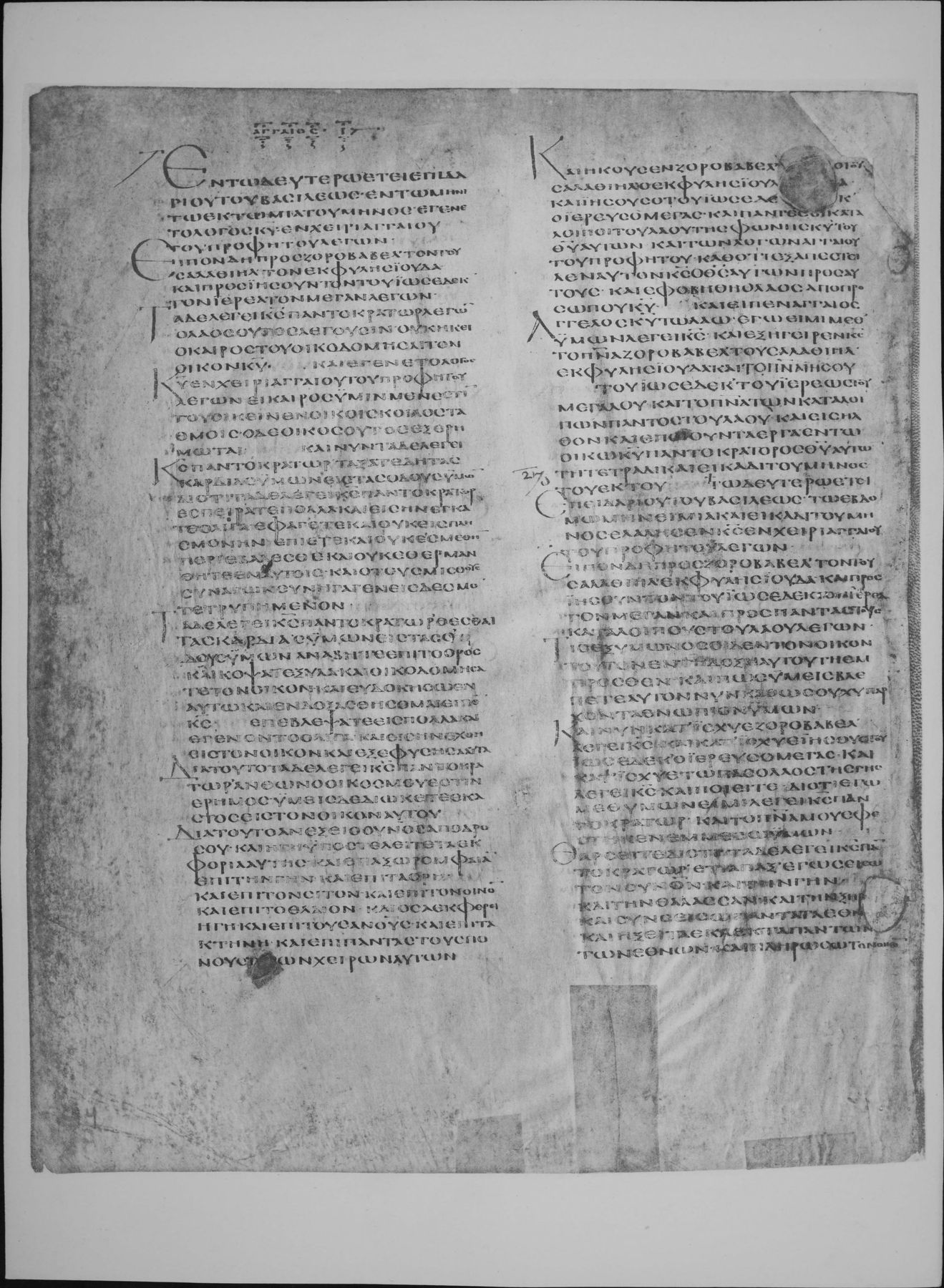
Haggai 2 in the Greek Old Testament (the Septuagint) as written in Codex Alexandrinus, a Greek Bible copied in the fifth century, probably in Egypt, and now in the British Library (Royal MS 1 D. VI, the second of its four volumes). It is one of the three great early codices of the whole Greek Bible, with Codex Vaticanus and Codex Sinaiticus.
Numbering: Swete's Greek and Brenton's English number or divide some verses of this chapter differently (Swete 2:1 = Brenton 1:15-2:1). Each column keeps its own verse numbers, and sections are cut only where the two texts agree, so each section holds the same passage in both languages.
This entry meets the strict three-criteria standard of the Theosis Library:
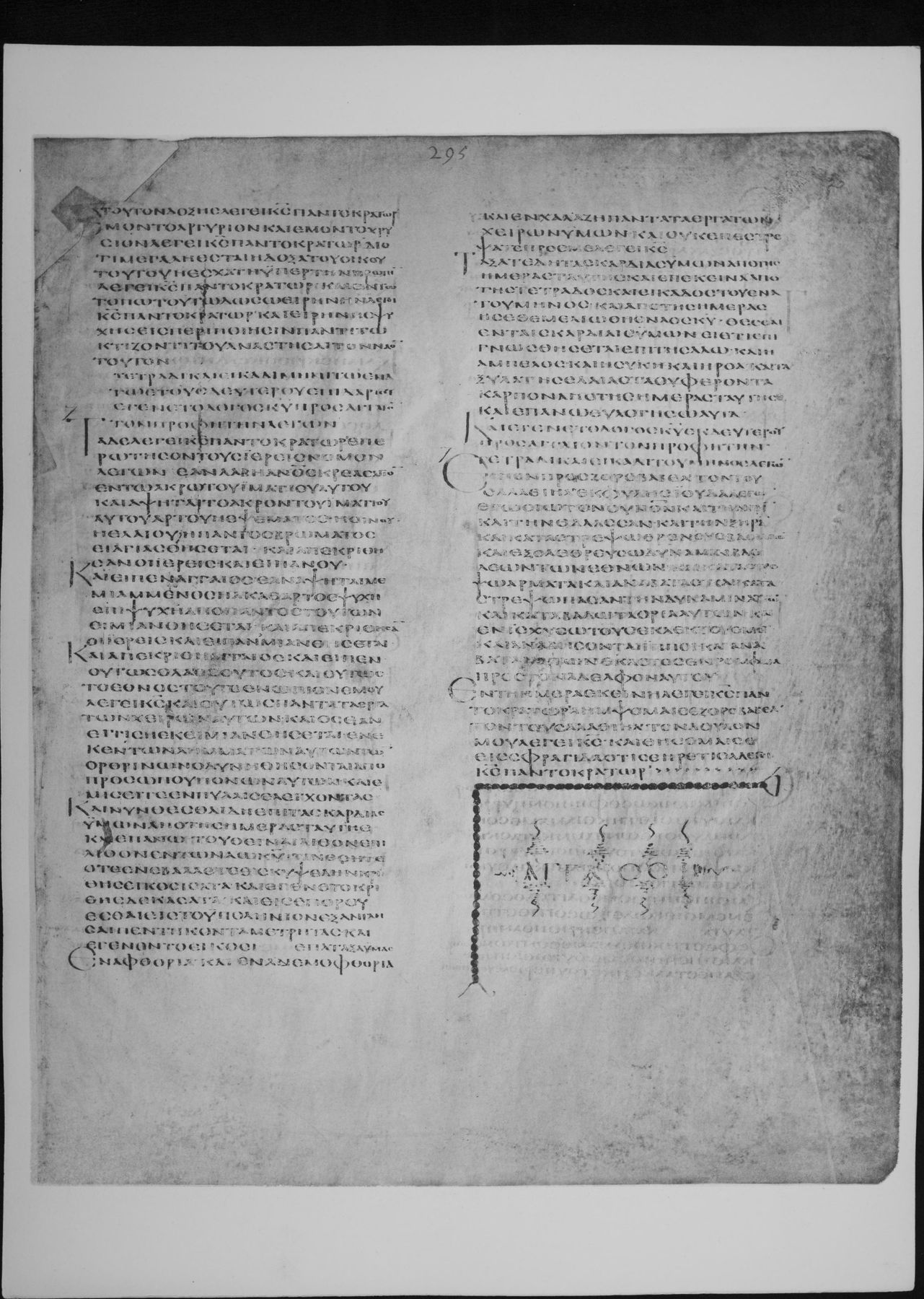
- Manuscript scan: the pages of Codex Alexandrinus carrying this chapter (fol. 294v, fol. 295r), from the full-size photographic (autotype) facsimile published by the British Museum in 1879-1883, as digitised on the Internet Archive. The verse range of every page comes from the reduced photographic facsimile of 1936, which prints it beneath each plate, and the opening words of every page were read on the plate to confirm the page and the verse it begins with. Each section links to the page or pages that hold its verses. Folio numbers are those written at the head of each leaf and visible on the plates.
- Original text: Swete's edition, which here prints the text of Codex Vaticanus (Vat. gr. 1209), the base of his edition, and gives the readings of Alexandrinus only in his apparatus. The Greek column is therefore Vaticanus' text; where Alexandrinus differs, the plate shows what Alexandrinus reads.
- English translation: Sir Lancelot C. L. Brenton, The Septuagint Version of the Old Testament (1844; 1851 edition), a translation of the Greek, public domain, from the eBible.org text.
How was this verified? (Provenance)
Where on the image
Haggai 2:1-7 is on fol. 294v (full-size facsimile of 1879-83, Internet Archive codex-alexandrinus leaf 613). The 1936 reduced facsimile prints beneath this page: Hag. i. 1-ii. 7. Checked on the plate: the page begins at the start of Haggai 1:1 (first words read: ΕΝ ΤΩ ΔΕΥΤΕΡΩ ΕΤΕΙ ΕΠΙ ΔΑΡΕΙΟΥ ΤΟΥ ΒΑΣΙΛΕΩΣ ΕΝ ΤΩ ΜΗΝΙ ΤΩ ΕΚΤΩ ΜΙΑ ΤΟΥ ΜΗΝΟΣ). Haggai 2:7-8 is on fol. 295r (full-size facsimile of 1879-83, Internet Archive codex-alexandrinus leaf 614). The 1936 reduced facsimile prints beneath this page: Hag. ii. 7-23. Checked on the plate: the page begins inside Haggai 2:7 (first words read: ΤΟΥΤΟΝ ΔΟΞΗΣ ΛΕΓΕΙ ΚΣ ΠΑΝΤΟΚΡΑΤΩΡ ΕΜΟΝ ΤΟ ΑΡΓΥΡΙΟΝ ΚΑΙ ΕΜΟΝ ΤΟ ΧΡΥΣΙΟΝ).
1τῇ τετράδι καὶ εἰκάδι τοῦ μηνὸς τοῦ ἕκτου τῷ δευτέρῳ ἔτει ἐπὶ Δαρίου τοῦ βασιλέως. Τῷ μηνὶ τῷ ἑβδόμῳ μιᾷ καὶ εἰκάδι τοῦ μηνὸς ἐλάλησεν Κύριος ἐν χειρὶ Ἁγγαίου τοῦ προφήτου λέγων 2Εἰπὸν δὴ πρὸς Ζοροβαβὲλ τὸν Σαλαθιὴλ ἐκ φυλῆς Ἰούδα καὶ πρὸς Ἰησοῦν τὸν τοῦ Ἰωσεδὲκ τὸν ἱερέα τὸν μέγαν καὶ πρὸς πάντας τοὺς καταλοίπους τοῦ λαοῦ λέγων 3Τίς ἐξ ὑμῶν ὃς εἶδεν τὸν οἶκον τοῦτον ἐν τῇ δόξῃ αὐτοῦ τῇ ἔμπροσθεν; καὶ πῶς ὑμεῖς βλέπετε αὐτὸν νῦν; καθὼς οὐχ ὑπάρχοντα ἐνώπιον ὑμῶν. 4καὶ νῦν κατίσχυε, Ζοροβαβέλ, λέγει Κύριος, καὶ κατίσχυε, Ἰησοῦ ὁ τοῦ Ἰωσεδὲκ ὁ ἱερεὺς ὁ μέγας, καὶ κατισχυέτω πᾶς ὁ λαὸς τῆς γῆς, λέγει Κύριος, καὶ ποιεῖτε· διότι μεθ᾽ ὑμῶν ἐγώ εἰμι, λέγει Κύριος ὁ παντοκράτωρ, 5καὶ τὸ πνεῦμά μου ἐφέστηκεν ἐν μέσῳ ὑμῶν· θαρσεῖτε. 6διότι λέγει Κύριος Παντοκράτωρ Ἔτι ἅπαξ ἐγὼ σείσω τὸν οὐρανὸν καὶ τὴν γῆν καὶ τὴν θάλασσαν καὶ τὴν ξηράν, 7καὶ συνσείσω πάντα τὰ ἔθνη, καὶ ἥξει τὰ ἐκλεκτὰ πάντων τῶν ἐθνῶν· καὶ πλήσω τὸν οἶκον τοῦτον δόξης, λέγει Κύριος Παντοκράτωρ. 8ἐμὸν τὸ ἀργύριον καὶ ἐμὸν τὸ χρυσίον, λέγει Κύριος Παντοκράτωρ.
1:15on the four and twentieth day of the sixth month, in the second year of Darius the king. 1In the seventh month, on the twenty-first day of the month, the Lord spoke by Aggæus the prophet, saying, 2Speak now to Zorobabel the son of Salathiel, of the tribe of Juda, and to Jesus the son of Josedec, the high priest, and to all the remnant of the people, saying, 3Who is there of you that saw this house in her former glory? and how do ye now look upon it, as it were nothing before your eyes? 4Yet now be strong, O Zorobabel, saith the Lord; and strengthen thyself, O Jesus the high priest, the son of Josedec; and let all the people of the land strengthen themselves, saith the Lord, and work, for I am with you, saith the Lord Almighty; 5and my Spirit remains in the midst of you; be of good courage. 6For thus saith the Lord Almighty; Yet once I will shake the heaven, and the earth, and the sea, and the dry land; 7and I will shake all nations, and the choice portions of all the nations shall come: and I will fill this house with glory, saith the Lord Almighty. 8Mine is the silver, and mine the gold, saith the Lord Almighty.
Where on the image
Haggai 2:9-16 is on fol. 295r (full-size facsimile of 1879-83, Internet Archive codex-alexandrinus leaf 614). The 1936 reduced facsimile prints beneath this page: Hag. ii. 7-23. Checked on the plate: the page begins inside Haggai 2:7 (first words read: ΤΟΥΤΟΝ ΔΟΞΗΣ ΛΕΓΕΙ ΚΣ ΠΑΝΤΟΚΡΑΤΩΡ ΕΜΟΝ ΤΟ ΑΡΓΥΡΙΟΝ ΚΑΙ ΕΜΟΝ ΤΟ ΧΡΥΣΙΟΝ).
9διότι μεγάλη ἔσται ἡ δόξα τοῦ οἴκου τούτου ἡ ἐσχάτη ὑπὲρ τὴν πρώτην, λέγει Κύριος Παντοκράτωρ· καὶ ἐν τῷ τόπῳ τούτῳ δώσω εἰρήνην, λέγει Κύριος Παντοκράτωρ, καὶ εἰρήνην ψυχῆς εἰς περιποίησιν παντὶ τῷ κτίζοντι τοῦ ἀναστῆσαι τὸν ναὸν τοῦτον. 10Τετράδι καὶ εἰκάδι τοῦ ἐνάτου μηνὸς ἔτους δευτέρου ἐπὶ Δαρίου ἐγένετο λόγος Κυρίου πρὸς Ἁγγαῖον τὸν προφήτην λέγων 11Τάδε λέγει Κύριος Παντοκράτωρ Ἐπερώτησον τοὺς ἱερεῖς νόμον λέγων 12Ἐὰν λάβῃ ἄνθρωπος κρέας ἅγιον ἐν τῷ ἄκρῳ τοῦ ἱματίου αὐτοῦ, καὶ ἅψηται τὸ ἄκρον τοῦ ἱματίου αὐτοῦ ἄρτου ἢ ἑψέματος ἢ οἴνου ἢ ἐλαίου ἢ παντὸς βρώματος, εἰ ἁγιασθήσεται; καὶ ἀπεκρίθησαν οἱ ἱερεῖς καὶ εἶπαν Οὔ. 13καὶ εἶπεν Ἁγγαῖος Ἐὰν ἅψηται μεμιαμμένος ἀκάθαρτος ἐπὶ ψυχῇ ἐπὶ παντὸς τούτων, εἰ μιανθήσεται; καὶ ἀπεκρίθησαν οἱ ἱερεῖς καὶ εἶπαν Μιανθήσεται. 14καὶ ἀπεκρίθη Ἁγγαῖος καὶ εἶπεν Οὕτως ὁ λαὸς οὗτος, καὶ οὕτως τὸ ἔθνος τοῦτο ἐνώπιον ἐμοῦ, λέγει Κύριος, καὶ οὕτως πάντα τὰ ἔργα τῶν χειρῶν αὐτῶν, καὶ ὃς ἐὰν ἐγγίσῃ ἐκεῖ, μιανθήσεται ἕνεκεν τῶν λημμάτων αὐτῶν τῶν ὀρθρινῶν, ὀδυνηθήσονται ἀπὸ προσώπου πόνων αὐτῶν· καὶ ἐμισεῖτε ἐν πύλαις ἐλέγχοντας. 15καὶ νῦν θέσθε δὴ εἰς τὰς καρδίας ὑμῶν ἀπὸ τῆς ἡμέρας ταύτης καὶ ὑπεράνω, πρὸ τοῦ θεῖναι λίθον ἐπὶ λίθον ἐν τῷ ναῷ Κυρίου, 16τίνες ἦτε, ὅτε ἐνεβάλλετε εἰς κυψέλην κριθῆς εἴκοσι σάτα, καὶ ἐγένετο κριθῆς δέκα σάτα, καὶ εἰσεπορεύεσθε εἰς τὸ ὑπολήνιον ἐξαντλῆσαι πεντήκοντα μετρητάς, καὶ ἐγένοντο εἴκοσι.
9For the glory of this house shall be great, the latter more than the former, saith the Lord Almighty: and in this place will I give peace, saith the Lord Almighty, even peace of soul for a possession to every one that builds, to raise up this temple. 10On the four and twentieth day of the ninth month, in the second year of Darius, the word of the Lord came to Aggæus the prophet, saying, 11Thus saith the Lord Almighty; Inquire now of the priests concerning the law, saying, 12If a man should take holy flesh in the skirt of his garment, and the skirt of his garment should touch bread, or pottage, or wine, or oil, or any meat, shall it be holy? And the priests answered and said, No. 13And Aggæus said, If a defiled person who is unclean by reason of a dead body, touch any of these, shall it be defiled? And the priests answered and said, It shall be defiled. 14And Aggæus answered and said, So is this people, and so is this nation before me, saith the Lord; and so are all the works of their hands: and whosoever shall approach them, shall be defiled [because of their early burdens: they shall be pained because of their toils; and ye have hated him that reproved in the gates]. 15And now consider, I pray you, from this day and beforetime, before they laid a stone on a stone in the temple of the Lord, what manner of men ye were. 16When ye cast into the corn-bin twenty measures of barley, and there were only ten measures of barley: and ye went to the vat to draw out fifty measures, and there were but twenty.
Where on the image
Haggai 2:17-23 is on fol. 295r (full-size facsimile of 1879-83, Internet Archive codex-alexandrinus leaf 614). The 1936 reduced facsimile prints beneath this page: Hag. ii. 7-23. Checked on the plate: the page begins inside Haggai 2:7 (first words read: ΤΟΥΤΟΝ ΔΟΞΗΣ ΛΕΓΕΙ ΚΣ ΠΑΝΤΟΚΡΑΤΩΡ ΕΜΟΝ ΤΟ ΑΡΓΥΡΙΟΝ ΚΑΙ ΕΜΟΝ ΤΟ ΧΡΥΣΙΟΝ).
17ἐπάταξα ὑμᾶς ἐν ἀφορίᾳ καὶ ἐν ἀνεμοφθορίᾳ καὶ ἐν χαλάζῃ, πάντα τὰ ἔργα τῶν χειρῶν ὑμῶν, καὶ οὐκ ἐπεστρέψατε πρὸς μέ, λέγει Κύριος. 18ὑποτάξατε δὴ τὰς καρδίας ὑμῶν ἀπὸ τῆς ἡμέρας ταύτης καὶ ἐπέκεινα, ἀπὸ τῆς τετράδος καὶ εἰκάδος τοῦ ἐνάτου μηνός, καὶ ἀπὸ τῆς ἡμέρας ἧς τεθεμελίωται ὁ ναὸς Κυρίου· θέσθε ἐν ταῖς καρδίαις ὑμῶν, 19εἰ ἐπιγνωσθήσεται ἐπὶ τῆς ἅλω, καὶ εἰ ἔτι ἡ ἄμπελος καὶ ἡ συκῆ καὶ ἡ ῥόα καὶ τὰ ξύλα τῆς ἐλαίας τὰ οὐ φέροντα καρπόν· ἀπὸ τῆς ἡμέρας ταύτης εὐλογήσω. 20Καὶ ἐγένετο λόγος Κυρίου ἐκ δευτέρου πρὸς Ἁγγαῖον τὸν προφήτην τετράδι καὶ εἰκάδι τοῦ μηνὸς λέγων 21Εἰπὸν πρὸς Ζοροβαβὲλ τὸν τοῦ Σαλαθιὴλ ἐκ φυλῆς Ἰούδα λέγων Ἐγὼ σείω τὸν οὐρανὸν καὶ τὴν γῆν καὶ τὴν θάλασσαν καὶ τὴν ξηράν, 22καὶ καταστρέψω θρόνους βασιλέων, καὶ ὀλεθρεύσω δύναμιν βασιλέων τῶν ἐθνῶν, καὶ καταστρέψω ἅρματα καὶ ἀναβάτας, καὶ καταβήσονται ἵπποι καὶ ἀναβάται αὐτῶν ἕκαστος ἐν ῥομφαίᾳ πρὸς τὸν ἀδελφὸν αὐτοῦ. 23ἐν τῇ ἡμέρᾳ ἐκείνῃ, λέγει Κύριος Παντοκράτωρ, λήμψομαί σε Ζοροβαβὲλ τὸν τοῦ Σαλαθιὴλ τὸν δοῦλόν μου, λέγει Κύριος, καὶ θήσομαί σε ὡς σφραγῖδα, διότι σὲ ᾑρέτισα, λέγει Κύριος Παντοκράτωρ.
17I smote you with barrenness, and with blasting, and all the works of your hands with hail; yet ye returned not to me, saith the Lord. 18Set your hearts now to think from this day and upward, from the four and twentieth day of the ninth month, even from the day when the foundation of the temple of the Lord was laid; 19consider in your hearts, whether this shall be known on the corn-floor, and whether yet the vine, and the fig-tree, and the pomegranate, and the olive-trees that bear no fruit are with you: from this day will I bless you. 20And the word of the Lord came the second time to Aggæus the prophet, on the four and twentieth day of the month, saying, 21Speak to Zorobabel the son of Salathiel, of the tribe of Juda, saying, 22and I will overthrow the thrones of kings, and I will destroy the power of the kings of the nations; and I will overthrow chariots and riders; and the horses and their riders shall come down, every one by the sword striving against his brother. 23In that day, saith the Lord Almighty, I will take thee, O Zorobabel, the son of Salathiel, my servant, saith the Lord, and will make thee as a seal: for I have chosen thee, saith the Lord Almighty.
Cite
Sources
- Source: Codex Alexandrinus (British Library Royal MS 1 D. VI) via the British Museum photographic facsimiles of 1879-83 and 1936 (Internet Archive) + Swete's Septuagint + Brenton's English (holding institution)
- Critical edition: H. B. Swete, The Old Testament in Greek according to the Septuagint (1909)
← previous · → next · v cycle view · l back to library