Isaiah, Chapter 36 (Codex Alexandrinus)
Introduction
Isaiah 36 in the Greek Old Testament (the Septuagint) as written in Codex Alexandrinus, a Greek Bible copied in the fifth century, probably in Egypt, and now in the British Library (Royal MS 1 D. VI, the second of its four volumes). It is one of the three great early codices of the whole Greek Bible, with Codex Vaticanus and Codex Sinaiticus.
This entry meets the strict three-criteria standard of the Theosis Library:
- Manuscript scan: the pages of Codex Alexandrinus carrying this chapter (fol. 317r, fol. 317v), from the full-size photographic (autotype) facsimile published by the British Museum in 1879-1883, as digitised on the Internet Archive. The verse range of every page comes from the reduced photographic facsimile of 1936, which prints it beneath each plate, and the opening words of every page were read on the plate to confirm the page and the verse it begins with. Each section links to the page or pages that hold its verses. Folio numbers are those written at the head of each leaf and visible on the plates.
- Original text: Swete's edition, which here prints the text of Codex Vaticanus (Vat. gr. 1209), the base of his edition, and gives the readings of Alexandrinus only in his apparatus. The Greek column is therefore Vaticanus' text; where Alexandrinus differs, the plate shows what Alexandrinus reads.
- English translation: Sir Lancelot C. L. Brenton, The Septuagint Version of the Old Testament (1844; 1851 edition), a translation of the Greek, public domain, from the eBible.org text.
How was this verified? (Provenance)
Where on the image
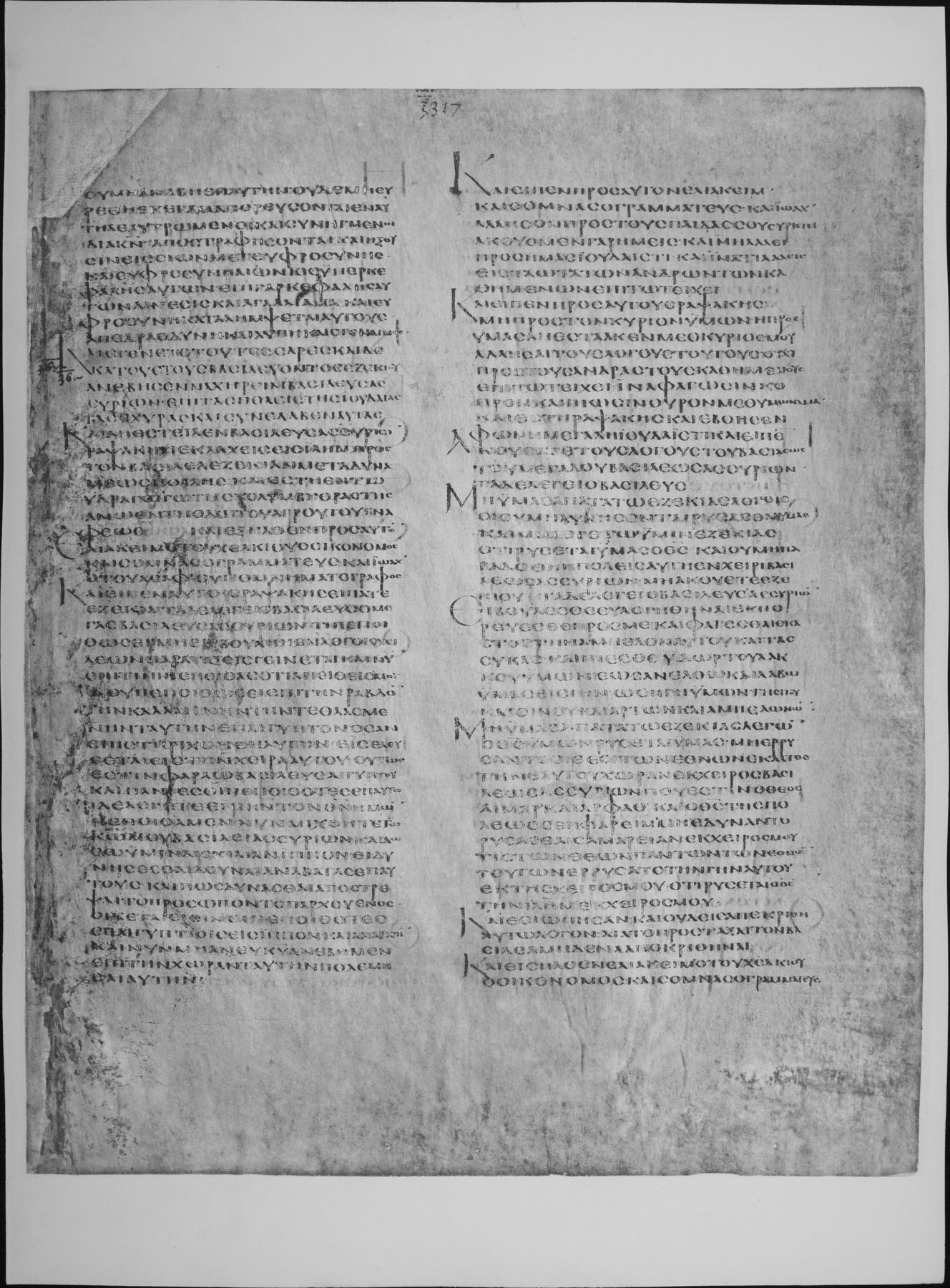
Isaiah 36:1-8 is on fol. 317r (full-size facsimile of 1879-83, Internet Archive codex-alexandrinus leaf 658). The 1936 reduced facsimile prints beneath this page: Is. xxxv. 9-xxxvi. 22. Checked on the plate: the page begins inside Isaiah 35:9 (first words read: ΟΥ ΜΗ ΑΝΑΒΗ ΕΠ ΑΥΤΗΝ ΟΥΔΕ ΜΗ ΕΥΡΕΘΗ ΕΚΕΙ ΑΛΛΑ ΠΟΡΕΥΣΟΝΤΑΙ ΕΝ ΑΥΤΗ ΛΕΛΥΤΡΩΜΕΝΟΙ).
1Καὶ ἐγένετο τοῦ τεσσαρεσκαιδεκάτου ἔτους βασιλεύοντος Ἑζεκίου ἀνέβη Σενναχηρεὶμ βασιλεὺς Ἀσσυρίων ἐπὶ τὰς πόλεις τῆς Ἰουδαίας τὰς ὀχυρὰς καὶ ἔλαβεν αὐτάς. 2καὶ ἀπέστειλεν βασιλεὺς Ἀσσυρίων Ῥαβσάκην ἐκ Λαχεὶς εἰς Ἰερουσαλὴμ πρὸς τὸν βασιλέα Ἑζεκίαν μετὰ δυνάμεως πολλῆς, καὶ ἔστη ἐν τῷ ὑδραγωγῷ τῆς κολυμβήθρας τῆς ἄνω, ἐν τῇ ὁδῷ τοῦ ἀγροῦ τοῦ γναφέως. 3καὶ ἐξῆλθεν πρὸς αὐτὸν Ἐλιακεὶμ ὁ τοῦ Χελκείου ὁ οἰκονόμος καὶ Σόβνας ὁ γραμματεὺς καὶ Ἰωὰχ ὁ τοῦ Ἀσὰφ ὁ ὑπομνηματογράφος. 4καὶ εἶπεν αὐτοῖς Ῥαβσάκης Εἴπατε Ἑζεκίᾳ Τάδε λέγει ὁ βασιλεὺς ὁ μέγας βασιλεὺς Ἀσσυρίων Τί πεποιθὼς εἶ; 5μὴ ἐν βουλῇ καὶ λόγοις χειλέων παράταξις γίνεται; καὶ νῦν ἐπὶ τίνα πέποιθας ὅτι ἀπειθεῖς μοι; 6ἰδοὺ πεποιθὼς εἶ ἐπὶ τὴν ῥάβδον τὴν καλαμίνην τὴν τεθλασμένην ταύτην, ἐπ᾽ Αἴγυπτον· ὃς ἂν ἐπιστηρισθῇ ἑπ᾽ αὐτήν, εἰσελεύσεται εἰς τὴν χεῖρα αὐτοῦ· οὕτως ἐστὶν Φαραὼ βασιλεὺς Αἰγύπτου καὶ πάντες οἱ πεποιθότες ἐπ᾽ αὐτῷ. 7εἰ δὲ λέγετε Ἐπὶ Κύριον τὸν θεὸν ἡμῶν πεποίθαμεν, 8νῦν μίχθητε τῷ κυρίῳ μου τῷ βασιλεῖ Ἀσσυρίων, καὶ δώσω ὑμῖν δισχιλίαν ἵππον, εἰ δυνήσεσθε δοῦναι ἀναβάτας ἐπ᾽ αὐτούς.
1Now it came to pass in the fourteenth year of the reign of Ezekias, that Sennacherim, king of the Assyrians, came up against the strong cities of Judea, and took them. 2And the king of the Assyrians sent Rabsaces out of Laches to Jerusalem to king Ezekias with a large force: and he stood by the conduit of the upper pool in the way of the fuller's field. 3And there went forth to him Heliakim the steward, the son of Chelcias, and Somnas the scribe, and Joach the son of Asaph, the recorder. 4And Rabsaces said to them, Say to Ezekias, Thus says the great king, the king of the Assyrians, Why art thou secure? 5Is war carried on with counsel and mere words of the lips? and now on whom dost thou trust, that thou rebellest against me? 6Behold, thou trustest on this bruised staff of reed, on Egypt: as soon as a man leans upon it, it shall go into his hand, and pierce it: so is Pharao king of Egypt and all that trust in him. 7But if ye say, We trust in the Lord our God; 8yet now make an agreement with my lord the king of the Assyrians, and I will give you two thousand horses, if ye shall be able to set riders upon them.
Where on the image
Isaiah 36:9-16 is on fol. 317r (full-size facsimile of 1879-83, Internet Archive codex-alexandrinus leaf 658). The 1936 reduced facsimile prints beneath this page: Is. xxxv. 9-xxxvi. 22. Checked on the plate: the page begins inside Isaiah 35:9 (first words read: ΟΥ ΜΗ ΑΝΑΒΗ ΕΠ ΑΥΤΗΝ ΟΥΔΕ ΜΗ ΕΥΡΕΘΗ ΕΚΕΙ ΑΛΛΑ ΠΟΡΕΥΣΟΝΤΑΙ ΕΝ ΑΥΤΗ ΛΕΛΥΤΡΩΜΕΝΟΙ).
9καὶ πῶς δύνασθε ἀποστρέψαι εἰς πρόσωπον τῶν τοπαρχῶν; οἰκέται εἰσὶν οἱ πεποιθότες ἐπ᾽ Αἴγυπτον, εἰς ἵππον καὶ ἀναβάτην. 10καὶ νῦν μὴ ἄνευ Κυρίου ἀνέβημεν ἐπὶ τὴν χώραν ταύτην πολεμῆσαι αὐτήν; Κύριος εἶπεν πρὸς μέ Ἀνάβηθι ἐπὶ τὴν γῆν ταύτην καὶ διάφθειρον αὐτήν. 11καὶ εἶπεν πρὸς αὐτὸν Ἐλιακεὶμ καὶ Σόμνας καὶ Ἰώας Λάλησον πρὸς τοὺς παῖδάς σου Συριστί, ἀκούομεν γὰρ ἡμεῖς, καὶ μὴ λάλει πρὸς ἡμᾶς Ἰουδαιστί· καὶ ἵνα τί λαλεῖς εἰς τὰ ὦτα τῶν ἀνθρώπων ἐπὶ τῷ τείχει; 12καὶ εἶπεν Ῥαβσάκης πρὸς αὐτούς Μὴ πρὸς τὸν κύριον ὑμῶν ἢ πρὸς ὑμᾶς ἀπέσταλκέν με ὁ κύριός μου λαλῆσαι τοὺς λόγους τούτους; οὐχὶ πρὸς τοὺς ἀνθρώπους τοὺς καθημένους ἐπὶ τῷ τείχει, ἵνα φάγωσιν κόπρον καὶ πίωσιν οὖρον μεθ᾽ ὑμῶν ἅμα; 13καὶ ἔστη Ῥαψάκης καὶ ἀνεβόησεν φωνῇ μεγάλῃ Ἰουδαιστὶ καὶ εἶπεν Ἀκούσατε τοὺς λόγους τοῦ βασιλέως τοῦ μεγάλου βασιλέως Ἀσσυρίων 14Τάδε λέγει ὁ βασιλεύς Μὴ ἀπατάτω ὑμᾶς Ἑζεκίας λόγοις, οὐ μὴ δύνηται ῥύσασθαι ὑμᾶς· 15καὶ μὴ λεγέτω ὑμῖν Ἑζεκίας ὅτι Ῥύσεται ὑμᾶς ὁ θεός, καὶ οὐ μὴ παραδοθῇ ἡ πόλις αὕτη ἐν χειρὶ βασιλέως Ἀσσυρίων· 16μὴ ἀκούετε Ἑζεκίου. τάδε λέγει ὁ βασιλεὺς Ἀσσυρίων Εἰ βούλεσθε εὐλογηθῆναι, ἐκπορεύεσθε πρὸς μέ, καὶ φάγεσθε ἕκαστος τὴν ἄμπελον αὐτοῦ καὶ τὰς συκᾶς, καὶ πίεσθε ὕδωρ τοῦ χαλκοῦ ὑμῶν,
9And how can ye then turn to the face of the satraps? They that trust on the Egyptians for horse and rider are our servants. 10And now, Have we come up against this land to fight against it without the Lord? The Lord said to me, Go up against this land, and destroy it. 11Then Eliakim and Somnas and Joach said to him, Speak to thy servants in the Syrian tongue; for we understand it: and speak not to us in the Jewish tongue: and wherefore speakest thou in the ears of the men on the wall? 12And Rabsaces said to them, Has my lord sent me to your lord or to you, to speak these words? has he not sent me to the men that sit on the wall, that they may eat dung, and drink their water together with you? 13And Rabsaces stood, and cried with a loud voice in the Jewish language, and said, Hear ye the words of the great king, the king of the Assyrians: 14thus says the king, Let not Ezekias deceive you with words: he will not be able to deliver you. 15And let not Ezekias say to you, That God will deliver you, and this city will not at all be delivered into the hand of the king of the Assyrians. 16Hearken not to Ezekias: thus says the king of the Assyrians, If ye wish to be blessed, come out to me: and ye shall eat every one of his vine and his fig-trees, and ye shall drink water out of your own cisterns;
Where on the image
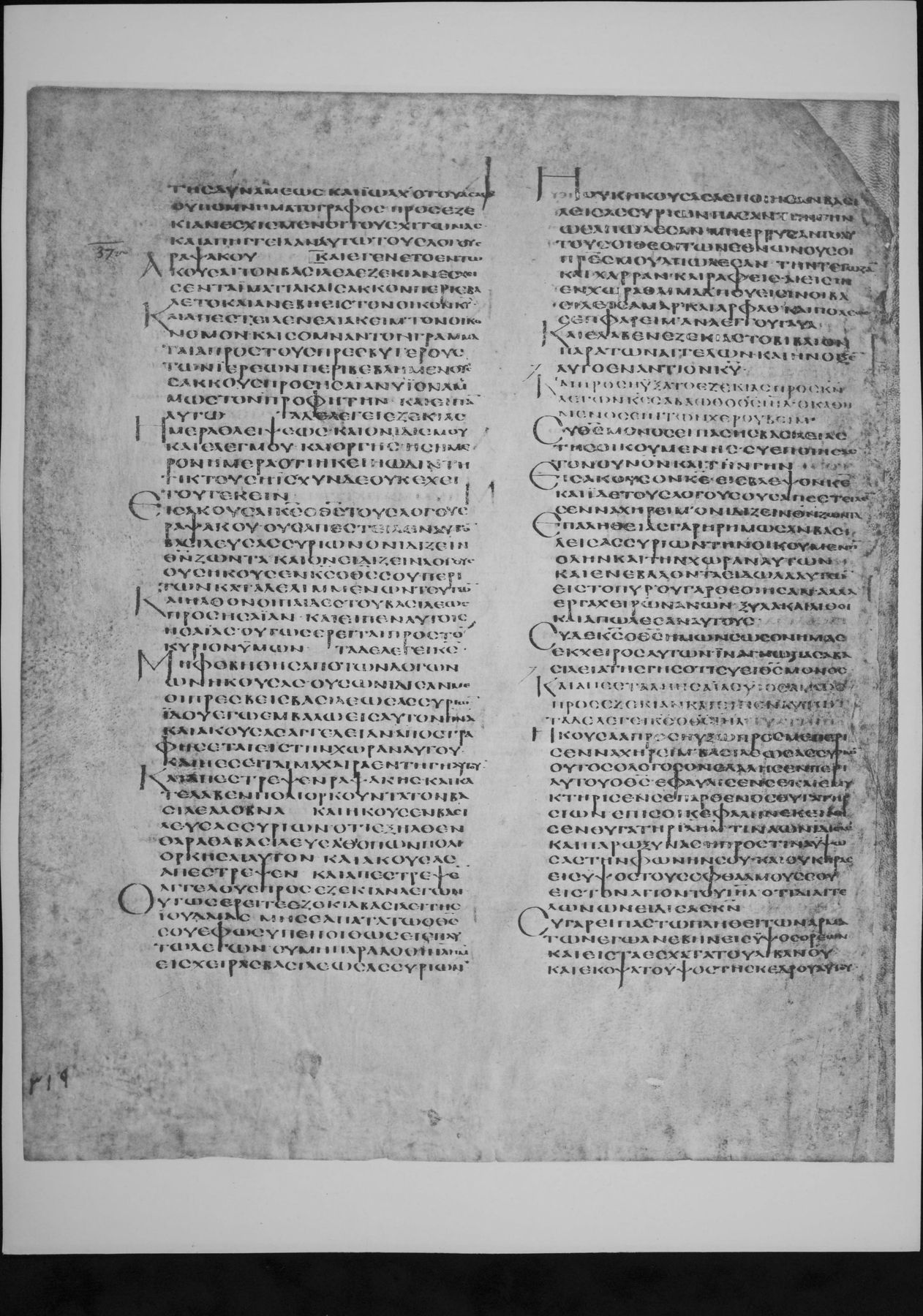
Isaiah 36:17-22 is on fol. 317r (full-size facsimile of 1879-83, Internet Archive codex-alexandrinus leaf 658). The 1936 reduced facsimile prints beneath this page: Is. xxxv. 9-xxxvi. 22. Checked on the plate: the page begins inside Isaiah 35:9 (first words read: ΟΥ ΜΗ ΑΝΑΒΗ ΕΠ ΑΥΤΗΝ ΟΥΔΕ ΜΗ ΕΥΡΕΘΗ ΕΚΕΙ ΑΛΛΑ ΠΟΡΕΥΣΟΝΤΑΙ ΕΝ ΑΥΤΗ ΛΕΛΥΤΡΩΜΕΝΟΙ). Isaiah 36:22 is on fol. 317v (full-size facsimile of 1879-83, Internet Archive codex-alexandrinus leaf 659). The 1936 reduced facsimile prints beneath this page: Is. xxxvi. 22-xxxvii. 24. Checked on the plate: the page begins inside Isaiah 36:22 (first words read: ΤΗΣ ΔΥΝΑΜΕΩΣ ΚΑΙ ΙΩΑΧ Ο ΤΟΥ ΑΣΑΦ Ο ΥΠΟΜΝΗΜΑΤΟΓΡΑΦΟΣ ΠΡΟΣ ΕΖΕΚΙΑΝ).
17ἕως ἂν ἔλθω καὶ λάβω ὑμᾶς εἰς γῆν ὡς ἡ γῆ ὑμῶν, γῆ σίτου καὶ οἴνου καὶ ἄρτων καὶ ἀμπελώνων. 18μὴ ἀπατάτω ὑμᾶς Ἑζεκίας λέγων Ὁ θεὸς ῥύσεται ὑμᾶς. μὴ ἐρρύσαντο οἱ θεοὶ τῶν ἐθνῶν ἕκαστος τὴν ἑαυτοῦ χώραν ἐκ χειρὸς βασιλέως Ἀσσυρίων; 19ποῦ ἐστιν ὁ θεὸς Ἑμὰθ καὶ Ἀρφάθ; καὶ ποῦ ὁ θεὸς τῆς πόλεως Ἐπφαρουαίμ; μὴ ἐδύναντο ῥύσασθαι Σαμάρειαν ἐκ χειρός μου; 20τίς τῶν θεῶν πάντων τῶν ἐθνῶν τούτων ὅστις ἐρρύσατο τὴν γῆν αὐτοῦ ἐκ χειρός μου, ὅτι ῥύσεται ὁ θεὸς τὴν Ἰερουσαλὴμ ἐκ χειρός μου; 21καὶ ἐσιώπησαν, καὶ οὐδεὶς ἀπεκρίθη αὐτῷ λόγον, διὰ τὸ προστάξαι τὸν βασιλέα μηδένα ἀποκριθῆναι. 22καὶ εἰσῆλθεν Ἐλιακεὶμ ὁ τοῦ Χελκίου ὁ οἰκονόμος καὶ Σόμνας ὁ γραμματεὺς τῆς δυνάμεως καὶ Ἰωὰχ ὁ τοῦ Ἀσὰφ ὁ ὑπομνηματογράφος πρὸς Ἑζεκίαν ἐσχισμένοι τοὺς χιτῶνας, καὶ ἀνήγγειλαν αὐτῷ τοὺς λόγους Ῥαβσάκου.
17until I come and take you to a land, like your own land, a land of corn and wine, and bread and vineyards. 18Let not Ezekias deceive you, saying, God will deliver you. Have the gods of the nations delivered each one his own land out of the hand of the king of the Assyrians? 19Where is the god of Emath, and Arphath? and where is the god of Eppharuaim? have they been able to deliver Samaria out of my hand? 20Which is the god of all these nations, that has delivered his land out of my hand, that God should deliver Jerusalem out of my hand? 21And they were silent, and none answered him a word; because the king had commanded that none should answer. 22And Heliakim the son of Chelcias, the steward, and Somnas the military scribe, and Joach the son of Asaph, the recorder, came in to Ezekias, having their garments rent, and they reported to him the words of Rabsaces.
Cite
Sources
- Source: Codex Alexandrinus (British Library Royal MS 1 D. VI) via the British Museum photographic facsimiles of 1879-83 and 1936 (Internet Archive) + Swete's Septuagint + Brenton's English (holding institution)
- Critical edition: H. B. Swete, The Old Testament in Greek according to the Septuagint (1909)
← previous · → next · v cycle view · l back to library