Isaiah, Chapter 53 (Codex Alexandrinus)
Introduction
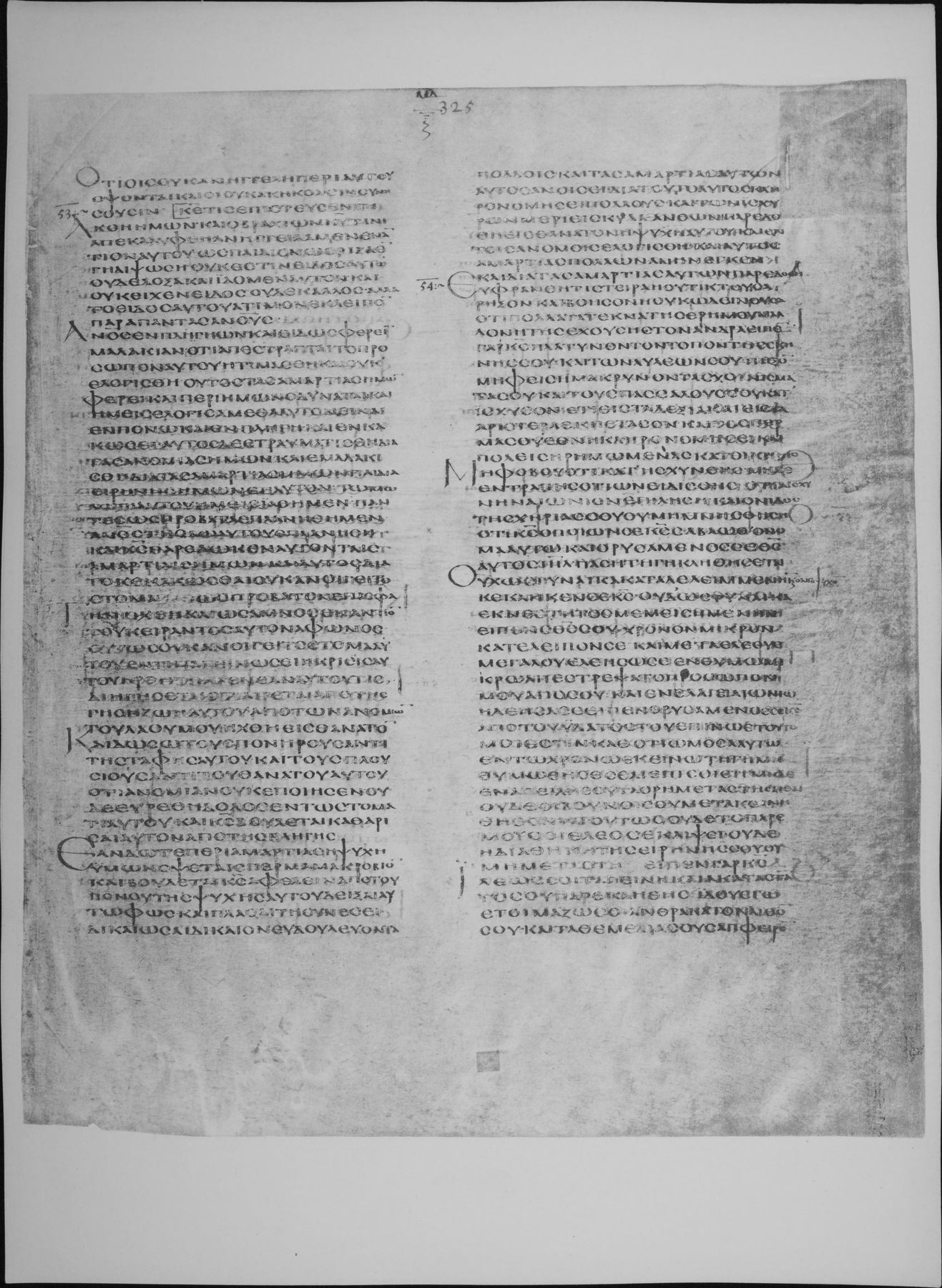
Isaiah 53 in the Greek Old Testament (the Septuagint) as written in Codex Alexandrinus, a Greek Bible copied in the fifth century, probably in Egypt, and now in the British Library (Royal MS 1 D. VI, the second of its four volumes). It is one of the three great early codices of the whole Greek Bible, with Codex Vaticanus and Codex Sinaiticus.
This entry meets the strict three-criteria standard of the Theosis Library:
- Manuscript scan: the page of Codex Alexandrinus carrying this chapter (fol. 325r), from the full-size photographic (autotype) facsimile published by the British Museum in 1879-1883, as digitised on the Internet Archive. The verse range of every page comes from the reduced photographic facsimile of 1936, which prints it beneath each plate, and the opening words of every page were read on the plate to confirm the page and the verse it begins with. Each section links to the page or pages that hold its verses. Folio numbers are those written at the head of each leaf and visible on the plates.
- Original text: Swete's edition, which here prints the text of Codex Vaticanus (Vat. gr. 1209), the base of his edition, and gives the readings of Alexandrinus only in his apparatus. The Greek column is therefore Vaticanus' text; where Alexandrinus differs, the plate shows what Alexandrinus reads.
- English translation: Sir Lancelot C. L. Brenton, The Septuagint Version of the Old Testament (1844; 1851 edition), a translation of the Greek, public domain, from the eBible.org text.
How was this verified? (Provenance)
Where on the image
Isaiah 53:1-8 is on fol. 325r (full-size facsimile of 1879-83, Internet Archive codex-alexandrinus leaf 674). The 1936 reduced facsimile prints beneath this page: Is. lii. 15-liv. 11. Checked on the plate: the page begins inside Isaiah 52:15 (first words read: ΟΤΙ ΟΙΣ ΟΥΚ ΑΝΗΓΓΕΛΗ ΠΕΡΙ ΑΥΤΟΥ ΟΨΟΝΤΑΙ ΚΑΙ ΟΙ ΟΥΚ ΑΚΗΚΟΑΣΙΝ ΣΥΝΗΣΟΥΣΙΝ).
1Κύριε, τίς ἐπίστευσεν τῇ ἀκοῇ ἡμῶν; καὶ ὁ βραχίων Κυρίου τίνι ἀπεκαλύφθη; 2ἀνηγγείλαμεν ὡς παιδίον ἐναντίον αὐτοῦ, ὡς ῥίζα ἐν γῇ διψώσῃ· οὐκ ἔστιν εἶδος αὐτῷ οὐδὲ δόξα. καὶ εἴδομεν αὐτόν, καὶ οὐκ εἶχεν εἶδος οὐδὲ κάλλος, 3ἀλλὰ τὸ εἶδος αὐτοῦ ἄτιμον καὶ ἐκλιπὸν παρὰ τοὺς υἱοὺς τῶν ἀνθρώπων· ἄνθρωπος ἐν πληγῇ ὢν καὶ εἰδὼς φέρειν μαλακίαν, ὅτι ἀπέστραπται τὸ πρόσωπον αὐτοῦ, ἠτιμάσθη καὶ οὐκ ἐλογίσθη. 4οὗτος τὰς ἁμαρτίας ἡμῶν φέρει καὶ περὶ ἡμῶν ὀδυνᾶται, καὶ ἡμεῖς ἐλογισάμεθα αὐτὸν εἶναι ἐν πόνῳ καὶ ἐν πληγῇ καὶ ἐν κακώσει. 5αὐτὸς δὲ ἐτραυματίσθη διὰ τὰς ἁμαρτίας ἡμῶν, καὶ μεμαλάκισται διὰ τὰς ἀνομίας ἡμῶν· παιδία εἰρήνης ἡμῶν ἐπ᾽ αὐτόν, τῷ μώλωπι αὐτοῦ ἡμεῖς ἰάθημεν. 6πάντες ὡς πρόβατα ἐπλανήθημεν, ἄνθρωπος τῇ ὁδῷ αὐτοῦ ἐπλανήθη· καὶ Κύριος παρέδωκεν αὐτὸν ταῖς ἁμαρτίαις ἡμῶν. 7καὶ αὐτὸς διὰ τὸ κεκακῶσθαι οὐκ ἀνοίγει τὸ στόμα· ὡς πρόβατον ἐπὶ σφαγὴν ἤχθη, καὶ ὡς ἀμνὸς ἐναντίον τοῦ κείροντος ἄφωνος, οὕτως οὐκ ἀνοίγει τὸ στόμα αὐτοῦ. 8ἐν τῇ ταπεινώσει ἡ κρίσις αὐτοῦ ἤρθη· τὴν γενεὰν αὐτοῦ τίς διηγήσεται; ὅτι αἴρεται ἀπὸ τῆς γῆς ἡ ζωὴ αὐτοῦ, ἀπὸ τῶν ἀνομιῶν τοῦ λαοῦ μου ἤχθη εἰς θάνατον.
1O Lord, who has believed our report? and to whom has the arm of the Lord been revealed? 2We brought a report as of a child before him; he is as a root in a thirsty land: he has no form nor comeliness; and we saw him, but he had no form nor beauty. 3But his form was ignoble, and inferior to that of the children of men; he was a man in suffering, and acquainted with the bearing of sickness, for his face is turned from us: he was dishonoured, and not esteemed. 4He bears our sins, and is pained for us: yet we accounted him to be in trouble, and in suffering, and in affliction. 5But he was wounded on account of our sins, and was bruised because of our iniquities: the chastisement of our peace was upon him; and by his bruises we were healed. 6All we as sheep have gone astray; every one has gone astray in his way; and the Lord gave him up for our sins. 7And he, because of his affliction, opens not his mouth: he was led as a sheep to the slaughter, and as a lamb before the shearer is dumb, so he opens not his mouth. 8In his humiliation his judgment was taken away: who shall declare his generation? for his life is taken away from the earth: because of the iniquities of my people he was led to death.
Where on the image
Isaiah 53:9-12 is on fol. 325r (full-size facsimile of 1879-83, Internet Archive codex-alexandrinus leaf 674). The 1936 reduced facsimile prints beneath this page: Is. lii. 15-liv. 11. Checked on the plate: the page begins inside Isaiah 52:15 (first words read: ΟΤΙ ΟΙΣ ΟΥΚ ΑΝΗΓΓΕΛΗ ΠΕΡΙ ΑΥΤΟΥ ΟΨΟΝΤΑΙ ΚΑΙ ΟΙ ΟΥΚ ΑΚΗΚΟΑΣΙΝ ΣΥΝΗΣΟΥΣΙΝ).
9καὶ δώσω τοὺς πονηροὺς ἀντὶ τῆς ταφῆς αὐτοῦ, καὶ τοὺς πλουσίους ἀντὶ τοῦ θανάτου· ὅτι ἀνομίαν οὐκ ἐποίησεν, οὐδὲ δόλον ἐν τῷ στόματι αὐτοῦ. 10καὶ Κύριος βούλεται καθαρίσαι αὐτὸν τῆς πληγῆς· ἐὰν δῶτε περὶ ἁμαρτίας, ἡ ψυχὴ ἡμῶν ὄψεται σπέρμα μακρόβιον· καὶ βούλεται Κύριος ἀφελεῖν ἀπὸ τοῦ πόνου τῆς ψυχῆς αὐτοῦ, 11δεῖξαι αὐτῷ φῶς καὶ πλάσαι τῇ συνέσει, δικαιῶσαι δίκαιον εὖ δουλεύοντα πολλοῖς, καὶ τὰς ἁμαρτίας αὐτῶν αὐτὸς ἀνοίσει. 12διὰ τοῦτο αὐτὸς κληρονομήσει πολλούς, καὶ τῶν ἰσχυρῶν μεριεῖ σκῦλα· ἀνθ᾽ ὧν παρεδόθη εἰς θάνατον ἡ ψυχὴ αὐτοῦ, καὶ ἐν τοῖς ἀνόμοις ἐλογίσθη, καὶ αὐτὸς ἁμαρτίας πολλῶν ἀνήνεγκεν, καὶ διὰ τὰς ἀνομίας αὐτῶν παρεδόθη.
9And I will give the wicked for his burial, and the rich for his death; for he practised no iniquity, nor craft with his mouth. 10The Lord also is pleased to purge him from his stroke. If ye can give an offering for sin, your soul shall see a long-lived seed: 11the Lord also is pleased to take away from the travail of his soul, to shew him light, and to form him with understanding; to justify the just one who serves many well; and he shall bear their sins. 12Therefore he shall inherit many, and he shall divide the spoils of the mighty; because his soul was delivered to death: and he was numbered among the transgressors; and he bore the sins of many, and was delivered because of their iniquities.
Cite
Sources
- Source: Codex Alexandrinus (British Library Royal MS 1 D. VI) via the British Museum photographic facsimiles of 1879-83 and 1936 (Internet Archive) + Swete's Septuagint + Brenton's English (holding institution)
- Critical edition: H. B. Swete, The Old Testament in Greek according to the Septuagint (1909)
← previous · → next · v cycle view · l back to library