Isaiah, Chapter 56 (Codex Alexandrinus)
Introduction
Isaiah 56 in the Greek Old Testament (the Septuagint) as written in Codex Alexandrinus, a Greek Bible copied in the fifth century, probably in Egypt, and now in the British Library (Royal MS 1 D. VI, the second of its four volumes). It is one of the three great early codices of the whole Greek Bible, with Codex Vaticanus and Codex Sinaiticus.
This entry meets the strict three-criteria standard of the Theosis Library:
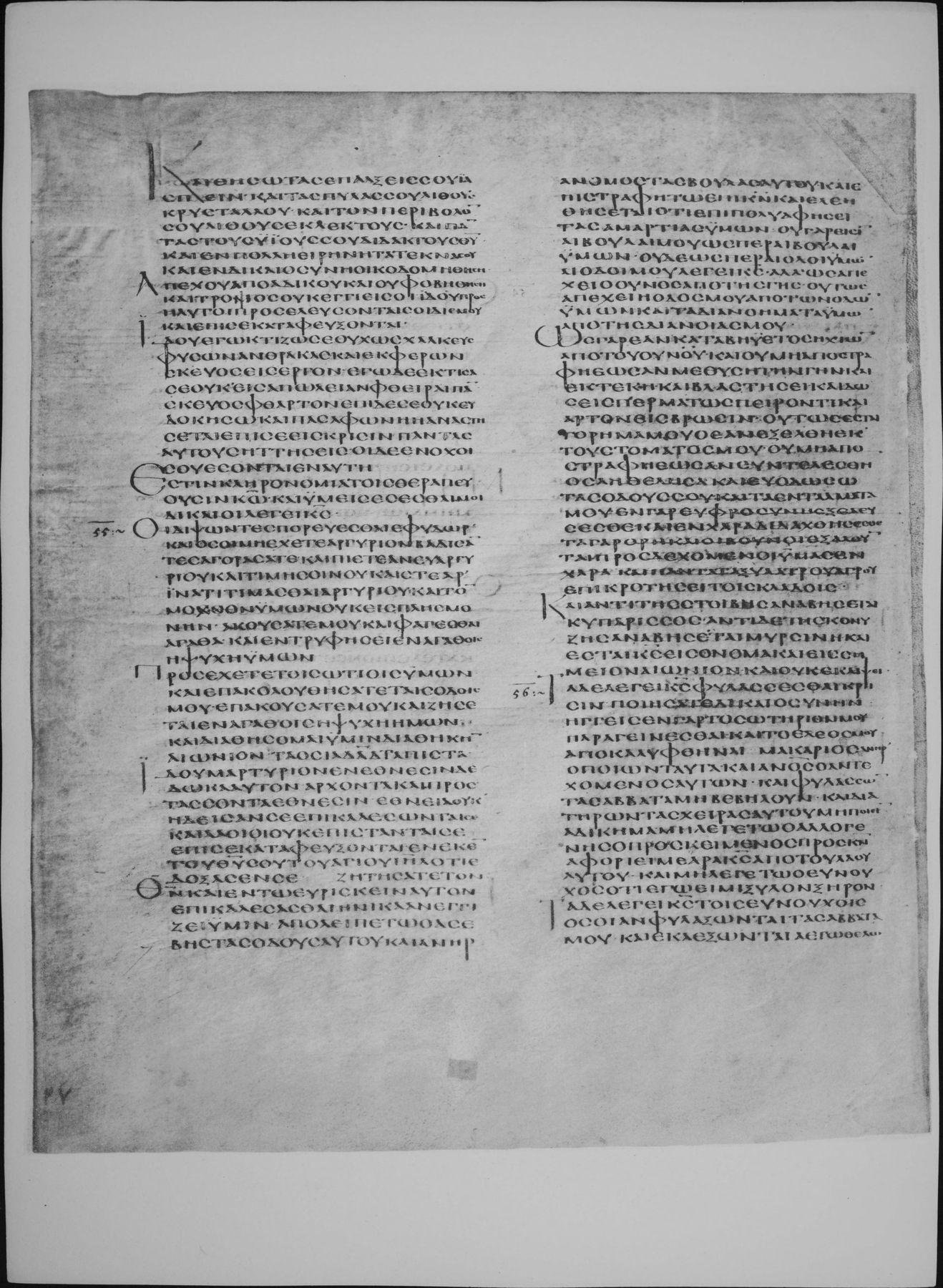
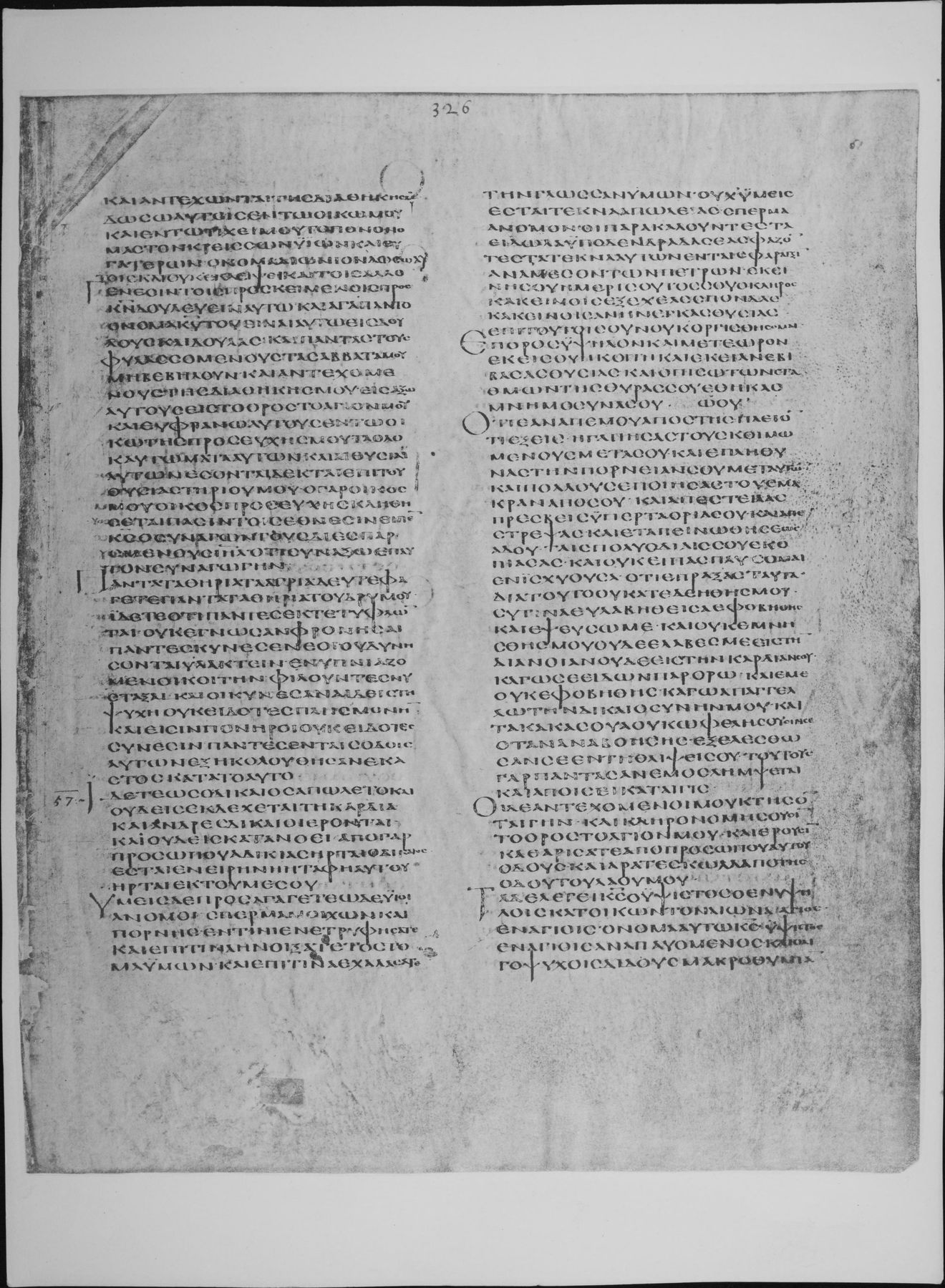
- Manuscript scan: the pages of Codex Alexandrinus carrying this chapter (fol. 325v, fol. 326r), from the full-size photographic (autotype) facsimile published by the British Museum in 1879-1883, as digitised on the Internet Archive. The verse range of every page comes from the reduced photographic facsimile of 1936, which prints it beneath each plate, and the opening words of every page were read on the plate to confirm the page and the verse it begins with. Each section links to the page or pages that hold its verses. Folio numbers are those written at the head of each leaf and visible on the plates.
- Original text: Swete's edition, which here prints the text of Codex Vaticanus (Vat. gr. 1209), the base of his edition, and gives the readings of Alexandrinus only in his apparatus. The Greek column is therefore Vaticanus' text; where Alexandrinus differs, the plate shows what Alexandrinus reads.
- English translation: Sir Lancelot C. L. Brenton, The Septuagint Version of the Old Testament (1844; 1851 edition), a translation of the Greek, public domain, from the eBible.org text.
How was this verified? (Provenance)
Where on the image
Isaiah 56:1-4 is on fol. 325v (full-size facsimile of 1879-83, Internet Archive codex-alexandrinus leaf 675). The 1936 reduced facsimile prints beneath this page: Is. liv. 12-lvi. 4. Checked on the plate: the page begins at the start of Isaiah 54:12 (first words read: ΚΑΙ ΘΗΣΩ ΤΑΣ ΕΠΑΛΞΕΙΣ ΣΟΥ ΙΑΣΠΙΝ ΚΑΙ ΤΑΣ ΠΥΛΑΣ ΣΟΥ ΛΙΘΟΥΣ ΚΡΥΣΤΑΛΛΟΥ). Isaiah 56:4-8 is on fol. 326r (full-size facsimile of 1879-83, Internet Archive codex-alexandrinus leaf 676). The 1936 reduced facsimile prints beneath this page: Is. lvi. 4-lvii. 15. Checked on the plate: the page begins inside Isaiah 56:4 (first words read: ΚΑΙ ΑΝΤΕΧΩΝΤΑΙ ΤΗΣ ΔΙΑΘΗΚΗΣ ΜΟΥ ΔΩΣΩ ΑΥΤΟΙΣ ΕΝ ΤΩ ΟΙΚΩ ΜΟΥ ΚΑΙ ΕΝ ΤΩ ΤΕΙΧΕΙ ΜΟΥ ΤΟΠΟΝ).
1Τάδε λέγει Κύριος Φυλάσσεσθε κρίσιν καὶ ποιήσατε δικαιοσύνην· ἤγγικεν γὰρ τὸ σωτήριόν μου παραγίνεσθαι, καὶ τὸ ἔλεός μου ἀποκαλυφθῆναι. 2μακάριος ἀνὴρ ὁ ποιῶν ταῦτα, καὶ ἄνθρωπος ὁ ἀντεχόμενος αὐτῶν, καὶ φυλάσσων τὰ σάββατα μὴ βεβηλοῦν, καὶ διατηρῶν τὰς χεῖρας αὐτοῦ μὴ ποιεῖν ἄδικα. 3μὴ λεγέτω ὁ ἀλλογενὴς ὁ προσκείμενος πρὸς Κύριον Ἀφοριεῖ με ἄρα Κύριος ἀπὸ τοῦ λαοῦ αὐτοῦ· καὶ μὴ λεγέτω ὁ εὐνοῦχος ὅτι Ἐγώ εἰμι ξύλον ξηρόν. 4τάδε λέγει Κύριος τοῖς εὐνούχοις ὅσοι ἐὰν φυλάξωνται τὰ σάββατά μου καὶ ἐκλέξωνται ἃ ἐγὼ θέλω καὶ ἀντέχωνται τῆς διαθήκης μου, 5δώσω αὐτοῖς ἐν τῷ οἴκῳ μου καὶ ἐν τῷ τείχει μου τόπον ὀνομαστόν, κρείττω υἱῶν καὶ θυγατέρων, ὄνομα αἰώνιον δώσω αὐτοῖς καὶ οὐκ ἐκλείψει. 6καὶ τοῖς ἀλλογενέσι τοῖς προσκειμένοις Κυρίῳ δουλεύειν αὐτῷ, καὶ ἀγαπᾷν τὸ ὄνομα Κυρίου τῷ εἶναι αὐτῷ εἰς δούλους καὶ δούλας, καὶ πάντας τοὺς φυλασσομένους τὰ σάββατά μου μὴ βεβηλοῦν καὶ ἀντεχομένους τῆς διαθήκης μου, 7εἰσάξω αὐτοὺς εἰς τὸ ὄρος τὸ ἅγιόν μου, καὶ εὐφρανῶ αὐτοὺς ἐν τῷ οἴκῳ τῆς προσευχῆς μου· τὰ ὁλοκαυτώματα αὐτῶν καὶ αἱ θυσίαι αὐτῶν ἔσονται δεκταὶ ἐπὶ τὸ θυσιαστήριόν μου. ὁ γάρ οἶκός μου οἶκος προσευχῆς κληθήσεται πᾶσιν τοῖς ἔθνεσιν, 8εἶπεν Κύριος ὁ συνάγων τοὺς διεσπαρμένους Ἰσραήλ, ὅτι συνάξω ἐπ᾽ αὐτὸν συναγωγήν.
1Thus saith the Lord, Keep ye judgment, and do justice: for my salvation is near to come, and my mercy to be revealed. 2Blessed is the man that does these things, and the man that holds by them, and keeps the sabbaths from profaning them, and keeps his hands from doing unrighteousness. 3Let not the stranger who attaches himself to the Lord, say, Surely the Lord will separate me from his people: and let not the eunuch say, I am a dry tree. 4Thus saith the Lord to the eunuchs, as many as shall keep my sabbaths, and choose the things which I take pleasure in, and take hold of my covenant; 5I will give to them in my house and within my walls an honourable place, better than sons and daughters: I will give them an everlasting name, and it shall not fail. 6And I will give it to the strangers that attach themselves to the Lord, to serve him, and to love the name of the Lord, to be to him servants and handmaids; and as for all that keep my sabbaths from profaning them, and that take hold of my covenant; 7I will bring them to my holy mountain, and gladden them in my house of prayer: their whole-burnt-offerings and their sacrifices shall be acceptable upon mine altar; for my house shall be called a house of prayer for all nations, 8saith the Lord that gathers the dispersed of Israel; for I will gather to him a congregation.
Where on the image
Isaiah 56:9-11 is on fol. 326r (full-size facsimile of 1879-83, Internet Archive codex-alexandrinus leaf 676). The 1936 reduced facsimile prints beneath this page: Is. lvi. 4-lvii. 15. Checked on the plate: the page begins inside Isaiah 56:4 (first words read: ΚΑΙ ΑΝΤΕΧΩΝΤΑΙ ΤΗΣ ΔΙΑΘΗΚΗΣ ΜΟΥ ΔΩΣΩ ΑΥΤΟΙΣ ΕΝ ΤΩ ΟΙΚΩ ΜΟΥ ΚΑΙ ΕΝ ΤΩ ΤΕΙΧΕΙ ΜΟΥ ΤΟΠΟΝ).
9Πάντα τὰ θηρία τὰ ἄγρια, δεῦτε φάγετε, πάντα τὰ θηρία τοῦ δρυμοῦ. 10ἴδετε ὅτι ἐκτετύφλωνται πάντες, οὐκ ἔγνωσαν, κύνες ἐνεοί, οὐ δυνήσονται ὑλακτεῖν, ἐνυπνιαζόμενοι κοίτην, φιλοῦντες νυστάξαι. 11καὶ οἱ κύνες ἀναιδεῖς τῇ ψυχῇ, οὐκ εἰδότες πλησμονήν· καί εἰσιν πονηροὶ οὐκ εἰδότες σύνεσιν, πάντες ταῖς ὁδοῖς αὐτῶν ἐξηκολούθησαν, ἕκαστος κατὰ τὸ ἑαυτοῦ.
9All ye beasts of the field, come, devour, all ye beasts of the forest. 10See how they are all blinded: they have not known; they are dumb dogs that will not bark; dreaming of rest, loving to slumber. 11Yea, they are insatiable dogs, that know not what it is to be filled, and they are wicked, having no understanding: all have followed their own ways, each according to his own will.
Cite
Sources
- Source: Codex Alexandrinus (British Library Royal MS 1 D. VI) via the British Museum photographic facsimiles of 1879-83 and 1936 (Internet Archive) + Swete's Septuagint + Brenton's English (holding institution)
- Critical edition: H. B. Swete, The Old Testament in Greek according to the Septuagint (1909)
← previous · → next · v cycle view · l back to library