Jeremiah, Chapter 20 (Codex Alexandrinus)
Introduction
Jeremiah 20 in the Greek Old Testament (the Septuagint) as written in Codex Alexandrinus, a Greek Bible copied in the fifth century, probably in Egypt, and now in the British Library (Royal MS 1 D. VI, the second of its four volumes). It is one of the three great early codices of the whole Greek Bible, with Codex Vaticanus and Codex Sinaiticus.
This entry meets the strict three-criteria standard of the Theosis Library:
- Manuscript scan: the pages of Codex Alexandrinus carrying this chapter (fol. 341r, fol. 341v), from the full-size photographic (autotype) facsimile published by the British Museum in 1879-1883, as digitised on the Internet Archive. The verse range of every page comes from the reduced photographic facsimile of 1936, which prints it beneath each plate, and the opening words of every page were read on the plate to confirm the page and the verse it begins with. Each section links to the page or pages that hold its verses. Folio numbers are those written at the head of each leaf and visible on the plates.
- Original text: Swete's edition, which here prints the text of Codex Vaticanus (Vat. gr. 1209), the base of his edition, and gives the readings of Alexandrinus only in his apparatus. The Greek column is therefore Vaticanus' text; where Alexandrinus differs, the plate shows what Alexandrinus reads.
- English translation: Sir Lancelot C. L. Brenton, The Septuagint Version of the Old Testament (1844; 1851 edition), a translation of the Greek, public domain, from the eBible.org text.
How was this verified? (Provenance)
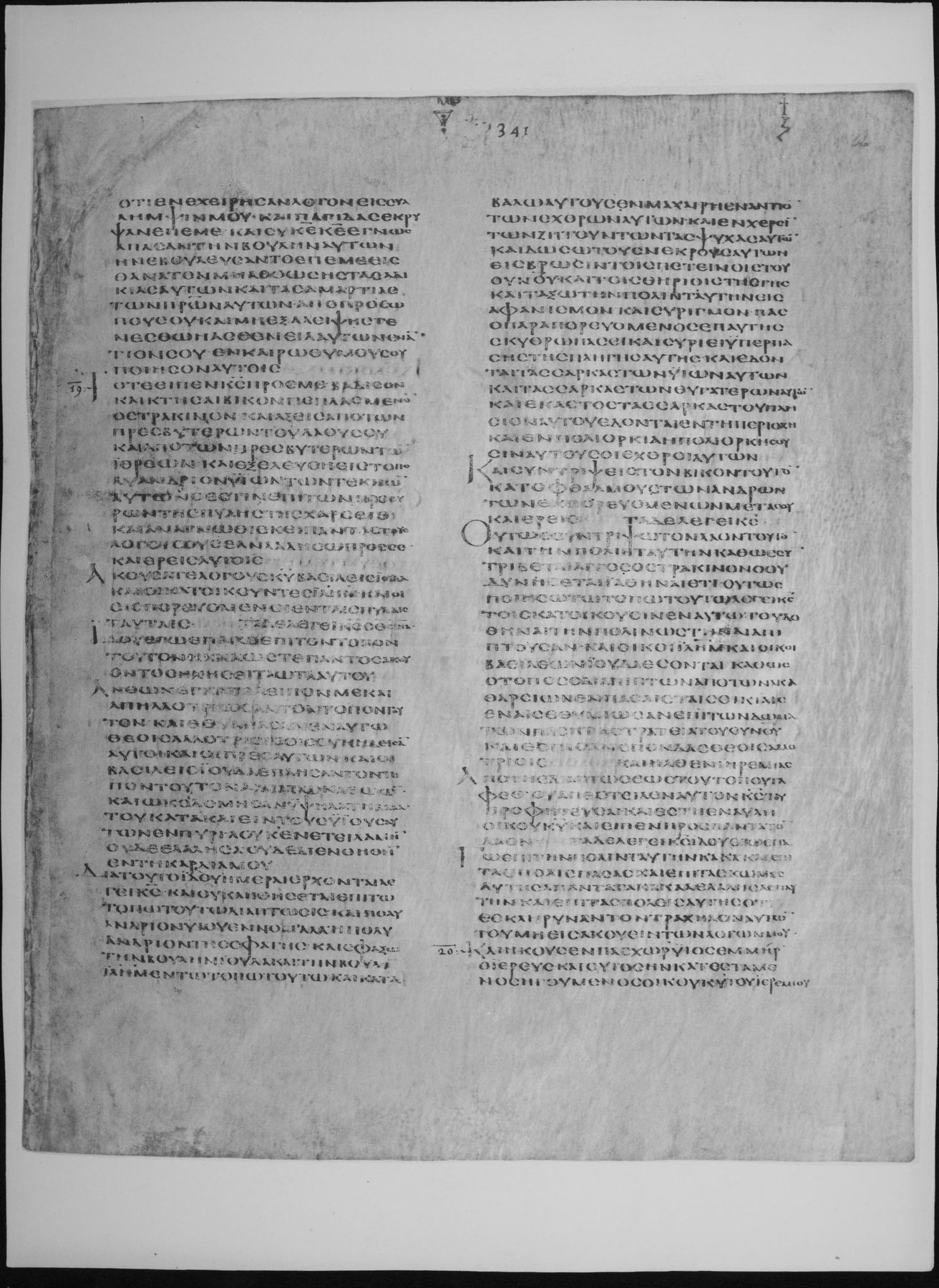
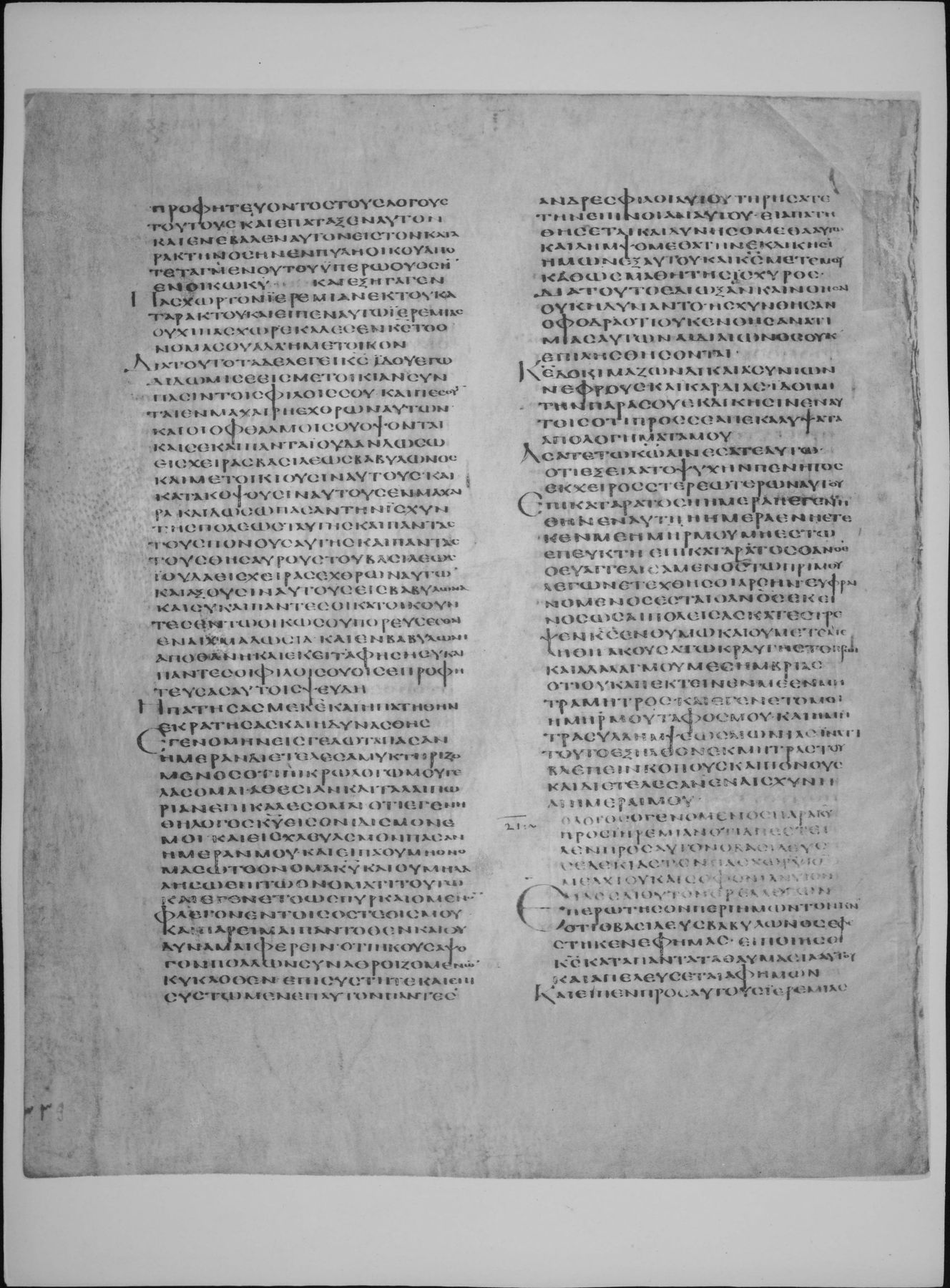
Where on the image
Jeremiah 20:1 is on fol. 341r (full-size facsimile of 1879-83, Internet Archive codex-alexandrinus leaf 706). The 1936 reduced facsimile prints beneath this page: Jer. xviii. 22-xx. 1. Checked on the plate: the page begins inside Jeremiah 18:22 (first words read: ΟΤΙ ΕΝΕΧΕΙΡΗΣΑΝ ΛΟΓΟΝ ΕΙΣ ΣΥΛΛΗΜΨΙΝ ΜΟΥ ΚΑΙ ΠΑΓΙΔΑΣ ΕΚΡΥΨΑΝ ΕΠ ΕΜΕ ΚΑΙ ΣΥ ΚΕ ΕΓΝΩΣ). Jeremiah 20:1-8 is on fol. 341v (full-size facsimile of 1879-83, Internet Archive codex-alexandrinus leaf 707). The 1936 reduced facsimile prints beneath this page: Jer. xx. 1-xxi. 3. Checked on the plate: the page begins inside Jeremiah 20:1 (first words read: ΠΡΟΦΗΤΕΥΟΝΤΟΣ ΤΟΥΣ ΛΟΓΟΥΣ ΤΟΥΤΟΥΣ ΚΑΙ ΕΠΑΤΑΞΕΝ ΑΥΤΟΝ ΚΑΙ ΕΝΕΒΑΛΕΝ ΑΥΤΟΝ ΕΙΣ ΤΟΝ ΚΑΤΑΡΡΑΚΤΗΝ).
1Καὶ ἤκουσεν Πασχὼρ υἱὸς Ἐμμὴρ ὁ ἱερεύς, καὶ οὗτος ἦν καθεσταμένος ἡγούμενος οἴκου Κυρίου, τοῦ Ἰερεμίου προφητεύοντος τοὺς λόγους τούτους. 2καὶ ἐπάταξεν αὐτόν, καὶ ἐνέβαλεν αὐτὸν εἰς τὸν καταράκτην ὃς ἦν ἐν πύλῃ οἴκου ἀποτεταγμένου τοῦ ὑπερῴου, ὃς ἦν ἐν οἴκῳ Κυρίου. 3καὶ ἐξήγαγεν Πασχὼρ τὸν Ἰερεμίαν ἐκ τοῦ καταράκτου, καὶ εἶπεν αὐτῷ Ἰερεμίας Οὐχὶ Πασχὼρ ἐκάλεσεν Κύριος τὸ ὄνομά σου ἀλλ᾽ ἢ Μέτοικον. 4διότι τάδε λέγει Κύριος Ἰδοὺ ἐγὼ δίδωμί σε εἰς μετοικίαν σὺν πᾶσι τοῖς φίλοις σου· καὶ πεσοῦνται ἐν μαχαίρᾳ ἐχθρῶν αὐτῶν, καὶ οἱ ὀφθαλμοί σου ὄψονται· καὶ σὲ καὶ πάντα Ἰουδὰ δώσω εἰς χεῖρας βασιλέως Βαβυλῶνος, καὶ μετοικιοῦσιν αὐτοὺς καὶ κατακόψουσιν ἐν μαχαίραις. 5καὶ δώσω τὴν πᾶσαν ἰσχὺν τῆς πόλεως ταύτης καὶ πάντας τοὺς πόνους αὐτῆς καὶ πάντας τοὺς θησαυροὺς τοῦ βασιλέως Ἰούδα εἰς χεῖρας ἐχθρῶν αὐτοῦ, καὶ ἄξουσιν αὐτοὺς εἰς Βαβυλῶνα. 6καὶ σύ καὶ πάντες οἱ κατοικοῦντες ἐν τῷ οἴκῳ σου πορεύσεσθε ἐν αἰχμαλωσίᾳ, καὶ ἐν Βαβυλῶνι ἀποθανῇ, καὶ ἐκεῖ ταφήσῃ σὺ καὶ πάντες οἱ φίλοι σου οἷς ἐπροφήτευσας αὐτοῖς ψευδῆ. 7Ἠπάτησάς με, Κύριε, καὶ ἠπατήθην, ἐκράτησας καὶ ἠδυνάσθης· ἐγενόμην εἰς γέλωτα, πᾶσαν ἡμέραν διετέλεσα μυκτηριζόμενος· 8ὅτι πικρῷ λόγῳ μου γελάσομαι, ἀθεσίαν καὶ ταλαιπωρίαν ἐπικαλέσομαι, ὅτι ἐγενήθη λόγος Κυρίου εἰς ὀνειδισμὸν ἐμοὶ καὶ χλευασμὸν πᾶσαν ἡμέραν μου.
1Now Paschor the son of Emmer, the priest, who also had been appointed chief of the house of the Lord, heard Jeremias prophesying these words. 2And he smote him, and cast him into the dungeon which was by the gate of the upper house that was set apart, which was by the house of the Lord. 3And Paschor brought Jeremias out of the dungeon: and Jeremias said to him, The Lord has not called thy name Paschor, but Exile. 4For thus saith the Lord, Behold, I will give thee up to captivity with all thy friends: and they shall fall by the sword of their enemies, and thine eyes shall see it: and I will give thee and all Juda into the hands of the king of Babylon, and they shall carry them captives, and cut them in pieces with swords. 5And I will give all the strength of this city, and all the labours of it, and all the treasures of the king of Juda, into the hands of his enemies, and they shall bring them to Babylon. 6And thou and all the dwellers in thine house shall go into captivity: and thou shalt die in Babylon, and there thou and all thy friends shall be buried, to whom thou hast prophesied lies. 7Thou hast deceived me, O Lord, and I have been deceived: thou hast been strong, and hast prevailed: I am become a laughing-stock, I am continually mocked every day. 8For I will laugh with my bitter speech, I will call upon rebellion and misery: for the word of the Lord is become a reproach to me and a mockery all my days.
Where on the image
Jeremiah 20:9-18 is on fol. 341v (full-size facsimile of 1879-83, Internet Archive codex-alexandrinus leaf 707). The 1936 reduced facsimile prints beneath this page: Jer. xx. 1-xxi. 3. Checked on the plate: the page begins inside Jeremiah 20:1 (first words read: ΠΡΟΦΗΤΕΥΟΝΤΟΣ ΤΟΥΣ ΛΟΓΟΥΣ ΤΟΥΤΟΥΣ ΚΑΙ ΕΠΑΤΑΞΕΝ ΑΥΤΟΝ ΚΑΙ ΕΝΕΒΑΛΕΝ ΑΥΤΟΝ ΕΙΣ ΤΟΝ ΚΑΤΑΡΡΑΚΤΗΝ).
9καὶ εἶπα Οὐ μὴ ὀνομάσω τὸ ὄνομα Κυρίου, καὶ οὐ μὴ λαλήσω ἔτι ἐπὶ τῷ ὀνόματι αὐτοῦ. καὶ ἐγένετο ὡς πῦρ καιόμενον φλέγον ἐν τοῖς ὀστοῖς μου, καὶ παρεῖμαι πάντοθεν καὶ οὐ δύναμαι φέρειν, 10ὅτι ἤκουσα ψόγον πολλῶν συναθροιζομένων κυκλόθεν κυκλόθεν Ἐπισύστητε, καὶ ἐπισυστῶμεν ἐπ᾽ αὐτῷ πάντες ἄνδρες φίλοι αὐτοῦ· τηρήσατε τὴν ἐπίνοιαν αὐτοῦ εἰ ἀπατηθήσεται, καὶ δυνησόμεθα αὐτῷ καὶ λημψόμεθα τὴν ἐκδίκησιν ἡμῶν ἐξ αὐτοῦ. 11ὁ δὲ κύριος μετ᾽ ἐμοῦ καθὼς μαχητὴς ἰσχύων· διὰ τοῦτο ἐδίωξαν καὶ νοῆσαι οὐκ ἠδύναντο· ᾐσχύνθησαν σφόδρα, ὅτι οὐκ ἐνόησαν ἀτιμίας αὐτῶν, αἳ δι᾽ αἰῶνος οὐκ ἐπιλησθήσονται. 12Κύριε, δοκιμάζων δίκαια, συνίων νεφροὺς καὶ καρδίας, ἴδοιμι τὴν παρὰ σοῦ ἐκδίκησιν ἐν αὐτοῖς, ὅτι πρὸς σὲ ἀπεκάλυψα τὰ ἀπολογήματά μου. 13ᾄσατε τῷ κυρίῳ, αἰνέσατε αὐτῷ, ὅτι ἐξείλατο ψυχὴν πένητος ἐκ χειρὸς πονηρευομένων. 14Ἐπικατάρατος ἡ ἡμέρα ἐν ᾗ ἐτέχθην ἐν αὐτῇ. ἡ ἡμέρα ἐν ᾗ ἔτεκέν με ἡ μήτηρ μου μὴ ἔστω ἐπευκτή· 15ἐπικατάρατος ὁ ἄνθρωπος ὁ εὐαγγελισάμενος τῷ πατρί μου λέγων Ἐτέχθη σοι ἄρσεν, εὐφραινόμενος. 16ἔστω ὁ ἄνθρωπος ἐκεῖνος ὡς αἱ πόλεις ἃς κατέστρεψεν Κύριος ἐν θυμῷ καὶ οὐ μετεμελήθη, ἀκουσάτω κραυγῆς τὸ πρωὶ καὶ ἀλαλαγμοῦ μεσημβρίας· 17ὅτι οὐκ ἀπέκτεινέν με ἐν μήτρᾳ καὶ ἐγένετό μοι ἡ μήτηρ μου τάφος μου καὶ ἡ μήτρα συλλήμψεως αἰωνίας. 18ἵνα τί τοῦτο ἐξῆλθον ἐκ μήτρας τοῦ βλέπειν κόπους καὶ πόνους, καὶ διετέλεσαν ἐν αἰσχύνῃ αἱ ἡμέραι μου;
9Then I said, I will by no means name the name of the Lord, and I will no more at all speak in his name. But it was as burning fire flaming in my bones, and I am utterly weakened on all sides, and cannot bear up. 10For I have heard the reproach of many gathering round, saying, Conspire ye, and let us conspire together against him, even all his friends: watch his intentions, if perhaps he shall be deceived, and we shall prevail against him, and we shall be avenged on him. 11But the Lord was with me as a mighty man of war: therefore they persecuted me, but could not perceive anything against me; they were greatly confounded, for they perceived not their disgrace, which shall never be forgotten. 12O Lord, that provest just deeds, understanding the reins and hearts, let me see thy vengeance upon them: for to thee I have revealed my cause. 13Sing ye to the Lord, sing praise to him: for he has rescued the soul of the poor from the hand of evil-doers. 14Cursed be the day wherein I was born: the day wherein my mother brought me forth, let it not be blessed. 15Cursed be the man who brought the glad tidings to my father, saying, A male child is born to thee. 16Let that man rejoice as the cities which the Lord overthrew in wrath, and repented not: let him hear crying in the morning, and loud lamentation at noon; 17because he slew me not in the womb, and my mother became not my tomb, and her womb always great with me. 18Why is it that I came forth of the womb to see troubles and distresses, and my days are spent in shame?
Cite
Sources
- Source: Codex Alexandrinus (British Library Royal MS 1 D. VI) via the British Museum photographic facsimiles of 1879-83 and 1936 (Internet Archive) + Swete's Septuagint + Brenton's English (holding institution)
- Critical edition: H. B. Swete, The Old Testament in Greek according to the Septuagint (1909)
← previous · → next · v cycle view · l back to library