Homer, Odyssey, Book 1: Athena visits Telemachus
Introduction
The Odyssey, composed around 700 BCE and attributed to Homer, tells of Odysseus' ten-year journey home from Troy and his return to Ithaca. Book 1 (444 lines): Athena visits Telemachus.
The page photographs are from Florence, Biblioteca Medicea Laurenziana, Plut. 32.24 (parchment, 10th century, 234 folios; the oldest manuscript of the Odyssey with published images), in the Biblioteca Medicea Laurenziana's Teca Digitale. This book is on fol. 2r-10v; each section below is one page, with its first and last line as read on the photograph. Many pages carry interlinear glosses and a few marginal notes in later hands.
The Greek is A. T. Murray's Loeb text (1919) via Perseus, not a transcription of this manuscript, whose wording differs in places. The English is Murray's prose translation (1919), divided every five lines; at a page break a five-line block goes with the page holding most of it, except at the page breaks where a section's note says the English is cut at the end of Murray's sentence. Each section's note gives its English line range.
Where the scribe left out a line, wrote one in the margin, changed the order or added a line not in Murray's text, the section's note on the photograph says so; the Greek and English shown are Murray's full text for the page's range.
How was this verified? (Provenance)
Where on the image
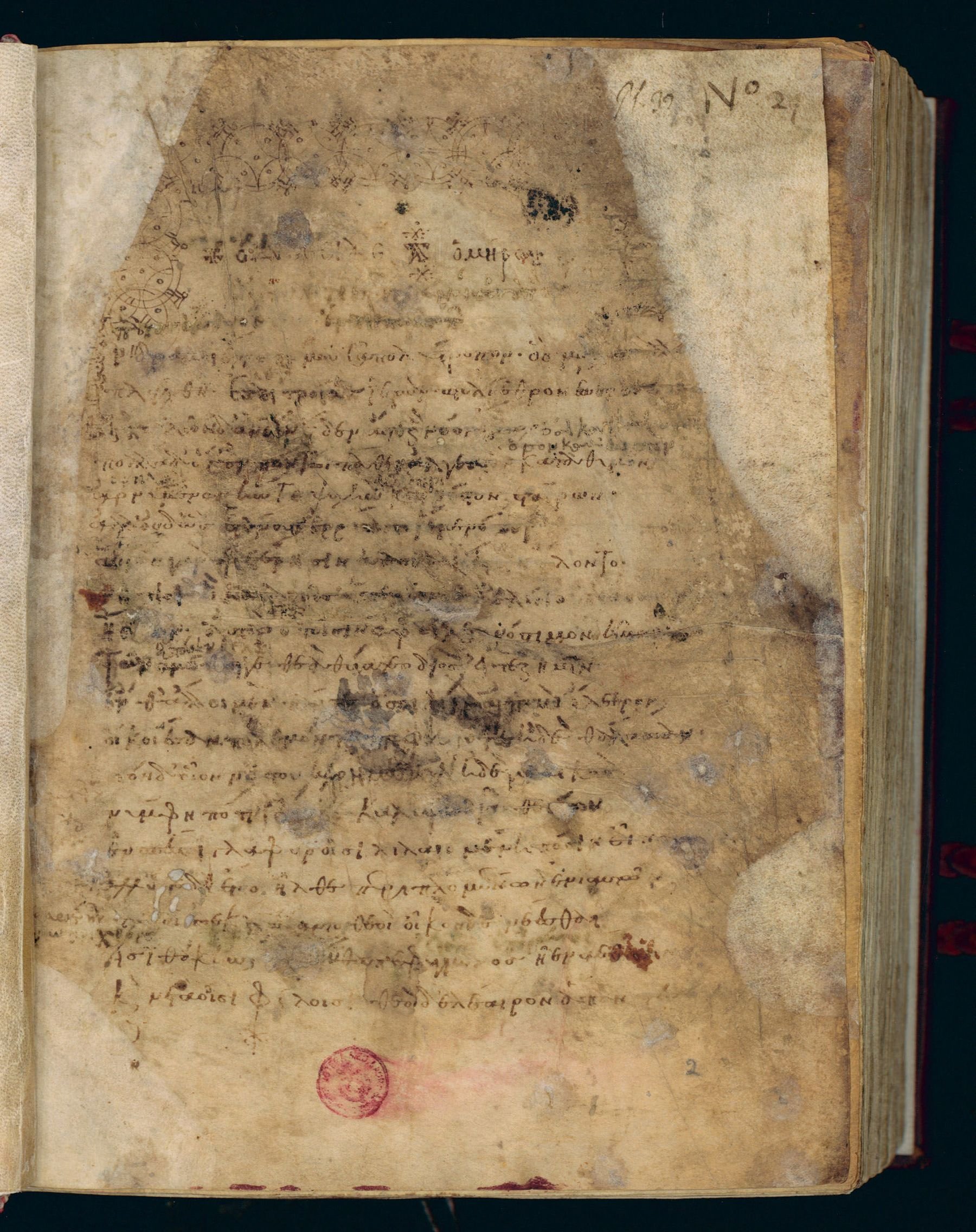
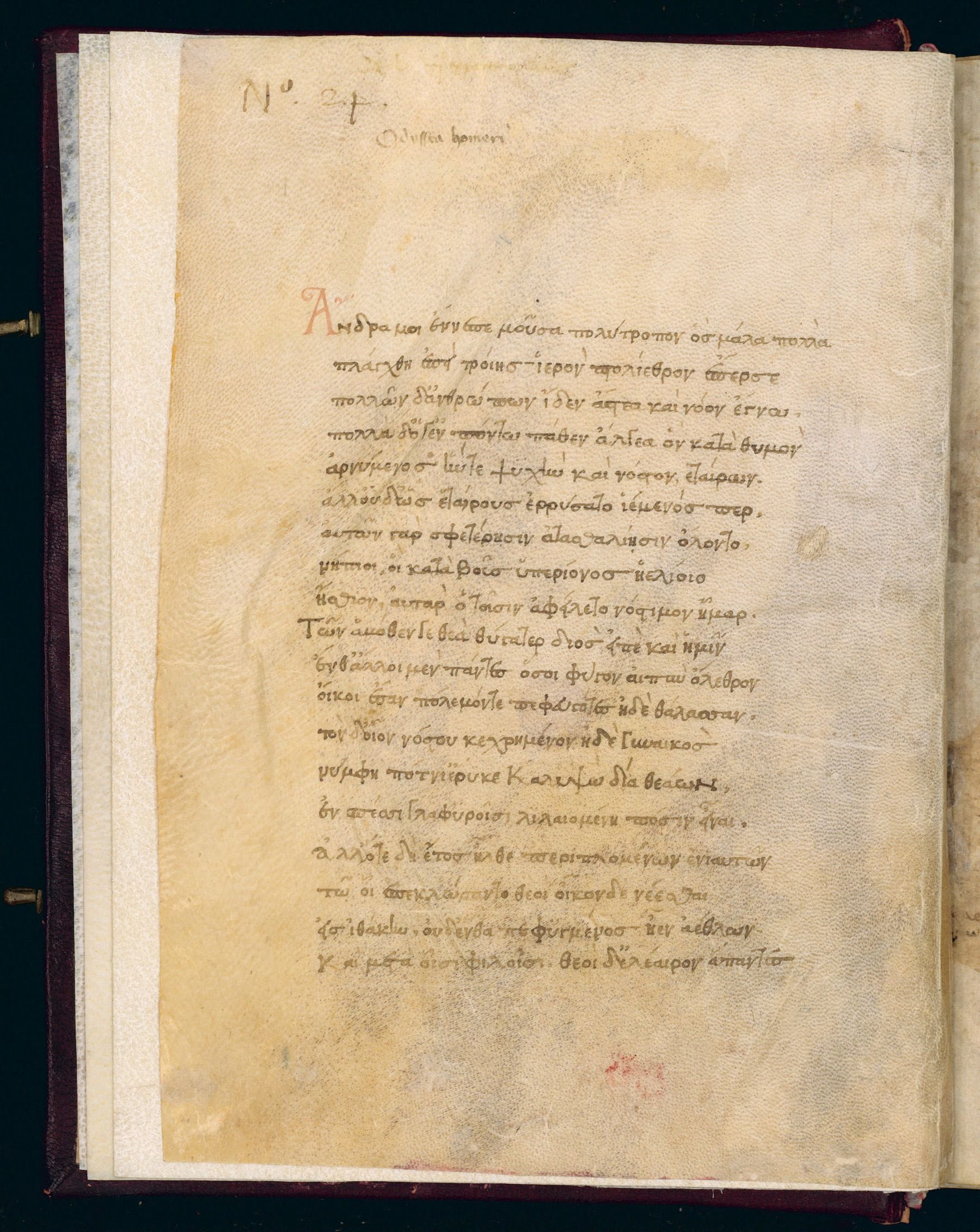
Laur. Plut. 32.24, fol. 2r: Odyssey 1.1-19, begins ‹ἄνδρα μοι ἔννεπε, μοῦσα,›, ends ‹θεοὶ δʼ ἐλέαιρον ἅπαντες›. Checked on the image: first and last lines read and matched to the Greek. Fol. 2v begins with 1.20. The original first page, worn and stained; the title is written at the top. 19 lines. The same lines are also on fol. 1v, shown second: A later replacement page in a different, later hand (on a leaf added at the front) repeating lines 1-19 of the damaged original page, fol. 2r. English blocks here: 1-4, 5-9, 10-14, 15-19.
1ἄνδρα μοι ἔννεπε, μοῦσα, πολύτροπον, ὃς μάλα πολλὰ
2πλάγχθη, ἐπεὶ Τροίης ἱερὸν πτολίεθρον ἔπερσεν·
3πολλῶν δʼ ἀνθρώπων ἴδεν ἄστεα καὶ νόον ἔγνω,
4πολλὰ δʼ ὅ γʼ ἐν πόντῳ πάθεν ἄλγεα ὃν κατὰ θυμόν,
5ἀρνύμενος ἥν τε ψυχὴν καὶ νόστον ἑταίρων.
6ἀλλʼ οὐδʼ ὣς ἑτάρους ἐρρύσατο, ἱέμενός περ·
7αὐτῶν γὰρ σφετέρῃσιν ἀτασθαλίῃσιν ὄλοντο,
8νήπιοι, οἳ κατὰ βοῦς Ὑπερίονος Ἠελίοιο
9ἤσθιον· αὐτὰρ ὁ τοῖσιν ἀφείλετο νόστιμον ἦμαρ.
10τῶν ἁμόθεν γε, θεά, θύγατερ Διός, εἰπὲ καὶ ἡμῖν.
11ἔνθʼ ἄλλοι μὲν πάντες, ὅσοι φύγον αἰπὺν ὄλεθρον,
12οἴκοι ἔσαν, πόλεμόν τε πεφευγότες ἠδὲ θάλασσαν·
13τὸν δʼ οἶον νόστου κεχρημένον ἠδὲ γυναικὸς
14νύμφη πότνιʼ ἔρυκε Καλυψὼ δῖα θεάων
15ἐν σπέσσι γλαφυροῖσι, λιλαιομένη πόσιν εἶναι.
16ἀλλʼ ὅτε δὴ ἔτος ἦλθε περιπλομένων ἐνιαυτῶν,
17τῷ οἱ ἐπεκλώσαντο θεοὶ οἶκόνδε νέεσθαι
18εἰς Ἰθάκην, οὐδʼ ἔνθα πεφυγμένος ἦεν ἀέθλων
19καὶ μετὰ οἷσι φίλοισι. θεοὶ δʼ ἐλέαιρον ἅπαντες
1Tell me, O Muse, of the man of many devices, who wandered full many ways after he had sacked the sacred citadel of Troy. Many were the men whose cities he saw and whose mind he learned, aye, and many the woes he suffered in his heart upon the sea, 5seeking to win his own life and the return of his comrades. Yet even so he saved not his comrades, though he desired it sore, for through their own blind folly they perished—fools, who devoured the kine of Helios Hyperion; but he took from them the day of their returning. 10Of these things, goddess, daughter of Zeus, beginning where thou wilt, tell thou even unto us. Now all the rest, as many as had escaped sheer destruction, were at home, safe from both war and sea, but Odysseus alone, filled with longing for his return and for his wife, did the queenly nymph Calypso, that bright goddess, 15keep back in her hollow caves, yearning that he should be her husband. But when, as the seasons revolved, the year came in which the gods had ordained that he should return home to Ithaca, not even there was he free from toils, even among his own folk. And all the gods pitied him
Where on the image
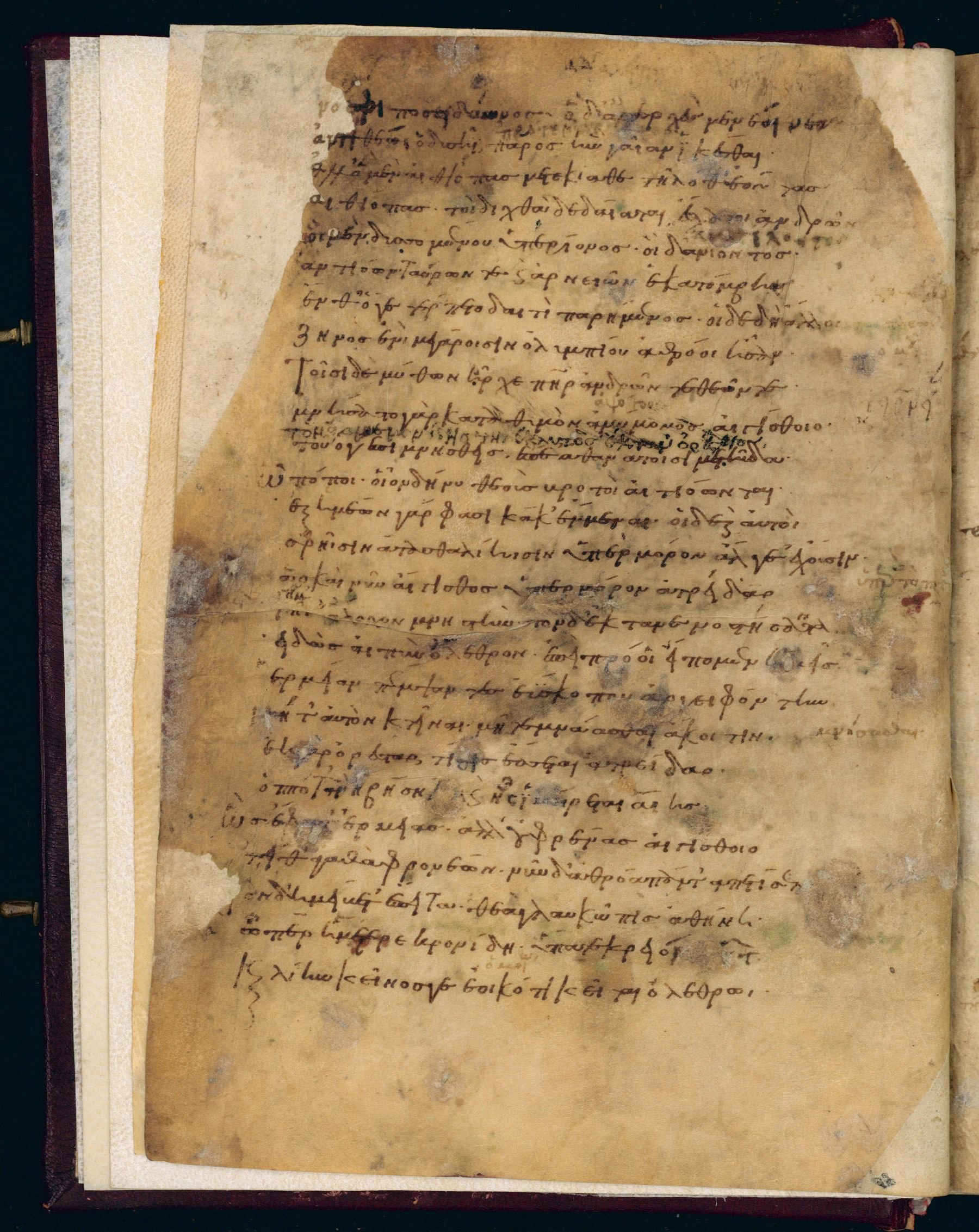
Laur. Plut. 32.24, fol. 2v: Odyssey 1.20-46, begins ‹νόσφι Ποσειδάωνος· ὁ δʼ›, ends ‹γε ἐοικότι κεῖται ὀλέθρῳ·›. Checked on the image: first and last lines read and matched to the Greek. Fol. 2r ends with 1.19. Fol. 3r begins with 1.47. Damaged along the edges. English blocks here: 20-24, 25-29, 30-34, 35-39, 40-43, 44-44.
20νόσφι Ποσειδάωνος· ὁ δʼ ἀσπερχὲς μενέαινεν
21ἀντιθέῳ Ὀδυσῆι πάρος ἣν γαῖαν ἱκέσθαι.
22ἀλλʼ ὁ μὲν Αἰθίοπας μετεκίαθε τηλόθʼ ἐόντας,
23Αἰθίοπας τοὶ διχθὰ δεδαίαται, ἔσχατοι ἀνδρῶν,
24οἱ μὲν δυσομένου Ὑπερίονος οἱ δʼ ἀνιόντος,
25ἀντιόων ταύρων τε καὶ ἀρνειῶν ἑκατόμβης.
26ἔνθʼ ὅ γʼ ἐτέρπετο δαιτὶ παρήμενος· οἱ δὲ δὴ ἄλλοι
27Ζηνὸς ἐνὶ μεγάροισιν Ὀλυμπίου ἁθρόοι ἦσαν.
28τοῖσι δὲ μύθων ἦρχε πατὴρ ἀνδρῶν τε θεῶν τε·
29μνήσατο γὰρ κατὰ θυμὸν ἀμύμονος Αἰγίσθοιο,
30τόν ῥʼ Ἀγαμεμνονίδης τηλεκλυτὸς ἔκτανʼ Ὀρέστης·
31τοῦ ὅ γʼ ἐπιμνησθεὶς ἔπεʼ ἀθανάτοισι μετηύδα·
32ὢ πόποι, οἷον δή νυ θεοὺς βροτοὶ αἰτιόωνται·
33ἐξ ἡμέων γάρ φασι κάκʼ ἔμμεναι, οἱ δὲ καὶ αὐτοὶ
34σφῇσιν ἀτασθαλίῃσιν ὑπὲρ μόρον ἄλγεʼ ἔχουσιν,
35ὡς καὶ νῦν Αἴγισθος ὑπὲρ μόρον Ἀτρεΐδαο
36γῆμʼ ἄλοχον μνηστήν, τὸν δʼ ἔκτανε νοστήσαντα,
37εἰδὼς αἰπὺν ὄλεθρον, ἐπεὶ πρό οἱ εἴπομεν ἡμεῖς,
38Ἑρμείαν πέμψαντες, ἐύσκοπον ἀργεϊφόντην,
39μήτʼ αὐτὸν κτείνειν μήτε μνάασθαι ἄκοιτιν·
40ἐκ γὰρ Ὀρέσταο τίσις ἔσσεται Ἀτρεΐδαο,
41ὁππότʼ ἂν ἡβήσῃ τε καὶ ἧς ἱμείρεται αἴης.
42ὣς ἔφαθʼ Ἑρμείας, ἀλλʼ οὐ φρένας Αἰγίσθοιο
43πεῖθʼ ἀγαθὰ φρονέων· νῦν δʼ ἁθρόα πάντʼ ἀπέτισεν.
44τὸν δʼ ἠμείβετʼ ἔπειτα θεά, γλαυκῶπις Ἀθήνη·
45ὦ πάτερ ἡμέτερε Κρονίδη, ὕπατε κρειόντων,
46καὶ λίην κεῖνός γε ἐοικότι κεῖται ὀλέθρῳ·
20save Poseidon; but he continued to rage unceasingly against godlike Odysseus until at length he reached his own land. Howbeit Poseidon had gone among the far-off Ethiopians—the Ethiopians who dwell sundered in twain, the farthermost of men, some where Hyperion sets and some where he rises, 25there to receive a hecatomb of bulls and rams, and there he was taking his joy, sitting at the feast; but the other gods were gathered together in the halls of Olympian Zeus. Among them the father of gods and men was first to speak, for in his heart he thought of noble Aegisthus, 30whom far-famed Orestes, Agamemnon's son, had slain. Thinking on him he spoke among the immortals, and said: “Look you now, how ready mortals are to blame the gods. It is from us, they say, that evils come, but they even of themselves, through their own blind folly, have sorrows beyond that which is ordained. 35Even as now Aegisthus, beyond that which was ordained, took to himself the wedded wife of the son of Atreus, and slew him on his return, though well he knew of sheer destruction, seeing that we spake to him before, sending Hermes, the keen-sighted Argeiphontes, that he should neither slay the man nor woo his wife; 40for from Orestes shall come vengeance for the son of Atreus when once he has come to manhood and longs for his own land. So Hermes spoke, but for all his good intent he prevailed not upon the heart of Aegisthus; and now he has paid the full price of all.” 44Then the goddess, flashing-eyed Athena, answered him:
Where on the image
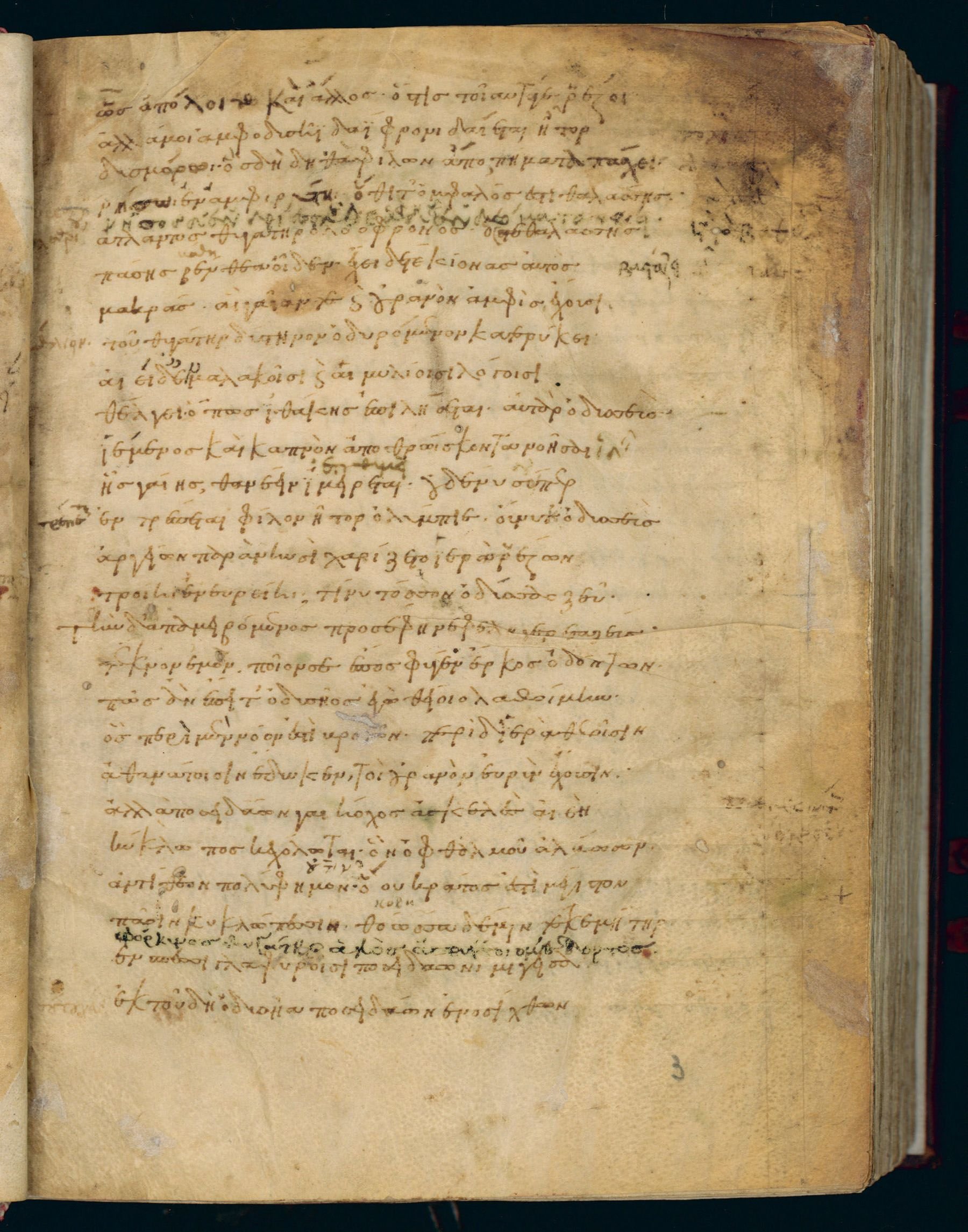
Laur. Plut. 32.24, fol. 3r: Odyssey 1.47-74, begins ‹ὡς ἀπόλοιτο καὶ ἄλλος,›, ends ‹δὴ Ὀδυσῆα Ποσειδάων ἐνοσίχθων›. Checked on the image: first and last lines read and matched to the Greek. Fol. 2v ends with 1.46. Fol. 3v begins with 1.75. Stained. English blocks here: 45-49, 50-54, 55-59, 60-64, 65-69, 70-74.
47ὡς ἀπόλοιτο καὶ ἄλλος, ὅτις τοιαῦτά γε ῥέζοι·
48ἀλλά μοι ἀμφʼ Ὀδυσῆι δαΐφρονι δαίεται ἦτορ,
49δυσμόρῳ, ὃς δὴ δηθὰ φίλων ἄπο πήματα πάσχει
50νήσῳ ἐν ἀμφιρύτῃ, ὅθι τʼ ὀμφαλός ἐστι θαλάσσης.
51νῆσος δενδρήεσσα, θεὰ δʼ ἐν δώματα ναίει,
52Ἄτλαντος θυγάτηρ ὀλοόφρονος, ὅς τε θαλάσσης
53πάσης βένθεα οἶδεν, ἔχει δέ τε κίονας αὐτὸς
54μακράς, αἳ γαῖάν τε καὶ οὐρανὸν ἀμφὶς ἔχουσιν.
55τοῦ θυγάτηρ δύστηνον ὀδυρόμενον κατερύκει,
56αἰεὶ δὲ μαλακοῖσι καὶ αἱμυλίοισι λόγοισιν
57θέλγει, ὅπως Ἰθάκης ἐπιλήσεται· αὐτὰρ Ὀδυσσεύς,
58ἱέμενος καὶ καπνὸν ἀποθρῴσκοντα νοῆσαι
59ἧς γαίης, θανέειν ἱμείρεται. οὐδέ νυ σοί περ
60ἐντρέπεται φίλον ἦτορ, Ὀλύμπιε. οὔ νύ τʼ Ὀδυσσεὺς
61Ἀργείων παρὰ νηυσὶ χαρίζετο ἱερὰ ῥέζων
62Τροίῃ ἐν εὐρείῃ; τί νύ οἱ τόσον ὠδύσαο, Ζεῦ;
63τὴν δʼ ἀπαμειβόμενος προσέφη νεφεληγερέτα Ζεύς·
64τέκνον ἐμόν, ποῖόν σε ἔπος φύγεν ἕρκος ὀδόντων.
65πῶς ἂν ἔπειτʼ Ὀδυσῆος ἐγὼ θείοιο λαθοίμην,
66ὃς περὶ μὲν νόον ἐστὶ βροτῶν, περὶ δʼ ἱρὰ θεοῖσιν
67ἀθανάτοισιν ἔδωκε, τοὶ οὐρανὸν εὐρὺν ἔχουσιν;
68ἀλλὰ Ποσειδάων γαιήοχος ἀσκελὲς αἰεὶ
69Κύκλωπος κεχόλωται, ὃν ὀφθαλμοῦ ἀλάωσεν,
70ἀντίθεον Πολύφημον, ὅου κράτος ἐστὶ μέγιστον
71πᾶσιν Κυκλώπεσσι· Θόωσα δέ μιν τέκε νύμφη,
72Φόρκυνος θυγάτηρ ἁλὸς ἀτρυγέτοιο μέδοντος,
73ἐν σπέσσι γλαφυροῖσι Ποσειδάωνι μιγεῖσα.
74ἐκ τοῦ δὴ Ὀδυσῆα Ποσειδάων ἐνοσίχθων
45“Father of us all, thou son of Cronos, high above all lords, aye, verily that man lies low in a destruction that is his due; so, too, may any other also be destroyed who does such deeds. But my heart is torn for wise Odysseus, hapless man, who far from his friends has long been suffering woes 50in a sea-girt isle, where is the navel of the sea. 'Tis a wooded isle, and therein dwells a goddess, daughter of Atlas of baneful mind, who knows the depths of every sea, and himself holds the tall pillars which keep earth and heaven apart. 55His daughter it is that keeps back that wretched, sorrowing man; and ever with soft and wheedling words she beguiles him that he may forget Ithaca. But Odysseus, in his longing to see were it but the smoke leaping up from his own land, yearns to die. Yet thy 60heart doth not regard it, Olympian. Did not Odysseus beside the ships of the Argives offer thee sacrifice without stint in the broad land of Troy? Wherefore then didst thou conceive such wrath against him, O Zeus?” Then Zeus, the cloud-gatherer, answered her and said: “My child, what a word has escaped the barrier of thy teeth? 65How should I, then, forget godlike Odysseus, who is beyond all mortals in wisdom, and beyond all has paid sacrifice to the immortal gods, who hold broad heaven? Nay, it is Poseidon, the earth-enfolder, who is ever filled with stubborn wrath because of the Cyclops, whom Odysseus blinded of his eye— 70even the godlike Polyphemus, whose might is greatest among all the Cyclopes; and the nymph Thoosa bore him, daughter of Phorcys who rules over the unresting sea; for in the hollow caves she lay with Poseidon. From that time forth Poseidon, the earth-shaker,
Where on the image
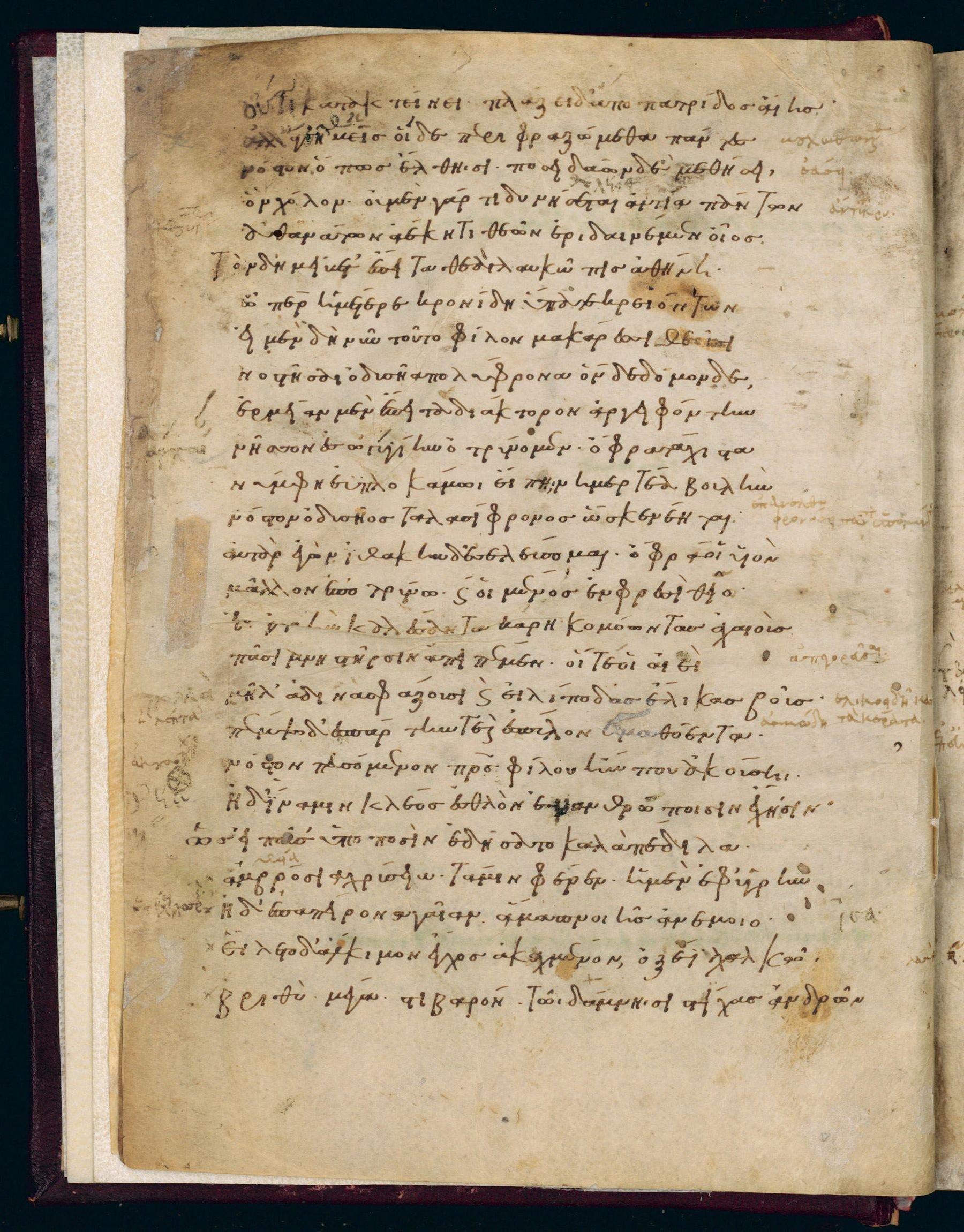
Laur. Plut. 32.24, fol. 3v: Odyssey 1.75-100, begins ‹οὔ τι κατακτείνει, πλάζει›, ends ‹τῷ δάμνησι στίχας ἀνδρῶν›. Checked on the image: first and last lines read and matched to the Greek. Fol. 3r ends with 1.74. Fol. 4r begins with 1.101. English blocks here: 75-79, 80-84, 85-89, 90-94, 95-99.
75οὔ τι κατακτείνει, πλάζει δʼ ἀπὸ πατρίδος αἴης.
76ἀλλʼ ἄγεθʼ, ἡμεῖς οἵδε περιφραζώμεθα πάντες
77νόστον, ὅπως ἔλθῃσι· Ποσειδάων δὲ μεθήσει
78ὃν χόλον· οὐ μὲν γάρ τι δυνήσεται ἀντία πάντων
79ἀθανάτων ἀέκητι θεῶν ἐριδαινέμεν οἶος.
80τὸν δʼ ἠμείβετʼ ἔπειτα θεά, γλαυκῶπις Ἀθήνη·
81ὦ πάτερ ἡμέτερε Κρονίδη, ὕπατε κρειόντων,
82εἰ μὲν δὴ νῦν τοῦτο φίλον μακάρεσσι θεοῖσιν,
83νοστῆσαι Ὀδυσῆα πολύφρονα ὅνδε δόμονδε,
84Ἑρμείαν μὲν ἔπειτα διάκτορον ἀργεϊφόντην
85νῆσον ἐς Ὠγυγίην ὀτρύνομεν, ὄφρα τάχιστα
86νύμφῃ ἐυπλοκάμῳ εἴπῃ νημερτέα βουλήν,
87νόστον Ὀδυσσῆος ταλασίφρονος, ὥς κε νέηται·
88αὐτὰρ ἐγὼν Ἰθάκηνδʼ ἐσελεύσομαι, ὄφρα οἱ υἱὸν
89μᾶλλον ἐποτρύνω καί οἱ μένος ἐν φρεσὶ θείω,
90εἰς ἀγορὴν καλέσαντα κάρη κομόωντας Ἀχαιοὺς
91πᾶσι μνηστήρεσσιν ἀπειπέμεν, οἵ τέ οἱ αἰεὶ
92μῆλʼ ἁδινὰ σφάζουσι καὶ εἰλίποδας ἕλικας βοῦς.
93πέμψω δʼ ἐς Σπάρτην τε καὶ ἐς Πύλον ἠμαθόεντα
94νόστον πευσόμενον πατρὸς φίλου, ἤν που ἀκούσῃ,
95ἠδʼ ἵνα μιν κλέος ἐσθλὸν ἐν ἀνθρώποισιν ἔχῃσιν.
96ὣς εἰποῦσʼ ὑπὸ ποσσὶν ἐδήσατο καλὰ πέδιλα,
97ἀμβρόσια χρύσεια, τά μιν φέρον ἠμὲν ἐφʼ ὑγρὴν
98ἠδʼ ἐπʼ ἀπείρονα γαῖαν ἅμα πνοιῇς ἀνέμοιο·
99εἵλετο δʼ ἄλκιμον ἔγχος, ἀκαχμένον ὀξέι χαλκῷ,
100βριθὺ μέγα στιβαρόν, τῷ δάμνησι στίχας ἀνδρῶν
75does not indeed slay Odysseus, but makes him a wanderer from his native land. But come, let us who are here all take thought of his return, that he may come home; and Poseidon will let go his anger, for he will in no wise be able, against all the immortal gods and in their despite, to contend alone.” 80Then the goddess, flashing-eyed Athena, answered him: “Father of us all, thou son of Cronos, high above all lords, if indeed this is now well pleasing to the blessed gods, that the wise Odysseus should return to his own home, let us send forth Hermes, the messenger, Argeiphontes, 85to the isle Ogygia, that with all speed he may declare to the fair-tressed nymph our fixed resolve, even the return of Odysseus of the steadfast heart, that he may come home. But, as for me, I will go to Ithaca, that I may the more arouse his son, and set courage in his heart 90to call to an assembly the long-haired Achaeans, and speak out his word to all the wooers, who are ever slaying his thronging sheep and his sleek kine of shambling gait. And I will guide him to Sparta and to sandy Pylos, to seek tidings of the return of his dear father, if haply he may hear of it, 95that good report may be his among men.” So she spoke, and bound beneath her feet her beautiful sandals, immortal, golden, which were wont to bear her both over the waters of the sea and over the boundless land swift as the blasts of the wind. And she took her mighty spear, tipped with sharp bronze,
Where on the image
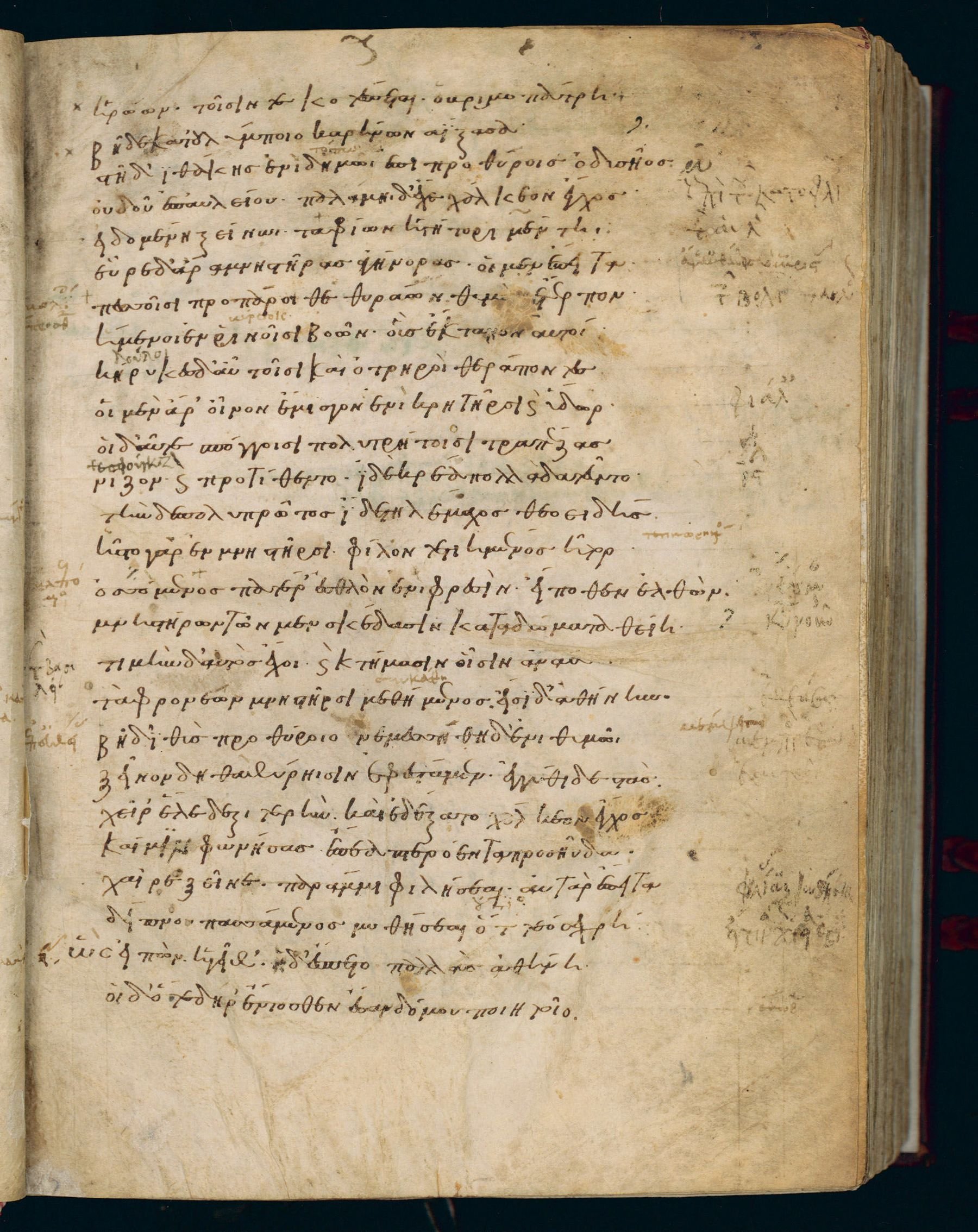
Laur. Plut. 32.24, fol. 4r: Odyssey 1.101-126, begins ‹ἡρώων, τοῖσίν τε κοτέσσεται›, ends ‹ἔντοσθεν ἔσαν δόμου ὑψηλοῖο,›. Checked on the image: first and last lines read and matched to the Greek. Fol. 3v ends with 1.100. Fol. 4v begins with 1.127. English blocks here: 100-104, 105-109, 110-114, 115-119, 120-124.
101ἡρώων, τοῖσίν τε κοτέσσεται ὀβριμοπάτρη.
102βῆ δὲ κατʼ Οὐλύμποιο καρήνων ἀίξασα,
103στῆ δʼ Ἰθάκης ἐνὶ δήμῳ ἐπὶ προθύροις Ὀδυσῆος,
104οὐδοῦ ἐπʼ αὐλείου· παλάμῃ δʼ ἔχε χάλκεον ἔγχος,
105εἰδομένη ξείνῳ, Ταφίων ἡγήτορι Μέντῃ.
106εὗρε δʼ ἄρα μνηστῆρας ἀγήνορας. οἱ μὲν ἔπειτα
107πεσσοῖσι προπάροιθε θυράων θυμὸν ἔτερπον
108ἥμενοι ἐν ῥινοῖσι βοῶν, οὓς ἔκτανον αὐτοί·
109κήρυκες δʼ αὐτοῖσι καὶ ὀτρηροὶ θεράποντες
110οἱ μὲν οἶνον ἔμισγον ἐνὶ κρητῆρσι καὶ ὕδωρ,
111οἱ δʼ αὖτε σπόγγοισι πολυτρήτοισι τραπέζας
112νίζον καὶ πρότιθεν, τοὶ δὲ κρέα πολλὰ δατεῦντο.
113τὴν δὲ πολὺ πρῶτος ἴδε Τηλέμαχος θεοειδής,
114ἧστο γὰρ ἐν μνηστῆρσι φίλον τετιημένος ἦτορ,
115ὀσσόμενος πατέρʼ ἐσθλὸν ἐνὶ φρεσίν, εἴ ποθεν ἐλθὼν
116μνηστήρων τῶν μὲν σκέδασιν κατὰ δώματα θείη,
117τιμὴν δʼ αὐτὸς ἔχοι καὶ δώμασιν οἷσιν ἀνάσσοι.
118τὰ φρονέων, μνηστῆρσι μεθήμενος, εἴσιδʼ Ἀθήνην.
119βῆ δʼ ἰθὺς προθύροιο, νεμεσσήθη δʼ ἐνὶ θυμῷ
120ξεῖνον δηθὰ θύρῃσιν ἐφεστάμεν· ἐγγύθι δὲ στὰς
121χεῖρʼ ἕλε δεξιτερὴν καὶ ἐδέξατο χάλκεον ἔγχος,
122καί μιν φωνήσας ἔπεα πτερόεντα προσηύδα·
123χαῖρε, ξεῖνε, παρʼ ἄμμι φιλήσεαι· αὐτὰρ ἔπειτα
124δείπνου πασσάμενος μυθήσεαι ὅττεό σε χρή.
125ὣς εἰπὼν ἡγεῖθʼ, ἡ δʼ ἕσπετο Παλλὰς Ἀθήνη.
126οἱ δʼ ὅτε δή ῥʼ ἔντοσθεν ἔσαν δόμου ὑψηλοῖο,
100heavy and huge and strong, wherewith she vanquishes the ranks of men—of warriors, with whom she is wroth, she, the daughter of the mighty sire. Then she went darting down from the heights of Olympus, and took her stand in the land of Ithaca at the outer gate of Odysseus, on the threshold of the court. In her hand she held the spear of bronze, 105and she was in the likeness of a stranger, Mentes, the leader of the Taphians. There she found the proud wooers. They were taking their pleasure at draughts in front of the doors, sitting on the hides of oxen which they themselves had slain; and of the heralds and busy squires, 110some were mixing wine and water for them in bowls, others again were washing the tables with porous sponges and setting them forth, while still others were portioning out meats in abundance. Her the godlike Telemachus was far the first to see, for he was sitting among the wooers, sad at heart, 115seeing in thought his noble father, should he perchance come from somewhere and make a scattering of the wooers in the palace, and himself win honor and rule over his own house. As he thought of these things, sitting among the wooers, he beheld Athena, and he went straight to the outer door; for in his heart he counted it shame 120that a stranger should stand long at the gates. So, drawing near, he clasped her right hand, and took from her the spear of bronze; and he spoke, and addressed her with winged words: “Hail, stranger; in our house thou shalt find entertainment and then, when thou hast tasted food, thou shalt tell of what thou hast need.”
Where on the image
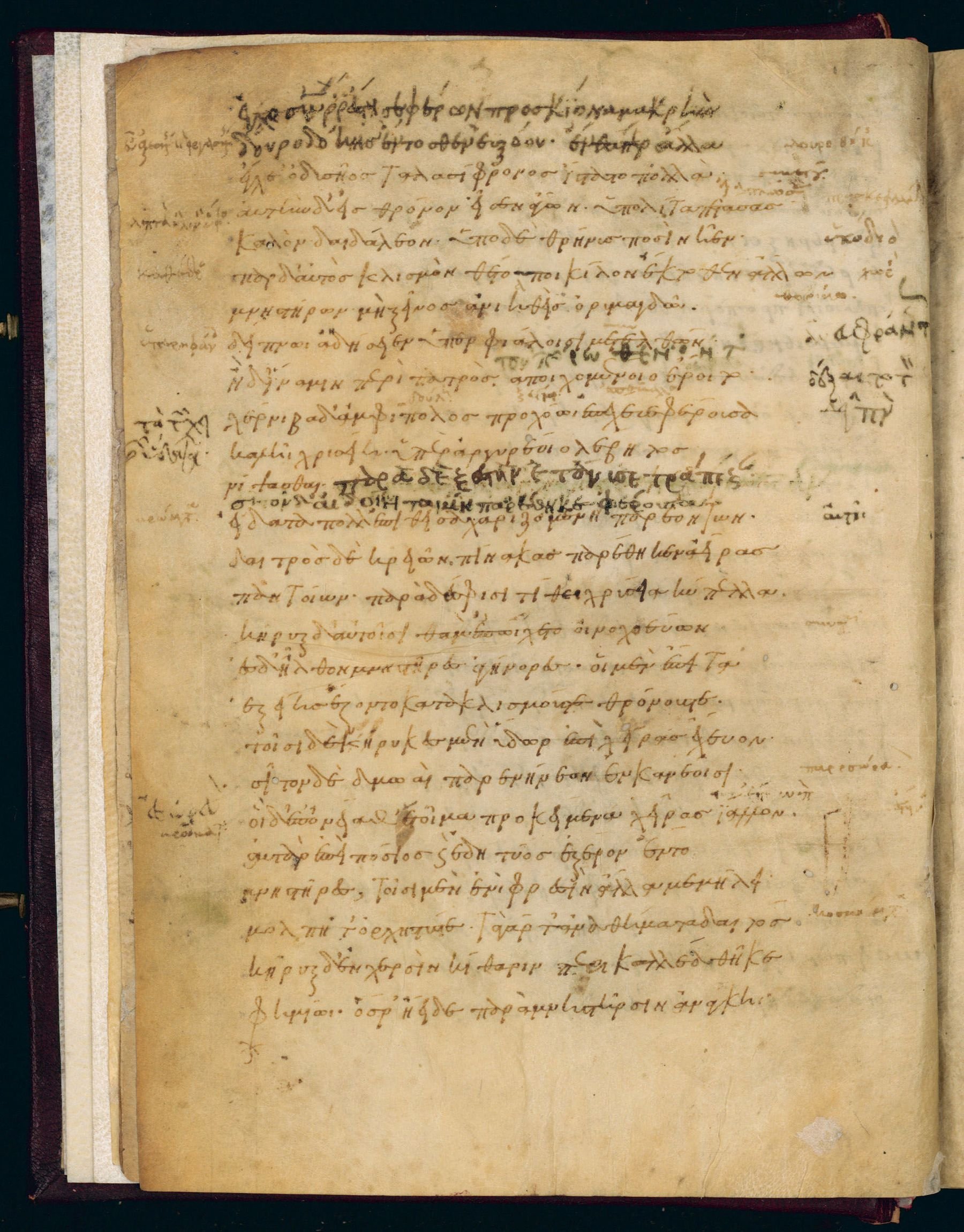
Laur. Plut. 32.24, fol. 4v: Odyssey 1.127-154, begins ‹ἔγχος μέν ῥʼ ἔστησε›, ends ‹ἤειδε παρὰ μνηστῆρσιν ἀνάγκῃ.›. Checked on the image: first and last lines read and matched to the Greek. Fol. 4r ends with 1.126. Fol. 5r begins with 1.155. English blocks here: 125-129, 130-134, 135-139, 140-144, 145-149, 150-154.
127ἔγχος μέν ῥʼ ἔστησε φέρων πρὸς κίονα μακρὴν
128δουροδόκης ἔντοσθεν ἐυξόου, ἔνθα περ ἄλλα
129ἔγχεʼ Ὀδυσσῆος ταλασίφρονος ἵστατο πολλά,
130αὐτὴν δʼ ἐς θρόνον εἷσεν ἄγων, ὑπὸ λῖτα πετάσσας,
131καλὸν δαιδάλεον· ὑπὸ δὲ θρῆνυς ποσὶν ἦεν.
132πὰρ δʼ αὐτὸς κλισμὸν θέτο ποικίλον, ἔκτοθεν ἄλλων
133μνηστήρων, μὴ ξεῖνος ἀνιηθεὶς ὀρυμαγδῷ
134δείπνῳ ἁδήσειεν, ὑπερφιάλοισι μετελθών,
135ἠδʼ ἵνα μιν περὶ πατρὸς ἀποιχομένοιο ἔροιτο.
136χέρνιβα δʼ ἀμφίπολος προχόῳ ἐπέχευε φέρουσα
137καλῇ χρυσείῃ, ὑπὲρ ἀργυρέοιο λέβητος,
138νίψασθαι· παρὰ δὲ ξεστὴν ἐτάνυσσε τράπεζαν.
139σῖτον δʼ αἰδοίη ταμίη παρέθηκε φέρουσα,
140εἴδατα πόλλʼ ἐπιθεῖσα, χαριζομένη παρεόντων·
141δαιτρὸς δὲ κρειῶν πίνακας παρέθηκεν ἀείρας
142παντοίων, παρὰ δέ σφι τίθει χρύσεια κύπελλα·
143κῆρυξ δʼ αὐτοῖσιν θάμʼ ἐπῴχετο οἰνοχοεύων.
144ἐς δʼ ἦλθον μνηστῆρες ἀγήνορες. οἱ μὲν ἔπειτα
145ἑξείης ἕζοντο κατὰ κλισμούς τε θρόνους τε,
146τοῖσι δὲ κήρυκες μὲν ὕδωρ ἐπὶ χεῖρας ἔχευαν,
147σῖτον δὲ δμῳαὶ παρενήνεον ἐν κανέοισιν,
148κοῦροι δὲ κρητῆρας ἐπεστέψαντο ποτοῖο.
149οἱ δʼ ἐπʼ ὀνείαθʼ ἑτοῖμα προκείμενα χεῖρας ἴαλλον.
150αὐτὰρ ἐπεὶ πόσιος καὶ ἐδητύος ἐξ ἔρον ἕντο
151μνηστῆρες, τοῖσιν μὲν ἐνὶ φρεσὶν ἄλλα μεμήλει,
152μολπή τʼ ὀρχηστύς τε· τὰ γάρ τʼ ἀναθήματα δαιτός·
153κῆρυξ δʼ ἐν χερσὶν κίθαριν περικαλλέα θῆκεν
154Φημίῳ, ὅς ῥʼ ἤειδε παρὰ μνηστῆρσιν ἀνάγκῃ.
125So saying, he led the way, and Pallas Athena followed. And when they were within the lofty house, he bore the spear and set it against a tall pillar in a polished spear-rack, where were set many spears besides, even those of Odysseus of the steadfast heart. 130Athena herself he led and seated on a chair, spreading a linen cloth beneath—a beautiful chair, richly-wrought, and below was a footstool for the feet. Beside it he placed for himself an inlaid seat, apart from the others, the wooers, lest the stranger, vexed by their din, should loathe the meal, seeing that he was in the company of overweening men; 135and also that he might ask him about his father that was gone. Then a handmaid brought water for the hands in a fair pitcher of gold, and poured it over a silver basin for them to wash, and beside them drew up a polished table. And the grave housewife brought and set before them bread, 140and therewith dainties in abundance, giving freely of her store. And a carver lifted up and placed before them platters of all manner of meats, and set by them golden goblets, while a herald ever walked to and fro pouring them wine. Then in came the proud wooers, and thereafter 145sat them down in rows on chairs and high seats. Heralds poured water over their hands, and maid-servants heaped by them bread in baskets, and youths filled the bowls brim full of drink; and they put forth their hands to the good cheer lying ready before them. 150Now after the wooers had put from them the desire of food and drink, their hearts turned to other things, to song and to dance; for these things are the crown of a feast. And a herald put the beautiful lyre in the hands of Phemius, who sang perforce among the wooers;
Where on the image
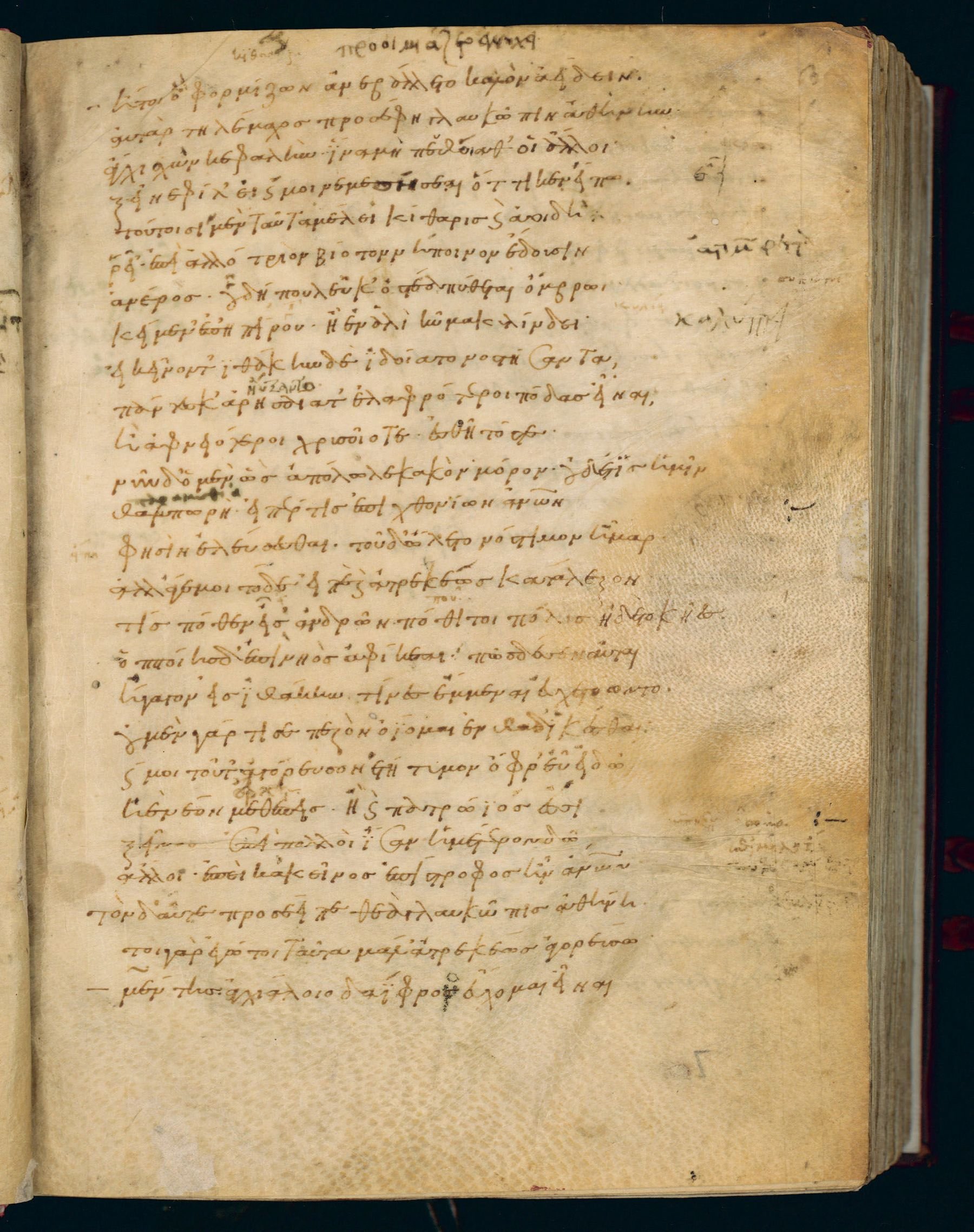
Laur. Plut. 32.24, fol. 5r: Odyssey 1.155-180, begins ‹ἦ τοι ὁ φορμίζων›, ends ‹Ἀγχιάλοιο δαΐφρονος εὔχομαι εἶναι›. Checked on the image: first and last lines read and matched to the Greek. Fol. 4v ends with 1.154. Fol. 5v begins with 1.181. A gloss is written above the first line. English blocks here: 155-159, 160-164, 165-169, 170-174, 175-177, 178-179.
155ἦ τοι ὁ φορμίζων ἀνεβάλλετο καλὸν ἀείδειν.
156αὐτὰρ Τηλέμαχος προσέφη γλαυκῶπιν Ἀθήνην,
157ἄγχι σχὼν κεφαλήν, ἵνα μὴ πευθοίαθʼ οἱ ἄλλοι·
158ξεῖνε φίλʼ, ἦ καί μοι νεμεσήσεαι ὅττι κεν εἴπω;
159τούτοισιν μὲν ταῦτα μέλει, κίθαρις καὶ ἀοιδή,
160ῥεῖʼ, ἐπεὶ ἀλλότριον βίοτον νήποινον ἔδουσιν,
161ἀνέρος, οὗ δή που λεύκʼ ὀστέα πύθεται ὄμβρῳ
162κείμενʼ ἐπʼ ἠπείρου, ἢ εἰν ἁλὶ κῦμα κυλίνδει.
163εἰ κεῖνόν γʼ Ἰθάκηνδε ἰδοίατο νοστήσαντα,
164πάντες κʼ ἀρησαίατʼ ἐλαφρότεροι πόδας εἶναι
165ἢ ἀφνειότεροι χρυσοῖό τε ἐσθῆτός τε.
166νῦν δʼ ὁ μὲν ὣς ἀπόλωλε κακὸν μόρον, οὐδέ τις ἡμῖν
167θαλπωρή, εἴ πέρ τις ἐπιχθονίων ἀνθρώπων
168φῇσιν ἐλεύσεσθαι· τοῦ δʼ ὤλετο νόστιμον ἦμαρ.
169ἀλλʼ ἄγε μοι τόδε εἰπὲ καὶ ἀτρεκέως κατάλεξον·
170τίς πόθεν εἰς ἀνδρῶν; πόθι τοι πόλις ἠδὲ τοκῆες;
171ὁπποίης τʼ ἐπὶ νηὸς ἀφίκεο· πῶς δέ σε ναῦται
172ἤγαγον εἰς Ἰθάκην; τίνες ἔμμεναι εὐχετόωντο;
173οὐ μὲν γάρ τί σε πεζὸν ὀίομαι ἐνθάδʼ ἱκέσθαι.
174καί μοι τοῦτʼ ἀγόρευσον ἐτήτυμον, ὄφρʼ ἐὺ εἰδῶ,
175ἠὲ νέον μεθέπεις ἦ καὶ πατρώιός ἐσσι
176ξεῖνος, ἐπεὶ πολλοὶ ἴσαν ἀνέρες ἡμέτερον δῶ
177ἄλλοι, ἐπεὶ καὶ κεῖνος ἐπίστροφος ἦν ἀνθρώπων.
178τὸν δʼ αὖτε προσέειπε θεά, γλαυκῶπις Ἀθήνη·
179τοιγὰρ ἐγώ τοι ταῦτα μάλʼ ἀτρεκέως ἀγορεύσω.
180Μέντης Ἀγχιάλοιο δαΐφρονος εὔχομαι εἶναι
155and he struck the chords in prelude to his sweet lay. But Telemachus spoke to flashing-eyed Athena, holding his head close, that the others might not hear: “Dear stranger, wilt thou be wroth with me for the word that I shall say? These men care for things like these, the lyre and song, 160full easily, seeing that without atonement they devour the livelihood of another, of a man whose white bones, it may be, rot in the rain as they lie upon the mainland, or the wave rolls them in the sea. Were they to see him returned to Ithaca, they would all pray to be swifter of foot, 165rather than richer in gold and in raiment. But now he has thus perished by an evil doom, nor for us is there any comfort, no, not though any one of men upon the earth should say that he will come; gone is the day of his returning. But come, tell me this, and declare it truly. 170Who art thou among men, and from whence? Where is thy city and where thy parents? On what manner of ship didst thou come, and how did sailors bring thee to Ithaca? Who did they declare themselves to be? For nowise, methinks, didst thou come hither on foot. And tell me this also truly, that I may know full well, 175whether this is thy first coming hither, or whether thou art indeed a friend of my father's house. For many were the men who came to our house as strangers, since he, too, had gone to and fro among men.” 178Then the goddess, flashing-eyed Athena, answered him: “Therefore of a truth will I frankly tell thee all.
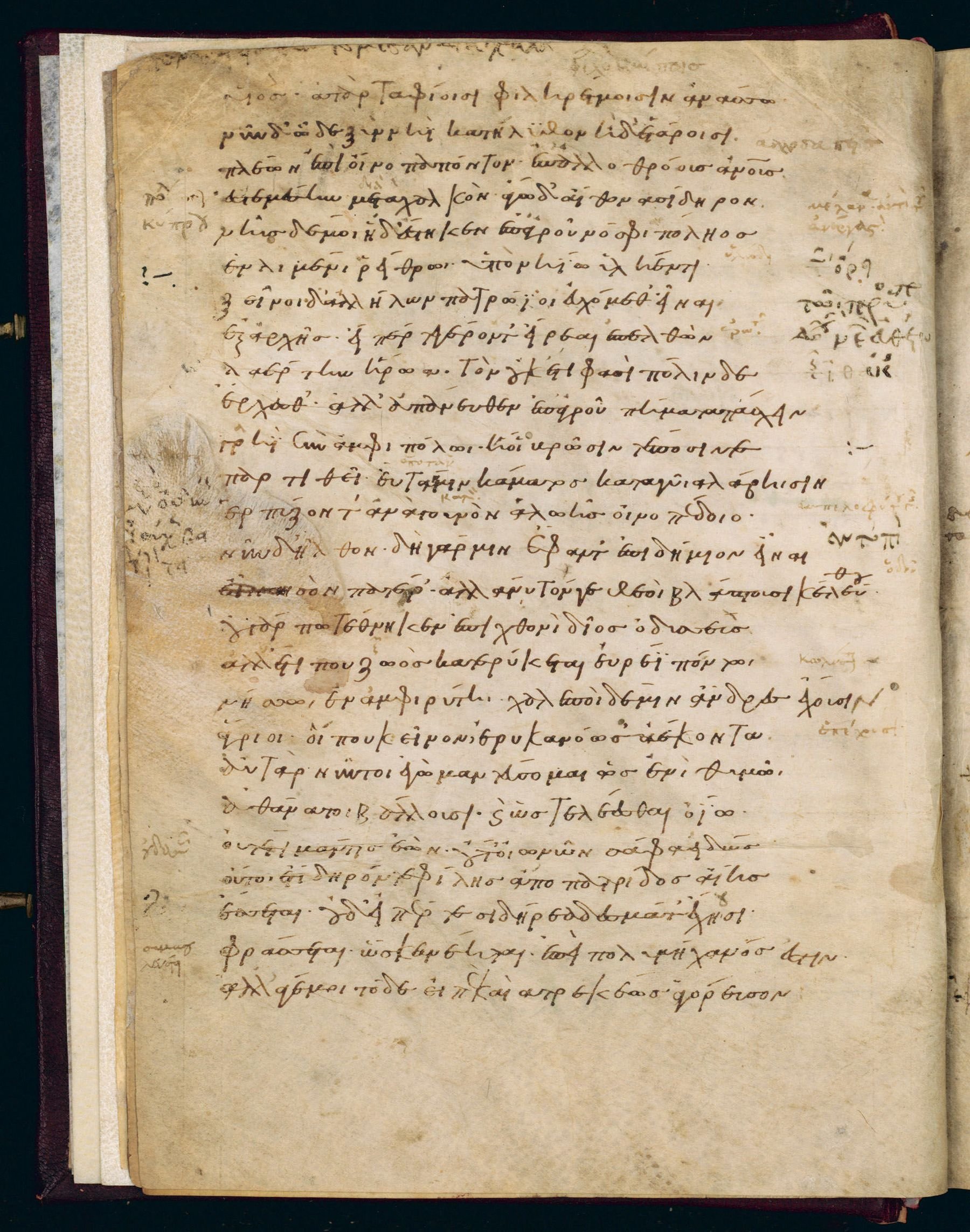
Where on the image
Laur. Plut. 32.24, fol. 5v: Odyssey 1.181-206, begins ‹υἱός, ἀτὰρ Ταφίοισι φιληρέτμοισιν›, ends ‹εἰπὲ καὶ ἀτρεκέως κατάλεξον,›. Checked on the image: first and last lines read and matched to the Greek. Fol. 5r ends with 1.180. Fol. 6r begins with 1.207. English blocks here: 180-184, 185-189, 190-194, 195-199, 200-204.
181υἱός, ἀτὰρ Ταφίοισι φιληρέτμοισιν ἀνάσσω.
182νῦν δʼ ὧδε ξὺν νηὶ κατήλυθον ἠδʼ ἑτάροισιν
183πλέων ἐπὶ οἴνοπα πόντον ἐπʼ ἀλλοθρόους ἀνθρώπους,
184ἐς Τεμέσην μετὰ χαλκόν, ἄγω δʼ αἴθωνα σίδηρον.
185νηῦς δέ μοι ἥδʼ ἕστηκεν ἐπʼ ἀγροῦ νόσφι πόληος,
186ἐν λιμένι Ῥείθρῳ ὑπὸ Νηίῳ ὑλήεντι.
187ξεῖνοι δʼ ἀλλήλων πατρώιοι εὐχόμεθʼ εἶναι
188ἐξ ἀρχῆς, εἴ πέρ τε γέροντʼ εἴρηαι ἐπελθὼν
189Λαέρτην ἥρωα, τὸν οὐκέτι φασὶ πόλινδε
190ἔρχεσθʼ, ἀλλʼ ἀπάνευθεν ἐπʼ ἀγροῦ πήματα πάσχειν
191γρηὶ σὺν ἀμφιπόλῳ, ἥ οἱ βρῶσίν τε πόσιν τε
192παρτιθεῖ, εὖτʼ ἄν μιν κάματος κατὰ γυῖα λάβῃσιν
193ἑρπύζοντʼ ἀνὰ γουνὸν ἀλωῆς οἰνοπέδοιο.
194νῦν δʼ ἦλθον· δὴ γάρ μιν ἔφαντʼ ἐπιδήμιον εἶναι,
195σὸν πατέρʼ· ἀλλά νυ τόν γε θεοὶ βλάπτουσι κελεύθου.
196οὐ γάρ πω τέθνηκεν ἐπὶ χθονὶ δῖος Ὀδυσσεύς,
197ἀλλʼ ἔτι που ζωὸς κατερύκεται εὐρέι πόντῳ
198νήσῳ ἐν ἀμφιρύτῃ, χαλεποὶ δέ μιν ἄνδρες ἔχουσιν
199ἄγριοι, οἵ που κεῖνον ἐρυκανόωσʼ ἀέκοντα.
200αὐτὰρ νῦν τοι ἐγὼ μαντεύσομαι, ὡς ἐνὶ θυμῷ
201ἀθάνατοι βάλλουσι καὶ ὡς τελέεσθαι ὀίω,
202οὔτε τι μάντις ἐὼν οὔτʼ οἰωνῶν σάφα εἰδώς.
203οὔ τοι ἔτι δηρόν γε φίλης ἀπὸ πατρίδος αἴης
204ἔσσεται, οὐδʼ εἴ πέρ τε σιδήρεα δέσματʼ ἔχῃσιν·
205φράσσεται ὥς κε νέηται, ἐπεὶ πολυμήχανός ἐστιν.
206ἀλλʼ ἄγε μοι τόδε εἰπὲ καὶ ἀτρεκέως κατάλεξον,
180I declare that I am Mentes, the son of wise Anchialus, and I am lord over the oar-loving Taphians. And now have I put in here, as thou seest, with ship and crew, while sailing over the wine-dark sea to men of strange speech, on my way to Temese for copper; and I bear with me shining iron. 185My ship lies yonder beside the fields away from the city, in the harbor of Rheithron, under woody Neion. Friends of one another do we declare ourselves to be, even as our fathers were, friends from of old. Nay, if thou wilt, go and ask the old warrior Laertes, who, they say, 190comes no more to the city, but afar in the fields suffers woes attended by an aged woman as his handmaid, who sets before him food and drink, after weariness has laid hold of his limbs, as he creeps along the slope of his vineyard plot. And now am I come, for of a truth men said that he, 195thy father, was among his people; but lo, the gods are thwarting him of his return. For not yet has goodly Odysseus perished on the earth, but still, I ween, he lives and is held back on the broad sea in a sea-girt isle, and cruel men keep him, a savage folk, that constrain him, haply sore against his will. 200Nay, I will now prophesy to thee, as the immortals put it in my heart, and as I think it shall be brought to pass, though I am in no wise a soothsayer, nor one versed in the signs of birds. Not much longer shall he be absent from his dear native land, no, not though bonds of iron hold him.
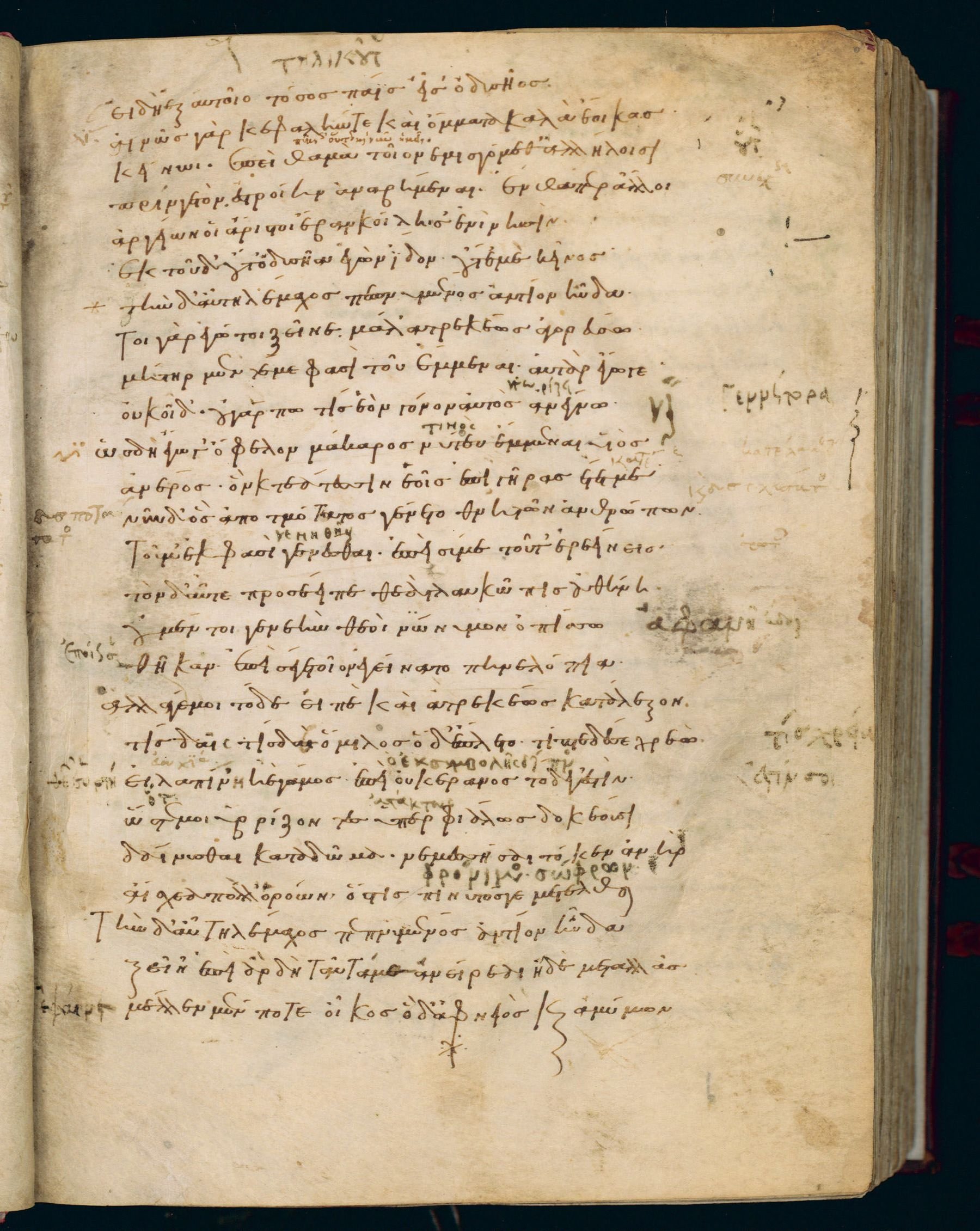
Where on the image
Laur. Plut. 32.24, fol. 6r: Odyssey 1.207-232, begins ‹εἰ δὴ ἐξ αὐτοῖο›, ends ‹ὅδʼ ἀφνειὸς καὶ ἀμύμων›. Checked on the image: first and last lines read and matched to the Greek. Fol. 5v ends with 1.206. Fol. 6v begins with 1.233. English blocks here: 205-209, 210-214, 215-219, 220-224, 225-229, 230-234.
207εἰ δὴ ἐξ αὐτοῖο τόσος πάϊς εἰς Ὀδυσῆος.
208αἰνῶς μὲν κεφαλήν τε καὶ ὄμματα καλὰ ἔοικας
209κείνῳ, ἐπεὶ θαμὰ τοῖον ἐμισγόμεθʼ ἀλλήλοισιν,
210πρίν γε τὸν ἐς Τροίην ἀναβήμεναι, ἔνθα περ ἄλλοι
211Ἀργείων οἱ ἄριστοι ἔβαν κοίλῃς ἐνὶ νηυσίν·
212ἐκ τοῦ δʼ οὔτʼ Ὀδυσῆα ἐγὼν ἴδον οὔτʼ ἔμʼ ἐκεῖνος.
213τὴν δʼ αὖ Τηλέμαχος πεπνυμένος ἀντίον ηὔδα·
214τοιγὰρ ἐγώ τοι, ξεῖνε, μάλʼ ἀτρεκέως ἀγορεύσω.
215μήτηρ μέν τέ μέ φησι τοῦ ἔμμεναι, αὐτὰρ ἐγώ γε
216οὐκ οἶδʼ· οὐ γάρ πώ τις ἑὸν γόνον αὐτὸς ἀνέγνω.
217ὡς δὴ ἐγώ γʼ ὄφελον μάκαρός νύ τευ ἔμμεναι υἱὸς
218ἀνέρος, ὃν κτεάτεσσιν ἑοῖς ἔπι γῆρας ἔτετμε.
219νῦν δʼ ὃς ἀποτμότατος γένετο θνητῶν ἀνθρώπων,
220τοῦ μʼ ἔκ φασι γενέσθαι, ἐπεὶ σύ με τοῦτʼ ἐρεείνεις.
221τὸν δʼ αὖτε προσέειπε θεά, γλαυκῶπις Ἀθήνη·
222οὐ μέν τοι γενεήν γε θεοὶ νώνυμνον ὀπίσσω
223θῆκαν, ἐπεὶ σέ γε τοῖον ἐγείνατο Πηνελόπεια.
224ἀλλʼ ἄγε μοι τόδε εἰπὲ καὶ ἀτρεκέως κατάλεξον·
225τίς δαίς, τίς δὲ ὅμιλος ὅδʼ ἔπλετο; τίπτε δέ σε χρεώ;
226εἰλαπίνη ἠὲ γάμος; ἐπεὶ οὐκ ἔρανος τάδε γʼ ἐστίν·
227ὥς τέ μοι ὑβρίζοντες ὑπερφιάλως δοκέουσι
228δαίνυσθαι κατὰ δῶμα. νεμεσσήσαιτό κεν ἀνὴρ
229αἴσχεα πόλλʼ ὁρόων, ὅς τις πινυτός γε μετέλθοι.
230τὴν δʼ αὖ Τηλέμαχος πεπνυμένος ἀντίον ηὔδα·
231ξεῖνʼ, ἐπεὶ ἂρ δὴ ταῦτά μʼ ἀνείρεαι ἠδὲ μεταλλᾷς,
232μέλλεν μέν ποτε οἶκος ὅδʼ ἀφνειὸς καὶ ἀμύμων
205He will contrive a way to return, for he is a man of many devices. But come, tell me this and declare it truly, whether indeed, tall as thou art, thou art the son of Odysseus himself. Wondrously like his are thy head and beautiful eyes; for full often did we consort with one another 210before he embarked for the land of Troy, whither others, too, the bravest of the Argives, went in their hollow ships. But since that day neither have I seen Odysseus, nor he me.” Then wise Telemachus answered her: “Therefore of a truth, stranger, will I frankly tell thee all. 215My mother says that I am his child; but I know not, for never yet did any man of himself know his own parentage. Ah, would that I had been the son of some blest man, whom old age overtook among his own possessions. But now of him who was the most ill-fated of mortal men 220they say that I am sprung, since thou askest me of this.” Then the goddess, flashing-eyed Athena, answered him: “Surely, then, no nameless lineage have the gods appointed for thee in time to come, seeing that Penelope bore thee such as thou art. But come, tell me this and declare it truly. 225What feast, what throng is this? What need hast thou of it? Is it a drinking bout, or a wedding feast? For this plainly is no meal to which each brings his portion, with such outrage and overweening do they seem to me to be feasting in thy halls. Angered would a man be at seeing all these shameful acts, any man of sense who should come among them.” 230Then wise Telemachus answered her: “Stranger, since indeed thou dost ask and question me of this, our house once bade fair to be rich and honorable, so long as that man was still among his people. But now the gods have willed otherwise in their evil devising,
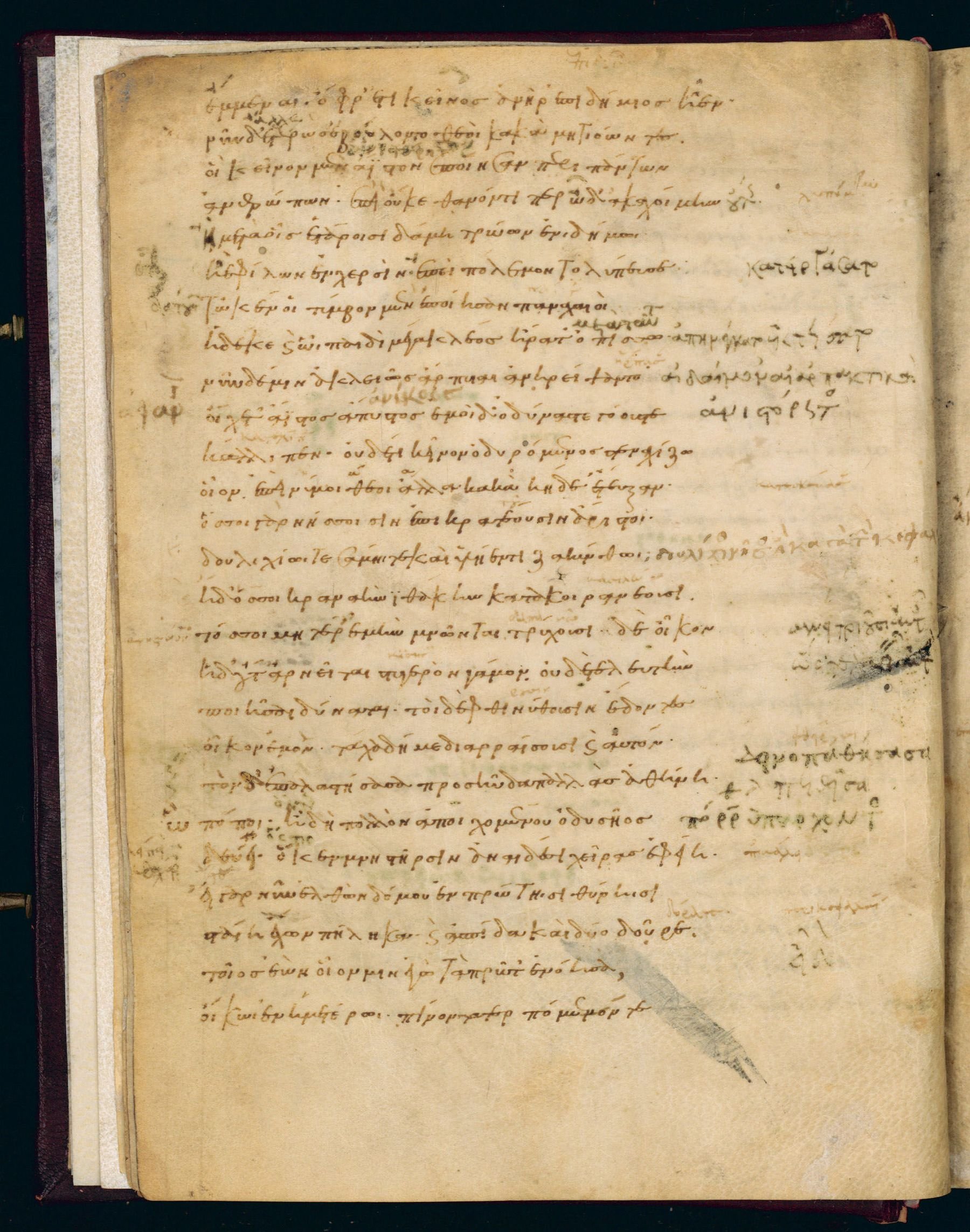
Where on the image
Laur. Plut. 32.24, fol. 6v: Odyssey 1.233-258, begins ‹ἔμμεναι, ὄφρʼ ἔτι κεῖνος›, ends ‹πίνοντά τε τερπόμενόν τε,›. Checked on the image: first and last lines read and matched to the Greek. Fol. 6r ends with 1.232. Fol. 7r begins with 1.259. 1.257 and 1.258 are the last two lines of the page (corrected 2026-11-12 after a recheck of the bottom of 6v). English blocks here: 235-239, 240-244, 245-249, 250-254, 255-259.
233ἔμμεναι, ὄφρʼ ἔτι κεῖνος ἀνὴρ ἐπιδήμιος ἦεν·
234νῦν δʼ ἑτέρως ἐβόλοντο θεοὶ κακὰ μητιόωντες,
235οἳ κεῖνον μὲν ἄιστον ἐποίησαν περὶ πάντων
236ἀνθρώπων, ἐπεὶ οὔ κε θανόντι περ ὧδʼ ἀκαχοίμην,
237εἰ μετὰ οἷς ἑτάροισι δάμη Τρώων ἐνὶ δήμῳ,
238ἠὲ φίλων ἐν χερσίν, ἐπεὶ πόλεμον τολύπευσεν.
239τῷ κέν οἱ τύμβον μὲν ἐποίησαν Παναχαιοί,
240ἠδέ κε καὶ ᾧ παιδὶ μέγα κλέος ἤρατʼ ὀπίσσω.
241νῦν δέ μιν ἀκλειῶς ἅρπυιαι ἀνηρείψαντο·
242οἴχετʼ ἄιστος ἄπυστος, ἐμοὶ δʼ ὀδύνας τε γόους τε
243κάλλιπεν. οὐδέ τι κεῖνον ὀδυρόμενος στεναχίζω
244οἶον, ἐπεί νύ μοι ἄλλα θεοὶ κακὰ κήδεʼ ἔτευξαν.
245ὅσσοι γὰρ νήσοισιν ἐπικρατέουσιν ἄριστοι,
246Δουλιχίῳ τε Σάμῃ τε καὶ ὑλήεντι Ζακύνθῳ,
247ἠδʼ ὅσσοι κραναὴν Ἰθάκην κάτα κοιρανέουσιν,
248τόσσοι μητέρʼ ἐμὴν μνῶνται, τρύχουσι δὲ οἶκον.
249ἡ δʼ οὔτʼ ἀρνεῖται στυγερὸν γάμον οὔτε τελευτὴν
250ποιῆσαι δύναται· τοὶ δὲ φθινύθουσιν ἔδοντες
251οἶκον ἐμόν· τάχα δή με διαρραίσουσι καὶ αὐτόν.
252τὸν δʼ ἐπαλαστήσασα προσηύδα Παλλὰς Ἀθήνη·
253ὢ πόποι, ἦ δὴ πολλὸν ἀποιχομένου Ὀδυσῆος
254δεύῃ, ὅ κε μνηστῆρσιν ἀναιδέσι χεῖρας ἐφείη.
255εἰ γὰρ νῦν ἐλθὼν δόμου ἐν πρώτῃσι θύρῃσι
256σταίη, ἔχων πήληκα καὶ ἀσπίδα καὶ δύο δοῦρε,
257τοῖος ἐὼν οἷόν μιν ἐγὼ τὰ πρῶτʼ ἐνόησα
258οἴκῳ ἐν ἡμετέρῳ πίνοντά τε τερπόμενόν τε,
235seeing that they have caused him to pass from sight as they have no other man. For I should not so grieve for his death, if he had been slain among his comrades in the land of the Trojans, or had died in the arms of his friends, when he had wound up the skein of war. Then would the whole host of the Achaeans have made him a tomb, 240and for his son, too, he would have won great glory in days to come. But as it is, the spirits of the storm have swept him away and left no tidings: he is gone out of sight, out of hearing, and for me he has left anguish and weeping; nor do I in any wise mourn and wail for him alone, seeing that the gods have brought upon me other sore troubles. 245For all the princes who hold sway over the islands—Dulichium and Same and wooded Zacynthus—and those who lord it over rocky Ithaca, all these woo my mother and lay waste my house. And she neither refuses the hateful marriage, 250nor is she able to make an end; but they with feasting consume my substance: ere long they will bring me, too, to ruin.” Then, stirred to anger, Pallas Athena spoke to him:“Out on it! Thou hast of a truth sore need of Odysseus that is gone, that he might put forth his hands upon the shameless wooers. 255Would that he might come now and take his stand at the outer gate of the house, with helmet and shield and two spears, such a man as he was when I first saw him in our house drinking and making merry, on his way back from Ephyre, from the house of Ilus, son of Mermerus.
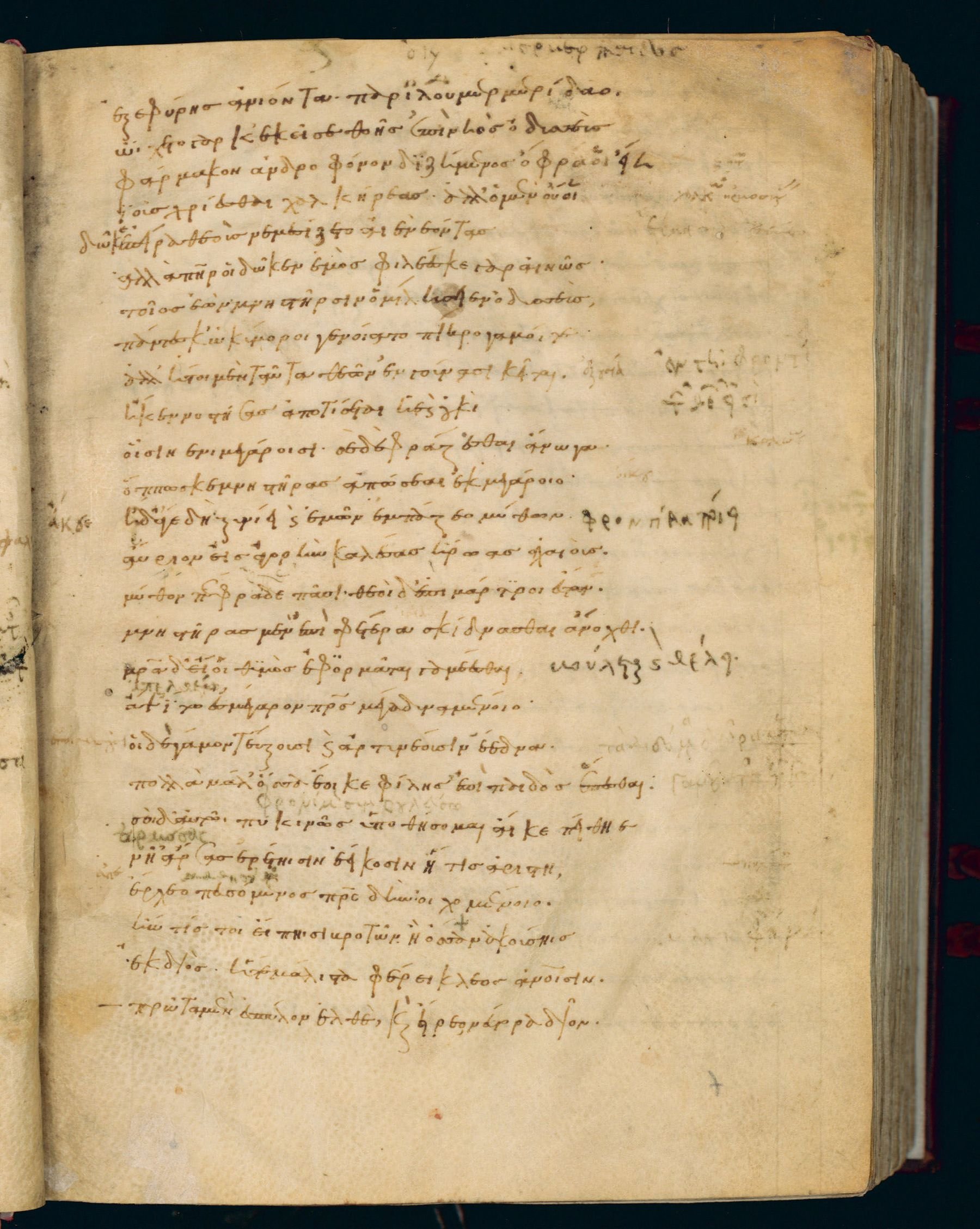
Where on the image
Laur. Plut. 32.24, fol. 7r: Odyssey 1.259-284, begins ‹ἐξ Ἐφύρης ἀνιόντα παρʼ›, ends ‹καὶ εἴρεο Νέστορα δῖον,›. Checked on the image: first and last lines read and matched to the Greek. Fol. 6v ends with 1.258. Fol. 7v begins with 1.285. The top edge is curled in the photograph; the first line of the column is 1.259 (ἐξ Ἐφύρης ἀνιόντα ...). The faint letters on the curled edge above it are not a line of this page's text. English blocks here: 260-264, 265-269, 270-274, 275-279, 280-284.
259ἐξ Ἐφύρης ἀνιόντα παρʼ Ἴλου Μερμερίδαο—
260ᾤχετο γὰρ καὶ κεῖσε θοῆς ἐπὶ νηὸς Ὀδυσσεὺς
261φάρμακον ἀνδροφόνον διζήμενος, ὄφρα οἱ εἴη
262ἰοὺς χρίεσθαι χαλκήρεας· ἀλλʼ ὁ μὲν οὔ οἱ
263δῶκεν, ἐπεί ῥα θεοὺς νεμεσίζετο αἰὲν ἐόντας,
264ἀλλὰ πατήρ οἱ δῶκεν ἐμός· φιλέεσκε γὰρ αἰνῶς—
265τοῖος ἐὼν μνηστῆρσιν ὁμιλήσειεν Ὀδυσσεύς·
266πάντες κʼ ὠκύμοροί τε γενοίατο πικρόγαμοί τε.
267ἀλλʼ ἦ τοι μὲν ταῦτα θεῶν ἐν γούνασι κεῖται,
268ἤ κεν νοστήσας ἀποτίσεται, ἦε καὶ οὐκί,
269οἷσιν ἐνὶ μεγάροισι· σὲ δὲ φράζεσθαι ἄνωγα,
270ὅππως κε μνηστῆρας ἀπώσεαι ἐκ μεγάροιο.
271εἰ δʼ ἄγε νῦν ξυνίει καὶ ἐμῶν ἐμπάζεο μύθων·
272αὔριον εἰς ἀγορὴν καλέσας ἥρωας Ἀχαιοὺς
273μῦθον πέφραδε πᾶσι, θεοὶ δʼ ἐπὶ μάρτυροι ἔστων.
274μνηστῆρας μὲν ἐπὶ σφέτερα σκίδνασθαι ἄνωχθι,
275μητέρα δʼ, εἴ οἱ θυμὸς ἐφορμᾶται γαμέεσθαι,
276ἂψ ἴτω ἐς μέγαρον πατρὸς μέγα δυναμένοιο·
277οἱ δὲ γάμον τεύξουσι καὶ ἀρτυνέουσιν ἔεδνα
278πολλὰ μάλʼ, ὅσσα ἔοικε φίλης ἐπὶ παιδὸς ἕπεσθαι.
279σοὶ δʼ αὐτῷ πυκινῶς ὑποθήσομαι, αἴ κε πίθηαι·
280νῆʼ ἄρσας ἐρέτῃσιν ἐείκοσιν, ἥ τις ἀρίστη,
281ἔρχεο πευσόμενος πατρὸς δὴν οἰχομένοιο,
282ἤν τίς τοι εἴπῃσι βροτῶν, ἢ ὄσσαν ἀκούσῃς
283ἐκ Διός, ἥ τε μάλιστα φέρει κλέος ἀνθρώποισι.
284πρῶτα μὲν ἐς Πύλον ἐλθὲ καὶ εἴρεο Νέστορα δῖον,
260For thither, too, went Odysseus in his swift ship in search of a deadly drug, that he might have wherewith to smear his bronze-tipped arrows; yet Ilus gave it not to him, for he stood in awe of the gods that are forever; but my father gave it, for he held him strangely dear. 265Would, I say, that in such strength Odysseus might come amongst the wooers; then should they all find swift destruction and bitterness in their wooing. Yet these things verily lie on the knees of the gods, whether he shall return and wreak vengeance in his halls, or whether he shall not; but for thyself, I bid thee take thought 270how thou mayest thrust forth the wooers from the hall. Come now, give ear, and hearken to my words. On the morrow call to an assembly the Achaean lords, and speak out thy word to all, and let the gods be thy witnesses. As for the wooers, bid them scatter, each to his own; 275and for thy mother, if her heart bids her marry, let her go back to the hall of her mighty father, and there they will prepare a wedding feast, and make ready the gifts full many—aye, all that should follow after a well-loved daughter. And to thyself will I give wise counsel, if thou wilt hearken. 280Man with twenty rowers the best ship thou hast, and go to seek tidings of thy father, that has long been gone, if haply any mortal may tell thee, or thou mayest hear a voice from Zeus, which oftenest brings tidings to men. First go to Pylos and question goodly Nestor,
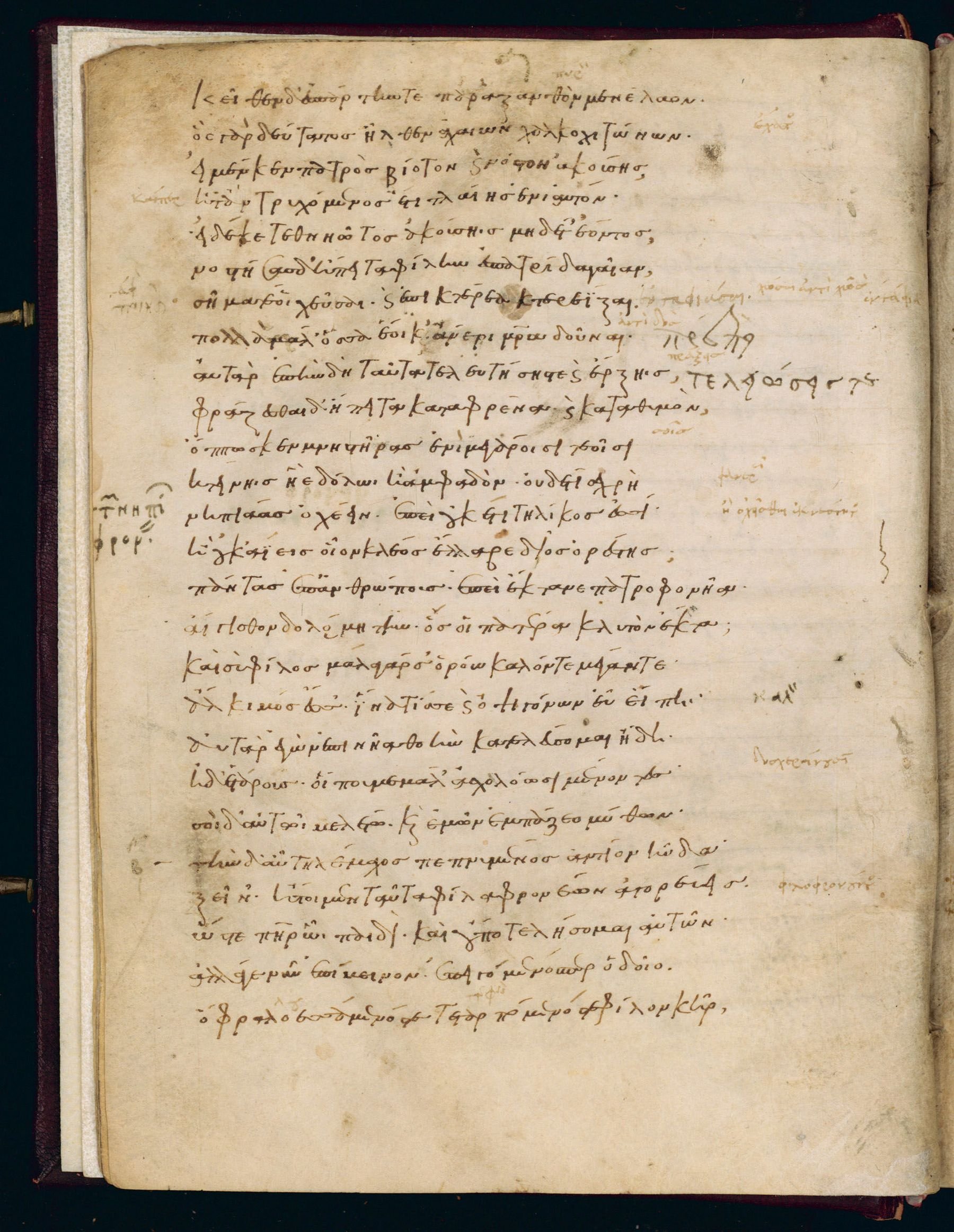
Where on the image
Laur. Plut. 32.24, fol. 7v: Odyssey 1.285-310, begins ‹κεῖθεν δὲ Σπάρτηνδε παρὰ›, ends ‹τεταρπόμενός τε φίλον κῆρ,›. Checked on the image: first and last lines read and matched to the Greek. Fol. 7r ends with 1.284. Fol. 8r begins with 1.311. English blocks here: 285-289, 290-294, 295-299, 300-304, 305-309.
285κεῖθεν δὲ Σπάρτηνδε παρὰ ξανθὸν Μενέλαον·
286ὃς γὰρ δεύτατος ἦλθεν Ἀχαιῶν χαλκοχιτώνων.
287εἰ μέν κεν πατρὸς βίοτον καὶ νόστον ἀκούσῃς,
288ἦ τʼ ἂν τρυχόμενός περ ἔτι τλαίης ἐνιαυτόν·
289εἰ δέ κε τεθνηῶτος ἀκούσῃς μηδʼ ἔτʼ ἐόντος,
290νοστήσας δὴ ἔπειτα φίλην ἐς πατρίδα γαῖαν
291σῆμά τέ οἱ χεῦαι καὶ ἐπὶ κτέρεα κτερεΐξαι
292πολλὰ μάλʼ, ὅσσα ἔοικε, καὶ ἀνέρι μητέρα δοῦναι.
293αὐτὰρ ἐπὴν δὴ ταῦτα τελευτήσῃς τε καὶ ἔρξῃς,
294φράζεσθαι δὴ ἔπειτα κατὰ φρένα καὶ κατὰ θυμὸν
295ὅππως κε μνηστῆρας ἐνὶ μεγάροισι τεοῖσι
296κτείνῃς ἠὲ δόλῳ ἢ ἀμφαδόν· οὐδέ τί σε χρὴ
297νηπιάας ὀχέειν, ἐπεὶ οὐκέτι τηλίκος ἐσσι.
298ἢ οὐκ ἀίεις οἷον κλέος ἔλλαβε δῖος Ὀρέστης
299πάντας ἐπʼ ἀνθρώπους, ἐπεὶ ἔκτανε πατροφονῆα,
300Αἴγισθον δολόμητιν, ὅ οἱ πατέρα κλυτὸν ἔκτα;
301καὶ σύ, φίλος, μάλα γάρ σʼ ὁρόω καλόν τε μέγαν τε,
302ἄλκιμος ἔσσʼ, ἵνα τίς σε καὶ ὀψιγόνων ἐὺ εἴπῃ.
303αὐτὰρ ἐγὼν ἐπὶ νῆα θοὴν κατελεύσομαι ἤδη
304ἠδʼ ἑτάρους, οἵ πού με μάλʼ ἀσχαλόωσι μένοντες·
305σοὶ δʼ αὐτῷ μελέτω, καὶ ἐμῶν ἐμπάζεο μύθων.
306τὴν δʼ αὖ Τηλέμαχος πεπνυμένος ἀντίον ηὔδα·
307ξεῖνʼ, ἦ τοι μὲν ταῦτα φίλα φρονέων ἀγορεύεις,
308ὥς τε πατὴρ ᾧ παιδί, καὶ οὔ ποτε λήσομαι αὐτῶν.
309ἀλλʼ ἄγε νῦν ἐπίμεινον, ἐπειγόμενός περ ὁδοῖο,
310ὄφρα λοεσσάμενός τε τεταρπόμενός τε φίλον κῆρ,
285and from thence to Sparta to fair-haired Menelaus; for he was the last to reach home of the brazen-coated Achaeans. If so be thou shalt hear that thy father is alive and coming home, then verily, though thou art sore afflicted, thou couldst endure for yet a year. But if thou shalt hear that he is dead and gone, 290then return to thy dear native land and heap up a mound for him, and over it pay funeral rites, full many as is due, and give thy mother to a husband. Then when thou hast done all this and brought it to an end, thereafter take thought in mind and heart 295how thou mayest slay the wooers in thy halls whether by guile or openly; for it beseems thee not to practise childish ways, since thou art no longer of such an age. Or hast thou not heard what fame the goodly Orestes won among all mankind when he slew his father's murderer, 300the guileful Aegisthus, for that he slew his glorious father? Thou too, my friend, for I see that thou art comely and tall, be thou valiant, that many an one of men yet to be born may praise thee. But now I will go down to my swift ship and my comrades, who, methinks, are chafing much at waiting for me. 305For thyself, give heed and have regard to my words.” Then wise Telemachus answered her: “Stranger, in truth thou speakest these things with kindly thought, as a father to his son, and never will I forget them. But come now, tarry, eager though thou art to be gone,
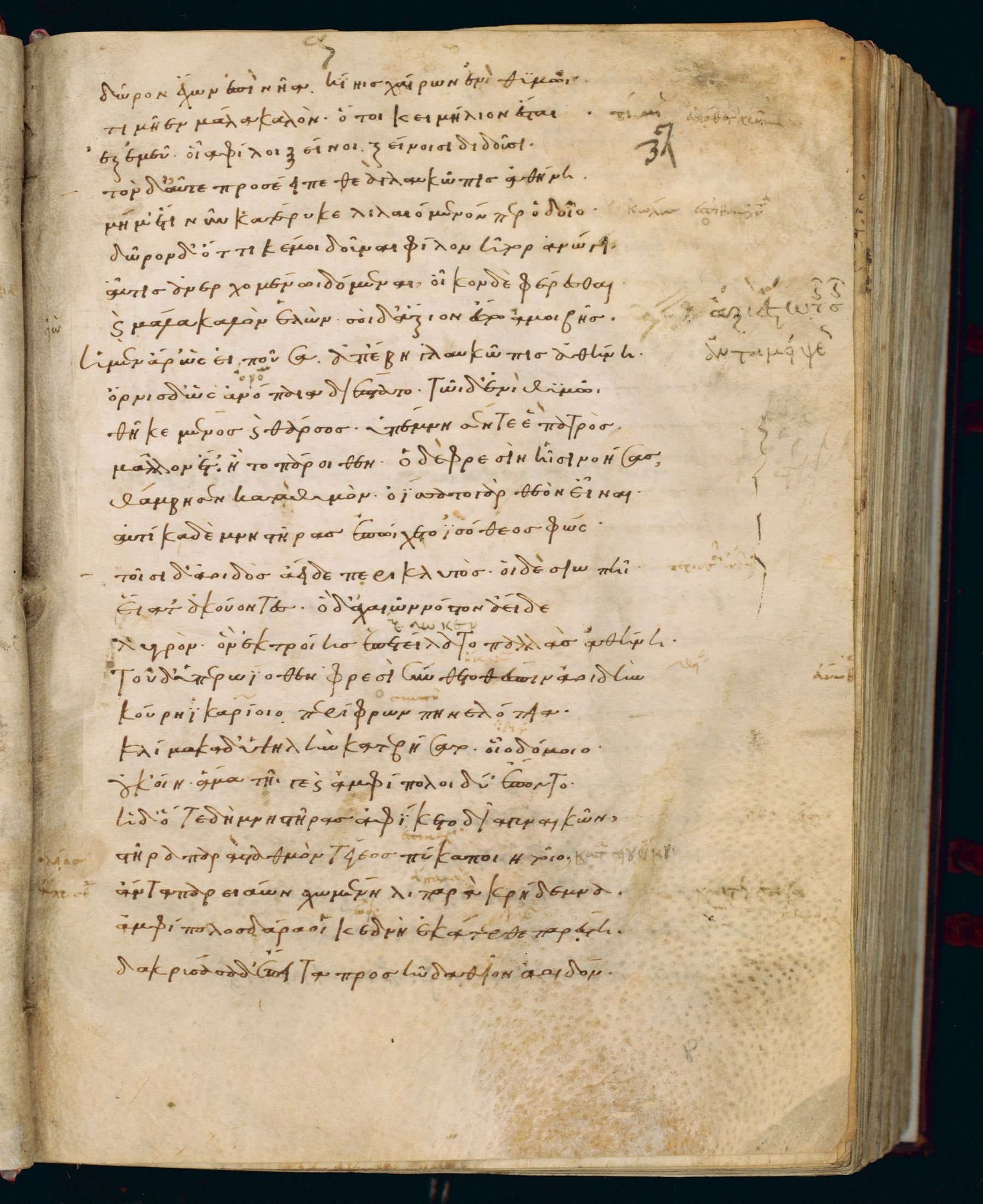
Where on the image
Laur. Plut. 32.24, fol. 8r: Odyssey 1.311-336, begins ‹δῶρον ἔχων ἐπὶ νῆα›, ends ‹ἔπειτα προσηύδα θεῖον ἀοιδόν·›. Checked on the image: first and last lines read and matched to the Greek. Fol. 7v ends with 1.310. Fol. 8v begins with 1.337. English blocks here: 310-314, 315-319, 320-324, 325-329, 330-334.
311δῶρον ἔχων ἐπὶ νῆα κίῃς, χαίρων ἐνὶ θυμῷ,
312τιμῆεν, μάλα καλόν, ὅ τοι κειμήλιον ἔσται
313ἐξ ἐμεῦ, οἷα φίλοι ξεῖνοι ξείνοισι διδοῦσι.
314τὸν δʼ ἠμείβετʼ ἔπειτα θεά, γλαυκῶπις Ἀθήνη·
315μή μʼ ἔτι νῦν κατέρυκε, λιλαιόμενόν περ ὁδοῖο.
316δῶρον δʼ ὅττι κέ μοι δοῦναι φίλον ἦτορ ἀνώγῃ,
317αὖτις ἀνερχομένῳ δόμεναι οἶκόνδε φέρεσθαι,
318καὶ μάλα καλὸν ἑλών· σοὶ δʼ ἄξιον ἔσται ἀμοιβῆς.
319ἡ μὲν ἄρʼ ὣς εἰποῦσʼ ἀπέβη γλαυκῶπις Ἀθήνη,
320ὄρνις δʼ ὣς ἀνόπαια διέπτατο· τῷ δʼ ἐνὶ θυμῷ
321θῆκε μένος καὶ θάρσος, ὑπέμνησέν τέ ἑ πατρὸς
322μᾶλλον ἔτʼ ἢ τὸ πάροιθεν. ὁ δὲ φρεσὶν ᾗσι νοήσας
323θάμβησεν κατὰ θυμόν· ὀίσατο γὰρ θεὸν εἶναι.
324αὐτίκα δὲ μνηστῆρας ἐπῴχετο ἰσόθεος φώς.
325τοῖσι δʼ ἀοιδὸς ἄειδε περικλυτός, οἱ δὲ σιωπῇ
326ἥατʼ ἀκούοντες· ὁ δʼ Ἀχαιῶν νόστον ἄειδε
327λυγρόν, ὃν ἐκ Τροίης ἐπετείλατο Παλλὰς Ἀθήνη.
328τοῦ δʼ ὑπερωιόθεν φρεσὶ σύνθετο θέσπιν ἀοιδὴν
329κούρη Ἰκαρίοιο, περίφρων Πηνελόπεια·
330κλίμακα δʼ ὑψηλὴν κατεβήσετο οἷο δόμοιο,
331οὐκ οἴη, ἅμα τῇ γε καὶ ἀμφίπολοι δύʼ ἕποντο.
332ἡ δʼ ὅτε δὴ μνηστῆρας ἀφίκετο δῖα γυναικῶν,
333στῆ ῥα παρὰ σταθμὸν τέγεος πύκα ποιητοῖο,
334ἄντα παρειάων σχομένη λιπαρὰ κρήδεμνα·
335ἀμφίπολος δʼ ἄρα οἱ κεδνὴ ἑκάτερθε παρέστη.
336δακρύσασα δʼ ἔπειτα προσηύδα θεῖον ἀοιδόν·
310in order that when thou hast bathed and satisfied thy heart to the full, thou mayest go to thy ship glad in spirit, and bearing a gift costly and very beautiful, which shall be to thee an heirloom from me, even such a gift as dear friends give to friends.” Then the goddess, flashing-eyed Athena, answered him: 315“Stay me now no longer, when I am eager to be gone, and whatsoever gift thy heart bids thee give me, give it when I come back, to bear to my home, choosing a right beautiful one; it shall bring thee its worth in return.” So spoke the goddess, flashing-eyed Athena, and departed, 320flying upward as a bird; and in his heart she put strength and courage, and made him think of his father even more than aforetime. And in his mind he marked her and marvelled, for he deemed that she was a god; and straightway he went among the wooers, a godlike man. 325For them the famous minstrel was singing, and they sat in silence listening; and he sang of the return of the Achaeans—the woeful return from Troy which Pallas Athena laid upon them. And from her upper chamber the daughter of Icarius, wise Penelope, heard his wondrous song, 330and she went down the high stairway from her chamber, not alone, for two handmaids attended her. Now when the fair lady had come to the wooers, she stood by the door-post of the well-built hall, holding before her face her shining veil;
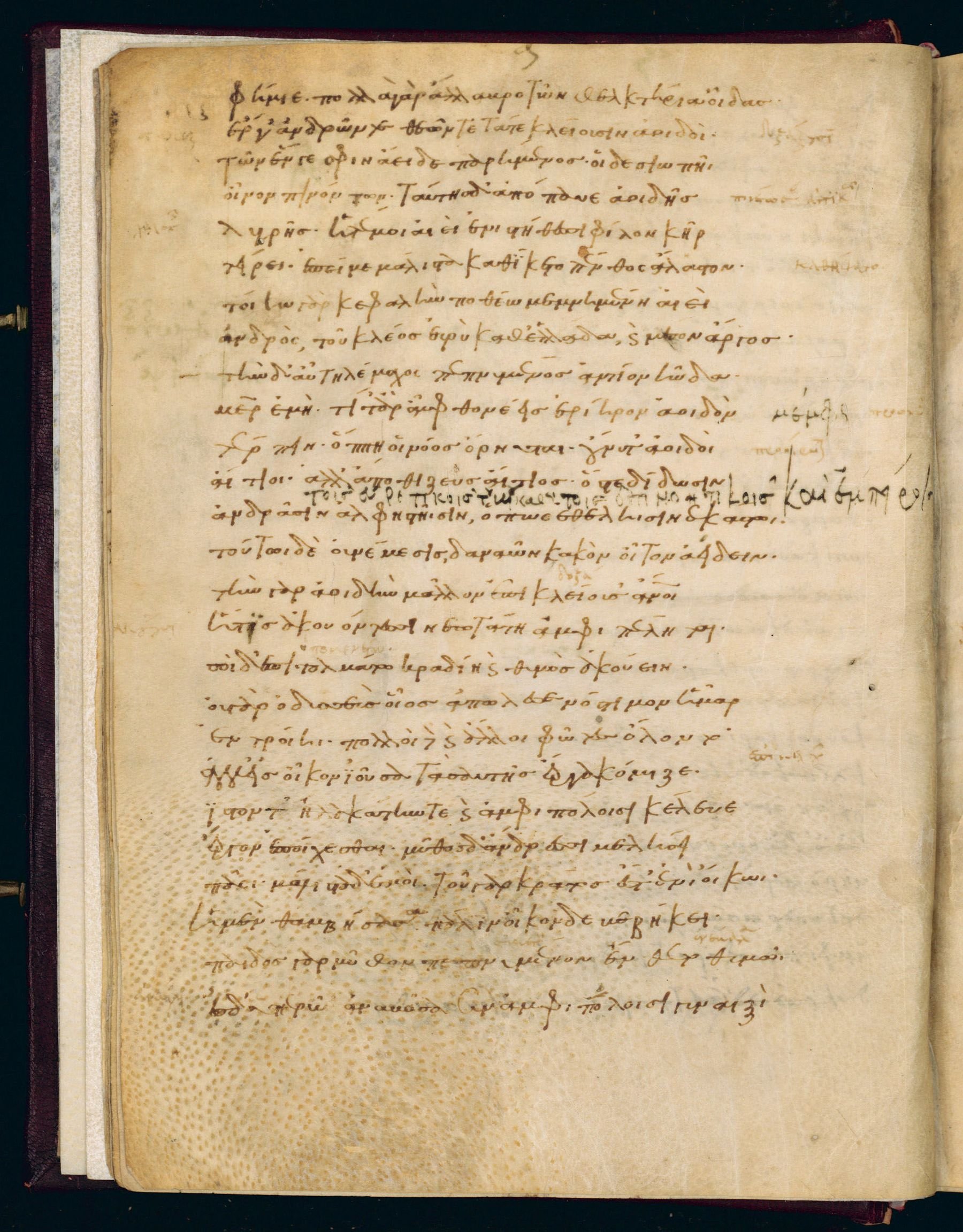
Where on the image
Laur. Plut. 32.24, fol. 8v: Odyssey 1.337-362, begins ‹Φήμιε, πολλὰ γὰρ ἄλλα›, ends ‹ἀναβᾶσα σὺν ἀμφιπόλοισι γυναιξὶ›. Checked on the image: first and last lines read and matched to the Greek. Fol. 8r ends with 1.336. Fol. 9r begins with 1.363. English blocks here: 335-339, 340-344, 345-349, 350-354, 355-359, 360-364.
337Φήμιε, πολλὰ γὰρ ἄλλα βροτῶν θελκτήρια οἶδας,
338ἔργʼ ἀνδρῶν τε θεῶν τε, τά τε κλείουσιν ἀοιδοί·
339τῶν ἕν γέ σφιν ἄειδε παρήμενος, οἱ δὲ σιωπῇ
340οἶνον πινόντων· ταύτης δʼ ἀποπαύεʼ ἀοιδῆς
341λυγρῆς, ἥ τέ μοι αἰεὶ ἐνὶ στήθεσσι φίλον κῆρ
342τείρει, ἐπεί με μάλιστα καθίκετο πένθος ἄλαστον.
343τοίην γὰρ κεφαλὴν ποθέω μεμνημένη αἰεί,
344ἀνδρός, τοῦ κλέος εὐρὺ καθʼ Ἑλλάδα καὶ μέσον Ἄργος.
345τὴν δʼ αὖ Τηλέμαχος πεπνυμένος ἀντίον ηὔδα·
346μῆτερ ἐμή, τί τʼ ἄρα φθονέεις ἐρίηρον ἀοιδὸν
347τέρπειν ὅππῃ οἱ νόος ὄρνυται; οὔ νύ τʼ ἀοιδοὶ
348αἴτιοι, ἀλλά ποθι Ζεὺς αἴτιος, ὅς τε δίδωσιν
349ἀνδράσιν ἀλφηστῇσιν, ὅπως ἐθέλῃσιν, ἑκάστῳ.
350τούτῳ δʼ οὐ νέμεσις Δαναῶν κακὸν οἶτον ἀείδειν·
351τὴν γὰρ ἀοιδὴν μᾶλλον ἐπικλείουσʼ ἄνθρωποι,
352ἥ τις ἀκουόντεσσι νεωτάτη ἀμφιπέληται.
353σοὶ δʼ ἐπιτολμάτω κραδίη καὶ θυμὸς ἀκούειν·
354οὐ γὰρ Ὀδυσσεὺς οἶος ἀπώλεσε νόστιμον ἦμαρ
355ἐν Τροίῃ, πολλοὶ δὲ καὶ ἄλλοι φῶτες ὄλοντο.
356ἀλλʼ εἰς οἶκον ἰοῦσα τὰ σʼ αὐτῆς ἔργα κόμιζε,
357ἱστόν τʼ ἠλακάτην τε, καὶ ἀμφιπόλοισι κέλευε
358ἔργον ἐποίχεσθαι· μῦθος δʼ ἄνδρεσσι μελήσει
359πᾶσι, μάλιστα δʼ ἐμοί· τοῦ γὰρ κράτος ἔστʼ ἐνὶ οἴκῳ.
360ἡ μὲν θαμβήσασα πάλιν οἶκόνδε βεβήκει·
361παιδὸς γὰρ μῦθον πεπνυμένον ἔνθετο θυμῷ.
362ἐς δʼ ὑπερῷʼ ἀναβᾶσα σὺν ἀμφιπόλοισι γυναιξὶ
335and a faithful handmaid stood on either side of her. Then she burst into tears, and spoke to the divine minstrel: “Phemius, many other things thou knowest to charm mortals, deeds of men and gods which minstrels make famous. Sing them one of these, as thou sittest here, 340and let them drink their wine in silence. But cease from this woeful song which ever harrows the heart in my breast, for upon me above all women has come a sorrow not to be forgotten. So dear a head do I ever remember with longing, even my husband, whose fame is wide through Hellas and mid-Argos.” 345Then wise Telemachus answered her: “My mother, why dost thou begrudge the good minstrel to give pleasure in whatever way his heart is moved? It is not minstrels that are to blame, but Zeus, I ween, is to blame, who gives to men that live by toil, to each one as he will. 350With this man no one can be wroth if he sings of the evil doom of the Danaans; for men praise that song the most which comes the newest to their ears. For thyself, let thy heart and soul endure to listen; for not Odysseus alone lost 355in Troy the day of his return, but many others likewise perished. Nay, go to thy chamber, and busy thyself with thine own tasks, the loom and the distaff, and bid thy handmaids ply their tasks; but speech shall be for men, for all, but most of all for me; since mine is the authority in the house.” 360She then, seized with wonder, went back to her chamber, for she laid to heart the wise saying of her son. Up to her upper chamber she went with her handmaids, and then bewailed Odysseus, her dear husband until flashing-eyed Athena cast sweet sleep upon her eyelids.
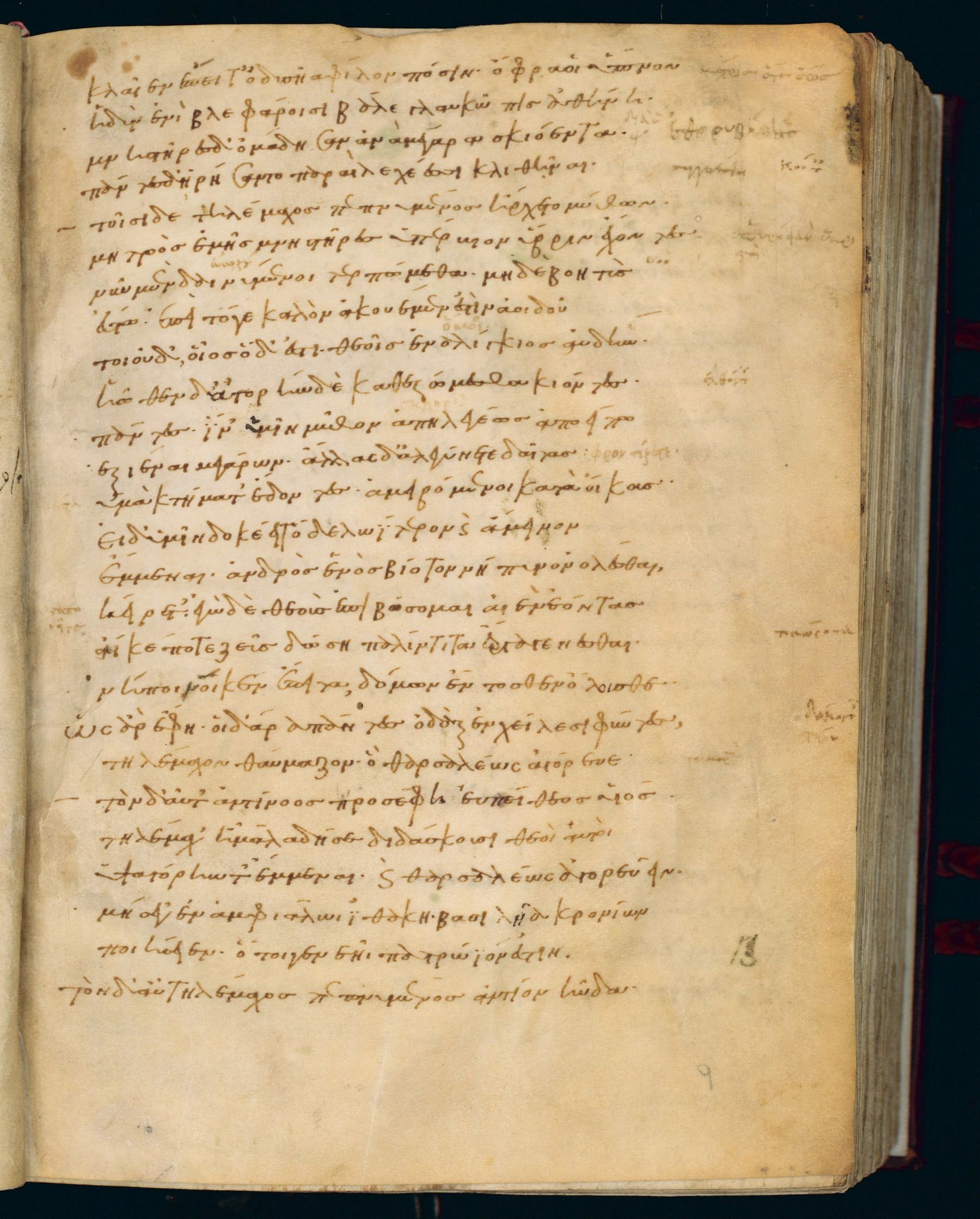
Where on the image
Laur. Plut. 32.24, fol. 9r: Odyssey 1.363-388, begins ‹κλαῖεν ἔπειτʼ Ὀδυσῆα φίλον›, ends ‹Τηλέμαχος πεπνυμένος ἀντίον ηὔδα·›. Checked on the image: first and last lines read and matched to the Greek. Fol. 8v ends with 1.362. Fol. 9v begins with 1.389. English blocks here: 365-369, 370-374, 375-379, 380-384, 385-389.
363κλαῖεν ἔπειτʼ Ὀδυσῆα φίλον πόσιν, ὄφρα οἱ ὕπνον
364ἡδὺν ἐπὶ βλεφάροισι βάλε γλαυκῶπις Ἀθήνη.
365μνηστῆρες δʼ ὁμάδησαν ἀνὰ μέγαρα σκιόεντα,
366πάντες δʼ ἠρήσαντο παραὶ λεχέεσσι κλιθῆναι.
367τοῖσι δὲ Τηλέμαχος πεπνυμένος ἤρχετο μύθων·
368μητρὸς ἐμῆς μνηστῆρες ὑπέρβιον ὕβριν ἔχοντες,
369νῦν μὲν δαινύμενοι τερπώμεθα, μηδὲ βοητὺς
370ἔστω, ἐπεὶ τόδε καλὸν ἀκουέμεν ἐστὶν ἀοιδοῦ
371τοιοῦδʼ οἷος ὅδʼ ἐστί, θεοῖς ἐναλίγκιος αὐδήν.
372ἠῶθεν δʼ ἀγορήνδε καθεζώμεσθα κιόντες
373πάντες, ἵνʼ ὕμιν μῦθον ἀπηλεγέως ἀποείπω,
374ἐξιέναι μεγάρων· ἄλλας δʼ ἀλεγύνετε δαῖτας,
375ὑμὰ κτήματʼ ἔδοντες, ἀμειβόμενοι κατὰ οἴκους.
376εἰ δʼ ὕμιν δοκέει τόδε λωίτερον καὶ ἄμεινον
377ἔμμεναι, ἀνδρὸς ἑνὸς βίοτον νήποινον ὀλέσθαι,
378κείρετʼ· ἐγὼ δὲ θεοὺς ἐπιβώσομαι αἰὲν ἐόντας,
379αἴ κέ ποθι Ζεὺς δῷσι παλίντιτα ἔργα γενέσθαι·
380νήποινοί κεν ἔπειτα δόμων ἔντοσθεν ὄλοισθε.
381ὣς ἔφαθʼ, οἱ δʼ ἄρα πάντες ὀδὰξ ἐν χείλεσι φύντες
382Τηλέμαχον θαύμαζον, ὃ θαρσαλέως ἀγόρευεν.
383τὸν δʼ αὖτʼ Ἀντίνοος προσέφη, Εὐπείθεος υἱός·
384Τηλέμαχʼ, ἦ μάλα δή σε διδάσκουσιν θεοὶ αὐτοὶ
385ὑψαγόρην τʼ ἔμεναι καὶ θαρσαλέως ἀγορεύειν·
386μὴ σέ γʼ ἐν ἀμφιάλῳ Ἰθάκῃ βασιλῆα Κρονίων
387ποιήσειεν, ὅ τοι γενεῇ πατρώιόν ἐστιν.
388τὸν δʼ αὖ Τηλέμαχος πεπνυμένος ἀντίον ηὔδα·
365But the wooers broke into uproar throughout the shadowy halls, and all prayed, each that he might lie by her side. And among them wise Telemachus was the first to speak: “Wooers of my mother, overweening in your insolence, for the present let us make merry with feasting, 370but let there be no brawling; for this is a goodly thing, to listen to a minstrel such as this man is, like to the gods in voice. But in the morning let us go to the assembly and take our seats, one and all, that I may declare my word to you outright that you depart from these halls. Prepare you other feasts, 375eating your own substance and changing from house to house. But if this seems in your eyes to be a better and more profitable thing, that one man's livelihood should be ruined without atonement, waste ye it. But I will call upon the gods that are forever, if haply Zeus may grant that deeds of requital may be wrought. 380Without atonement, then, should ye perish within my halls.” So he spoke, and they all bit their lips and marvelled at Telemachus, for that he spoke boldly. Then Antinous, son of Eupeithes, answered him:“Telemachus, verily the gods themselves are teaching thee 385to be a man of vaunting tongue, and to speak with boldness. May the son of Cronos never make thee king in sea-girt Ithaca, which thing is by birth thy heritage.” Then wise Telemachus answered him: “Antinous, wilt thou be wroth with me for the word that I shall say?
Where on the image
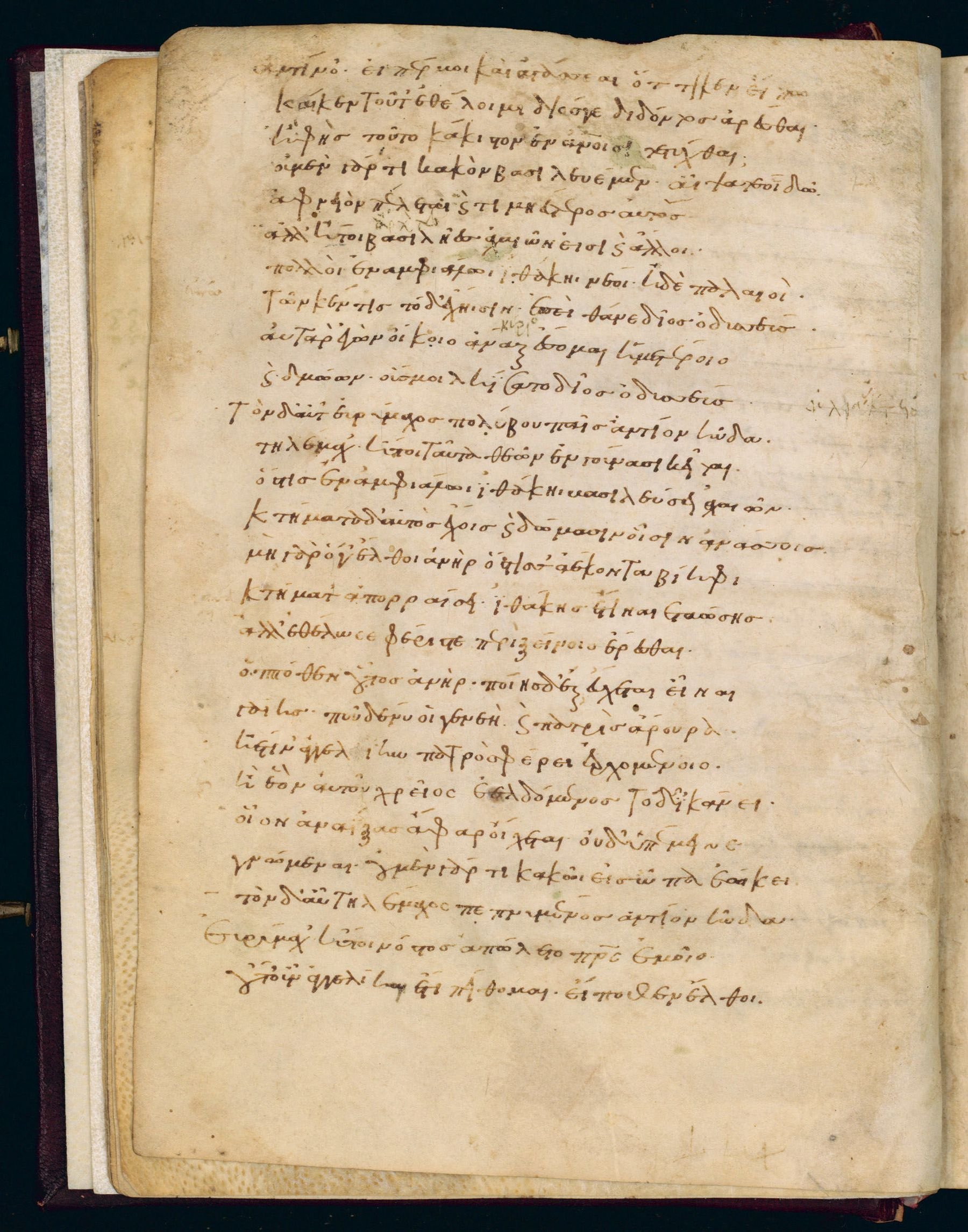
Laur. Plut. 32.24, fol. 9v: Odyssey 1.389-414, begins ‹Ἀντίνοʼ, ἦ καί μοι›, ends ‹πείθομαι, εἴ ποθεν ἔλθοι,›. Checked on the image: first and last lines read and matched to the Greek. Fol. 9r ends with 1.388. Fol. 10r begins with 1.415. English blocks here: 390-394, 395-399, 400-404, 405-409, 410-414.
389Ἀντίνοʼ, ἦ καί μοι νεμεσήσεαι ὅττι κεν εἴπω;
390καί κεν τοῦτʼ ἐθέλοιμι Διός γε διδόντος ἀρέσθαι.
391ἦ φῂς τοῦτο κάκιστον ἐν ἀνθρώποισι τετύχθαι;
392οὐ μὲν γάρ τι κακὸν βασιλευέμεν· αἶψά τέ οἱ δῶ
393ἀφνειὸν πέλεται καὶ τιμηέστερος αὐτός.
394ἀλλʼ ἦ τοι βασιλῆες Ἀχαιῶν εἰσὶ καὶ ἄλλοι
395πολλοὶ ἐν ἀμφιάλῳ Ἰθάκῃ, νέοι ἠδὲ παλαιοί,
396τῶν κέν τις τόδʼ ἔχῃσιν, ἐπεὶ θάνε δῖος Ὀδυσσεύς·
397αὐτὰρ ἐγὼν οἴκοιο ἄναξ ἔσομʼ ἡμετέροιο
398καὶ δμώων, οὕς μοι ληίσσατο δῖος Ὀδυσσεύς.
399τὸν δʼ αὖτʼ Εὐρύμαχος Πολύβου πάϊς ἀντίον ηὔδα·
400Τηλέμαχʼ, ἦ τοι ταῦτα θεῶν ἐν γούνασι κεῖται,
401ὅς τις ἐν ἀμφιάλῳ Ἰθάκῃ βασιλεύσει Ἀχαιῶν·
402κτήματα δʼ αὐτὸς ἔχοις καὶ δώμασιν οἷσιν ἀνάσσοις.
403μὴ γὰρ ὅ γʼ ἔλθοι ἀνὴρ ὅς τίς σʼ ἀέκοντα βίηφιν
404κτήματʼ ἀπορραίσει, Ἰθάκης ἔτι ναιετοώσης.
405ἀλλʼ ἐθέλω σε, φέριστε, περὶ ξείνοιο ἐρέσθαι,
406ὁππόθεν οὗτος ἀνήρ, ποίης δʼ ἐξ εὔχεται εἶναι
407γαίης, ποῦ δέ νύ οἱ γενεὴ καὶ πατρὶς ἄρουρα.
408ἠέ τινʼ ἀγγελίην πατρὸς φέρει ἐρχομένοιο,
409ἦ ἑὸν αὐτοῦ χρεῖος ἐελδόμενος τόδʼ ἱκάνει;
410οἷον ἀναΐξας ἄφαρ οἴχεται, οὐδʼ ὑπέμεινε
411γνώμεναι· οὐ μὲν γάρ τι κακῷ εἰς ὦπα ἐῴκει.
412τὸν δʼ αὖ Τηλέμαχος πεπνυμένος ἀντίον ηὔδα·
413Εὐρύμαχʼ, ἦ τοι νόστος ἀπώλετο πατρὸς ἐμοῖο·
414οὔτʼ οὖν ἀγγελίῃ ἔτι πείθομαι, εἴ ποθεν ἔλθοι,
390Even this should I be glad to accept from the hand of Zeus. Thinkest thou indeed that this is the worst fate among men? Nay, it is no bad thing to be a king. Straightway one's house grows rich and oneself is held in greater honor. However, there are other kings of the Achaeans 395full many in seagirt Ithaca, both young and old. One of these haply may have this place, since goodly Odysseus is dead. But I will be lord of our own house and of the slaves that goodly Odysseus won for me.” Then Eurymachus, son of Polybus, answered him: 400“Telemachus, this matter verily lies on the knees of the gods, who of the Achaeans shall be king in sea-girt Ithaca; but as for thy possessions, thou mayest keep them thyself, and be lord in thine own house. Never may that man come who by violence and against thy will shall wrest thy possessions from thee, while men yet live in Ithaca. 405But I am fain, good sir, to ask thee of the stranger, whence this man comes. Of what land does he declare himself to be? Where are his kinsmen and his native fields? Does he bring some tidings of thy father's coming, or came he hither in furtherance of some matter of his own? 410How he started up, and was straightway gone! Nor did he wait to be known; and yet he seemed no base man to look upon.” Then wise Telemachus answered him: “Eurymachus, surely my father's home-coming is lost and gone. No longer do I put trust in tidings, whencesoever they may come,
Where on the image
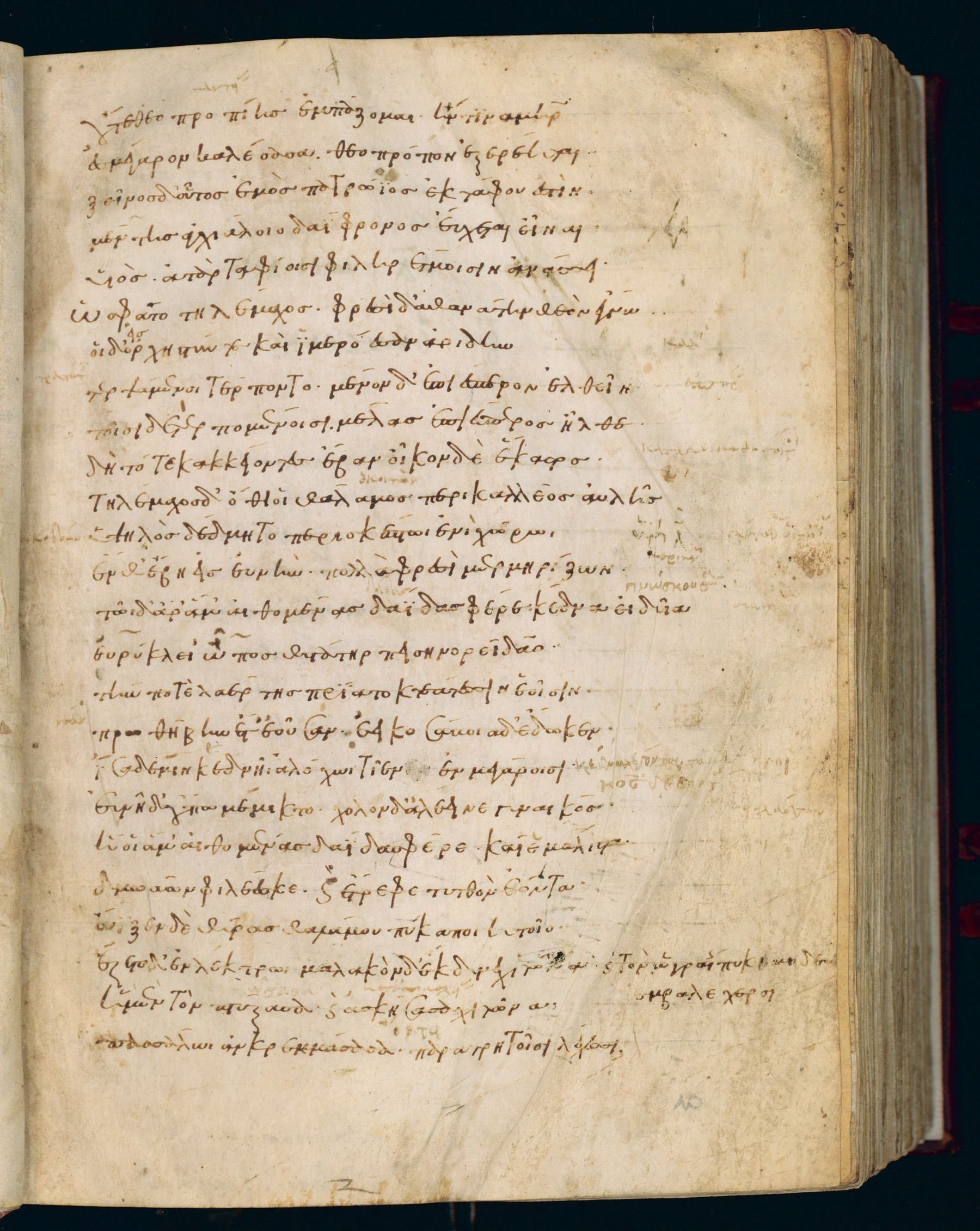
Laur. Plut. 32.24, fol. 10r: Odyssey 1.415-440, begins ‹οὔτε θεοπροπίης ἐμπάζομαι, ἥν›, ends ‹ἀγκρεμάσασα παρὰ τρητοῖσι λέχεσσι›. Checked on the image: first and last lines read and matched to the Greek. Fol. 9v ends with 1.414. Fol. 10v begins with 1.441. The top edge is curled; the first line (415) is legible. English blocks here: 415-419, 420-420, 421-424, 425-429, 430-434, 435-439.
415οὔτε θεοπροπίης ἐμπάζομαι, ἥν τινα μήτηρ
416ἐς μέγαρον καλέσασα θεοπρόπον ἐξερέηται.
417ξεῖνος δʼ οὗτος ἐμὸς πατρώιος ἐκ Τάφου ἐστίν,
418Μέντης δʼ Ἀγχιάλοιο δαΐφρονος εὔχεται εἶναι
419υἱός, ἀτὰρ Ταφίοισι φιληρέτμοισιν ἀνάσσει.
420ὣς φάτο Τηλέμαχος, φρεσὶ δʼ ἀθανάτην θεὸν ἔγνω.
421οἱ δʼ εἰς ὀρχηστύν τε καὶ ἱμερόεσσαν ἀοιδὴν
422τρεψάμενοι τέρποντο, μένον δʼ ἐπὶ ἕσπερον ἐλθεῖν.
423τοῖσι δὲ τερπομένοισι μέλας ἐπὶ ἕσπερος ἦλθε·
424δὴ τότε κακκείοντες ἔβαν οἶκόνδε ἕκαστος.
425Τηλέμαχος δʼ, ὅθι οἱ θάλαμος περικαλλέος αὐλῆς
426ὑψηλὸς δέδμητο περισκέπτῳ ἐνὶ χώρῳ,
427ἔνθʼ ἔβη εἰς εὐνὴν πολλὰ φρεσὶ μερμηρίζων.
428τῷ δʼ ἄρʼ ἅμʼ αἰθομένας δαΐδας φέρε κεδνὰ ἰδυῖα
429Εὐρύκλειʼ, Ὦπος θυγάτηρ Πεισηνορίδαο,
430τήν ποτε Λαέρτης πρίατο κτεάτεσσιν ἑοῖσιν
431πρωθήβην ἔτʼ ἐοῦσαν, ἐεικοσάβοια δʼ ἔδωκεν,
432ἶσα δέ μιν κεδνῇ ἀλόχῳ τίεν ἐν μεγάροισιν,
433εὐνῇ δʼ οὔ ποτʼ ἔμικτο, χόλον δʼ ἀλέεινε γυναικός·
434ἥ οἱ ἅμʼ αἰθομένας δαΐδας φέρε, καί ἑ μάλιστα
435δμῳάων φιλέεσκε, καὶ ἔτρεφε τυτθὸν ἐόντα.
436ὤιξεν δὲ θύρας θαλάμου πύκα ποιητοῖο,
437ἕζετο δʼ ἐν λέκτρῳ, μαλακὸν δʼ ἔκδυνε χιτῶνα·
438καὶ τὸν μὲν γραίης πυκιμηδέος ἔμβαλε χερσίν.
439ἡ μὲν τὸν πτύξασα καὶ ἀσκήσασα χιτῶνα,
440πασσάλῳ ἀγκρεμάσασα παρὰ τρητοῖσι λέχεσσι
415nor reck I of any prophecy which my mother haply may learn of a seer, when she has called him to the hall. But this stranger is a friend of my father's house from Taphos. He declares that he is Mentes, son of wise Anchialus, and he is lord over the oar-loving Taphians.” 420So spoke Telemachus, but in his heart he knew the immortal goddess. 421Now the wooers turned to the dance and to gladsome song, and made them merry, and waited till evening should come; and as they made merry dark evening came upon them. Then they went, each man to his house, to take their rest. 425But Telemachus, where his chamber was built in the beautiful court, high, in a place of wide outlook, thither went to his bed, pondering many things in mind; and with him, bearing blazing torches, went true-hearted Eurycleia, daughter of Ops, son of Peisenor. 430Her long ago Laertes had bought with his wealth, when she was in her first youth, and gave for her the price of twenty oxen; and he honored her even as he honored his faithful wife in his halls, but he never lay with her in love, for he shunned the wrath of his wife. She it was who bore for Telemachus the blazing torches; 435for she of all the handmaids loved him most, and had nursed him when he was a child. He opened the doors of the well-built chamber, sat down on the bed, and took off his soft tunic and laid it in the wise old woman's hands. And she folded and smoothed the tunic
Where on the image
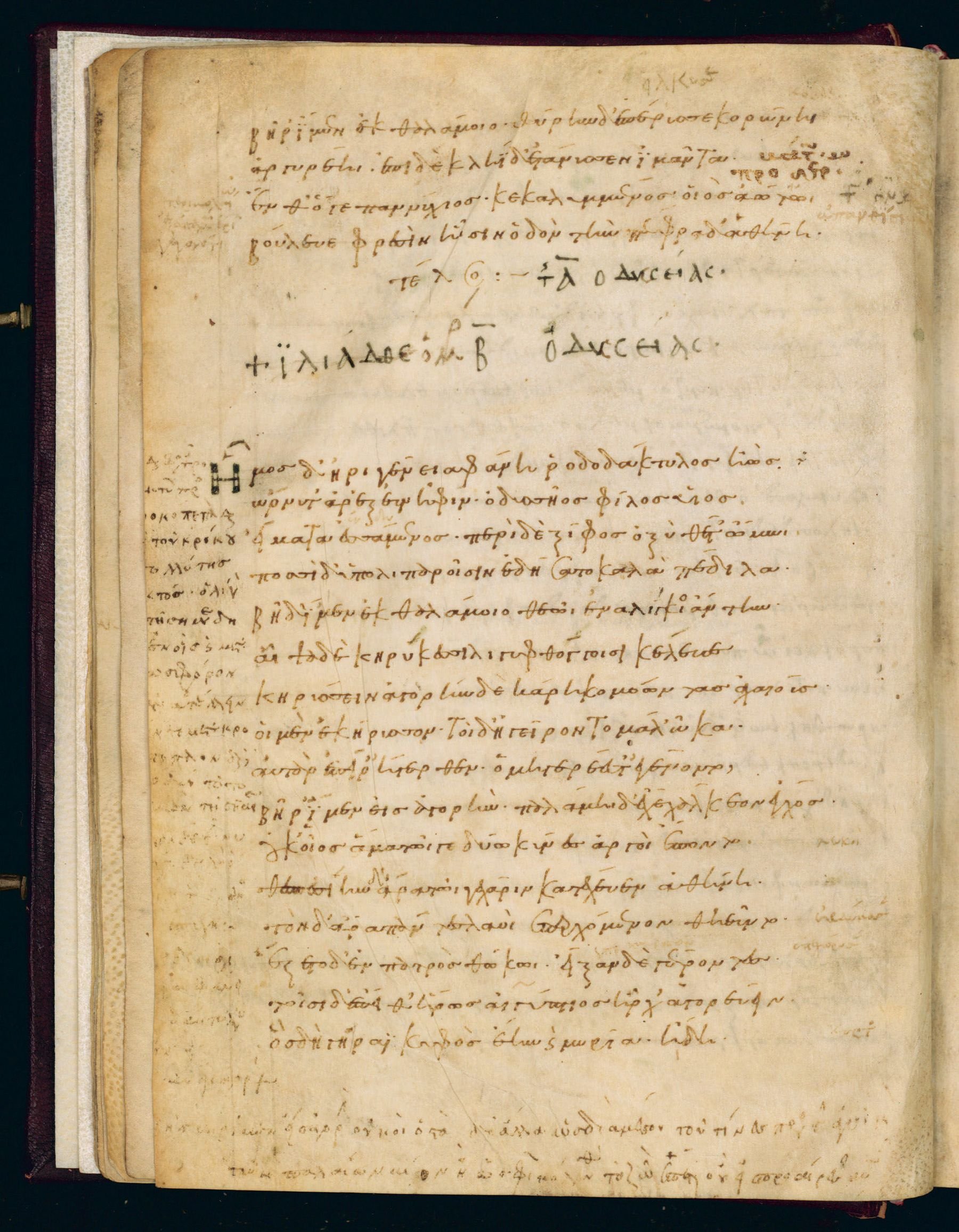
Laur. Plut. 32.24, fol. 10v: Odyssey 1.441-444, begins ‹βῆ ῥʼ ἴμεν ἐκ›, ends ‹ὁδὸν τὴν πέφραδʼ Ἀθήνη.›. Checked on the image: first and last lines read and matched to the Greek. Fol. 10r ends with 1.440. The page holds 1.441-444, 2.1-16. Book 1 ends with line 444, followed by the subscription τέλος τῆς α ὀδυσσείας; then a heading with the book number β in capitals and book 2 begins with a large initial. English blocks here: 440-444.
441βῆ ῥʼ ἴμεν ἐκ θαλάμοιο, θύρην δʼ ἐπέρυσσε κορώνῃ
442ἀργυρέῃ, ἐπὶ δὲ κληῖδʼ ἐτάνυσσεν ἱμάντι.
443ἔνθʼ ὅ γε παννύχιος, κεκαλυμμένος οἰὸς ἀώτῳ,
444βούλευε φρεσὶν ᾗσιν ὁδὸν τὴν πέφραδʼ Ἀθήνη.
440and hung it on a peg beside the corded bedstead, and then went forth from the chamber, drawing the door to by its silver handle, and driving the bolt home with the thong. So there, the night through, wrapped in a fleece of wool, he pondered in his mind upon the journey which Athena had shewn him.
Notes
- Greek: A. T. Murray, Homer: The Odyssey (Loeb Classical Library, 1919), via Perseus.
- English: A. T. Murray's translation in the same edition; his footnotes are omitted.
Cite
Sources
- Source: Laur. Plut. 32.24 (BML Teca Digitale IIIF) + Murray Greek (Loeb 1919, Perseus) + Murray English (Loeb 1919, Perseus) (holding institution)
- Critical edition: Murray, Loeb 1919, via Perseus
← previous · → next · v cycle view · l back to library